Showing posts with label Carole King Covers. Show all posts

Friday, November 27, 2015

Carole King Covers: (You Make Me Feel Like) A Natural Woman


Purchase [Carole King's version]
Purchase [Aretha Franklin's version]

If I were filling out a form that asked me for the first words that come to mind related to "You Make Me Feel ..", it would likely be "soul".

One of the first concerts I ever attended was back in the late 60s. At that time, I had a pretty big (for those times) collection of 33s that included Sgt Peppers, Smokey Robinson, Simon & Garfield, Are You Experienced, and Aretha. Must have been the summer of 69 when I caught "Little" Stevie Wonder in the same venue with the Supremes - would have been@ Seattle. That pretty much convinced me of the power of "soul",

In '68 or '69, Carole King had not hit the big time yet. She and her then husband, Gerry Goffin were writing hits, but she herself hadn't made much of a name. Aretha (and she don't need a last name) turned their song "You Make Me Feel" into a hit. Two years later, Carole King included it on her own album.

Here, the Queen of Soul sings to President Clinton:


And again. Guess you can ID the divas yourself?


Wednesday, November 25, 2015

Carole King Covers: Where You Lead


purchase the original [Where You Lead]

It's a default: Tapestry is Carole King's best. There's not a song on the album that isn't good - and the best of SMM agree.

Several of the songs on Tapestry were co-written with Toni Stern. But ...who is Toni Stern? Google says that Toni gets credits for both "Where You Lead" and "It's Too Late" from Tapestry. However, there is incredibly little info about Toni Stern on the Internet, and - as an amateur musician myself - it concerns me that someone could pen some of the best songs of all time and still remain under the radar! (There must be some online source that recognizes your work even if you don't flog it yourself!) The IMDB movie database credits a Toni Stern with work on Gilmore Girls and Karate Kid but those appear to be re-issues of the same Carole K
ing work 30 years earlier. Stern seems to focus on her writing - her web site is about her poetry. The IMDB/movie links are inconclusive in terms of providing much more depth.

Aside from the "Who is Toni Stern" issue, there is the question of who does the best cover of which Carole King song. Time was, when Star Maker posted most anything online ... because we could. Because the Internet allowed it. Because SMM's policies were based on "we provide this temporary (mp3) link in the hopes that you will love it and purchase the legal version". Gone are those days. Adapting to these conditions, I initially reverted to SoundCloud for a freely distributable cover of "Where You Lead" -of which there are several. Sadly, even the free download links aren't easy to embed here.


Like most of the bloggers @ SMM, I ended up @ YouTube. The listed YouTube covers don't include one by the Michael Baker Band - never head of them before - but they've got a decent cover of "Where You Lead."  Sadly, I can't locate any info clearly related to the band - there are a couple of Michael Bakers online but none appears to be this one.The lead vocals are very decent. The band is fairly tight. I would have wished the back vocals were a little louder. Hope you enjoy. And if you know more about the band, leave a comment.


Carole King Covers: Will You Still Love Me Tomorrow?


Me First & The Gimme Gimmes: Will You Still Love Me Tomorrow?
[purchase]

You could argue that one of the ways to tell if a song is really well-written is to see whether it holds up when performed in different styles. Some songs would seem to only be effective in a particular style—for example, the Sex Pistols’ great “God Save The Queen” only works as an angry blast of punk, and not, for example, as a folk tune. Although you might be surprised at how good King Crimson’s prog-rock archetype “21st Century Schizoid Man” sounds in Delta blues style.

“Will You Still Love Me Tomorrow” seems to sound great no matter how it is played. Written by King and Gerry Goffin when she was still in her teens, the song was first released by The Shirelles in 1960, in classic girl group style, with tight harmony vocals and lush orchestration. Although apparently banned by some radio stations because of the sexual nature of the lyrics (!), it nevertheless reached #1 on the Billboard Hot 100 chart.

I’m not going to give you a long tour through the many, many covers of this great song, except to point out that it works in Swedish. And when King recorded the song for the great Tapestry album, she did it in a slower, piano-driven, contemplative style with Joni Mitchell and James Taylor contributing background vocals.  It was both an artistic and commercial success, getting played regularly on FM radio.

It is sort of a gimmick to take classic rock songs of this, and other, eras, speed them up, and turn them into punk songs. Few artists are as committed to this niche that honors the songs, but with sufficient ironic detachment to retain their punk cred, than Me First and The Gimme Gimmes. A “supergroup” of sorts, with members that include Fat Mike of NOFX, Chris Shiflett of Foo Fighters, and Spike Slawson of Swingin’ Utters and Re-Volts, they have released a bunch of albums, EPs and singles, including their 2001 album, Blow In The Wind, which focuses on pop hits of the 1960s. Their version of “Will You Still Love Me Tomorrow” is, appropriately, loud, fast and surprisingly catchy, like The Shirelles’ version, but still retains some of the melancholy of King’s.

Monday, November 23, 2015

Carole King Covers: Going Back


Purchase: The Byrds, The Notorious Byrd Brothers
Listen:  Going Back


It is one of those almost cliché—yet still astounding—facts that Carole King is one of the most prolific songwriters in modern history. There are countless songs you know that she wrote and gave to other artists who then took the tunes to the top of the charts. She was prolific as she was talented and her influence has touched on almost every chart in popular music. She is even the subject of a Broadway play—Beautiful: The Carole King Musical. The tag line says it all: “The inspiring true story of how Carole King became the soundtrack of a generation.”

It would take another, separate post, to list the artists who’ve recorded King’s music, but one of my favorites is the The Byrds. The Byrd’s unique take on rock—chiming, majestic—was as dependent on the psychedelic sitarspin as it was on folk and pop. Jangly guitars, phasing sound from one ear to another, and a straight up reliance on the country and western rhythm made the Byrds one of the most unique bands of their era. I feel like they are mostly remembered for “Turn, Turn, Turn” which suffers from the invocation of the sappy, flower power ethic of the ‘60s. But, as the Byrd’s ranged more towards country and western and left behind the banalities of the hippie movement, they became a rich, influential outfit that would pave the way for some of today’s most seminal bands (at least in my record collection: Son Volt and Wilco, to name just two.) An early sense of breaking molds and exploring sonic possibilities will forever set the Byrds at a tier above many of their contemporaries, even if they are often overlooked as innovators and were sometimes incredibly uneven.

The Carole King penned “Going Back” was the lead single from The Notorious Byrd Brothers, and while the album didn’t chart very high, it is cited often as their best album for its experimental feel. It is a solid album all the way through, working towards a sonic vision, and unlike other albums, it cleaves to an idea and presents it to the listener in a gorgeous, shimmery blend of melody and chiming guitar and vox.  The cohesiveness is interesting in another way: in researching the album, one finds that it was tumultuous time for the band, and three members, including David Crosby, left  for good during the recordings.

The album has made its way onto various Greatest Albums lists (171 In Rolling Stones Greatest 500; 32 on NME’s Top 100) lists and writer, Johnny Rogan, in his book The Byrds: Timeless Flight Revisited, said: “The Byrds' greatest accomplishment on the album was in creating a seamless mood piece from a variety of different sources, bound together by innovative studio experimentation.”

The song itself has an almost antiquated chorus, reminiscent of so much of the sound of the day, but the Byrd’s add those odd, dithering guitars and the song goes from easy listening to something much more adventurous and exploratory.

“Going Back” has a long history, and while the version I’ve chosen is the Byrd’s take, the song has been recorded by artists as disparate as Phil Collins, The Pretenders, Freddy Mercury and Bon Jovi. David Crosby hated it because it felt it was unserious “fluff”. Indeed, it is pure pop whimsy, and covers a timeless theme of coming of age and the loss of innocence that adulthood brings. But, under Roger McGuinn’s harmony and the guitars, it’s a pure pop masterpiece and demonstration of Carole King’s talent at literally spinning gold. I think one way to put a definition on the influence and reach of Carole King is that she’d already written a decades worth of hits before she released her own album, Tapestry, which is one of the greatest selling pop records of all time.

Friday, November 20, 2015

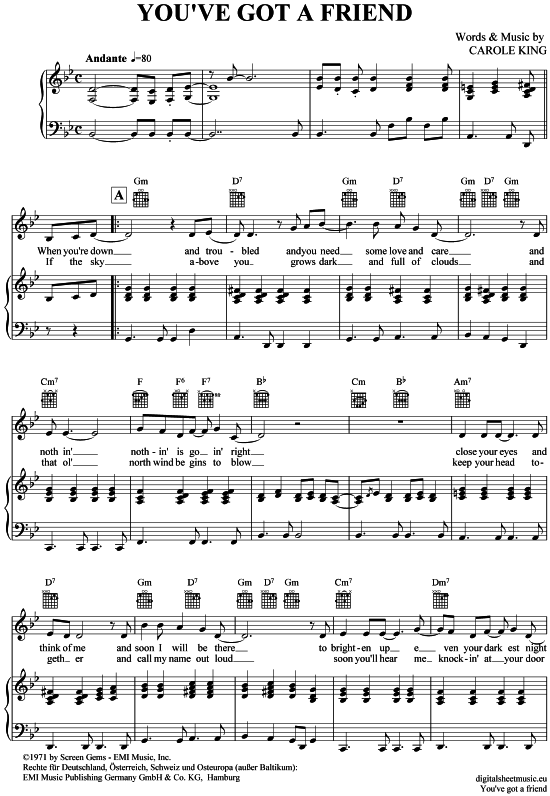
Carole King Covers: You've Got A Friend


It's possibly a fact that Ms King's best known song is in itself best known as a cover, namely the comforting and syrupy balm of James Taylor singing "You've Got a Friend", perhaps also "his" best known song. I don't know whether this can or could be proven as, with someone having a career stretching from being a Brill Building manufactured popsmith in the early 60s, to hippie chick troubador a decade later, to damn right, yes, she's still going with a bit of both and everything in between, it's difficult to work out. I guess it's in part generational, with the hepcats of '66 nodding sagely as the by then far and wigged-out Byrds phase their way through "Goin' Back", or the soulsters grooving to Aretha and "...Natural woman", so my generation picked up on "Tapestry", through her old friend and guitar slinger lifting a song from it as his break through single. But this isn't about sweet baby James, being more a tribute to some of the less well travelled versions. (Or is that so far travelled?)


I remain uncertain whether this is the worst thing I have ever heard or whether it is worse even than that, inescapably making me see the Muppets in my minds eye, so expertly do Bing Crosby and Fred Astaire channel Fozzie and Kermit. From the hideous patronising patronage of "contemporary" to the plodding singalongagramps of the performance, any nostalgic buzz for, say, "The Little Drummer Boy" evaporates.

Let's try something a bit more up-tempo, yeah, a James Brown influence:


Nooooooooo, take it off, take it away. Hideous even more than the old groaning above, is this supper club travesty really that Fred Wesley, those J.B.s? No wonder the album was "The Lost Album". I would.

Let's try again, some UK 80s indie, that'll be something, eh?


The Housemartins were the short-lived first band of Paul Heaton, later of "The Beautiful South" as here, and Norman "Fatboy Slim" Cook. And this version of the song is awful.

I'm beginning to lose faith and falter here. I mean, how difficult can it be? Hell, premium cover version listings site, Second Hand Songs, lists 125 versions. OK, so the list includes everyone from Billy Ray Cyrus to Barry Manilow, and God knows who in between.

One more, some late 90's acid jazz:


Brand New Heavies were/are a UK originally instrumental band forming in the mid 80s, diversifying into a somewhat bland vocal hybrid between jazz, funk and nods toward hip-hop and dance music, with a string of sultry southern US vocal divas passing through their ranks, Carleen Anderson and N'Dea Davenport being perhaps the 2 best known, but with Siedah Garrett on the above, a minor hit in the UK. Tellingly, it was not even on the US copy of its parent album. I have to say it's the best of the lot I have found today, if purely by virtue of comparison.

So what's my point? Is it a good song? Well, I had always thought so, but maybe there is rather more of the Brill Building professional hit maker weave in "Tapestry" and "You've Got A Friend" than first hearing makes believe, hence the ease with which it sheds any credibility into a nylon leisure suit of schmaltz. And thus, maybe it is just the consummate interpretation skill of Taylor that embues it with any subtlety at all, although, to be fair, the original is pretty damn good too. Carole King was trained to write songs that would sell. 125 versions is a lot of versions and, by virtue of the names mentioned, hideous though to my ears, a lot of royalties. Success by any marker.

Finally, by way of a lift to my sorry conclusion, was it a fluke? Has the song got the capability of rising above it's apparent formula? Well, who better to give us that answer than the writer and the singer already mention, both here together, a mere 5 years ago.


Praise be! No fluke. Song good, interpretations vary............


Sunday, November 15, 2015

Carole King Covers: Don’t Bring Me Down


David Johansen: We Gotta Get Out Of This Place/Don't Bring Me Down/It's My Life
[purchase]

Last week, I watched all 10 episodes of Aziz Ansari’s great new Netflix series Master of None. In addition to being very funny, the show deals head on with issues of racism, sexism and ageism, among other “isms.” So, when I thought about suggesting a cover song theme for the next two weeks, I became sensitive to the fact that over the years we have done nine other themes focusing on cover songs, and in each case, but one, the spotlight artists were male. Joni Mitchell was the only featured woman. (And as I write this, I realize that all nine artists are white, something that also needs to be addressed). And that’s how we ended up with a theme highlighting Carole King Covers. (That’s a lot of “K” sounds, so it must be funny.)

Next year is the 45th anniversary of the release of Tapestry, which was King’s second solo release. It established her as a commercial success as a performer, and is still one of the largest selling albums of all time. Pretty much every song on the album is great, and I loved it when I was a kid, but it is, honestly, not an album that I pull out to listen to anymore. I hope that some of the other writers here write about covers of songs from Tapestry, and I might down the road, but not today.

By 1971, when Tapestry was released, King had already had a 20 year long music career, beginning with her appearance on the Horn and Hardart Children’s Hour as an 8 year old, recording demos in high school with her friend Paul Simon, and, while attending Queens College, writing songs for others, mostly with Gerry Goffin, from an office in the famous Brill Building in Times Square. The number of hit songs she turned out is stunning, as is the breadth of styles—artists as diverse as Aretha Franklin, The Monkees, The Shirelles, Herman’s Hermits, The Drifters and even The Beatles recorded covers of her songs. The Broadway show Beautiful does a nice job bringing this to life, as well as discussing King’s later career. It is, of course, a cleaned up, streamlined version of the story, but it is very entertaining.

The Animals, led by singer Eric Burdon, were created in the early 1960s, and featured a gritty, blues based sound. In 1964, they released their signature song, a cover of the traditional blues song, “House of the Rising Sun.” Their producer, Mickie Most, reportedly called into the offices of Screen Gems music, then run by Don Kirshner, looking for songs. A furious competition ensued among the various writers and teams, which ultimately resulted in three hits—“We Gotta Get Out Of This Place,” written by Barry Mann and Cynthia Weil (who were friends and rivals of Goffin and King), “It’s My Life,” written by the team of Roger Atkins and Carl D’Errico, and “Don’t Bring Me Down,” a Goffin/King composition, which was the last hit for the band, before it was renamed “Eric Burdon and The Animals," before breaking up. (Burdon re-formed the band, with new members and a psychedelic style after moving to California in 1966, although the old incarnation also had reunions.)

I had the opportunity to interview David Johansen, I believe in 1981, when he appeared in Trenton at City Gardens. I might even have introduced him. Johansen is one of those musicians who has successfully reinvented himself over the years, from his days fronting the legendary New York Dolls, which was followed by a solo career under his own name, to his partying alter-ego Buster Poindexter and his more recent country-blues work with The Harry Smiths. I was, and continue to be a big fan of the music he released in the early ‘80s, particularly his first three albums, David Johansen, In Style, and Here Comes the Night, all of which received heavy airplay on my radio shows.

Shortly after I graduated from college, and regrettably left the radio world behind, Johansen released a great live record, Live it Up, which capitalized on his justified reputation as a great concert performer. The collection kicks off with an intense medley of the three songs that Mickie Most bought for the Animals from Screen Gems, including a great version of “Don’t Bring Me Down.” Not only is Johansen in total command of the material, his band is tight. It included guitarists Huw Gower, who power pop lovers might know best as the guitarist on The Records’ incredible “Starry Eyes,” and Dave Nelson, who was in Nektar, New Riders of the Purple Sage and The Turtles, as well as keyboard player Charlie Giordano, who now plays with the E Street Band and drummer Tony Machine, who had been in later versions of the New York Dolls.