


























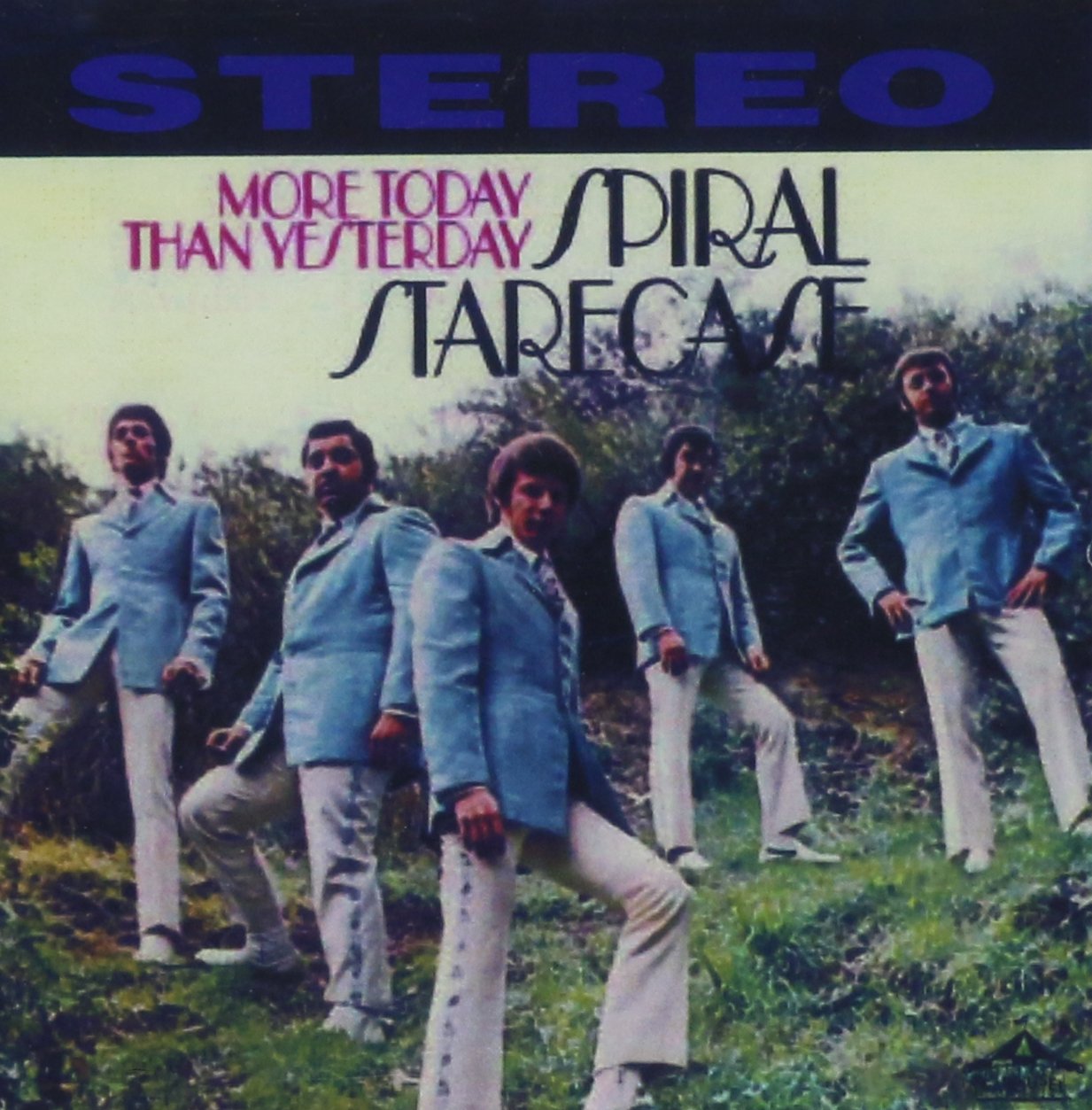
Spiral Starecase: I Love You More Today Than Yesterday
[purchase]
My blogging lately has really slowed. Typically, around this time every year, I tend to take time off to recharge my batteries, but I’m going to try to keep going this year without a true “blogcation,” to coin a very bad phrase. Since this is a labor of love, I do it in my spare time, and lately, that spare time has been occupied by work relating to my 40th college Reunion, which took place a couple of weeks ago. I was on the organizing team, and I’m also my class secretary, a job which I’ve somehow expanded to such a point that I’ve been swamped lately, creating video slideshows and other content for my classmates. It’s another labor of love, but I hope that the extra work I created for myself is winding down, and I can try to get back to regular writing here. And maybe even elsewhere.
I have written before that 1969 really was the year that I started listening to music, and it was that year that Spiral Starecase released their one hit, “I Love You More Today Than Yesterday,” a bouncy, fun, maybe even a little sappy profession of love. I think that the comment in the Allmusic bio of the band about their “one-hit wonder” status is great: “The Spiral Starecase may be a one-hit wonder group, but if you're only going to be allotted one, then their “More Today Than Yesterday” is the type of solitary charter you want as your lasting legacy.” And it is true. It’s a song that I remember hearing constantly over the years. It’s been covered by artists as diverse as Sonny and Cher, Lena Horne, Nick Carter, Diana Ross, Kermit Ruffins, the 2012 version of Chicago, and Goldfinger. And many others.
The Spiral Starecase was formed in the early 1960s in Sacramento as the Fydallions, and featured lead singer Pat Upton, who has a great voice. Columbia Records strongly suggested that they change their name before signing them, and they made a small spelling change to the title of an old movie, and voila, they had a name. And maybe that sort of misspelling was considered cool in the psychedelic era, not that the band was at all psychedelic.
They had a couple of regional hits in the Phoenix area, but when working on their first album, Upton was encouraged to write, and contributed the feature song, which he had written while the band was playing at the Flamingo in Las Vegas. And there is a little bit of Vegas lounge singer in the song, isn’t there? Despite the quality of the tune and its longevity, it only reached 12 on the Billboard Hot 100, although 1969 was a great year for singles.
Due to the dynamic duo of musical failures, poor management and disputes over finances, the band disbanded after the release of one album and a few more singles (somehow they escaped the third reason that good bands fail—problems with the record label).
An Upton-less version of the band toured in the 70s and 80s, proving that you can be successful with one famous song, even if the original singer isn’t singing it. Upton became a session musician, eventually hooking up with Ricky Nelson as a backup singer, and in 1985 declined to get on the flight that killed Nelson, five members of his band, and others. He died in 2016, at the age of 75.


