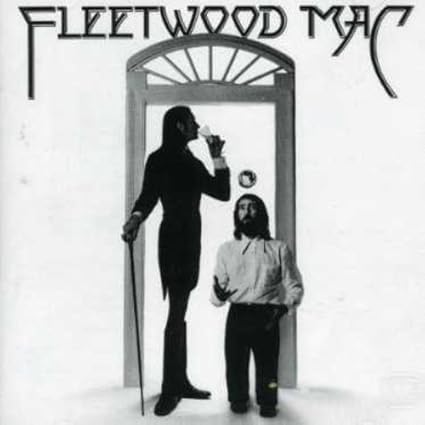
More than once here I have professed fealty to Fleetwood Mac.
In the early '70s, Fleetwood was on my playlist: Future Games and Bare Trees, But the musical style of Peter Green was not the same as what the band was producing after he left. <Mystery To Me> followed by <Heroes Are Hard to Find> filled my mid-'70s heavy play list. Bob Welch and Bob Weston had replaced Green on guitar: songs like Hypnotized & Bermuda Triangle. It was after this, in the later part of the mid-'70s with the addition of Lindsey Buckingham and Stevie Nicks that the band hit big time commercial success.
The song above comes from the first album with Nicks and Buckingham, sometimes called the White Album, and it charted at the top of the US Billboard list including a handful of top twenties. It took 10 years to produce their next, Rumours, aptly named amidst a period of difficult relationship issues.
In this version, Lindsey Buckingham's minimalistic guitar playing comes across well: a case of less is more. Buckingham's solos are as sparse as they are effective: harmonics ... repeated notes with effect...
It is not just Buckinghim who is effective in his use of sound: the whole band is tight to the point that this live performance rivals the studio version, where they would have had more control of the final result. As ever, there's the two stalwart members who've been there throughout the years: John McVie and Mick Fleetwood laying down the essential backbone of the music: the drums and the bass.
When this theme was announced, I decided to write about the X song, “Once Over Twice,” but before I even started that piece, I heard Crowded House’s great ballad, “Don’t Dream it’s Over” twice on different Sirius XM stations while driving around in my car. So, it seemed like the universe, or at least the satellite radio folks, were telling me something.
This song was discussed on this blog back in 2011, before I started writing here, by “boyhowdy,” who was one of the fine writers who attracted me to the blog as a reader first, and then as a writer. Unfortunately, he doesn’t write very often here anymore (and not at all since 2018), but still writes quite well and somewhat irregularly at Cover Lay Down. As it is my oft-stated policy not to try to write something if someone has said it better already, and because boyhowdy is a really good writer, let me quote briefly from his short post:
this well-known EnZed pop ballad is clearly intended to be romantic in nature. But strip away the pop production . . .and it, too, transforms effectively as an anthem for our times, a call for change in a world where the vitriolic stream of talk radio madness overwhelms any attempt at rational discourse, where the news stations dumb down our world daily in their attempt to demonstrate that every idea has two equal and equivalent sides, where my inner city students struggle to find safe haven in a culture which seems to have forgotten them.
And remember that passage was written in 2011, when the idea of Donald Trump as president still seemed like a joke. (Damn. Can’t stop inserting politics into music posts. Bad Jordan.)
“Don’t Dream It’s Over,” was written by Neil Finn, who I still have trouble distinguishing from his older and also very talented brother Tim, for his band Crowded House, and was released on their 1986 self-titled album. It was a massive international hit, peaking at No. 2 on the Billboard Hot 100 in the US.
Since I’m stealing stuff from better writers, here’s a description of the song two Australian writers, Andrew Ford and Anni Heino, from their book, The Song Remains the Same: 800 Years of Love Songs, Laments and Lullabies, as excerpted in The Guardian:
It was the song you danced to at the end of the night, pressed close to the intriguing person you’d just met while wondering what might happen next. The palpable sincerity in Neil Finn’s voice and the expansive melodic line of the song’s chorus encouraged hope. The song was also fast becoming an anthem for Antipodeans overseas, the slightly maudlin counterpart to Men at Work’s novelty song Down Under.
If you read the Guardian piece, there’s a lot more about the musical attributes of the song that I have no ability to write myself.
According to Finn, despite the fact that he knew the song was good, it almost didn’t come together. He told Uncut (I can’t find a link to the whole interview):
The day I did it, I knew I had something quite special. Then the next day we played it with the band and it sounded like a bag of s--t. It was only when Mitchell (Froom) suggested the bassline, which Nick (Seymour) elaborated on, that it really found its groove. I was wavering away doing demos, and Mitchell made some quite profound suggestions. Like an R&B bassline might be better than a rock or pop approach, or a Hammond organ could sound nice. These were not textures I was used to. He filled in quite a few areas that we weren't covering, but maybe it made our individual sound less distinctive. It took a while, but then 'Don't Dream It's Over' started to work in the US and whole record went on to have a pretty big life.
Somehow, Neil Finn ended up in the most recent touring version of Fleetwood Mac (replacing Lindsey Buckingham), and the band performed the song as a duet by Finn and Stevie Nicks. Check out this version from a show in Auckland, New Zealand, not that far from where Finn was born, and where he probably never dreamed he’d be singing on stage with Stevie Nicks.
I’ve written before about my admiration for Hole’s album Live Through This, and in that piece, I summarized Courtney Love’s difficult life, so I won’t repeat the details here, except to note that if her life has been marked by addiction, wild behavior and anger, she came by it honestly. She is someone that I have found fascinating but not always in a good way. But I think that she has produced a bunch of good music over her career. There has been a lot written by young women who identify with her anger, her pain, and her attitude, and as an older man, I can’t understand her music the same way, but I don’t think you can listen to Live Through This without being moved by it.
“Softer, Softest” is a song that I really hadn’t paid much attention to, but in researching this piece, I think that it is one of the most poignant songs on the album. Introducing the song on MTV Unplugged in 1995, Love stated that it was “about the girl that always smelled like pee in your class, and she was me," so clearly it is autobiographical. The song’s lyrics appear to be about an abused girl, likely with the knowledge of her mother (or, at least, a female caregiver), because the litany of abuse is interrupted with the following lines:
Burn the witch The witch is dead Burn the witch Just bring me back her head
This is, of course, heartbreaking, and I don’t really think that there’s much more to say, other than, listen to the song.
Instead, let’s discuss whether Courtney Love is a witch, an issue which has a certain amount of currency on the Internet, with a number of sites claiming that she definitely is, although others point out that she has publicly discussed Buddhist chanting. I don’t know enough about witches to know whether you can be one and be a Buddhist.
At the same MTV Unplugged show, Hole covered Donovan’s “Season of the Witch,” although it wasn’t televised at the time, and was only released later. (That would be a good song to discuss in this theme, but Seuras Og already did so a couple of years ago, linking to Hole’s version). Love is friendly with Stevie Nicks, who has written songs about witches (and Love has covered “Gold Dust Woman,” Cover Me's No. 1 Fleetwood Mac cover of all time), but I’m not sure that is really evidence. Also, when she performed on Later... With Jools Holland in 1995, Love introduced a song by mentioning that she had “hexed” a “jerk” who was now losing his hair (probably former boyfriend Billy Corgan). No one, to my knowledge, has tried to determine whether she weighs as much as a duck. Although she has dressed up as Donald Duck.
Love’s daughter, Frances Bean Cobain has been pictured wearing what appears to be a Wiccan moon necklace, her Instagram user name is “space_witch666, and her Twitter handle is “The_Space Witch.” Of course, her daughter’s beliefs aren’t necessarily those of her mother’s, a distinction that Love, considering her childhood (and the lyrics to “Softer, Softest”), would probably agree with.
What has gotten into you, J. David, you may be asking. When we see your name on a SMM post, we can usually expect an alt-country song, maybe some old prog, or a new wave/power pop tune. Or something about TV or the Mets. But lately, we’ve had Miles Davis, William DeVaughn, and a couple of fake pop bands.
And now, Fleetwood Mac.
And not even the cool, bluesy Fleetwood Mac that never gets played on the radio (except, occasionally for “Oh Well” and maybe the original “Black Magic Woman” or “Sentimental Lady,” if the DJ is showing off).
Not even the experimental Fleetwood Mac that recorded “Tusk” (which I love).
But instead,“Landslide,” the Stevie Nicks tune that was a moderate hit from the band’s first album with Nicks and Lindsey Buckingham. Who are you, and what have you done to J. David?
Look, I chose the song because it fits the theme, and avoids the obvious (although I expect to get to those guys next), but it is actually one of my favorite Fleetwood Mac songs. I’ll admit that the Fleetwood Mac album, and Rumours, are great albums (and I love the song “Tusk,” if not the album so much), but I don’t go out of my way to listen to them. To me, they exist in a world of good music that has just been overplayed, and usually, I’d just rather listen to something else.
Not surprisingly, the song is rooted in Nicks and Buckingham’s relationship, at a time when their professional and personal lives were not going well, she was living in the Rockies, and the landslide metaphor related to everything that was crashing down on her.
A month or so ago, Angela Hughey wrote an excellent “Five Good Covers” piece about the song at Cover Me, and she is a fine writer, so just go here and read it after you finish my piece, if you want to learn more about the song, and hear five good covers of it. There’s also a “Best Fleetwood Mac Covers Ever” piece over there from a year ago, in which I wrote about covers of other Mac songs, but Seuras Og (who, like me writes both here and there), acknowledged his own attraction to “Landslide,” and posted yet another cover. So read that, too.
Fleetwood Mac goes back to the mid 60s in one incarnation or another.
At first, without any women. Except for one: Black Magic Woman (yes, that one) was written by Peter Green - at that time an integral part of the band.
In 1970, Christine Perfect married bassist John McVie, and Fleetwood Mac had a female band member. Among their albums was Future Games, which included a track called Woman of a 1000 Years:
In 1974 Stevie Nicks joined the band to make up one of the most successful bands ever, including a hit named Gold Dust Woman.
purchase [Heroes Are Hard to Find] How our music tastes can change over time. Fleetwood Mac's <Heroes Are Hard To Find> was one of my favorite albums way back then. (Yes, I bought it - see my previous!) The album came out at about the height of the band's fame: that would be just before the addition of Lindsey Buckingham and Stevie Nicks and just after the release of < Mystery To Me> , which - at the time - I couldn't get enough of. On cassette tape, of course. Admittedly, (still after all these years), there are several great pieces on the <Heroes> album - many of them better than my choice of "Heroes Are Hard to Find" , but they don't meet the current theme criteria. There's the mesmerizing "Bermuda Triangle", the take on Elmore James' "Coming Home" .. lots of Bob Welch before he left the band ... and some other good music here. The fact is that Fleetwood Mac was pretty big stuff in the mid 70s. Mick Fleetwood had put together a group that moved the Fleetwood name from a mildly successful 60s band to the top of the charts - repeatedly- throughout the 70s. The funny thing to me is how - 40 years later - the title track (Heroes) no longer does much for me. You know how they talk about songs that maintain their allure/stature over the years? My take is that this isn't one. Admittedly, I made good use of it a few years back in one of the courses I taught. The unit's topic was heroes, and the song seemed to fit in alongside Tina's <We Don't Need Another ...) and Little Feat's <Time Loves A...> ... but now, it just comes up a little short. That said, I wouldn't be bringing up a song that didn't have some kind of value. The value for me is mostly in memories. The value for you ... ? Possibly a song you hadn't heard before? Possibly a new perspective on the song. Maybe just a reminder of a bygone era. Then again, as I cued the song for one more play before posting, I was struck by the similarity with my previous post (Little Feat's Don't Try So Hard) - as Fleetwood began to roll, I might have been listening to Feat - close to the same beat. Guess it says something about my musical taste.
Fortuitously, the clip above includes both Christine McVee and Stevie Nicks.
Never Going Back Again is a Fleetwood Mac song, technically. But, really, it’s a Lindsey Buckingham song—and in my opinion has always stood as prime evidence of his masterful, poetically great skills as a guitarist. To proclaim Buckingham’s greatness as a guitarist is stating the well known to a room full of those who know it well. But, this song—Buckingham alone, laying down just two tracks—is such an exquisite piece of work, it always deserves another mention, and asks for another listen.
Never Going Back Again comes from the mega popular Rumors, the 1977 album that launched Fleetwood Mac into the stratosphere and has achieved legendary status—not just in terms of sales, but in ubiquity, as an omnipresent staple of classic rock radio. It deserves it’s status: the sheer number of songs on this album that are on so many “personal playlists” (a concept I’ve used before to talk about those songs, be they well known, or obscure, that are ones that you love, and return to over and over, without shame that the songs probably appear on everyone else’s fave’s list, too…) is kind of mind boggling, and Rumors is truly a historical artifact, a primary document of what a rock band, at their absolute apex, is capable of doing. Rumors is a greatest hits collection long before the band was at the point in their career where they would need to package a Greatest Hits Collection.
Rumors doesn’t need me to celebrate it in writing—it’s been celebrated for years, and will continue to be. There is a certain joy in going back to an album with so many great songs, and being able to listen, not critically, but just as a fan of good songs. And for me, the peak point of Rumors is Never Going Back Again.
Punchy, complex and sweetly harmonized, the song sinks in and stays there. It’s a summer day made musical in a few glorious bars and a repeating riff; it’s a pure example of a how a song feeds into the pleasure zones in our heads and makes us feel…great. Books have been written about the science of what a great song does to us at a neurological level. I don’t know how to say much on that. I do know when I listen to Never Going Back, a wonderfully quickening feeling comes over me, one that centers somewhere I imagine the soul resides, and for 2 minutes and 15 seconds, things are great. That’s what good music does.
When the theme first cropped up, one of my first thoughts was "Future Games." Must have been '73 that Fleetwood Mac first captured me with Mystery To Me. As indicated in the name, the mesmerizing effect of many of the songs fit the times (mild psychedelia) and my own frame of mind. I listened for hours to the album: side A, side B, side A again (of course, on cassette tape- de rigeur).
You check out the song titles of Fleetwood Mac songs from the era, and notice that no small number of them reference time, the future: "Woman of a 1000 Years" ... "Sands of Time" ...
I did check into the archives of SMM - seemed not possible that the song had never been posted afore, and sure enough - back in 2009, it was presented here. Both in consideration of the fact that few of you were likely to have been here then and still here now, but even worse- the fact that the link to that post has deteriorated/gone missing, it would appear to be time to bring it back to life.
I recently revisited the Feb 2015 print
copy of Wired – specifically an article about Microsoft’s new CEO. Segments of
Jessi Hempel’s article worth relating seemed to resonate with where I am
vis-a-vis Star Maker blogging, (and our theme of “lies”)
When Vannevar Bush first envisioned the Internet
(his memex), the idea was that “trailblazers” could share their trails – the
sequence of links they followed to get to a certain (re)source. More often than
not, current web files lead us to the end rather than sharing the process and
all the intermediary by-paths that might add value to our journeys. For most of
us, searching for information about music related to lies, this would be a
likely starting point:
Of the fairly decent list of links that
appeared, my trail began at the top, and- partway down the list- I locked in on
Steely Dan – mostly because, well … they had their heyday when I was a radio
disk jockey and… because I like the jazz-rock mix
But I couldn’t place the song “Book of
Liars”. Turns out it is a Walter Becker “solo” piece from a 1994 album (Alive
in America) produced by the other ½ of Steely Dan, Donald Fagan, and then
brought out again in 2004.
This got me thinking about other Steely Dan
songs/lyrics. If we stretch the “lies” theme to include cheating lovers, our
trail could wind on over to Reelin in the Years
(where they sing: “after all the things
we’ve seen and done you go and find another man…” – cheat city)
Back to Vannevar Bush and his memex and his
trailblazers. My thought process continued by following Steely Dan – at which
point I saw that Steely Dan appeared on the TV show Midnight Special – and so
did Fleetwood Mac, at about the same time. My YouTube right-side links (your
results may vary) suggested I would like some Fleetwood Mac (Vanovar Bush in
action).I am not sure I have my
Fleetwood Mac timeline down all that well, but .. well … there was a certain
amount of spouse sharing, and it seems to me that there must have been a
certain amount of lies going on there: hence: Go Your Own Way.
Again, the YouTube right-side link. This
time: Tom Petty (and one-time Fleetwood Mac member Stevie Nicks. Stop Draggin My Heart ...
Quick submission loosely lauding the legend of farmer's daughters, usually involving buxom beauties, forever enticing the sort of man, well, any man really, of which their father, inevitably a brick shithouse of humanity, would disapprove, and the shenanigans thus ensuing. Here's 3 of my favourites:
"Anyone's Daughter," which also includes another staple of songsmithery, the judge's daughter, is from Deep Purple's 1971 LP, Fireball, and it really caught my teenage ears as it was so unlike anything else in their oeuvre, thus, as ever the awkward, I had to profess it to be my favourite. (I was never really, or for long, a fan of the hard rock school of the Deeps, Black Sabbath, Uriah Heep and all that malarkey.) Listening again, as the decades disappear, it isn't even much good. Hey ho.........
Onto something perhaps a bit more authentic, "Wolverton Mountain," this being the version by Doug Sahm, from his evocatively titled Texas Rock for Country Rollers, in 1976, cementing my peculiarity amongst my peers. Actually written much much earlier and covered first by a number of different acts, it was seemingly based on a real character. Nowhere does it actually say the daddy was a farmer, but I somehow have always assumed he was at least a farmsteader. And I'm writing this piece.
Finally, here is a more innocent offering, the Beach Boys with their, at least accurately, entitled, "Farmer's Daughter." Little happens, beyond yearning, and it is short. Great vocal, though, reminding you of quite why Brian Wilson was (and is) so revered. Such a pity his voice is so shot now. But, as an excuse to shoehorn in yet another vid, until today, I had no idea that this song by Fleetwood Mac was one and the same
When Danny Kirwin joined Fleetwood Mac as it's third singer/guitarist in 1968, second singer/guitarist Jeremy Spencer became the odd man out. As Kirwin and first singer/guitarist Peter Green started exploring new sounds, Spencer's repetitive Elmore James impersonations were getting old. In concert, he only played on his songs, sitting out while the rest of the band jammed on. The shows often ended with Jeremy and the band transforming into Earl Vince and the Valiants for an encore of '50s rockers, but that hardly qualified as a new direction.
So when the band assembled to record Then Play On, Spencer didn't participate. A plan was floated to include with the album a free EP of Spencer's sarcastic takes on current popular music, but the record company didn't go for it. The EP (recorded in '68 while the rest of the band were working on the chart-topping instrumental "Albatross") was conceived as a mythical U.S. TV program, "The Milton Schlitz Show". The five tracks were eventually released in 1998 as part of the now-out-of-print outtakes compilation The Vaudeville Years - 1968 to 1970, and they're a hoot.
Spencer parodies doo-wop, British bluesmen Alexis Korner and John Mayall, and Lightnin' Hopkins, but the highlight of the set is Jeremy's take on "heavy" psychedelic rock, "(Watch Out for Yourself) Mr. Jones," performed by "The Orange Electric Squidders." Although the fake band name was meant to evoke the likes of the Electric Prunes, the music has more in common with Cream. Had it been released as a single at the time, one wonders how it would have fared.
Jeremy released a whole album of spoofs in 1970 (including "Take a Look Around Mrs. Brown", a song that would not have been out of place on a Dukes of Stratosphear album) and one more album with the Mac (Kiln House) before unexpectedly leaving the band for a religious cult while on tour in America. Surprisingly, after being considered a lost cause for decades, Spencer resurfaced in the last few years playing the blues again.
This haunting Peter Green instrumental is perhaps more well known in the U.K., where it was #1 hit, than in the U.S., where the Buckingham-Nicks version of the band is just about all that people remember. When it was released in early 1969, it was quite a departure from the straight-ahead blues that had been the Mac's bread and butter up until then. Of course it was the first of many musical changes the band would undergo in the following decade.
Reportedly inspired by Santo & Johnny's classic "Sleepwalk" (and in turn an inspiration for the Beatles' "Sun King"), "Albatross" came together not long after Danny Kirwin joined the band as third guitarist. (The band's second guitarist, Jeremy Spencer, had no involvement in this recording.) It was Green's vision, but Danny helped him bring it to fruition, his and Peter's guitars harmonizing beautifully over Mick Fleetwood's muted drums and swelling cymbals and John McVie's simple, pulsing bass line.
In a year when everything was becoming "heavy", it was a gentle, soothing balm. It still is.
I was extremely happy to see Boyhowdy post the original Fleetwood Mac version of "Black Magic Woman" last week. I'm a big fan of the Peter Green-era Mac. In fact, I almost posted their full version of "Oh Well" this week.
But I also have a soft spot for the Mac's Bob Welch years, too. In some ways, they are the lost years, when the band was searching for a new identity. They were well past their blues beginnings and their acid-rock adolescence, but had yet to mature into the LA hit machine they became when Stevie Nicks and Lindsey Buckingham came on board.
They released a lot of mediocre albums during this period (1971-74), but they contain a clutch of unique, atmospheric Bob Welch songs. My favorite is the title track to their first album with Welch, "Future Games". It clocks in at over eight minutes, but it never overstays its welcome. I really have no idea what Bob's singing about; I just love the way it sounds, floating out of the speakers.
As I noted in back in February over at the coverblog, most folks have no idea that Santana signature tune Black Magic Woman is a cover song. But the 1968 original, which peaked at #37 on the UK Singles chart, is worth celebrating, too, and it's nothing like the smooth radiopop which most modern listeners associate with the classic literock radio era of Fleetwood Mac.
Instead, prepare yourself for a perfectly smooth, slightly trippy sixties sound straight out of a Vietnam-era documentary soundtrack, guitar-driven and full of funky feeling, that falls somewhere between the best of Cream and the Zombies. Note the sparse high production, which allows the listener to experience each instrument distinctly. And don't forget to stick around for the blues coda.
When I told my wife about this week's theme, she told me that I had to post Fleetwood Mac's "The Chain" from the classic 1977 album Rumours. Of course, she's the Fleetwood expert... not me. This is her take on the track.
Although he is honored in the name of the band, John McVie is arguably the least recognized of the members of Fleetwood Mac (that is, the five most well-known and long-lasting members).He doesn’t provide lead vocals like Lindsey, Stevie, or Christine, and he’s not an ebullient showman like his partner-in-crime Mick.What he provides, however, are solid basslines that make up the backbone of several of the band’s hits.
That’s never more apparent than with The Chain, off the mega-selling album Rumours.Besides the fact that its lyrical content represented the well-known turmoil going on in the band at the time, the most interesting aspect of this song is that it actually started out as two separate pieces.John, Mick, Lindsey, and Christine had worked out the part that begins with John’s memorable bassline (about 3:00 in), but that’s all they had – a great musical demonstration, but certainly not a complete song.Enter Stevie with a song she had written during the Buckingham Nicks days.After some resistance by Lindsey, the group decided to put the two together, with Stevie’s contribution leading off.It was a perfect fit.
So, here’s The Chain – featuring two demonstrably different musical movements, with an unforgettable bassline seamlessly tying them together.
Star Maker Machine does not accept music submissions from artists or promoters. However, most of the contributors here do accept submissions for our own blogs, listed below. Please visit our blogs, take the time to listen to what we post, and then feel free to contact us if you feel that your music would be a good fit.


























:format(jpeg):mode_rgb():quality(90)/discogs-images/R-1470870-1491419418-4866.jpeg.jpg)
:format(jpeg):mode_rgb():quality(90)/discogs-images/R-3921490-1557509164-6335.jpeg.jpg)