


























Well, if nothing else, a post here about Joanna Newsom has the opportunity to sidestep a similar piece appearing in the FUNNY VOICES theme, should the team ever take that one on. For too long her name has been a cipher for folk to take a potshot at her curious singing style, possibly to the extent that she is known better for that than for any of her music. (How I am helping is arguably not by starting off with this opener, but, hey, I have to find some traction.....) So, here I will do my best to avoid any reference to helium or to alleycats, concentrating more on her music. And her instrument, the harp.
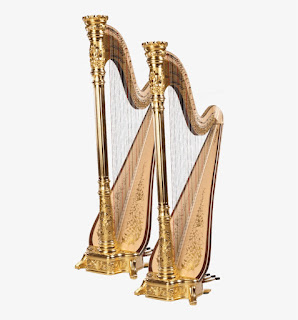
Harps have only a small footprint in popular music, give or take the odd appearance, for texture and effect. Like here and here. Folk music rather more, if more often the smaller Celtic harp: clarsachs and the like, thinking of the Breton, Alan Stivell, and the Scottish duo, Sileas. Folk then crosses over into classical with the afro-welsh chamber style of classical harp soloist Catrin Finch, in her works with Senegalese kora maestro, Seckou Keita. Jazz is mainly centred on the trance-like meanderings of Alice Coltrane, and then there are the hard to classify new-age ambient noodlings of Mary Lattimore. Newsom fits into none of these categories, although there is the attempt, or intent, to shoe-horn her into wyrd-folk territory, quite whatever that really means.
Classically trained in the instrument from an early age, she is proficient to a degree that can sometimes have you wonder how many of her are playing, or whether all that sound comes from just a harp. Just over a month away from her fortieth birthday, it was actually on keyboards the she began her musical career. But, having been drafted in to add her harp to the experimental rock of Nervous Cop. With the reception seeming promising, she self-produced a couple of EPs, which led her to be drawn to the attention of, initially, Will Oldham ( aka Bonnie "Prince" Billy) who then alerted record label, Drag City, who promptly signed her up. 2004 saw her full length debut, The Milk Eyed Mender. All the usual right-on culprits, Pitchfork and that ilk, hailed it amongst the years best, as did the UK's Sunday Times, that level of acclaim lingering into the later end of decade credits, six years later. In 2016, NME, the erstwhile inkie indie bible for counter-cultural teens, voted it 12th best folk album ever. Sales? Less so, it failing to chart, ever the lot of a critic's favourite.
Touring with the likes of Devendra Banhart and Vetiver, she was at the forefront of the aforementioned wyrd-folk movement. (Answering my own query, I guess, thus, it means a folk electronica garnished with a hippy dippy ambience.) Festival appearances, many in the UK, underpinned her footprint, with the follow-up, Ys, released in 2006. Heavy duty contributions from along the lines of Van Dyke Parks and Steve Albini added no small gravitas, and she broke into the lower end of the charts. Some backlash, relating to her vocal, also became more overt: "an acquired taste", a "too precious warble that either bewitches or repels." Ouch.
One can't help but think these criticisms hurt. Although she made occasional guest appearances on other records, it was again two years ahead of her 3rd record. However, rather than reining back in any tendency to the grandiose, this was a triple. Have One On Me extended her appeal to the converted, but was deemed overly ambitious by some early acolytes. This isn't stop it out performing her earlier output apropos sales and charting. Indeed, when her 4th album, Divers, dropped in 2015, this too sold more than its predecessor, this time also recouping any loss of critical sway, it deemed her best yet by many. Any perceived change in her vocal timbre on these last two releases seem down to circumstance than to unappreciative ears; vocal cord nodules required medical attention in 2009. Unlike, let's say, Rod Stewart, this may have worked in her favour.
I appreciate I have actually made little overt reference to her actual harp playing. This is better stated by listening to the clips above, I believe, and I think and hope that there may be rather more harpists appearing as a result of her putting this instrument into the front line, however much she has also diversified into playing rather more keyboard instruments alongside. It would be good to see why she has been doing, becoming a mother apart, these past six years.


