












Showing posts with label Roxy Music. Show all posts

Saturday, December 4, 2021

LEFTOVERS: BIGGER STRINGS: JOANNA NEWSOM

 Well, if nothing else, a post here about Joanna Newsom has the opportunity to sidestep a similar piece appearing in the FUNNY VOICES theme, should the team ever take that one on. For too long her name has been a cipher for folk to take a potshot at her curious singing style, possibly to the extent that she is known better for that than for any of her music. (How I am helping is arguably not by starting off with this opener, but, hey, I have to find some traction.....) So, here I will do my best to avoid any reference to helium or to alleycats, concentrating more on her music. And her instrument, the harp.
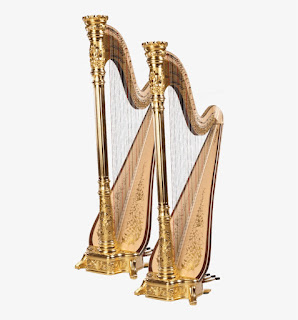
Harps have only a small footprint in popular music, give or take the odd appearance, for texture and effect.    Like here and here. Folk music rather more, if more often the smaller Celtic harp: clarsachs and the like, thinking of the Breton, Alan Stivell, and the Scottish duo, Sileas. Folk then crosses over into classical with the afro-welsh chamber style of classical harp soloist Catrin Finch, in her works with Senegalese kora maestro, Seckou Keita. Jazz is mainly centred on the trance-like meanderings of Alice Coltrane, and then there are the hard to classify new-age ambient noodlings of Mary Lattimore. Newsom fits into none of these categories, although there is the attempt, or intent, to shoe-horn her into wyrd-folk territory, quite whatever that really means. 

Frank vs. Frank/Nervous Cop 

Classically trained in the instrument from an early age, she is proficient to a degree that can sometimes have you wonder how many of her are playing, or whether all that sound comes from just a harp. Just over a month away from her fortieth birthday, it was actually on keyboards the she began her musical career. But, having been drafted in to add her harp to the experimental rock of Nervous Cop. With the reception seeming promising, she self-produced a couple of EPs, which led her to be drawn to the attention of, initially, Will Oldham ( aka Bonnie "Prince" Billy) who then alerted record label, Drag City, who promptly signed her up. 2004 saw her full length debut, The Milk Eyed Mender. All the usual right-on culprits, Pitchfork and that ilk, hailed it amongst the years best, as did the UK's Sunday Times, that level of acclaim lingering into the later end of decade credits, six years later. In 2016, NME, the erstwhile inkie indie bible for counter-cultural teens, voted it 12th best folk album ever. Sales? Less so, it failing to chart, ever the lot of a critic's favourite. 

Bridges and Balloons/The Milk Eyed Mender

Touring with the likes of Devendra Banhart and Vetiver, she was at the forefront of the aforementioned wyrd-folk movement. (Answering my own query, I guess, thus, it means a folk electronica garnished with a hippy dippy ambience.) Festival appearances, many in the UK, underpinned her footprint, with the follow-up, Ys, released in 2006. Heavy duty contributions from along the lines of Van Dyke Parks and Steve Albini added no small gravitas, and she broke into the lower end of the charts. Some backlash, relating to her vocal, also became more overt: "an acquired taste", a "too precious warble that either bewitches or repels." Ouch.

Cosmia/Ys

One can't help but think these criticisms hurt. Although she made occasional guest appearances on other records, it was again two years ahead of her 3rd record. However, rather than reining back in any tendency to the grandiose, this was a triple. Have One On Me extended her appeal to the converted, but was deemed overly ambitious by some early acolytes. This isn't stop it out performing her earlier output apropos sales and charting. Indeed, when her 4th album, Divers, dropped in 2015, this too sold more than its predecessor, this time also recouping any loss of critical sway, it deemed her best yet by many. Any perceived change in her vocal timbre on these last two releases seem down to circumstance than to unappreciative ears; vocal cord nodules required medical attention in 2009. Unlike, let's say, Rod Stewart, this may have worked in her favour.

You and Me, Bess/Have One On Me

I appreciate I have actually made little overt reference to her actual harp playing. This is better stated by listening to the clips above, I believe, and I think and hope that there may be rather more harpists appearing as a result of her putting this instrument into the front line, however much she has also diversified into playing rather more keyboard instruments alongside. It would be good to see why she has been doing, becoming a mother apart, these past six years.

Leaving the City/Divers


Take your pick......

Tuesday, September 7, 2021

WOODWINDS: KATE ST.JOHN

Woodwinds seem often made of brass, which is confusing, but don't include horns, except the english horn, which seems to be a form of clarinet. And, even more extraordinarily, that includes bagpipes and accordions, but don't panic, I'm not going there, at least not this week. So, choices, choices and I think I'm going for oboe, as it looks so darn difficult, like trying to blow a hard-boiled egg down a curtain rod. And because the list of greatest oboe player in rock is a short and exclusive list. To be fair most people falter after Andy Mackay

I'd like to show you and explain how Kate St. John has a better claim to that title. And, as I write this down, I find myself suddenly panicking, realising she is probably playing cor anglais, or some such, in the songs I use to apply my thesis. Luckily, hardly any reader will be capable of telling the difference; it seems it is all to do with available pitch, the cor anglais (or english horn, see above, who knew) having access to the lower notes.

So, that exquisite sound on Julian Cope's 'World Shut Your Mouth' album is oboe/cor anglais and is played by Kate St John. Originally classically trained, well, you'd have to be, she will be familiar to older readers as being a core member of those fey purveyors of winsome pop, The Dream Academy, who, for some strange reason I confuse with the nothing like them at all Dream Syndicate, who never knowingly branded woodwinds at all, in love or warfare. (OK, I lied.....). I like the video below as it actually shows off Ms St. John on active service, the Smith's cover version being the one from the film, 'Ferris Bueller's Day Off'.


At this time she was married to Sid Griffin, the all americana leader of the Long Ryders, who actually were label mates of Dream Syndicate, adding to the confusion. The oboe never comes to mind often in country tinged music, but, hey, she gets there, not until his next band, the Coal Porters. (And it is cor anglais here, nitpickers!!) A Gram Parsons song, too, no less.


Later, in the 1990s, she worked with a lot withVan Morrison, often on saxophone but still managing to to get her chosen out for when Van needed to go his most transcendental. A lovely, evocative sound, it also transfers well into new age music. In the short lived band Channel Light Vessel, she hooked up with Roger, brother of Brian, Eno, Bill Nelson and Laraaji. I suspect I was one of the few who bought anything by them, with it being, it's true, seldom the record I need to hear too much of, but it has its moments.


Other contributions have included playing with the Waterboys on their 2011 'Appointment With Mr Yeats'; if she could do Donne with Van, she could certainly do Yeats with Scott!! Whether it all works is arguably up for grabs, but it has the song below is worth it for the burst of play that comes after Scott's doleful sing song recital.


In more art imitating life, she got also to tour with Morrissey, perhaps getting to play her oboe part for 'Please, Please Let Me Get What I Want' with one of the songwriters. Other folk who paid up for her live contributions have included Marianne Faithfull and Damon Albarn. And she has been credited to discs for those as varied as the Pet Shop Boys, XTC and Boyzone. However, by now married to Neil MacColl, son of Ewan and half-brother of Kirsty, she has found a niche as the musical director for a number of big production shows and projects. These have included Joe Boyd's Nick Drake tributes, some of the late Hal Willner works, like his Rogues Gallery Sea Chanteys project, and various collective performances of the Richard Thompson and extended family performances. Husband and wife have also worked together on a number of film and TV scores. Whilst this means she is now more often arranging and on keyboards, like the song below, it is too good not to include, her link with MacColl drawing her into folk networks and the songs of her late father-in-law, had he ever been alive to meet her.


Busy, busy woman, and, now you know, I dare say there is way more of her you have heard than earlier you ever knew. 

Take a chance?


Thursday, September 17, 2020

Lesson: Lesson In Love

Paul Carrack: Lesson In Love 

[purchase

Of course, the musically knowledgeable readers of Star Maker Machine know who Paul Carrack is. But, on the off chance that you’ve stumbled across this blog and don’t think you know who Paul Carrack is, I bet that you do. 

That great song by Ace, “How Long”? Sung by Carrack. “Tempted,” one of Squeeze’s most well-known songs? Carrack on lead vocals. Remember Mike + the Mechanics? Their songs “Silent Running (On Dangerous Ground)” and “The Living Years,” among others? Paul Carrack is the singer. Did you like Roger Waters’ albums Radio Kaos and The Wall—Live in Berlin? Carrack sang lead on some of the tracks. And he’s released a bunch of solo albums. 

In 2013, Record Collector magazine stated that “if vocal talent equalled financial success, Paul Carrack would be a bigger name than legends such as Phil Collins or Elton John.” Clearly, it doesn’t, and he isn’t. 

Oh, Carrack also plays keyboards well enough to have been briefly in Squeeze, mostly to play, not sing, and also in Roxy Music (which was a surprise to me), and has backed Nick Lowe. He’s been a studio or touring musician for acts as diverse as Elton John, The Smiths and B.B. King, and has had songs recorded by artists as different as Diana Ross, The Eagles and Jools Holland. Check out his Wikipedia page for more details. 

In 1981, after his stint in Squeeze, Carrack joined up with Nick Lowe, former (and future) Rumour guitarist Martin Belmont, bassist James Eller and drummer Bobby Irwin, to form Noise to Go, which, like how Rockpile backed both Lowe and Dave Edmunds, was created to back Carrack and Lowe on solo albums. The band also played on one album by Carlene Carter, Lowe’s then-wife (and June Carter’s daughter and Johnny Cash’s stepdaughter). 

Carrack’s 1982 solo album, Suburban Voodoo, featured this group of musicians, and was produced by Lowe.  It is a very good album, was a modest chart success and got fairly good reviews at the time. Most reviews of the album fail to mention “Lesson In Love,” which is a song that I’ve enjoyed since I first heard it back in the day (and it did hit the Billboard Rock Chart). It’s got a bouncy feel, great organ playing by Carrack, and features his clearly underrated blue-eyed soul vocals. “I Need You,” a soulful ballad from the album, was a minor hit, but I like our featured song better. 

Noise to Go backed Lowe on 1982’s Nick The Knife, and after Eller departed, were renamed “Nick Lowe and His Cowboy Outfit,” releasing two albums (and also backing John Hiatt on part of Riding With The King). After that, Carrack joined up with Roger Waters, then Mike + Mechanics, worked as a session musician and as part of a number of different collaborations (not all of which led to recorded music), with musicians from many genres, including King Crimson's Tony Levin, Timothy B. Schmidt and Don Felder of the Eagles, Ringo Starr, Beth Nielsen Chapman and Eric Clapton. And he even jumped back into Squeeze briefly. 

Carrack periodically released solo albums, with occasional, limited, chart success, and the fact that in 2012 he was the subject of a BBC Four documentary called Paul Carrack: The Man with the Golden Voice, indicates that despite his relative anonymity to the general public, Carrack is respected by critics and his fellow musicians, across a wide spectrum of styles. 

So, if you knew who Paul Carrack was, maybe you learned more about him. And if you didn’t think you knew who he was, did I win my bet that you actually did?

Monday, July 30, 2018

Remedies: Mental Medication


U.K.: Mental Medication [purchase]

The original lineup of U.K. brought together some of the best at their instruments British prog rockers. The band was formed in the late 1970s by drummer Bill Bruford, who had played in Yes and King Crimson, and singer/bassist John Wetton, who had played with Bruford in King Crimson and had also been part of Roxy Music and Uriah Heep. Bruford and Wetton each recruited another musician, with Bruford bringing Allan Holdsworth, who had been with Soft Machine, Tony Williams’ Lifeline, Gong, and Jean-Luc Ponty, as well having played on Bruford’s debut solo album, and Wetton inviting Eddie Jobson, a keyboard player and violinist who had played with him in Roxy Music, and who was in Frank Zappa’s band.

U.K., the one and only album recorded by this lineup is considered by many to be a prog-rock classic. Excellent playing (of course) on interesting, unusual songs, featuring a true fusion of rock, jazz and classical influences, has made this one of my favorites—which is not surprising, considering that Bruford is probably my favorite drummer, Holdsworth is my favorite guitarist, and I have lots of respect for both Wetton and Jobson.

That being said, I have to admit that “Mental Medication” is not one of my favorite songs from the album. There’s something about Wetton’s vocals, particularly at the beginning, that I don’t love. But there’s a thrilling four minute stretch of instrumental music, including a guitar solo from Holdsworth that is both jaw dropping and subtle at the same time, and a violin solo from Jobson, all over Wetton’s stellar bass playing and Bruford’s signature drumming, that makes it worth a listen.

Sadly, after some extensive touring, tensions in the band led to Wetton and Jobson “firing” Holdsworth, and Bruford also left. Rather than find a new guitarist, the remaining members brought in drummer Terry Bozzio, also from Frank Zappa’s band, and recorded Danger Money as a trio. It isn’t a bad album, and actually spawned a minor hit, “Nothing to Lose.” After a live album, Wetton and Jobson themselves disagreed on the future of the band, and they broke up. A couple of years later Wetton formed Asia, with Steve Howe, Carl Palmer and Geoff Downes, which definitely sounded a lot like what U.K. might have sounded like if it tried for a more commercial sound.

Bruford took some of the songs that he had written for a second U.K. album and used them on his second solo album, the great One of a Kind (which also featured Holdsworth on guitar). There were a few Wetton/Jobson led reunions of U.K. over the years, featuring various drummers and guitarists, but the original lineup never got back together.

Sadly, both Wetton and Holdsworth died in 2017, which I commemorated here.

Friday, December 15, 2017

The End: Surrender


Cheap Trick: Surrender (live)
[purchase the full concert—it’s cheaper than the original version!]

When you Surrender, it is The End, right?

I’m willing to bet that the first time that most of us heard the word “Budokan,” it was because of the release of Cheap Trick’s 1978 album, Cheap Trick at Budokan.” There was a slightly earlier release, Live at the Budokan by the Ian Gillan Band, so if you were a metal head or Deep Purple fan, you might have heard of that one first (John Gustafson, the bass player in the Ian Gillan Band, also played on Roxy Music’s “Both Ends Burning,” the subject of my last piece, which is a total coincidence.)

The Budokan is, according to Wikipedia, “an indoor arena located in Chiyoda, Tokyo, Japan.. . .originally built for the judo competition in the 1964 Summer Olympics, hence its name, which translates in English as Martial Arts Hall.” The Beatles were the first rock band to play there, in 1966. Also according to Wikipedia, a couple of dozen or so live albums have been recorded there, by artists including Bob Dylan, Dream Theater, Quincy Jones, Avril Lavigne, John Hiatt and Sheryl Crow.

But I think that Cheap Trick’s album is the most well-known, and it is the only one that made Rolling Stone’s list of the 50 greatest live albums of all time (#13). Like 1976’s Frampton Comes Alive (Rolling Stone’s #41), the live set helped to break an act that had not really clicked with the public into the big time.

“Surrender” is a great, anthemic song, that appears to be about teenagers discovering that their parents aren’t as “uncool” as they believe—and, in fact, may even be cooler than they are. It is sort of an illustration of that point in your life when you realize that your parents actually are people, with experiences, who might have some wisdom that is worth listening to. What you are supposed to be surrendering to is, I think, unclear, especially since the chorus is:

Surrender, Surrender, but don’t give yourself away.

Away to what?

It really doesn’t matter, does it?

"Surrender" is a song that you can listen to over and over and over, and the live version has that little edge of excitement that the best live performances add to a song.

I remember listening to this with my kids when they were young, and bouncing around and singing at the top of our lungs:

Mommy's all right 
Daddy's all right 
They just seem a little weird 

Are we, though?

Friday, December 8, 2017

The End: Both Ends Burning


Roxy Music: Both Ends Burning
[purchase]

Roxy Music is one of those bands that have a handful of songs that I like (basically, the band’s “greatest hits”), but I never really spent time with their deeper tracks. Strangely, I think that it is Bryan Ferry’s voice that has put me off, despite the fact that I recognize that it is a fine voice. There’s a certain smarminess that I’ve never really liked, and his lounge lizard persona never appealed to me. I’ve been a bigger fan of guitarist Phil Manzanera and original synthesizer/effects man Brian Eno (and even multi-instrumentalist Eddie Jobson, who was in the band for a few albums) than I ever was of Ferry or Roxy. Despite my reservations, I do recognize that the band was influential, straddling the worlds of prog, glam, dance and new wave music during their career.

“Both Ends Burning” is from Roxy’s fifth album, Siren, the blue one with Jerry Hall, one of many Ferry girlfriends to grace the band’s albums over the years, on the cover (see above). It’s the album that had “Love Is The Drug” on it, which I’m willing to bet was the first Roxy Music song that I ever heard. Siren is a transitional album, where the quirkier edges of their early work began to smooth out, and that is probably why it was popular, but also why some critics found it less compelling.  “Both Ends Burning” is a good example of this—it is a relatively straightforward, mid-tempo rock song about the rigors of living a hard life, including long stretches on the road, but it also has odd synth and guitar bits and textures that makes it memorable. And Ferry’s louche, world-weary delivery works perfectly for the song.

Over the next few years, Roxy Music became more of a Bryan Ferry vehicle (even as Ferry was releasing solo albums), and became slicker and slicker, culminating with Avalon, which was popular, lushly beautiful and to some degree, dull. And I say that, acknowledging that there are a couple of songs on it that I do really like. While the band performed live over the years, in various configurations, Avalon turned out to be Roxy Music’s last studio album, or, as we call it here, The End.

Thursday, October 2, 2014

Musical Chameleons: Brian Eno

The modern Eno.
How could I pass up another opportunity to write about Brian Eno? The ambient sound he helped pioneer isn't only completely distinct from what most of the world considers "music," it's also different from Eno's own style in his first years as a musician.


While he now expertly produces quiet, soothing sounds engineered to fit into the backgrounds of hip, minimalist art shows, Brian Eno got his start in glam rock band Roxy Music, playing the synthesizer along in poppy, upbeat tunes.

The early Eno.
Eno's departure from Roxy Music didn't lead immediately into his ambient obsession, but the early signs of ambitious audial experimentation are obvious. In fact, he continued playing somewhat noisy, new wave music through several of his first solo albums, gradually mixing more ambient arrangements into his discography until around 1978, when the minimalist style became his primary medium.


Tuesday, February 25, 2014

Scrabble Value Letters (Z): Zawinul/Lava


Brian Eno: "Zawinul/Lava"
[purchase]

Brian Eno has been an influence on me since before I even knew who he was. As an extremely amateur high school hard rock musician, I sought early exposure through the freshly founded GarageBand.com (which later licensed its name to Apple for use on recording software). At that time, one feature the site offered musicians was to have uploads critiqued by professional musicians. During the registration process, users scrolled through an extensive list of names to choose from. Being the ignorant, malleable ball of brain clay that I was at the time, I only recognized one name on the list, and I couldn't quite put my finger on where I had heard it before: Brian Eno.

That was the name I picked, and it went absolutely nowhere. In truth, I couldn't tell you if I even ever got around to uploading any music for Eno to theoretically review. If that had happened, who knows what interests I would have taken in music. My grunge-inspired teen angst would certainly not have been received well by the god of ambient music. And negative feedback at that volatile time in my life could have instilled in me a permanent aversion to Eno's snooty sounds.

Thankfully, nothing went down that way. My tastes in music have continually evolved, and my appreciation for John Cage's aleatoric music and Brian Eno's Oblique Strategies methodologies have rooted my endless fascination with new sounds. The ambient and minimalist compositions of Eno, Harold Budd, Erik Satie, Moby, Steve Roach, and Klaus Schulze are now the regnant (though often unnoticeable) backdrops to my daily activities.

By the time he released Another Green World in 1975, Eno had already established himself as a musician through Roxy Music and two other solo albums, but with each album, he further explored the ideas of ambient music. This single song, appearing near the end of side two of the record, was a landmark experimentation in minimalist soundscape, standing distinct from the other upbeat, funky riffs surrounding it.

Sunday, September 30, 2012

Birthstones: Diamond Head


Phil Manzanera: Diamond Head
[purchase]

When you think of Roxy Music (if you think of Roxy Music), you probably think about Bryan Ferry’s suave, sultry vocals. Or you may think about the pioneering “treatments” that Brian Eno provided in the band’s early years. The contributions of guitarist Phil Manzanera to Roxy’s sound and success are often overlooked. Manzanera is, however, a brilliant guitarist who was capable of terse, tasteful solos but preferred to use his guitar in layers, processed to create sonic effects and textures.

Manzanera was born in England, of an English father and Colombian mother, and grew up around the world, including Hawaii, Cuba, Columbia and Venezuela, before returning to England for public school. His music incorporates influences from his Latin American experiences, as well as his involvement in the English prog rock world of the 1970’s. His schoolmates and friends included members of Soft Machine, Matching Mole and Pink Floyd.

His first solo album, Diamond Head, was recorded while he was between Roxy Music albums, and includes contributions from Eno, Eddie Jobson, Paul Thompson and Andy Mackay (of Roxy Music, among other bands), Robert Wyatt, John Wetton and members of Quiet Sun, his band while still in school. In fact, while recording Diamond Head, Quiet Sun reunited and released their only album, the quite interesting, jazzy, Mainstream, (which features a song with one of the best titles ever—“Mummy Was an Asteroid, Daddy Was a Small Non-Stick Kitchen Utensil”).

Most reviews of the Diamond Head album take pains to note the lack of ego displayed by Manzanera, who lets his collaborators shine. Manzanera’s live album, 801 Live, released the next year, and featuring some of the Diamond Head players, has gotten more adulation, but Diamond Head is one of the lesser known gems of its era.

The song starts simply, and Manzanera begins to layer on guitar effects, strings, keyboards and drums, all expertly played. As much as I enjoy electric guitar, I am ignorant of what effects he uses, but Manzanera coaxes a number of interesting sounds from his guitar. The solos are fluid and extraordinary, but without being showy. And the song is simply beautiful.

Diamond Head, the volcano, is, of course, the signature sight of Honolulu, a place that I have been once, but quite memorably. The song “Diamond Head,” doesn’t scream “Hawaii” but there is something about it—maybe its calmness and beauty, but also its complexity, that makes the title fitting.

Friday, July 18, 2008

Heaven Week: Angel Eyes


Roxy Music: Angel Eyes

[purchase]


Manifesto was Roxy Music's sixth studio album and came after a hiatus of several years that saw lead singer, Brian Ferry, release two successful solo records. Angel Eyes was the third single from the album, which was minus former members Paul Thompson (drums) and Eddie Jobson (synthesizer/violin) and supplemented by session players Andy Newmark, Neil Hubbard, and Alan Spenner. This resulted in a distinct change in the band's sound, which shifted to a more middle-of-the-road musical arrangement. IMO, Roxy became Bryan Ferry's backing band, this is more of the sort of music you would expect from his solo efforts.

Angel Eyes is a heavenly slab of seductive smooth-soul Pop - St. Pete would understand if you went back for more.