


























The Osmonds: Crazy Horses
[purchase]
It was one of the strange moments in pop when the South African Broadcasting Corporation, the apartheid-era cheerleaders for racist Puritanism, banned those clean-living Osmonds from its airwaves because they assumed Crazy Horses was about drugs. The song is, in fact, the rockingest environmental anthem of its day – at least among those songs of that kind aimed at the pubescent crowd or younger.
The song is, of course, not about heroin, but about the air pollution caused by automobiles. Written by Alan, Merrill and Wayne (the three older brothers), the Osmonds at other times apparently suggested it might about smoking cigarettes, one of the hundreds of things their Mormonism bans. Why in that case the single cover (and the LP of the same title) would show exhaust fumes emanating from heaps of cars copiously corrupting the air in clouds of poison, heroically breathed in by Donny and his brothers for my benefit and yours, is as unclear as the air of any urban conurbation in rush hour traffic.
Crazy Horses certainly is not your typical Osmonds number. If one didn’t know better, one would imagine the gruff lead singer to sport a beard bigger even than that of the dude in Kansas; the keyboardist not being happy young Donny, but some bespectacled evil genius whose excess consumption of hallucinogenic substances has given him the illusion that his screaming synth riff will literally blow your mind, man (and if you are under the influence of hallucinogens while listening to Crazy Horses, our putative malevolent mastermind might well be right); and the guitarist being the newly-recruited glam rocker who by sheer force of glitter and make-up infuses the old band’s hard rock sound with a pop sensibility.
Instead, as we know, the performers are not drugged dropout hippie veterans who in 1972 still coming to terms with the cold ’70s, but a gang of clones created by a mad orthodontist and his flamboyant hairdresser brother.
Friday, April 22, 2011
Earth Day: Crazy Horses
Thursday, April 21, 2011
Earth Day: (Nothing But) Flowers

Talking Heads: (Nothing But) Flowers
[purchase]
One day some time ago, I was in New York City, and I overheard a remarkable conversation. Two young ladies, both vegan, were talking about an awful experience one of them had had recently. She had decided that she ought to get closer to nature by getting a pet. She chose a snake. She wanted to find vegan food for it, but she learned to her horror that it only ate live animals. Almost sobbing, she told her friend that she was forced to get rid of it. Now, these two young ladies might have gained from this a greater appreciation of the balance of nature and its delicacy. But no. They both agreed that snakes were immoral creatures because they ate meat.
This story gets to the heart of what makes the lyrics to so many potential songs for this week’s theme so “hippy-dippy”, as FiL put it so well. And (Nothing But) Flowers starts off this way. But then comes the line, “If this is paradise, I wish I had a lawn mower.” From there, the song becomes a lament for bygone suburban sprawl and technology. I don’t think that David Byrne meant the song to be a celebration of certain parts of New Jersey, however. Rather, Byrne is using irony to say that, yes, we as humans need to change our relationship with our planet, but this does not mean renouncing every footprint of human habitation from the planet. We must find a balance. Earth belongs to whales and dolphins, but also to human beings, and none of us would know how to live without our technology. Try not using any electricity in your house for 24 hours, and you will see what I mean. I think this is also what David Byrne is saying.
Wednesday, April 20, 2011
Earth Day: Don't Kill the Whale

Yes: Don't Kill the Whale
[purchase]
1978's Tormato is generally considered one of Yes' worst albums, and I won't argue with that. Most of it is a mess. ("Arriving UFO", anyone?) However I always thought that this song rocked. But with it's proggy keyboards and hippy-dippy lyrics, it was probably Exhibit #1 in the case for punk rock.
Tuesday, April 19, 2011
Earth Day: Grazing in the Grass

The Friends of Distinction: Grazing in the Grass
[purchase]
Grazing in the Grass was a #1 Billboard hit in 1968 for the South African trumpet player Hugh Masekela. In that incarnation, it was originally an instrumental song, but in 1969 the pop group The Friends of Distinction set lyrics to it and made the top ten with it once again. And what cheerful, nature-loving lyrics they are: The sun beaming down between the leaves,
And the birds dartin' in and out of the trees,
Everything here is so clear, you can see it,
And everything here is so near, you can feel it…
Can you dig it?
Sunday, April 17, 2011
Fiddle and Violins => Earth Day: Gentle Arms of Eden

Dave Carter and Tracy Grammer: Gentle Arms of Eden
[purchase]
Dave Carter gives us a lyric that offers the history of life on earth as a prayer of thanks for all that She gives us, and he manages the neat trick of not sounding at all preachy. So Gentle Arms of Eden seemed to me to be the perfect overture for our week-long celebration of Earth Day. Tracy Grammer’s fiddle enters on the second verse, and she takes a solo after the second chorus. Grammer is not a flashy fiddler, which may be why we got through all of last week without hearing her playing. But flash is not what this song needs. Her part here is the perfect complement to the mood of the song.
Saturday, April 16, 2011
Fiddle and Violins: Stringed Quartet
Jay Unger and Molly Mason: Ashokan Farewell
[purchase]
Still on the Hill: Round Barn
[purchase]
It's a Beautiful Day: White Bird
[purchase]
GrooveLily: Gotham City Breakdown
[purchase]
Whether Cajun, country, jazz, classical or rock, the fiddle/violin is my favorite instrument in the world - I should have posted a song a day for this right-up-my-musical alley theme, but I started a new job in an accounting firm two months ago... and we are heavily immersed in tax season!
However, the IRS deadline is April 18 this year and I am beginning to see the proverbial end-of-the-tunnel light - a vision of my newfound freedom has prompted me to share this quartet of favorites:
~ Jay and Molly's signature tune of loss and longing was showcased in Ken Burns' The Civil War - it brings me to tears each and every time I hear it...
~ Still on the Hill went from a foursome to a duo, but Donna's fiddle (and broad smile and bare feet) remains a constant - her joy of playing is only matched by those listening and watching...
~ It's a Beautiful Day will always remind me of my high school years - the soaring violin solo is part-escape/part-climax...
~ I had the sincere pleasure of hosting GrooveLily in a house concert in November 2001 - Valerie's Viper is going strong, composing for musical theater these days...
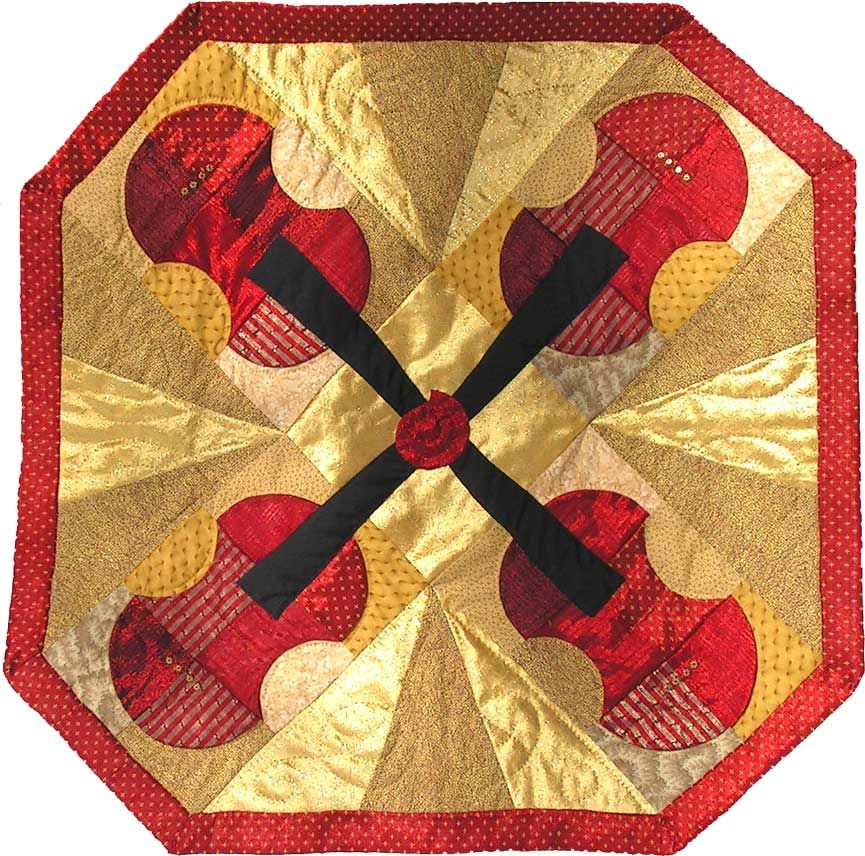
P.S. My graphic is a gorgeous quilted piece made by my friend Elizabeth Crisfield, who is quite a fine fiddler in her own right!
Fiddle and Violins: Red Wing

Johnny Gimble: Red Wing
[purchase]
Speaking of obvious choices, no survey of fiddle music would be complete in my mind without some western swing. And the only choice to represent the genre has to be Johnny Gimble. Gimble was born in 1926 and played with Bob Wills in his peak years, but Gimble was still there to join western swing revivalists Asleep at the Wheel about fifty years later, and he still sounded great. Amazingly, he still does. Gimble’s most recent album came out just last year, and it was fine. Red Wing may sound familiar to some readers, even if you don’t know the title. Somewhere, it acquired a set of lyrics, and became Union Maid.
Fiddle and Violins: Orange Blossom Special

Vassar Clements & the Nitty Gritty Dirt Band: Orange Blossom Special
[purchase]
I've danced around not posting any obvious songs this week, but heck with it. If we can't post Vassar Clements on fiddle week, then what can be said for us? And Orange Blossom Special is known as the fiddle player's national anthem, so it's a natural fit.
Will the Circle Be Unbroken was the first bluegrass album I'd ever heard, and it came courtesy of two of my college freshman roommates at the University of Michigan. Robyn played violin, but we made her play fiddle; Meryl played banjo, and me, well, I played guitar. What we lacked in talent we made up for in enthusiasm. Robyn especially liked to play this spirited song from her album at full volume at 7 in the morning after our other hallmates kept us awake until 2 am. (She liked to alternate this with Gregorian chants).
It might be easier to list musicians that Vassar Clements didn't play with over his long career, but here's a quick list of some of those he accompanied: Bill Monroe, John Hartford, Norman Blake, Earl Scruggs, the Grateful Dead, Jimmy Buffett, David Grisman, Dicky Betts, Paul McCartney, Stephane Grapelli, Woody Herman, and Linda Ronstadt. He was an early innovator in what's now called newgrass.
This album, both innovative and well-received in 1972, brought together many traditional bluegrass and country-western artists with the country rock group, the Nitty Gritty Dirt Band. It also introduced Clements to a broader audience, including Robyn, Meryl, me, and those hapless hallmates at U of M.
Friday, April 15, 2011
Fiddle and Violins: Eck Robertson and Fiddlin' John Carson

FIRST EVER COUNTRY RECORD:
Eck Robertson: Sally Gooden
[purchase]
FIRST EVER COUNTRY HIT:
Fiddlin' John Carson: Little Old Cabin In The Lane
[purchase]
The first-ever country record was recorded on 30 June 1922 (or possibly on July 1) – not in a random southern location, but in New York City, at the Victor Talking Machine Company on West 38th Street – and it was a fiddle number.
Over two days, the 35-year old Texan fiddler Eck Robertson put on record several tracks, accompanied on some by Henry C Gilliland, a 70-year old Civil War veteran wearing an old Confederate uniform. Robertson had been performing with his wife since 1906. At a gig in Richmond (though they probably didn’t call public performances “gigs” then) he met Gilliland, and both were urged by a lawyer with connection to Victor to go to New York and audition for the label, one of the biggest even then (it would go on to become RCA Victor).
Victor, which later became RCA Victor, had been decidedly mainstream. It had been Enrico Caruso’s label. But as the 1920s dawned, sales were dropping, so fiddlers like Robertson promised to serve the ethnic (read rural and/or black) niche markets. After a few months, Victor chose to release Robertson’s signature song, Sally Gooden. It made no impact whatsoever, nor did the fiddler’s four follow-up releases. The first country hit came soon after, and it was recorded in the South. In March 1922, an Atlanta radio station, WSB, invited local fiddlers and other folk string musicians – pickers – to perform in its studio. The experiment proved popular, and the star performer was Fiddlin’ John Carson, then already 44. He was heard by a visiting A&R man, Ralph Peer, who three years earlier had released one of the first blues records, Mamie Smith’s Crazy Blues. Peer, a key person in the development of country music, signed up Carson for the Okeh label.
On 14 June 1923, in a make-shift studio on Atlanta’s Nassau Street, Carson recorded Little Old Cabin In The Lane, a minstrel song from the 1870s written by Will S Hays. Peer thought Carson’s vocals were nothing like anything he had heard before, and not in a good way. Yet, what Peer thought was “pluperfect awful” singing would provide a template for generations of country singers. The recording was a hit – country’s first ever hit record.
(The above is reproduced and slightly expanded from a post in a series on the history of country music on my blog)
Thursday, April 14, 2011
Fiddle and Violins: H.C.M. (Violin Cadenza) / Pushin' the Button

Tiny Lights: H.C.M. (Violin Cadenza)
Tiny Lights: Pushin' the Button
[purchase]
I remember the moment I fell in love with Hoboken's Tiny Lights, even if I no longer remember the exact date. It was somewhere around April 1990 and they were opening for Throwing Muses at the campus center at Rutgers' Cook College in New Brunswick, N.J. Lead vocalist Donna Croughn was wailing away on her electric violin on what I later came to know as "H.C.M. (Violin Cadenza)" and my mind was suitable blown.
I have a feeling you had to be there to really get this track and it's other half, "Pushin' the Button", but if you were there, you know how much fun a Tiny Lights show was. And after that first show, I was there whenever they were in town. Which was quite often back in the early '90s, when it seemed like they played the Court Tavern every couple of months.
Both of these tracks come from the album Hot Chocolate Massage, an album recoded hastily and on the cheap after what should have been their Enigma Records debut got lost when the record label reorganized just before the album's release date. The band never really recovered from that bit of bad luck, and after several more indie releases, finally called it quits in the late '90s. Guitarist John Hamilton, who also shared lead vocal duties on "Pushin' the Button", is now a professor of comparative literature, at Harvard. Not a bad consolation career.
Fiddle and Violins: Oxford Suite Part 2

Ed Alleyne-Johnson: Oxford Suite Part 2
[purchase]
This fascinating electric violin track has been on my replay list for a while. Oddly enough, when I juxtapose it with the J-Rock tune I posted a few days ago, there's not a lot of difference between them: they're both pretty solid electronica pieces, even though they're by artists from opposite ends of the globe.
Ed Alleyne-Johnson deserves to be better known, I think. He's made a small splash online, but is better known as a world-travelled busker from northern England. This song's a self-penned instrumental tune from his 90s release, Purple Electric Violin Concerto, but lately he's been putting out albums of covers that are well worth buying.
There's something both simultaneously distancing and intimate about electric violin, especially in electronica, I've decided. What's your opinion?
Fiddle and Violins: Bulgars/ The Kiss

Itzhak Perlman with The Klezmatics: Bulgars/ The Kiss
[purchase]
In the comments earlier this week, Owyn asked about the difference between a fiddle and a violin. His answer was a punch line, and it made me smile. But, if I may, I would like to answer the question seriously. The answer is how the instrument is played. No one is a better example of this than Itzhak Perlman. Perlman is a world-renowned classical violinist, but he explored his Jewish roots a while back, and he learned about Klezmer. Klezmer is a traditional Jewish music from eastern Europe. I did a post about it two years ago on Oliver di Place, and you can see that here for a fuller explanation. When Itzhak Perlman plays Klezmer, he is a fiddler. The song I have chosen finds him, not on the roof, but on the stage of Radio City Music Hall in 1996. Bulgars/ The Kiss is a medley of four tunes. A Bulgar is a traditional dance, and the three heard here are Tate Ziser, A Galitsyaner Tentsl, and Undzer Toyrele. The Kiss is a tune that was written by Frank London and Lorin Sklamberg for The Klezmatics.
Before I go, let me wish a happy Passover to all of our readers who celebrate.
Monday, April 11, 2011
Fiddle and Violins: Spirit
Wild Colonials: Spirit
[Purchase]
I have previously written about the band Wild Colonials and even then mentioned that they had a fantastic violinist that participated on almost every song.
Their violinist, Paul Cantelon, works with numerous bands and also scores movies, including The Other Boleyn Girl, but I know him as a founding member of Wild Colonials, a band born of collaboration between talented artists that had made careers for themselves, but enjoyed working together enough to form this dynamic band.
This track from their 1996 album "This Can't Be Life", and I enjoy the way they use the violin to temper the song, it works beautifully. The song also features strong songwriting, exceptional vocalist Angela McCluskey, and backing vocals by Rickie Lee Jones as well.

Fiddle and Violins: EMD

David Grisman Quintet: EMD
[purchase]
Hey, here’s something I bet you didn’t know: a fiddle can do scat singing. It sounds ridiculous, I know. But listen to Darol Anger’s solo on EMD, and tell me I’m wrong.
I have written here and elsewhere about my dislike of musical genre labels. In 1977, David Grisman was about to release the first album of his quintet. The music was acoustic, with fiddle, mandolin, guitar and bass. But this certainly was not bluegrass. It sounded more like jazz, but not exactly. Grisman evidently didn’t like genre labels either, so he came up with something silly to fend off the question. The only trouble was, the new label stuck. This, then, is Dawg music, the first anyone ever heard. EMD is the opening track off the debut of the David Grisman Quintet.
Sunday, April 10, 2011
Fiddle and Violins: Rest In Peace & Fly Away

Sugizo: Rest in Peace & Fly Away
[purchase]
Like a lot of the other SMMers last week, I had a hard time coming up with songs about Truth, Veracity, Honesty, or even Truthiness that I really enjoyed.
Not so with this week's theme.
In fact, I've almost come full circle with this post – it was nearly a year ago that I joined the group here (thanks for inviting me!) and I posted a near-twin of this song, a similarly slow, moving instrumental by the Japanese rock star, Sugizo. He wrote this as a theme song for the movie "Soundtrack," in which he also starred.
Sugizo is kinda like the Ry Cooder of J-Rock, with his capable fingers in many pies. He's currently a member of not one but two of the foremost bands in Japan (Luna Sea and, most recently, X-Japan). If that doesn't keep him busy enough, he's a featured musician on numerous other bands' songs, writes soundtracks, and contributes to many ecological and humanitarian causes. He's primarily noted as a guitarist, but as you can see, he also plays the violin quite well.
So check out the song, but you won't get the full effect until you watch him perform with X-Japan live in Tokyo in this YouTube clip. If you want to know why I'm so hot for J-Rock, then this clip might give you a hint. It's got it all: the long-awaited hometown resurrection of a hugely popular band whose members went through more trials than Britney, Mariah, and Tina Turner combined, the emo-classical intro—a duet with Sugizo and J-diva Yoshiki playing matching clear acrylic instruments and wearing matching frilly waistcoats, joined by their clearly overwhelmed vocalist who'd just had the scales fall from his eyes about a cult he'd been entangled in for the past ten years, a duet which then segues into an over-the-top uber-rock-band anthem, complete with enough flashing lights and fireworks to trigger epilepsy, where Sugizo swaps his violin for a clear acrylic guitar and Yoshiki mounts his drum kit and never holds back even though everyone in the audience knows he's nearly been paralyzed from repetitive stress motion and could still succumb…. Whoa. This needs to be a reality show, you know what I'm saying?
Saturday, April 9, 2011
Honesty and Truth: True Colors

Eva Cassidy: True Colors
[purchase]
This seems to have turned into a week for confessions, which is probably my fault for my choice of the transition song. So you can go back over my posts from last week, and you will find the explanations of my lies in bold. Also, I am not afraid to admit that, when I first heard Cyndi Lauper, I really liked her, and I still do. The entire album She’s So Unusual was quirky heaven. I was eager for more, but the follow-up album was True Colors, and the title song was all over the radio. I was disappointed. Someone seemed to have told Lauper that she had to be normal if she wanted to stay popular, and got her to believe it. Listening to the song True Colors now, I realize that it is a fine piece of songwriting, but Lauper’s original version, for me, is marred by dated production techniques. So I’m glad I found Eva Cassidy’s cover. Cassidy strips the song down to its essentials, and then builds it anew. Along the way, she cuts loose without overpowering the song, and finds a passion in it that I never knew was there. I will praise Lauper’s writing again, but Eva Cassidy made me realize that Lauper may not have the best voice for this song. Give it a listen, and see what I mean.
Friday, April 8, 2011
Honesty And Truth: Father Of A Boy Named Sue
Shel Silverstein: Father Of A Boy Named Sue [purchase] We are all familiar with the tale of the boy named Sue, as told by Johnny Cash in his concert in St Quentin jail. To recap, the boy named Sue bumped into his father, who abandoned the family when Sue was three, in a bar in Gatlinburg, Tennessee. He starts a fight with the appalling dad as payback for being saddled with that awful name. Once both are suitably bloodied they make up and the father explains that he gave Sue his effeminate name because he’d be bullied for it, and therefore be compelled to fight back and “get tough or die”. I wager that Sue’s dad was not of the Dr Benjamin Spock school of pedagogy. Well, Shel Silverstein, who wrote the song, felt it only fair to give the old man his say as well. And it seems that the father was an even bigger bastard than we thought. He confirms that he told Sue the story about the name prompting resilience by the fatherless boy. But that was a lie. The truth is, when Sue – “the ugliest queen I've ever seen “ – pulled a gun “out of his carter”, the old drunk told him “how I named him Sue just to make him tough”. And Sue obviously bought the lie, and…well, the ending is decidedly odd; listen to it yourself. The big question really is this: why didn’t Sue just change his name to Bill or George or anything but Sue? Incidentally, in last week’s entry on Ben E. King’s “Don’t Play That Song”, I lied about Elvis having been interested in recording that song. Though I wish he had recorded it.
Wednesday, April 6, 2011
Honesty and Truth: Gimme Some Truth

John Lennon: Gimme Some Truth
[purchase]
Like some other contributors at Star Maker Machine, this is a busy week for me, with nary a moment to spare. But I couldn't let this week's theme go by without posting this song. Lennon always knew how to speak the truth. In this song, he asks for it. It is, unfortunately, a timeless sentiment.
Sunday, April 3, 2011
Dishonesty and Lies => Honesty and Truth: Confessin’ the Blues

Jay McShann: Confessin‘ the Blues
[purchase]
I’ll get to the main body of this post in a moment, but first, I have a confession to make. I’m sure many of you noticed that last week’s posts were… odd. There was a secret theme that became less secret as the week went on: each post had to contain at least one lie in honor of April Fool’s Day. So now, those who wish to can go on a scavenger hunt. Find the lie in each post. Beware, some posts had more than one, and the lie isn’t always the one identified in the comments. To start you off, my last post of the week was a sort of existential lie. Everything I said about Would I Lie To You was true, but, of course, that wasn’t the song I posted. Can you find the other lies? Have fun with it, and good luck.
Confessin’ the Blues seemed to me to be the perfect transition song, going from lies to truth. The narrator here is promising his honesty in the name of love. Jay McShann leaves it at that, but some versions have additional lyrics that imply that he used to be a liar, and that the woman he sings this to has lied to him. So, he is at a turning point, and he hopes she can love him back and join him there. Like many others, I first heard Confessin’ the Blues as performed by the Rolling Stones. The Stones were a fine blues band in their early days, and they always tried to get their fans to seek out the great blues masters they covered. In the case of Confessin’, the Stones probably based their version on the one by Little Walter, but the song is older than that. There is a fine version from the big band era, by Joe Williams with the Count Basie Band. McShann slims that version down a bit, and creates a wonderful jump blues version.
Friday, April 1, 2011
Dishonesty and Lies: Would I Lie to You?

Eurythmics: Would I Lie to You?
[purchase]
I seem to be reliving the days of synth-pop this week. First the Thompson Twins, and now this. But surely, no one did it better than the Eurythmics. One reason for this was the amazing voice of Annie Lennox. But the songwriting of Dave Stewart may have been just as important. In turn, this may be because Stewart’s first instrument was not the synthesizer, but the guitar. Whatever the case, by 1985, the group had decided to feature more of Stewart’s guitar playing, and one result was the crunching guitar parts of Would I Lie to You? It was a high point of the band’s artistry, and probably my favorite song of theirs.
;)


