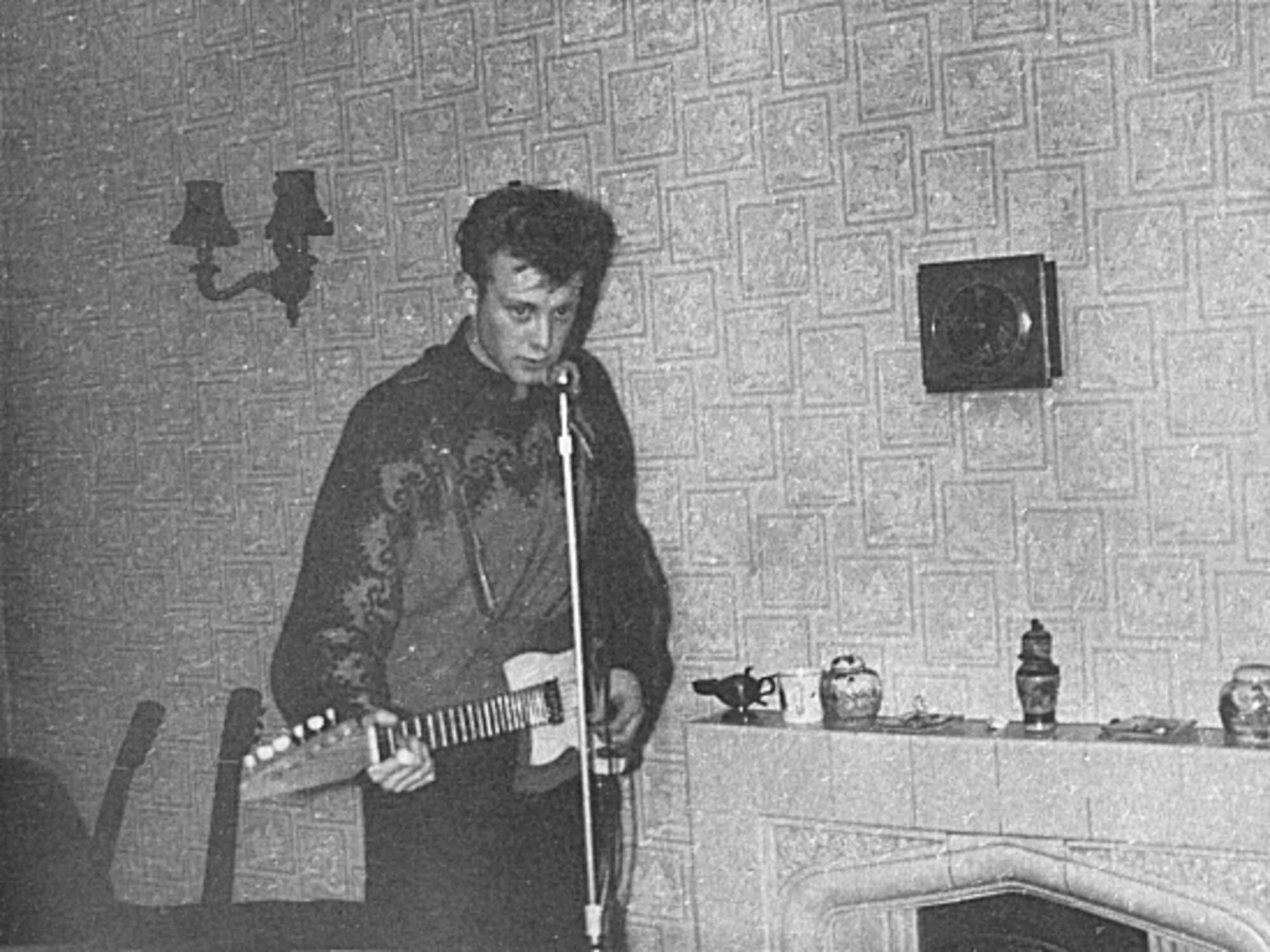
You’re a teenage (left-handed) bass player, and a former band mate asks you to fill in on a few gigs with a cover band that had recently
been on tour, because their bass player is unavailable.Needing a bit of extra Christmas cash, Chas
Newby agreed, and played four shows in England with his old friend Pete, and
his fellow band members, John, Paul and George.Chas had fun and pocketed all of £4.But when John suggested he stay with the band
for a tour in West Germany, Newby declined, figuring that he had a better
chance of success in his preferred field of chemistry.
Of course, the rest is history.Nearly two years after Newby declined Lennon’s
offer, the Beatles hit it big with “Love Me Do,” featuring Paul McCartney on
(left-handed) bass.
As Newby said:
To me then it was just four gigs with a different band. Music
was never going to be a living for me. All of us at that time were thinking
what we were going to do with our lives, some doing teaching, or science, or
whatever.
I wanted to do chemistry. John, Paul and George, they just
wanted to be musicians.
They had been away in Hamburg. They’d played a hell of a lot
over there so they were very tight, very proficient, and they gave it some
stick. But I did the four gigs and went back to my college course the week
afterwards.
In fact, Newby went back to St. Helens College and continued
his studies in chemistry, eventually getting his Master’s from
Manchester University.In 1971, a decade
after his brief encounter with possible superstardom, he joined Triplex Safety
Glass, which manufactured windscreens for trains and aircraft.He retired in 1990 and became a math
teacher.
Further proof of his being merely a blip in Beatles’ history,
Chas only had one encounter with any of the band after his four gigs (the last
of which was 63 years ago today--New Year's Eve 1960--at the Casbah).In 1962, he recounted:
I was on my way home and I pulled up at some traffic lights.
There, waiting at the crossing, was George. I said hello and asked if he needed
a lift. He said he was waiting for someone and that was that. Off I went.
Before his death on May 22, 2023, Newby played in a charity
band, The Racketts, and in the reformed Quarrymen, which once counted John,
Paul, George, and Newby’s predecessor in the Beatles, Stu, as members.
We continue featuring drummers who died in 2022. Part I featured Jet Black (Brian Duffy), Jerry Allison, and Dino Danelli, and you can read that here, if somehow you haven’t read it already. We’re proceeding oldest to youngest, and Part III should be posted soon.
Alan White—White was best known as the drummer for Yes, although I admit that I always think of him as “the drummer for Yes who replaced Bill Bruford.” Bruford is my favorite rock drummer, so White was never going to measure up, but he was a fine drummer in his own right, and played on many great Yes songs.
Born in 1949, White joined his first band at 13, turning pro at 17. In 1969, White received a call from someone claiming to be John Lennon, looking for a drummer for the Plastic Ono Band. White thought that someone was yanking his chain, but it turned out to be a genuine offer. White, given three days to prepare, performed with them for a show, and later played on Lennon’s Imagine album, the song “Instant Karma,” and George Harrison’s All Things Must Pass. This led to a brief enlistment in Ginger Baker’s Air Force, and work with Steve Winwood and Terry Reid.
White shared a London flat with Eddy Offord, who worked as an engineer and producer for Yes, and occasionally hung out at the studio with the band. Once, when Bruford had to leave a rehearsal session early, White sat in. Later, after Bruford left Yes to join King Crimson in 1972, White was asked to join the band, and again was given three days to learn their repertoire before the Close to the Edge tour started. You can see and hear White playing on “Roundabout” from that tour here:
White played drums and percussion on more than 40 studio and live Yes albums, and occasionally added piano parts and collaborated on songwriting. He also released one solo album and had a few side projects.
White was one of 8 of the myriad members of Yes inducted into the Rock and Roll Hall of Fame in 2017 (as was Bruford, who is not also in as a member of King Crimson, because that band has somehow never been inducted. Don’t get me started.)
After what was described as a “brief illness,” White died on May 26, 2022 at the age of 72. Sadly, two months before his death a large number of personal items, including musical instruments (the drum set he played with the Plastic Ono Band, for example), and platinum records, were stolen from a storage unit.
John Hartman-The original drummer for The Doobie Brothers, John Hartman died on September 22, 2022. Hartman originally moved to Northern California at the request of Skip Spence, who wanted him to participate an a revival of Moby Grape. That never happened, but Spence introduced Hartman to Tom Johnston, and eventually they, along with Pat Simmons, formed The Doobie Brothers.
Here’s Hartman playing “China Grove” on the BBC in 1974:
Hartman drummed with the band, sometimes with a second drummer, until 1979, straddling their early days as funky, bluesy rockers fronted by Johnston, to the smooth purveyors of “yacht rock,” led by Johnston’s replacement, Michael McDonald. He returned for a benefit tour in 1987, and two more Doobies albums (with Johnston and not McDonald) but retired from the band for good in 1992.
After that, Hartman attempted to become a police officer, but the drummer, described by the band at his death as a “wild spirit,” found it hard to break into law enforcement due to his previous drug use, despite having graduated from a police academy.
Hartman was inducted into the Rock and Roll Hall of Fame as a Doobie Brother, but because of COVID, plans for a performance by the original members were scotched. Interestingly, Hartman was the only living major figure from the Doobies not interviewed for the 2021 biography documentary, Let The Music Play.
Ric Parnell-You know how the drummers in This Is Spinal Tap! all died in strange ways? Remember how Mick Shrimpton spontaneously combusted? Real drummer Ric Parnell was Mick Shrimpton. When Spinal Tap recorded its two albums, and did TV performances and live shows through 1992, it was Parnell who handled the drums. But, you ask, how did he do that if Mick Shrimpton was dead? Turns out, Mick had a twin brother, Rick Shrimpton, who was also a drummer!
Spinal Tap was not Parnell’s only claim to fame. Born in London in 1961, to a drummer father and with two drummer brothers, percussion was basically the family business. In 1968, due to one of his father’s jobs at a TV station, Parnell got to see Jimi Hendrix perform on Dusty Springfield’s TV show.
Parnell had two stints with Atomic Rooster, initially briefly replacing a pretty fair drummer, Carl Palmer, and then rejoining and playing on their last two albums.
You can see Parnell’s Bonham-influenced drumming here, on Atomic Rooster’s “A Spoonful of Bromide Helps the Pulse Rate Go Down” from 1972:
After that, Parnell played in some Italian bands before becoming a sideman for artists including Michael Des Barres and was the drummer on Toni Basil’s hit “Mickey.” He was offered a chance to join Journey, but declined, which probably cost him a ton of money. But if he had joined that band, I would not have written this, because I really do not like Journey. So, he clearly made the right call.
Parnell settled in Missoula, Montana, where he would gig locally, and for a while Parnell hosted a radio show called, yes, “Spontaneous Combustion,” where he played basically whatever he wanted and told stories. (Boy, I miss doing that on the radio....)
On May 1, 2022, Parnell died at the age of 70 from a blood clot in his lungs that led to organ failure.
If we are talking about questions, I suppose the question word <why> is at the fore of this theme. What better choice then, than a song that asks that self-same question: why?
Without any previous background knowledge, I would have posited that the Beatles' <Why Don't We Do It In The Road?> was a Lennon composition. You know? Free Love ... Push the limits...
To my surprise, I learn that it is a McCartney piece with Starr's assistance and that - to top it off - Lennon is said to have been hurt that he was not included.
By the time the <White Album> came out, the band was all but defunct. As opposed the the relative conformity/sequence/progression of songs on <Revolver>, <Sgt Peppers>, <Magical Mystery Tour>, the <White Album> is disparate, disjointed in terms of theme.
Granted, there is a certain amount of non-sense coming in from time to time starting earlier. Earliest Beatles songs were very muchly boy/girl themed, and then we start getting things like "We all live in a yellow submarine". WTF? I mean, I can kind of see "We're Sgt Peppers Lonely Hearts Club Band" in terms of lyrics, but by this point in time, we've gone a bit off the rail - in terms of what AM radio thrived on.
And then there's "why dont we do it in the road?"
I suppose there's the distant possibility that what we could be doing in the road is scat, but that's not much more sociologically acceptable than the actual, more obvious notion behind the song.
McCartney apparently witnessed 2 monkeys in the act in the streets of India. But as I said, this seems much more the kind of question that Lennon would have raised - delving into and questioning the social stigmas that define our behaviors. You know: if love is so beautiful/the answer to all our troubles, then why don't we do "it" in the road?
The following is all possibly "fake".
How would you know?
Yoko Ono is an artist? (True/False?) Yes, I guess so.
You are what you claim to be? Well ... that's certainly part of the road to your destination. But it generally doesn't guarantee it (see the various unknowns I try to include every now and then in my post of famous people's songs [JimiHerbie]. It's a fact that some of us are better positioned for one reason or another (and some are luckier)
Is Yoko Ono a witch? The jury seems to be out on that one.
You don't need my history lesson about Yoko to guide you towards your decision. (you can get your own here). On the other hand, I was one of millions that tracked the story of John and Ono in real time (because I was born in the 50s).
Yoko was one of the primary reasons the Beatles dis-banded? (maybe). Yoko "twisted" John's mind. (love tends to do strange things to your perceptions). Etc ... etc...
Does/Did Yoko Ono bring a new (artistic) dimension to John's (read: the Beatles at that stage) perceptions? (yes). Was it (artistically) creative? (Um ... yeah) Does that mean that she should be making her own albums at this point (2019) in time? ( uh ... no. But I am clearly biased from the start.)
I think the first time I really noticed Yoko's musical influence (yes - knew, but didnt register back in the 70s), was Plastic Ono Band - the husband/wife collaboration
Other input towards our theme - (witch or not) -Yoko is somewhere in the picture(like a true witch)
I'm Losing You
Watching the Wheels Turn (again .. Yoko here or not?)
Pardon the extensive parentheses - they seemed needed to separate my wandering thoughts this time around ...
So many titles, so little time, so I thought I would cheat and sling in a threefer, three for the price of one, choosing three heads of royalty of differing style and background. Of course, there are many Kings in music, even if we discount those with the surname King. So no Albert, Ben E. or B.B. And I thought I would stick to titles rather than honourifics, so no Kings of Pop, Delta Blues or even the.
King Curtis may be an unfamiliar name to many, albeit probably not here, but the diversity of his career and the broadness of his legacy surpasses many better known names. His given name, Curtis Ousley is even less well known. As a child in the sixties, and teen in the seventies, my first awareness of him was his raw honking on John Lennon's Imagine album, especially on 'It's So Hard'. Subtle it ain't, and though he became best known for his aggressive and rasping sound, it wasn't always so. His early influences were in jazz, with his joining Lionel Hampton's band instead of taking up a music scholarship, before branching into sessions. One early piece of work was with Buddy Holly, 'Reminiscin'', for which Holly gave him the songwriting credit. Mixing his own work, with several successful singles of his own, alongside working as a bandleader for, amongst others, Aretha Franklin, he continued still to find plenty of session work. Tragically he was killed in 1971, being stabbed in a fracas with a couple of dealers he heard arguing outside his front door. The song below, made before his death, gave him a grammy for best R&B instrumental, featuring also the late Duane Allman on guitar.
King Tubby is a name associated more as a producer and re-mixer, that being his metier. Unarguably one of the fathers of dub, that studio process of vast and sudden echoes and repeats clattering around a soundscape, entire instruments dropping randomly in and out, all underpinned by subterranean basslines. I bloody love it and, the older I get, so I can't get enough. (Plus it is the golden guarantee of getting a crying baby off to sleep, rocking in your arms to some of Kingston's finest.) Tubby or Neil Fraser as he was known to his mother, is seen largely the instigator of this style, working out of his studio from the late 50s, evolving the format over the next decade or so. Principally derived within and from reggae, in more recent times it has become a much loved tool of re-mixers, some of Tubby's disciples, notably the Mad Professor applying the same techniques to dance and electronica. Here, another of his acolytes, Scientist, explains the roots of dub. Sadly, and worryingly for my 3rd King, Tubby was also murdered, this time shot, and also on his front porch.
So we have had some gold and some frankincense. So it must be creosote time. Or King Creosote, aka Kenny Anderson, from the Kingdom of Fife, in Scotland. An astonishingly busy career has seen him start and run his own record label, produce and collaborate with any number of other artists and release over 40 recordings of his own, all by his half-century. Most has, however, been under any mainstream radar, however world famous in his own backyard. Through his Fence Collective he was able to nurture local talent and one famous graduate of that scene is K.T. Tunstall. Other names such as James Yorkston and onetime business partner, Johnny Lynch, aka Pictish Trail, have also had some wider exposure. Creosote himself gradually has become more widely known, in part through his soundtrack work, notably 'From Scotland With Love', and through his work with electronica artist Jon Hopkins. More recently still, his last record, 'Astronaut Meets Appleman', in 2016, featured in many best of year lists, including my own, his mix of a whimsical and emphatically scottish folk sensibility with a motorik rhythm, effortlessly crossing many a barrier of genre. Here's my review of him live in 2017. Give him some eartime and spread his word wider. (Plus he is still alive!)
Can you identify a musician's "signature style" just by hearing them play on a particular track? For a vocal artist, it's pretty straight forward - their "instrument" is highly unique. But whaddabout a guitar player or a keyboard player? To the knowledgeable, a Fender sounds different from a Gibson. A country picker sounds different from a rocker and so on ... But what is it about their style, their sound that sets them apart?
In the case of Nicky Hopkins - need I say, one of the most sought after session keyboard artists throughout the 70s and 80s - it appears that it was personality more than keyboard fingering that set him apart. Great work, but could you identify him on a track just by hearing it?
I've been to the Keyboard mag site and an article titled "5 Ways to Play Like Nicky Hopkins" in search of an answer. Among other notes, they report one of his signature techniques involved: " a sus2 embellishing the third scale degree". If that tells you more than your ears tell you ... Wow! Their review of his style only gets more technical as it continues (beyond my ability to follow).
His Rolling Stone obituary said he played "fast, accurate pounding piano lines to flesh out the sound of everything ...", as well as "skill, reliability and cheerful personality ensured he was the sort of session player untutored rockers could relate to". I want to believe that it is this that put him in such demand. When you play with others, how you fit in at the moment is as important as your speed or your technique.
My bad: I hadn't realized that Nicky Hopkins had passed - and it's been 25 years. I knew his name/fame primarily because of his session work with the Stones and the Kinks, but never delved particularly deeper than acknowledging his chops here and there. So ... let's post this under <Nick> but let it lead us into <In Memoriam>, even if he didn't pass this past year. (SMM might have missed him back when he did ... wait: SMM wasn't yet online back then!)
His Wikipedia page reveals so much more: all over the place, he was. The full list is overwhelming:
A taste below:
Art Garfunkel (above)
Jeff Beck (above)
The Rolling Stones - Sympathy (above)
The Grateful Dead/Quicksilver (Edward the Mad Shirt Grinder)
Regular readers of my work here and elsewhere know that I’m a fan of prog rock, and I think that it is pretty clear that the Beatles were a profound influence on prog bands, many of whom have acknowledged this directly, or have covered Beatles songs. Electric Light Orchestra,which was founded when Roy Wood, of The Move, wanted to explicitly pick up where the Beatles left off, and use orchestral arrangements and instruments to fuse classical music with pop shows how it is possible to mix the two.
Initially, Wood recruited Jeff Lynne to join The Move, which also included drummer Bev Bevan, and they gradually morphed the older band into a new unit, Electric Light Orchestra. Wood left the band during the recording of their second album, leaving Lynne as the leader. And, there is no question that Lynne loved the Beatles (and the Beatles loved him—as you can see in the article that I linked to above, not only did they like his songs, Ringo and George guested on their albums, Lynne produced solo albums for Ringo, Paul, and George, replaced George Martin as producer for the Beatles’ last singles, and, of course Lynne was a Traveling’ Wilbury).
I was a fan of ELO during their mid-late 1970s heyday. I enjoyed the mix of pomp and pop. “Fire on High” is one of their stranger songs, suitable only as a B-side—an instrumental (mostly), with backwards vocals ("The music is reversible, but time... is not. Turn back! Turn back! Turn back! Turn back!"), choral segments and all sorts of odd stuff going on, making it still a fascinating listen.
Interestingly, despite its weirdness, a portion of the song was used by CBS for its sports coverage in the 70s. I have a strong memory that it was used for the network’s NBA coverage, but the Internet disagrees, telling me that it was actually, used for a sports anthology show, sort of like the better-known Wide World of Sports called the CBS Sports Spectacular. As we know, memory is a strange thing.
Back in the late 1980s, my friend Bill and I shared an apartment in New York, in the days when having an answering machine was still something that everyone had, and creating a theoretically clever outgoing message was popular. I remember that we used a few seconds of “Fire on High” and pretended that we were announcing a game while imparting the standard “we aren’t home, leave a message at the beep” message.
As I am writing this, I’m having second thoughts about whether it is a good idea to share this story or not. But we're all friends, here, right, and you won't think less of me. Right?
I come from a generation where Lennon/McCartney was impossible to beat: I'm pretty sure the first "Rock 'n Roll" I heard was the Beatles. Must have been '65.
So it was with some dismay that I learned of the Beatles' rancor and breakup around the time of <The White Album>. But that was combined with an awakening to the fact that the world and relationships include change - as in trips to India that expanded your mind. As in girl friends that are no longer.
By the time of their breakup and Lennon's many year silence - well beyond the <White Album>, I had been enured to the mystique: people do things beyond your control/expectations. So it was with a fair amount of joy that I went out and bought Double Plastic on cassette tape for my SONY Walkman back in the early 80s. Yes, a legal copy when I could have easily made a copy of the tape.
As for Double Plastic (which I do love), there's an entirely valid argument about whether Yoko Ono deserves credit as a musician (I won't argue "artist", because art is what you define it as) The album was conceived as a back-and-forth between Lennon and Ono (one song his, one hers), but it is the Lennon songs that stay with me (and none of the Ono)
Backbeat, a
bio-pic about the earliest iteration of The Beatles—well, The Silver Beatles,
actually—came out in 1994, and at the time, I remember thinking: wow! What a
movie! So cool, so uber-hip as to be so different from what was happening at
the time. I’ve re-watched it since and all I can really say is, in deference to
the aging process, the accents are good, especially the guy who played George
Harrison. In fact, all the portrayals are good: Lennon is brooding and nasty,
Paul is smiley, yet focused. George is quiet. Then there’s Pete Best, the
world’s unluckiest drummer, but the focus of the film, Stuart Sutcliffe, the
“lost Beatle” or the “5th Beatle”, who left the band to become a
painter and then tragically died from an intracerebral hemorrhage is the central story. The injury
was the possible result of a vicious beating he took, and a kick to the head,
in one of the Beatle’s many misadventures in Hamburg, Germany, where they cut
their teeth as a bar band pre-1964 and their history-making splashdown in
America to start the British Invasion. The film’s focus is on those wild times,
as the Beatles sorted out just exactly who they were, and the irony of seeing
them portrayed as pre-icons, unaware of what was to come, makes for interesting
watching.And the fact that the film
devotes most of its image making to Sutcliffe and his relationship with
photographer Astrid Kirchher, lends to the air of mystery around just who the
Beatles were before they become the biggest celebrities in history.
Sutcliffe died a year after leaving the band, at the age of
21, after having secured a scholarship to attend the Hamburg School of Art.
Pete Best was replaced by Richard Starkey…the rest is history.
It’s sad to think of what could have been when one discusses
Sutcliffe (or Pete Best, for that matter). An artist first, Lennon convinced
him to join the band and play the bass, which Sutcliffe had absolutely no
talent for whatsoever. But, he looked cool, and in a band as image-conscious as
this, that counted for a lot. In fact, it was arguably Sutcliffe that inspired
and invented the Beatle’s image—point in fact: he was the first to wear a
mop-top; the others were copying him. Same with the Beatle boots and the duds.
But, with Lennon, McCartney and Harrison being as talented as they were, tensions
were bound to arise—the looks would only get them so far. Seriously, think
about it: The Beatles started out like any other pop outfit: thriving,
rocketing to fame on their carefully cultivated image and the devastating good
looks. But, they surpassed the look and did something as yet really unachieved
at that time in pop/rock music, which was make music.
Music, as in italicized
music, asterixed music, real music*.
The level of talent, of song writing and
composition skills, has rarely, if ever, been matched since by a pop band. So,
good looks, mop top haircuts, and those Chesterfield suits with the velvet
collars and the drainpipe pants, would have only taken The Beatles so far if
not for the god-given musical talents. Imagine a history where the Beatles were
a relegated to a few oldies hits, dusted off on classic rock radio, never achieving
Abbey Road, or Sgt. Pepper’s, because they were kind of Justin Beiber, or
something even less, a factory made hit, here and then gone. Pop music is more
flash than it is bonfire. The Beatles remain an ever-growing phenomenon not
because they were among the first, but because they deserve, perhaps, had to be
that.
The movie itself, as I said, is…OK. It’s a nice period
piece, full of authentic sets, haircuts, and great wardrobe. It shows the
tensions in the band, defines the personalities that would go on to be more
legendary the real, and depicts Paul’s anger and dislike of Sutcliffe, knowing
he was better on bass than the aspiring art-school aesthete.
But, it is the soundtrack that we will end on. Produced by
Don Was, and featuring a veritable all-star line up including Dave Priner of
Soul Asylum (huge at the time the movie came out); Greg Dulli of the Afghan
Whigs; Mike Mills of REM; Thurston Moore of Sonic Youth; and a young kid named
Dave Grohl from a little band called Nirvana. The album is a vanity project of
sorts, with ace musicians, wildly popular at that particular juncture, covering,
in a most un-ironic way, their roots. The music that Beatles started out with
was and remains some of the most enjoyable ever written: 2-minute, whip crack
rockabilly and soul numbers that really, though covers themselves at the time,
were the very earliest traces of rock n roll. The DNA of the genre, if you
will—what made rock n roll a cultural force, and not just a local southern
radio oddity named after a slang term for sex, with a fast backbeat and a
quicker guitar riff and shuffle.
This modern day crew cuts a fantastic, hyped up and
warp-speed collection of such tunes as Little Richard’s “Long Tall Sally” and
“Good Golly Miss Molly”, “Twist and Shout”, Chuck Berry’s “Rock ‘n’ Roll Music”
and “Carol” and the Berry Gordy penned, “Money”, perhaps the most recognizable
of the later Beatle’s hits.
The soundtrack is well done, recorded crisply and full of a
buoyant, joyous energy. And like its predecessors, it clocks in at under a
half-hour—those 2-minute pop classics, all jangle guitar, shotgun snares and
ripping vox are a thing of the past, sadly. I remember thinking of the album as a nice
little novelty, a different kind of sound from musicians who I loved at the
time, doing far different sounding music than what was popular (Greg Dulli, in
particular, is in excellent form—but, then, the Afghan Whigs were really just a
hyped up, angry soul band…).
For me, having grown up on The Beatles and studied
them deeply well before I even got out of middle school, the soundtrack was a
lark, a fun reinterpretation. But, for a lot of people my age, in the confused
post-Nirvana (Cobain committed suicide just about a week after the soundtrack
came out), still growing grunge and alterna-revolution, the soundtrack to Backbeat was kind of a text book, a
primer for what came before and laid the groundwork for the rock ‘n roll that
was happening now (well, then actually…).
The thing itself, rock ‘n ‘ roll, is constantly changing, but its roots,
as open to debate of ownership and origin as they are, remain solid. The place
rock music came from is sacred, a spring or an oracle, still able to mystify.
Going back, regardless for the reason, proves, like all good art, that
reinterpretation, not necessarily reinvention, will keep the thing perpetually
alive. And kicking. Hopefully to a kicking backbeat…
Star Maker Machine does not accept music submissions from artists or promoters. However, most of the contributors here do accept submissions for our own blogs, listed below. Please visit our blogs, take the time to listen to what we post, and then feel free to contact us if you feel that your music would be a good fit.




















_500prop_pix.png)


