Showing posts with label Talking Heads. Show all posts

Wednesday, September 21, 2022

THE ROAD: TO NOWHERE

Less on, more been, my excuse is down to the scourge of IT. (Others may vary.) As far as I’m concerned, the IT superhighway can go take one. Sure, sure, without the gift of information technology, I could not be able to waste time you could be better spending elsewhere, let alone my own. But, jeez, don’t you just take the bastard for granted. My laptop recently caught a cold, and has been in the computer fever hospital, getting the best of not inexpensive attention. Meanwhile I am wrestling with my phone to pick up the slack. Which, are you with me, leads inevitably to this post. Ever done Blogger or Wordpress on your phone? The dogs within this lesser tool seem far better able to eat your homework than my usual medium. And much more willing, eager, even, to throw the lovingly chosen words into the ether. So, a lot of roads to nowhere between Run and Road. Or that there were a song to hang on that peg……

Oh, there is, it being a latter day jewel in the crowned (Talking) Heads of popular music. But you knew that. Talking Heads were always either better than their hype or never quite matching it, making for quite the paradox.


In the beginning came Psycho Killer, I still in awe and of a tremble to the above clip. I remember it well, on the UK televisual “inkie”, the Old Grey Whistle Test, or Whistle Test as us teenage bedroom groovers called it. David Byrne looked such a dork, in his slacks and preppy polo shirt, yet the menace he imbued into this hypnotic throb of a song was intense. With Tina Weymouth plugging away on bass, and the other two being, well, the other two, it was nothing short of apocryphal. At home the punks had to look scary, ‘this guy was the real deal.


The album, 77, was good, but not so good as to disappoint around how much better than the other tracks was Killer. Which sort of summed up the band, their albums tending towards one standout track, and then the rest. Their version of Al Green’s Take Me To The River did that for the next, Songs About Buildings And Food, great title, by the way, but I lost interest.

I missed out on several intervening years, or maybe switched off. Meanwhile folk were raving about that film and that video, but not me, my eyes were averted. In fact, it wasn’t until the featured song came out, that I came off my Talking Head road to nowhere. In truth, I suspect it was Tom Tom Club that re-engaged interest; I loved Wordy Rappinghood. 


Little Creatures came out four years after the Tom Tom Club had their brief turn in the sun. Uncertain why, but I really took to And She Was, the first single, swiftly followed, as it was, by Road To Nowhere. I was back on the bus, big time  so much so I duly bought also the next album, Naked. From which I fell right off, in dismay. Even ahead the unavoidable implosion of the band.

David Byrne has, of course, gone on and on, regrouping, regaining and retaining acclaim. The rest of the band less so. The Heads album was a huge letdown, despite the guest singers, and, despite the critical plaudits, I always struggle to see beyond the artifice in Byrne’s solo art. Not for me. I still seem always to see through the facade of world music inspiration and icon, only seeing the jerky nerves of the psycho killer. Which is as good as any a place to leave.

Perhaps my laptop will be repaired soon. Until then, follow me

Monday, January 31, 2022

Boss: Little Johnny Jewel

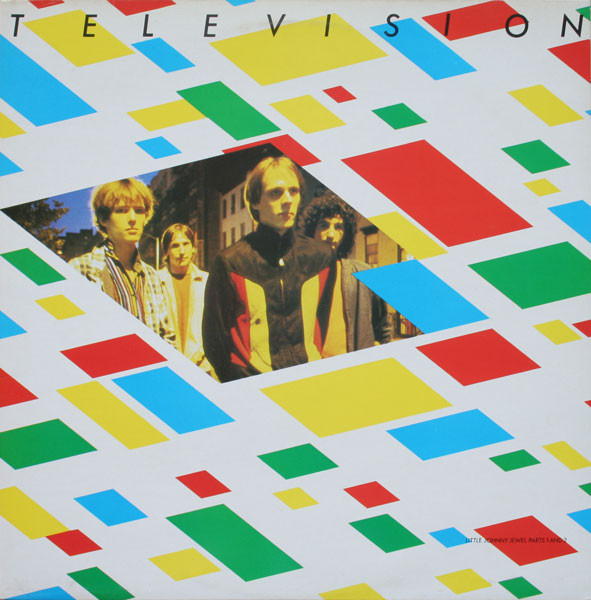
Television: Little Johnny Jewel
[purchase] 

I scanned my list of potential subjects for this theme (read my last post if you don’t know what I’m talking about) and decided again to write about a band that I hadn’t discussed before—Television. I’ve written about small-t television many, many times, here and elsewhere (not going to link, since there are too many), because watching TV is probably how I spend more of my leisure time than anything else, but I’ve never written about the band. While Todd Rundgren’s failure to ever be discussed in this space was very surprising, it is almost as surprising that Television has only been discussed twice—back in 2008 and 2009—and both times about the same song, “Marquee Moon.” Which happens to be an excellent song, but we’re going back to Television’s first release, “Little Johnny Jewel,” a single on their manager’s label, released in 1975. 

Although Television came up out of the same C.B.G.B. scene as the Ramones, Blondie, Patti Smith, Talking Heads, Richard Hell and the Voidoids and the Heartbreakers, among others, who I often played on the radio back in the 1979-1982 period when I was doing college radio, I had trouble connecting with the band then. As someone who grew up on classic rock and prog, I (eventually) came to understand the hard, fast ethos of punk that those other bands followed (although for some, that changed over time) as a rejection of the older forms of rock.  While I still loved what I grew up on, I also learned to love punk (and new wave). But Television’s meandering jams and guitar solos and stream of consciousness lyrics, sung by Tom Verlaine in a yelping voice that, to my ears at least, made David Byrne sound great in comparison, somehow didn’t fit in to the slots that I had in my head at the time. I couldn’t understand how they were in the same category as the Ramones, whose simple two-minute songs done at breakneck speed were nothing like the long songs that Television produced. 

Because of their timing, and their identification with the downtown NYC music scene, and because of the rough sound of their music, Television is usually lumped in with the punks, but interestingly, I’ve seen them referred to as both proto-punk and post-punk, which seems impossible without some sort of time machine. And yet, it makes sense, when you look closely. Television presaged punk both temporally and in their attitude, but their sound was not “punk” in the way that word is commonly used, so like “post-punk” bands, they embraced the brashness of punk, but not all of the sound. 

In my old(er) age, I’ve come to appreciate Television more and more. Maybe it is my more mature approach to music that is less interested in putting artists and their music in genre slots, so that I enjoy the connections that artists that seem very different actually have. I know, for example, that the first time that I heard “Impossible Germany,” by Wilco, one of my favorites, I was struck by how the intertwined guitar parts played by Nels Cline and Jeff Tweedy reminded me of Television’s Verlaine and Richard Lloyd. 

As mentioned above. “Little Johnny Jewel” was the first song released by Television, its 7 plus minutes split into two parts on a 45, and it’s an odd one. Opening with a bass line (from Fred Smith, who had replaced Richard Hell), before Billy Ficca’s drums and the guitars enter, the instrumental eventually resolves into a groove before the vocals begin. The song may be about Iggy Pop, whose real name was James Newell Osterberg, Jr., but his middle name is sometimes listed as “Jewel.” There’s a long instrumental guitar section featuring Verlaine soloing in the middle that sounds closer to psychedelia or even jazz than punk before the groove returns, along with the lyrics: 

Oh, Little Johnny Jewel
He's so cool
But if you see him looking lost
You ain't gotta come on so boss


Verlaine recalled in an interview: “Lou Reed asked me, ‘Why’d you put out this song? This is not a hit.’ I said, ‘What band playing a bar in New York, issuing their own single, is gonna have a hit?’” However, the single sold surprisingly well, and arguably kickstarted the New York punk movement.

Wednesday, December 29, 2021

In Memoriam: Three Vaguely Prog Musicians

Jon Hassell/Brian Eno: Chemistry
[
purchase] 

Kansas: Cheyenne Anthem
[
purchase]

Brand X: Nuclear Burn
[purchase] 

Part of it, I guess, comes from the fact that prog rock era musicians are getting to that age, but it seems like almost every year at about this time, I’m writing about some of them. This year, I’m taking a broad view of the genre, with one musician probably best known for ambient music, one for a distinctly American take on prog, and one who is more from the fusion world, but I like to do group In Memoriam pieces, and this is the best excuse I could come up with to write about these three artists together. And for no real reason, I’ll discuss them in the order that they passed. 

For some reason, I assumed that trumpeter Jon Hassell was European, but he isn’t. He was born in Tennessee in 1937, but did study serial music in Germany, where he befriended the future founders of Can, before returning to the US, where he performed on Terry Riley’s first recording of In C. He also was part of LaMonte Young’s Theater of Eternal Music (which also spawned John Cale) and also studied Indian music. 

I first became aware of Hassell when he collaborated with Brian Eno in 1980 on an album called Fourth World Vol.1: Possible Musics (and he also played on Eno’s 1982 album Ambient 4: On Land). Hassell used the term “Fourth World” to describe his work as “a unified primitive/futuristic sound combining features of world ethnic styles with advanced electronic techniques.” Hassell used lots of electronic processing and effects on his trumpet, leading to strange, otherworldly sounds. He also appeared on the track “Houses In Motion” on Talking Heads’ Remain In Light, on Peter Gabriel’s Birdy and Passion soundtracks, along with a bunch of solo and group recordings, and guest spots with artists as diverse as David Sylvain, Jackson Browne, Ani DiFranco, Ry Cooder, Tears For Fears, Lloyd Cole and the Commotions, and k.d. lang. 

Hassell had been in bad health for about a year before dying on June 26, 2021 of natural causes. 


I’d argue that Kansas was, during their strongest period, the best American prog rock band (I also love Happy The Man, but most people have never heard of them). Kansas fused the mostly European prog sound with American music, fitting for their origin in the country’s heartland. Most reviews of the band refer to them mixing prog with “boogie,” and I’m not sure I can really describe what that is, but you know it when you hear it. Their albums Leftoverture and Point of Know Return were staples of FM radio during my high school years and one key to the band’s sound was violinist/vocalist Robby Steinhardt. 

Steinhardt was born in Chicago in 1950, but grew up in Lawrence, Kansas, where he started violin lessons at age 8, and was classically trained both in the US and Europe. In 1972, he joined a band in Topeka, White Clover, which eventually became Kansas. Steinhardt was mostly known for his violin work, but sang harmony on most of the band’s songs, and lead on more than a few. He also acted as the “MC” during live performances. 

I started losing interest in Kansas after 1979’s Monolith, after which the band turned toward a strong Christian influence and began to splinter. Steinhardt left the band in 1982 for “personal reasons,” although one article I read referred to his substance abuse during this time. He was part of a band, Steinhardt-Moon, and performed with other acts until rejoining Kansas in 1997, but tired of the pace of touring, and left for good in 2006. In 2013, Steinhardt suffered a heart attack and underwent quadruple bypass surgery but began making guest appearances with Stormbringer (which had formed from Steinhardt-Moon). 

In 2020, Steinhardt began work on a symphonic prog-rock project that included contributions from, among others, Ian Anderson, Steve Morse, Billy Cobham, Patrick Moraz, Chuck Leavell, Liberty Devitto, Pat Travers, and Lisa Fischer. Unfortunately, the album, Not In Kansas Anymore, was not released until October, 2021, a few months after Steinhardt died on July 17, from complications of acute pancreatitis. 


Back in 2014, I wrote a short piece about Brand X for our “Side Projects” theme, because it was, for Phil Collins, a side project from Genesis. But one of the few consistent members of that band, and one of its founding members, was guitarist John Goodsall. Goodsall was born in 1953 in England and picked up the guitar at age 7. He went pro at age 15, touring with a few bands, including Atomic Rooster (which also included drummer Ric Parnell, who later played Mick Shrimpton in This Is Spinal Tap, the drummer who spontaneously combusted, and then toured with the Tap as Mick’s twin brother Rick). Brand X performed and recorded from 1975-1982, and to my ear produced a great deal of interesting music. 

Starting in 1979. Goodsall moved to Los Angeles, and also worked as a session musician, appearing on albums with Peter Gabriel, Bill Bruford, Bryan Adams, and yes, even on Toni Basil’s hit “Mickey.” He was a member of Zoo Drive in the mid-1980s, and after that, the Fire Merchants, before reforming Brand X in 1992. Later, he appeared with various combinations of musicians and recorded music as a leader and session musician. According to Wikipedia, Goodsall appeared on a few soundtracks, ranging from mainstream films such as No Small Affair, Can’t Buy Me Love, and Point Break, and the somewhat less mainstream Anal Intruder 9. 

Goodsall died on November 11, 2021, possibly of complications from pneumonia.

Monday, November 8, 2021

CANDY/SWEETS: CHOCOLATE

Duty bound to prop up this side of the atlantic, with candy, like movies and garbage, an americanism that has crept in and gained an increasing traction in the language over here. I feel I have to say we eat sweets, or, even, sweeties, when in need of a sugar kick. So, true to form, tapping 'sweet' into my i-tunes search, I anticipated reams of inspiration. Sadly, give or take this song, very little fitted the bill, even were I to turn a blind eye to the innumerable double entendres out there, as most of the sweetness and most of the honey referred to comes in a two legged form. Needing, thus, a quick reboot, and chocolate became my go-to. 


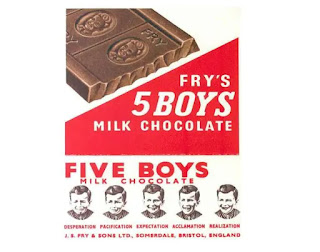
Courtesy disallows any discussion over the pros and cons of US versus UK in this confection, the age-old Hershey versus Cadbury, perhaps now academic that Cadbury, for chrissakes, are owned by the cheese paste magnate, Kraft. (The answer, by the way, is neither, my taste erring towards dark and interesting, the continental "plain" chocolate that actually bears some acquaintance with the cocoa bean.) So, with no further ado, here's a selection box of choccy treats, which I will deliver in the form of the once mighty Fry's Five Boys bar. This was a childhood treat in, admittedly, simpler times, a thin bar comprising 5 segments, each with a different boy at the different 5 stages of engagement therewith. Entitled Desperation, Pacification, Expectation, Acclamation and Realisation, the classic stages of how to bribe a small child. Once the most recognised bar in the world, it was launched in 1902, surviving until the late '70s, by which time it had become desperately low key and old hat. 

Desperation:

I Like Chocolate/Johnny and the Raindrops

Has anyone actually heard this monster before? Uncertain quite as to which demographic it was aimed toward, nonetheless it is so gallingly sickly as to deserve a place here. Johnny and the Raindrops, who "have been making music for children and their grown-ups since 2008", that quote giving away the game that they are in that small selection of bands for pre-school kids, like Australia's more famous Wiggles. (I'd love to say like They Might Be Giants, but I am aware their fans now come also in long trousers and are fiercely protective of the band and their oeuvre.)

Pacification:

Chocolate/Tindersticks

An unusual piece from the Tindersticks canon. Unusual, in that it is spoken word, spoken with a voice that sounds normal and unmannered. The singing style of the vocalist, Stuart Staples, is not always so, with one of the, let's say, more curious timbres out there. Don't get me wrong, I adore the band, and his odd vocal style is a big part of that, this song somehow diminishing him a little, making him sound just a normal lad from Nottingham. The backing remains, of course, exquisitely characteristic, a mix twixt David Lynch soundtrack and european art-house film music. It is a long track; please bear with it. If you can't, well, skip to the end. With luck you will then want to hear the whole thing.

Expectation:

Chocolate Girl/Deacon Blue

The song that first endeared me to this ongoing Scottish institution. A terrific song from their debut album, the mere act of adding some sublime pedal steels ensured my interest and attention. I have written about them before, my belief maintained that their first work was their best, further albums never quite having quite the same hooks. But they play on, fairly big hitters, still, on the bigger UK indoor venue circuit: indeed, I caught them, if briefly, playing at  festival just this last summer. With a largely all the hits show, they had the audience lapping it all out of their hands. And, sure, they played this.

Acclamation:

Chocolate Drops/Iggy Pop

A newer song, slightly, one of the highpoint of Mr Osterberg's 5 year old opus, Post Pop Depression. I like it, he coming on all over like a cross between his old mucker, David Bowie, and Mark Lanegan, the thoughtful use of chimes in the percussion department always a mood lifter in my house. It has intriguing lyrics, Pop's own, added to a riff album producer Josh Homme had had lying around for some few years. Basically a variation on the Monty Python song about looking on the bright side, here Pop muses on how, as you sink to the bottom, you become the top of that trajectory, inviting the then corollary that the brown stuff accumulating there might then become chocolate drops. Enticing stuff, eh? But it is a lovely little tune so, with that positivity in mind, who is to say the yellow snow isn't honey?

Realisation:

More Songs About Chocolate and Girls/The Undertones

I'm not sure whether this was written as a response to the Talking Heads' worthy sounding album, More Songs About Buildings and Food; I should check. (A: It came two years later and both bands were on the same label, so it seems a reasonable supposition.) No clever allegorical verbiage here, just a dumb yet smart ode to the simple pleasures of, um, chocolate and girls, sung in Feargal Sharkey's unmistakeable wobbly warble. At the end of this or any day, I am not sure if any of the greatest philosophers could put it better:

"Sit down, relax and cancel all other engagements
It’s never too late to enjoy dumb entertainment"

So, there you have it, 5 boys worth of chocolate. Before I finish, however, let me share with you the delight of discovery as to what the Scots Gaelic for candy turns out to be, sweeties being so integral in Scottish life and dentistry..... (Hint: try saying 'suiteas' aloud. And 'seòclaid' isn't heaven a million miles away, either!)


Friday, May 21, 2021

Head: Talking Heads


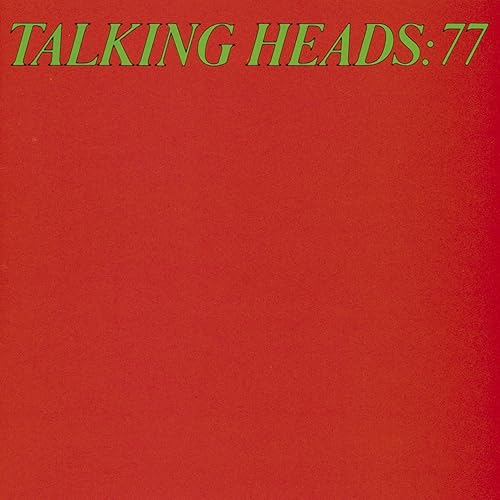
purchase [ Talking Heads:77 ]


It hasn't been easy finding a Talking Heads song that has not appeared on SMM before. A veritable Who's Who of SMM contributors over the years have brought them into play for topics from "Shadows", "Government", "Nonsense", "Tricky Beats", "Civics Lessons" and "Speak/Talk". There's more, but this kind of encapsulates a lot of what Talking Heads embodies: songs about tricky, shadowy government nonsense.

Figuring it's been too long since we visited them here, I took off from a comment that Jordan Becker raised not too long ago about one of his greatest musicial regrets: opting for a campus Springsteen concert in place of the Talking Heads back in '78. I might have done the same.

Jordan and I were both campus radio DJs (myself a few years earlier/older, at a time when the Talking Heads were not well-known but might have been found on campus radios across the US)

Drummer Chris Frantz (husband of bassist Tina Weymouth) notes in a bio that David Bryne was not easy to work with in a number of ways- often taking credit for work that wasn't exactly his to claim. I think you would have to agree that to many people he comes across as ...quirky. But that is part of the enduring value. Among Byrne's criticisms (of bandmates, the world, the way things are ...) was the fact that Weymouth, who had taken up the bass only a year before their first album  was developing too slowly/holding them back. Several critics note that it is her experimenting as she develops a personal style that adds to the quirkiness of their songs. 

I recently brought up the importance of lyrics (yes: Townshend; no: Fleetwood Mac), an area where Talking Heads shines. Check 'em out again for this one. Come to your own conclusions about the true meaning:


Incidentally, I mentioned this not too long back, but repeat: Byrne produces a provocative monthly music file that you can subscribe to:

David Byrne Radio  informative and eclectic every month


Oh! And of course:


Sunday, February 28, 2021

MR/MS : JONES

Have you ever realised how many Jones's there are in music. And I don't mean performers, I mean in the material. Is it the commonest surname in song? (Answer: Possibly. Unless Mr and Mrs Postman of Poughkeepsie beg to differ.) So why is that, do you think? Is it because of the pervasive influence of the Welsh, creeping into all our genepools? Extensive research (wikipedia) tells me that, after Smith, Jones is one of the seven commonest names in the US and, again after Smith, the second commonest name in the UK. Plus it's short, it's anonymous by virtue of its ubiquity and it rhymes with bones. (I made that bit up. I mean, sure, it does rhyme with bones, but that may not be the reason for the popularity. But consider the possibility.)


Let's agree the above is the best Jones, a song I have adored these long 18 years since it became a staple on any mixtape song selection I have ever made. A glorious riot of teenage dreams for stardom, it is a true story. Or, at any rate, Mr Jones, singer Adam Duritz's buddy Marty Jones, and he did spend a night at the New Amsterdam, getting drunk and imagining how, if they were famous, they would get the girls they could only ogle. Funny thing fate, as, courtesy the song, Mr Duritz did become a big big star. As for Marty Jones, did he ever become someone just a little more funky? Sadly, that much I don't know.

So, back to Adam Duritz, and his wanting to be Bob Dylan. The Bob Dylan, above, I'm assuming, at peak mystique. As a boy I was, obviously, familiar with all the early hit singles, and bought Greatest Hits, an early step in my obsession with recorded music, and I remember two songs standing out in particular. Firstly, Rainy Day Women #12 & 35, because it was such utter shite, beyond the hey man, he said stoned schtick, and Ballad of a Thin Man, because it was just so damned cool. My views haven't changed, and the chunk out the vinyl just around track side 2 track 5 confirms that, it being the UK version, trainspotters, as well as revealing that Ballad of a Thin Man wasn't actually on the record. But you catch my drift.


When Mr Jones recovers from the shock of seeing his paramour in flagrante, he realises it was time to get him some cool. So off he shuffles, tail between his legs, possibly to the New Amsterdam, with the aim of smartening up his act. And, boy, can he shake his stuff. David Byrne could have been an archetypical Mr Jones, himself, almost the antithesis of hip, all nerdy shirts and mannerisms, yet somehow transcending all that and being just that figure he lampoons, but, hey, after all, "he is not so square". And that feisty arrangement, years before it became the thing, something to relish and wonder.


Mind you, it hadn't always been like that. Little did all those hipsters and hepcats know, but Mr Jones had a further backstory, the stuff of tragedy. Tragedy was, of course, de rigeur for the early Bee Gees, as their stage wear above demonstrates. (Nope, I'm not going to make a joke or insert a glib clip to any of their later work.) No wonder he had developed a little problem.....


That's right, too clever by half, here the neat insertion of a 'Jones' meaning a habit. OK, the lyrics aren't so subtle, but the song is OK in a non-threatening way, but it at least enable me to share my learning. So, if you have a 'jones' for something, we all know it is lifted from junkie slang for their fix, but, similarly, having a 'yen' for something comes from the exact same territory, 'yen' being a corruption of yan, meaning a craving, usually for opium. Well, I didn't know that.


So it's about time something turned good for our titular friend. So what better than a night out with the delightful Ms Winehouse. And before you smart alecs tell me she actually had quite a yen for a jones, it apparently refers to her, um, alleged friendship with the rapper Nas. (Actually me neither.) It isn't a bad song, even if it leads you into expecting something a bit more like this.


Finally, and to draw to a close the long and sorry saga of Jones esquire, and it's a rum old do, suggesting all sorts of shenanigans. I'm not too sure quite what Richard Butler, the lead Fur was thinking about here, but it seems, as fiction becomes fact and facts become fun, it refers to a real life Mr Jones. Sad, but true, my little scenario thus far is based upon little more than my fevered imagination. But Butler's Mr Jones, and possibly even Mrs Jones, refers to one David Jones. This one. I like to imagine all the Mr Jones' might also be. Try it.


Monday, November 16, 2020

Joe: Joey


Concrete Blonde: Joey
[purchase] 

One of the things that made Joe Biden a compelling candidate (other than the fact that most people look good by comparison to the lame-duck president) is the way he appears to relate to his family. Clearly, so much of Biden’s life was shaped by the tragic loss of his wife and child, and his attempts to continue to be there for them as a single father trying to make his way in the Senate. And we’ve heard about his second marriage, his support of one son through addiction and other personal issues, and having to watch another child die. . His sister is his closest political advisor, who ran all of his campaigns until this last one. Not to mention his relationship with his grandchildren, who he claims to call or text every day. There’s a genuineness to all of this, which again contrasts with the man he beat handily, whose children seem to be more like junior business associates, and whose third wife regularly slaps his hand away. 

Much of this can be explained, I think, by the relationship that the men had with their fathers. Mary Trump has described her grandfather (and the two-time popular vote loser’s father) in very cruel terms, and as a man who forced his children to fight for his affection and money. (He also was charged more than once with racist practices in his business and was arrested outside a Klan rally. We report. You decide). 

Biden, on the other hand, had a close, friendly relationship with his namesake father, who appeared to instill in his son respect for others, personal humility, and a resilient personality, but most of all, a belief that family is paramount. Hearing Biden speak over the past few months, it is clear that he’s no communicator in the way that President Obama was, but he does display an “everyman” charm, and an empathy that has been lacking in our president since the current impeached resident of the White House was sworn in before a small crowd. Biden often refers to his father, and wisdom that Joe, Sr. imparted to him, and he often starts these anecdotes by quoting his father calling him “Joey.” (You knew we’d get there eventually, right?) Which makes sense, in a family with two Joes. In fact, last summer, Jill Biden released a children’s book about her husband’s childhood, called Joey. 

The featured song, “Joey” is, for most of us, the only song by Concrete Blonde that we know, and it was released in 1990 on the band’s third album, Bloodletting. Written by singer Johnette Napolitano, it was the group's biggest hit, topping Billboard’s Modern Rock Tracks chart for four weeks and hitting number 19 on the Billboard Hot 100. The song is about being in love with an alcoholic, who Napolitano eventually revealed to be Marc Moreland of Wall of Voodoo. 

Formed in 1982 as Dream 6, and renamed at the suggestion of Michael Stipe after signing to IRS Records, the band failed to achieve much success after “Joey,” broke up in 1993, and has had occasional reunions over the years. Napolitano has released albums as a solo act and with other artists, and was even part of the Heads, a project with the members of Talking Heads, without David Byrne, which fizzled out after the requisite litigation. 

Joe Biden ran for president in 1998, with little success, dropping out after a series of plagiarism allegations, briefly tried again in 2008, but was overshadowed by Hillary Clinton and Barack Obama, and was asked to join Obama’s ticket in 2008, becoming Vice-President. He chose not to run in 2016, in part because of the death of his son Beau, and in part, I think, because there was a feeling that it was time for a woman to be president (which it was, and should have been). Biden has admitted regretting that decision. I have to admit that I thought that Biden’s dream of becoming President was over, and that someone younger would end up running in 2020. So, I was wrong. As it turned out, Biden’s message of empathy, competence, calmness and bipartisanship struck a nerve, and he won with an enormous margin in the popular vote, and a significant margin in the stupid Electoral College (winning a few states, though, by a slim margin). 

So, maybe Concrete Blonde has another comeback in them. Just ask Joey.

Monday, November 2, 2020

Hidden Places: Don’t Worry About The Government


Talking Heads: Don’t Worry About The Government
[purchase] 

I am sooooooo worried about the government. 

Four years ago, relying on pretty much every polling expert and pundit, and the clearly misguided belief that there was no chance in hell that my beloved country would elect a racist, sexist, selfish, pathological liar with no empathy, no interest in, or knowledge of, how the government works, and who would spend his time in office doing everything possible to enrich himself and his family, attempt to destroy any sense that the government was fair and cared about its citizens while fanning every sort of division and harping on imagined grievances, I was feeling pretty good as Election Day approached. Sure, I was surprised at the popularity that Trump seemed to be garnering, but I felt secure that we’d be electing a smart, caring woman who had devoted her life to public service. And I was comfortable that under Hillary Clinton, our country would continue bending the arc, if slowly due to the obstructionism of people like Mitch McConnell, toward a more fair and just future. 

Boy, was I wrong. 

And that’s why today, I sit in front of my computer, days before Election Day, facing the real prospect that Trump will be re-elected, whether fairly, or, more likely, due to the distortion of the Electoral College, or through fraud, and interference by sycophantic judges. Or some combination of them both. I’ve been voting in presidential elections since 1980, and never before have I had to consider that one candidate has refused to admit that he will leave the White House if he loses, or that one candidate has spent months trying to sow confusion by lying about the voting process, or that one candidate’s supporters actually have surrounded a campaign bus to prevent an appearance, or that one party has discussed ways to appoint electors contrary to the popular vote, or that there might be actual violence after the election, and on and on. 

I’m worried that even if Trump loses, he and his power hungry minions have created a playbook for future authoritarians to follow, because he’s exposed all of the ways that the Constitution and laws can be ignored, perverted or interpreted to lead to strong-man rule, when some or all of Congress and the Supreme Court is willing to roll over and not protect their prerogatives or perform oversight. And I’m worried that if he wins, with no concern about re-election, and with a compliant court system, that the march toward authoritarianism and kleptocracy and racism will continue unabated. 

I’m worried that the damage that Trump has already done will take years, even generations, to fix, and that a second term might be an existential threat to our democracy. 

And I’m worried about what I’m going to do in my spare time instead of deleting the hundreds of emails that I’ve been getting daily from Jaime Harrison. 

Like many of us, I think, to distract from this, compounded, of course, by the raging pandemic that this administration has failed to seriously try to combat, I’ve turned to television, even more than in the past, and last Friday, my wife and I watched David Byrne’s American Utopia on HBO. It’s a filmed version of the Broadway show, directed by Spike Lee, and it was great. I won’t get into the obvious comparisons between American Utopia and Stop Making Sense, considered by many to be one of the greatest music films of all time (which my then-future wife and I saw in an actual theater, on 57th Street in New York when it came out in 1984), or between it and the filmed version of Hamilton that recently ran on Disney+. If you’re interested in such comparisons, you have the same Google that I have…. (OK, here's one.)

American Utopia is a collection of songs, some from Talking Heads, some from Byrne’s solo and collaborative works, and a couple of covers, all performed by a talented group of musicians, singers and dancers, on a bare stage, all wearing essentially identical gray suits (of normal size) and no shoes, with some personal and political commentary by Byrne. For the most part, the songs are great (the Talking Heads songs tend to get the best reaction from the audience), the performances tight, and the choreography interesting and mesmerizing. And there’s a joy about the performances that is infectious. 

One of the older Talking Heads songs in the show is “Don’t Worry About The Government,” from the band’s first album, which is written from the point of view of a person (who some people believe is a government official) discussing his simple, comfortable, happy life. And it fits our “Hidden Places” theme when Byrne sings: 

I see the states across this big nation
I see the laws made in Washington, D.C
I think of the ones I consider my favorites
I think of the people that are working for me

Some civil servants are just like my loved ones
They work so hard and they try to be strong
I'm a lucky guy to live in my building
They own the buildings to help them along 

Almost every article that I read before writing this piece referred to the lyrics of this song as “ironic” or “sarcastic.” But here’s what Byrne himself said about the song, in an interview from 2019, before American Utopia opened on Broadway: 

It’s funny. When Talking Heads originally did that song, it was a song about living in a nice condo with modern conveniences and good plumbing and no cockroaches. It became the opposite of what everybody was doing in the folk scene at that moment. Everybody was snarling and angry, and this was a young guy who just wanted to live in a nice apartment! Everybody thought I was being ironic with the song because of the lyrics and the context. But I think people will see a certain truth to it now. It’s not a great virtue living in an apartment filled with cockroaches. You don’t have to have a penthouse, but people want to have a decent life. Everyone can accept that in some way. It’ll be seen and understood in another way with the passage of time. 

I’m hoping that, in a short time, I can stop worrying about the government every day, and that we can get back to the days when civil servants do their work, and people in government work for us.

Wednesday, August 26, 2020

Counting/Count: 12345678910

Human Sexual Response: 12345678910 
[purchase] 

Did I ever see Human Sexual Response live? Did I interview them at WPRB? I have no memory of doing so, but there’s also a good chance that I did one or both of those things, because they performed at City Gardens in Trenton during my time at WPRB. 

I do remember playing their music on the radio pretty often, initially “Jackie Onassis” from their debut, Fig. 14 (where they rhymed “Onassis” with “sunglasses”), but there were a bunch of other good songs on that record. And their second disc, “In a Roman Mood” might have been better, with the highlight being “Land of the Glass Pinecones” a true earworm if ever there was one. (Note—the Allmusic biography of the band refers to this album as “a comparatively dour affair, loaded down with art rock pretensions and lifeless arrangements,” but the same site’s review of the album itself says that it is an “extraordinary album.” Who to believe? Me.) 

If you’ve never heard the band, try to track them down. Think a mix of Talking Heads, B-52s, and fellow Boston-area band Mission of Burma (but not really like any of them), often with sexually related lyrics, befitting a band named after the famous Masters and Johnson book. One of the good non-“Glass Pinecones” songs on the album is “12345678910” which, I think, is another sex-related song, but I’ve read the lyrics a bunch of times and can’t really be sure what it is about exactly. So, I’ll just let you decide. (Too bad that the song wasn’t on Midnight Oil’s album, 10, 9, 8, 7, 6, 5, 4, 3, 2, 1). 

Despite generally good reviews and reportedly great live performances (which makes me think that I would have remembered seeing them), the band broke up after the second album. One member left music and went to work for Sun Microsystems. Most of the other members joined different bands, sometimes together, sometimes not, and one of the band members, Dini Lamot, became a drag performer. They have reunited for the occasional show, most recently in 2017. Here’s a video of our featured song from that show, and it looks like fun.

Friday, June 22, 2018

Speak/Talk: Talking Heads Burning Down the House


purchase [ Speaking in Tongues ]

It seemed such a no-brainer to include Talking Heads Speaking in Tongues that I feared it had already been done here. It's been done lots of other places, but I'll bring it back from wherever in history it's been lurking for you. We're talking about 1983 here.

To start, I browsed the entire archive of Star Maker posts related to the Talking Heads over the years (of which there are about 20) and don't see that anyone has ever picked this one up.

Curiously, the Wiki tells us that Burning Down the House was their "lone top ten single on the US Billboard Hot 100." Me? I loved them and I still follow David Byrne through his mailing list/blog at http://davidbyrne.com/connect

Just about every one of their albums "went gold", so that's nothing to scoff at, and there's no denying that especially Tina Weymouth and David Byrne have written their names in the pantheon of modern music greats.

You are aware of course that their vocal style is pretty heavily built on talking imposed over a funky/new wave instrumental composition. Burning Down the House is no exception. The line itself apparently comes from a common audience chant of those years, which the band adopted/converted to their use.

And then there's the Tom Jones/Cardigans rendition of the same. One of his better outputs (unless you want to count Delilah!)


Friday, March 23, 2018

Women: The Ideal Woman


Adrian Belew: The Ideal Woman
[purchase]

To some extent, this is a tricky theme for a blog that currently appears to have only male writers. In light of years of feminists correctly clamoring to end objectification of women, and in the immediate post #MeToo era, stuff that we used to take for granted is, properly, subject to stricter scrutiny. These days, what one says, or does, to or with or about a woman could be damaging, and for the most part, I have to say, the additional care and thought is a good thing. Of course, if you can pay for a nondisclosure agreement, you can get away with misbehavior.

Maybe.

So, after nearly two weeks of scanning my library for a theme-appropriate song, why did I finally land on Adrian Belew’s “The Ideal Woman,” a song that is clearly an objectification of women? Part of it, of course, is that the song is from 1983, which doesn’t sound like it was so long ago, but both of my kids are now older than I was in that year, so maybe it was a long time ago. And because times have changed significantly since then, although there’s still all sorts of misogyny and objectification in the music world. Part of it, too, is that I really like Adrian Belew, having written about his solo work, his time with King Crimson and his work with Talking Heads. (Although I’ve sort of lost track of his career in recent years.) In addition to his music, I think he also has a sense of humor, and it seems like this song is more than a little tongue in cheek.

I have to believe that all of us have some idea of what an ideal partner would be. It was not too long ago that I would have written that sentence using the phrase “opposite sex,” but you can’t have Smithies in your family, or spend as much time at the Athena Film Festival as I have, without learning that the phrase is really useless. Maybe you’re not as specific in your specifications as Belew is in the song, and even he gives himself some leeway, at least with height—he waffles between 5’6,” 5’8” and 5’9”—and there are some contradictions—he wants a woman both independent and controllable, whatever that means. But definitely blonde. As someone whose ideal woman is many of these things (including beautiful, independent and blonde, but not all of them--she's 5'10"), maybe that’s what drew me to the song.

Friday, September 1, 2017

Shadows: Shadows In The Rain

 
Sting: Shadows In The Rain (studio version)
[purchase]

For those who remember 2012, I mentioned in a post that one of the first dates I went on with my now wife was to see the movie Bring On The Night, which was the Michael Apted-directed documentary about the creation of Sting’s first solo album The Dream of the Blue Turtles and the subsequent tour. We loved the movie, and I still have fond memories of seeing it, both because of the film and my date.

I enjoy learning about how music is created, probably because my love of music is not coupled with any real ability to make it. I’m jealous of those who can, so this movie was right up my alley. I was also a big Police fan and had heard, and liked, The Dream of the Blue Turtles. I know that Sting has gotten a reputation for arrogance and pretension over the years, but as someone who likes the often pretentious prog rock, it didn’t bother me that for his first solo album, Sting tried to move beyond the reggae flavors of the Police and try to push the boundaries a bit. As a brief aside, I had the chance to briefly interview Sting the summer before my senior year in college, backstage at an outdoor concert at Liberty Bell Race Track in Philadelphia. He was extremely genial and answered all my probably dumb questions, and readily recorded a station ID that we ran regularly — Stewart Copeland, on the other hand, had to be shamed into even doing a station ID for us. But he did two. You can hear them here.

In addition to wanting to expand his musical palette (which the Police had begun to do as time went on), Sting decided that his band wouldn’t be The Police Mark II (or III, for those few Henry Padovani fans out there), and instead chose young, hotshot jazz musicians. This isn’t as strange as it sounds — Sting’s earliest gigs were playing jazz and fusion music in Newcastle during his free time during college and while working as a teacher. Here's a jazzy tune from Sting's last pre-Police band, Last Exit—the melody of which was used in Blue Turtles' "We Work the Black Seam."

The people that he chose were all extraordinary musicians. Keyboard master Kenny Kirkland had played with Wynton Marsalis, bass player Daryl Jones had been in Miles Davis’ band, and Branford Marsalis, on sax, had been in Art Blakey’s Jazz Messengers, and played with his brother Wynton, Herbie Hancock and Dizzy Gillespie. Drummer Omar Hakim, who was in Weather Report (with Mino Cinélu), was the only member with significant rock credits, having backed Carly Simon, David Bowie and Dire Straits. In addition, Sting brought on veteran backup singers Janice Pendarvis (who was in another of my favorite documentaries, 20 Feet From Stardom) and Dolette McDonald (who worked with the Talking Heads, but was not in another of my favorite music films, Stop Making Sense, or on my favorite Talking Heads album).

The film shows how this mostly non-rock band fused with Sting to create a sound that was still identifiably rock, but had some elements of jazz. Maybe the easiest way to see what Sting was after is to compare the original Police version of “Shadows In The Rain,” a somewhat meandering, spooky dub track, with the studio version from Blue Turtles, which was reportedly based on the original demo that Sting wrote. Amusingly beginning with Marsalis asking frantically what key the song is in over a funky Hakim groove, a harsh voiced Sting enters, and the song turns into an exuberant, upbeat soulful and jazzy tune with solos from Kirkland and Marsalis.

Part of the tension in Bring On The Night, beyond the question of whether the whole concept would work, is that the band was scheduled to play some live shows on little rehearsal. As you can see from the video above, they had no problem with the performance, and the exuberance of the album track is even more apparent.

Another part of the tension in the movie is that it shows, in pretty graphic detail, the birth of Sting and wife Trudy Styler’s son Jake, who is now this guy.

Thursday, May 4, 2017

Songs From Movies About Musicians: Girlfriend is Better

Talking Heads (from Stop Making Sense): Girlfriend is Better

[purchase CD]

[purchase DVD]

Director Jonathan Demme died last week, so it is only fitting that we include him in this theme. Demme could almost be the subject of his own theme here. He directed fictional films such as Something Wild, which made brilliant use of music. Bruce Springsteen won an Oscar for his song from Demme’s film Philadelphia. Demme also made music videos. But here I turn my attention to another form that Demme excelled in: the concert film.

Talking Heads and their leader David Byrne were great subjects for Jonathan Demme. The band came together in art school, and they always had a strong visual sense. Early in the movie, we see David Byrne in normal clothing. He looks skinny, almost emaciated, but man can he move! Girlfriend is Better is a dramatic moment in the film, because it is our first glimpse of the big suit. Demme shows it to us first in the form of a menacing shadow, and then lets us see the man casting the shadow. Suddenly, David Byrne is transformed into something other. When I saw the film in 1984, I did not know that Byrne was on the autistic spectrum, and if I had known, I would not have understood at the time. Now I know that people on the spectrum often feel that they are “other”, that they don’t quite fit in with a neurotypical society. They do however have much of value to contribute. To me now, the arrival of the big suit in the movie is a great visual expression of all of this.

I don’t want it to sound like the movie Stop Making Sense is some kind of manifesto. Taken as a whole, the movie is first of all a record of a great show. Beyond that, it is also a generous film that makes time not just for the music of Talking Heads, but also for spotlights on solo projects by members of the band, including Tina Weymouth and Chris Franz’ side project the Tom Tom Club. Even when David Byrne is on stage, Jonathan Demme’s camera finds other permanent and guest members of the band, and lets us get to know them through their performances. There was talk in the music press at the time of strains in the band, but the film shows a large group that knew how to be in perfect synch for their performances.

Friday, January 6, 2017

In Memoriam: Some Overshadowed 2016 Losses


In a year in which we lost David Bowie, Prince, Merle Haggard, two thirds of ELP, Paul Kantner, George Michael, Leonard Cohen, Maurice White, George Martin, Glenn Frey, Sharon Jones, and Mose Allison, to name just a very few (most of whom are still available as subjects for this theme, hint, hint), it is not surprising that some deaths during 2016 were overshadowed by bigger names. Here are a few that you may have missed:

Fred Tomlinson: Tomlinson wrote much of the music that added to the lunacy of Monty Python’s Flying Circus and other British shows, and as leader of the Fred Tomlinson singers, performed a good deal of it. If he did nothing else but write the music for “The Lumberjack Song” and lead the Vikings in singing “Spam,” he’d deserve lionization, but he did much more.

[purchase the complete Monty Python series]

Dave Swarbrick and Pete Zorn: I was introduced to both of these musicians due to their connection to Richard Thompson. Swarbrick was best known as a fiddler, and was a member of Fairport Convention, remaining as a member after Thompson left, playing numerous instruments, singing and writing songs. He also contributed to many albums by Thompson and other members of the extended Fairport circle and performed as a solo artist and in various combinations. Check out this footage of him wailing on the fiddle, and singing, with Fairport Convention live in 1970.


Pete Zorn was an American multi-instrumentalist who played with Thompson live and on record, as well as other bands, often in the same English folk world as Swarbrick, and it does seem that they crossed paths. Zorn was Gerry Rafferty’s first choice to play the sax solo in “Baker Street,” but was unavailable; instead Raphael Ravenscroft got the gig. I remember seeing Zorn play with Thompson and handling many stringed and woodwind instruments, including the bass flute. Here he is, singing and playing sax on Thompson’s “Tear Stained Letter.”

[purchase Richard Thompson’s Hand of Kindness, featuring Zorn]
[purchase Fairport Convention’s Liege & Lief]

Gilli Smyth: The co-founder of Gong, with her partner and collaborator Daevid Allen (who died last year), Smyth was a musician, poet, writer and activist. Her contributions to Gong (where she was sometimes billed as Shakti Yoni), and the spin off collections that sprung up over the years, were eccentric, provocative and always interesting. You can get a sense of her "space whispering" performing style, and that of Gong, in this performance from 1973 of “Witch's Song, I Am Your Pussy.”

[purchase Gong’s Flying Teapot]

Bernie Worrell: O.K., enough with the Brits. Worrell, a New Jersey native, was a classically trained pianist who gained fame (and entry to the Rock & Roll Hall of Fame) playing funk with Parliament/Funkadelic in the 1970s. I really began to appreciate Worrell when he joined the expanded Talking Heads. After that, he continued to play with a wide variety of musicians, and as a leader of his own group. Here he is, featured in the introduction and throughout the live performance of “Life During Wartime” from Stop Making Sense.

[purchase the DVD of Stop Making Sense]

Sunday, December 27, 2015

In Memoriam: Stephen R. Johnson


Anyone who reads my stuff would probably have bet on an In Memoriam post about the late Daevid Allen, of Soft Machine and Gong, who died on March 13, 2015. But I’ve already written about him here, and decided to look in a different direction--Stephen R. Johnson, one of the most important people in music history that you have never heard of, who died back on January 26, 2015.

If you are a person who came of age watching MTV when it still played music videos, and someone asked you what the most memorable video was, there’s a pretty good chance that you would say, “Sledgehammer,” by Peter Gabriel. And, considering that the video won a still unsurpassed 9 MTV Video Awards, and was the most played video on the channel, it is fair to say that it changed people’s perceptions of what a music video could be. The song is great and moved Peter Gabriel’s solo career from a prog-rock niche into mass popularity, but the video was what made it stick in our minds. It was directed by Stephen R. Johnson.

The animation was done, in part, by Aardman Animations, which went on to create Wallace and Gromit, and the production of the clip required that Gabriel remain under a glass sheet for 16 hours. I’m really not a huge fan of music videos, but this one was special, and still holds up. Johnson also directed similarly wild videos for Gabriel’s “Big Time” and “Steam,” which won a Grammy. He also directed the video for Talking Heads’ “Road To Nowhere,” and Dire Straits’ “Walk of Life” (which, at Mark Knopfler's direction, included sports footage and no shots of his large-nosed profile), received an Emmy nomination for directing the first season of Pee-Wee’s Playhouse, and did work for Amnesty International.

Johnson was born July 12, 1952, in Paola, Kansas and attended college at Kansas University and the University of Southern California, where he created an award-winning movie using the stop-motion technique that he would use in many of his music videos. His first music video was an awful one for an awful 80’s band called Combonation, redeemed only by an appearance by a pre-stardom Robin Wright, and the fact that a guy in the video is wearing a Mets hat. From that humble beginning, his career went on a rapid upswing to the heights of “Sledgehammer.”

Unfortunately, Johnson passed away, too young, on January 26, 2015, of what was described as “cardiac complications.”

Thursday, December 3, 2015

Leftovers: It's Elemental/Once In A Lifetime


purchase [Once In A Lifetime]

The Element: Water redux

I really thought Retropath was headed down the right path when he started out to list the entire table of elements. I was seriously looking forward to the full 118.

Then again, considering the amount of time and energy involved in his somewhat quixotic endeavor, I was more inclined to simply complete the table of medieval elements along the lines of what J. David referred to.

Back at the time of the “It's Elemental” theme, I posted Hot Tuna's "Water Song" (Which I have since learned to play!). Without making distinction on the theme of the element of water - since the two songs are in rather different musical categories, I now realize I might well have posted Talking Heads' “Once In a Lifetime”.

For almost a decade, back in the 90s, I collected and re-re-listened to David Byrne and the band. I later relished Clap Your Hands Say Yeah, and Arcade Fire (although I haven’t seen anyone else group them with Talking Heads, I think so) as re-incarnations of the Talking Heads’ genre.


Still, Talking Heads would still take my category prize as the elemental band of its style. And critical to that catalogue would be “Once In a Lifetime” – not least for its relevance to “Plato and Aristotle’s” Elements: there's water running all the way through in its original MTV version here:


Tuesday, July 28, 2015

It’s Elemental: King’s Lead Hat


Brian Eno: King’s Lead Hat
[purchase]

If you only think of Brian Eno as the guy who does those long, ambient pieces, let me introduce you to the rocking “King’s Lead Hat.” During the mid-1970s, Eno first entered the world of popular music as the synthesizer player for Roxy Music, quit the band, and then released four remarkable solo albums that mixed rock, electronic music, jazz and experimental sounds in a way that was, if not groundbreaking, was pretty damn cool. At the same time, he began to experiment with various techniques that led to the release of his ambient music, and released a series of such albums, including the legendary Music For Airports.

Before and After Science was the last of the rock-oriented albums from this period, released in 1977, and it includes ambient pieces, silly ditties, and a few rockers, none more aggressively so than “King’s Lead Hat.” Reportedly recorded, but lacking lyrics and a title, before Eno and John Cale saw an up and coming band, Talking Heads, at CBGB in New York, Eno gave the song a title that was an anagram for Talking Heads and wrote a bunch of lyrics around the title which either make no sense or are brilliant. Or both. Many Eno lyrics seem to use words more for their sound than as a vehicle for imparting meaning (like, say, this one), or to create vivid imagery. There may well be some sexual references in the lyrics of “King’s Lead Hat.” Or not.

What is clear, though, is that the music was way ahead of its time. You can certainly hear some Talking Heads in the jittery, New-Wavy sound, but you can also hear precursors of what the Talking Heads would sound like a few years later, when Eno began to produce them. And you can hear the roots of the synthesizer based pop music, that would become popular in the late 1970s and early 1980s, starting with Gary Numan and exploding from there.

Not surprisingly, I had never heard Eno on the radio before working at WPRB starting in 1979, and his music was treated there with incredible reverence. We even had a show one evening, named in honor of his earlier, somewhat more experimental album, Another Green World, for music that fit into that genre of experimental, electronic, OK, I’ll say it—weird--music. One night, my friend Bill and I took over the show for a “performance” that you can read about in more detail here, along with a bunch more of my college radio reminiscences. Considering Eno’s involvement with the Portsmouth Sinfonia, an orchestra that admitted only players who were either non-musicians, or were playing an unfamiliar instrument (Eno played clarinet), I suspect he would have been fine with my “performance.”

With the perspective of years, there are times that I think that some of the Eno worship is a bit over the top, but you can’t deny that he has produced some of the best and most popular albums ever, has made music that has influenced generations of musicians in numerous genres. And, I still enjoy his music.

Thursday, May 29, 2014

Side Projects: Talking Heads ‘81 Edition

David Byrne: Eyes Wide Open

[purchase]

Tom Tom Club: Genius of Love

[purchase]

Jerry Harrison: Slink

[purchase]

What is a side project? How is it different from a solo album? In choosing a song for this week‘s theme, I have wrestled with these questions. In mind, the difference is intent. Here I present three side projects related to the Talking Heads, all from 1981. Each, as I will explain, qualifies as a side project for different reasons.

1981 was a scary year for Talking Heads fans like myself. We now know that some of the band’s best work was still in the future, but it looked at the time like the band might break up. Officially, they were on hiatus, but we have all heard that before, and many bands do not survive it. Talking Heads did, but the year also produced some great music while they were apart.

David Byrne was the most prolific. My Life in the Bush of Ghosts was a collaboration with Brian Eno, and it would prove to be a study of African rhythms in preparation for the next Talking Heads album, Remain in Light. But Byrne also released a second album that year. The Catherine Wheel was a commission for the Twyla Tharp Dance Company. Byrne and Tharp were a couple for a brief time that year, and Byrne created a set of songs specifically intended for the dance. I was lucky to find a video of one of Twyla Tharp’s dances from this work.

Chris Franz and Tina Weymouth decided to use their time off from Talking Heads to have some fun. They gathered some musical family and friends and formed what was intended to be a one-shot project, the Tom Tom Club. This turned out to be the most popular of the Heads related projects of 1981. Genius of Love and Wordy Rappinghood were hits, and the Tom Tom Club’s label wanted a follow-up two years later. Franz and Weymouth would then go back to Tom Tom Club when Talking Heads finally did break up for good.

Jerry Harrison was interested in exploring what could be done in a recording studio. The Red and the Black features a large cast of musicians, many of whom would be featured in later Talking Heads albums. Harrison used layered multiple instruments and vocals to create a dense but funky soundscape. There would be two more Harrison solo albums in later years, but The Red and the Black is probably more important for laying the groundwork for the producing career that Harrison has enjoyed since the break up of Talking Heads.

Monday, January 27, 2014

Gravity: Top 5 Gravity Tunes of the Indie 80's


In the 1980's most indie rockers didn't dwell on love songs. To truly provide an alternative to the crap on mainstream radio, they had to sing songs about rain, the elements of earth, wind and fire... and gravity. The natural phenomenon" by which all physical bodies attract each other " was a good metaphor for the subjects of Michael Jackson and Madonna songs, but when indie rockers sang about gravity, it just sounded a whole lot more intelligent.

Here are the top 5 "Gravity" songs from the Indie 80's.

"Gravity is bringing me down..."

#5. New Zealand's Tall Dwarfs with "Gravity" from the Homestead sampler Human Music.


"Gravity blocks my screams..."

#4 Basketball Diaries memoirist Jim Carroll and his band's "Wicked Gravity" from Catholic Boy


"And Gravity don't mean a thing..."

#3. Talking Heads "I Get Wild/ Wild Gravity" from Speaking in Tongues.


"Gravity is pulling me around.."

#2. R.E.M. "Feeling Gravity's Pull" from Fables of the Reconstruction


"You can not move; you can not dance..."

#1 Pylon "Gravity" from Gyrate

Saturday, November 23, 2013

PUNCTUATION: !!!, "The Step"


!!!: "The Step"
[Purchase]

When it comes to punctuation in music, it doesn't get any more, uh, punctuated, than the band known as !!! (or, as they have come to be known by those speaking the name, since exclamation points are quite difficult to pronounce on their own: Chk Chk Chk). And in my estimation, they chose a pretty appropriate punctuation mark, since their music is usually quite emphatic. There isn't the uncertainty that would warrant ???, the to-be-continued feeling of ..., or the ambivalent wildcard-ness of ***.

In the music of !!!, the emphasis is on the edgy, post-punk funk, influenced by the music of early Talking Heads, Gang of Four, and Can, with vocals that bring to mind some of the more subdued singing of Mick Jones in Big Audio Dynamite. The song I'm featuring here today, "The Step," is from their 2001 debut album, !!! (their latest album, from earlier this year, is the cleverly titled Thr!!!er). It features a funky guitar and percussion line that could have been lifted direct from Talking Heads' incredible 1980 album, Remain in Light. But it doesn't feel like outright thievery -- more like paying tribute to their predecessors. And arriving on the scene as the first song on their first album, one might say that it was a very "punctual" -- not just "punctuational" -- tribute.