Thursday, June 14, 2012

Regional Music: Gogom Ghimili Machuka

Iveroni: Gogom Ghimili Machuka

[purchase]

The Republic of Georgia was in the headlines in 2008, and it wasn't in regards to their music. An album from Iveroni arrived in my mailbox at the very same time that Russia was aggressively invading the small, independent, pro-Western democracy to subordinate it and remove its freely elected President. I immediately put on the album and said a prayer for the refugees who were being forced to flee from their homes in the South Ossetia and Abkhazia regions.

Regardless of the tense situation in their homeland, Iveroni is a group of five young talented musicians (Roman Lashkhia, Gieorgi Chikovani, Davit Batiashvili, Davit Gogitishivili, Beka Tcertcvadze). Their instruments are the panduri, bass panduri, salamuri, and changuri. Their traditional songs emphasize vocals, and they relate stories of love, heroism, and brotherhood. Producer Nathaniel Berndt traveled to the old city of Tblisi to record Iveroni on location. Their album includes 26 different tracks that range in length from one to three minutes each. Additional liner notes would've been nice to explain more about this group, their music and traditional songs. I don’t know what the song “Gogom Ghimili Machuka” is about, but I like its mixture of vocals and instrumentation. And don’t these four guys look cool in those outfits with those Russian dirks and kindjal daggers at their side!

Back in 2008, the war with Russia left Georgia's countryside scorched by bombs and tank fire, and I wonder if Iveroni has songs that would be appropriate in such a circumstance. The war most likely put a damper on their performances. I hope that they are back out singing them now that peace has been restored to the Caucasus Mountains and Russian forces have withdrawn.

Wednesday, June 13, 2012

Regional Music: Loveless Love


Just across the river from New York City lies a small city just two square miles in size but with a musical heritage that rivals some of the biggest metropolitan areas in the US of A. Hoboken, New Jersey--the city where Elia Kazan shot Marlon Brando and Eva Marie Saint in On The Waterfront--is the birthplace of both Frank Sinatra and the polyrhythmic guitar raves of great 80's bands beginning with The Feelies and including The Bongos, The Cucumbers, The Individuals, The dB's and , of course, Yo La Tengo. They all played at Maxwell's, a dark club that can hold no more than 200 people. 


In his book Big Day Coming: Yo La Tengo And The Rise of Indie Rock, writer Jesse Jarnow says Maxwell's owner Steve Fallon really nurtured the Hoboken Sound. He gave The Bongos a place to rehearse and gave Yo La Tengo's Ira Kaplan and Georgia Hubley jobs ( as sound man and DJ respectably). Fallon has since sold the club but Maxwell's is still going strong and there is still a thriving indie rock scene in Hoboken.

Regional Music: Amairam

Malam Maman Barka: Amairam

[purchase]

From southeastern Niger, Malam Maman Barka is a teacher, musician and poet. Barka has been performing on his 2-stringed gurumi for over 20 years. The gurumi's body is a calabash shell, and its skin head comes from an iguana. While his music is deeply rooted in the traditions of the Hausa civilization, Barka has composed over 250 new pieces that document life experiences, address contemporary issues, build bridges across cultures, make political statements, and provide optimistic direction to deal with life's struggles. It's understandable how Malam Barka's captivating vocals and intriguing gurumi have built him a strong fan base among Nigerians.

While the musical ambassador has traveled internationally, this is his first album to be released outside of Niger. Accompanied by percussionist Oumarou Adamou on douma and kalongu, Barka's music is being disseminated through the efforts of the album's producer Nathaniel Berndt who collected these field recordings on location for our education and enjoyment. I may not be able to speak or understand Barka's language, but I appreciate what he's trying to accomplish as a contemporary African bard.

With the song “Amairam,” Barka is singing an ode to a woman who is “very beautiful, beautiful like a gazelle” (from the translation offered at www.beautysaloonmusic.com). The song has many beautiful and heartfelt sentiments, but the recurring theme may be best expressed as follows:

Amairam respects me,
Amairam is respectful,
Come next to me with your smile,
Come next to me with your laugh,
You have taken my spirit
Friend Amairam, darling Amairam, for the love of God trust in me

Regional Music: Gothenburg


Maia Hirasawa: Gothenburg
[purchase]

Ten years ago this week, I lost my grandfather.  It wasn't a shock as he had been ill for some time, but having looked after him for a good few years the aftermath of his passing and the nasty physical minutiae of having to sort through his affairs and possessions found me oddly rudderless.  Over thirty but still living like a first-year undergraduate, staggering from work to pub to off-license and then home again to the house in less-than-sunny Harringay that I shared with friends.  Lather, rinse, repeat - and if I felt any pang of regret or doubt at the aimlessness of it all it didn't last long, especially if my housemate was mixing one of his magic G&Ts.

As I write these words, I can hear my two elder children outside.  They are arguing over the correct deployment of a hula-hoop.  The sunlight, refracted through the leaves both in-and-outside the window, dapples the walls with faint, apt, reminders of yellow and green.  This is no idyll - the baby is screaming and the hula discussion will escalate into war at any second, but it's bliss.  And I owe it to Gothenburg, a city that had it been suggested to me a decade ago that I would choose to visit, let alone emigrate to, would have elicited a shrug at best.

But there's magic to this town, to this country.  I know most miss it, but then that's often the case.  Our eyes can't always see the light to which they are most acclimatised.  I should be thankful for that, at least, otherwise Gothenburg couldn't have given me someone to love, to lead me back here.  In the corner of the room, I see an old ghost smiling.  From the hallway I hear the sound of a hula hoop clattering off a hard object, possibly a cranium.  I hear the sun is shining in London today, but I don't care.  Gothenburg, I really owe you.

Sunday, June 10, 2012

Regional Music: Istanbul's Dolapdere Big Gang


Dolapdere Big Gang: Another Day in Paradise
[purchase]
Turkey – Istanbul in particular – deserves its name as a crossroads of cultures. Half of the city is in Europe, the other half in Asia. And while it isn’t the political capital of the country, it is the cultural and economic center. Noted as one of the coolest cities in the world several years ago, it certainly has a lively music scene. (Madonna was on stage a few blocks away from me a few days ago)
Traditional Turkish music is based on a different style of music than what we listen to – nay –what we in the West can count the beats to: time signatures of 5/8, 7/8, 9/8 and so on. Believe me, if you didn't grow up with it, you can’t keep time. Turkish music also uses a different scale. Whereas western music typically uses a scale of 7 notes (ABCDEFG - well... add a few more with sharps and flats), the Turkish musical scale uses notes that are half-way between (for example half way between B and B-flat).
Combining East and West gives rise to some creative/curious mixtures and the convergence of East and West certainly colors the current Turkish music scene. About 5 years ago, I learned about a musician named Mercan Dede, who fuses East and West: a month later, I saw him perform in Seattle. Of course, two prominent Turks made their mark on music we in the west are familiar with: Arif Mardin (Atlantic records) and Ahmet Ertegun. There are several other examples (MFO, Sezen Aksu, Tarkan..)

About 4 years ago (2008) I was partially responsible for bringing to our stage a band that produced one of these East/West combinations. Their music was an Eastern interpretation of Western songs. Like most of the tracks on "Just Feel" (yes, the title is in English) in the link above, you’ll hear local instruments: among them notably the “kanun”, a version of the autoharp and the common use of the clarinet as the song resolves to a more recognizable format. Unfortunately, the band has not made the international splash I thought they might: personally I love the mélange and thought for sure that their music was destined for international recognition.


The Age of Aquarius --> Regional Music: Life During Wartime


Talking Heads: Life During Wartime
[purchase]

I just finished reading a great book, Love Goes To Buildings On Fire by Will Hermes [purchase], which is about the “regional music” being made in New York City in the mid-1970’s. By that time, much of the optimism of the Age of Aquarius had been turned into pessimism brought on by Watergate and economic crises (particularly the oil crisis). New York is kind of a big region, and Hermes’ book details the many different kinds of music that were being made, improved and cross-pollinated in the city during this time, including rap, disco, minimalism, avant-garde jazz, salsa and, closest to my heart, punk. So the region that I am focusing on here is Lower Manhattan, the nearest thing to the birthplace of punk.

At this time, New York was at maybe its lowest point since, maybe, the British occupation during the Revolutionary War. A vicious cycle of budget and service cuts resulted in increased crime and drug use. The infrastructure was falling apart, which led to cheap housing and performance spaces. The city was on the verge of bankruptcy and the Daily News ran its famous headline, “Ford to City: Drop Dead.” In 1977 there was a huge blackout, followed by widespread looting and crime. I suspect that most readers of this blog are aware of the bands and clubs, both famous and not, that arose from New York during this period, so I won’t waste your time, or expose myself to criticism for leaving out your favorite band, by listing them here.

I graduated from high school in the New York suburbs in 1978 and started college in central New Jersey that fall. My musical tastes at that time were, as careful readers of my posts well know, geared more toward Genesis, Led Zeppelin and Jefferson Airplane/Starship. But I started to become aware of “New Wave” music that was beginning to get played on the radio, such as Elvis Costello and Joe Jackson. I’m sure that I had heard Talking Heads’ “Psycho Killer” and “Take Me To The River,” but I don’t recall much specifically about them.

So, I’m a freshman in college, trying to figure out what the hell is going on, and two concerts are announced—Bruce Springsteen at the big gym on Monday, November 1, 1978, and Talking Heads, at a smaller auditorium the Friday before. I get tickets to Springsteen, which was an incredible show, and decide to pass on the Talking Heads. This is probably my life’s biggest musical regret. But, to be fair, I wasn’t that into them yet and my friends weren’t into them (remember, I’d been at college less than two months, and I was still figuring out my friends’ names, much less being aware if they liked the Talking Heads). I hear it was a great show. (Grrrrr.)

Second semester, I start working at WPRB and begin to immerse myself in the new music that I soon become to love. At some point, I finally “get” The Ramones. And in the fall of 1979, when I return to WPRB, I get to play songs from Fear of Music, which had been released during the summer. One of my favorites is “Life During Wartime,” which encapsulates the paranoia and craziness of living in New York, especially the Lower East Side, during that era. David Byrne has said that the song was written in his loft in that part of the city and that it is about living in Alphabet City, a tough part of downtown. In probably its most famous line, the song name checks two of the most prominent downtown punk clubs, CBGB’s and The Mudd Club. Further, in keeping with one of the themes of the Hermes book—that New York music was full of stylistic cross-pollination—it is a rock song influenced by disco, and produced by Brian Eno, whose own musical influences were myriad.

Saturday, June 9, 2012

The Age of Aquarius: Revolution


Gerry Colvin: Revolution
[it's a creative commons download]

I am writing/posting once again about The Age of Aquarius at this late time just before we move on to a new theme because I felt we haven’t done justice to the topic: if it weren’t for the hippies and their “peace/love” message, we wouldn’t be where we are. Women’s Lib, a better sense of our stewardship of Earth, respect for diversity… would all be further back in our awareness. The Age of Aquarius was a revolution. As boyhowdy put it in an email to me this week “we’re all hippies”. And he’s right (although he was referring to my long hair in the 70s).

Pre-Aquarius music and culture may have flown in the face of previous standards: Elvis’ pelvis, the irreverence of the jitterbug and all that WWII spawned in terms of societal mores. And while it probably set the stage for us hippies, it took the 60s to bring it to fruition. It could have faded like some other fashions. But it didn’t – because, at heart, it was right.

It’s a matter of historical record that has been well researched and documented, and I am far from being an authority about how it all transpired. From what I know, however, in and around 1967, the Beatles’ music changed from the era’s standard 3 minute “Top 10” pop format (Love Me Do) to something different. That’s the year they released both Sgt. Peppers and Magical Mystery Tour. That is also about the time they began exploring different philosophies (think guru from India). But this was the 60s.

Roger Greenawalt and crew (from where this song comes) do a remarkable job of disseminating Creative Commons versions of Beatles songs that include embedded insightful textual comments detailing the conditions and history of the times. The background research is informative – to say the least. The Beatles Complete on Ukulele has almost 150 freely downloadable Beatles tunes.

The song I choose here should speak for itself.  If you don’t see the embedded textual notes (not visible in the default Yahoo player) download the file and play it in Media Player, where you can. Above all, head to the Beatles Complete on Ukulele project web site and grab all 100+ tunes.

Friday, June 8, 2012

The Age of Aquarius: Okie from Muskogee

Merle Haggard: Okie from Muskogee

[purchase]

No compilation of hippie music is complete without acknowledging its counterpart, the anti-hippie song. And no song better embodies the counter-counter-culture than Merle Haggard's "Okie from Muskogee."

Haggard released the song twice in 1969 (as a studio recording and again as a live record), at the height of the anti-war protests. Its lyrics take a broad swipe at the hippie ethos. "We don't smoke marijuana in Muskogee," Haggard boasts in the song's opening salvo. "We don't let our hair grow long and shaggy...Leather boots are still in style for manly footwear...The kids here still respect the college dean."

There's a lingering question as to whether Haggard subscribed to the song's philosophy. It's easy to assume he was being sincere; listen to the introduction he gives the song on his landmark Okie from Muskogee Live record. "Okie" is one of several songs Haggard wrote and recorded at the time tweaking the counter-culture ("Fightin' Side of Me", "Working Man Blues"). And he didn't squawk when Richard Nixon endorsed the song and used it at political rallies.

But, in many interviews over the past two decades, Haggard has claimed he meant "Okie" to be a character study or satire. For example, in an interview with the A.V. Club website, Haggard says the song is merely "documentation of the uneducated that lived in America at the time." In another interview cited by Tom Roland in the book Number One Country Hits, Haggard says, "I didn't intend for 'Okie' to be taken as strongly from my lips as it was." And certainly, Haggard has written many songs that could be considered to be left of center, including Steinbeck-esque portraits of economic injustice in California, where he grew up.

"I always thought everybody got 'Okie from Muskogee' wrong," Bob Dylan told Rolling Stone in a profile of Haggard. "It's one of the funniest satires ever. If Randy Newman had written it, nobody would have thought twice."

Maybe. I suspect that while Haggard may not have fully sympathized with the song's sentiment, he meant for it to appeal to people who aligned themselves with its philosophy. As his politics changed -- and as he came to be recognized by the mainstream music press as one of the finest writers in the history of country music (an assessment I whole-heartedly agree with) -- Hag began engaging in a bit of revisionist history.

Kris Kristofferson, who for years satirized "Okie from Muskogee" in his live act, offers one of the best assessments of the song, suggesting it could be a kind of hippie anthem after all. He told Rolling Stone: "I remember saying...'Maybe that's the only bad song he ever wrote.' I was wrong. That song is saying 'I'm proud to be an Okie from Muskogee.' Coming from his background in California, that's like saying I'm black and I'm proud."

Thursday, June 7, 2012

The Age of Aquarius: Get Together

The Youngbloods: Get Together

[purchase]

Talk about a period piece. It's hard to imagine "Get Together" making a mark in any era but the groovy 1960s. "Come on people now, smile on your brother, everybody get together, try to love one another right now." Those lyrics couldn't be sung in earnest by Sinatra in the 1940s or the Black Eyed Peas today.

In fact, the song predates the hippie movement a bit. It was written by Dino Valenti (later of Quicksilver Messenger Service) in 1960. In the mid-60s, various folkies and rockers took a stab at the song, including Judy Collins, Jefferson Airplane and the Kingston Trio. When the Youngbloods -- led by Jesse Colin Young -- first released the song in 1967, it was not an immediate hit. Two years after its initial release, "Get Together" was used as the soundtrack to a public service announcement, produced by the National Conference of Christians and Jews, advocating for peace, love and understanding. (Ah, the '60s!) The Youngbloods' recording was re-released and became a top 5 hit. "From then on," writes Brian Boone in his book I Love Rock and Roll (Except When I Hate It), "it became an iconic flower-child anthem, mostly after the fact, popping up in countless '60s documentaries, '60s-set movies, Boomer-targeted soda commercials and what felt like every other episode of China Beach."

Wednesday, June 6, 2012

The Age Of Aquarius: Vi Har Bara Varandra


Di Leva: Vi Har Bara Varandra
[purchase]

Funny thing about hippies: they tend to be right.  Oh sure, it's easy to sneer at the earnestness and positivity: after all, sneering is just what we do.  They're so naive.  And those clothes! They probably don't wash!  I'll bet they smell bad...  So we joke and belittle, look down our noses and snort, because we're just so much worldlier than them.  But deep down we know: they're right.

You see, the world would be a better place without hatred and war.  The love of one another and the planet we appear to be trying so hard to ruin may well be the only thing that can pull us all back from the brink.  These ideas aren't really open to debate, but we debate them anyway because that's the only way we can think of to justify our cavalier behaviour.  We're angry people, and we reserve the right not to want to move beyond that anger in order to try to find some positivity in amongst all the gloom and grime.

So it is that here in Sweden, Thomas Di Leva is something of a punchline.  Resolutely hippy, happy in the childlike persona he wears like a comfortable kaftan, he sings about how all we have is each other and how everything is interconnected, and everyone snickers.  Then they join in and sing along.  And perhaps, just perhaps, the joke is on us because in that brief moment that catches us roaring along with the ridiculous, infectious chorus, we might understand the gleam in Di Leva's eye, and the fact that he made believers out of cynical-old us, however fleetingly.

As someone else once sang, Immerse your soul in love.  After all, we only have each other.

Tuesday, June 5, 2012

The Age of Aquarius: Fresh Air


Quicksilver Messenger Service: Fresh Air
[purchase]

In the late 1960’s, Quicksilver Messenger Service was a popular Bay Area band, but it has been overshadowed by its more successful contemporaries like The Grateful Dead, Jefferson Airplane, Janis Joplin and Santana. According to some accounts, the group was to be led by Dino Valenti, who wrote the song “Get Together” (under his birth name, Chet Powers). Unfortunately, before they really got going, Valenti spent almost two years in jail on marijuana possession charges. Instead, the band included David Freiberg, who later was a member of Jefferson Starship, guitarist John Cipollina, and guitarist and singer Gary Duncan, among others. For their fourth album, Just for Love, Valenti finally joined the fold, wrote most of the songs (this time under the name Jesse Oris Farrow), and their sound became more pop oriented.

“Fresh Air,” the single from the album, is Quicksilver’s biggest hit, reaching 49 on the Billboard chart. The song has a nice jam band feel to it, Marty Balin-esque vocals, good harmonies, a great Santanaish guitar solo from Cipollina and a piano solo from Nicky Hopkins, the great session musician, who was a member of the band at the time.

In the song, the singer tells a woman to “have another hit” of:

Sweet air;
Fresh air;
Sweet love; and
Sweet California sunshine

What I think he really is telling her to “have another hit” of:

Marijuana.

I could be wrong, but it was 1970, and considering the musicians involved, I’m going to go with that.

Monday, June 4, 2012

The Age of Aquarius: Do What You Like


Blind Faith: Do What You Like
[purchase]

I happened to be in Seattle in the summer of 69, and although I was just barely a teen (14 counts, doesn’t it?), my parents gave me and my younger brother permission to see Blind Faith. We got mugged on the way back home after the concert, but that’s another story and that was in the days before “terror” carried the meaning it does today.
Like so many others, including boyhowdy, my brother and I wore our hair long. Mine being thin (in more ways than one), I wore it tied back; his was even longer, kind of a cross between Tiny Tim’s and Ginger Baker’s. I kept mine long until I took a full time job after college.
I was schooled in a co-ed boarding school in the Philly area in the early 70s. Although it is a little bit of a stretch to say I was a hippie, there were forays into the culture – to the extent that circumstances allowed (maintaining a passing gpa, staying on the tennis team…). The school was bordered on one side by a river called the Neshaminy, and there were times that we would leave our clothes on the school-side riverbank and cavort nekkid in the field/woods on the other side for an afternoon’s fun. All very “Hair” even if we were only teens.
Do What You Like, from the only album Blind Faith made (the band came together in early 69 and disbanded in late 69), has lyrics that espouse the mentality of the hippy lifestyle:
Do right, use your head (one wonders exactly how)
Get together, break your bread… (peace, man)
The song also has the prerequisite extended jam that the hippie generation loved: nigh on 15 minutes of it, and it ends in a rather spacey ramble of notes.

Sunday, June 3, 2012

The Age of Aquarius: Almost Cut My Hair


Crosby, Stills, and Nash: Almost Cut My Hair

[purchase]

Yes, that's me up there, in 2002: prep school teacher, daddy, and long haired hippie freak. Though I've never identified as terribly liberal or hippie-ish, I managed to avoid cutting my hair from the middle of high school; by the time I turned thirty, I could sit on it. The stories that this brought about are numerous, and include multiple old ladies stroking my head without asking first, a long-standing reputation as one of the "cool teachers" on the faculty, and a long tense standoff with the well-intentioned folks at the Amsterdam airport, who seemed convinced that anyone who looked like one of the Fabulous Furry Freak Brothers was surely trying to smuggle hash back into the United States.

I swear, I only cut it because the changing table was higher than my hair hung down. That, and the sheer weight was starting to cause serious back and neck problems.

David Crosby's freak anthem, written and recorded in the midst of some pretty heavy drug use, has been recorded several times by Crosby and company, but I've always liked the long-form take above, recorded in 1970 but not released until 1991. It was played multiple times to welcome me to parties, in my long and misbegotten youth.

In my defense, I liked having long hair. The way it functioned as a bullshit detector for people carrying the weight of stereotype, and the way it lowered expectations from the universe, leaving room to impress, were a shield against the world as I learned to become a late-blooming adult. Unfortunately, I have no such excuse for the hemp necklace, nor the patchouli vial which hangs suspended from it, which you can see in the picture above.

Wednesday, May 30, 2012

Eating The Animal Kingdom: Catfish Blues

David "Honeyboy" Edwards: Catfish Blues


[purchase]


My wife's diet changes in the past year or so have meant that we are eating a lot more fish than we used to. We live on the water, so fish is plentiful and cheap. Where I live, you don't need no fishing license - you can feed yourself for free. Just dangle a line over the edge (if you are brave enough to eat the fish from a waterway that supports 16 million people!)  But we ain't got no catfish in these parts - far as I know.


The catfish has a venerable heritage. They say it can reach impossible proportions: 150 lbs? They say it was once a staple of the folks who played the early blues. They say that Robert Petaway wrote a song that Muddy Waters adapted and that many others heard and copied. It appears it isn't all that clear who took what and who did what with the conceit, but there are many folk who have a song called Catfish Blues.


Lightnin' Hopkins has a version, B.B. King has a version, Canned Heat has a version and so does Jimi Hendrix. Taj Mahal sings Catfish Blues, too.


Of the many versions I have, "Honeyboy" Edwards, whose version is showcased here above, does the best true blues: just the right number of notes. The wait-time between the notes is just what you want from the blues. You've got the harmonica, guitar and vocals that "hit' it just right to give you the feel - 'most like the catfish itself.

Eating The Animal Kingdon: Ham 'n' Eggs


A Tribe Called Quest: Ham ‘n’ Eggs
[purchase]

So, when was the last time you heard a rapper worrying about cholesterol?  Back in the days when Hip Hop was both funky and fun it was more than okay just to talk about what kind of food was palatable or otherwise, and being a "finger-lickin' winner" just meant that Q-Tip enjoyed his KFC.  No gold, no diamonds, no pretensions toward mafia-chic or the accoutrements of political clout: just beef jerky and asparagus tips.  But by all means, no ham and eggs.  They kind of smell bad, plus, you know, fatty blood.

And I wonder: were we really ever that young?  The hope and fun, the ramshackle sense of enjoyment: all of these things are missing, not just from Hip-Hop but from just about every genre of popular music.  We can do earnest - we're pretty good at that, and nowadays very few 'serious' artists arrive with chins unscratched and navels un-contemplated - and we can certainly still do throwaway, but everything just seems so premeditated, so calculated.  Every rhyme, every run, every Auto-tuned coo has been A&R-ed and focus-groupped to death, even in these days of waning record company power. And who knows, maybe the Tribe were too.  They just sounded like they weren't, and that's all that matters in the end.

Tuesday, May 29, 2012

Eating the Animal Kingdom : Enchanted Pork Fist


Meat Puppets: Enchanted Pork Fist

[Purchase]

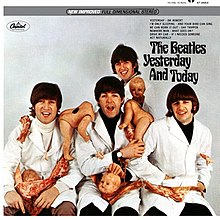
Before Star Maker Machine looks like a series of Yesterday and Today Butchers Cover outtakes, I thought I'd offer some simple cover art with my entry. "Enchanted Pork Fist", from The Meat Puppet's 1985 album Up On The Sun, shows off Curt Kirkwood's Allman-Brothers-at-double-speed guitar chops before the boys sing about pistachios and getting back to bed.

 When the Puppets follow-up, Out My Way , came out in 1986 I got a phone interview with Curt and asked how he learned to move his fingers so quickly. In his laconic drawl, Curt said when you live in the Arizona desert there's nothing to do but jerk off and play your guitar and he's had a lot of practice at both.


Monday, May 28, 2012

Eating The Animal Kingdom: Praying Mantis


Don Dixon & Marti Jones: Praying Mantis
[purchase studio version]

I just finished spending the day smoking a pork butt, creating some delicious pulled pork, so I’m going to head off in a very different direction. There is a sense of recycled-ness to this week’s theme—we are extending last week’s theme, and this blog has already done a food theme, but a long time ago in Internet terms, and in any event before I was part of this community of music obsessives. So, in keeping with this overlay to the theme, I am writing about a song that was posted back in 2009 by Darius, our fearless leader. But to liven things up, so to speak, I am posting a live version.

“Praying Mantis,” by Don Dixon, is a great, twisted pop song, by a performer who is not widely known, and known if at all for being a producer of little known acts such as R.E.M., The Smithereens (the New Jersey band founded in 1980, not the Northampton, Mass. a capella group founded in 1945), Marshall Crenshaw, and his wife, Marti Jones. Dixon, as a songwriter and performer, reminds me of people like Nick Lowe and John Hiatt.

This track is from a live “official bootleg” that was, I believe, available for purchase at some point, but no more. I originally downloaded it from the music blog Popdose, which states that Dixon and Jones permitted them to post the show for download. It was recorded on May 11, 1990 at the 1313 Club in Charlotte, NC. It is still up and you can hear the entire show here: [Live from the 1313 Club]

It appears, however, that the story that the female praying mantis always eats the male after mating isn’t true. [Snopes Article] So, if any male praying mantises are reading this blog, you may be able to rest easily, and should get out of your house, or nest, or wherever praying mantises live, and try to meet a nice girl.

Eating The Animal Kingdom: Pigmeat


Ry Cooder: Pigmeat

[purchase]

A belated start to this week's theme, but not as late as all that, really, given how closely connected it is to our previous conceit - the difference here is, instead of merely celebrating fauna in all its forms, we find ourselves going for the gastronomical. In doing so, we retroactively include this morning's post featuring Little Feat classic Dixie Chicken, or at least the image accompanying it. Expect more of the same lip-smacking imagery as we move forward into June. Vegetarians, we apologize in advance for any distress.

This mess of a tune - originally by Huddie Ledbetter, swung here by master guitarist, composer, and one-time Rolling Stones studio sideman Ry Cooder - is a perfect thematic reboot, and not solely for the barely buried innuendo it hides under its sloppy, juicy performance. Pig meat, indeed. See also Cooder's One Meat Ball (pasted below), a tin pan alley cover from the same self-titled debut solo album, for thematically related though sonically distinct thrills.


The Animal Kingdom: Dixie Chicken


Little Feat: Dixie Chicken
 [purchase]

While we're stuck on the animal kingdom and temporarily focused on fowl (and the plural is fowls?), allow me to once again plug both one of my favorite bands and one of my favorite resources (poignantly appropriate at this point in time)

The original studio version (purchase link goes there) is from the 1973 album of the same name. This embedded link is from the legal/free repository at archive.org where it is labeled as a 1976 live recording from the Warner Theater. I think you'll agree that it is pretty crisp (all around) for a live recording. ( I hear something "funky" happen to the recording at about 9'30", but it doesn't detract much from the overall value. Am I wrong? Do you hear it, too?)

Please pardon my irreverance as to the image choice for "the animal kingdom", but I kind of wish that it might provoke a remark about what it is that we do to our animal brethren.

Saturday, May 26, 2012

The Animal Kingdom: Gallo del Cielo


Tom Russell: Gallo del Cielo

[purchase]

Due to my love of country and folk music, I have 68 horse mp3s in my collection. But since I always wait until the last minute to post on Star Marker Machine, I usually miss my chance to post my first thought on the given subject. I spent the week scouring my brain trying to think of a non-horse animal kingdom song to post. Finally on Thursday, while listening to Outlaw Country on XM radio, it hit me.

Tom Russell's "Gall del Cielo" is the quintessential Americana song. Written near his native Los Angeles in 1979, the song tells the story of Carlos Zaragoza, a Mexican man trying to win enough money via betting on cockfights to buy back the land that Pancho Villa stole from his family. The rooster from heaven, Gallo del Cielo, is the strongest of the cockfighters. Zaragoza steels the rooster from his home in northern Mexico, swims the Rio Grande and travels the southwestern US and California winning money on Gallo del Cielo's fighting prowess. Unfortunately by the time Zaragoza gets to Santa Clara, Gallo del Cielo meets his match. Zaragoza losses all of his money on the fight, and exiles himself so as to not bring his family shame.

Ruseell has recorded several versions of "Gallo del Cielo." This one is from the completion Veterans Day: The Tom Russell Anthology, but the original is from Russell's 1984 album Heart on a Sleeve.