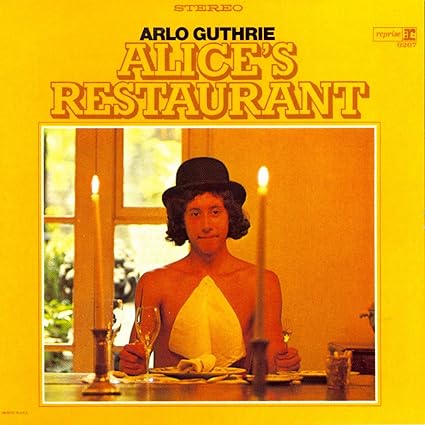
Showing posts with label Arlo Guthrie. Show all posts

Saturday, November 21, 2020

No Thanks: Dead or Alive


purchase [ Woody's version  ]

<No, thanks> or <no thanks>. There is a difference. Syntax/punctuation matters.

Actually, I think this SMM theme is more about <no Thanksgiving> and other joys denied us in 2020. Yes, the holiday will come and go, but we are being told not to invite the whole family. I'm usually the host, but if I were invited, I would say "No, thanks. Not this year."

"No, thanks" leads me to think of all sorts of issues that have poppped up in 2020: Another 4 years? Classes in a room with 20 X 14 year olds? Sharing my office with a colleague who has had COVID? Riding a service bus to work with 20 others? No, thanks no thanks to our incompetent "leadership".

Then consider the other version: I have recieved no thanks for my actions related to many of the above. At this point I am expected to be thankful for still being alive?

That aside, let's focus on the music that drills down into the theme. Above Woody, then here his son Arlo: <Dead or Alive>. How appropriate!

   the sherrif wants me dead or alive ... no thanks

Arlo sounds a lot better than his old man, but that may be related to recording technologies as much as the way things evolve over time.


I think it's fair to say that Woody Guthrie was re-working a "traditional African-American work song", a tune called <Poor Lazarus>, but the chronology is a bit muddy as far as I could discover.

James Carter is credited as the author of Poor Lazarus, but the Alan Lomax recording from the state pen is dated 1959. setlist.fm lists the first Woody Guthrie performance of <Dead or Alive> recording as dated 1949. 


Poor Lazarus and Dead or Alive are pretty much the same story and I would be inclined to leave the provenance as traditional. The Guthrie legacy is managed by grandchild anna canoni and there is an informative dialog here.

The Alan Lomax/James Carter story includes this information.

Other versions based on the original: 

There's a version by Lonnie Donegan (a Brit I've never heard about, but Wikipedia calls the "King of Skiffle")


Bob Dylan made his reverence for Woody Guthrie clear: his song called <Song to Woody> and his version of <Dead or Alive>:


Saturday, July 20, 2019

Alabama: Alabama Bound


purchase [Doc Watson]

As I noted last post, the train is a classic element of music from the south -be it the blues or country. Whether it is the rhythm of the wheels on the rails that matches the musical beat, the role the railroad played in the escape from the south, the resemblance of the whistle and some of the sounds you can get from the harmonica or the loneliness that can come from being on the road.


Herewith 3 versions in somewhat chronologichal order of the classic that combines once again Alabama and trains:

Leadbelly:


Doc & Merle :


Arlo Guthrie


and just for silliness:


Monday, November 19, 2018

Arlo: Low & Lonely


Rick Robbins: Low & Lonely
[purchase]

You know how in “Alice’s Restaurant Massacree,” Arlo sings that it:

all started two Thanksgivings ago, was on - two years ago on Thanksgiving, when my friend and I went up to visit Alice at the Restaurant?

The friend at issue, an unindicted co-conspirator in the criminal garbage dump, was named Rick Robbins. They had been friends since the early 1960s, when they both attended the Stockbridge School, where the librarian was a woman named Alice Brock. That Alice. At the Stockbridge School, Robbins was exposed to American music from Bessie Smith to Arlo’s dad, to current stars such as Joan Baez and Bob Dylan.  He's the guy on the left.

In 1965, Robbins and Guthrie set off on the road to discover music and themselves, and spent a lot of time singing and playing folk music and the blues. But rather than opt for the life of a professional musician, Robbins settled down to build houses and learn architectural design.

Fast forward to 1995, when Robbins was trading construction work at a music studio for recording time to create a record of some songs for his family.  Rory Block, the blues guitarist and singer (who I saw the other day, opening for Richard Thompson), happened to hear him playing, added some vocals, and persuaded Robbins to release an album. Block produced the album, Walking Down The Line, which also features Ramblin' Jack Elliott, John Sebastian, Eric Weissberg, and Larry Campbell, as well as old buddy Arlo. Not bad for an unknown carpenter/folk singer, right?

Robbins and Guthrie perform a fun, jaunty version of “Low & Lonely,” a song written by “the father of the Nashville music business,” Fred Rose, who wrote, under his own name, and as “Floyd Jenkins,” a number of legendary songs including "'Deed I Do" and "Blue Eyes Crying in the Rain.” He’s the “Rose” in the name of famed music publishing firm Acuff-Rose.

“Low & Lonely” was originally released in 1942 by Rose’s partner, Roy Acuff and His Smoky Mountain Boys, and has been covered a few other times, notably by Ramblin’ Jack Elliott, one of Robbins’ main mentors and influences, Hank Williams, and George Jones, who recorded the song with Acuff’s Smoky Mountain Boys.

Robbins has released two more albums of music, most recently an album of original songs, in 2006.

Wednesday, November 14, 2018

Arlo: Highway in the Wind


purchase[Highway in the Wind ]

Most everyone with some music background knows that Arlo Guthrie is the son of Woody Guthrie. Most everyone knows that he wrote <Alice's Restaurant> if not the fact that it was an exaggerated "Massacree". But, the times being such as they were (Vietnam War, Nixon and more) ... the song gained a foothold in the popular imagination.

Before he breaks into the song here/above, Guthrie opens with an entertaining story about an early trip out West when he stayed with Ramblin' Jack and when/where he first saw his wife to be. Possibly, you have to have been a contemporary to fully appreciate the humor, but the audience seems to be in tune. But it is a wonderful example of how the Guthrie musicians were able to (a) place their songs within a relatable socio-economic time-frame and (b) draw in said audience.

Perhaps a word or two about Ramblin Jack Elliot is warranted - Guthrie mentions that his dad (!) and Ramblin Jack had been on the road together. Born in 1931 and scheduled to play this week in Santa Cruz and the following week in Texas [ramblinjack.com], the man is has been mentor to many musicians, ranging from Bob Dylan to The Grateful Dead.

Back to the lyrics of this one ...
Seems to me that the first phrases of the song show the lingering effects of the night before (not that I've ever been there myself, but there's something in the choice of words that suggest to me  that ... a change... a revelation ... has occurred.)

Says he:
Sail with me into the unknown void
That has no end
Swept along the open road
That don't seem to begin

Versions:


Kate Wolf above


Hearts and Flowers

Tuesday, November 13, 2018

Arlo: Alice’s Restaurant Massacree


Arlo Guthrie: Alice’s Restaurant Massacree
[purchase]

There comes a moment on Thanksgiving Day, right about noon, when my wife and I, and whoever is cooking with us, or just kibitzing, stop what we are doing, and listen to WFUV’s annual broadcast of Arlo Guthrie’s “Alice’s Restaurant Massacree,” an 18 plus minute talking blues about how littering on Thanksgiving kept Arlo Guthrie out of the Vietnam War. It is a funny song, clever in its "shaggy dog" structure, and how it ties together so many disparate threads, with a message—a message that Guthrie has specifically noted was not anti-war in general, but rather against the Vietnam War in particular.  Actually, Guthrie likes to say that it is actually an “anti-stupidity” song. I’m not going to discuss in any great detail the history of the song, or what it is about—because I’m betting that most people reading this already know most of it, and Google is our friend.

Listening to this song on Thanksgiving has become a family tradition for our family and for many others, and is the Thanksgiving connection—which is tenuous at best—is why we are running this theme now. But, of course, there is much about Thanksgiving traditions that makes little sense. Nowadays, we identify Thanksgiving with the Pilgrims and (sometimes) the Wampanoag, who celebrated what is considered the “First Thanksgiving” in 1621. It is unlikely that there was turkey, but there was waterfowl, venison, ham, seafood, fruit and berries, pumpkin and squash. But probably not marshmallows on anything. And how did an over-hyped parade in New York, sponsored by a department store, featuring huge balloons, marching bands, celebrities, and Santa Claus, become a centerpiece of the celebration (not to mention the inflation of said balloons). Or football?  Just repetition, over a long period of time.

Interestingly (to me, at least), the tradition of tying our Turkey Day to the 1621 feast is a relatively recent phenomenon. Although there have been official and unofficial Thanksgiving celebrations in our part of North America going back to that “First” one, Thomas Jefferson didn’t continue the Thanksgiving proclamations of his predecessors, but James Madison renewed the tradition at the end of the War of 1812. Its observance was spotty and localized during the following era, but since 1863, Thanksgiving has been a national holiday in the United States (usurping “Evacuation Day,” commemorating the withdrawal of British troops after the Revolutionary War. I’d hate to know what people ate on Evacuation Day.)

In the mid-1800s, around the time that Thanksgiving was getting a publicity boost, the publication and popularization of Longfellow’s The Courtship of Miles Standish and the recovery of Governor Bradford’s lost manuscript Of Plimoth Plantation, began to spark interest in the Pilgrims and Wampanoags, and by the end of the 19th Century, the First Thanksgiving story became inextricably interwoven into the holiday, in part because of its message of American freedom, citizenship, and, I’d argue, propagation of a “noble savage” role for Native Americans.

How did it become a Thanksgiving tradition? I don’t know, and the Internet isn’t helping. Even Arlo doesn’t know, although he certainly appreciates the royalties. One thing that I can say, though, is that since radio programmers are not always the most creative folks (anymore—and that’s not a boast about my college radio programming days—OK, not completely—but more of a look back to the 60s and 70s, a time when FM radio really was progressive and interesting), someone thought it was a good idea, and everyone copied him. (And I say “him,” because I don’t think there were too many female program directors then, but it could have been a woman, because who knows.)

I also have no clue how “Alice” became a tradition in my family—it wasn’t part of mine growing up, and I’m pretty sure that it wasn’t a tradition in my wife’s family. For a while now, my wife and I have hosted Thanksgiving for our families, and do the bulk of the cooking. Which is fine—we like to do it, and like having quality control. I suspect that one year, while we were all working in the kitchen, we dialed it up on WFUV, and we all enjoyed it, including my kids, who love a good song, a good joke, and a good message of peace. And we did it the next year, and the next. Boom—a tradition!!!  One year, my in-laws were there, and my father-in-law enjoyed it, but had trouble understanding all of Arlo’s words, so the next year, we printed the lyrics for him to follow along.

That 18 minutes around noon is like the calm before the storm—the dishes you started early are humming away, but you have some time before the later-prepared items need to be done. Also, it’s lunch time.

"Alice" isn’t a tradition in Arlo’s family. As he said in an interview with Rolling Stone a few years ago, he doesn’t listen, and “no one in my family does either. There are better things to do for us and I’ve got grandkids now.” They really should.

Last year, I wrote about how Thanksgiving traditions change over time, and it is still pretty accurate, although my son’s fiancée is now his wife (yay!). But because this is their year to go to her parents, and my daughter still living in Spain, it is likely that this year’s “Alice” tradition will just be me and my wife. Which is fine, for now, although it is more fun to listen to it with a group, especially one that isn’t familiar with the song.

Sunday, May 6, 2012

Eateries and Watering Holes: Alice's Restaurant


Jeff Fiorentino: Alice's Restaurant

[download other Fiorentino tracks]

More or less immediately, Arlo Guthrie's (1967) Alice's Restaurant came to mind. I'm not sure why: maybe it's because I worked as a chef in a restaurant for a few years after graduating from college.

I want to assume that any information I can provide here about the original/Arlo Guthrie is superfluous to anything you can find online. (start here?)

While you can check out Arlo's original here, I wanted to send you a different and considerably shorter (Arlo's original is 18 minutes+) version with a different slant. I have been into Berlin-based SoundCloud for nigh on a year now, and continue - almost daily - to find something new and worth my time there.

This post features Jeff Fiorentino's SoundCloud version. This is the first time I have come across his name, but it appears that he offers online guitar tutorials. This cover is a considerably "harder" version  of Arlo's song, but it retains the essence of the original.

Friday, July 17, 2009

Songs Called Songs: The Motorcycle Song


Arlo Guthrie: Motorcycle (Significance of the Pickle) Song

[purchase]

This one is fairly self-explanatory.

I don't want a pickle, I just wanna ride on my...

Sunday, August 3, 2008

Cars: Riding In My Car


Woody Guthrie: Riding in My Car [purchase]

Bruce Springsteen: Riding in My Car [purchase]

Elizabeth Mitchell: Car Car [purchase]

Woody and Arlo Guthrie: Riding In My Car [purchase]

Every time someone tries to deify the great troubadors of early folk in my presence, I remember that I grew up listening to this silly yet classic Woody Guthrie song, thinking this was folk music, and wondering what all the fuss was about. Apparently, I'm not the only one, either. Bruce Springsteen's tribute-album cover is hilariously earnest; Elizabeth Mitchell's duet with her own kid is surprisingly tender. Woody's cross-generational recut, a jouncy hillybilly romp with jaw harp, banjo, harmonica, and son Arlo, is a bit too long for its own good, but a decent novelty all the same.