Showing posts with label Bruce Springsteen. Show all posts

Sunday, December 11, 2022

LEFTOVERS: BOSS: THE FEVER


OK, sorta kinda a contrivance here, given I have been away a week or two, with, if not a fever, the treatment for one I had earlier. Anyone here had biliary colic or cholecystitis? Not fun, right? And that was how I found myself in the casualty (emergency room) of my local hospital, some time back in the summer, ahead of a scan showing me the presence of a big old bag of stones. The bag my gall bladder, the stones painful. Cue change of diet whilst I was put on the list for the necessary surgery, to rid me of the offending organ and it's unruly passengers. Against the odds, as we have a bit of a post covid crisis in our national health system, I got given a date and underwent the knife a couple of weeks ago. Nominally a day case, they do it, these days, by laparoscope, or keyhole surgery as it is called. Instead of cutting me in half, they make four small incisions and wiggle about inside me, via levers and pulleys. A "very big" and "very dirty" bag and stone combo was thus drawn out of me, allowing me home the same day. (Actually, not, as it happened, as my other bladder took umbrage at the anaesthetic and decided not to work until the last bus had departed, meaning an overnight stay.) I was hoping to have pictorial evidence of all this, expecting I might be offered, as a trophy, the removed detritus, but no such luck. This is, apparently, no longer hospital policy. Boo.

Two weeks off work was all I was offered, expecting that to be insufficient, surprising myself by how quickly everything bounced back, and how little pain the various stab wounds gave me. They use glue, these days, to cover up all the evidence, with hefty dollops of Loctite squirted over the incisions. That was fun as it peeled away..... 

So here I lie, early am on the (Sun)day before I return to work. Time for  catch-up post and any of the Dr and Hospital songs I could shoehorn in, this seemed to fit best into the open ended theme of leftovers. We did "Boss" earlier in the year, and I certainly shied away from Mr Springsteen at that juncture: far too obvious. As, sadly, has the man himself become, his star irredeemably faded in recent years, tarnished by the limelight of Vegas and lacklustre material. (Don't get me started on his latest travesty, the dreadful collection of dreck, dredged up from the vault of songs even Rod Stewart wouldn't dare cover. Good songs, sure, in their own right, but despoiled by the vanity of the project.) This track first came out with '18 Tracks', the 1999 album to lure in punters to his then back catalogue, but had been originally made during the session for his second record, 1973's 'The Wild, the Innocent and the E Street Shuffle'. And isn't it good? I bought the compilation as it was released, and it has sat on the shelves, progressively gathering dust as my love affair with the Boss diminished. So, then, a timely reminder of what the man was capable of in his prime. the two live versions each coming from 1978, the first being performed by Southside Johnny and his also containing Steve Van Zandt band, with Bruce as a guest. Both traffic versions.

Fever.

Friday, August 12, 2022

Thunder & Lightning: Thunder road (again)


purchase [ Born to Run ]

Faced with yet another theme where I have run the clock down to the buzzer, I am going to re-mention a song that I posted about in 2016. That *is* 6 years ago (what?), but - in addition to the time constraints, there are also just too many confluences to let this go.

-#1: an article I came across in the Washington Post last week about how TicketMaster's dynamic pricing algorithms have set some tickets for "man of the people" Bruce Sprinsteen's 2023 tour in the thousands of dollars - the question being "Does the boss know and/or care?

-#2: I am on the road yet again and continuing my somewhat disjointed first summer of retirement

-#3: I'm in New Jersey

-and #4: there have been thunderstorms almost every late afternoon here for the past week (par for the course along the East Coast if memory serves me right)

So, while, back in 2016 the clip I chose was the incredible version with Springsteen joining Melissa Etheridge on stage, here are some other performances of this wonderful musical story


Monday, July 18, 2022

Home: I Don’t Want To Go Home

Southside Johnny and the Asbury Jukes: I Don’t Want To Go Home
[purchase] 

I mentioned a few weeks ago that I’d been spending a lot of time preparing for my 40th college reunion, which was a lot of fun. But I want to talk today, a little, about our 25th reunion. At that time, although I was an active alumnus, in the sense that I went to reunions and sporting events and was proud of my college, I did little or no volunteer work for my class or school. In my mind, the reunion just sort of happened, and although I knew that classmates were involved in organizing it, I had no clue as to how much work it takes, and how hard it is to do it. I know now. Trust me, I know now. 

When I showed up at our 25th, in addition to receiving a uniquely beautiful garish jacket, I found out that our entertainment for one of the evenings was going to be Southside Johnny and the Asbury Jukes. I had always enjoyed their music, had played them occasionally on the radio during college, and was surprised that they would be appearing at our reunion. Typically, classes hire cover bands of various styles, and to my knowledge it was unusual to have a “name” band, even one whose best years seemed to be behind them, as entertainment. I later discovered that the band was paid for by a wealthy classmate, so that the cost was not passed along to the rest of us, which was nice of him. (This appearance appeared to set off a bit of an arms race among reunions classes, with appearances by acts such as Joan Jett, Duran Duran, Naughty By Nature, some version of the Beach Boys, and others until it seems that the University has discouraged this practice. Also, Phil Lesh played with his son, who was graduating, one year at an off-campus eating club, and Stanley Jordan joined in.) 

They were great, if a little loud under our tent, and the picture above is from his performance (and thanks to the classmate who provided me with this and other pictures from that night for our slideshow, because that was 2007, before everyone carried a digital camera in their pocket). 

Southside Johnny (John Lyon) and Bruce Springsteen met as young, aspiring musicians in the late 1960s, became close friends, and were both involved in creating the New Jersey/Asbury Park sound. A number of musicians played with both men, including Gary Tallent and Vini Lopez, who went to high school with Lyon, and Steve Van Zandt. But where Springsteen went on to become The Boss, Southside’s success was more limited. There are tons of articles on the Internet discussing their friendship, which continues, but I found one from 2012, an interview with Lyon, that seems to lay it out pretty clearly. According to that article, even in the early days, Lyon knew that among all of the musicians in their group, Springsteen stood out. As Lyon remembered, “He just had that presence where you couldn’t take your eyes off him.” Lyon described the difference between the bands: “He's got more straight ahead rock 'n' roll roots and I have more rhythm and blues roots. And I have a horn section and he doesn't." 

Southside Johnny and the Asbury Jukes’ first album, I Don’t Want to Go Home, is excellent, and the title track, written by Van Zandt (who also produced the record), is maybe the band’s signature track. It’s a blusey, horn-drenched rocker, telling the story of someone who, well, doesn’t want to go home and face the fact that his love has left him. For what it is worth, I’m using a live version of the song, from the 1980 album Reach Up and Touch the Sky, because I like it a little better. 

Lyon has continued to perform and record pretty much non-stop with various lineups of the Jukes, solo, and with other side projects, but has generally flown under the radar. But, at least back in 2012, Lyons seemed comfortable with his career. As he said in that interview: 

I like where I am. I'm friends with a lot of these guys who have become big rock stars and it's not for me. I treasure my privacy and l like being left alone on the street. Garry Tallent and I were talking a couple of years ago and realized everybody pretty much got what they wanted. Steven always wanted to be active politically and to play music and now he's an actor as well. Bruce always wanted to make his music count for people. He carried himself as a person who has something to say, and still does. And I've always wanted to be as free and odd and eccentric as I wanted, because I'm just naturally that way - and I can. I haven't put on a suit for 40 years.

Sunday, May 29, 2022

ONLY: THE LONELY

Dum dum da dooby dum dum, is that how it goes? You know it does, of course, one of those terific songs that, no matter your age, evokes simpler times, perhaps in black and white, quiffs, brylcreem and big collars over the top of suit lapels. These are tend to be vague and somewhat inaccurate tropes, for, even I am too young to have been a teen in the Big O's prime. (Or should that be first prime?) But listening to his creamy voice makes me imagine I was.

I wasn't, growing up in the sixties, a big fan of rock and roll. in fact, give or take very early Elvis and Jerry Lee at his hair shaken forward all over his face peak, I found it all a little ludicrous. Bill Haley? Pur-leease. I sorta got Chuck Berry as I grew older, perhaps as the bands I did like covered so much his stuff, but have never taken to Little Richard. Again, I could appreciate the rockabilly styles of Eddie Cochran and Gene Vincent, but not so much the choreographed oddness of Buddy Holly, whom I thought looked a bit of a geek. (It took me decades to realise he was actually rather good...) But Roy Orbison, perhaps not really a rocker, in that grey area when the aggression of the late 50's was morphing into the schlocky easy listening balladeers of the early 60's, something about his shtick appealed to me, and, even aged in single figures, I was happy to sing along with his mellifluous melasma. He looked different, too, with the dark glasses, an air of mystery to the extent I thought him probably blind. (He wasn't, but looked way better in shades than without them, when he resembled a bewildered owl.) Plus he had the tragic side story of his real life, something that even endeared him to my mother, who seemed to want to mother him, and, unusually for her, had an opinion about him, unlike virtually any other performer beamed into our Thursday evenings, via Top of the Pops. (Positive opinion, that is, she having plenty to say about the Stones and the Who!)

I was three when 'Only the Lonely' was first a hit, so my memory is likely subliminal at best, later probably reconstructed as I grew. A number one in the UK, a place above its US pinnacle, it was said to be Orbison's longest lasting tenure in the hit parade. Not bad, when you consider he was also packing 50% of the royalties, it being a co-write of his with Joe Melson. Intriguingly, the idea had initially been to flog it to Elvis, or the Everly Brothers, Orbison only recording it as they turned it down. More fool they? It is astonishing, looking back at this run of hits, throughout the '60s, how big a star he then was, it hardly surprising that, as he dropped out of view and, perhaps, favour, to realise quite how influential he was with the next generation of performers.

Bruce Springsteen was never shy of his admiration, as the song 'Thunder Road' showed, the reference to Orbison a delight for those listening, themselves possibly already in thrall to him. Then, in 1988, came two momentous reawakenings. Firstly the possibly initial shock that greeted the formation of the Travellin' Wilbur's, the faux band of brothers, aka supergroup of George Harrison, Bob Dylan, Tom Petty and Jeff Lynne. And Roy Orbison. Who? That old fart, thought the world, ahead of having him blow off their socks with the power of his vocals and his understated and charismatic presence. And listen to what he actually sings in 'Handle me With Care'! (Me, I thought Jeff Lynne the nipple in the woodpile, but hey, his compadres seemed to like his execrable production style.) As Lefty Wilbury, Orbison made that album for me, he then moving straight on, or seeming to, to the Black and White Night video and album This was  from an HBO TV special, actually shown the year before, making it chronologically ahead of the Wilbury's, but I did not know that then. Now, this really was a superstar session, with respect to Otis, Lucky, Nelson and Charlie T. Jr., with Orbison running through a stack of his hits and more. With Presley's old TCB (takin' care of business) band, aka, later on, Emmylou's Hot Band behind him, James Burton, Jerry Scheff, Ronnie Tutt and Glen D. Hardin, how could it not sound great? Add in guests of the calibre of the aforesaid Springsteen, Elvis Costello, Tom Waits and Jackson Browne, and this was catnip to me. Hell, even the girly singers were Bonnie Raitt and Jennifer Warnes. Shot in black and white, this is a wonderful recordd of what must have been quite a night, and one that still bears repeated plays today.

All to suddenly, the Big O's renaissance ended. In December 1988, having been touring and needing downtime ahead of a trip to London to record some Wibury videos, he retreated to his home, dying, on the 6th, at his mother's house, of a massive heart attack. Astonishingly, in this age of octogenarian rockstars, plus my then thinking him unspeakably ancient, he was only 52. A generation ahead of his fellow Wilbury's, he was barely any older.

Finally, given the theme, and for completeness, here is another Only song he made. This one came from his last album, another posthumous release, Mystery Girl, coming out in 1989, and actually completed a month before he died. Even the Jeff Lynne production cannot hide the quality of the performance. 'The Only One' it is called, and he was, really, wasn't he?


"I'm so tired and very lonely"

Thursday, March 10, 2022

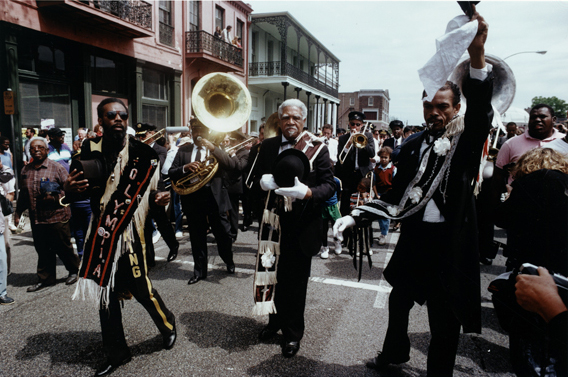
Marching: When The Saints Go Marching In

Although the month of March is named after the Roman god of war, Mars, while the English verb “to march” is derived a different source, the Old French “marcher,” meaning "to stride, march, walk," we here at SMM seem to insist on tying the two together, which is why most of the songs that would have marched into my consciousness for this theme already did so in prior years, leaving me not without options, but without options that I cared to write about. 

But one of the things about being among the last remaining regular writers on this site, which has gone through dozens since it started back in 2008, is that it is important to try to write at least once, if not more, for each theme, so I realized that Mardi Gras was just over a week ago, and therefore a discussion of “When The Saints Go Marching In” would work. And, in a tip of the hat to another of the other remaining regular SMM contributors (and recent birthday boy), Seuras Og, I’m going to model my post on one of his regular formats. 

Like many standards, the origins of the song are unclear. It seems that there were a number of gospel/spiritual songs with similar titles, but in 1923, the Paramount Jubilee Singers recorded a song similar to the one we all know and love, titled, “When All The Saints Go Marching In:”


Other recorded versions of the song, with varying lyrics, were recorded throughout the the 1920s and 30s, often becoming less hymn-like and more uptempo, but the song’s popularity really started when Louis Armstrong recorded a version in 1938, which also cemented the song’s identification with New Orleans:


There are probably thousands of covers of this standard, especially if you include every Dixieland or brass band that does it live (and on video....), but we will look at a few notable ones, in roughly chronological order: Here’s a peppy, folk approach from The Weavers in 1951:


Not surprisingly, Mahalia Jackson returned the song to its gospel roots in 1955:


Elvis Presley, and the rest of the “Million Dollar Quartet (Jerry Lee Lewis, Carl Perkins and Johnny Cash), did a loose rockabilly version that wasn’t released to the public until 1990:


In 1956, Sister Rosetta Tharp started turning “The Saints” into a rock ‘n’ roll song:


And Fats Domino finished the transformation in 1958:


Judy Garland and Liza Minnelli took a more pop approach when they performed the song in 1964:


The following year, Lester Flatt & Earl Scruggs, not surprisingly, took “The Saints” in a bluegrass direction:


Jumping forward a few decades, here’s a traditional take by New Orleans’ Preservation Hall Jazz Band from 1983:


In the mid-2000s, Bruce Springsteen regularly performed the song, in a pretty subdued arrangement, on his Seeger Sessions tour, with this version from 2006 being released on the Live in Dublin album:


Look, I could go on forever, and some of you may think I already have, so I’ll close this out with a version from New Orleans’ great Dirty Dozen Brass Band from 2012 that is pretty traditional (and a bit funky) and loads of fun:

Wednesday, November 17, 2021

BREAK/BROKEN: PIANO

If I get this in before a 'heart', I'll be surprised, the sentimental old buzzards that we all are, over here at SMS, but I'll have ago, knowing the thrill we all get from smashing a piano. No? Never done it? But you wan't to, don't you. Can you imagine the pure recidivist pleasure, the crash, the chords, the cacophony? We've all seen it done, surely?


Well, that was refreshing. Given custom and practice, what we now need is some music. Handily one Frank Turner has thoughtfully written a song on the subject, or about the post-traumatic debris. Wondering, perhaps, whether the piano is a metaphor for something else, the lyric certainly gives that suggestion. A pretty good song, isn't it, folk in its structure and melody, his voice in the unstructured school of similar observationalists like Billy Bragg. As the rhythm section come crashing in, the whole mood changes, into a bit of perfect and powerful 21st century pop music, indelibly English.

Broken Piano (2013)

I'll bet this is Carter's first appearance in these pages. He is an artist I have come to quite like these recent years, as he has gradually fought his way out of anonymous punky thrashes into a songwriter of some nuance. He has had a far from usual trajectory: old Etonians are more likely to end up running the country than topping the bill at medium sized music festivals; Eton College is the ultimate toff school in the country, a term there costing the price of a small family car, even before all the add-ons. Like the school uniform. Given the standard expectation for any self-respecting rocker to disguise their background, with


Joe Strummer and Shane McGowan each preferring folk forgot their sojourns at similar, if ever so slightly less elite institutions, the average public (as we call our private) school boy has to affect rough and tough back street upbringing to make it in the music biz. An Eton accent must have decimated credibility at the Roxy in 1975, or whenever. Indeed, the number of Old Etonians in the annals of popular music are relatively small. I couldn't find any, if you exclude Prince William, a contemporary of Turner, who is said to be quite the demon axe shredder. (I lied; he isn't.) But let's move on, Turner must be as sick as anyone by this concentration of his background. But, before doing so, given Eton has also a reputation as a finishing school for posh thick, Boris Johnson and that ilk, Turner actually completed his studies and then attended Mick Jaggers's old uni, the London School of Economics.

The Half-Life of Kissing/Kneejerk (2001)

A metalhead by choice in his teens, Iron Maiden* were his go-to band. And, surprise, surprise, like every other school or college, even Eton had its own band, Kneejerk, subsequently described as short-lived. From then he moved onto the post-hardcore (no, me neither) London band Million Dead. Around the time that band was appreciating 'irreconcilable differences', we should be grateful Turner caught hold of a cassette version of Bruce Springsteen's 'Nebraska'. This led to his style becoming more measured, with the introduction of melody, even if the words remained as vitriolic. Two well received albums under his name came out in the middle to late noughties, ahead of relative breakthrough, with 2009's 'Poetry of the Deed', bolstered by his relentless touring tendencies, becoming a summer festival staple across the realm of folk, roots, rock and alternative. His next move was to strip back further into a near acoustic mode, for 'England Keep My Bones'. Mind you, he kept his hardcore hand in, simultaneous touring with the unfortunately named Möngöl Horde. Switching allegiances between how much electricity he was needing to perform, The featured song for this piece comes from 2013's 'Tape Deck Heart', which, yes, was his break-up album, after the demise of a longterm relationship, making my suspicions above seem correct.

Live Fast, Die Old (2009)

I Still Believe (2012)

Keeping his b(r)and alive, a stream of EPS and compilations followed, until 2015's 'Positive Songs For Negative People', which drew some criticisms of being blander and more platitudinous lyrically, but was just as reassuringly and rousingly lively in its anthemic choruses. By now he was a chart regular, the album attaining a 2 in its week of domestic release, gaining also some US traction, 69 on the Billboard 

The Next Storm (2015)

chart. I personally didn't get on board until 2019's 'No Man's Land', a concept album, the subject matter and songs referring to powerful women, which included, in the final track, a tribute to his mother. Before, during and since he has maintained his hectic touring schedule, both solo and with the Sleeping Souls, the constant crew of musicians with him since 2006. Having discovered his work, I have delved back into his catalogue and, covid willing, he is one of the first acts I plan to see live when normal service fully resumes, this being something I have had yet to manage.

Rosemary Jane (2019)

Mindful I have strayed far from the theme, outwith the sole song offered, please accept the below as some slight recompense, being a revisioned version, 5 years on, from 2018's 'Songbook'.

Broken Piano (2018)

*Little known fact, in 2014 Turner appeared as a guest on BBC's Celebrity Mastermind, a special edition of the general knowledge quiz, wherein contestants start with a specialist round of questions. Turner chose Iron Maiden as his subject. And won!

To be perfectly Frank.....
 

Thursday, January 28, 2021

Over: The Go-Gos, Head Over Heels


Purchase Head Over Heels--skip the middleman, buy from the band! 

I love songs that work in dichotomy. Particularly, when the upbeat melody and sound of the song in no way matches the lyrics. Some songs are so happy, so poppy, that it's hard to relate the sonic sensation that listening brings when you actually listen to what the singer is on about.  I recall this was a point of criticism in 2002, when Springsteen put out the September 11th response album, The Rising. Mixed into those soaring, elegiac and hymn-like sounds were songs of tragedy, pain and heartbreak. Some too-stiff typewriter trolls found that unforgivable.

But, then, music is meant to be a healing force, and I think that a sad lyric put to a bursting, energetic melody is the perfect combo. 

Pink Floyd's "Comfortably Numb" never fails to uplift, despite the near-suicidal evocation in the lyrics. Springsteen's "The Rising" is a prayer of gratitude and awe for those who risk their lives to save others, and "Mary's Place" is a hell-with-it-all promise to the self, made at a turning point in grief and a personal decision to move on and find the beauty in life, a soul-fused, dance floor banishing of sorrow for affirmation of the fact that life goes on. 

Catharsis measured by sing-alongabiltiy, release in turning the volume up. There is just an ineffable magic about something sad that still makes you feel good. It's the magic of the music whispering the lyrics in one ear, and in the other, the gentle admonish, "Don't be sad..." 

I can't think of a better place to turn when I'm done than my record collection. 

I can write you a nice long playlist to help you out of emotional jams...

Which takes us to the song I've picked for the theme this month, which is 'over'. Over it, over done, overwrought, over and out? "Head over Heels," as done by the four album power pop, cute-punk California girls of my adolescent dreaming, The Go-Gos. A band that never got taken seriously, much to the "Doh!" of many of us who wrote them off as cream puff radio wannabes.

I love a lot of what the Go-Gos did, especially on their first album, where there was a lot of new wave grit to give the bubble gum some snap and sizzle. They made radio history with distinctly cool, distinctly genre leaning pop-punk tunes. There's glitz, and glam, but their music had a California vibe that would serve as the melodic precursor to your Green Days and your Blink 182s, abhorrent as it is to think punk could be pop, listened to by the masses and blared on commercial radio. Such is the way these things go--I mean, how many people who wear a Ramones t-shirt know the Ramones were a band? Music, as a cultural force, isn't exclusive to any one tribe, and the chameleon like appeal some bands carry is tribute to the universality of sound and the resistance we should all have toward arbitrary labels.

But, back to the Go-Gos.  They got short shrift for being the first Billboard charting, all female band to write all of their own songs, and play all of their own instruments. That sounds like a backhand slight, disguised as a compliment, but given the politics of pop music, and the exploitation that went along with so many of the hits that will forever be staples in our cultural history, the Go-Gos were a real band. With talent, and hooks, and looks.

"Head Over Heals" comes from Talk Show, their last album before they split up. It's the most commercial album they did, yet reflects the pressures of fame, and the lead single in particular speaks to the struggles the band faced with big label pressures, finances, substance abuse, and personality conflicts. Like any juggernaut pop band, the Go-Gos were put on a running cycle of touring and producing that brought fame very quickly. So many cautionary tales come from the world of pop and rock--young talent, driven by labels to repeat early flashes of magic, and then the trappings of fame, in the guise of sex, drugs and all the other glittery delights. It did the Go-Gos in, like so many other acts, but they managed four great hybrid albums in that run that reward listeners with fresh appeal, almost 40 years on. 

The Go-Gos certainly had a bright flash across the pop landscape, top 10 hits and fun videos. But, it came at a cost, as it did for so many bands, over the years. In a New York Times interview, lead singer Belinda Carlisle said "We were run ragged, we didn't know how to say no. ['Head Over Heels'] has an upbeat, cheerful melody and lyrically it really captures the darker side of fame and fortune - I had an appreciation for the lyrics then but not like I do now in hindsight." What make "Head Over Heels" such an interesting song--aside from it's confectionary of the opening piano riff to its tub thumping drums and static robot signal guitars, is the very dark nature of the lyrical content. 

Any song talking about head going over heels would most likely be about love, and while there is an intimation of romance here, "Head Over Heels" is a far darker, more plaintive song about being overwhelmed and out of control. It's a heavy ditty disguised as a light one, and the timelessness of the angst and the fear at being out of control has a universal appeal. You can tap your toes and snap your fingers to the song, but maybe it's a nervous tic rather than a signal of how into the groove you got. 

"Been running so fast
Right from the starting line
No more connections
I don't need any more advice
One hand's just reaching out
And one's just hangin' on
It seems my weaknesses
Just keep going strong..."

I know the song just went on repeat in your head--it's catchy, to say the least. But what I find most striking, again, is the dichotomy: here we have a dark confession of how fear and anxiety seem to rule the mind, and the lament that, despite best intentions, one's weaknesses are often stronger than our intentions not to be ruled by them. But, if there's anything to this song, it's the embodiment of hope and perseverance in the music. And music itself is sometimes just the thing we need to take one more step towards something better than the slow, sad moment we find ourselves in. Our weaknesses might be the only thing that has any strength, but keep working--you're doing fine, and it will get better.


Wednesday, October 7, 2020

Empty: The Void (Filler)


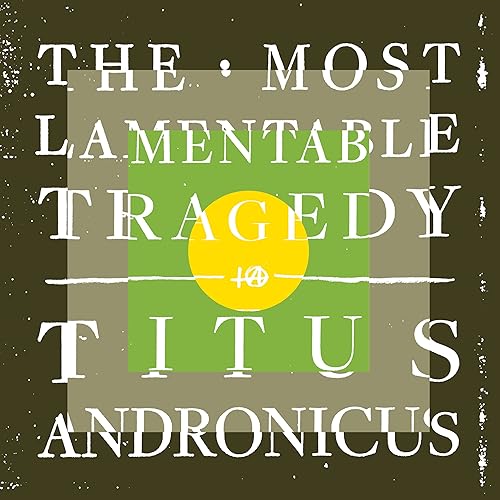
Titus Andronicus: The Void (Filler)
[purchase] 

Titus Andronicus is a frustrating band. (Shakespeare’s Titus Andronicus, a play that I’ve never seen, is also supposed to be pretty frustrating, and for years was considered to be his worst play. But, as it always seems to happen, it appears that this appraisal has changed. End of gratuitous Shakespeare section). They’re frustrating because they have incredibly grand ambitions, but don’t always live up to them. Because some of their music is really great, and some of it is headscratching. Because the band’s leader, Patrick Stickles, can be incredibly open and interesting when interviewed, but sometimes comes off as difficult. Although he suffers from various mental health issues, which may explain some or all of this. And, by some reports, sometimes their live shows are great, and others stink. 

And I need to admit that part of my frustration is that I recognize that Titus Andronicus is a band that requires the kind of attention that I haven’t really been able to focus on music since maybe college. 

Back when I was in high school, it was not uncommon for bands to create “rock operas” or albums that had some sort of overarching narrative. Some of these were and are considered classics, and others were considered silly or pretentious or indecipherable. As punk music began to gain notice, one of the things that you heard regularly was that the simple, stripped down music was a reaction to the excesses of classic rock and prog, and all of the hifalutin’ pretense, particularly the rock opera and its ilk. 

Eventually, though, punks succumbed to the artistic temptation of trying to create a song cycle with a narrative, and the stories that were told often rivaled the prog masters for incomprehensibility. Although the music was, generally, more concise. 

It probably came as no surprise to fans of Titus Andronicus, though, a band that fused punk with large helpings of Springsteen-esqe rock, that Sickles would attempt his own rock opera. As a Civil War buff of sorts, I first became aware of the band in 2010 when they released The Monitor, which used themes from the Civil War to reflect Stickles’ emotional issues. And some of the music really was thrilling. Their next album, Local Business, was more straight-ahead rock, but for 2015’s The Most Lamentable Tragedy, Stickels created a rock opera lasting more than an hour and half, on the topics of mental health and neurodiversity. As Spin explained, 

the rock opera’s plot is roughly as follows: A manic-depressive young man meets a lookalike who shows him, through pharmacology and/or religious awakening, a better way of life. He meets and falls for a girl, but has become drug-dependent and experiences a breakdown. He nearly ends it all, but learns at the last second that life is worth trudging through. It’s basically impossible to track the story just by listening — Stickles’ guttural spitting makes many tracks indecipherable — but Quadrophenia and American Idiot were hardly coherent original screenplays, either.

And have you ever read the liner notes to The Lamb Lies Down on Broadway?

The music is also diverse; while most of it skews punkward, there are also electronic/noise interludes, poppy songs, some clear Springsteen homages, fiddle-heavy Celtic rock, and a version of “Auld Lang Syne.” And it was reviewed in The New York Times. 

Toward the end, is “Into the Void (Filler),” a hard rocker with more than a little bit of Bob Mould/Hüsker Dü influence. I’ve read the lyrics and I’m frankly not at all sure about what it means, but if it is part of a piece about mental illness, maybe it not a surprise that it is hard to decipher. I still don’t know, though, whether the “Filler” in the title refers to filling the titular void, or that the song is filler, but I don’t think so, because it's pretty good (although I've never seen it mentioned in any of the reviews I read in preparing this piece).

I saw Titus Andronicus in 2013 at Terminal 5 in New York with my son, where they were the second act on a bill with The Menzingers opening and Lucero closing. I was excited to see Lucero for the first time since 2006 and to hear Titus Andronicus, but had never heard of The Menzingers. I think that Terminal 5 had really crappy sound, so the loud fast dense sound of Titus Andronicus was hard to listen to or understand (and looking at the setlist now, it appears they played a few songs from the not yet released The Most Lamentable Tragedy). Lucero was fine, although not as good as the first time, although it was maybe because of the bad sound. The Menzingers, though, made a good impression.

Saturday, August 29, 2020

COUNT: 1,2,3,4,

There are few more rousing introductions to any piece of rhythmic music than the exhortation to the band of a swift entry count, the musical equivalent of get on your marks, get set, go. And many have made much of this, with particular favourites being the Ramones (on just about everything) and, in the middle eight drop of Born to Run, Bruce Springsteen. (It's at 3.04.) But there is another, a far more languid take on it, the appeal of which lingers for all time, making me smile even now.....


By slowing it down, as well as getting to 6, Richman totally blew my twenty year old mind when I first heard it, 'with my radio on', and it became one of the few singles this album buyer bought. Adding to the joy and the confusion was that it was on both sides; the version above nominally the A side, Roadrunner (twice) being on the flip. Even more confoundingly, 'twice' was the earlier version, '72, I think, against the '74 of 'once'. The charts were clearly not ready for this garage band romp until softened by the early UK stirrings of punk in 1977. A relatively early adopter, I was already in thrall to the Beserkely record label, the self-entitled 'Home of the Hits', populated with such delights as the Rubinoos and Greg Kihn. Trivia moment: although Roadrunner (once) is often attributed to the Modern Lovers, Richman is here actually backed by the Greg Kihn band. I don't know whether it made any impression in the U.S., but it captured a credible 11 in the UK singles chart. Richman later toured, this time with the Modern Lovers, promoting the LP, Rock'n'Roll With the Modern Lovers, getting another hit with the equally quirky (and even stranger) Egyptian Reggae, an instrumental. I didn't catch the tour, deeply of a friend who did, hooking up with the band and accompanying the band for the rest of the tour and to Germany. A very surreal experience, I gather and I am uncertain whether he was ever the same.


This is neither the time nor place to discuss further the charm of Richman, taking his idiot savant persona further and forward in ever more endearing/annoying directions. (I have R&RwtMLs and can still enjoy it, but I would confess to that being entirely as much as I need. There are only so many Ice Cream Men and Rocking Leprechauns I can stomach.)


The earlier Roadrunner (twice) probably deserves a little background, if only to namecheck the produce, welsh Velvet Underground man John Cale, he perhaps appreciating the debt to VU song, Sister Ray, which is hardly dissimilar.


The lyrics of the song are also conveniently very conducive to a counting theme, as Richman returns, time and time again, in the chorus, a repeated and echoed refrain of Roadrunner, then applying the time old contrivance of emphasis: 'I said roadrunner once, I said roadrunner twice', failing to even leave it at that. It's a delight.
You're begging to ask, was there a Roadrunner (thrice)? Of course there was, a live version, a b side of a later single.


Once, twice, thrice.........

Tuesday, June 23, 2020

LOOKING FORWARD: BETTER DAYS

That's the point of it, of life, wherever you are, the excitement and anticipation of a day yet to unfold, whether a definite day pinned on the calendar, or an arbitrary aspiration of a future different from the now. We call such days Lollo Rosso in my house, when we have had one and while we await one. Why? Italian lettuce, doncha know. Italian red lettuce.  Red lettuce/red letters? (I know, I'll give you a moment to repair your sides.)


My i-pod is crammed with songs about shit days; it is the basis, arguably, for the entire genre of music, the blues. So where's the hope, the optimism? If we disregard that happy-go-lucky music is so often a happy clappy pap of little merit, let's, instead, celebrate when it isn't.

Better Days/Bobby Charles

Where better to start than the down-home charm of Bobby Charles? A southern swampy country soul man in the style of Dan Penn, he moved in all the right circles, if never quite making it in his own right. I was alerted to him a couple of decades ago, via a friend pointing me in the direction of his first and eponymous album, a slow burner that first dropped in 1972. An acolyte of the Band, he actually appears in their Scorsese-helmed "farewell" performance, The Last Waltz, if edited out for the cinema cut. Rick Danko, of said band, produced his debut, the rest of the group offering cameos, as did Dr John, whose then band later backed him in the Last Waltz. Here's quite a nice bio. Cut short, the album didn't sell and, though later a cult record to many a current mover and shaker, he quietly ploughed his furrow, with several more popping out of his home studio until his 2010 death. This song, the title song from his chronologically second, and best, album, Better Days, which actually took his death, 36 years later, to give it a formal release.  What I hadn't, however, realised is that he was the author, as a much younger man, of both Bill Haley's See You Later, Alligator and almost the signature tune of Fats Domino, Walkin' to New Orleans. So maybe most of his better days were behind him, but the laidback drawl suggests he was never discounting the dream. The royalty checks possibly helped too.

(This is for the)Better Days/Band of Bees

Sticking with funky sounds, you could be mistaken for thinking this, vocal timbres apart, comes also from the Louisiana delta country, such are the distinctive keyboard burbles and understated guitar witterings. But you couldn't be much further wrong, with Band of Bees (or the Bees) coming from the UK's Isle of Wight, yes the festival one, and the record released in 2007. Like the rest of their work, a delightful summery breeze of slightly retro themes, allied with the trippier vocals of a "Madchester" influence, if you will, with more musical chops. Lovely, if with any new songs long overdue.

Better Days/Roseanne Cash (via Guy Clark)

Guy Clark is another wistful reference, maybe his name better known than his music. Certainly any fan of Steve Earle will be familiar with the name, given his recent tribute album thereto. Along with Townes Van Zandt, to whom Earle has also paid reverence, he was part of the nascent Texas scene of dusty troubadours that Earle always aspired to. Indeed, back in 1995, his career on the rise, Van Zandt's on the wane and Clark, well, pretty much where it always was, the three of them played a benefit together, recorded as Together at the Bluebird Cafe. The cause, of all things, was for the dental health of the dustbowl disenfranchised. Clark has always seemed a quiet and unassuming guy, who latterly kept an eye on the increasingly fragile Van Zandt, happier at home with his wife than endlessly promoting his hefty and respected repertoire. In 2011 a host of his friends and admirers put out a terrific two disc tribute, This Songs For Him; A Tribute to Guy Clark, The song above, as performed by Roseanne Cash, comes from that. Here's his own version. He died in 2016.

Better Days/Elliott Murphy

Another? Well, eschewing the Bruce song that this piece invites, have instead something occupying a similar territory. OK, you got me, I'm joshing with you, it IS the Bruce Springsteen song, if in a rootsier and acoustic format that bounces along with some considerable vim. And, rather than expectant of any better future, this celebrates that these are indeed now, already, better days. (Better than glory days? Hmmm..., I wonder.A: yes.) Murphy is another spectre on the sidelines, better name dropped than numbered amongst purchases. But he's well worth a punt, his easy going Long Island lope not a million miles removed from his more famous New Jersey neighbour, with whom he has often appeared and collaborated. Now a dedicated europhile, based in Paris, he has over 35 records to his name. Where to start? You could do a lot worse than his debut, 1973's Aquashow, released in the same week as Springsteen's debut, they both immediately grabbing the new Dylan tag so beloved of rock journalists. Last of the Rockstars gives a taste.

So let's agree, raise a glass, slainte mhor, to Bobby, Elliott, Guy and the Bees! Better days, bring 'em on!!

Wednesday, June 3, 2020

War/Peace: The Warrior’s Code


I suspect that many of you who read this blog also attend live music performances—or at least, you did before that stopped being a thing (temporarily, I hope). Musicians have been trying different ways to get live music out to their fans, some for free, some charging, some seeking “tips,” and others seeking charitable donations, while some are trying to use Patreon or other similar subscription type programs to try to partially replace the revenue lost from cancelled tours. I think that it is pretty well known that these days, most musicians make the bulk of their living from touring and merch, and not so much from streaming and music sales.

Since the pandemic closed most venues, I’ve watched some of my favorite musicians from the comfort of my house—Richard Thompson, Jason Isbell and Amanda Shires, Dan Bern, Rhiannon Giddens and Francesco Turrisi, as well as her fellow Native Daughters, Amythyst Kiah, Allison Russell and Leyla McCalla, Ben Nichols of Lucero, Jeff Tweedy, Raul Malo, Lucy Wainwright Roche, Indigo Girls, and I’m sure I’m leaving some out. Most of these performances have come from the performers’ homes (or, at least where they are sheltering), except for an Isbell/Shires album release show from the stage of an empty Brooklyn Bowl in Nashville. These performances aren’t the same as being at a live show, but on the other hand, they are also more intimate—as one friend mentioned to me after we separately watched Richard Thompson, her husband was excited to be able to see the master’s hands close up while he played the guitar.

Last Friday, I watched most of an unusual performance—Dropkick Murphys, a band that is closely associated with the Boston Red Sox (they even were given World Series rings by the team one year), playing live on the field at an empty Fenway Park, with the band members all more than the now traditional six feet apart. The concert was organized to promote a number of charitable organizations, which is common for the band. For nearly two hours, the band ripped it up with their trademark Celtic flavored punk, and they were amazing. It wasn’t the same as when I saw them live at Warped Tour 15 years ago, but then again, what is? I had to reluctantly step away after two hours for a virtual college reunion Zoom session, but the next day, I found the video, and watched the end, when Bruce Springsteen appeared on the giant video screen in centerfield and performed two songs with DKM—one of theirs (“Rose Tattoo,”) and one of his, “American Land,” an appropriate anthem for our times, with its message of an America made up of immigrants and people of all races. Remarkably, considering the logistics, the entire concert sounded great, and I give much credit to whoever did the sound.

One of the songs that they played that night was “The Warrior’s Code,” which technically isn’t about war, but about a boxer, "Irish" Micky Ward. But since boxing and war often use each other’s metaphors and terminology, I’m OK with this. Also, back in 2016, I wrote about a different DKM song, a cover of “Fields of Athenry,” which is about World War I (and it is far from the only song by the band that references actual war, for example “The Fighting 69th” (Civil War) and “Johnny, I Hardly Knew Ye” (anti-war song written in Ireland in 1867), all of which were played at Fenway, along with a cover of The Standells' “Dirty Water,” which has nothing to do with war, but which I wrote about, here.)

The video of the show is still available here, among other places, so check it out, and send a few bucks to the charities.

Wednesday, July 25, 2018

Remedies: Cure For AIDS


Dan Bern: Cure For AIDS [purchase]

A couple of weeks ago, my wife and I went to see Karen Finley’s show, Grabbing Pussy (based on her new book, coincidentally published by a company partially owned by a friend). If you have never seen Karen, one of the most famous performance artists ever, you really should. Her shows, which focus on political and social issues, are always thought provoking. She makes connections and observations that are truly astounding. Watching her shows is like trying to drink from a fire hose--her words and ideas come at you in torrents, you can't take it all in, but what you are able to digest is pretty incredible.

We first met Karen years ago when I coached her daughter Violet, a friend of my daughter’s, in soccer, and became friendly with her and her ex-husband Michael. We’ve seen Karen’s shows where she channeled Liza Minnelli, Jackie O and others, but she is always her provocative self. This show, though, as you can tell from its title, was focused on the current groper-in-chief, and others, such as Harvey Weinstein, who used their power to exploit women. Karen also touched on many other things, including something that has profoundly affected her (as we have seen from her other shows and writings), the many friends that she lost over the years to AIDS.

When my wife and I arrived at the theater (early, of course), we were happy to see that Michael was there, and that Violet (who was a pretty good soccer player, and has created her own controversial art) had flown in from LA). Not surprisingly, many people in the crowd knew Karen, Michael, and Violet, and we were introduced to some of them. Joining us at the table was a gentleman who was introduced to us as Michael, another old friend, and it quickly became clear that he had an electric personality. At one point, Karen came out of the dressing room to say hi, and new Michael mentioned that he had seen an exhibition of works by David Wojnarowicz, an artist and AIDS activist who died of the disease in 1992, who had been a friend of theirs.

Our new friend, it turned out, is named Michael Alago, and he has had a fascinating life, some of which we learned chatting with him before the show, and more of it we learned from watching a documentary about him on Netfilx, with the great title, Who The Fuck Is That Guy? Alago, a gay Puerto Rican from Brooklyn was, and is, a music obsessive, whose vast knowledge of, and boundless enthusiasm for, music got him jobs at The Ritz, eventually booking the shows at that legendary venue, and as an A&R representative for Elektra Records, where he signed Metallica and executive produced Nina Simone's last album, and later at Geffen Records.

Michael (and Karen and Michael) and I are roughly the same age, and yet we lived very different lives. While I was obsessing over music in my suburban bedroom, and at WPRB, Alago was going to Max’s Kansas City, CBGB and other clubs, staying out all night, and hanging out with Bono, Johnny Lydon, Springsteen, the Dead Boys, Metallica, and many, many, many others (which you can see in the film). The three of them were part of a world of music, art, photography, and writing that was sadly filled with many people lost to AIDS, addiction, or both. And it struck me that while these losses devastated people like them, to me it was really more of an abstract concept because none of my friends died from these scourges. So, while I can certainly understand it when Karen discusses the effect of this lost generation of her friends, it can't really affect me the same way. But one of the things that great art can do is to allow you to experience feelings outside your personal existence.

Towards the end of Who The Fuck Is That Guy?, the discussion turns to the fact that Alago was HIV positive, and appeared, a number of times, to be on the edge of death, something that he was open about during our discussions at the theater. Now, because current-day Michael is all over the film, we know that he didn’t die then, and the film doesn’t really explain what happened, except to refer to new drug cocktails and regimens, so it is fair to assume that this is what “cured” him. And today, he appears to be in excellent health, he is clean and sober (although he did eat a bunch of french fries during Karen’s show), and he has left the music business to become a photographer.

Another thing that we all discussed before the show (I did mention that we got there early, right?) was the fact that there doesn’t seem to be the same kind of protest music against the president and his awful policies as there had been against the Vietnam War when we were kids. We had heard the CSN&Y song “Ohio” in the car coming into the city, and that song, about the killing of students at Kent State during an antiwar protest, was all over the radio then, and continues to be part of the classic rock canon. And it isn’t the only song like that. While there are anti-Trump songs, they don’t get played as broadly, which in part is a result of the way that the radio and music business has changed, but it also does seem that there just isn’t as much political music being made these days. Alago mentioned that Ministry recently released AmeriKKKant, which is overtly political, but it is unlikely to break into the mainstream. I brought up Dan Bern, about whom I have often written, who writes political songs (and poetry, and paints political pictures), but again, he doesn’t get all that much airplay. The Drive-By Truckers released a pointedly political album at the end of 2016, which got a reasonable amount of positive press, but was not heard much on mainstream media.

Back in 1998, Bern released an album, Fifty Eggs, produced by Ani DiFranco, which had, as one would expect from Bern, a bunch of topical songs (and one beautiful tribute to his sister). One of them was “Cure For AIDS.” At the time, the AIDS epidemic was still rampant—the number of HIV infections, globally, peaked in about 1997, the number of AIDS deaths globally was still rising, as were the number of people living with HIV. But in the US, AIDS deaths, as a result of new drug regimens, had recently begun to plummet. Bern’s song, though, posits a magic bullet-type cure for the disease, which resulted in a six-month long period of sexual excess, ready access to morning after pills, and the end of homophobia. And, most importantly, “Nobody was afraid.” Of course, none of that has happened, but it is certainly better now, when an HIV diagnosis is no longer a sure death sentence, and AIDS is no longer an easy excuse for hatred.

In March, Bern mangled some of the fingers on his left hand, and had surgery, which led to the removal of part of his middle finger, a partial remedy at best. He is out on tour—I know that at one point he had friends play guitar for him, but I’m not sure if he is able to play guitar now (there is at least one pretty famous guitarist who did pretty well without a middle finger on his right hand, though).

Tuesday, July 17, 2018

July: Walking The Dog


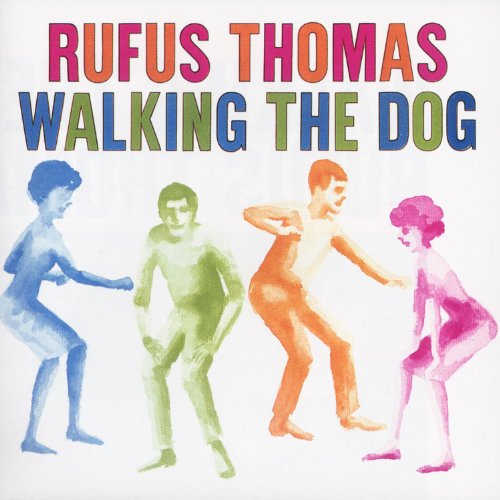
Rufus Thomas: Walking The Dog
[purchase]

At this point, Rufus Thomas is probably best remembered for this fun, nursery rhyme influenced song, but it was only one of his hits, mostly novelty dance songs, often about dogs or other animals, in a long musical career that started as a child tap dancer on the streets of Memphis in the 1920s, and included stints in minstrel shows in the 1930s, as a vaudeville performer in the 1940s, as a songwriter, performer and DJ in the 1950s, as a popular recording artist in the 1960s, and he continued to perform and record thereafter, often billed as “The World’s Oldest Teenager” and “The Funkiest Man Alive,” until not long before he died in 2001 at the age of 84.

Thomas recorded for Sun and for Stax, the minister at his wedding was Aretha Franklin’s father C.L. Franklin, he worked for 20 years in a textile factory, he acted in Jim Jarmusch and Robert Altman movies, and he performed with Prince, at the 1996 Olympics, and with the Blues Brothers Band. And his daughter Carla Thomas is considered the Queen of Memphis Soul (and who I missed when I wrote this.)

Pretty much everyone has covered “Walking The Dog,” from the Stones, to the Everly Brothers, to the Flamin’ Groovies, as well as Aerosmith, Roger Daltrey, Bruce Springsteen (in an epic 14 minute plus version), Ratt, The Grateful Dead, and John Cale. And many, many more.  Even in Finnish! But Thomas’ version, with its New Orleans influenced style, and the joy that he brings to the silly lyrics, is still remembered because it is just that good.

And yes, it mentions July.

As I was writing this piece, I thought back to walking our family dog, Strummer, who died back in 2014. In July. You can read more about him, and our relationship, here.

Friday, March 30, 2018

Steps & Stairs: Springsteen/Into the Fire


purchase [The Rising]

I recently read a poignant piece about fire-fighters ( The Perfect Fire) in which stairs played a major role. Obviously, a lot of the work of firefighters involves stairs, multiple flights of stairs in dark, smokey and deathly conditions. Granted, they are trained for these conditions, but there are always surprises and the job isn't one most people would likely choose off hand.

The article covers the story a multistory fire in Worcester, MA back in '99.
In a large multistory building, it's pretty crucial that the firemen keep precise track of their location. They've got tools: GPS locators, "squawkers" that emit sounds and live wireless/walkie-talkies as well as a lot of primitive [Hagar the Horrible] tools.

But sometimes that whole collection isn't enough.
When a fireball comes at you, none of the above may suffice to save you on its own. And so, sadly, in the case of [The Perfect Fire] - a more or less abandoned warehouse.

Fire-fighters may be the epitome of the working "man" - a thankless job without which society would be more or less paralyzed - kind of like the McDonald's employee? And Springsteen has always been a man pretty much in tune with the working man. He has sung <Factory>, <Working on the Highway>, <Jack of All Trades> ...

<Into the Fire>, from Springsteen's 2002 album The Rising is an anthem about these heroes. The album has been widely ID'ed as Springsteen's "response" to 9/11, with songs titled <Empty Sky> and <City of Ruins>, the claim seems pretty obvious. But there is much more than "the people who put out fires" in his lyrics and equally in his voice:
It's a song about sacrifice.
If I am not reading too much into the song, there's also a cross-over between an actual fire and the emotional/physical fire some may feel from some kinds of love - Love can burn and empower at the same time. Although not explicitly stated in the lyrics, it seems pretty clear that the fire-fighter referenced is a woman.

He sings:
It was dark, too dark to see, you held me in the light you gave
You lay your hand on me
Then walked into the darkness of your smoky grave
Somewhere up the stairs into the fire

Monday, August 7, 2017

Chaos/Confusion: Disorder In The House


Warren Zevon (w/Bruce Springsteen): Disorder In The House
[purchase]

Warren Zevon is one of those artists whose music I’ve enjoyed and appreciated over the years without ever really being a fan, or learning all that much about him. There’s just so much music out there, and so little time. David Letterman, on the other hand, was a huge Zevon fan. He was a guest on Letterman’s various shows more than two dozen times, and even filled in 20 times as bandleader when Paul Shaffer was unavailable.

Back in 2002, Zevon was diagnosed with lung cancer, and shortly afterwards appeared as the only guest on Letterman’s show. Their interview soon became a classic. Letterman’s respect and compassion for his dying subject, coupled with Zevon’s unflinching honesty and humor (which gave Letterman the opening to be funny, too) is striking.  During the course of their discussion, Zevon responded to Letterman’s question about his new-found understanding of life and death with the phrase “Enjoy every sandwich,” which became a pretty well-known distillation of his life's philosophy. Zevon also performed three songs on the show that night. The Letterman show is worth watching, and you can see the interview here, the performance of “Mutineer,” here, “Genius” is here, and Letterman’s request, “Roland The Headless Thompson Gunner” is here. And Letterman's and Shaffer's heartfelt announcement of Zevon's death about a year later is here.

At the time of the Letterman interview, Zevon had recently released an album whose title, My Ride’s Here, seemed eerily prescient in retrospect. But to be fair, his prior album was called Life’ll Kill Ya, so it is probably more fair to say that he was comfortable with his death as a concept, not that he had any mystical foreshadowing of his demise.

After his diagnosis, Zevon worked on his last album, which ended up titled The Wind. It is hard to listen to the album without feeling that Zevon was trying to sum up his tumultuous life and preparing for its end. It includes 10 original songs (or co-writes with his long-time collaborator Jose Calderón), and a poignant cover of Dylan’s “Knockin’ On Heaven’s Door.” The album included numerous high profile guests, including Mick Fleetwood, Jackson Browne, Joe Walsh, Tom Petty, Billy Bob Thornton, Dwight Yoakam, T-Bone Burnett, David Lindley and Emmylou Harris.  While the album contained its share of contemplative ballads, Zevon could still rock and show his trademark twisted humor, most notably with guest Bruce Springsteen, who shared vocals and played electric guitar on the raucous “Disorder In The House.”

The song lays out the chaos and confusion in the titular house--overflowing bathtubs, falling plaster, doors coming off their hinges. It’s so bad that “even the Lhasa Apso seems to be ashamed.” Then, it becomes clear that the song is about criminals being chased by the police, but it appears that the narrator escapes.

To me, what is most memorable about the song is the fun that Zevon and Springsteen seem to have performing it. The Wind was released two weeks before Zevon died, at the age of 56. The album received five Grammy nominations, including Song of the Year for "Keep Me in Your Heart," and it won two Grammys, for Best Contemporary Folk Album, and "Disorder in the House" was awarded Best Rock Performance by a Duo or Group With Vocal. These were the first Grammys of Zevon's career, and I suspect that he’d be chuckling to himself if he knew what it took for him to get them.

Wednesday, April 12, 2017

Steel: Steel Mill—He’s Guilty (The Judge Song)

[purchase Chapter and Verse]
[purchase Born to Run (the book)]

What would Lynryd Skynyrd have sounded like if it was fronted by a kid from Jersey named Springsteen? Check out “He’s Guilty” by Steel Mill, a band from 1969-70 featuring Bruce Springsteen on vocals and guitar, future E Street Band members Danny Federici on keyboards and Vini “Mad Dog” Lopez on drums, and “Little” Vinny Roslin on bass.

Bruce’s first band was The Castiles. When that band broke up, he joined a hard rock band called Earth, then formed Child, which then became Steel Mill, when another band had already registered as Child. As Springsteen described Steel Mill in his excellent autobiography Born To Run:

It was blue-collar, heavy music with loud guitars and a Southern-influenced rock sound. If you mixed it up with a little prog and all original songs, you had Steel Mill . . . you know, STEEL MILL . . .like LED ZEPPELIN… elemental-metal-based, bare-chested, primal rock. 

After becoming a big deal in Jersey, and somewhat surprisingly, in Richmond, Virginia, the band decided it needed to head to San Francisco and teach the hippies about rock n’ roll. Auditioning at the Matrix (the club co-founded by Marty Balin of the Jefferson Airplane) they got a gig opening for Boz Scaggs, Elvin Bishop and Charlie Musselwhite. Steel Mill was apparently good enough that a critic from the San Francisco Examiner wrote, “Never have I been so surprised by completely unknown talent.” Shades of Jon Landau’s famous quote from a few years later, "I saw rock and roll's future and its name is Bruce Springsteen.” You can hear a bootleg of one of the Matrix shows here.

Steel Mill got to play a few shows at the legendary Fillmore (where Bruce heard future band mate Nils Lofgren’s band Grin perform), and were well enough received that Bill Graham offered to record demos, one of which was “The Judge Song.” But nothing happened. Instead, they returned to New Jersey, where they could make a living.

Over the next few years, Steel Mill went through personnel changes (including a period with Steve van Zandt on bass). Springsteen explored different musical styles in bands named Dr. Zoom & the Sonic Boom (early- to mid-1971), the Sundance Blues Band (mid-1971), and the Bruce Springsteen Band (mid-1971 to mid-1972), before getting signed to Columbia Records and, ultimately forming the E Street Band.

“He’s Guilty” was never officially released until last year’s Chapter and Verse, the companion musical collection to the autobiography. The official version is edited down a little from the original, which can be found on some bootlegs, but I couldn’t find one online to post.

Wednesday, June 15, 2016

Roads/Streets: Thunder Road


purchase [Thunder Road]

Roads ahead. Roads behind. Roads leading everywhere. I recall a story off a 60's comedy album called <Bert and I> wherein the humorist explains that "come to think of it, you can't get there from here".

Bob Dylan sang about roads more than once (On the Road Again and many many other songs that include references to roads  such as Tangled Up in Blue's 'by the side of the road'...." and this song that includes the lyrics "how many roads.." . A few blues-men sang about cross-roads and other roads. Seems like if you are a musician, you sing about some kind of roads. And then Bruce Springsteen sang about roads. Thunder Roads.


There's a certain - limited -  American romanticism in the image of Jersey streets/life - the probable venue for Thunder Road- it being Springsteen's home turf and evocative of the events in the lyrics.
In the late 70s Springsteen was one step short of rock god. Heck - most polls still place him at or near the top of their charts.  The <Born to Run> album  has been voted and re-voted as one of the best because it includes: "Thunder Road" , "Tenth Avenue Freeze-Out"  ,"Born to Run"   , "She's the One"  and " Jungleland". And the E-Street Band (apropos our theme) includes "street".


Thunder Road leads off the album. According to multiple web sources, the song has been through a number of revisions (the girl is now Mary, previously Angelina or Chrissie; now out of here ... previously ...) On occasion a solo/acoustic rendition, at other times, the full power of  the E-Street Band  in force,  the song may be Springsteen's best. There's more than one essay written about it: the Jersey kid who aims to "make it good somehow ... pulling out of here to win"


Aside from the obvious (title), there aren't many direct "road" reference in Springsteen's lyrics : "...two lanes...", "... dusty beach road..." and "savior to rise from these streets", but there are many about cars: burnt-out Chevrolets .. wings on wheels...roll down the window and more. The Internet informs us that Springsteen had a '57 Chevy with fire/flames painted on the body.

Sez the Boss: there's magic in the night

Friday, February 5, 2016

The Accordion: 4th of July, Asbury Park (Sandy)


" 4th of July, Asbury Park (Sandy)", better known as "Sandy," is early Springsteen and the E Street Band at their poetic best, a beautiful image-laden tone poem about Asbury Park, New Jersey, where Springsteen cut his teeth as a young musician, the place that made him, in many ways. Or perhaps his legend—it’s hard to separate the two.  "Sandy" is a wistful, fairy-tale ode to ‘home’, or at least a place that is home in the heart, much like The Clash's tribute to London in London Calling and Van Morrison's Belfast in Cyprus Avenue, evoke more than just a sense of a place.

"Sandy," from Springsteen’s second album, The Wild, the Innocent & the E Street Shuffle, is a beautiful little ballad that shuffles and skips along, mostly due to dearly departed accordionist Danny Federici's lilting and elegant accordion line. Federici, a founding member of the E Street Band, passed away in 2008. The song is a love song, for a girl, for a lifestyle, for a certain place in a certain time, destined to never really come back again, thanks to the way youth speeds away from us and leaves us with just memories. Hopefully, good ones—and the best part of good memories is how much better they get with time.

Robert Santelli, in Greetings From E Street:The Story of Bruce Springsteen and the E Street Band, describes the song as “the perfect musical study of the Jersey Shore boardwalk culture.” The song is populated with the eccentric, vibrant characters that populated many of Springsteen’s youthful, Dylan-inspired street epics: switch blade kids, tramps, factory girls…all those faces that made Springsteen’s street-scene operas such wonderful pieces of not only music, but poetry as well.


His greatest work in regards to the neon, asphalt and brick fables is Jungleland, but it is "Sandy" that invokes a sense of nostalgia, even for places an times that the listener might have no claim on at all. Springsteen is that kind of writer: universal in the experiences he relates.  But, here it is Federici’s accordion that makes "Sandy" such a beautiful song, that as the major aural element works to emphasize the sadness that sits underneath the bright sun and the brash joking of the narrator, trying to get right, but just not making it. The accordion here sounds like youthfulness, it sounds like the carnival. It sounds, truly, like a a whole soundtrack to memory.

The E Street Band still brings this tune out, as a tribute to Federici, much as 10 Avenue Freeze-out is done now as tribute to the Big Man, Clarence Clemons. That’s a hell of a thing: a song that comes to serve as a monument to one who made it sound so distinctive.  "Sandy" has always a special place for E Street Band fans, and will now stand not only as memory of Danny Federici, but as a hat tip and a wink to youthful days, long gone by…