Welp ... it looks like SMM posts for this theme never got in to the alternate meaning of <fast> timed to fit the Islamic month of Ramadan, where believers fast from sunrise to sunset. Our theme looks set to end here; Ramadan in a few days. Here is a food-related post to compensate or celebrate.
Pete Townshend/The Who has something for musicals: Tommy ... Quadrophenia ... The Iron Man ... more? The rock musical is not exactly a grossly popular format but there are several more than I was aware of sprinkled among the 75+ listings at the Wiki - some Lloyd Webber, Pink Floyd's The Wall - but also Paul Simon, Green Day, Bono ... have a look.
Townshend's Iron Man eats heavy metal as well as fast food. Fast? you say. In the Ted Hughes book from which the musical is adapted, the iron man wreaks havoc by eating industrial farm machinery- until he changes his mind and saves the world from a space alien. ... sci-fi from '68 adapted with Hughes' support and turned into a musical after several re-writes by Townshend and David Thacker, Director of the Young Vic theater at the time.
The lyrics are extensive - lines and lines of somewhat rique material: rich in connotation and, as ever for Townshend, critical. In this case about, of course, fast food. The album where it appears is kind of a off-spring of the full musical, which was still being cobbled together in 1989 when the album was released. According to at least one critic, the song following Fast Food (I Eat Heavy Metal) had the potential for a more raucus rendition, but both- to my ears - sound like The Who. Nina Simone is credited with the vocals but it sounds to me like mostly Townshend (but then again, I don't really knoiw much about Simone). Daltry and Entwhistle also perform on the album, which is not a Who album since the band had since disbanded. Kind of: Superbowl XLIV anyone?
You can read a lot lot more yourself here in an extensive, entertaining and informative read at petetownshend.net
And a snippet of the lyrics, for your eyes (for your ears is at the top of the page):
I don't even want it killed
If it's dead I heave, it makes me sick
So check that it can breathe and bring it to me quick
I'm of the age where Steppenwolf's <Born To Be Wild> was a head-banging hit (before "head-banging" was a thing) This would have been '68 or '69. <Born to Be Wild> came out on their 2nd album in late '68, so it would have been '69 for me, considering the inter-continental delay in the pre-Internet world (we did have radio wave technology, so ... maybe '68)
Original band members brothers Dennis and Jerry were members of a Canadian band called The Sparrows (along with Bruce Palmer - later of Buffalo Springfield) who, along with John Cay, Goldy McJohn also of the Sparrows, then formed Steppenwolf. The brothers changed their surname to Edmonton, and it is Jerry - the drummer- who is credited with writing <Born To Be Wild> as well as the song behind this post: <Faster Than The Speed of Life>. Speed of light?
As for the band name: Steppenwolf ... there's an air of roughness embedded in the name itself (that would be the wolf part) ... and Steppen is ...? Fast? As in stepping? (probably not) , but the word is related to the English word step/walk.
Then, there's the whole Hermann Hesse "craze" of the late '60s, where every school in the US was requiring its student to read Hesse's Siddhartha and Steppenwolf. I have to believe that the band could not not (=must) have been influenced to some degree by this '60s Hesse meme (and ... meme was not a word then? yes/no ...it was not: introduced to English in 1976)
Steppenwolf mostly utilized the simplistic 3-chord musical progression and made the most of it: I-IV-V, in musical literature - actually the basics of much of rock, but essential to their formula for the short time they were at the top of the charts. But top they were: Born To Be WIld was .... Faster Than the Speed Of Life was not... and while both are fairly fast, tempo-wise, only the latter qualifies for our post this time.
But you should still listen to Born to Be Wild once again.
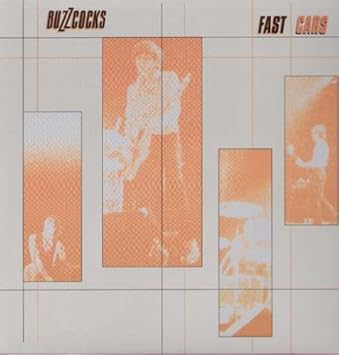
Last week, “Fast Car,” this week, “Fast Cars.” Despite the similarity in the titles, the songs could not be more different—Tracy Chapman’s is a soulful folk song, while Buzzcocks’ is a hard chunk of punk. But both are great in their own ways.
My introduction to Buzzcocks came, as so many of my musical discoveries did, in the basement studios of WPRB. I’m pretty sure that it was the singles compilation, Singles Going Steady, filled with perfect morsels of melodic punk and heartfelt lyrics about love and sex and heartbreak, that was my gateway. It came out in 1979, and I played it regularly. Their next album, A Different Kind of Tension, came out around the same time, and was also great, although it was a little more experimental.
I don’t think that I spent a lot of time investigating the band’s two earlier albums, both released in 1978, Another Music In A Different Kitchen, and Love Bites, probably because there were so many great songs on the two albums that I already knew better. I’ve subsequently learned about the earlier music from some compilation albums I picked up over the years.
Buzzcocks never got the same respect as their contemporaries The Sex Pistols or The Clash, and I’d argue that they were way, way better than the Pistols, and that their limited output approaches The Clash’s in quality during the same period. However, Buzzcocks' relatively short life as a band (pre-reunions) prevented them from showing the same growth as The Clash did in their masterpieces London Calling and Sandinista! (a flawed masterpiece, I’d say). And, remarkably, although they’ve been mentioned on this blog in passing (and in a cover), there has never been a post that featured this amazing, influential band.
Founded in 1976 by Pete Shelley and Howard Devoto, they eventually added bassist Steve Diggle and drummer John Maher and self-released an EP, Spiral Scratch. Devoto left the band (and soon formed Magazine), Shelley became the singer, Diggle moved to guitar and Garth Davies, who had been in an early version of the band, rejoined on bass, rejoined, only to be again replaced by Steve Garvey (not the baseball player).
Signed by United Artists, their great first single, “Orgasm Addict,” was banned by the BBC, because, you know, sex, and they commenced to release the series of excellent singles that were later compiled on Singles Going Steady.
Their first studio album, Another Music In A Different Kitchen, included the single, “I Don’t Mind,” which charted at number 55 in the UK Singles Chart, as well as “Fast Cars,” a song that was mostly written by Diggle in response to a car crash that he had endured. It is a typically fast and catchy song that criticizes the titular vehicles, and namechecks Ralph Nader. It seems that Mr. Diggle hates fast cars.
The band broke up in 1981, after a dispute with their record company, reuniting in 1988, with varying lineups over the years. Shelley died of a suspected heart attack in 2018, but Buzzcocks have soldiered on with Diggle taking over vocals.
Our head honcho here at SMM sends out our homework on just about every second Saturday, with a handy explanation of how it may be tackled: what the words mean, how it may be interpreted and, often, links and examples to songs, bands and whatnot, that could bear association, however arbitrary. Anything, really, to stoke the fires of inspiration. My brief is to steer as far astray.....
So "Fast", as well as vroom vroom, is a verb to abstain from food, whether for health or for religious goal. The latter is a common concept, the Bible honing in on forty days (and nights) as the ideal length to achieve peak asceticism. Bonus points if spent in the wilderness. Plus, of course, in Islam there is the yearly rite of Ramadan, conveniently ongoing now, whereby followers forgo food during daylight hours. An old workplace had an extensive moslem workforce, Monday night monthly meetings torture for them, as the rest of us tucked in to the bribery of sandwiches. Then, at a decreed moment, suddenly, the day ended, and they dived in to whatever was left, breaking their fast. Hence also breakfast, the end of the fast we all undertake overnight, give or take midnight munchies. And the catalogue of songs about breakfast is as enriching as a full english of sausage, bacon, eggs, mushrooms, beans and black pudding. Oh, and tomatoes, lest anyone think it unhealthy.
Given the Yusuf/Cat Stevens song linked above, it is quite by chance that this song carries a distinct middle eastern flavour to its opening. The impeccably no notes knowingly underused vocal of the brilliant late Billy McKenzie are plastered all over the melody, and it is one of the highlights of the Associates 1995 third album, Perhaps. So ahead of the time was McKenzie, ahead of any time, arguably, it was widely slated at the time, with the passage of time being far kinder than the critics of the day. I love it and his bonkers vocal cascades. The lyrics, as was entirely normal for the band, seem to bear little application to the meal in question, other than a passing mention. But I'm not going to let that deny me featuring th song.
No such frippery with good old Bill Callahan, breakfast: its preparation and its delivery is all the song is about. OK, so a subtext about anorexia might also be in there, but Bill has such a deep inviting bathtub of a voice, it's more about the sound. I would have liked to know what the menu featured. I'm guessing eggs are featured, no doubt 'over easy' or some such americanism. A newer song than often featured here, from his 2020 recording, Gold Record, but I just so love this guy's voice as to feel it churlish not to include it. Funnily enough, although I never bother with it, when I do indulge, it could also be my favourite meal of the day.
Is bed and breakfast a thing outside the British Isles? The idea of a room for hire, with purpose self-explanatory. Not a hotel, a private house, often with a formidable harridan at the helm, letting out her rooms, providing a cooked meal in the morning, ahead of booting you out on your arse until the evening, whereupon you could return, alone, no guests, to your room. Seaside towns have street after street of them. OK, the picture I paint is as dated as the world within all the songs by Madness, the endearingly chirpy ska band with a way both for the gaucheness of English life and the rose tint they apply to it. Hugely successful over four decades, they translate especially badly to countries where the language is supposedly the same. The bed and breakfast man of the song is, I suspect, rather than a frequenter of such establishments, more the sort of chap capable of treating the bed of his paramour as if it were such.
An instrumental interlude courtesy the genius of Norman Blake, a consummate artist on any stringed instrument you might ever mention, guitar through mandolin, banjo and dobro. Here, effortless finger picking evokes the joys of an eye-opener, that pre-solids shot of the hard stuff that rightly gives drunks such a bad name, the first tune displaying that he'd had the (absent) fiddlers ration too. A US national treasure, he is not to be mistaken with the same named weegie guitarist with Teenage Fanclub, himself not averse to a song about the demon drink. Time of drink taken not alluded to.
One of the disappointments that comes with continental travel is the continental breakfast, paltry fare where the only hot thing provided is, if you are lucky, a hardboiled egg, plonked alongside a cold croissant and the end of last nights baguette. Sue Foley, a Canadian blues singer and guitarist, perpetually number three in the rankings, behind Bonnie Raitt and Susan Tedeschi, has clearly toured Europe and tries to excite the table with some local colour. I think I'd sooner have breakfast in Texas.....
Way the world's going, what we need and what we need now is some head's down, no nonsense, mindless boogie. (No, not that one.) After a disastrous start, UK has begun to vaccinate itself to a state of current easing, but large parts of the rest of the world are daily scuttling ever more perilously to the edge of wipe-out. How to, what to, why to? None of this I know any more, but, in the avoidance of the harsh and bleak, new variants willing, grant me a couple of minutes of escapism.
Brinsley Schwarz were and are a staple of my listening pleasure. Actually the name of one of the guitarists, the name became that of the band, bastions of the burgeoning UK pub-rock scene, that pre-punk escape from the scourge of prog pomp posturing, embracing flavours of country, blues and soul into short punchy songs. Nick Lowe was the most lauded member, going on, via Rockpile, to build himself a healthy solo career that runs to this day. (Not all healthy: down on his luck in the early 90's, the chance pick up of one of his songs for Hollywood blockbuster, The Bodyguard, was said to have led a cheque, for a seven figure sum, dropping into his postbox. Which must have been nice.) Other members later found their way into Graham Parker's Rumour. BS, the band, were as famous, at the time, for a disastrous promo exercise, going disastrously wrong, whereby they were flown to the Fillmore East, NYC, for a showcase gig in front of a throng of top music biz journos. Late on arrival, unpractised and under-rehearsed, with pick-up kit, it was a fiasco, with them laughed out of town and pocket. Astonishingly, rather than throwing in the towel, they picked themselves up and built themselves a strong grassroots following, back from the bottom, producing a run of well received records. This is typical of their style, a bucolic mix of keyboards and choogling rhythm. But, never enough a concern to make their fortunes, and they folded their four year career in 1974. The song comes from their 1973 album, 'Please Don't Ever Change', and was written by Lowe.
Ironically, shortly before they split, one of their final gainfully was to back Welsh retro-rocker Dave Edmunds on tour. Edmunds and Lowe hit it off and the next step was the formation of Rockpile. Initially, again, Edmunds' group but they gradually became co-pilots, the band then backing each other on each of their then solo output recordings, and then a specific Rockpile as a band album release, 'Seconds of Pleasure'. The band, a four piece, with later 2nd generation Pretender Billy Bremner on additional guitar and vocals, and later Dire Straiter Terry Williams on drums. I really expected huge things for them, but the honeymoon bubble burst, and they split, their legacy hidden as much in those solo albums, and that of Lowe's then wife, Carlene Carter. (Yup, that one, Johnny Cash's step-daughter!) Their version of the featured song eschews some of the melodic swagger for an altogether more muscular take, guitars to the fore and no piano. But no less pleasurable. (And, special credit clearly must here go to the video, one of several made by Garren Lazar, all featuring the Peanuts Gang giving their best to a whole host of songs, culled from all genres and all decades.
But the song was not dead, and it took Nashville country-rockers BR549 to kick some yee-haw sawdust in the face of the song, adding some fiddle and altogether western swing flavours that give yet more zest than the versions before. From their 3rd 2001 album, 'This is BR549', this has them perched between a traditional country take and some of the more populist hat act territory of the time. This song bestrides that fence perfectly.
That's it, no message, no preaching. That is beyond, if and when in doubt, Play That Fast Thing One More Time!!
This is my third piece in a row focusing on a Black woman. I’m not sure why, but I realized the other day that my wife and I have, over the past few months, watched five movies/TV shows (it is hard to tell the difference these days) about legendary Black women singers—Ma Rainey’s Black Bottom, Aretha, The United States Against Billie Holliday, Tina, and Mahalia. (Plus One Night in Miami, in which one of the main characters is a Black male singer). How much of the fact that so many fine films featuring mostly Black casts is a result of the agitation about the whiteness of the Oscars? And how much did the fallout from the George Floyd killing, and the other killings of Black Americans over the past year, convince studios to release, and people like me to watch, films like this?
So, once again, I’ve forced potential readers to wade through a paragraph that is, basically, unrelated to the song I’ve chosen to discuss. Maybe that’s why I write these things for fun and not money (not that anyone’s offering), because it allows me to go off on tangents. Like I just did there, again.
But let’s get to the meat of the topic.
Tracy Chapman’s 1988 song “Fast Car,” from her self-titled debut album is an amazing song on so many levels. It is so good, in fact, that one writer declared that it “essentially revived the singer-songwriter movement.” I’m not sure I’d go that far, but it didn’t hurt—and the fact that Chapman was Black, which was unusual in a genre that had become pretty white by that point, was another reason that the song was noticed.
The song also has a great “discovery” story. Shortly after her debut album was released, Chapman was part of a megastar-studded bill for the Nelson Mandela Birthday Concert in 1988 at Wembley Stadium. She had completed a three-song set and cleverly stuck around. When Stevie Wonder went to perform, he discovered that the hard disk for his Synclavier was missing, and he walked off the stage in tears (he did, eventually, return using borrowed equipment). Chapman was asked to go again, and she agreed, doing two songs, including “Fast Car.” It went over big.
But the real reason that the song became a hit (No. 6 on the Billboard Hot 100), and got a Grammy for Best Female Pop Vocal Performance (and another for Chapman as Best New Artist and the album for Best Contemporary Folk Album) and MTV Video Music Award nominations, is that it is an incredible piece of songwriting, delivered brilliantly by Chapman in her rich contralto voice.
“Fast Car” is, however, a pretty depressing song. The first stanza describes the singer’s desperation:
You got a fast car
I want a ticket to anywhere
Maybe we make a deal
Maybe together we can get somewhere
Any place is better
Starting from zero, got nothing to lose
Maybe we'll make something
Me, myself, I got nothing to prove
We learn why she wants out in the next few stanzas—she’s working at a convenience store, had to drop out of school to care for her alcoholic father after her mother left him. But it’s not only the car—it’s the owner, who when they drove, made her feel like she belonged and could be someone. It’s a dream that dies all too quickly—she works, he stays out late, drinks and ignores their kids—and she sees no future.
And in the last stanza, she lays it out:
You got a fast car
Is it fast enough so you can fly away?
You gotta make a decision
Leave tonight or live and die this way
Anybody want to wager on whether or not they left?
Star Maker Machine does not accept music submissions from artists or promoters. However, most of the contributors here do accept submissions for our own blogs, listed below. Please visit our blogs, take the time to listen to what we post, and then feel free to contact us if you feel that your music would be a good fit.




























:format(jpeg):mode_rgb():quality(90)/discogs-images/R-5947127-1435056219-4942.jpeg.jpg)


