










Showing posts with label The Who. Show all posts

Friday, August 12, 2022

THUNDER & LIGHTNING: CALL ME LIGHTNING

I have always found the idea of the Flaming' Groovies decidedly enticing and enthralling. Even before they ever came into my personal earshot. Long before, in truth. For a while, in the early thru' mid '70s they seemed to have a permanent feature in the inky pages of the hipper than thou UK music press, peddling a mythology that so appealed to my teenage fantasies. My understanding was that they had hopped over the ocean for some such tour or other, thereafter becoming stranded, destined to eke a basic existence in the bars and clubs of London. The truth? A little more prosaic.

Let's start now, as the band have still a footprint, although that may have faded with the death, in 2019, of original member, Ray Loney. Although he had left the band in 1972, he was deemed integral enough to be granted special guest status on the 2019 tour, during which he sustained the fall that precipitated his demise and possibly that of the band. He had kickstarted the band, a gaggle of snotty nosed brats in 1965 San Francisco. With an initial foray into the A Mighty Wind type folk music of that day, the Rolling Stones seemed a far more potent influence, and he linked up with teenaged guitar poser, Cyril Jordan and George Alexander, a school friend told to learn how to play the bass guitar. With Tim Lynch on 3rd guitar, alongside Loney and Jordan, and, eventually, drummer Danny Mihm, image was as much their calling card as their scuzzy and scuffed r'n'b, all chelsea boots, shades and attitude, snarled vocals, spiky guitars and harmonica, propelling an ugly, organic rhythm. Their debut, a home-recorded and released EP, Sneakers, came out in 1968. That got them a deal with Epic records and a somewhat chaotic first long player dropped the following year. The label dropped them and they spent the next year or so on the road, honing their craft and toughing up. Kama Sutra then picked them up, with their second release for that label, Teenage Head, hitting the zeitgeist, if not the charts. No less than Mick Jagger rated it highly, comparisons being made to the Stones own Sticky Fingers. Loney, with his heart more in the rockabilly roots he had always been in thrall to, here jumped ship. Which is roughly where we came in.

I'm Drowning (1968)

Dropped again by their label, and struggling to find another, it was the unlikely haven of the UK that threw them a lifeline, via the British division of United Artists. (The US end of the organisation had not been so enamoured.) With Chris Wilson, another youthful wannabe guitarslinger, drafted in to replace Loney, and whose musical preferences aligned more with Jordan, and a new drummer, it was off to Rockfield studios in Wales they headed. This was 1972. Dave Edmunds, himself having made no small waves in an energetic amalgam of 50s style and 60s melodicism, each with a keen rock rhythmic core, was hired to produce. With hindsight, the product they there produced was probably their finest hour, including, as it did, their perhaps best known song, Shake Some Action, not then able to see the light of day.

Shake Some Action (Remastered 1976 version of 1972 original at Rockfield)

But that promise came to nought, UA not liking so much their direction as they had thought, the deal dissipating into a pair of singles. Flailing around somewhat, the band oscillated, seeking further deals and shedding drummers at a pace. Action was ultimately released, albeit in re-recorded form, on Capitol, itself not without delay, down to internal brouhahas within that company. Meanwhile, record executive Seymour Stein was setting up his new label, Sire. Without it being a major, he had the knack of hitting on zesty acts with counter-cultural and counter-intuitive appeal, garnering a roster of hip acts. Ideal for the Groovies, who found themselves back in Wales and back with Edmunds. No wonder I thought they had never been away, and their 1976 album, of the same name, finally allowed the original 1972 versions of it and a couple of other songs from those sessions, along with some new stuff, to reach the record racks. With Sire then taken over by Warner Brothers, they now had some muscle behind them.

Shake Some Action (later version)

Plain sailing ahead? Well, no, this is the Groovies, remember, never much in favour with Lady Luck.Memebers started coming and going, although the Jordan, Wilson, Alexander trio kept a grip on the baton. Sire too bounced them in 1990, and even the aggressive management style of Elvis Costello manager Jake Riviera couldn't stop them flailing between labels, their image never quite that of the team in charge of their promotion. History tells us their style was power pop, just that nobody quite ever twigged that point at the time. Eventually, in disarray in 1991, with their catalogue scattered across multiple rights holders, they split. Perhaps just as their songs, courtesy appearances on any number of samplers and collections, were becoming better known.

Teenage Head (1971)

Fast forward a further few years. Since 72, Loney had remained in the music business, on occasion with other erstwhile members of the band. When the film, Clueless (1995) included Shake Some Action on the soundtrack, that was impetus enough for him to put the band name back into use, despite having had nothing to do with that particular song or that version of the b(r)and. Coaxing Jordan back into the fold and they were off. Over the next decade there would be sporadic appearances, usually just Loney and whoever he could find, sometimes with Jordan too. With that duo, a UK tour, in 2009, led to a serendipitous hook up with Wilson, himself now a UK resident, and the founder of the not un-Grooviesesque Barracudas, self styled surf-punks. Wilson, relishing in the reconnect, put out a run of solo albums, each recouping as many of the old gang as he could, with core member Alexander and various other ex-Groovies also present, alongside he, Loney and Jordan. One of these was even entitled It's Flamin' Groovy. 

Gamblin' Man (2013) - Chris Wilson feat. Ray Loney

By 2012 it seemed logical to go the whole hog, and the band were once again an item, with Jordan, Wilson and Alexander, but Loney again on the bench. 2017 even saw a new album, Fantastic Plastic. To be fair, consistency of both material and line-up was hard to maintain, and it was often a case of whomsoever was available, willing or present, as first Alexander again dropped out and, then, Wilson took a break. This was where Loney again popped up and in, if in a nominal guest role. 

End of the World (2017)

Is that it? Uncertain has to be the answer, at leat while Jordan and Wilson survive, arguably equally so Alexander. Wilson is now back home in the States, and has supposedly semi-retired. Jordan? Who knows, but, as the co-writers of their most famous song, never say never. 

Here's a live version featuring both of them, from 2013:


(What about the song in the subject, I hear you say? And yes, you are entirely right, it is more a shoehorn to get the Groovies into a post. And, yes, you probably have heard it before, it being a cover of the Who's first 1968 US single release. I found this version on one of the legion of dodgy compilations out there, cobbled together by various offshoots of various record companies, all trying to make a belated buck on the back of the Groovies. It appears on Replays: Groovies Greatest, a double CD I picked up for a couple of quid in a supermarket, and that reawoke my dormant interest in this unluckiest of bands. Here's the original version.)

Buy some Groovies!

Wednesday, August 3, 2022

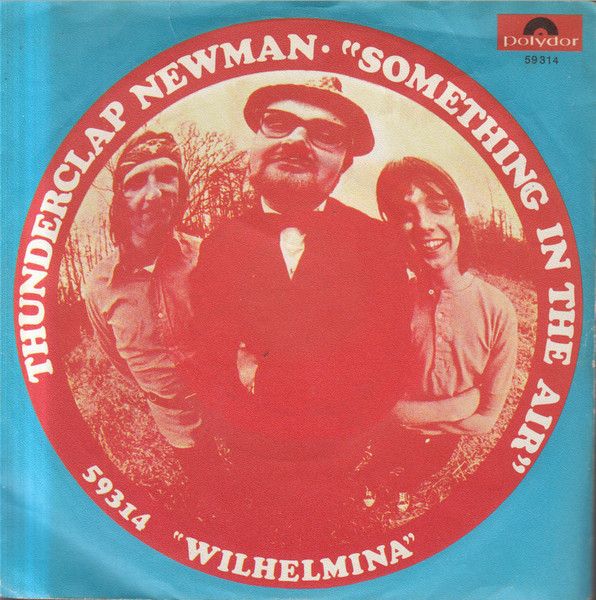
Thunder & Lightning: Thunderclap Newman


Thunderclap Newman: Something In The Air
[purchase

I suggested this theme during a summer thunderstorm, but when I started brainstorming ideas for a post, the band Thunderclap Newman jumped into my brain and wouldn’t leave, so there are no (other) storm references here. 

Like most people, I bet, I could name exactly one song by Thunderclap Newman, the wonderful “Something In The Air,” but no others. I’ve mentioned before the “classic rock radio” syndrome (although I’ve never called it that), where bands are remembered only for a handful of songs—or even in this case, for one song—and the rest of their discography gets forgotten. I’m sure you have your favorites, and I’ve even used “Something In The Air” as an example in an earlier post. I also knew that Pete Townshend produced their album, and that he played on it, under a pseudonym, although I didn’t know what that was (Bijou Drains). But that’s pretty much it. 

The band was assembled by Townshend in 1969 as a vehicle to support the songwriting and other talents of John “Speedy” Keen, who wrote “Something In The Air.” It was an unlikely crew: Keen, who had been a friend of Townshend's and a driver for the Who, had written “Armenia City in the Sky,” the opening track on The Who Sell Out. Townsend enlisted Andrew “Thunderclap” Newman, a postal worker and piano player, and 15-year-old guitarist Jimmy “No Nickname” McCulloch. They met at Townshend’s home studio, and the four recorded a single, with Townshend producing. 

It was a big hit in England, was in a couple of movie soundtracks, and was a minor success in the US, initially. Followup singles were less popular, but the success of “Something” led to the band having to do live performances, augmented by a drummer and bass player who was not Pete Townshend. The band’s album, Hollywood Dream, was released in 1970, to excellent reviews, but only modest sales. After some more touring, the band broke up in the spring of 1971. As Wikipedia noted, “The members of the band had little in common. In a 1972 NME interview, Newman said that he got on with Keen's music but not with Keen personally, while the exact opposite was true with regard to McCulloch.” 

Apparently, Hollywood Dreams is now considered a forgotten classic, with Allmusic stating, “So many bands have been hauled out of obscurity to be tagged the greatest secret you've never been told. Thunderclap Newman are one of the few who actually deserve that epithet.” I admit to only sampling a few tracks, and I have trouble getting past Keen’s reedy voice and the excessive music hall influences, but maybe it takes a few solid listens before the genius is revealed. And that’s why I’ve perpetuated the “classic rock radio syndrome” here, focusing on the one song we all know. 

McCullough went on to play with John Mayall, Stone the Crows, and, most famously, Wings, but died from heroin-induced cardiac arrest in 1979 at the age of 26. Keen’s solo career went nowhere, and became a producer, helming Johnny Thunders and the Heartbreakers’ debut, L.A.M.F. and Motõrhead’s first album (and appears on one of that band’s live albums) and was a session musician before leaving the music industry. Keen died of a heart attack in 2002 at the age of 56. 

Newman recorded an unsuccessful solo album and was a studio musician before retiring until 2002, when he formed the Thunderclap Newman Band, which toured until it disbanded in 2010. Newman formed a new band (which included Pete Townshend’s nephew Josh and the former drummer of Big Country), billed simply as Thunderclap Newman. In 2010 this group released an album, Beyond Hollywood, and toured from 2010-2012, with their last gig at the Isle of Wight Festival. Newman died in 2016 at the age of 73. 

And I’ve made you wait to the end to know why Andy Newman was known as “Thunderclap”—it was a nickname he received in school because of his playing technique.

Saturday, May 8, 2021

Fast: Fast Food


purchase [ The Iron Man]


Welp ... it looks like SMM posts for this theme never got in to the alternate meaning of <fast> timed to fit the Islamic month of Ramadan, where believers fast from sunrise to sunset. Our theme looks set to end here; Ramadan in a few days. Here is a food-related post to compensate or celebrate.

Pete Townshend/The Who has something for musicals: Tommy ... Quadrophenia ... The Iron Man ... more? The rock musical is not exactly a grossly popular format but there are several more than I was aware of sprinkled among the 75+ listings at the Wiki - some Lloyd Webber, Pink Floyd's The Wall - but also Paul Simon, Green Day, Bono ... have a look.

Townshend's Iron Man eats heavy metal as well as fast food. Fast? you say. In the Ted Hughes book from which the musical is adapted, the iron man wreaks havoc by eating industrial farm machinery- until he changes his mind and saves the world from a space alien. ... sci-fi from '68 adapted with Hughes' support and turned into a musical after several re-writes by Townshend and David Thacker, Director of the Young Vic theater at the time.

The lyrics are extensive - lines and lines of somewhat rique material: rich in connotation and, as ever for Townshend, critical. In this case about, of course, fast food. The album where it appears is kind of a off-spring of the full musical, which was still being cobbled together in 1989 when the album was released. According to at least one critic, the song following Fast Food (I Eat Heavy Metal) had the potential for a more raucus rendition, but both- to my ears - sound like The Who. Nina Simone is credited with the vocals but it sounds to me like mostly Townshend (but then again, I don't really knoiw much about Simone). Daltry and Entwhistle also perform on the album, which is not a Who album since the band had since disbanded. Kind of: Superbowl XLIV anyone?

You can read a lot lot more yourself here in an extensive, entertaining and informative read at petetownshend.net

And a snippet of the lyrics, for your eyes (for your ears is at the top of the page):

I don't even want it killed

If it's dead I heave, it makes me sick

So check that it can breathe and bring it to me quick

I want food fast

I want fast food

Frisky little children

Served up in the nude


Friday, April 23, 2021

Double Entendres: Squeeze Box


purchase [ The Who By Numbers]


When I purchased my own first "stereo" back in '71, the merchant included a copy of "Who's Next" in the deal. I have mentioned this before here. Andy La RayGun has also brought it to our attention

Always a fan of the Who/Pete Townsend, I have tried to keep up as he has done side gigs, the NFL Superbowl (however difficult with the group at that age) and more.

The album <The Who By Numbers> includes this piece that might fit the current theme: Squeeze Box.

Ostensibly, a squeeze box is an accordion: you know, the player pulls and pushes/squeezes the box to produce the musical sounds. That doesn't  appears to be the actual subject of the song:

Mama's got a squeeze box she wears on her chest

 .. [daddy] never gets no rest

Yes, the accordion usually rests on the players chest. But more:

She goes in and out and in and out ... [Hmm...meaning what?]

... Come on and squeeze me ...come on and tease me ... [Hmm.. tease the accordion?]

The album studio version is a lot better:


Sheryl Crow does it too


Wednesday, January 27, 2021

OVER: SHAKIN' ALL OVER

Can there be a more evocative intro to a song? The pizzicato guitar plucks, with then the rolling riff of the lead guitar, sounding exactly how a shiver feels, creeping up your back(bone), standing all the hairs up on end. It's glorious. But the version you know is possibly not the version I know, the original failing to cross the atlantic at the time. Which is a pity, as it that rarity, a song of the early pre-Beatle 60s that can still hold its head up, undrenched in the syrupy strings that would spoil most of the UK's rock'n'roll output, often a tawdry and anodyne bowdlerisation of the real thing.

Johnny Kidd and the Pirates were huge during that short period of homegrown rockers, their calling card being their appearance, always in pirate costume, Kidd sporting an eyepatch and a cutlass. With the line up including the now legendary session man on drums, Clem Cattini, the guitar motif, both bits, was provided by one Joe Moretti, a Scot who also played on Vince Taylor's Brand New Cadillac. Number one in 1960, Kidd and his band couldn't hold on to that momentum, each further follow-up bringing diminishing returns, the line-up frequently changing until Kidd was killed, in a car accident, in 1966. For trivia lovers, also injured in that same crash was then Pirate, Nick Simper, later to be a founder member of Deep Purple. The Pirates weren't finished though, and I saw a revived version perform at the famous London pub venue, The Hope and Anchor, in the late 70s. A trio including the dynamic guitarmanship of Mick Green, he was one of the first players to play in a hybrid lead/rhythm style. Somehow, despite their age and portliness, they were lumped into the punk movement, mainly due the speed and precision of their sonic assault. Green was a key influence on Wilko Johnson, who picked up and ran with that style in first Dr Feelgood and then is his own band and with Ian Dury. I remember they did play Shakin' All Over that night, and I was bemused, knowing the song but not why they were playing it, other than the fact it was fast and ferocious. Green later became an integral part of Van Morrison's band, in the days when fellow 60's survivor, Georgie Fame was musical director and organist supreme. He died in 2010.

Wilko Johnson is then a link to the next version, courtesy his still fairly recent album with Roger Daltrey, the excellent Going Back Home, from 2014. Daltrey, of course, the then, the very much earlier and the still vocalist of the Who. Often cited as one of the best live albums of all time, their Live At Leeds, their version is a little slower and has a harder rock sound, with less roll. Legend has it that the only reason they played the song, was to get over the sometime confusion between themselves and Canadian band, the Guess Who, who had had a big North American hit with the song, in 1965. If a confused section of the audience were to muddle them up, and to call out for the song, it was easier to just play it, rather than have to explain. 

(By coincidence, and possibly for the same reason, guess what song the Guess Who played on their possibly less well remembered 1967 Live in Winnipeg opus? Good stuttering practice for a  later collaboration, too.)

Another noteworthy version was by from veteran rockabilly shouter, Wanda Jackson, who possibly shared a stage with Kidd at some time in the late 50s or early 60s. Better perhaps known for another song about shaking, she gave it a delightfully retro twang, including it on her 2011 collaboration with Jack White, The Party Ain't Over.

Quite why the emerging country and blues singer Eilen Jewell included it in her repertoire, on Sea of Tears, I do not know, other than that the idea was to reproduce the twangy tone of that time period, it suiting well her own material, if written nearly a half century later. But I'm glad she did. Still then an avid mix-tape maker, quirky covers were always a welcome discovery to slip alongside other songs I was trying to impress upon friends and family. It meant, in her case, I got to hear more of her own work, liking them and keeping up with her continuing career. Again, her cover is not a radical rewrite, but offered a little more of a western swing to it, with a decidedly more touchy vocal.

Johnny, Rog, Wanda, Eilen.

Tuesday, June 16, 2020

Open/Close: A selection of great albums that start as well as they finish


It's been a while since I've posted on SMM. No excuses--just the unpredictable rhythms of life that sometimes stir a current that takes you in strange directions. Riding the waves hasn't gotten me too far, a few thousand words deep into other projects, but not closer to anyplace special. Missing having a place to talk music with like minded obsessives, and with the permission of the venerable KKafa, who answered the door when I knocked, I'm back. 

SMM is a place I always find the kind of unique connection that good writing and great music can make in a life. And I really missed that.

So, hello. Again.

Our theme is “Open/Close.” I looked through my library for songs about openings and closings, and when I came across the 1998 hit, "Closing Time", by Seminsonic, and felt the familiar, shuddery revulsion that ubiquitous, somehow pseudo-anthem always brings up, and used that as impetus to get a little creative on the theme.

I decided to look at great opening and closing tracks from albums. How important is the first introductory burst of sound from the opening of an album, the signal of what is to come? If it's weak, a song you really don't like, the album as a whole might be doomed. It's a great song, an epic introduction, you'll never forget that perfect sensation of hearing it for the first time. Example: REM's "Radio Song", from 1991's Out of Time, was such a grave sonic let down for me that it kind of ruined the band, once my near beatific favorite, for me permanently. Whereas, "Up The Beach", from Jane's Addiction's explosive Nothing's Shocking, was akin to perhaps seeing the Red Sea part under the hand of Moses. Or something similarly miraculous. Oddly, both albums, while wildly different in so many ways it seems silly to compare them, could have been vastly different, even better, had they been tracked differently. Out of Time really should have opened with "Losing My Religion", that strident, minor key pop mediation on anger, played on a very non-top 40 mandolin; Nothing's Shocking would have been even more epic had it opened with "Coming Down the Mountain", an pure avalanche of a song.

The opening, then, is of the utmost importance. As is the ending. And how many albums end as memorably as they started? It's surprisingly few. But, then, that is my opinion and comes from my lament at the seemingly lost art of the full length album, and the collection of songs as a celebration, not just the single. Growing up, the 45, then the cassingle, was always secondary to the whole LP. The best bands put out the single, and the B-side was the 'unreleased' material. Kind of essential to the rest of the album, a completion of the experience as a whole.  But, B sides that are better than the A is another topic entirely. 

I scrolled through my Spotify feed (Sadly, I don't have a single CD, LP, or cassette in my possession right now), and found what I thought might be a good start to, and by no means exhaustive or exclusive, list of a handful of the greatest pairings of opening and closing tracks to feature on an album.

In no specific order, I posit the following opening and closing tracks to be the GOAT

The Rolling Stones, Goat's Head Soup: Side A, track 1: "Dancing With Mr. D"; Side B, Track 5: "Star, Star".  Wicked, naughty, steeped in dark arts,  these two songs provide the caps to my favorite Stone’s album ever. 1973's Goat's Head Soup, is a druggy, boogie down trip. There’s a strangely sinister vibe to the whole collection. "Mr. D" concerns death, and possibly meeting the devil  to discuss matters related to how the narrator might exit this world for another. "Star, Star" is...well, if you haven't heard it, you've heard about it.  It's classic Jagger bravado, and might be the response to Carly Simon's mysterious "You're So Vain."  It doesn't really ever make itself clear on that, but it is a celebration of the activity that culminates in the ‘little death’...to draw a connection. If there's a reason people thought rock n roll might be the devil's music, Goat's Head Soup makes for pretty compelling evidence.

AC/DC, Highway to Hell: Side A, track 1: "Highway to Hell:; Side B, Track 5: "Night Prowler" This classic opens with one of rock’s greatest travelogues, an invitation to travel straight to rock n roll hell, set to an instantly iconic guitar riff. The whole album is amazing, but starting with such a striding opening salvo, you are along for the ride, no matter where it takes you--I said it was hell, right? AC/DC proceeds to walk you along the same dark, dirty path as the Stones did, and they distinguish themselves as the only band that makes the Devil seem like a cool guy you want to hang out...The album closes out with the dark, blues dirge  "Night Prowler", a sinister soliloquy of a serial killer, delivered by Bon Scott in his signature howl. The song generated a lot of controversy, so it's best just to dig it as AC/DC's unique take on the blues.  On a strange note, the last words ever recorded by Bon Scott, as the song and the album fade out are "Shazbot nanu nanu", the famous catchphrase of one Mork, from a place called Ork...it was meant to be funny, but it is perfectly sinister here.

Prince and the Revolution, Purple Rain: Side A, Track 1: "Let's Go Crazy" is about as close to church as one can get. The man in the pulpit is calling the faithful to the ceremony, and it's impossible not to heed the call. Side B, track 4, "Purple Rain" is epically beautiful, achingly sad, and elegiac.  And it was somehow transcendent when it was new, a gospel tune over a rock orchestra, and a searing guitar solo to end. The song has never lost that sense of mournful beauty. It's poignant now, more than ever, as Prince's going home hymn. When I get to heaven, I too, hope to hear "Purple Rain" playing me in.  


The Who, Who's Next--not a question so much as dare to step up to a fight. Side A, track 1: "Baba O'Riley" is arguably the greatest, most imitated, most triumphant rock anthem. Ever. If you like rock n roll, have ever been moved by the power of simple chords, pumped at high volumes, chances are, "Baba O'Riley" set you down the road to glorious ruin and riot. The name is still a misnomer, even to people who love the song. The lyrics are strange and a bit more like a medieval pastoral than a stadium sing along. But, when Townshend sets the windmill going, and you're invited to scream the words that so aptly sum up so much of our collective youthful glory ("Teenage wasteland!"), you have to believe in the power of three chords and the truth. Side B, Track 4 is "Won't Get Fooled Again", which contains so much legendary greatness it is hard to call it just a song. It's a call to arms and poetic in its anger. The song gives eloquence voice to rail against  your frustrations and limits, and is a license to break the rules that keep you tied down. It crescendos with the greatest scream ever recorded in modern music. It's the song Whitman might have recorded, had he been born 100 years later. And, in the end it's the greatest 'eff you' ever recorded.

Who's Next, one of rock's great albums, starting and ending with two of the most powerful songs ever recorded , is one the greatest rides you can ever take in the grooves of a vinyl record, and the greatest fulfillment of rock music's transformative promise. And, my obvious vote for greatest opening/closing set in rock history.


Friday, January 4, 2019

Un-Sainted Nicks: Nicky Hopkins


purchase [No More Changes ]

Can you identify a musician's "signature style" just by hearing them play on a particular track?
For a vocal artist, it's pretty straight forward - their "instrument" is highly unique. But whaddabout a guitar player or a keyboard player? To the knowledgeable, a Fender sounds different from a Gibson. A country picker sounds different from a rocker and so on ... But what is it about their style, their sound that sets them apart?

In the case of Nicky Hopkins - need I say, one of the most sought after session keyboard artists throughout the 70s and 80s - it appears that it was personality more than keyboard fingering that set him apart. Great work, but could you identify him on a track just by hearing it?

I've been to the Keyboard mag site and an article titled "5 Ways to Play Like Nicky Hopkins" in search of an answer. Among other notes, they report one of his signature techniques involved: " a sus2 embellishing the third scale degree". If that tells you more than your ears tell you ... Wow! Their review of his style only gets more technical as it continues (beyond my ability to follow).

His Rolling Stone obituary said  he played "fast, accurate pounding piano lines to flesh out the sound of everything ...", as well as "skill, reliability and cheerful personality ensured he was the sort of session player untutored rockers could relate to". I want to believe that it is this that put him in such demand. When you play with others, how you fit in at the moment is as important as your speed or your technique.


My bad: I hadn't realized that Nicky Hopkins had passed - and it's been 25 years. I knew his name/fame primarily because of his session work with the Stones and the Kinks, but never delved particularly deeper than acknowledging his chops here and there. So ... let's post this under <Nick> but let it lead us into <In Memoriam>, even if he didn't pass this past year. (SMM might have missed him back when he did ... wait: SMM wasn't yet online back then!)

His Wikipedia page reveals so much more: all over the place, he was. The full list is overwhelming:


A taste below:


Art Garfunkel (above)


Jeff Beck (above)


The  Rolling Stones - Sympathy (above)


The Grateful Dead/Quicksilver (Edward the Mad Shirt Grinder)


the Who -the Song is over (above)


John Lennon -Jealous Guy

Tuesday, June 20, 2017

Hard: The Who - It's Hard


purchase [It's Hard]

One of the first cassette tapes I ever bought for my brand-new SONY Walkman back in 1982 was the Who's <Face Dances>. And now that I think back on it - the first 33 1/3 album that came with my new SONY "stereo" in high school was <Who's Next>. Guess I've always been a Who affecionado. And yes, I certainly chuffed at the Who's Super Bowl performance - more pleased that they were still able to do their thing at that age (more or less) than at their current abilities- after all, it's the show that matters for that kind of thing.

As I previously noted, my departure from the US music scene at the end of the 70s probably played a role in why I missed the <It's Hard> album. Yes, I picked up on the songs Athena and Eminence Front, but I didn't buy the album in any form (vinyl or tape) - again, my bad.

The 1982 <It's Hard> album comes just before their <Who's Last>, intended to signal the end of the road for the group (more or less true). The muscial style showcases the transitional stage between the late 60s and 70s (My Generation >>>Who's Next >>> Face Dances) and sounds an awful like <Face Dances> in many places.


The "hit" Athena from <It's Hard>


The equally well-known Eminence Front from <It's Hard>


All said and done, I think my favorite Townshend is <Rough Mix>, with Ronnie Lane. Nothing I could find there about "Hard", How about "... easy .." @ 2:46?


Friday, May 12, 2017

Songs From Movies About Musicians: Gimme Shelter

[purchase 20 Feet From Stardom]

One of the best documentaries about musicians was 2013’s 20 Feet From Stardom, which focused on the background singers that we all have heard, but often don’t recognize by name. Not only was it interesting and filled with great music, the film addresses one of my regular writing subjects—why are some incredibly talented musicians not as famous as they probably should be. 20 Feet discusses many of the reasons—bad advice, bad luck, bad decisions, and even a lack of that certain something that allows you to traverse that 20 feet. I’ve mentioned the film before, in my piece about Darlene Love, who is probably the most famous of the singers featured in the film.

But maybe the most famous vocal discussed in 20 Feet, and for me the most memorable segment, was about Merry Clayton’s searing “rape, murder” vocal part in the Rolling Stones’ “Gimme Shelter.” Luckily, I don’t have to describe the scene in detail, because the video above is a clip from the movie, in which Clayton and Mick Jagger discuss the circumstances. But if you can’t watch the video, in short strokes, Clayton was called out of bed to sing for a band that she hadn’t heard of, was whisked to the studio, pregnant and in her pajamas, to add a searing and unforgettable part to what would become a classic song. Not only are the vocals powerful, the way her voice cracks only adds to the emotional impact of the part. In the video above, you can hear the isolated vocal tracks, which is cool. Here’s Clayton’s cover of “Gimme Shelter,” featuring occasional Stones sideman Billy Preston:


Clayton, born on Christmas Day (which led to her name) in New Orleans, was a veteran singer by the time the Stones roused her from bed. Her powerful vocals were also featured on, among other songs, Neil Young’s “The Old Laughing Lady,” and Lynyrd Skynrd’s “Sweet Home Alabama” (reluctantly). While Clayton never covered “Sweet Home,” she did do a great, soulful version of the song that it responded to:


In addition, she has had an acting career, both musically—Clayton was the Acid Queen in the first London stage production of The Who’s Tommy—and in movies and TV. More recently, she contributed vocals to albums by G. Love & Special Sauce and one of my least favorite bands, Coldplay.

Unfortunately, in 2014, Clayton was in a serious car accident that led to her having both legs amputated at the knees. She returned to the public eye in 2015, receiving an award from the Jazz Foundation of America (where Keith Richards performed "Gimme Shelter" in her honor with, among others, fellow 20 Feet star Lisa Fischer, who sang the song for years on tour with the Stones) and supporting Obamacare and the MusicCares charity that installed a chairlift in her home, and reportedly is working on a new album.

Friday, October 14, 2016

My First Album: Who's Next

purchase [Who's Next]


What is an album? Do they still exist?

If you are following SMM, you probably don't need a lesson about "albums", as out-dated as they are. A concept from the past - before iTunes and $0.99 singles online.


I started buying music for myself with my allowance at about age 12, and naturally I could only afford 45's. ( that's a vinyl disk that spins at 45 RPM (er ... rotations per minute). Your typtical teen had a leather covered "album" filled with these disks. 45s had an :A: side and a :B: side -with the big hit on the A, the lesser on the B.


True "albums" were collections of hits and lessers that spun at 33 1/3 RPMs. And they cost more than 45s - you had to save up to buy an album, and so you considered if it was worth it (45@ $1.25... album @ $%8.00...?)


But a 33 1/3 RPM album gave you 30-40 minutes of the band's music. More or less non-stop (you had to flip the platter half way through...) but often, there were 3 or more :hits: on an album


My first album was likely a Motown album. I'm no longer sure: that was going on 50 years ago (1966?)


However, the first album that came with my own/personal "stereo" (purchased with my own money) was Who's Next  - and *that* I remember well because I nigh on wore out the grooves of the album, playing it again and again. 


It was - and still is- an album incomparable: there's not a single bad song in the entire package. An album you could listen to from start to end without lifting the needle (no electronic skip - only manual)


And although Daltry and Townsend aren't what they used to be, it's not for nothing that they were the half-time NFL show back in 2010.  OK...OK, nowhere near their prime, but - all things considered - a "primo" production. And the NFL half-time show is mostly made up of songs from Who's Next.


Who's Next 40 years later - the NFL half-time show:


Saturday, April 23, 2016

Child: The Who, The Kids Are Alright


From their first album, and though it wasn’t a hit when it came out, it is now a title that has become ubiquitous with the band. They are the kids. Were the kids. But, if you love them, they still are the kids. The original punks, angry, playful, bombastic. Revolutionaries in stripes and sneakers, dippity-doed hair, mod before mod was a thing.

Who? The Who.

The Kids are Alright set a great standard. The standard for rock greatness. Greatness was Keith Moon’s frenzied, nuclear motored drumming. It is still the greatest drumming I’ve ever heard. Townshed’s spectrum spanning guitar, crunching, driving, melodic, a full on range of sound from a mere six strings.  He wielded chords with an orchestral strength. Daltry sang like he had a brass pair. Entwistle rolled thunder like a Greek god.

1965. They looked so clean cut, so reserved. Yet in this amazing song one finds their personas of greatness, rock gods in waiting, like Clark Kent behind his glasses - almost there, bursting at the seams to do what they were destined to do. There are two versions, but the UK album version has a glorious instrumental break that personifies Townshed’s ability to spin melodic gold.  

The original promo video was filmed in Hyde park at the water’s edge, while holiday makers rowed past. A number of them have stopped to watch the band play, unamplified and lip-synching to a pre-recorded track. Moon is his usual self—a ball of energy, barely able to stay in his seat. Entwistle is straight knife-fight nonchalant, playing his bass with fingers the defied the limits of the bones under the skin. Townshed is reserved, but breaks into a genuine smile, a goofy grin that is unmistakable joy, then he throws in his classic windmill, forever changing the way we would all play guitar thereafter. Daltry is sullen, looking away from the camera rather than giving any of himself to it. He looks off to the side, this way and that—later you see all the girls that had gathered just the side of the band, and the boys on their bikes.  Do you think they knew what they were watching? The very evolution of rock ‘n roll…the kids were definitely alright.

The song is still as fresh as it was in 1965, still packs the same raw, punchy joyous power. It’s a retrospective on youth now, but the song itself is still young, still invokes and evokes the joyousness of abandon and the joy of not knowing any better and not needing to. T
he assured swagger that comes with knowing everything will be fine.

In 2000, at the Royal Albert Hall, they extended the song, and Townsend took the opportunity to sing a new interlude:

"When I wrote this song I was nothing but a kid, trying to work out right and wrong through all the things I did. I was kind of practicing with my life. I was kind of taking chances in a marriage with my wife. I took some stuff and I drank some booze. There was almost nothing that I didn't try to use. And somehow I'm alright."
 
the kids are definitely alright, still. 


Wednesday, March 23, 2016

Re/Again: Won't Get Fooled Again


purchase [Wont Get Fooled Again]
 
I'm an old fogey, and there are 2 rock bands from my rocking days still more or less rating near the top: the Stones and the Who. (Got another? Then comment.)

The first LP I actually bought after I purchased my own "stereo" - in those days you couldn't download no music - was Who's Next. Must have been about the fall of '71.

I said "still more or less rating". Even as late as SuperBowl XLIV (that's 44, but looks like X-LIVE), Daltry and Townshend appear to have it together enough to come across as competent rockers- they put on a good show -but it does appear to me that it takes SuperBowl money to pull it off. Draw your own conclusions, but they seem to  need a fair amount of backup/support and there are numerous missed/fudged cues that the supporting band covers well. However, Townshend seems to be surviving the years better than Daltry. He's certainly more energetic and seems to miss fewer beats/cues. This is not just true at the SuperBowl, but beyond.


I guess one of the things that has always bound me to Rock 'n Roll is the in-your-face/I'll do it my way (- thanks, Frank) attitude, which the Who (and Stones) embody: smash your guitar or .. whatever... Townshend's iconic round-wheeling "strum" of the guitar is yet another: slash .. bang ... reckless ... here's how we do it. That - to me - is a large part of what is embodied in the ethos of Rock: we don't subscribe to the standards of previous generations and we don't intend to get fooled again.

In the end, I guess the part of "Wont Get Fooled Again" that most voices my perspective on life is (appropriately) the end:
 

Meet the new boss
Same as the old boss


Again and again. Plus ca change, plus c'est le meme chose.


Tuesday, October 27, 2015

Cartoons/Comics: Winged Mammal Theme


R.E.M.: Winged Mammal Theme
[purchase]

I’m a little obsessed with baseball right now, on the verge of Game 1 of the World Series. As a Mets fan, this has really been an unexpected and exciting playoff run. I’ve already discussed this in my Future post, and I’ve also written about tonight’s Game 1 starter, Matt Harvey, the Dark Knight of Gotham.

Which brings me to today’s discussion of Batman. I was utterly unaware of the Batman comics that predated the TV series that ran from January 12, 1966, to March 14, 1968. I have a pretty strong memory of watching maybe the first episode as a young child, and watching many more episodes, either during the initial run, or after school in syndication. I’m sure I knew that it was silly, even before I understood the concept of “camp.”

I never read any of the later Dark Knight stuff, or any of the later Batman comics, and while I remember seeing the Tim Burton/Michael Keaton Batman movie, I can’t remember whether I’ve seen any of the sequels or reboots (although I’m pretty sure I saw the one with George Clooney). Because I really don’t care all that much.

In fact, after all these years, it is probably the great theme song from the TV series that I remember the most. Written by the great musician, composer and arranger Neil Hefti (who also wrote the Odd Couple theme), the version that played during the credits is faster, and was arranged by the great composer and arranger Nelson Riddle. And I’m obviously not the only one with the song stuck in my brain, because the “Na na na na na na…..Batman!” meme is pretty much ubiquitous on the Internet. (There are, apparently 80 “nas” in the theme.) You can even buy shirts with it.

Considering the theme’s exalted place in popular culture, it is not surprising that it has been covered many, many times, by bands as diverse as Jan & Dean, The Jam, John Zorn, Serbian alternative band Disciplina kicme, The Who, Link Wray, The Ventures, and The Standells (and yes, I know I'm leaving some out).

R.E.M. submitted their reimagining of the theme for inclusion in the soundtrack of Batman Returns, the sequel to the first Burton/Keaton film. It was rejected, and instead became the B-side to the “Drive” single, and has been included in a few box sets and anthologies.  It actually hit #11 on the UK charts, and was used by the Weather Channel under local weather updates.

Pow!

Wednesday, October 14, 2015

The Future: 2000 Man


Purchase: Their Satanic Majesties Request

 
Ah, the future—flying cars, fully-automated homes, robot girlfriends…What a time to be alive.

When the information age really started taking off, which I calculate to be when I got my fist cell phone, I used to like to talk about how we really were living in age of The Jetsons. All those cartoon-fantastic, whiz bang inventions that made everyday life something much faster, more convenient and brought us more in tune with the wider world seemed to be coming true. Within reason, of course—I still had to sit in traffic, rather than fly over it on my way to not a pneumatic hive of prodigious industry and lightning fast tech innovations, but rather a crumbling building without air-conditioning.

But, no worry—I had a cell phone; I could talk to people while I sat in traffic. I had satellite radio, which meant I never lost the signal, unless it rained. And, as a teacher, I had this resource called the internet, so I didn’t really need to do much planning for my lectures—it was all right there for me, no trip to the library needed…

Strange how the Future ended up. I find myself often wishing for the days before I had high speed internet service and could stream and Google and text and Tweet and Snapchat and Instagram—and a whole host of other common elements of my life. Life seems to have taken not only a semantic shift of meaning, but undergone a radical revision in action and lifestyle as well. This is the information age, yes, but things change so rapidly as we trip merrily along to the future, we might as well dub it the age of Neologism, as well. We're constantly reinventing, in order to achieve this almost undefinable 'better', but we don't stay in one place long enough to think of what the better might entail...

But, let’s go back to get forward, shall we?

When I think of the theme “the Future”,  a lot of songs come immediately to mind, one because of their subject matter, but more for the sense that, when it comes to music, the future is all well and good, and I’m sure some great things are coming—but, it’s the past, the pedigree, the primordial beginnings, that make the future what it is. Rock comes from a specific well spring, a beautiful, ever-thriving gene pool that keeps replicating its DNA into new creatures, that look a little different but all come from the same family. Its like Jurassic Park—the old stuff makes the new...We never have to go travel too far into the past to find the specific root of not only the modern sense of music, but also to predict where it is headed. Rock 'n roll is very simple--it's a product of its upbringing, and damn, did it have good parents...

My song this month is The Rolling Stone’s “2000 Man”, from Their Satanic Majesties Request, their 1967 concession to psychedelia, and psychedelics (that means “drugs,” kids). It’s not a great album—even the band admits to thinking it was mess—court appearances, drug indulgences, no one to pull the strings—and it adds up to a collection of silly, flower child ditties, but overall, the album carries with the same sense of messiness that comes from over indulgence and the sense of boredom that inevitably follows said abusive behavior.

They say too much of anything that raises the senses will eventually dull them. And Request is just that: dull. And a bit silly.  Have you looked at the cover? It’s like a low-rent version of Sgt. Peppers, without the interesting subtext and treasure chest of oddities.
Even the band looks a little uncomfortable about what they are doing.  One might guess they are about 30 years early for one of those midnight Harry Potter Sales…

There are a few exceptions, such as the perfectly-pop She’s a Rainbow, and 2000 Light Years From Home, both of which listen now as not only what was good about psychedelic rock, but as a blue print for the sonic architecture of Brit Pop, and bands like Blur, The Stone Roses at their jammy best, and Oasis.

My favorite track on the album—the only other one I like, aside from the aforementioned two above is 2000 Man. Let’s be honest: it’s the standout track on the album. It starts with a country twinged guitar stutter and the chorus descends into a drum smashing, organ grind shout out, something that wouldn’t be out of place in the Three Penny Opera. The breakdown is pure static, and the song reads like a mash up of a few genres, steps lively, and relies on those gorgeous twin guitar ripples that Keith and Brian Jones did so well during their brief tenure as the melody makers in the Stones.

It’s reminiscent of The Who’s  A Quick One While He’s Away or Medley, from The Beatles’ later Abbey Road  in that it is more than one song rolled into a single vinyl track. And while both of those songs are much longer in scope and more masterful in instrumentation and riskier in trying to accomplish something grandiloquent and operatic, 2000 Man makes it mark as a gesture towards taking rock music in a grandly nuanced direction.

Lyrically, which is what brought me to the song for our theme, 2000 Man is as interesting as it is nonsensical. It’s a confessional poem of sorts, delivered by a man who identifies himself as the 2000 Man and who proceeds to confess his misdeeds, his infidelity to his wife, his disconnect from his children and in a strange nod to horticulture, the strange flowers he’s growing on his window sill.

In a way, the song talks to the future in the sense that the narrator just doesn’t fit—perhaps he’s outdated, but when he says don’t you I’m a 2000 man, he seems to be saying, you don’t get me because I’m well beyond you. I am the future. When the song switches narrative perspectives and the speaker’s kids start responding to the conceited claims of their father, they simply chant:
                           “Oh daddy, proud of your planet/ Oh mummy, proud of your sun.”

It’s not necessarily done with the clearest of intentions, but it does read like a back and forth between two parties, both insisting they are  hipper, more knowledgeable,  more at home in the new paradigm. The insistence at being a 2000 man comes across as a desperate claim of relevance, which is what happens to those of us who stick around long enough to see the world change, without our help, perhaps before we’re ready.


The world morphs at a rapidly accelerating pace and it’s hard to hold steady sometimes, especially for those of us who work and have to interact cross-generationally. Nostalgia—looking back fondly, or fiercely or with bitterness—is simply a self-defense mechanism that helps us to feel relevant in a place where the only true relevancy is measured by the newness of the idea or innovation.

The future was not kind to him...
I think, though, to disparage a younger generation is somewhat pointless. Being grumpy about being 'out if it' won't get us anywhere.   And, really, the more things change, the more they stay the same…No, that’s bullshit. The more things change, the better things will alwys have been ‘back in the day’.  It will just depend on whose day it was. Bands like The Rolling Stones? It will always have been their day, their party; we were just lucky enough to get the invite.
At some point—sooner, not later—those that think we’re dinosaurs will experience the same shame of irrelevance. Such is the pace at which we are growing. Hold on to the classics—they will be everyone’s classics at some point. Because, no matter how far we grow and move on, the beginning, the fount and wellspring of greatness, the firsts—will always be the best. Elvis, The Beatles, The Stones…all that amazing rock n roll, that was the future at one point—the future with a capital F and italicized, the ideal. And, because it was first, it will always be first and won’t fade away.

And if we go back to our stubborn speaker in 2000 Man, who insists he’s not lost his hipness yet, it’s interesting to compare him to Jagger and the Stones—is there any other outfit in rock ‘n roll who has the privilege of not having to insist at all on having stayed relevant, no longer taste makers, but the creators of the taste and pretty much the judge and jury of rock ‘n roll cool and the ones who created the measure that everyone else will always have to live up to…?

Saturday, October 3, 2015

Summer Clearance: 1965


The year, 1965. It’s a magic charm of sorts. Say the year, summon the mystical brilliance of one of the greatest years in musical history—great in the sense that so many bands and songs that would become contributors to the canon were born in these 12 fortuitous months. So many great entries, so many great authors, at the forefront of this beautiful revolution that keeps turning, keeps revolving, keeps innovating, despite the modern trends that seem so bent on working against its progress. Rock is dead, they say? Daltrey sang it so in 1972—he wasn’t the first; he won’t be the last.

If rock survives, it should be in spite of all those whole take such joy in declaring it flat lined while celebrating the latest trend and innovation that take music in some new, misguided direction. If rock survives—and seriously, stop bitching about it—it will be by virtue of a strange alchemy of swagger, sex, rebellion and a whole host of attitudes and behaviors. It will not depend on the older generation's disapproval and the sneering reaction of the younger one--rock will always be frowned upon by ‘polite’ society. How many times has the press declared rock’s heartbeat to have ceased and insisted on putting it in the ground, ignoring the funky, beautiful rhythm of the dirt falling on the casket? Rock dies and comes back to life in the same ragged breath. How many times? Too many. And none of them have ever been right. Look at this year, look 5 years, 10 years, 20 years back. Rock is rebellion, rock is pure eff you attitude, rock is refusal to be labeled, dead, alive, whatever.

Look back as far as you want--rock music thrives off being the anti. But look at the year 1965 if you want to get a historical frame of perspective—so many songs that would be exemplars for what was to come, and what the rest of rock ‘n roll history would always have to live up to came out in one simple year. It’s hard to believe. It’s a bit of magic, and with that kind of mojo working in it's favor, you have to admit, rock ‘n roll has got all the odds beat, and while it might go through fits and spurts and change its appearance, maybe get a little silly, a little bitchy, and little funny at times, might even need a smack to set it right, it will never die.
Not with this kind of pedigree…

Rather than linger any longer on this sermon I present a small sampling of a few of the sacred verses from that blessed year, of 1965. Imagine hearing these songs for the first time? Did those kids have any idea of the history making moment they were listening to?

Dominus Ominous, pass the wine, hit the chords, turn it up, Long live rock…


In 1965, The Who released I Can't Explain, from their debut, My Generation. Power chords and madman drummers. The Who is rock 'n roll. pure, simple. Rock 'n roll.


Bob Dylan abandoned his acoustic, to a very well-documented collective howl of betrayal from his folk-purist fans and put out Highway 61 Revisited . the lead track? "Like a Rolling Stone What else can you say? Nothing has been the same since.


The Tracks of My Tears, by Smokey Robinson and the Miracles has always been one of my favorites. Immortalized in Oliver Stone’s Platoon, “Tracks” is soul at it’s best: smooth vocal harmony, bittersweet lamentation, pure groove, all all right.


Van Morrison defined badass cool so much better, and earlier, than anyone else with his band, Them Baby Please Don't Go" still sounds like the toughest tough guy you know showing just a little bit of vulnerability in the face of losing the hottest girl you’ve ever know. Or wish you did. Switchblades included with purchase of this 45.

("I Can’t Get No) Satisfaction" by The Rolling Stones. Seriously. If you don’t understand the absolute holy place this Keith Richard’s riff holds in the very echelon of rock’s greatest, absolutely greatest, moments, than you’ve missed the whole point. A few notes, a bit of fuzz, and everything—EVERYTHING—changed. Amazing what a hard snare-driver beat, a thumping base, and repeating riff can do to stir the soul of a few million kids looking for a brand new way to give the finger to the generation before, and the one to come.


Oh yeah, and there was also this little group called The Beatles. They released a lot of music between 1964 and 1965. Help, Ticket to Ride, Eight Days a Week—The Beatles. What else can you say?


Rubber Soul…Released December 3, 1965. One of the greatest pop/rock albums ever recorded. Nice way to end one of the greatest years rock will ever know…
1965—what would rock be without it?