












Showing posts with label Saturday Night Live. Show all posts

Wednesday, August 17, 2022

Don’t: (Don’t Fear) The Reaper

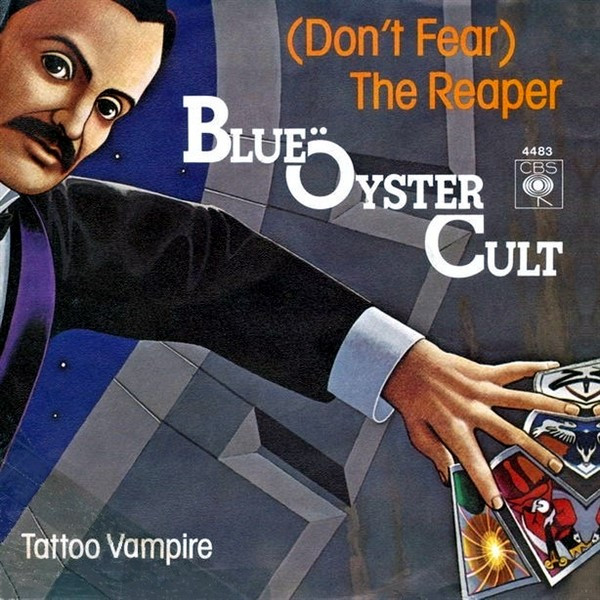
Blue Öyster Cult: (Don’t Fear) The Reaper
[purchase

For the second post in a row, I’m writing about a band that I know pretty much nothing about, although unlike Thunderclap Newman, Blue Öyster Cult had a career that spanned decades. Before I started to write this piece, literally the only song of theirs that I could name was our featured song, “(Don’t Fear) The Reaper,” but after reading a little about the band, I realized that I also knew the song “Burning For You,” although I didn’t know that it was by BOC. 

If you are still reading this, despite the fact that I’ve basically told you that I’m ignorant about the subject, I appreciate your sticking with me. I’ll try to make it interesting and fun. 

Blue Öyster Cult was formed in 1967(!) at Stony Brook University, when critic, producer, music business executive, poet, college professor, and manager Sandy Pearlman heard a jam session and offered to manage the band. For what it is worth, Pearlman seems like a fascinating figure in music, and probably deserves his own post. Originally named Soft White Underbelly, the band’s sound started off psychedelic, but gradually moved toward hard rock. After cycling through a number of pretty bad names, they ended up as Blue Öyster Cult in 1971, derived from one of Pearlman’s poems. The umlaut was added later, but who came up with using the much-imitated diacritic is a matter of dispute. 

After recording two albums of material that was not released at the time, except for a small promo release of a single, the band’s self-titled debut album was released in 1972. They released an album a year, with increasing success, until 1976’s Agents of Fortune spawned “Reaper,” the single version of which reached 12 on the Billboard chart and was a fixture on the radio when I was in high school. The song was written and sung by lead guitarist Donald “Buck Dharma” Roeser, and not the band’s main singer, Eric Bloom. 

If you’ve made it this far, I’m pretty sure that you know what the song sounds like—you’ve probably heard it a million times. Because it is a great song. I remember someone at WPRB trying to convince me to listen to and play other Blue Öyster Cult songs on the radio, but I never really tried hard to listen to them (honestly, there were so many other artists, old and new, that grabbed my attention in those days). 

As Dharma explained, 

I felt that I had just achieved some kind of resonance with the psychology of people when I came up with that, I was actually kind of appalled when I first realized that some people were seeing it as an advertisement for suicide or something that was not my intention at all. It is, like, not to be afraid of [death] (as opposed to actively bring it about). It's basically a love song where the love transcends the actual physical existence of the partners. 

So, let’s talk about the cowbell. 

It was overdubbed on the original recording, and it is credited to drummer Albert Bouchard, although at least two other people have claimed to have played it. Whoever actually did, there’s no question that, as bassist Joe Bouchard (Albert’s brother) recalled, “It really pulled the track together.” And, of course, it became more famous in a 2000 Saturday Night Live sketch, in which Christopher Walken, portraying producer Bruce Dickenson (an actual record producer, but who had nothing to do with the song) demanded “more cowbell.” Apparently, the band loved the sketch. (As do my friends in the Princeton Class of 1983, who have adopted “More Cowbell” as an unofficial motto). 

Blue Öyster Cult has continued to tour and release music, with some personnel changes, to the present day, and currently includes both Dharma and Bloom in its lineup.

Monday, April 8, 2019

Fake Bands: Ming Tea

[purchase]

I’m not exactly sure why KKafa took offense at my characterization that The Monkees were a fake band—in fact, as I wrote, some would argue that they turned into a real band. And argue he did. It isn’t a bad argument—although initially The Monkees didn’t, for the most part, write their own music or play their own instruments, as time went on, they did do more of both.

But I’m writing about a band that sort of evolved in the opposite way—starting out as sort of a real band, then gaining fame because they were in a movie. When Mike Myers left Saturday Night Live he formed a band with Matthew Sweet and ex-Bangle Susanna Hoffs to play 60s style music, which they called Ming Tea, after a fake company from the 1965 Ursula Andress movie, The 10th Victim. They decided to perform under pseudonyms: Sweet as Sid Belvedere, Hoffs as Jillian Shagwell and Myers as Austin Powers. I think you can see where this is going.

Myers’ wife at that time was Robin Ruzan (whose mother, Linda Richman, was the inspiration for Myers’ “Coffee TalkSNL sketches, suggested that Myers write a film based on this new “Austin Powers” character. And thus was born Austin Powers: International Man of Mystery. Keeping things in the family, Myers asked Hoffs’ husband, Jay Roach (who had directed one movie at that point) to direct the film. This launched Roach’s career, as well as vaulting Myers’ into movie stardom.

Ming Tea appeared throughout the film, augmented by actor Stuart Johnson as Manny Stixman (on drums, of course) and songwriter Christopher Ward as Trevor Aigburth, the lead guitarist. And they played “BBC” over the closing credits. The band performed on some talk shows to promote the film, and in the second sequel, Austin Powers in Goldmember, they performed “Daddy Wasn’t There.”

There appears to be some evidence on the interwebs of some later gigs, but no video. Sweet and Hoffs went on to do a series of cover albums together, among other things, and there are rumors of another Austin Powers sequel, so we may get another serving of Ming Tea. And that would certainly be groovy.

Friday, April 22, 2016

Child: Steve Martin's A Holiday Wish

[purchase]

From the beginning, what made Steve Martin great was the way he turned expectations on its head. Martin first burst into public consciousness at a time when comedians were moving away from the buttoned-up look to a more 60s counterculture appearance. Yet, he was known for performing in white suits, virtually the dictionary definition of “uncool.” His routines were based on unexpected juxtapositions, and ironic goofiness, like putting a fake arrow through his head. Or interrupting his set with some banjo playing. He is a true comic genius, and isn’t bad as an actor, playwright, musician, author, and art collector.

For some reason, despite the huge number of possible songs that I could have written about, this routine from the 1986 holiday episode of Saturday Night Live immediately jumped into my head. It is a classic example of Martin’s way of twisting expectations. It starts off with Martin, in a stereotypical “sincere television” Christmas setting, with soft music playing behind him, stating that if he had one holiday wish, “it would be for all the children of the world to join hands and sing together in the spirit of harmony and peace.” A beautiful sentiment, but not particularly funny, and we know that SNL at least tries to be funny.

Of course, Martin actually has other wishes, and by the end, “the crap about the kids” gets shunted behind what people would really want for the holiday, even if they wouldn’t ever admit it, and certainly not as part of a sappy ‘holiday wish” TV segment, including a month-long orgasm, unlimited power over every living being in the universe, $30 million a month, and that his enemies “should die like pigs in Hell!”

Then, of course, the children joining hands and singing.

Sunday, January 24, 2016

The Accordion: Cabbage Rolls And Coffee

[purchase The Last Polka on VHS]

I’m old enough to remember seeing The Lawrence Welk Show on TV, featuring polka music which, of course, highlighted the accordion. Not that I ever watched it—but in those days, to change the channel, you had to turn a dial and pass through each channel, so sometimes I would see a snippet of the show which looked like it was from another time. It just seemed so incongruous that during the rock era, there was a show featuring polka music, on television, and that there were people who actually watched it. The concept just was, to my mind, farcical.

So, when Eugene Levy and John Candy at SCTV created the Shmenge Brothers, a pair of “Leutonian” musicians, one of whom (Stan) played the accordion, I got the joke.

I’m also old enough to remember when Saturday Night Live was a subversive, counterculture program that quickly became mainstream entertainment. And then discovering the lower budget, more anarchic SCTV, although it never seemed to be on at any regular time. I think that, at least initially, the fact that SCTV flew under the radar allowed it the freedom to display a more subtle and weird comedic sensibility than SNL. The premise of the show—that it all related to a fictional TV station/network, also gave the show a narrow focus, yet allowed it the freedom to do wide ranging parodies. And it is hard to argue that the SCTV cast members haven’t had incredible influence on comedy—we’re talking John Candy, Rick Moranis, Eugene Levy, Catherine O’Hara, Andrea Martin, Harold Ramis, Dave Thomas, Robin Duke, Joe Flaherty, and, of course, Martin Short, among others.

The Shmenge Brothers were just one of these parodies, and like so many of their skits, the humor was subtle and character based. Candy apparently based the characters on Gaby Haas, a Czechoslovakian native who had a polka-based show based in Edmonton—meaning that there was actually more than one polka-based TV show on the air. The brothers appeared on a few episodes of SCTV, starting in 1982 and ending in 1983, with an ill-fated attempt to cash in on the “New Wave” and music videos. Their retirement was chronicled in an hour-long mockumentary called The Last Polka, based, of course, on The Last Waltz. The clip above, of the Shmenges and the Happy Wanderers playing their “classic” “Cabbage Rolls And Coffee,” comes from the film. They also performed this song on Late Night With David Letterman and at Comic Relief.

Part of the humor of the sketch is the fact that polka music, and the accordion, was at that time considered a joke in itself. Of course, the accordion, and its related instruments, has a respected place in the music of many countries and cultures.  And as the roots music movement spread, more and more musicians proudly feature a squeezebox, so that when, say, David Hidalgo of Los Lobos, picks up his accordion, no one laughs.

One last admission—for a brief time in my childhood, I tried to learn to play the accordion. It didn’t take.

Thursday, May 15, 2014

Television: I’m the Slime

Frank Zappa: I’m the Slime

[purchase]

After a remarkable burst of posts regarding radio, it would seem that Television has us at a loss here at Star Maker. How can this be? Television surely occupies at least as important a place in our culture as radio does, yet I confess it took me a while to think of songs for this theme. I think it has to do with how we relate to TV, at least here in the United States. Television embarrasses us. If you want to insult an actor, tell him he is a television actor. For every John Travolta, there are ten Adam Wests. And most people forget that Travolta first became famous as the Fonz, a fact I would bet his publicist does not emphasize. We all have TV shows we love, that have influenced us greatly, but we don‘t discuss them with the same pride as a favorite movie. And so it is with songs about TV as well. You will find affectionately mocking covers of theme songs, but no one takes the originals seriously as great music when they cover TV themes. Original songs about TV have this same gently satiric tone; I hope to get to one of those later. But I know of no songs that simply embrace TV as an art form or an inspiration without apology, although the case can certainly be made

Frank Zappa, predictably, doesn‘t even try. He comes right out and spells out bluntly what makes us so uneasy about television. To him, it represents all the worst excesses of mass media, with all the big brother implications. Ironically, the video I have chosen is a television performance of I‘m the Slime. It comes from a 1976 episode of Saturday Night Live, and features an unlikely collaborator named Don Pardo.