












Showing posts with label Television. Show all posts

Monday, January 31, 2022

Boss: Little Johnny Jewel

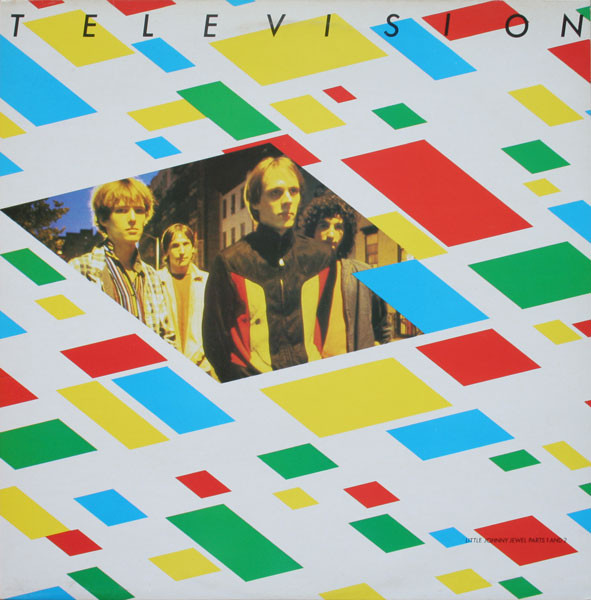
Television: Little Johnny Jewel
[purchase

I scanned my list of potential subjects for this theme (read my last post if you don’t know what I’m talking about) and decided again to write about a band that I hadn’t discussed before—Television. I’ve written about small-t television many, many times, here and elsewhere (not going to link, since there are too many), because watching TV is probably how I spend more of my leisure time than anything else, but I’ve never written about the band. While Todd Rundgren’s failure to ever be discussed in this space was very surprising, it is almost as surprising that Television has only been discussed twice—back in 2008 and 2009—and both times about the same song, “Marquee Moon.” Which happens to be an excellent song, but we’re going back to Television’s first release, “Little Johnny Jewel,” a single on their manager’s label, released in 1975. 

Although Television came up out of the same C.B.G.B. scene as the Ramones, Blondie, Patti Smith, Talking Heads, Richard Hell and the Voidoids and the Heartbreakers, among others, who I often played on the radio back in the 1979-1982 period when I was doing college radio, I had trouble connecting with the band then. As someone who grew up on classic rock and prog, I (eventually) came to understand the hard, fast ethos of punk that those other bands followed (although for some, that changed over time) as a rejection of the older forms of rock.  While I still loved what I grew up on, I also learned to love punk (and new wave). But Television’s meandering jams and guitar solos and stream of consciousness lyrics, sung by Tom Verlaine in a yelping voice that, to my ears at least, made David Byrne sound great in comparison, somehow didn’t fit in to the slots that I had in my head at the time. I couldn’t understand how they were in the same category as the Ramones, whose simple two-minute songs done at breakneck speed were nothing like the long songs that Television produced. 

Because of their timing, and their identification with the downtown NYC music scene, and because of the rough sound of their music, Television is usually lumped in with the punks, but interestingly, I’ve seen them referred to as both proto-punk and post-punk, which seems impossible without some sort of time machine. And yet, it makes sense, when you look closely. Television presaged punk both temporally and in their attitude, but their sound was not “punk” in the way that word is commonly used, so like “post-punk” bands, they embraced the brashness of punk, but not all of the sound. 

In my old(er) age, I’ve come to appreciate Television more and more. Maybe it is my more mature approach to music that is less interested in putting artists and their music in genre slots, so that I enjoy the connections that artists that seem very different actually have. I know, for example, that the first time that I heard “Impossible Germany,” by Wilco, one of my favorites, I was struck by how the intertwined guitar parts played by Nels Cline and Jeff Tweedy reminded me of Television’s Verlaine and Richard Lloyd. 

As mentioned above. “Little Johnny Jewel” was the first song released by Television, its 7 plus minutes split into two parts on a 45, and it’s an odd one. Opening with a bass line (from Fred Smith, who had replaced Richard Hell), before Billy Ficca’s drums and the guitars enter, the instrumental eventually resolves into a groove before the vocals begin. The song may be about Iggy Pop, whose real name was James Newell Osterberg, Jr., but his middle name is sometimes listed as “Jewel.” There’s a long instrumental guitar section featuring Verlaine soloing in the middle that sounds closer to psychedelia or even jazz than punk before the groove returns, along with the lyrics: 

Oh, Little Johnny Jewel
He's so cool
But if you see him looking lost
You ain't gotta come on so boss


Verlaine recalled in an interview: “Lou Reed asked me, ‘Why’d you put out this song? This is not a hit.’ I said, ‘What band playing a bar in New York, issuing their own single, is gonna have a hit?’” However, the single sold surprisingly well, and arguably kickstarted the New York punk movement.

Saturday, May 24, 2014

Television: Crowded House, "My Telly's Gone Bung"

[Purchase "My Telly's Gone Bung"]

As far as I can tell, no one ever said that these had to be the "best" songs about TV, right? Okay, good. Because the song I've decided to feature is clearly not one of Crowded House's better songs by any stretch, having been written by their least-frequent songwriter, drummer Paul Hester, and released on a collection of previously unreleased odds and ends, Afterglow (released in 2000). Nonetheless, it isn't a bad song either, and it fits the current theme to a "T"(V).

Hester's lyrics about the death of his television ("bung" in this case being an Australian term for "useless") are cutely amusing, but not exactly a cutting indictment of TV culture -- just a mildly self-deprecating tease of those whose lives are probably too tele-centric. Had the song been sped up significantly and given more lyrical bite via a rewrite by Neil Finn, this could have been a song worthy of inclusion on one of their proper studio albums, but as it turned out it's a little ditty that's fun while it lasts, but eminently forgettable afterward. Much like 90% of the programming that gets shown on TV. (Pow! Now we're talkin'!)
My telly's gone bung
What am I to do about the ABC
My telly's gone bung
What am I to do about my predicament
My telly's gone bung
I plugged it it in and it turned me off again 
I've waited up for you
To come alive and bring some truth back to me yeah
'Cause I'm where I wanna be in front of my TV 
My telly's gone bung
What am I to do about Kylie & Jason now
My telly's gone bung
I don't really care for their predicament 
If it was up to me
I'd let these people see
What people do
I've been watching you too

Tuesday, May 20, 2014

Television: Turn Me On


The Tubes: Turn Me On
[purchase]

I will never forget the glee I felt when I started training at WPRB and was told that we had free rein to come to the studios and listen to records. Even better, we were encouraged to do so. I had a good collection, but it was nothing compared to the shelves of vinyl that I now had access to. The smell of a room filled with records still brings me back to those days. And while I felt like I had a pretty broad knowledge of rock music, there were hundreds of records—maybe thousands—in there that I had never heard of. To this day, I listen to many of the musicians who I discovered pawing through the stacks in the basement of Holder Hall.

I’m pretty confident that I was unaware of The Tubes before I picked up 1979’s Remote Control in the studio. I was immediately taken by its biting satire of television, a medium that I loved, the quality of the songs and performances, and by Todd Rundgren’s production. I know I played a number of songs from the album, and started to look back to the band’s earlier albums, which consistent with their name, touched on television, particularly, the hucksterism lampooned in “What Do You Want From Life?” However, the band skewered other targets, too, including sex and drugs, with varying success.

But Remote Control, from the opener, “Turn Me On” to the closing track, “Telecide,” is a concept album that is a focused, scathing attack on the influence that television has on individuals and society. The music jumps genres, but never disappoints, and its message is consistent—TV is dangerous. Here’s an excerpt from “Turn Me On”:

Let me know what I need to know 
Make me go where I want to go 
Let me stand and wonder 
Let me feel the thunder 
See the lightning and the picture show 

After Remote Control, The Tubes experienced a brief period of increasing popularity, ironically fueled by exposure on MTV (and the participation of members of, I hesitate even to write the name, Toto), and decreasing creativity (caused, in part, by the participation of members of Toto). But then the bottom dropped out, people started to leave and the band broke up.

As much as I like this song, and this album, I can’t completely agree with their thesis. Like anything that is powerful, television can be misused and abused. While I recognize that television provides tons of misinformation, hours of trashy entertainment and unreal “reality” programming, is probably overused as a babysitter and keeps people on the couch when they should be doing something else, it also provides enormous value. If it wasn’t for television, I would never have seen the Mets win the World Series, the Giants win the Super Bowl, the Knicks win the NBA Championship (I am that old) or get to watch the World Cup. I wouldn’t have seen Nixon resign or Obama get elected. I would never have experienced “Hill Street Blues,” “All in the Family,” “Seinfeld,” “The West Wing,” “Monty Python’s Flying Circus,” “Friday Night Lights,” “Sports Night,” “Deadwood” or David Letterman. Or any number of other great programs or events. And while I personally can attest to the fact that much of the time you can scroll through hundreds of channels and find nothing to watch, that doesn’t mean that there aren’t times when there are too many things to see (and thanks, therefore, to our DVR and to VOD). And it doesn’t mean that television is evil.

I guess, like pretty much everything, moderation is the key. But that doesn’t make for much of a concept album.

Sunday, May 18, 2014

Television: 5 Great TV Themes


A boyhood friend of Buddy Holly, Sonny Curtis is best known for writing " I Fought The Law" for the Bobby Fuller Four. When you listen to the entire song, "Love Is All Around" is hardly the Woman's Lib anthem the opening credits of The Mary Tyler Moore Show made it seem:
     All the men around adore you/ 
That sexy look will do wonders for you.


Thanks to his duets success with Roberta Flack, Donny Hathaway was recruited to sing the title track to the Norman Lear comedy Maude in 1972. The songwriting team of Alan and Marilyn Bergman also gave us "Up Where We Belong" and "You Don't Bring Me Flowers".


"Everybody's Talkin" had everybody talkin about Harry Nilsson who in 1969 was commissioned to record the title sequence theme for The Courtship of Eddie's Father. He rewrote something he called "Girlfriend". Harry never bothered to record a full length version of the tune which might have been a nice single.


For the 1979 Martin Short Wall Street comedy The Associates, producer James L Brooks got B B King to record "The Wall Street Blues". The show lasted just 9 episodes.


Finally, not only did The Waitresses performed the title track for the Sarah Jessica Parker vehicle "Square Pegs", they appeared in the premiere episode, at the school dance, singing their hit "I Know What Boys Like".

Friday, May 16, 2014

Television: Bjork


 This probably belong here.

TELEVISION : TOP OF THE POPS


I loved Top of the Pops. On this side of the pond it was both the chart TV show and the only  music show for many of the population, sucking in massive audiences for it's heyday between the early sixties and late eighties, aka my childhood and young adulthood. Usually on thursdays, BBC1, for about half an hour, the format was broadly unchanged until it fizzled out in 2006. With a set designed to look like a naff nightclub, actually probably not, but that's how it was, gurning adolescents dancing badly, cheesy disc jockeys announcing each act in turn, with  a tacky dance troupe to cover no-shows, the occasional specially made film and, when they were invented, 1 or 2 videos. But the highlight was always the artist "performances", mimed or played with backing tracks, sometimes wildly dissimilar to the original, with no regard to anything other than who was in the top 30 at any one time. So novelty schlock songs would follow out and out rockers, bookended by crooners and whirling motown soulsters. Anything and everything fitted, highly appropriately, as it was truly a whole family entertainment show. I recall watching it with my sister and parents, my mother being the one to make the most caustic remarks about the shaggier representatives of my counter-culture. Who's that, she would say, and I would bite my tongue, for fear of being outed as either a fan or seeming to be. Of the wrong person. I lived in fear that she think I liked T.Rex, for instance.

Here's a good example of the style, conveniently being scottish punks the Rezillos, performing, on the programmed, their homonymous (and solitary) hit. Through the mists of time I am uncertain now whether their gaucheness was even ironic or just as they were. Hoping the former, I fear the latter.

Buy it!  (sadly the best I can offer is a 2nd hand single.........)

There were a number of other songs that referenced the show, commemorating it's place in the pantheon of british broadcasting iconography. Here's another, The Boomtown Rats, wherein "little Judy's tryin to watch Top of the Pops". And if you think Geldofs sax playing is, well, um, optimistic, later on, with the song newly number 1, he "played" the same break on a candelabra. Particularly in this era and later, there would be deliberate lampooning of the supposed "live presence", reaching it's nadir as the charts became taken over by dance music, where the musicians were, at best, faceless. Here's a good example, where the trick is even whether they were plugged in. (Answer: Not!) Ultimately this probably killed the show, a combination of anonymous dance music and the death of the singles market, ironically now on a wave back to viability. Of course there have been other shows, before and since, notably the magazine format Old Grey Whistle Test, beloved by chin stroking proggers, and Later, fronted and hosted by Jools Holland, invariably allowing him to join in at some stage, as various assorted acts play genuinely live and in the round. But TOTP, as it was acronymed, is always the one remembered with most reverie.

I wish it could come back, if only to ask my children, and theirs, what this claptrap thump thump thump is.....

STOP PRESS: So who were the Rezillos? Why, only Edinburghs most famous New Wave Beat Group. Sort of a lighter hearted Cramps. Centred around dual frontline singers, Fay Fife and Eugene Reynolds, they had an explosive sense of fun, in their all too brief first  incarnation, 1976-8, with, for me, extra delight in that the singing was all unapologetically with broad scottish accents. When Jo Callis, their dour faced guitarist left, to join the Human League, on synthesisers, clearly, going on to co-write most of their hits, including here on Top of the Pops, Fife and Reynolds re-grouped as the Revillos, on and off until the original name became revived in 2001. They still tour.

Thursday, May 15, 2014

Television: I’m the Slime

Frank Zappa: I’m the Slime

[purchase]

After a remarkable burst of posts regarding radio, it would seem that Television has us at a loss here at Star Maker. How can this be? Television surely occupies at least as important a place in our culture as radio does, yet I confess it took me a while to think of songs for this theme. I think it has to do with how we relate to TV, at least here in the United States. Television embarrasses us. If you want to insult an actor, tell him he is a television actor. For every John Travolta, there are ten Adam Wests. And most people forget that Travolta first became famous as the Fonz, a fact I would bet his publicist does not emphasize. We all have TV shows we love, that have influenced us greatly, but we don‘t discuss them with the same pride as a favorite movie. And so it is with songs about TV as well. You will find affectionately mocking covers of theme songs, but no one takes the originals seriously as great music when they cover TV themes. Original songs about TV have this same gently satiric tone; I hope to get to one of those later. But I know of no songs that simply embrace TV as an art form or an inspiration without apology, although the case can certainly be made

Frank Zappa, predictably, doesn‘t even try. He comes right out and spells out bluntly what makes us so uneasy about television. To him, it represents all the worst excesses of mass media, with all the big brother implications. Ironically, the video I have chosen is a television performance of I‘m the Slime. It comes from a 1976 episode of Saturday Night Live, and features an unlikely collaborator named Don Pardo.

Wednesday, August 5, 2009

Long Songs: Marquee Moon


Television: Marquee Moon

[purchase]

Well it seems like a lot of the SMMers are on summer vacation, so here's another one from the new guy.

Television sprung from the same mid-'70s CBGB's scene that gave us Blondie and the Ramones, but they weren't really punk or new wave. While their peers were putting out two- and three-minute bursts of pop energy, Television were stretching out, jamming with a purpose. The interplay between guitarists Richard Lloyd and Tom Verlaine was the draw, and that was never more fully realized than on the nearly 11-minute title track off their debut album from 1977.

I didn't discover Television until their 1992 reunion album. And while that's an okay album, it wasn't until I went back to their first album that I discovered what all the fuss was about. After getting past Verlaine's adenoidal vocals, hearing this song was a revelation.

Monday, July 28, 2008

The Moon: Marquee Moon


Television: Marquee Moon

[purchase]

Here we are at the beginning of the week, everyone's feeling fresh and revived from the weekend, so we better get the mad genius of "Marquee Moon" in before we all get too tired to appreciate it by the end of the week.

This is the pinnacle of Television's first and greatest album. An anti-punk epic—despite punk still being in its infantile stages! In the same year, in the same club, the Ramones embodied an ethic and aesthetic that shunned technical proficiency, insisting on getting in and out of a song before you could say Hey Ho. On the same stage, here was Television: everything punk rejected—long, complex, full of skill and chops. Yet the band had a raw, gritty gusto like no stadium rocker of its day possessed. It still came from the East Village, the quintessential New York that belonged to the VU before Verlaine and to Sonic Youth after. Tom Verlaine's solo in the second half of this song is so dense you can get lost in it; but just when it feels like it might overstay its welcome, verging on overwhelming, the entire band coalesces into a sharp-edged octave charge for sixteen bars before dispersing—the guitars almost sound like raindrops, before that sim-ple, rhy-thm, re-turns, for one, more verse.

Classic.

I remember how the darkness doubled
I recall lightning struck itself,
I was listenin, listenin' to the rain
I was hearin', hearin', something else.