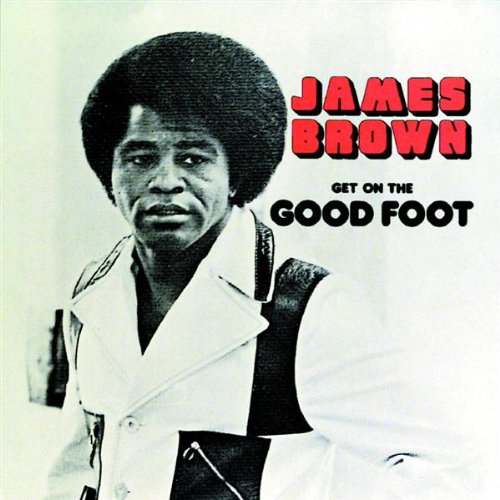
I don’t like to dance, mostly because I look like an uncoordinated tub of Jello, and it has never been one of the things that I go out of my way to do. (Except at Princeton Reunions, at least since 2012) But if James Brown tells you to get up and dance, you get up and dance. I mean, the man is the Godfather of Soul.
Brown had been performing since the 1950s, but starting in the mid- to late-1960s, he began to pioneer what came to be called “funk” music, featuring danceable grooves, with lots of soul and R&B influences, and performing it with a big band and lots of intense dancing. Often the songs included a social message in between the dance breaks. As I read that, I’m thinking to myself that the words don’t do the music justice. How’s this: It’s the kind of music that you feel in your gut and makes you want to move your butt. To steal a title from another band popular at the time, Funkadelic, “Free Your Mind….and Your Ass Will Follow.”
A couple of years after that Funkadelic song came out, Charles released “Get On The Good Foot,” a song about dancing and partying to forget the hard parts of life. Originally released as a two sided single, which meant, for you young’uns, that you’d have to flip the 45 (just go with it..) over to play the second side. Apparently Brown, who owned Augusta, GA, radio station WDRW, interrupted the programming to introduce the unreleased “Get On The Good Foot,” because he thought it was going to be a big hit, and he called it—the song topped the R&B chart and reached 18 on the pop chart.
Later that year, Brown released an album of the same name, featuring the full track, so that there was no need to turn it over (although being a double album, you’d have to flip it twice to hear the whole thing on your record player).
And because we at SMM believe in uninterrupted funk, it’s the album version that you can check out, above.
As a theme, getting locked up carries a lot of weight and
takes on various manifestations: there’s mental prisons of our own making;
lonely cells behind actual bars; locks, and chains and the heavy burden of
time, doing it and being crushed under it.
It’s really no surprise to see the number of songs related
to some variant of the word ‘prison’, not to mention movies. Prison films make
up a special genre all their own, and I’m sure you have your favorite.
Something about a piece of art that depicts the horrors of losing one’s most
fundamental right, their freedom, just begs for a deeper look, and creates in
the depiction a purer form of empathy than exists in other genres. Something
about being locked away, unable to control even the slightest aspect of your
own autonomy, and often subject to the basest of human behaviors, creates in
the viewer/listener a sense of fear and sympathy. Simply put, it boils down to:
there but for the grace of God…No matter how awful the subject, the lack of
freedom makes us pause and wonder. And feel what the prisoner feels.
But, there will be plenty of time to focus on a nice, dark
bit of music inspired by prison. For now, let’s have a little fun.
Despite the inherent silliness of this song I’m choosing, or
perhaps because the subject leans so precariously toward the dark and the
serious, I can’t resist highlighting The Blues Brother’s take on the classic
“Jailhouse Rock” for our theme of “Prison.”
The Blues Brothers movie—cable TV ubiquity aside—is a
classic. Over the top, gratuitous, destructive, balls to walls in every way,
including the straight up marvel of the live musical numbers, The Blues
Brothers is one of the films that tends to overcome its own flaws and take on a
greater sense of iconic the older it gets.The musical performances, including Ray Charles, James Brown, Aretha
Franklin, and more are the strongest aspect of the movie. The all-out musical
mayhem and the use of the city of Chicago as a set to pay tribute to some of
the great voices of Rhythm and Blues is what make the film. James Brown’s burn
down the house preacher scene, Ray Charles’ pawn shop jam, Aretha Fraklin
singing R.E.SP.E.C.T in the diner, John Lee Hooker as a street musician. The
movie would be great without the addition of the madcap antics of brothers
Blues, the Illinois Nazis (“I hate Illinois Nazis!”), the entirety of the
Chicago PD force, The National Guard, and the Good Ol' Boys…You know the movie. If you don’t, you
should. It deserves the cult status it has earned and for a certain segment of
us, the “We’re On a Mission From God” poster was standard décor for the dorm
room.
The song itself? If you don’t know it was one of Elvis’
earliest and biggest hits, then you probably don’t know much about music. Here,
John Belushi and partner Dan Aykroyd, both musical aficionados and true fans in
real life, use the movies to enact their own living, breathing rock n roll
fantasy while paying tribute to the King, much in the same way they did with
other greats, such as Sam and Dave and Solomon Burke. A lot of people viewed
the Blues Brother’s musical venture with cynical scorn: two Hollywood goofs
play acting their way through a vanity project. But with the heavy weight
additions of some of the aforementioned greats, a legit backing band, and a
true love for Rock ‘n Roll, Soul and the Blues, the Blues Brothers output, at
this far remove, seems like a lot more than shtick. And, their first album, Briefcase Full of Blues, did actually
reach number one.
“Jailhouse Rock” is the end scene of the movie, last in
line for a lot of amazing musical numbers. While most of the movie was done in
Chicago, and was, according to Aykroyd a tribute to the city itself, the finale
was shot in LA. Somehow, the entire band ends up prison, thought it was only
Jake and Elwood that got arrested. Joe Walsh, from the Eagles, plays the
prisoner who jumps up on the table and starts the riot. Its not the highlight of the film but it is
the Blues Brothers doing what they did: down and dirty R&B that passed for
the real thing, because it is.
As for the original, by Elvis—have you ever listened to the
lyrics?It’s a great rock song that features
that indescribable shuffle and strum that only the King could spin, the beat
that changed the sound of pop music ever after. It’s such an iconic piece of
musical history, the covers of it run into the thousands (Search Spotify if you
doubt me…). But honestly, its an odd song, content-wise, and I always wondered
about it. According to Rolling Stone, the “…theme song for Presley's third movie was decidedly silly…
kind of tongue-in-cheek goof. The King, however, sang it as straight rock &
roll, overlooking the jokes in the lyrics (like the suggestion of gay romance
when inmate Number 47 tells Number 3, 'You're the cutest jailbird I ever did see')..."
I feel like I need to add, not that there’s anything wrong with that, and there
isn’t, but, seriously: the song has
forever struck me as odd, simply for the fact that it does seem to be a
strange, poorly told, and in poor taste joke, that despite his uber-cool, Elvis
really didn’t get what he was singing.Maybe that’s an indication of the times, maybe there’s noting wrong with
keeping an innocent sense of what the song is. Maybe we should just focus on
the sound: the clock-work rhythm, the punchy up-down guitar, the spin out drums
and Scotty Moore’s quick-step riff or wailing solo. When a song is as instantly
iconic and recognizable as “Jailhouse Rock”, does it really matter who sings
it (movie stars), or what it really means, so long as it gets played? And
really, great songs, or movies, don’t really need to make sense to be good.
Most of us would prefer to learn things the easy way, but life often doesn’t cooperate. As Tina Turner, a clear influence on Sharon Jones, memorably said in “Proud Mary,”
You see we never ever do nothing Nice and easy
Sharon Jones & The Dap-Kings, in our featured song, recognize that sometimes you end up learning important things the hard way.
Jones and her band play music that is characterized as funk, or soul, or R&B, in a retro style that would not be out of place in the late 1960s or early 1970s, and they do it quite well. And “I Learned The Hard Way,” is a story as old as stories, about a woman learning about the hidden infidelity of her man. Some reviewers appreciate their talents and uncanny ability to evoke the sound of that era, while some others criticize them for supposedly lacking new ideas. But it is impossible to listen to their music without acknowledging its quality, the tightness of the band, and most of all, the powerhouse that is Sharon Jones.
Jones’ story is pretty well-known—Born in North Augusta, South Carolina to a mother who was acquainted with James Brown (who Jones would later be compared to because of the energy and power of her live shows), her family moved to Brooklyn when Sharon was a child. Jones, like my parents twenty years before, graduated from Thomas Jefferson High School, and like my father, attended Brooklyn College. A gospel singer from an early age, Jones performed and recorded secular music in the 1970s, with limited success, sang in wedding bands and worked as a Rikers Island corrections guard and armored car guard for Wells Fargo. Jones learned the hard way that major labels were not interested in her, not because of her singing, but because she was, as one executive reportedly informed her, "too fat, too black, too short and too old."
But she pressed on, and in 1996, she sang at a session for Lee Fields, run by Gabriel Roth and Phillip Lehman, who after recording Jones’ background vocals, recorded a couple of songs with Jones singing lead. These songs were later released on an album credited to the Soul Providers, members of which would ultimately comprise the Dap-Kings. Roth and Lehman went on to create Desco Records, which recorded and released more of Jones’ work, before the label shut, and its principals split. Roth then formed Daptone Records with musician Neal Sugarman.
At Daptone, Jones and the newly formed Dap-Kings, released two well-received albums, before her commercial breakthrough, the 2007 album 100 Days, 100 Nights, and its title track. I Learned The Hard Way, another critical and commercial success, followed in 2010 (in the interim, she worked with Lou Reed, David Byrne, Phish and Michael Bublé).
But then, just as the late-bloomer was at the peak of her career, and with a new album essentially ready to be released, in 2013, Jones was diagnosed with first bile duct cancer and then pancreatic cancer. Jones underwent surgery and chemotherapy, resulting in the usual sickness and hair loss.
During this time, legendary documentarian Barbara Kopple filmed a documentary about Jones and her fight against cancer, Miss Sharon Jones!, which premiered at the 2015 Toronto Film Festival. My wife and I had a chance to see the film this summer as part of a music documentary series at the Jacob Burns Film Center, and it is really incredible (and we got to hear a Q&A with Koppel). Not only is Jones’ story amazing, and her strength and courage remarkable, the film addresses issues like the effect on the Dap-Kings, who were losing their main source of income while Jones fought her cancer. There’s a great scene where Roth recounts his difficulty in getting a mortgage because of the publicity about Jones not performing, and other members of the band discuss the effects on them. Included in the film are scenes that show Jones, at her peak, showing her dynamic stage presence, along with more somber scenes filmed during her treatment and recovery. The movie ends in triumph, with the new album, Give The People What They Want, released, and Jones, weak, but unwilling to concede much to her limitations, performing at New York’s Beacon Theater before a packed house of ecstatic fans.
The soundtrack to the film is filled with older songs, but there is a great autobiographical new song, “I’m Still Here,” which I have posted at the end of this piece, because if you listen to it, you really didn’t need to read most of what I wrote:
Unfortunately, though, that isn’t the end of the story. Jones learned, presumably the hard way, that her cancer has returned, and she is again undergoing chemotherapy, while continuing to perform and record as best as she can. She remains undaunted, saying, "I have this saying: I have cancer; cancer don't have me. I'm gonna keep on going. I'm gonna take this medicine, and it'll be alright."
We were excited to see Jones and the band at the 2013 Clearwater Festival, but the appearance was cancelled due to her illness, and for some reason, we passed on seeing them at the Tarrytown Music Hall in late 2015. I do hope that her health improves, and that I someday get a chance to experience her live show, not only because it would be a great experience, but because it would mean that Jones, once again, triumphed over her cancer.
The Godfather of Soul sets aside the funk for a few minutes to rap brother to brother and brother and sister about the evils of one of the most deadly killers in our country: heroin.
I can make a man forsake his country and flag
Make a girl sell her body for a five-dollar bag
Some think my adventure's a joy and a thrill
But I'll put a gun in your hand and make you kill
This lyrics are credited to Manny Rosen, who --according to Wikipedia--worked at The Stage Delicatessan on Manhattan's Seventh Avenue, and had lost his daughter to a drug overdose. But according to Jet Magazine, "Manny Rosen" is a pseudonym for impressionist George Kirby who had seen the insides of a prison after dealing heroin to an undercover cop in Las Vegas. Whatever the circumstances, the lyrics deliver a haunting message that, as a single, managed to hit the Top 40 in 1972.
In 1969, coming off five singles with the word "popcorn" in the title, James Brown teamed up with a 20 piece big band to try a brand new bag.
‘At heart,” James told jazz writer Leonard Feather, “I’ve always been a jazz man. When I was just a kid in Macon, Ga., doing amateur shows, I went up on the stage with some of those great name bands that passed through town. I’ve never forgotten the impression those big band sounds made on me.”
With arrangements by Oliver Nelson and an orchestra led by jazz drummer Louie Bellson, JB brought his larger-than-life "soul power" to showtunes, jazz standards, a couple originals and this 1952 Hank Williams classic. Best known as a slow burning country blues ballad, "Your Cheatin' Heart" gets the full Godfather of Soul treatment with special thanks to Maceo Parker, Jr. for his incendiary sax solo. Pretty sure there isn't a version anywhere of Hank Williams singing "Can you.Gotta,Gotta,Gotta,Woah,Ow!"
From what is without any doubt a strong contender for the greatest live album ever title: Live At The Apollo (´63). I proudly present: the Hardest Working Man In Show Business, also known as Mr. Please Please Please. Pure dynamite.
To echo what Darius said about "Louisiana 1927," there are times when you wanna shoot for the deep cuts and this is not one of those times. The greatest song ever written with Georgia in mind is Hoagy Carmichael's "Georgia On My Mind." There's a reason why Brother Ray's version is the official state song, so for totally obvious reasons his version leads things off. However, I wanted to include another cover of the tune from a certain native Georgian. Augusta, G.A., to be precise. Of course, I'm talking about Soul Brother #1, James Brown.
Both versions are dedicated to Uga VI, the University of Georgia's legendary bulldog mascot who recently passed away due to heart failure. For those of you not SEC football fans like myself, the picture above is probably the most famous Uga-related photo. From 1996, it's actually Uga V snapping at booger-eating Auburn player, Robert Baker, after Baker had the nerve to score on Uga's beloved Bulldogs. RIP Uga. May Georgia always be on your mind.
* While "Georgia On My Mind" is on several different compilations, I'm linking to The Genius Hits The Road because its traveling motif is entirely appropriate to this week's theme. In fact, 11 different songs (!) name check states, so keep it in mind for future themes and your own blogs.
Star Maker Machine does not accept music submissions from artists or promoters. However, most of the contributors here do accept submissions for our own blogs, listed below. Please visit our blogs, take the time to listen to what we post, and then feel free to contact us if you feel that your music would be a good fit.