I particularly like a good cover. To the extent that more than once, I have shone a light on musicians most of us have never heard of, but whose music has shown up in a YouTube search.
I've never given Elvis Presley much love or credit but do realize that he was incredibly influential. One of my posts here includes a clip of him doing Little Sister (but it would have been the Ry Cooder version that sparked that post (and of course means that that "little" is off limits.)
Belatedly, it seems to me that if you don't give Elvis P. credit, you are denying an awful lot of history. The number of people who end up being internationally known by a single name are few. Ghandi, Stalin..need I go on? Equally curious is that our Seuras chose this time around to focus on "the other Elvis" who, although not commonly known by one name, comes a close second when this name is mentioned.
As I read read the somewhat improbable history, I am a little amazed at the progression Elvis followed: numerous setbacks, unlikely advances, timely appearances on TV shows like Ed Sullivan that propelled his rise and then spiraling disintegration ending in his early death.
A Little Less Conversation came out of a 1968 movie and didn't reach terribly high on any music charts. The 2001 remix by Tom Holkenborg (aka Junkie XL) did considerably better, reaching the number one position in several countries.
Although the month of March is named after the Roman god of war, Mars, while the English verb “to march” is derived a different source, the Old French “marcher,” meaning "to stride, march, walk," we here at SMM seem to insist on tying the two together, which is why most of the songs that would have marched into my consciousness for this theme already did so inprioryears, leaving me not without options, but without options that I cared to write about.
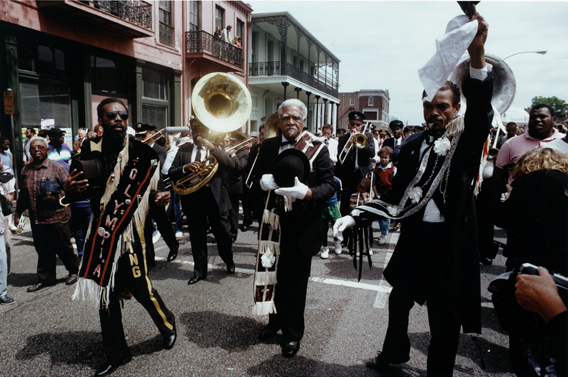
But one of the things about being among the last remaining regular writers on this site, which has gone through dozens since it started back in 2008, is that it is important to try to write at least once, if not more, for each theme, so I realized that Mardi Gras was just over a week ago, and therefore a discussion of “When The Saints Go Marching In” would work.
And, in a tip of the hat to another of the other remaining regular SMM contributors (and recent birthday boy), Seuras Og, I’m going to model my post on one of his regular formats.
Like many standards, the origins of the song are unclear. It seems that there were a number of gospel/spiritual songs with similar titles, but in 1923, the Paramount Jubilee Singers recorded a song similar to the one we all know and love, titled, “When All The Saints Go Marching In:”
Other recorded versions of the song, with varying lyrics, were recorded throughout the the 1920s and 30s, often becoming less hymn-like and more uptempo, but the song’s popularity really started when Louis Armstrong recorded a version in 1938, which also cemented the song’s identification with New Orleans:
There are probably thousands of covers of this standard, especially if you include every Dixieland or brass band that does it live (and on video....), but we will look at a few notable ones, in roughly chronological order:
Here’s a peppy, folk approach from The Weavers in 1951:
Not surprisingly, Mahalia Jackson returned the song to its gospel roots in 1955:
Elvis Presley, and the rest of the “Million Dollar Quartet (Jerry Lee Lewis, Carl Perkins and Johnny Cash), did a loose rockabilly version that wasn’t released to the public until 1990:
In 1956, Sister Rosetta Tharp started turning “The Saints” into a rock ‘n’ roll song:
And Fats Domino finished the transformation in 1958:
Judy Garland and Liza Minnelli took a more pop approach when they performed the song in 1964:
The following year, Lester Flatt & Earl Scruggs, not surprisingly, took “The Saints” in a bluegrass direction:
Jumping forward a few decades, here’s a traditional take by New Orleans’ Preservation Hall Jazz Band from 1983:
In the mid-2000s, Bruce Springsteen regularly performed the song, in a pretty subdued arrangement, on his Seeger Sessions tour, with this version from 2006 being released on the Live in Dublin album:
Look, I could go on forever, and some of you may think I already have, so I’ll close this out with a version from New Orleans’ great Dirty Dozen Brass Band from 2012 that is pretty traditional (and a bit funky) and loads of fun:
Thinking over the word <boss> and its connotations, it occured to me that the word probably came into the English language via Dutch. A little research and ... voila .. "boss is Dutch in origin"... it comes from base or bass or baas. However, being the polyglot that I am, I can't help surmising that there is more to this than that. The Turkish word for "put pressure on" (as in oppress a worker, or force) is <bas>. I am going to go one step further than Collins and Oxford dictionaries and posit that the root goes back further than the Dutch - back to the Ottomans, in fact. It's just an observation, but it makes an awful lot of sense. (You heard it here first.) bas=baas=boss.
So... who's the boss? Well, even that phrase, popularized in many forms, has a somewhat murkey provenance. A 1914 Oliver Hardy film?
The boss is "the person that other people have to obey". That could also take us down a rabbit hole of what it means "to obey", but it also conveys "authority and expertise", and with this we have a more accessible value to the word as it applies to musicians like Springsteen (known as "the boss" for some reason.)
I'll try to take a cue from our own Jordan Becker (and in the process confess that I too often paste information you can find in your own searches - tho' I generally say as much). This week it''s not Springsteen . although it could have been. Not bossanova (tho, again, I love Carlos' music in any form, and thanks Seuras). And not Blue Cheer who were also on my list of potentials on account of their "Summertime Blues" (wherein we have the <I hate my boss> theme).
Pardon me while I provide some freely accessible Wiki data as I assume you haven't yet been there nor know it. Big Boss Man is a Luther Dixon/Al Smith song first recorded by Jimmy Reed - and you would be excused for not knowing the names. That said, some of Dixon's songs were recorded by the Beatles, the Jackson 5 and more.
Sing "You ain’t so big, you’re just tall, that’s all."[
Above it's the Grateful Dead's version and below we have Jimmy Reed, then B.B. King and Elvis.
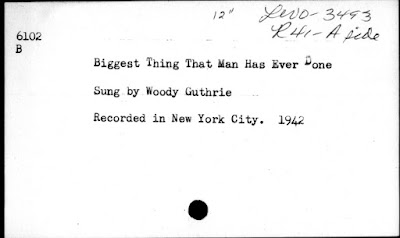
I’m staying in the political song area again, but this time something more overt, Woody Guthrie’s “The Biggest Thing That Man Has Ever Done.” The song takes the form of recollections of an “historical bum,” present at great moments in human history (real or imagined), sort of like a folk song version of Zelig.
It turns out that Guthrie borrowed the idea from earlier songwriters—the template (and even some of the lyrics) come from an 1894 song called “I’m A Highly Educated Man,” a version called “When Abraham And Isaac Rushed The Can,” was recorded in 1924 by “Fiddlin’ John Carson,” Grand Old Opry stars Uncle Dave Macon, Charlie Poole and Vernon Dalhart each did a version called “I’m The Man Who Ride The Mule Around The World,” (as has Loudon Wainwright III), and it has been recorded by many others, including Elvis Presley (in 1970), as “I Was Born About Ten Thousand Years Ago.” (And if you look hard, you might be able to find a version of the song by Jerry Garcia and Robert Hunter from 1961, before the Grateful Dead was formed).
Guthrie took the bones of the song and grafted on to it the populist, pro-labor, probably small-c communist politics that he espoused (and yes, I know that the evidence shows that Guthrie was probably a member of the Communist Party at some points, but also that he really wasn’t a “Party” kind of guy.)
So, he’s present at the creation, worked in the Garden of Eden (as a member of the apple pickers union), worked on the Pyramids and the Tower of Babel, fought in battles, beat Romans, Turks, and other great powers, helped win the American Revolution and the Civil War before moving on to the issue that was directly on Guthrie’s mind in 1944, when the song was recorded: World War II.
There was a man across the ocean, I guess you knew him well, His name was Adolf Hitler, goddam his soul to hell;
We kicked him in the panzers and put him on the run,
And that was about the biggest thing that man has ever done.
There's warehouse guys and teamsters and guys that skin the cats
Guys that run my steel mill, my furnace and my blast
We'll stop the Axis rattlesnakes and thieves of old Nippon
And that will be the biggest thing that man has ever done.
I know that the card that I used as an image indicates that it was recorded in 1942, and it may well have been—the record is vague—but the version above was probably from 1944, which makes sense, because by then, Hitler was more “on the run” than he would have been in 1942. But it is clear that Guthrie is also giving credit for winning the war to the workers, as well as the soldiers.
Guthrie ends this version of the song (and if you’re interested, here’s a set of lyrics that has many more, and different verses, but I haven’t been able to find a recording of this version):
Well I better quit my talking 'cause I told you all I know
But please remember pardner wherever you may go
The world is digging Hitler's grave and when the job is done
This'll be the biggest thing that man has ever done.
And, in 1944, that probably was right (and it still might be right, today.)
I’ll confess that the first time I heard this song, it was being sung by Dan Bern, and I didn’t know that it was a Woody Guthrie song until I did a little poking around. Bern, a family favorite who I’ve writtenaboutafewtimes, and seen even more times, is a folksinger in the Guthrie tradition, mixing politics with nonpolitical songs (and, like Guthrie, writing children’s songs and Hanukkah music). Bern released his version in 2004, and it included a few of the verses from the longer version linked to above (modified a bit). But he also updated it a little, adding a verse about the moon landing, and then the verse that probably was the impetus for the release:
There's one big thing we must do when shove comes to push
Defeat the so-called President by the name of Bush
Vote early and vote often, November 2 not 1
And that will be the biggest thing Man has ever done
That'll be the biggest thing Man has ever done
Now, that didn’t work, sadly, but it is nice to know that the Guthrie tradition of political songwriting carries on (and yes, Bern has written anti-Trump songs).
This may be the hardest theme we’ve tackled here, and I’ll take responsibility for it, for better or worse. As a history major in college, and general history buff, I’ve also been a fan of “alternative history,” where one historical fact changes, and you speculate on how things might have been different. One good recent example of this was the HBO series, The Plot Against America (and the 2004 Philip Roth novel that it was based on), which launches from the premise that Charles Lindbergh defeats Franklin Roosevelt in the 1940 election. I’ve also read a ton of “what if the South won the Civil War” fiction, which shouldn’t surprise anyone who knows me or has readmywriting.
But, as I often have to remind myself, this is a music blog, so we are going think about what would have happened if Buddy Holly’s plane hadn’t crashed on that cold February morning in 1959 in Iowa. I’m no Holly expert (although I’ve done some reading about his career), so I’m under no impression that this might be a “definitive” discussion. And because I’m not writing a piece of speculative fiction, and have to therefore pick one path and follow it, we’ll look at a few possibilities, focused more on Holly’s potential career than his potential effect on music as a whole (or the effect of the deaths of the others who were on the plane that day).
In "American Pie," Don McLean famously referred to the crash that killed Holly, Ritchie Valens, the Big Bopper (J.P. Richardson, Jr.), and pilot Roger Peterson, as the “day the music died,” but while that’s a great and memorable lyric, of course, it wasn’t. Most notably, two big Holly fans in Liverpool had recently formed a band named after an insect, in tribute to Holly’s band, the Crickets, and had Holly not died that day, I’m pretty confident that Beatlemania still would have swept through the world a few years later, changing the musical landscape forever, and pushing aside the type of “rock ‘n’ roll” music that Holly and his ilk had made popular (even as the Beatles covered Holly’s songs live and on record). In fact, I’d wager that had Holly lived, he would have been a fan of the Beatles, and even worked with them in some form—maybe writing songs with or for them or performing with them, or releasing his own Beatles covers (everyone else did). But probably not producing the Beatles, since they already had a pretty fair producer. (And don’t forget that the Rolling Stones covered “Not Fade Away” on their first album.)
Another huge Holly fan was Bob Dylan, who actually saw Holly on the ill-fated Winter Dance Party tour in Duluth, MN, about 3 days before the crash, and referenced Holly as his first musical influence in his Nobel Prize lecture. So, again, Holly’s death wouldn’t have prevented Dylan’s rise and influence on music, and again, I’d bet that they might have collaborated—or at least, become acquainted—particularly after Dylan began to perform regularly in New York. You can easily imagine Holly, with Maria Elena, and maybe a friend like Phil Everly or Waylon Jennings, trying to watch the young Dylan incognito from the back of the club, and being impressed by his talents.
But I’m getting a little ahead of myself.
One way of looking at this question is by starting by analyzing Holly’s life and music before he died. In late 1958, Holly and wife Maria Elena, moved to Greenwich Village, in part to get a new start, but also to get involved in the New York music scene of the time. Holly, who was not only a musical genius, but appeared to have a more sophisticated business sense than many of his contemporaries, wanted to start his own label and open his own studio. So, maybe, part of Holly’s future would have been as a music executive and producer of other acts.
During this period, Holly explored his love for jazz, regularly frequenting jazz clubs in the Village and elsewhere in the city. And he would go down to Washington Square Park and play with the other musicians hanging out there.
The last formal recording session that Holly participated in was in New York, in collaboration with the Dick Jacobs Orchestra, recording four songs with heavy string orchestration. So, by some analyses, at this point, Holly was moving away from the stripped down rock ‘n’ roll that made him famous to a more sophisticated, smooth pop sound. For example, one of these songs, Paul Anka’s “It Doesn’t Matter Anymore,” might have presaged a future career for Holly as another Anka-style pop singer.
At the same time, though, Holly was recording himself in his living room—what have later become known as the “Apartment Tapes,” and from these, you can hear Holly working both on his songwriting and lyrical craft, but also experimenting with tempo and styles. (Many of these demos were later overdubbed and released posthumously.) Add to this the reports that Holly planned to record with black artists such as Ray Charles, Mahalia Jackson and other soul singers (he was, memorably, the first white act to play Harlem’s Apollo Theater), and the prospect of Holly as a pop crooner becomes less likely. Nor do I see him turning to Vegas, like his friend Elvis Presley.
Another way to look at it is to consider the careers of two other musicians who were on the Winter Dance Party tour, but declined to get on the plane—Waylon Jennings, who was Holly’s bass player on the tour and gave up his seat to the Big Bopper, who was sick, and Dion DiMucci, who didn’t want to spend the extra money. There are some who think that Holly’s future, had he survived, would have been to move more toward country music, like Jennings, considering his Texas roots and twang. But I don’t think that Holly would have wanted to be so limited, because his musical tastes were so broad. Dion, of course, had early success, but when that faded, changed his sound to a more mature folk/pop approach, before moving through a Christian music phase, and more recently, focusing on blues, and I suspect that Holly, too, would have kept trying different things.
Ultimately, I don't think that Holly would have become an “oldies” act, performing versions of his hits to aging fans. Instead, I think that Holly would have gone on to a varied career—writing songs for himself and others, in various styles that would have reflected his curiosity, interests and the new sounds that were developing in the 1960s and 70s, producing and nurturing artists, and continuing to perform new music for years.
I am so uncertain as to whether there are any songs about e-mails that I am not going to look. Any complaints about that, send me a S.A.E. for my nuanced response. I like letters, yet I cannot recall the last time I either sent or received one, other than electronically. Even birthday and christmas cards seem but a fond memory, as even aged aunts resort to social media to mark their notice of such milestones. So, what then is the purpose of a postal service, mail and mailmen (and women)? Junk, bills and amazon deliveries seems to be the answer. Given at least one of our small and loyal band of posters works in a country where such luxury no longer exists, how long, I wonder, will the rest of us be graced by the regular tap tap tap of the postman's knock? And will that demise be hastened by the opinion of the extravagantly haired buffoon (U.S. version) wanting to knock postal voting out the ocean?
Time then to remind ourselves of the power of the post: the excitement and anticipation of writing and sending a letter to a loved one, awaiting, with baited breath, for a response. And then? Tell me text is as poignant, e-mail as effective, and I'll tell you different. Far too quick, too instant: where's the build up of hope, increasing by the day, layer upon layer. And supposing then, like this song, you then get this reply?
Since the gruff tones of Alex Chilton helmed the original Boxtops version, back in 1967, this song has been covered oodles, often from similarly chalky voiced singers, most attacking the lyric at the same lick. Walking in Memphis hitmaker Marc Cohn gives it a slightly less frantic approach, a sense of quiet determination rather than the breakneck rush of the original. I like it and hope he got there safe.
But it isn't always so simple, as Richard Thompson so exquisitely describes. A rousing song he still finishes most live shows with, it has a real zydeco vibe to it, many folk learning of the song through the version by cajun squeezeboxer Jo-El Sonnier. But prior to that, swamp rocker Jerry Williams had released the featured version, again, as with 'The Letter', a less frantic version, one that swings, perhaps like a pendulum of the emotions brought on by the letter in question. I say swamp rocker because that's what Williams sounds like, and an assumption I certainly initially made. In fact, he was a Swede, most of his career based there, as early rock'n'roll enticed the youth of his homeland just as much as the rest of the world. As a bonus, here is a link to the great RT, knowing he has fans here, this being from David Sanbourn's great 80s/90s TV show, Night Music, and which features him, alongside both Thompson and the above mentioned Sonnier.
Worse still than any reply, is the spectre of no reply, insult added to by the injury of having the letter you first sent dropped back to your door. Classic Elvis is the template, obviously, but I enjoy this curiously upbeat version, coming from the possibly little known Dave Kelly. However, if you are familiar with UK blues maestros, the, um, Blues Band, fronted by ex-Manfred Mann frontman and BBC radio blues broadcaster Paul Jones, you will recognise the voice and the slide guitar of Kelly. Sticking with a mail theme, here is that band, with a Son house classic.
You can find these songs yourself, but maybe won't think of this.....
This is going to be one of those posts that tries to create a fusion of different things. Let’s see if it works, or if it turns out to be like “cold fusion.”
Remarkably, although I’ve mentioned them in writing about Jeff Tweedy, Jay Farrar, and Wilco, I’ve never written a post on this site about Uncle Tupelo (although I did a long one at Cover Me). I wasn’t aware of the band during their existence, and learned about them after discovering Wilco and Son Volt, the two bands that were formed when childhood friends Tweedy and Farrar could no longer coexist. I wrote in detail about Uncle Tupelo’s history in that Cover Me piece, so, if you are really interested, go check it out, and come back here when you are ready.
R.E.M.’s Peter Buck heard Uncle Tupelo perform a cover of the Louvin Brothers’ song “Great Atomic Power” at a concert, and contacted the band after the show. The three musicians found a great deal of overlap in their musical interests, including bluegrass, and decided to do an acoustic project together. The band’s prior album, Still Feel Gone was, for the most part, a rocker, so it was a bit of a risk to follow it up with an acoustic album, and their record company was pressuring them to move to an even more rock-oriented sound, to compete with the emerging grunge movement. But Farrar and Tweedy were, as always, headstrong, and pissed at their label’s failure to pay them royalties, so they must have figured, “Fuck it,” we’re going to work with Peter Buck, and do an acoustic album.
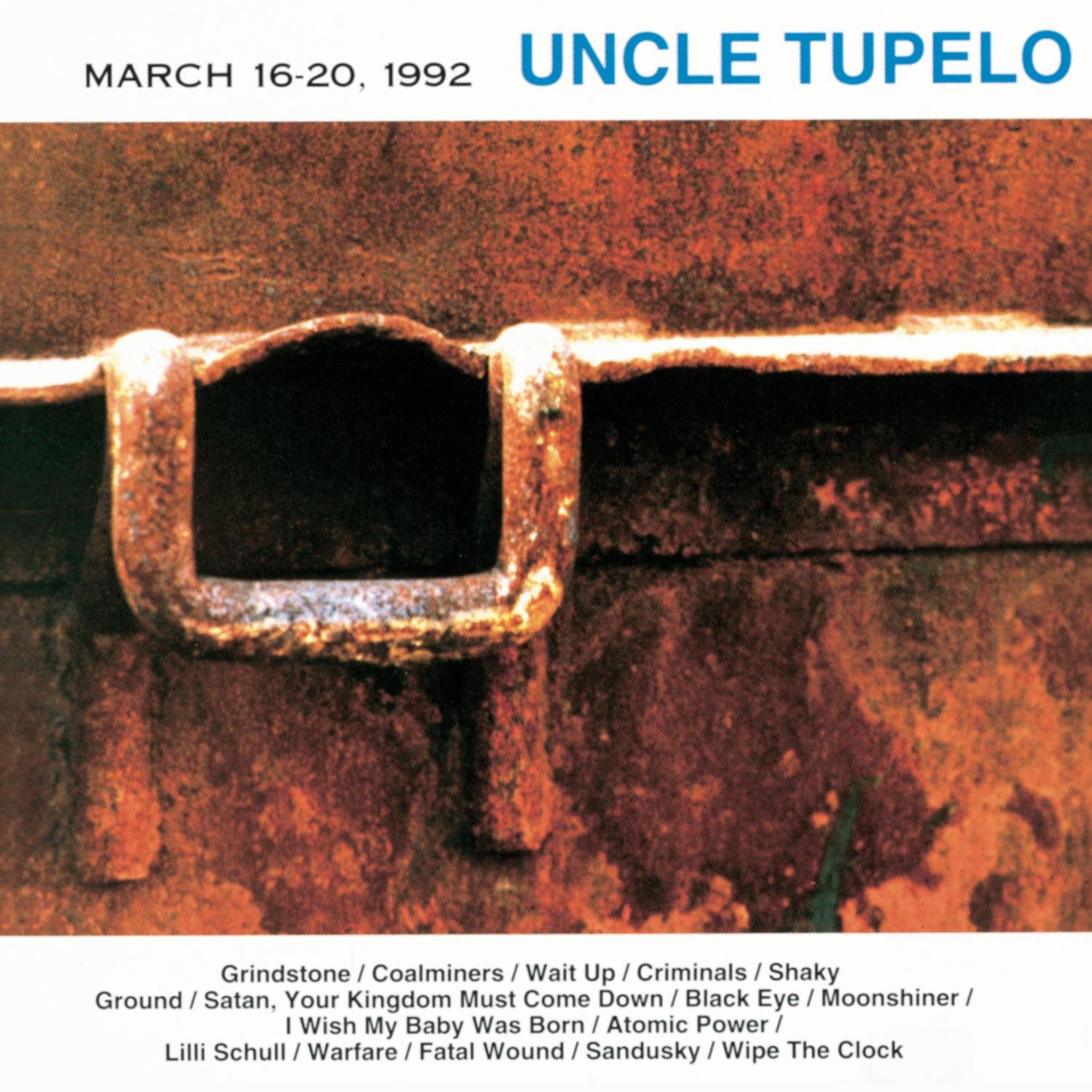
That album, March 16–20, 1992, mixed classic country tunes with originals that fit seamlessly with the older songs. Roadie Brian Henneman, who later founded the Bottle Rockets, even got to play the mandolin that was used in “Losing My Religion.” Uncle Tupelo’s cover of “Great Atomic Power” is very faithful to the Louvin Brothers’ original, and it is a very, very odd song.
It mixes the imagery of a devastating nuclear explosion with Armageddon, and asks the question—when that horrible time comes, will you be ready to meet your savior? As the lyrics inform us:
There is one way to escape and be prepared to meet the Lord Give your heart and soul to Jesus, He will be your shield and sword He will surely stand beside and you'll never taste of death For your soul will fly to safety and eternal peace and rest
The Louvin Brothers, Ira and Charlie, were popular in the 1950s and 1960s, and came from the gospel tradition, as many country singers did, so the fire and brimstone is not all that surprising. Charlie seemed to be the stable brother, while Ira was an alcoholic, who engaged in erratic and often abusive behavior, including toward his brother. Ira was married four times, and wife number three shot him four times in the chest and twice in the hand after he allegedly tried to strangle her with a telephone cord. Ira once made a racist remark that so angered Elvis Presley that Elvis refused to record any Louvin Brothers’ songs, probably costing the duo significant royalties.
Ultimately, Charlie had enough, and the brother act broke up in favor of separate solo careers. Ira and wife number four died in a car accident in 1965, when a drunk driver hit their car; Charlie lived until 2011, and recorded and performed until close to the end.
The Louvin Brothers make a brief appearance in Episode 4 of the Ken Burns documentary, Country Music, before the documentary moves on to a more popular act, The Everly Brothers, which is ironic because a suggestion that the Louvins change their sound to be more like the Everlys reportedly depressed Ira and contributed to his alcoholism.
As I write this, I’ve watched four episodes of Country Music and am enjoying it immensely. I really know little about the history of country music—it was not something that I listened to growing up in the NY suburbs. Like the blues, much of my knowledge of the genre has come from listening to covers, like “Atomic Power,” and going back to listen to the originals. And as I have become increasingly interested in Americana music, I find myself more interested in the music’s roots.
I’m someone who finds how things start to be fascinating, so it has been interesting learning about the long background and history of country music. One of the things that I have found striking is that even in its earliest days—going back to the 19th century—one of the hallmarks of country music has been nostalgia for older, simpler times. And I get that, although it often seems that there’s a real fear of trying anything new and radical. Which is why Elvis Presley, who came from a country and gospel tradition clearly scared the crap out of, and was rejected by, the establishment.
And it is interesting, too, that when the Louvin Brothers, who were traditionalists, chose to write “Great Atomic Power,” about something new and scary, rather than write about the potential of the new technology, they (and co-writer Buddy Bain, a musician and DJ) focused instead on its destructive power, and tied it to traditional religion.
For what it is worth, what made Uncle Tupelo stand out from the crowd was the way that they fused the tradition of old time country music with the new energy of punk, so it is also interesting that March 16–20, 1992 sounds so traditional. It is a bit of an oversimplification, but as time went on, it seems like Farrar (and Son Volt) has more often followed the country tradition of looking backwards, while Tweedy (and Wilco), have tended to look forward, including more rock and experimental influences in their music.
Of course, the potential of atomic power was touted by many, and numerous nuclear plants were built in the US and elsewhere, because of the desire to move away from depleting and polluting fossil fuels, until, at least in this country, the tide turned against them due to the danger of accidents and the difficulty in safely storing the radioactive waste. However, there seems to be some attempt to revive the industry, as it becomes clear that use of carbon based fuel continues to damage the environment, although its serious risks continue to be an obstacle.
The risks, of course, are real, as Chernobyl and Fukushima, among others, remind us. And I recall, that during my sophomore year in college, one of my roommate's friends stayed with us when his college was closed because of the partial nuclear meltdown at Three Mile Island.
A few years later, when I was a very junior associate at a very large Wall Street law firm, I was mostly working on two cases. One was the representation of Drexel Burnham, in the various investigations arising from the Mike Milken/junk bond issues. The other was representing Public Service of New Hampshire in proceedings to determine whether the costs involved in constructing the Seabrook nuclear power plant were reasonable, and could thus be passed along to the ratepayers. For the first one, much of my work revolved around gathering and reviewing Drexel Burnham documents to see whether they were responsive to an ever growing number of government subpoenas. The second one had me and a slightly more senior lawyer traveling regularly to Philadelphia to prepare our clients and monitor extremely dull hearings about arcane engineering issues.
Neither of these were particularly interesting, and I did have some qualms about representing a nuclear plant, but that’s the way it goes as a young lawyer at big firms.
One day, though, the senior partner on the Drexel case offered me the opportunity to spend a week (with other lawyers) at Drexel’s office in Beverly Hills. This was during the winter in New York, so it seemed like it would be fun. And, in those days, we all flew first class and stayed in fancy hotels. I was excited. Shortly after that, the senior partner on the Seabrook case offered me the opportunity to spend the same week in the small town in New Hampshire where the plant was, doing work in a makeshift office on the construction site. I, not at all regretfully, told him that I couldn’t, because I was going to Beverly Hills. A little while later, I got a call informing me that I was going to fly to California, spend half the week there, then take a redeye to Boston and drive to Seabrook. I will never forget that one day, I was staying at the Biltmore Hotel in Beverly Hills and walking around Rodeo Drive in warm weather and the next day I was tramping through the mud in the cold, and staying at the Hampton Falls Inn, a motel near the plant. At that point, I was no fan of atomic power, great or not.
<Green, Green Grass of Home> may well be the first Trees/Grass song that comes to mind for people my age. Possibly followed by <Tie a Yellow Ribbon>. I cannot say that either of them does much for me besides bring back memories - we were severely exposed to both as they sat atop the charts for longer than I would have placed them there.
For me, Green, Green Grass was a Tom Jones hit. I've brought this next point up before, but since we are talking memories... My pop music exposure during Tom Jones' Green Green Grass period was via a short-wave transistor radio connection to pirate radio Radio Luxembourg, more than 1,500 miles away. This meant that the signal came and went such that you mostly caught snippets of the song.
In perusing the Wikipedia article for the song, I was struck by the number of known covers of the song beyond Tom Jones: Johnny Darrell and Porter Wagoner, credited with the first public exposures, and then Jerry Lee Lewis, Joan Baez, Elvis, Nick Cave, Kenny Rogers - and believe it or not, the Grateful Dead.
I also had not fully focused on the lyrics - certainly registering the general melancholy, but ascribing that to an aspect of what I assumed Country music was like. And perhaps not totally wrongly - there are no few songs that lament the state of some po' boy on Death Row, for that's the story the song tells. If you hadn't noticed:
There's a guard, and there's a sad old padre, Arm in arm, we'll walk at daybreak Yes, they'll all come to see me in the shade of that old oak tree, So they lay me 'neath the green, green grass of home
James Bond, The Man from UNCLE, Our Man Flint ... the 60s spawned an interest in spies that played out in various TV and movie productions both in the US and in the UK.
Way out in San Fransisco, things were headed in a different direction. The "kids" out there tended to look askance at government antics - establishment lies and secrets. Some thumbed their noses, some were outright in-your-face hostile, in the streets protesting the government, while others chose to share their anti-government message in lyrics and song. Among those choosing music was Jefferson Airplane. Check out the lyrics for We Can Be Together.
Just a few weeks back, J.David noted the passing of Marty Balin, but in doing so, probably didn't anticipate that someone else would bring it back around in the Spies/Secrets theme.
Jefferson Airplane Takes Off. One of the earliest albums I owned. My musical proclivity then, as now, was pretty eclectic. Probably my favorite from this, their first album is <Let's Get Together> - a full on plea for the hippie-dom philosophy of "we are all brothers (and sisters)". After that track? It's a toss-up between <Come Up the Years> and <It's No Secret>.
<It's No Secret> isn't a song about spies. It's a plaintive Marty Balin love song. This, of course, before Grace Slick. And there doesn't appear to be any spying going on here. After all "it's no secret".
But consider the lyrics (credited to Balin):
As I get older the years they get heavy for you
Oh is it any wonder why I feel that my whole life is through
Yeah, when I stop feeling how strong my love is for you
Oh, know I'll be empty wanting your love like I do
This is nothing like the Beatles <Love Me Do>. The chord changes are beyond the Beatles' I-IV-V, and the notion of love that the song expounds is beyond the innocence of the "Love Me Do" type.
Incidentally, there are other <It's No Secret>s out there - because sometimes love IS a personal secret:
Elvis on a totally different track (he sings "... no secret what God can do"):
I’m willing to bet that the first time you saw The Last Waltz, there was a moment when you shook your head, surprised at what you were seeing on the screen. After seeing The Band play, then a guest spot from the rough and tumble rocker Ronnie Hawkins, who basically gave the guys their schooling in the music business, a brief excerpt from The Canterbury Tales (OK, that was kind of a head scratcher), and then performances from Dr. John, Neil Young, and the Staple Singers, out to the stage, in all of his blow-dried, tinted aviator glasses glory, strode none other than Neil Diamond.
WTF?
In 1976, when the concert was filmed, Diamond was not really considered part of the rock world at all—his music was too theatrical and bombastic, it would have seemed, to have shared the stage with the rest of the performers that night—the royalty of what is now called Americana music—folk, blues, and rock. And yet, there he is, strumming and belting away.
Apparently, his inclusion in the show was the result of the fact that he and Robbie Robertson were friends and neighbors. Robertson produced the album from whence came “Dry Your Eyes,” the song that Diamond performed (and which Robertson co-wrote).
Not surprisingly, the decision to include Diamond was as strange to the other Band members as it was to us watching, especially, of course, Levon Helm, who wrote in his autobiography, "When I heard that Neil Diamond was going to play I asked, 'What the hell does Neil Diamond have to do with us?' Robbie called me up and said, 'Well, Neil is like Tin Pan Alley. That Fifties Brill Building scene, songwriters like Doc Pomus.'" Levon wasn't convinced. "Why don't we just get Doc Pomus?'"
The funny thing, though, is that Diamond’s performance was not bad at all.
Here’s the other thing about Neil Diamond—the guy is a hell of a songwriter and performer, whose career really did straddle the music business from the Brill Building era, through the early rock era, into the folk-rock sound before he veered completely off into the easy listening, glossy pop world of people like his former high school chorus mate, Barbra Streisand (apparently, though, they didn’t know each other all that well).
Diamond was inspired to write music by a combination of seeing Pete Seeger perform at his summer camp (!), when Diamond was 16, and the fact that girls seemed attracted to guys who could play guitar and write love songs. He also attended NYU on a fencing scholarship (!) He wrote “I’m A Believer” (among other songs) for The Monkees, He wrote songs that were recorded by Cliff Richard, Jay and the Americans, Elvis Presley and others before he really got his performing career going.
In his early performing years, he had hits with “Solitary Man,” “Cherry, Cherry,” “Sweet Caroline,” and “Holly Holy,” and “Cracklin’ Rosie,” among others.
In 1971, Diamond released his album, Stones, which I am basically only mentioning because it fits the theme, although it was successful, and spawned singles “I Am….I Said” and “Crunchy Granola Suite.” And as far as I am concerned, that was pretty much the end for me, other than “Song Sung Blue” from his next album.
The real turning point for Diamond, though was the release, in 1972, of his double live album, Hot August Night, which, as Allmusic aptly states:
Captur[ed] all the kitsch and glitz of Neil Diamond, the showman. And that also means that it's not just loaded with flair, but with filler [and] attempts to write grand, sweeping epics that collapse under their own weight. Still, that's part of the charm of Diamond and while it can sound unbearable on studio albums, it makes some sense here, surrounded by his pomp and circumstance. That spectacle is the great thing about the record, since it inflates not just his great songs, it gives the weaker moments character.
I actually remember listening to that album, often, in those days, because it was captivating. Looking back now, I think that much of the appeal was the strength of (some of) the songwriting, but also by Diamond’s utter confidence and power as a performer.
There’s a story about Diamond’s performance at the Last Waltz concert that has been denied by him, but is still pretty good, and certainly reflects Diamond’s belief in his performing prowess. Supposedly, after his one song, Diamond came off stage and said to Bob Dylan, "Follow that," to which Dylan responded, "What do I have to do, go on stage and fall asleep?"
Purchase The Great 28 A lot of people claim to have invented rock 'n roll. But, that's a prodigious bit of boasting, to say you invented the genre, when the very mythology of the origin is so varied, so colorful, so joyously populated by gods and heroes. So, where was rock 'n roll made, and where and what from? To be sure their are ethnographic explanations and tracing the origins of the sound make for great myth-making and listening. But, the argument pertaining to its exact origin remains as varied as the source materials. No amount of explication or analysis or research can answer the question and assign a singular forefather to the origins of rock. No Cronus, just many, many Titans. And the myths are there for you to pick and choose from, but in reality, the birth of rock 'n roll is a singularly personal thing. What we lack in historical consensus, we make up for in in the purely individual. It's about a gut feeling, a deep vibe, a startling, life-altering chord change inside you that get not so much strummed as lit up and electrified and sent shivers all up and down your spine. Rock 'n roll was invented when you heard your first truly, foot shuffling, head bobbing, heart throbbing, "pants dropping" (Springsteen), earth shaking, heart attack making, soul quaking song. So, who to believe? I believe Little Richard when he said "The blues had an illegitimate baby and we named it rock 'n roll." I believe Alan Freed was spot on when he adopted an African-American slang phrase for having sex and used it to describe the new sound that he was spinning--a sound that mixed rhythm, blues and something swinging and new. Freed broke racial barriers by playing black artists on the mainstream airwaves and putting those same bands on stages together in racially mixed concerts. I believe Jack Newfield, who said in a 2004 article from the New York Sun that rock 'n roll was a "Black and White alloy" of many, many great players, from Ike Turner to Jerry Lee Lewis. I believe Elvis Presley, who was humble about his part in rock's invention and insisted that he simply took his influences and added something of his own and what came out was what he loved. I believe he truly was the King
Rock 'n roll has its origins, to be sure--historic, cultural, geographical. And it has its legends. Like any great monolith of our dreaming that holds sway in our fascinated imagining should--Rome, the Vikings, the Great Wall of China--the great ideas and events are bigger than even their own definition.
But I think the real inventor of rock 'n roll resides in the listener's own heart. No amount of explication or analysis or research can answer the question and assign a forefather to the origins of rock. It's about a gut feeling, a deep vibe, a starting, life-altering chord change inside you that is not so much strummed as lit up and electrified, sending shivers all up and down your spine. For me, it was Chuck Berry. Blistering guitar licks, snazzy suits, a ridiculously athletic and unselfconscious strut--called the duckwalk--that he employed on stage. Chuck Berry. He made me want to pick up a guitar. I could never master his leads when I played guitar, but I tried hard to learn "Johnny B. Good". His car crusing a road rhythms were easier for me, and I still love that sound. When a Chuck Berry song comes up on shuffle, I inevitably get the same rushing excitement that I did when I first heard that ripping, siren call sound of his Gibson hollow-body. I heard that sound, and I thought, that is rock 'n roll. That is where it comes from. The heart of rock n roll is an embodiment of spirit--something wild inside you that might be unattainable. It is all gut, a stirring fire that burns from your inner-self all the way out. What it makes you feel is what truly defines it. That's a wonderful little covenant to enter--if you don't love music, don't feel the almost indescribable thrum down in the part of your soul that speaks most closely with the gods--it won't matter to you who invented rock 'n roll. Extracurricular reading: Who Really Invented Rock 'n Roll?, from the New York Sun
As a theme, getting locked up carries a lot of weight and
takes on various manifestations: there’s mental prisons of our own making;
lonely cells behind actual bars; locks, and chains and the heavy burden of
time, doing it and being crushed under it.
It’s really no surprise to see the number of songs related
to some variant of the word ‘prison’, not to mention movies. Prison films make
up a special genre all their own, and I’m sure you have your favorite.
Something about a piece of art that depicts the horrors of losing one’s most
fundamental right, their freedom, just begs for a deeper look, and creates in
the depiction a purer form of empathy than exists in other genres. Something
about being locked away, unable to control even the slightest aspect of your
own autonomy, and often subject to the basest of human behaviors, creates in
the viewer/listener a sense of fear and sympathy. Simply put, it boils down to:
there but for the grace of God…No matter how awful the subject, the lack of
freedom makes us pause and wonder. And feel what the prisoner feels.
But, there will be plenty of time to focus on a nice, dark
bit of music inspired by prison. For now, let’s have a little fun.
Despite the inherent silliness of this song I’m choosing, or
perhaps because the subject leans so precariously toward the dark and the
serious, I can’t resist highlighting The Blues Brother’s take on the classic
“Jailhouse Rock” for our theme of “Prison.”
The Blues Brothers movie—cable TV ubiquity aside—is a
classic. Over the top, gratuitous, destructive, balls to walls in every way,
including the straight up marvel of the live musical numbers, The Blues
Brothers is one of the films that tends to overcome its own flaws and take on a
greater sense of iconic the older it gets.The musical performances, including Ray Charles, James Brown, Aretha
Franklin, and more are the strongest aspect of the movie. The all-out musical
mayhem and the use of the city of Chicago as a set to pay tribute to some of
the great voices of Rhythm and Blues is what make the film. James Brown’s burn
down the house preacher scene, Ray Charles’ pawn shop jam, Aretha Fraklin
singing R.E.SP.E.C.T in the diner, John Lee Hooker as a street musician. The
movie would be great without the addition of the madcap antics of brothers
Blues, the Illinois Nazis (“I hate Illinois Nazis!”), the entirety of the
Chicago PD force, The National Guard, and the Good Ol' Boys…You know the movie. If you don’t, you
should. It deserves the cult status it has earned and for a certain segment of
us, the “We’re On a Mission From God” poster was standard décor for the dorm
room.
The song itself? If you don’t know it was one of Elvis’
earliest and biggest hits, then you probably don’t know much about music. Here,
John Belushi and partner Dan Aykroyd, both musical aficionados and true fans in
real life, use the movies to enact their own living, breathing rock n roll
fantasy while paying tribute to the King, much in the same way they did with
other greats, such as Sam and Dave and Solomon Burke. A lot of people viewed
the Blues Brother’s musical venture with cynical scorn: two Hollywood goofs
play acting their way through a vanity project. But with the heavy weight
additions of some of the aforementioned greats, a legit backing band, and a
true love for Rock ‘n Roll, Soul and the Blues, the Blues Brothers output, at
this far remove, seems like a lot more than shtick. And, their first album, Briefcase Full of Blues, did actually
reach number one.
“Jailhouse Rock” is the end scene of the movie, last in
line for a lot of amazing musical numbers. While most of the movie was done in
Chicago, and was, according to Aykroyd a tribute to the city itself, the finale
was shot in LA. Somehow, the entire band ends up prison, thought it was only
Jake and Elwood that got arrested. Joe Walsh, from the Eagles, plays the
prisoner who jumps up on the table and starts the riot. Its not the highlight of the film but it is
the Blues Brothers doing what they did: down and dirty R&B that passed for
the real thing, because it is.
As for the original, by Elvis—have you ever listened to the
lyrics?It’s a great rock song that features
that indescribable shuffle and strum that only the King could spin, the beat
that changed the sound of pop music ever after. It’s such an iconic piece of
musical history, the covers of it run into the thousands (Search Spotify if you
doubt me…). But honestly, its an odd song, content-wise, and I always wondered
about it. According to Rolling Stone, the “…theme song for Presley's third movie was decidedly silly…
kind of tongue-in-cheek goof. The King, however, sang it as straight rock &
roll, overlooking the jokes in the lyrics (like the suggestion of gay romance
when inmate Number 47 tells Number 3, 'You're the cutest jailbird I ever did see')..."
I feel like I need to add, not that there’s anything wrong with that, and there
isn’t, but, seriously: the song has
forever struck me as odd, simply for the fact that it does seem to be a
strange, poorly told, and in poor taste joke, that despite his uber-cool, Elvis
really didn’t get what he was singing.Maybe that’s an indication of the times, maybe there’s noting wrong with
keeping an innocent sense of what the song is. Maybe we should just focus on
the sound: the clock-work rhythm, the punchy up-down guitar, the spin out drums
and Scotty Moore’s quick-step riff or wailing solo. When a song is as instantly
iconic and recognizable as “Jailhouse Rock”, does it really matter who sings
it (movie stars), or what it really means, so long as it gets played? And
really, great songs, or movies, don’t really need to make sense to be good.
NightRanger—I’m not going to claim I know much about them, save for a little trivia
(their guitarist, Brad Gillis, was one of OzzyOsborne’s ever-changing stable of
guitar heroes; singer Jack Blades went on to form Damn Yankees with Ted Nugent, which made
for a large part of the soundtrack that haunted all the frat parties I went to
freshman year down in Carolina—Damn Yankees were huge in NC in the early ‘90s
and I don’t have much else to say about that). Most importantly, they wrote Sister Christian, one of
the 80s greatest rock epics. It was their most popular song, and Sister Christian
went on to reclaim its greatness as the haunting musical stage dressing
to one of the greatest scenes in modern cinema (Boogie Nights), and no one
who’s seen the film can forget the epic drums that so perfectly
suited the spring-coiled violence about to unfold.
I can't
overstate this: Sister Christian—it was their greatest song. It has worked it’s
earnest way to becoming one of your favorite rock songs. And it was such a
strange anthem, sad and yearning, set to a rumbling take off engine thrum, and
like the greatest of rock songs, can fuel not only nostalgia, but oddly slide
it’s way in as an identifying soundtrack to a lot of ‘moments’, be it a first
kiss, a drunken sing along, or a violent shootout/robbery gone terribly awry.You choose, but, you know I'm telling the truth...
NightRanger? Am I really talking about Night
Ranger? The name doesn’t even make sense, but on second thought, my original
thesis—that Night Ranger is one of those bands that it's better to not know
much about—I guess I’m proving that wrong already, and we’re barely out of the
introductory paragraph.
As
I write this, I’ve got a Night Ranger playlist going on the youtubes…and though
I started this piece with one line repeating in my head, I realize, as always, I
should let the music speak for itself. If you're so inclined to recall the 80s,
and the buzzsaw guitar and strident keyboard marches that made rock music so
infectious, Night Ranger isn’t so bad. And trying to assign a scientific or
aesthetic principal to what makes music good, what makes a particular band or
song worth the cost of nostalgia, well…maybe that doesn’t need a thesis or an
explanation. As always, let the music speak for itself and prove its own point.
When I saw the theme for this
month’s theme of jukebox there
was one line that came to mind immediately—the opening line of Night Ranger’s “You Can Still Rock in
America” from their 1983 breakout album, Midnight Madness: “Little sister
by the record machine...”
“You
Can Still Rock in America” satisfies all the check boxes a band would need to
achieve an ‘anthem’, especially for the 80s: diddley-do keyboards, cowbell and
gong driven drum march, fuzzed out, metal guitar riffs and acrobatic
soloing. And, don’t forget the audience-participation-ready drum and vocal
breakdown. This was formula driven rock, arena ready before the tour even hit
the road, but it was brilliant right out of the gate. It might have fit into a
formula then, but as I sit and listen to it now, there is an
earnestness, a driving kind of beauty to the music that, if I can look at it
from my 43 year old perspective, reminds me of all that was good—No,
divine—in what made me fall in love with rock music, which is a relationship
I’ve had in my life that has truly made all the difference.
I remember when I was 7th
and 8th grade, discovering good music for the first time, these guys
rocked, despite what I was learning in my own,
older-brother’s-record-collection-Master-Class (which, of course was the
Beatles and the Stones). I had access to good music early, and my parents were
very cool about buying me ‘boom boxes’ and ceding over to me their turntable.
My bedroom and my pawn store bought-and-borrowed record collection was my
original sanctuary, my real classroom. When I think back to my childhood, I am
lucky to have an endless amount of great memories, but my best ones are of
learning to love music to the LPs playing on my scratchy, one-speaker
turntable. And for a long while, there was good music playing. Sadly, Night
Ranger, which in my final assessment right now I will say was a great band,
gave way to Hair Metal, and the overdone silliness of the LA rock scene—for a
while I thought Cinderella, Bon Jovi and Dokken were the pinnacle of rock
greatness…What can I say: I followed trends. The late 80s were a bad time for
popular music, and my allegiance to great bands, to great music, wouldn’t be
that tight until later in life. I was over eager, and perhaps I let slip a few
times...bad decisions...what excuse can I plead-I abandoned the turntable for
cassettes, and started listening to what everyone else was listening to. I’m
not proud of a lot of what I can pull out of my old collection…
But, hang
on a minute: the more I dig into what I was listening to at the time, the
more I think maybe I can give myself a small break: I snatched up the Van Halen catalog in
1984 and it got regular rotation in my concert hall bedroom, as did AC/DC’s Back
in Black, so…I have no real excuse for delving into bad music...I just like music. And that's where Night Ranger comes in: a bridge between the silly and the not-so bad...so I ask myself now, because back then there was no question: I could definitely rock, but now can you still...?
Maybe, “You Can Still Rock in America”?
Give it a
shot. It’s cheesy, of course, in the way 80’s ‘metal’ can be, but it’s a
jukebox song, and while it might be a lesser entry into the endless and
everlasting fuck the rules, break down the walls, go nuts escapism anthem
blast creed that tattoos the glorious history of this beautiful thing we call rock ‘n
roll, it still works damn well. It’s exuberant the way rock music should be: it
drives; it puts a foot to the floor, it has girls and fast cars, it's vaguely
rebellious about something vaguely troubling, maybe being young, maybe too many
rules. Who cares. Since when has rock ‘n roll needed something specific to
rebel against, so long as you’ve got wailing guitars and a good solid beat
pushing you into doing your very worst?
It’s rock n roll. It might be
a little silly, and sometimes I think we need to feel guilty for loving
something that might come across as dated, or too much of an era, or just to
silly and earnest in what is—in this case, Night Ranger was a great rock band,
full of radio friendly hooks, sugar-sweet anthems and fist in the air, foot to
the floor rock. Sometimes you need a little Night Ranger, lest you start taking
this whole rock thing a little too seriously. Rock music is supposed to be
mindless and it should make you go a little nuts, but it should also remind you
of who you used to be, before you got too old to still rock (in America…).
Star Maker Machine does not accept music submissions from artists or promoters. However, most of the contributors here do accept submissions for our own blogs, listed below. Please visit our blogs, take the time to listen to what we post, and then feel free to contact us if you feel that your music would be a good fit.