










Here’s the third and final part of my tribute to some of the surprisingly large number of drummers we lost in 2022 (and I'm not sure what's going on here, because in the first few days of 2023, the deaths of Jeremiah Green, drummer of Modest Mouse, and Fred White, the drummer with Earth, Wind and Fire, were reported) . If you are coming into this series now, Part I featured Jet Black (Brian Duffy), Jerry Allison, and Dino Danelli, and you can read that here, and Part II featured Alan White, John Hartman and Ric Parnell, and you can read that here. We’re proceeding oldest to youngest and are now beginning to get to two drummers who were pretty close to my age—and one who was younger.
Anton Fier—Fier was born in 1956 in Ohio and found his way into that city’s proto-punk scene, playing on a Pere Ubu album before moving to New York. In 1978, he joined The Feelies, and his “nervous drumming” was a highlight of the band’s great first album, before leaving. His career then moved between art rock, new wave, jazz and avant garde music, with stints in The Lodge and The Lounge Lizards he founded The Golden Palominos, a “super group” that featured a rotating and changing cast of musicians that I wrote about here.
You can see him drumming here at a Golden Palominos reunion show in 2010:
When that project ran its course, Fier played in other bands, toured with Bob Mould, and played on albums by, among others, John Zorn, Laurie Anderson, Mick Jagger, Yoko Ono, Herbie Hancock, Matthew Sweet, Los Lobos, Lloyd Cole, Afrika Bambaataa and Material.
Fier had serious issues with alcohol, which he had kicked in recent years, but injured his wrists, making it difficult for him to drum, and thus to make money. Hounded by creditors, Fier became despondent, which was exacerbated by the pandemic.
He died on September 14, 2022, in Switzerland, of what appears to have been assisted suicide. (And to eliminate any confusion, he is not Anton Figg, the drummer on David Letterman’s shows—and with others-- who is alive and well.)
D.H. Peligro (Darren Eric Henley)—An early Black punk icon, Henley was born in 1959 in St. Louis, and was influenced as a young drummer by Kiss, Bachman-Turner Overdrive, and Black Sabbath. Moving to San Francisco as a teenager, he was introduced to punk and new wave music before joining the band S.S.I. Taking the stage name “Peligro” (danger), his drumming style blended punk rock, hardcore, metal, and reggae.
In 1981, Peligro joined the Dead Kennedys, replacing original drummer Ted (Bruce Slesinger), who decided that he’d rather be an architect than a punk drummer. Peligro drummed with the DKs until their first breakup in 1986. Here he is, thrashing away (in a good way), on “Nazi Punks Fuck Off,” from a performance in 1982:
In 1988, Peligro joined his friends in Red Hot Chili Peppers, played a few gigs and contributed some writing to songs on Mother’s Milk, but was fired before the album was recorded due to his drug use. He did, however, introduce John Frusciante to the band, which worked out pretty well.
After that, Peligro played in other bands that I’ve never heard of, worked with Moby, fronted a few bands, including one called Peligro, and another with the wonderful name, Al Sharpton’s Hair, and participated in Dead Kennedys reunions albums and tours (without original front man Jello Biafra).
Peligro died on October 28, 2022, from head trauma caused by an accidental fall.
Taylor Hawkins—So, we finally get to Taylor Hawkins, the only person on this list who was younger than me, and who, by all accounts was universally beloved. Hawkins was born in 1972 in Fort Worth, Texas, and grew up idolizing classic rock drummers, particularly Phil Collins and Roger Taylor, as well as Stewart Copeland. He got a gig drumming for Sass Jordan, which led to backing Alanis Morissette on her Jagged Little Pill and Can’t Not tours. During these tours, he would occasionally be given the opportunity to show off his fine singing voice on a cover of Queen’s “We Will Rock You,” while Morissette would handle the drums.
When Dave Grohl needed a new drummer, he reached out to Hawkins for suggestions, and Hawkins suggested himself, because he preferred to be part of a rock band than backing a solo act. He quickly became an integral part of Foo Fighters due to his skill, his charisma, and his chemistry with Grohl. Over time, Hawkins began to perform the occasional lead vocal during shows and in the studio. I wrote about his cover of, yes, Queen’s rocking “Tie Your Mother Down,” for Cover Me’s “40 Best Queen Covers” article here, and you can see one performance of the song, with Hawkins singing and drumming here:
Hawkins was also reportedly a fine guitarist, bass player and pianist. In addition to his work with the Foo Fighters, he had tons of side projects, including Taylor Hawkins and the Coattail Riders, The Birds of Satan, DHC, with Dave Navarro and Chris Chaney of Jane’s Addiction, and played in a Police cover band (and another cover band, Chevy Metal), and with Coheed and Cambria, members of Queen in various projects, on one of fellow Foo Chris Shiflett’s solo albums, and with Elton John and Ozzy Osbourne, among others. And he played Iggy Pop in the movie CBGB, which I’m mostly mentioning because the movie was co-written and produced by a friend of mine (and is much better than most of the reviews I have read would have you believe).
Hawkins long had drug issues—he overdosed on heroin in 2001 and was in a coma for 2 weeks. By 2021, though, he claimed to be healthy and that he had replaced drugs with mountain biking. There are reports that in the period before his death, Hawkins had expressed concerns about the physical and psychological toll that the Foo Fighters’ long, demanding shows and lengthy tours were taking on his body and mind. It was reported that he told friends and management that he’d “had enough,” but those reports have subsequently been denied.
What cannot be denied, though, is that on March 25, 2022, Hawkins died in his hotel room in Bogotá, Colombia, at the age of 50, after reporting chest pains. The autopsy found ten “substances” in his system, including marijuana, antidepressants, benzodiazepines, and opioids. Also, his heart was nearly double the normal size, which could have caused his death independently of the “substances.”
***
With that, I think that this is possibly the last post for me here, at least for some time, and maybe forever. When I started writing for this blog just over 11 years ago, it gave me an outlet to write about music that I love, an opportunity to learn more about that music, and to expand my musical horizons. Writing here gave me a new identity—music blogger. Writer. And that separate identity helped keep me sane though some difficult work experiences and starting my own law practice. It gave me confidence to write for Cover Me, and to start my own blog, Another Old Guy. It also probably helped move me to become my college class secretary, another thing that has enriched my life.
But you might have noticed that Star Maker Machine, which used to have many writers, has, for the past few years, been down to three, and all of us have expressed concerns about having the motivation to post weekly (or even every other week). At least two of us have decided to stop, and the third is considering whether, and in what form, to keep this venerable blog alive. I encourage readers to look back at the posts over the years. We’ve had millions of views, because there’s some really great writing about music (and other stuff) in the archives.
My intention is to write more for Cover Me, and to revive Another Old Guy, which has fallen dormant. And maybe, if this blog remains alive, to post something if the spirit moves me.
Thank you for reading my work here for the past 11 years, and I hope that you check out my future writing elsewhere.
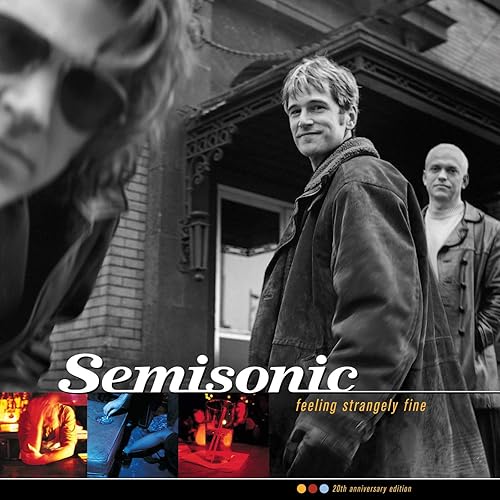
One reason that people love listening to music, particularly older music, is that songs, like smells, can evoke past memories. My wife, for example, regularly talks about how specific songs remind her of camp, or high school, or college, and I’vewrittenbeforeabout this phenomenon. I’ve also written about how certain songs remind me of specific people, oftenmyfriendChris, with whom I explored music in high school and attended many memorable shows. And there are songs that make me think about my kids, which I have alsowrittenabout. Today’s song, Semisonic’s "Closing Time," is another that reminds me of my son, who introduced me to this song back in 1998, when he was about 8 years old.
Semisonic was a band out of Minneapolis, fronted by Dan Wilson, and featuring John Munson and Jacob Slichter that formed out of the ashes of the band Trip Shakespeare, which included Wilson, Munson and Wilson’s brother Matt, among others. Both Wilsons and Slichter attended Harvard, but despite being a proud Tiger, I won’t hold that against them.
I sort of group Semisonic in my mind with bands like Toad the Wet Sprocket and Gin Blossoms, who made melodic, power-poppy albums in the 90s, which were radio friendly (for a slice of radio that still existed back then), although I was a bigger fan of those other two bands. Other reviews compare Semisonic (generally unfavorably) to Ben Folds Five, or even Matthew Sweet.
“Closing Time” is a catchy track that, on its surface, seems to be about the end of the night at a bar, a/k/a last call, and the patrons are being forced to decide whether to go home, and if not, where, and with whom, if anyone. It’s a time of both possibility and disappointment, and the song considers both options.
Interestingly, Dan Wilson has said that the song is also about his impending fatherhood. He said:
The guys wanted a new song to close our sets with. I thought 'Closing Time' would be a good title. We had spent seven years of our lives at that point, four nights a week entertaining people. That was our life. Some bouncers yelling things, closing time coming, all that imagery, literally, that's how the song started and then when I was halfway done, I started realizing the whole thing was a pun about being born, so I just made sure that the rest of the thing could ride with that double meaning, but nobody got the joke and I didn't bother to explain. I thought everyone would get it.
The song reached number one on the US Billboard Modern Rock Tracks chart, did well internationally, and got a Grammy nomination for Best Rock Song, losing to Alanis Morissette’s “Uninvited.” It’s been used in TV shows and movies, usually when there’s a scene at bar at closing time. Of course. Although two other singles from the album did OK, the followup album, which wasn’t released until 2001 (and even included a contribution from Carole King), was not successful, and the band went on hiatus, reuniting a few times in recent years for shows in the Twin Cities.
Dan Wilson, who is also apparently an accomplished visual artist, has released a bunch of solo albums, and also has written or co-written songs for others, including the Dixie Chicks’ “Not Ready to Make Nice,” and “Someone Like You,” with Adele. Munson continues to play with bands in the Minneapolis area and teaches, and Slichter wrote a book about being a rock musician and teaches, including in the MFA writing program at Sarah Lawrence College, where my daughter-in-law got her degree. She said she knew Slichter, but never took a course from him. To bring this piece to a satisfying "close," she’s married to the son I wrote about in the "open."
I have done a post or two about the Beatles here, here and here before: one of my most felicitous Internet discoveries was the <Beatles Complete on Ukelele> back when their entire archive was free, with new songs appearing more or less weekly over a period of 2 years. And then we lost free download access. The website is still there, but it's not set up for downloading the files for free any longer.
In digging around for this post/searching to see which - if any- Beatles songs had Open/Close in their titles, I ran across another cool Beatles resource that allows you to search their lyrics - in this case necessary if I wanted to continue to persue the Beatles idea, because from among the (officially) 213 songs they recorded, surprisingly not one has either Open or Close in the title.
I was thinking: surely... open heart ... open mind and if not closed heart/mind how about something along the lines of "close to me".
That said, the two words of our current theme show up multiple times in their lyrics. Enough of them that I'll have to pick and choose from among them.
beatlesagain.com lists 4 for "open" and 10 for "close". Across the Universe has open ears. Dear Prudence and Tell Me What You See also include open eyes and Help has open doors.
Looks like the eyes have it. All My Loving has "close your eyes"; Good Night has "I'll close [my eyes]"; Think For Yourself has "if we close our eyes"; Strawberry Fields of course has "living is easy with eyes closed". Five are about close as in near: Do You Want To Know a Secret has "Closer"; Besame Mucho has "Close to me"; Glass Onion has "close as can be"; Twist and Shout has "twist a little closer" and Words of Love has "hold me close".
Good Morning, Good Morning is an outlier with "everything is closed".
Nothin' about hearts open or closed nor about opening your mind. Nothing particularly romantic/mushy here either.
Pat Lewis & Joe Coghlan/Tell Me What You See:
Beatles out-take: Across the Universe
Alanis Morissette: Dear Prudence (and a story about its inception)
The Great American songbook is something that has me normally running for the hills, especially when utilised as a vehicle for ageing rockers who have overdrawn on their inspirations. Most such vanity projects have given such a bad name to the originals that one could be fooled too that the originals are cheesy and cheap. And sometimes they are, but there are a bevy of writers of such reliability that any such fear is misplaced. These would include Cole Porter, the Gershwins and Richard Rodgers, cited mainly as three who transcend the celluloid vintage of their origin and can hold their heads up against often the most lumpen of current interpreters. My title song, above, as played out by Ella (do I really have to add) Fitzgerald, was written by Richard Rodgers (music) and Lorenz Hart (lyrics). Although Ella was not the first, and, as someone I totally didn't "get" until maybe a decade ago, arguably she provides the definitive version. Quite how I couldn't see past the elderly and bespectacled, grandmarmy-like woman she had become, now defies me, it taking my Uncle George, a jazz lover who instilled in me the love of music if not, initially or necessarily, his tastes, to get me to see with my ears open, hear with my eyes open. He played me some Aretha Franklin, shocking me with his eclecticism, seamlessly then comparing and contrasting with Ella, getting me to allow both in my appreciation.
It's a great song, though, isn't it? From a 1940 musical, Pal Joey, it was originally sung by a Vivienne Segal on Broadway, reprised in a revival, 14 years later, with an ongoing life of it's own since then, with perhaps the most bizarre appearance coming in the UK royalty biopic, The Crown, as possibly sung by King George V and his daughter, Princess Margaret.
Here are three of the better contemporary versions. (With apologies to those who would say otherwise, Frank doesn't count as sufficiently contemporary.)
Boz Scaggs has one of those voices that hinges on the cusp of being just, and only just, right, fitting no definition of being good in any accepted classical sense. But, on the right material, perfect. Personally I am no lover of peak Boz, his disco years, Lido Shuffle and all that, much preferring his earlier and later more blues based work. But here, the juxtaposition of his strained holler alongside the consummate lounge jazz setting, is a glorious peanut butter/jelly combination. It comes from a 2003 release, But Beautiful: Standards, Volume 1. Strangely, no second volume has yet appeared.
Rufus Wainwright adores this stuff and it adores him. Many say he sings like a corncrake; I have to say I differ, finding his high camp self-belief so intoxicating as to have me forget the sentimentality of (some of) his material and the archness of his presentation. This version shouldn't really do it, as he milks the saccharine and cloys it to near curdle. But I love it. Just don't tell anyone. This comes from the film of Alan Bennett's The History Boys, my imagination that Bennett himself would be not amiss to crooning along with it.
Yes, that Jeff Lynne, Mr E.L.O. Astonishing, as I really cannot abide most of his output, in particular some of his trademark mannerisms, the echolalia backing vocals, for one, which threaten to appear here, retreating, thankfully, just as swiftly. This avoids the tweeness he often can bring to material, his voice managing to sound warm and genuine. It doesn't even make me think, that much, of the Beatles. Like the Boz Scaggs above, this comes from an oft overlooked record in his canon, Long Wave, in 2012, a album entirely of covers from the 40s and into the 50s.
Of course, there are some other crackers, Linda Ronstadt and Sinead O'Connor, as two women who have the pipes to nail it, each capable of singing the phone book and still sounding sweet. And clunkers aplenty, mentioning no names.
Star Maker Machine does not accept music submissions from artists or promoters. However, most of the contributors here do accept submissions for our own blogs, listed below. Please visit our blogs, take the time to listen to what we post, and then feel free to contact us if you feel that your music would be a good fit.