












Showing posts with label David Letterman. Show all posts

Tuesday, May 5, 2020

Musical Mysteries: What’s The Frequency, Kenneth?


R.E.M.: What’s The Frequency, Kenneth?
[purchase]

I know that my chosen song for this piece asks a question, but the answer to the question isn’t the mystery. In this case, it is the question itself, and the context in which it became famous, that is the mystery, albeit one that was solved years after the precipitating event, and the release of this song.

On October 4, 1986, newscaster Dan Rather was walking on Park Avenue in New York to his apartment after having dinner with a friend, when he was attacked and beaten by two “well-dressed” men, one of whom kept demanding, “Kenneth, what was the frequency?” Why Rather was attacked, why the assailant demanded to know the “frequency,” and kept calling Rather “Kenneth” were mysteries. Rather was quoted as saying, "I got mugged. Who understands these things? I didn't and I don't now. I didn't make a lot of it at the time and I don't now. I wish I knew who did it and why, but I have no idea." The New York Times article about the incident referred to the motive as a “mystery,” so I guess this officially validates my choice of subject.

The phrase, “What’s the frequency, Kenneth,” became part of popular culture afterwards, and in October, 1993, about 7 years after the event, R.E.M. recorded a song with that title, and included it on the 1994 album, Monster. According to Michael Stipe, the song isn’t directly about the Dan Rather incident, but is about the Generation X phenomenon in contemporary mass media, sung in character as an older critic whose information consists exclusively of media products:

I wrote that protagonist as a guy who's desperately trying to understand what motivates the younger generation, who has gone to great lengths to try and figure them out, and at the end of the song it's completely fucking bogus. He got nowhere.

Rather actually performed the song with R.E.M. on the Late Show With David Letterman. Based on that clip, it is no mystery why Rather did not pursue a singing career.

In 1997, the mystery was solved.

Just prior to the release of Monster in 1994, William Tager shot and killed an NBC technician, Campbell Montgomery, outside the sound studio of the Today Show. Tager had tried to enter the the studio with an assault rifle, and Montgomery died in an attempt to block him. Tager was arrested and reportedly told police that the television network had been monitoring him for years and beaming secret messages into his head. He apparently came to NBC looking for a way to block those transmissions.

Tager was convicted of murder and sentenced to 25 years in Sing Sing prison, not far up the road from where I’m sitting right now, and later told a psychiatrist that he was a time traveler from a parallel world in the year 2265. A convicted felon in the future, Tager said he was a test-pilot volunteer in a dangerous time travel experiment. If he was successful on his mission, his sentence would be overturned and he would be set free. The authorities in the future kept tabs on him via an implanted chip in his brain. During the examinations, Trager also confessed that he had attacked Dan Rather because he mistook him for the Vice President of his future world, one Kenneth Burrows. When Rather saw a picture of Tager in the newspaper, he identified him as the man who attacked him.

Of course, Dan Rather’s career took off after his coverage of the assassination of JFK in 1963, an event which some believe has never been properly solved. They’re wrong.
Tuesday, March 19, 2019

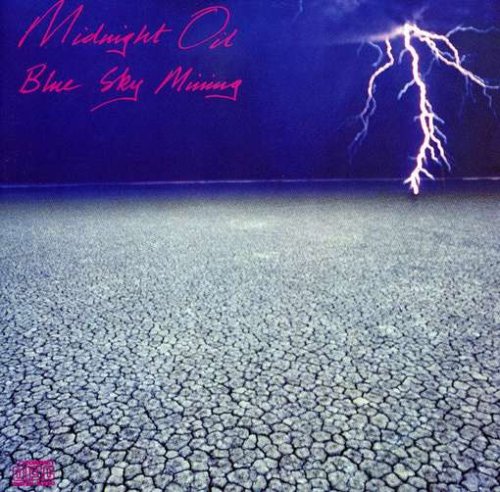
Australia: Midnight Oil/Blue Sky Mining


Midnight Oil: Blue Sky Mine
[purchase]

There are many great bands and musicians from Australia, and I hope that we get to a bunch of them over the next two weeks. I’m going to start off with my favorite, Midnight Oil. Like most Americans who have heard of Midnight Oil, I first became aware of them with what is still probably their most famous song, “Beds are Burning,” from 1987’s Diesel and Dust (released in the US in 1988). It is a great song, highlighting the claims of indigenous Australians to their historic land. And the album raised other concerns of indigenous Australians and environmental matters (and had another great single, “The Dead Heart.”)

Not surprisingly, there was a bit of a backlash about a bunch of white guys raising these issues, but it seems that the band did all of the right things (like donating their royalties to indigenous organizations and touring with indigenous bands), and it seems that eventually, most people appreciated the fact that Midnight Oil’s popularity raised the profile of these issues.

It was the band’s next album, 1990’s Blue Sky Mining, that made me a confirmed fan—in fact to this day, it remains one of my favorite albums, and is included in any conversation about my “Desert Island Discs.” I think that while it lacks a single track that has the staying power of “Beds are Burning,” each of Blue Sky Mining’s 10 songs are strong, and the album holds together from the opening sorta title track, “Blue Sky Mine,” about the experiences of workers at the Wittenoom blue asbestos mines, to the environmentally focused closer “Antarctica.”

The band decided to both make their music a little more accessible and make their message even more political, and it worked. Not to mention that the success of their prior album gave them the opportunity to work at a better studio, so the sound of the album is much cleaner. There are songs about the need to remember and examine Australia’s difficult history, corrupt politics, divisiveness, and other environmental and political issues. Damn—all of these issues are still problems in the world. Here’s a nice article about the album, including an interview with guitarist Jim Moginie and producer Warne Livesey, looking back on it after 25 years.

Midnight Oil’s environmental and political emphasis was not just empty rhetoric. On the tour supporting Blue Sky Mining, the band, in New York to play at Radio City Music Hall, pulled up on a flatbed truck at Exxon’s nearby headquarters, unfurled a banner that read “Midnight Oil makes you dance, Exxon oil makes us sick” and played a 30-minute lunch-hour set to protest the prior year’s Exxon Valdez spill. Peter Garrett. the band’s 6’4” shaved-head frontman was the President of the Australian Conservation Foundation in 1989–1993 and 1998–2002, and during 1993–1998 he was on the International Board of Greenpeace. He also served in the Australian House of Representatives and in the Cabinet as Minister for the Environment, Heritage and the Arts and later as Minister for School Education, Early Childhood and Youth.

David Letterman loved Midnight Oil, and I loved Dave. He usually introduced them with some crack about how Garrett scared him, and referred to them as “bushmen,” which seemed funny at the time, but hasn’t really aged well. Here’s a video of their performances on his show, and in the last one, you can hear some of Dave’s comments.

Being who I am, I did go back and get copies of most of the band’s albums before Diesel and Dust, and they didn’t totally grab me, and I didn’t listen to them much. They seemed to be searching for a style, mixing punk, pop and even prog influences that really came together in a trio of albums that started with Diesel, continued with Blue Sky and ended up with its successor, Earth and Sun and Moon (with a fine live set that was released during this period). After that, although they put out some good music, to my ears they never again reached the peak of that three album run. They are a band that I have never seen live, and regret it.

Midnight Oil disbanded in 2002, when Garrett left the band, although they reformed intermittently for benefit shows. They reunited for a world tour in 2017 (somehow, I missed their NY dates) and are touring Europe and the UK later this year.

Monday, August 7, 2017

Chaos/Confusion: Disorder In The House


Warren Zevon (w/Bruce Springsteen): Disorder In The House
[purchase]

Warren Zevon is one of those artists whose music I’ve enjoyed and appreciated over the years without ever really being a fan, or learning all that much about him. There’s just so much music out there, and so little time. David Letterman, on the other hand, was a huge Zevon fan. He was a guest on Letterman’s various shows more than two dozen times, and even filled in 20 times as bandleader when Paul Shaffer was unavailable.

Back in 2002, Zevon was diagnosed with lung cancer, and shortly afterwards appeared as the only guest on Letterman’s show. Their interview soon became a classic. Letterman’s respect and compassion for his dying subject, coupled with Zevon’s unflinching honesty and humor (which gave Letterman the opening to be funny, too) is striking.  During the course of their discussion, Zevon responded to Letterman’s question about his new-found understanding of life and death with the phrase “Enjoy every sandwich,” which became a pretty well-known distillation of his life's philosophy. Zevon also performed three songs on the show that night. The Letterman show is worth watching, and you can see the interview here, the performance of “Mutineer,” here, “Genius” is here, and Letterman’s request, “Roland The Headless Thompson Gunner” is here. And Letterman's and Shaffer's heartfelt announcement of Zevon's death about a year later is here.

At the time of the Letterman interview, Zevon had recently released an album whose title, My Ride’s Here, seemed eerily prescient in retrospect. But to be fair, his prior album was called Life’ll Kill Ya, so it is probably more fair to say that he was comfortable with his death as a concept, not that he had any mystical foreshadowing of his demise.

After his diagnosis, Zevon worked on his last album, which ended up titled The Wind. It is hard to listen to the album without feeling that Zevon was trying to sum up his tumultuous life and preparing for its end. It includes 10 original songs (or co-writes with his long-time collaborator Jose Calderón), and a poignant cover of Dylan’s “Knockin’ On Heaven’s Door.” The album included numerous high profile guests, including Mick Fleetwood, Jackson Browne, Joe Walsh, Tom Petty, Billy Bob Thornton, Dwight Yoakam, T-Bone Burnett, David Lindley and Emmylou Harris.  While the album contained its share of contemplative ballads, Zevon could still rock and show his trademark twisted humor, most notably with guest Bruce Springsteen, who shared vocals and played electric guitar on the raucous “Disorder In The House.”

The song lays out the chaos and confusion in the titular house--overflowing bathtubs, falling plaster, doors coming off their hinges. It’s so bad that “even the Lhasa Apso seems to be ashamed.” Then, it becomes clear that the song is about criminals being chased by the police, but it appears that the narrator escapes.

To me, what is most memorable about the song is the fun that Zevon and Springsteen seem to have performing it. The Wind was released two weeks before Zevon died, at the age of 56. The album received five Grammy nominations, including Song of the Year for "Keep Me in Your Heart," and it won two Grammys, for Best Contemporary Folk Album, and "Disorder in the House" was awarded Best Rock Performance by a Duo or Group With Vocal. These were the first Grammys of Zevon's career, and I suspect that he’d be chuckling to himself if he knew what it took for him to get them.

Thursday, February 9, 2017

Small Towns: Small Town News

[preorder a biography of Letterman because the only purchasable videos of his show are on VHS]

We did a theme a couple of years ago called “Where I Live,” and I wrote about my favorite small town, Tarrytown. I’m not going to that well again, so you should read that piece if you are interested.

Instead, I’m going to write about the second thing that popped into my head when I heard the theme, “Small Town News,” a segment that was regularly featured on Late Night With David Letterman, and occasionally on Late Show With David Letterman. Let me start by saying how much I miss David Letterman. I didn't start watching Late Night right away, when it started airing on NBC at 12:30 on February 1, 1982, but a couple of years later, I began to record it on my VCR and watch it in the mornings as I got ready for my day. I pretty much stuck with Dave, and followed him to CBS when he moved to the more coveted 11:30 slot (even if he lost the battle to succeed his idol Johnny Carson to the duller, more mainstream Jay Leno). And when Dave signed off in 2015, I tried to watch his successor, Stephen Colbert, but it wasn’t the same and I have gotten out of the habit.

Late Night was considerably stranger than the Late Show. It was as if NBC really didn’t care what happened after midnight, and it seemingly allowed Dave, and his writers, to do what appeared to be anything they wanted to do. Rotating the screen. Dubbing reruns. Involving the backstage staff. Having strange, fake guests. Having strange, real guests. Weird stunts. Letting Andy Kaufman go wild.  Which is not to say that what he was doing was unprecedented—Steve Allen’s Tonight Show was definitely an influence, and Ernie Kovacs did some similar stuff, but what made the Late Show so unusual was the way that it seemed to mock the entire genre of late night talk shows without being a parody.

The “Small Town News” segments were a perfect example of the show’s style. Like other segments on the show, like Stupid Pet Tricks, they took something ordinary and pretended that it was appropriate for network television.. As you can see in the video above, from 1988, Dave goes into the segment after what appears to be an improvised bit with a goofy bubble machine and having Paul Shaffer and the band play a cheesy 70's-style “Love Theme.” Throughout the segment, Letterman makes it seem like he has no idea what is going on, he donates $10 per laugh to the United States Olympic Luge Team, for no apparent reason, other than wanting to “just beat those damn Russians at luge once,” he engages in asides about the temperature in the theater, and regularly uses self-deprecating humor.

When Letterman moved an hour earlier, and to CBS, the show changed. Being in an earlier time slot, and competing against the Tonight Show, meant that the network cared more about the show, and many of the odder rough edges were sanded down. Of course, Letterman was also older, and seemed less interested in tweaking authority as much as he had in his younger days. Which was not to say that the Late Show lacked edge, or was slick, dull and mainstream, but it certainly lacked some of the absurdity and anarchy that the earlier show was famous for.

Compare this version of “Small Town News” from the Late Show from 2007—nearly 20 years after the video above.


Putting aside the better production values, including a still silly but more produced theme, nicer cards, etc., you can see that Letterman no longer was pretending that he didn’t know what was going on. No more asking the booth what comes next, or pretending to be confused. In other words, he had gone from being some renegade comedian who somehow found himself with a show that was not completely in his control to a confident TV star. One who still didn’t always seem comfortable with his fame, but was no longer surprised by his good fortune.

The CBS show was still great, and I enjoyed it enormously (because I was older, too), but I guess it is sort of how so often you love a band’s early, sloppier work more than their later, more polished stuff, even as you can appreciate that they have grown and the later material is objectively “better.”

Friday, October 7, 2016

Harvest/Fall Future Islands, Seasons (Waiting On You)


Purchase: Seasons (Waiting On You)


I think a lot of folks came to Future Islands via The Late Show with David Letterman. It was the band’s Late Show debut and they put on a masterful rendition of the hit single, “Seasons (Waiting on You)”—a buoyant, bouncy gem with a church-hymn-worthy chorus and a soaring dance-infused rhythm. I fell in the love with the song, and Letterman, ever a musical enthusiast and never one to shy away from promoting the bands he believed in, did too. But it was more than the song Letterman liked: lead singer and main songwriter Samuel Herring is blessed with many talents, but his peculiar dance moves are more akin to combat defense positions and he cuts quite a figure on stage.

Lettermen went a little nuts for Herring’s bombastic neo-slide moves and the YouTube version of their performance went on the garner millions of views. Views on YouTube have become a strange kind of modern currency, and the more one has, the greater one’s prowess in the modern social media arena. Or something like that—I had a kid in a summer class I taught tell me that he was a “famous YouTuber” and that he made money from having so many subscribers to his channel. I went to his channel and it was pretty much videos of him playing video games and putting his finger in his nose for comedic effect. But, one of those legends along the bottom of the screen did read that he had subscribers in the multi-thousands. And that equates to money? I’m digressing, I know, but, wow—if all it takes to earn cash these days is to put up poorly shit videos of bodily functions and boogers, then I ought to be a freaking mogul…

So, Future Islands, an eclectic, North Carolina born, Baltimore based synth pop band that is very worthy of accepting the throne from former synth-pop greats such as New Order, rose to fame because their incredibly talented singer/songwriter cuts a very strange rug? Yeah, that’s modern music. No need to actually pay attention to the sound itself, the lyrics or the vibe that gets spun by a group of musicians. Nope—just watch the video and click like. It’s a sad kind of world we’ve created, and those of us who remember the world before the internet, lament the state we find ourselves in (even if it’s just a sort of stasis, before we move on to the next fad). It seems sad and a bit incomprehensible to me that we can no longer rely on great music (albums) to be enough if it doesn't come with some strange, and useless viral hype. This applies to new music, I suppose. And, not all of it, I know: I'm generalizing.  But the changes that music industry has undergone are confounding, as well as myriad, and it seems odd to me that a song like Seasons grows a following because of social media, a phenomenon that is a far removed from music as can be...

Seasons is a gorgeous song—there’s no weird dancing in the video, and in the listening, we can judge the band on its true merits. As we should. And we can love the song because we are moved by what counts: melody, beat and soulful expression-what good music is really about.


But, lest you think I’m a grumpy, pessimistic old man (I am, don’t worry), you should know, despite the unwarranted attention Future Islands got due to the goofy dance moves, Seasons went on to be named the best song of 2014 by the Pazz & Jop critics' poll in the Village Voice, Pitchfork Media and Consequence of Sound. (Wikipedia)