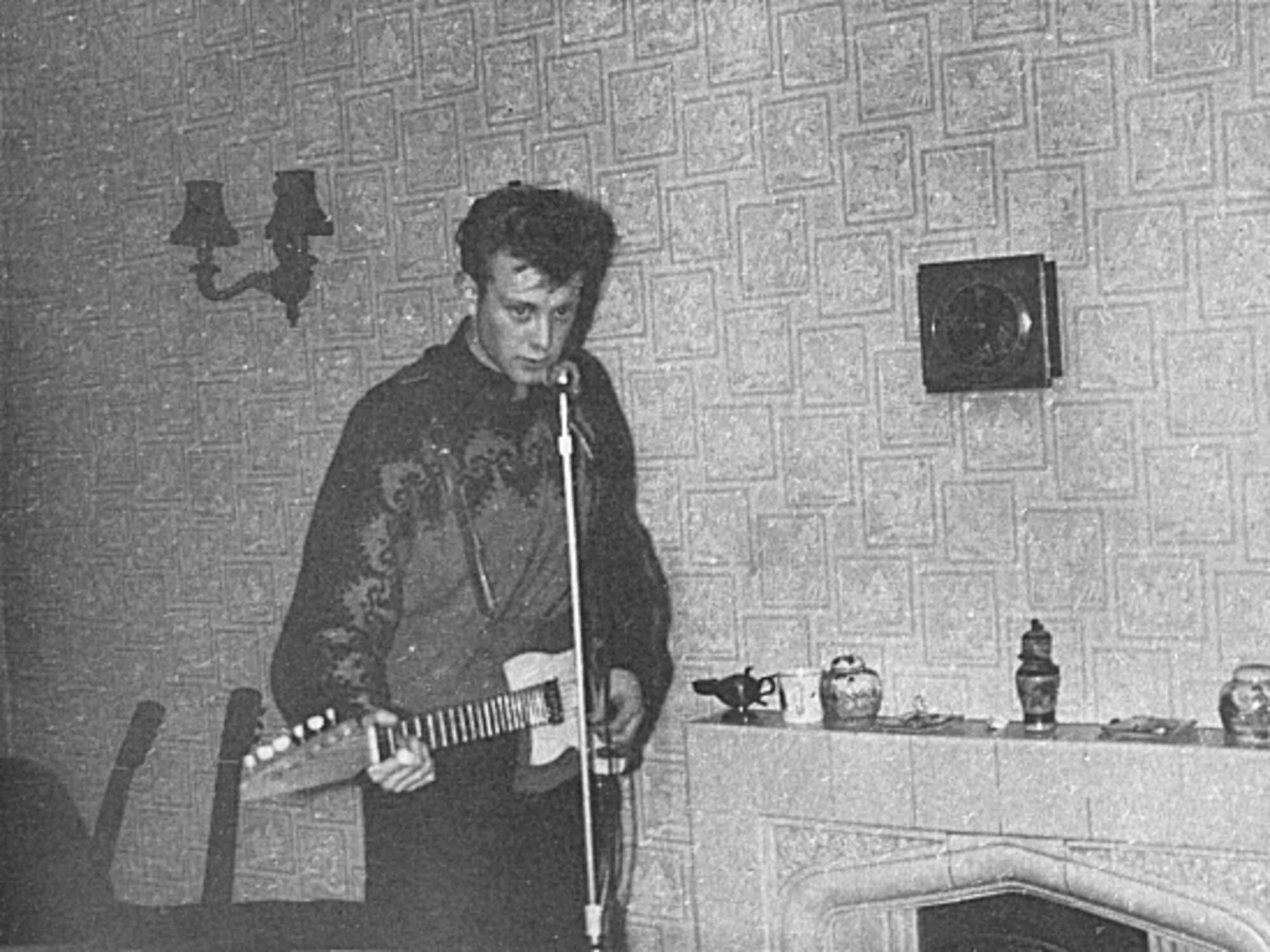
You’re a teenage (left-handed) bass player, and a former band mate asks you to fill in on a few gigs with a cover band that had recently
been on tour, because their bass player is unavailable.Needing a bit of extra Christmas cash, Chas
Newby agreed, and played four shows in England with his old friend Pete, and
his fellow band members, John, Paul and George.Chas had fun and pocketed all of £4.But when John suggested he stay with the band
for a tour in West Germany, Newby declined, figuring that he had a better
chance of success in his preferred field of chemistry.
Of course, the rest is history.Nearly two years after Newby declined Lennon’s
offer, the Beatles hit it big with “Love Me Do,” featuring Paul McCartney on
(left-handed) bass.
As Newby said:
To me then it was just four gigs with a different band. Music
was never going to be a living for me. All of us at that time were thinking
what we were going to do with our lives, some doing teaching, or science, or
whatever.
I wanted to do chemistry. John, Paul and George, they just
wanted to be musicians.
They had been away in Hamburg. They’d played a hell of a lot
over there so they were very tight, very proficient, and they gave it some
stick. But I did the four gigs and went back to my college course the week
afterwards.
In fact, Newby went back to St. Helens College and continued
his studies in chemistry, eventually getting his Master’s from
Manchester University.In 1971, a decade
after his brief encounter with possible superstardom, he joined Triplex Safety
Glass, which manufactured windscreens for trains and aircraft.He retired in 1990 and became a math
teacher.
Further proof of his being merely a blip in Beatles’ history,
Chas only had one encounter with any of the band after his four gigs (the last
of which was 63 years ago today--New Year's Eve 1960--at the Casbah).In 1962, he recounted:
I was on my way home and I pulled up at some traffic lights.
There, waiting at the crossing, was George. I said hello and asked if he needed
a lift. He said he was waiting for someone and that was that. Off I went.
Before his death on May 22, 2023, Newby played in a charity
band, The Racketts, and in the reformed Quarrymen, which once counted John,
Paul, George, and Newby’s predecessor in the Beatles, Stu, as members.
Backbeat, a
bio-pic about the earliest iteration of The Beatles—well, The Silver Beatles,
actually—came out in 1994, and at the time, I remember thinking: wow! What a
movie! So cool, so uber-hip as to be so different from what was happening at
the time. I’ve re-watched it since and all I can really say is, in deference to
the aging process, the accents are good, especially the guy who played George
Harrison. In fact, all the portrayals are good: Lennon is brooding and nasty,
Paul is smiley, yet focused. George is quiet. Then there’s Pete Best, the
world’s unluckiest drummer, but the focus of the film, Stuart Sutcliffe, the
“lost Beatle” or the “5th Beatle”, who left the band to become a
painter and then tragically died from an intracerebral hemorrhage is the central story. The injury
was the possible result of a vicious beating he took, and a kick to the head,
in one of the Beatle’s many misadventures in Hamburg, Germany, where they cut
their teeth as a bar band pre-1964 and their history-making splashdown in
America to start the British Invasion. The film’s focus is on those wild times,
as the Beatles sorted out just exactly who they were, and the irony of seeing
them portrayed as pre-icons, unaware of what was to come, makes for interesting
watching.And the fact that the film
devotes most of its image making to Sutcliffe and his relationship with
photographer Astrid Kirchher, lends to the air of mystery around just who the
Beatles were before they become the biggest celebrities in history.
Sutcliffe died a year after leaving the band, at the age of
21, after having secured a scholarship to attend the Hamburg School of Art.
Pete Best was replaced by Richard Starkey…the rest is history.
It’s sad to think of what could have been when one discusses
Sutcliffe (or Pete Best, for that matter). An artist first, Lennon convinced
him to join the band and play the bass, which Sutcliffe had absolutely no
talent for whatsoever. But, he looked cool, and in a band as image-conscious as
this, that counted for a lot. In fact, it was arguably Sutcliffe that inspired
and invented the Beatle’s image—point in fact: he was the first to wear a
mop-top; the others were copying him. Same with the Beatle boots and the duds.
But, with Lennon, McCartney and Harrison being as talented as they were, tensions
were bound to arise—the looks would only get them so far. Seriously, think
about it: The Beatles started out like any other pop outfit: thriving,
rocketing to fame on their carefully cultivated image and the devastating good
looks. But, they surpassed the look and did something as yet really unachieved
at that time in pop/rock music, which was make music.
Music, as in italicized
music, asterixed music, real music*.
The level of talent, of song writing and
composition skills, has rarely, if ever, been matched since by a pop band. So,
good looks, mop top haircuts, and those Chesterfield suits with the velvet
collars and the drainpipe pants, would have only taken The Beatles so far if
not for the god-given musical talents. Imagine a history where the Beatles were
a relegated to a few oldies hits, dusted off on classic rock radio, never achieving
Abbey Road, or Sgt. Pepper’s, because they were kind of Justin Beiber, or
something even less, a factory made hit, here and then gone. Pop music is more
flash than it is bonfire. The Beatles remain an ever-growing phenomenon not
because they were among the first, but because they deserve, perhaps, had to be
that.
The movie itself, as I said, is…OK. It’s a nice period
piece, full of authentic sets, haircuts, and great wardrobe. It shows the
tensions in the band, defines the personalities that would go on to be more
legendary the real, and depicts Paul’s anger and dislike of Sutcliffe, knowing
he was better on bass than the aspiring art-school aesthete.
But, it is the soundtrack that we will end on. Produced by
Don Was, and featuring a veritable all-star line up including Dave Priner of
Soul Asylum (huge at the time the movie came out); Greg Dulli of the Afghan
Whigs; Mike Mills of REM; Thurston Moore of Sonic Youth; and a young kid named
Dave Grohl from a little band called Nirvana. The album is a vanity project of
sorts, with ace musicians, wildly popular at that particular juncture, covering,
in a most un-ironic way, their roots. The music that Beatles started out with
was and remains some of the most enjoyable ever written: 2-minute, whip crack
rockabilly and soul numbers that really, though covers themselves at the time,
were the very earliest traces of rock n roll. The DNA of the genre, if you
will—what made rock n roll a cultural force, and not just a local southern
radio oddity named after a slang term for sex, with a fast backbeat and a
quicker guitar riff and shuffle.
This modern day crew cuts a fantastic, hyped up and
warp-speed collection of such tunes as Little Richard’s “Long Tall Sally” and
“Good Golly Miss Molly”, “Twist and Shout”, Chuck Berry’s “Rock ‘n’ Roll Music”
and “Carol” and the Berry Gordy penned, “Money”, perhaps the most recognizable
of the later Beatle’s hits.
The soundtrack is well done, recorded crisply and full of a
buoyant, joyous energy. And like its predecessors, it clocks in at under a
half-hour—those 2-minute pop classics, all jangle guitar, shotgun snares and
ripping vox are a thing of the past, sadly. I remember thinking of the album as a nice
little novelty, a different kind of sound from musicians who I loved at the
time, doing far different sounding music than what was popular (Greg Dulli, in
particular, is in excellent form—but, then, the Afghan Whigs were really just a
hyped up, angry soul band…).
For me, having grown up on The Beatles and studied
them deeply well before I even got out of middle school, the soundtrack was a
lark, a fun reinterpretation. But, for a lot of people my age, in the confused
post-Nirvana (Cobain committed suicide just about a week after the soundtrack
came out), still growing grunge and alterna-revolution, the soundtrack to Backbeat was kind of a text book, a
primer for what came before and laid the groundwork for the rock ‘n roll that
was happening now (well, then actually…).
The thing itself, rock ‘n ‘ roll, is constantly changing, but its roots,
as open to debate of ownership and origin as they are, remain solid. The place
rock music came from is sacred, a spring or an oracle, still able to mystify.
Going back, regardless for the reason, proves, like all good art, that
reinterpretation, not necessarily reinvention, will keep the thing perpetually
alive. And kicking. Hopefully to a kicking backbeat…
Star Maker Machine does not accept music submissions from artists or promoters. However, most of the contributors here do accept submissions for our own blogs, listed below. Please visit our blogs, take the time to listen to what we post, and then feel free to contact us if you feel that your music would be a good fit.