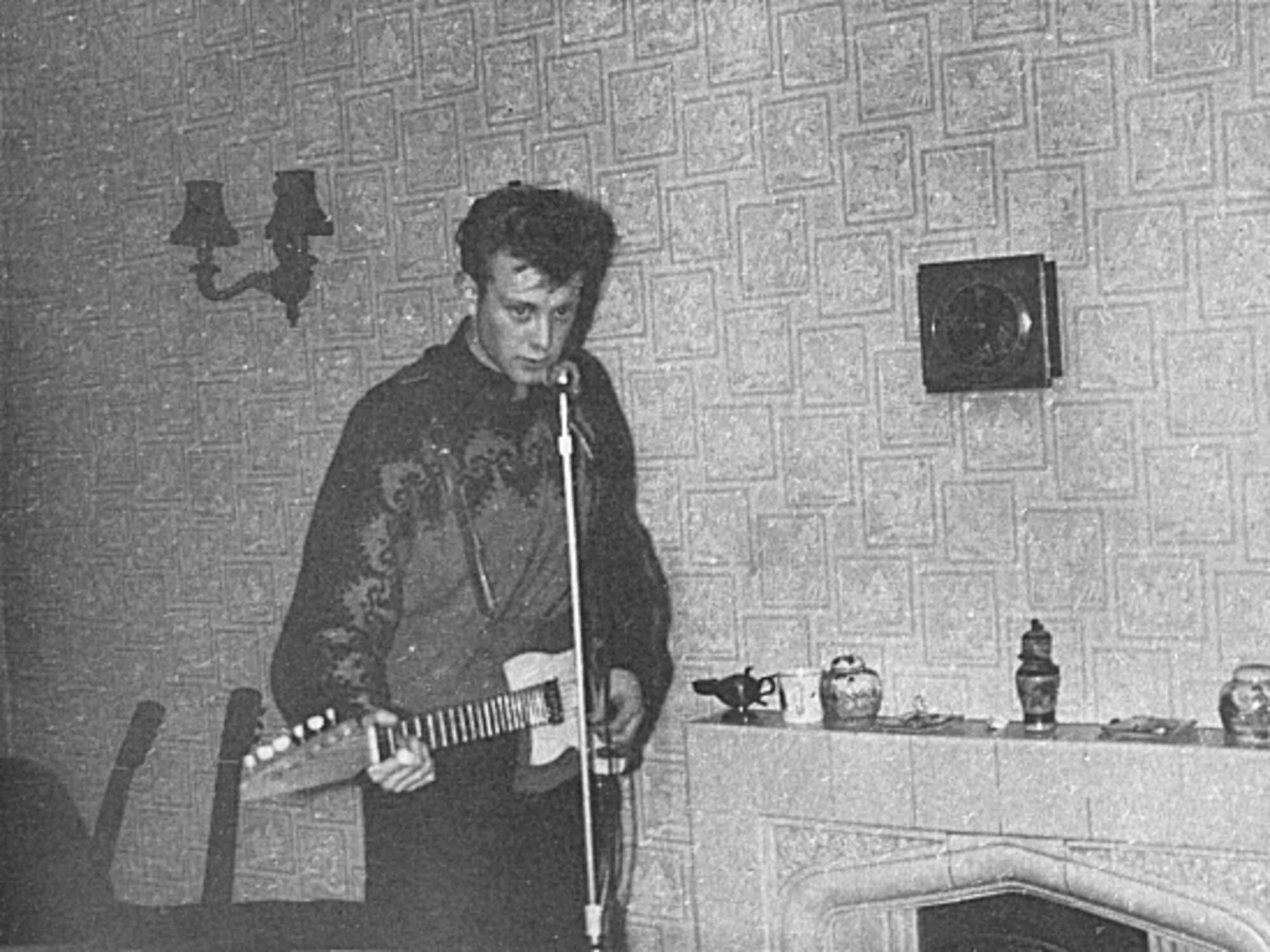
You’re a teenage (left-handed) bass player, and a former band mate asks you to fill in on a few gigs with a cover band that had recently
been on tour, because their bass player is unavailable.Needing a bit of extra Christmas cash, Chas
Newby agreed, and played four shows in England with his old friend Pete, and
his fellow band members, John, Paul and George.Chas had fun and pocketed all of £4.But when John suggested he stay with the band
for a tour in West Germany, Newby declined, figuring that he had a better
chance of success in his preferred field of chemistry.
Of course, the rest is history.Nearly two years after Newby declined Lennon’s
offer, the Beatles hit it big with “Love Me Do,” featuring Paul McCartney on
(left-handed) bass.
As Newby said:
To me then it was just four gigs with a different band. Music
was never going to be a living for me. All of us at that time were thinking
what we were going to do with our lives, some doing teaching, or science, or
whatever.
I wanted to do chemistry. John, Paul and George, they just
wanted to be musicians.
They had been away in Hamburg. They’d played a hell of a lot
over there so they were very tight, very proficient, and they gave it some
stick. But I did the four gigs and went back to my college course the week
afterwards.
In fact, Newby went back to St. Helens College and continued
his studies in chemistry, eventually getting his Master’s from
Manchester University.In 1971, a decade
after his brief encounter with possible superstardom, he joined Triplex Safety
Glass, which manufactured windscreens for trains and aircraft.He retired in 1990 and became a math
teacher.
Further proof of his being merely a blip in Beatles’ history,
Chas only had one encounter with any of the band after his four gigs (the last
of which was 63 years ago today--New Year's Eve 1960--at the Casbah).In 1962, he recounted:
I was on my way home and I pulled up at some traffic lights.
There, waiting at the crossing, was George. I said hello and asked if he needed
a lift. He said he was waiting for someone and that was that. Off I went.
Before his death on May 22, 2023, Newby played in a charity
band, The Racketts, and in the reformed Quarrymen, which once counted John,
Paul, George, and Newby’s predecessor in the Beatles, Stu, as members.
We continue featuring drummers who died in 2022. Part I featured Jet Black (Brian Duffy), Jerry Allison, and Dino Danelli, and you can read that here, if somehow you haven’t read it already. We’re proceeding oldest to youngest, and Part III should be posted soon.
Alan White—White was best known as the drummer for Yes, although I admit that I always think of him as “the drummer for Yes who replaced Bill Bruford.” Bruford is my favorite rock drummer, so White was never going to measure up, but he was a fine drummer in his own right, and played on many great Yes songs.
Born in 1949, White joined his first band at 13, turning pro at 17. In 1969, White received a call from someone claiming to be John Lennon, looking for a drummer for the Plastic Ono Band. White thought that someone was yanking his chain, but it turned out to be a genuine offer. White, given three days to prepare, performed with them for a show, and later played on Lennon’s Imagine album, the song “Instant Karma,” and George Harrison’s All Things Must Pass. This led to a brief enlistment in Ginger Baker’s Air Force, and work with Steve Winwood and Terry Reid.
White shared a London flat with Eddy Offord, who worked as an engineer and producer for Yes, and occasionally hung out at the studio with the band. Once, when Bruford had to leave a rehearsal session early, White sat in. Later, after Bruford left Yes to join King Crimson in 1972, White was asked to join the band, and again was given three days to learn their repertoire before the Close to the Edge tour started. You can see and hear White playing on “Roundabout” from that tour here:
White played drums and percussion on more than 40 studio and live Yes albums, and occasionally added piano parts and collaborated on songwriting. He also released one solo album and had a few side projects.
White was one of 8 of the myriad members of Yes inducted into the Rock and Roll Hall of Fame in 2017 (as was Bruford, who is not also in as a member of King Crimson, because that band has somehow never been inducted. Don’t get me started.)
After what was described as a “brief illness,” White died on May 26, 2022 at the age of 72. Sadly, two months before his death a large number of personal items, including musical instruments (the drum set he played with the Plastic Ono Band, for example), and platinum records, were stolen from a storage unit.
John Hartman-The original drummer for The Doobie Brothers, John Hartman died on September 22, 2022. Hartman originally moved to Northern California at the request of Skip Spence, who wanted him to participate an a revival of Moby Grape. That never happened, but Spence introduced Hartman to Tom Johnston, and eventually they, along with Pat Simmons, formed The Doobie Brothers.
Here’s Hartman playing “China Grove” on the BBC in 1974:
Hartman drummed with the band, sometimes with a second drummer, until 1979, straddling their early days as funky, bluesy rockers fronted by Johnston, to the smooth purveyors of “yacht rock,” led by Johnston’s replacement, Michael McDonald. He returned for a benefit tour in 1987, and two more Doobies albums (with Johnston and not McDonald) but retired from the band for good in 1992.
After that, Hartman attempted to become a police officer, but the drummer, described by the band at his death as a “wild spirit,” found it hard to break into law enforcement due to his previous drug use, despite having graduated from a police academy.
Hartman was inducted into the Rock and Roll Hall of Fame as a Doobie Brother, but because of COVID, plans for a performance by the original members were scotched. Interestingly, Hartman was the only living major figure from the Doobies not interviewed for the 2021 biography documentary, Let The Music Play.
Ric Parnell-You know how the drummers in This Is Spinal Tap! all died in strange ways? Remember how Mick Shrimpton spontaneously combusted? Real drummer Ric Parnell was Mick Shrimpton. When Spinal Tap recorded its two albums, and did TV performances and live shows through 1992, it was Parnell who handled the drums. But, you ask, how did he do that if Mick Shrimpton was dead? Turns out, Mick had a twin brother, Rick Shrimpton, who was also a drummer!
Spinal Tap was not Parnell’s only claim to fame. Born in London in 1961, to a drummer father and with two drummer brothers, percussion was basically the family business. In 1968, due to one of his father’s jobs at a TV station, Parnell got to see Jimi Hendrix perform on Dusty Springfield’s TV show.
Parnell had two stints with Atomic Rooster, initially briefly replacing a pretty fair drummer, Carl Palmer, and then rejoining and playing on their last two albums.
You can see Parnell’s Bonham-influenced drumming here, on Atomic Rooster’s “A Spoonful of Bromide Helps the Pulse Rate Go Down” from 1972:
After that, Parnell played in some Italian bands before becoming a sideman for artists including Michael Des Barres and was the drummer on Toni Basil’s hit “Mickey.” He was offered a chance to join Journey, but declined, which probably cost him a ton of money. But if he had joined that band, I would not have written this, because I really do not like Journey. So, he clearly made the right call.
Parnell settled in Missoula, Montana, where he would gig locally, and for a while Parnell hosted a radio show called, yes, “Spontaneous Combustion,” where he played basically whatever he wanted and told stories. (Boy, I miss doing that on the radio....)
On May 1, 2022, Parnell died at the age of 70 from a blood clot in his lungs that led to organ failure.
If you’ve been reading my work on this site since 2011 (!), you might notice that I often discuss why various artists aren’t as famous as I (or others) think they should be. That isn’t the problem this time, since our featured song was written and performed by James Taylor, who was, and still is, pretty famous.
Today, we’re looking at a song written from the perspective of someone who achieved fame, and is maybe not all that happy about it.
Taylor’s path to stardom is pretty well known. Born into a prosperous family, he was a sensitive musical child who eventually struggled with both mental illness and drug abuse. After his first “real” band, the Flying Machine, which also included his longtime friend and future collaborator Danny Kortchmar, failed to take off (sorry—I’m guessing that I’m not the first person to make that joke), he moved to England. Through Kortchmar, Taylor connected with Peter Asher, who at the time was running A&R for Apple Records, and Asher played Taylor’s demo for McCartney and Harrison, who loved it. Taylor was the first non-British act signed to Apple Records.
Taylor’s self-titled debut, despite positive reviews, and a fine single, “Carolina On My Mind,” failed to sell well, in part because Taylor couldn’t promote the album because he was again in rehab. Upon his release, Taylor was unable to maintain the momentum from enthusiastic crowds at live shows, including the 1969 Newport Folk Festival, because he broke his hands and feet in a motorcycle accident.
Signing with Warner Bros. Records, Taylor moved to California and recorded his next album with a big assist from Carole King (and Asher and Kortchmar). That album, Sweet Baby James, was justifiably a smash hit, garnering both critical and popular acclaim. This led to high profile concerts, benefit shows, TV appearances, and Time magazine’s declaration that he was the “face of new rock.” Let’s take a brief digression here to remind our readers who were not alive in 1971 that this was not at all as strange at the time as it sounds today.
As often happens, the followup to the big hit album pales in comparison. That’s not to say that Mud Slide Slim and the Blue Horizon was a bad album—it just wasn’t Sweet Baby James. Despite that, the album did spawn Taylor’s only Billboard No. 1 hit, a cover of King’s “You’ve Got a Friend,” featuring Joni Mitchell on background vocals, as well as Kortchmar and the crack rhythm section of Leland Sklar and Russ Kunkel.
Also on Mud Slide Slim is “Hey Mister, That's Me up on the Jukebox,” in which the singer, presumably Taylor, is pointing out to the titular Mister that it is, in fact, he who is singing the sad song on the jukebox. On the one hand, there has to be some pride in that, but there’s also a little shock, and some sadness about the fact that:
I have wasted too much time just to sing you this sad song And I've done been this lonesome picker a little too long
Taylor has said that the song “is basically a way of dealing with the shock of being a private person going public.” When asked if he found it jarring, Taylor responded:
Yeah. I found it - you know, of course, it's exactly what I wanted. I wanted to be successful. And I wanted to get people to hear my music. I wanted my music to make a difference to people. But at the same time, you know, making yourself the product, it's very distracting.
Coincidentally, not long before starting to write this, I got to see my daughter experience a small amount of similar weirdness, although without the corresponding ambivalence (or, so far, massive commercial success). I may have mentioned before that she’s a standup comedian in Barcelona, and for a few months has been appearing semi-regularly on a TV show there, The Weekly Mag, designed to help locals practice their English. I stumbled across her IMDB page, listing her one credit, and she was shocked when I sent it to her. No, it’s not the same as what JT went through, but it is a cute story, and it allows me to make this piece a little more personal than just a discussion of the early career of James Taylor.
Anyway, despite decades of fame, Taylor has always seemed to have a certain ambivalence about his place in the public spotlight consistent with “Hey Mister’s” lyrics, even as he has continued to record and perform, be a political and environmental activist, have a high profile marriage and divorce from Carly Simon, and a second marriage to actress Kathryn Walker (and another divorce). However, he seems to have settled into a quieter third marriage, to Kim Smedvig (who my wife, a huge Taylor fan, would point out is a Smithie), a comfortable recording and performing (pre-COVID) career, and maybe, finally, happiness.
I suppose that this could almost have fallen under the <slide> theme. Slide guitar is one area where George Harrison made a name. (See "My Sweet Lord").
It's been pointed out that of all the Beatles, the term "dark horse" probably best applies to George Harrison: someone who keeps their abilities and interests a secret, a surprise. Certainly, in terms of the heydays of the Beatles, Harrison fit the term. Known by name, but not as mediatic. Yes, he penned some of the Beatles' best (myself, I vote for Harrison's Taxman, below).
Then, following on the breakup of the band, Harrison's first two solo albums positioned him as the band's dark horse: <All Things Must Pass>, <Living In the Material World> and even the subsequent <Concert for Bangladesh> proved his dark horse status - all well received and charting well. A hit-generating contender beside McCartney and Lennon.
It was after this that Harrison headed into some real dark days - and not the kind defined by the term "dark horse" unless you twist the dictionary definition by comparing the life of a man to that of a horse. Stuff that's more like Darkest Days of Our Lives material. He tried to start his own recording label. Named Dark Horse no less. And the album of the same name (for which this was to be the hit song) didn't do so well. Perhaps not a surprise, considering the content focus, with songs titled "So Sad" and the classic "Bye Bye Love". As reviewer Nick Deriso said, the album is a "downer". Rolling Stone called it a "shrivelled career", 'awkward", "insufferable" and "hoarse"- pun probably intended. Ouch!
That said: this IS the one and only George Harrison. RIP.
Growing up, as a good liberal child in the late 1960s and early 1970s, the FBI was the enemy. Under the leadership of director J. Edgar Hoover, and after his death, the FBI was instrumental in trying to suppress the civil rights and anti-war movements, discriminate against gays, and generally act as a tool of the “Establishment.” I personally have no problem with enforcing the law, if done fairly and within the bounds of the law—and so I have no problem with the FBI’s anti organized crime or terrorism work, for example—but with respect to the civil rights and antiwar stuff, they definitely crossed the line. Which may be why, in part, it wasn’t hard to watchThe Americans, and find myself sorta pulling for the Russians, even though watching the show demonstrated that they were also pretty horrible.
It is interesting, though, that now it is the “leader” of the American government himself who is the biggest critic of the FBI, despite the fact that he appointed its director. And let me be clear—former director Comey deserved to be fired by whichever candidate won the 2016 election because of the way he botched the handling of the investigations of both candidates. But to have done so for the explicit reason of impeding the investigation into alleged conspiracy with Russia to influence the election is simply wrong, and probably illegal. So, it is amusing that these days, it seems like it is the liberal Democrats who seem to be bigger fans of the FBI than the Republicans.
I doubt that the FBI is that big a deal in England, much as the band The Shadows was never that big a deal here. (How’s that for a clunky segue?) But in England, they were huge, with multiple hits, and lead guitarist Hank Marvin influenced pretty much every great English/Canadian/Australian guitarist, including RichardThompson, Andy Summers, Brian May, Steve Howe, George Harrison, Neil Young, Tommy Emmanuel, Eric Clapton, Pete Townshend, Mark Knopfler, Peter Frampton, and Jeff Beck. Just to name a few.
Although they started out as the backup band for Cliff Richard, maybe the poster child for “huge in England, mostly unknown in the US,” the Shadows went on to fame in their own right, mostly as an instrumental band. “F.B.I.,” released in 1961, was not their biggest hit, but it did hit #6 on the UK charts (and never charted in the US.)
Ian Hunter opened his 1980 live album, Welcome to the Club, with a cover of the song, featuring his band’s guitarist, Mick Ronson, who has also been quoted as saying that Marvin and The Shadows were influences on him. (Both Ronson and Marvin appeared on Roger Daltrey’s solo album, One of the Boys, for what that’s worth). It is a great way to kick off a great live album that includes a bunch of Hunter’s and Mott the Hoople’s best songs (and some other interesting covers). I remember playing this album more than a few times at WPRB.
The aforementioned Brian May also covered the song on a 1996 tribute album to Marvin and The Shadows, as have others.
Regular readers of my work here and elsewhere know that I’m a fan of prog rock, and I think that it is pretty clear that the Beatles were a profound influence on prog bands, many of whom have acknowledged this directly, or have covered Beatles songs. Electric Light Orchestra,which was founded when Roy Wood, of The Move, wanted to explicitly pick up where the Beatles left off, and use orchestral arrangements and instruments to fuse classical music with pop shows how it is possible to mix the two.
Initially, Wood recruited Jeff Lynne to join The Move, which also included drummer Bev Bevan, and they gradually morphed the older band into a new unit, Electric Light Orchestra. Wood left the band during the recording of their second album, leaving Lynne as the leader. And, there is no question that Lynne loved the Beatles (and the Beatles loved him—as you can see in the article that I linked to above, not only did they like his songs, Ringo and George guested on their albums, Lynne produced solo albums for Ringo, Paul, and George, replaced George Martin as producer for the Beatles’ last singles, and, of course Lynne was a Traveling’ Wilbury).
I was a fan of ELO during their mid-late 1970s heyday. I enjoyed the mix of pomp and pop. “Fire on High” is one of their stranger songs, suitable only as a B-side—an instrumental (mostly), with backwards vocals ("The music is reversible, but time... is not. Turn back! Turn back! Turn back! Turn back!"), choral segments and all sorts of odd stuff going on, making it still a fascinating listen.
Interestingly, despite its weirdness, a portion of the song was used by CBS for its sports coverage in the 70s. I have a strong memory that it was used for the network’s NBA coverage, but the Internet disagrees, telling me that it was actually, used for a sports anthology show, sort of like the better-known Wide World of Sports called the CBS Sports Spectacular. As we know, memory is a strange thing.
Back in the late 1980s, my friend Bill and I shared an apartment in New York, in the days when having an answering machine was still something that everyone had, and creating a theoretically clever outgoing message was popular. I remember that we used a few seconds of “Fire on High” and pretended that we were announcing a game while imparting the standard “we aren’t home, leave a message at the beep” message.
As I am writing this, I’m having second thoughts about whether it is a good idea to share this story or not. But we're all friends, here, right, and you won't think less of me. Right?
Backbeat, a
bio-pic about the earliest iteration of The Beatles—well, The Silver Beatles,
actually—came out in 1994, and at the time, I remember thinking: wow! What a
movie! So cool, so uber-hip as to be so different from what was happening at
the time. I’ve re-watched it since and all I can really say is, in deference to
the aging process, the accents are good, especially the guy who played George
Harrison. In fact, all the portrayals are good: Lennon is brooding and nasty,
Paul is smiley, yet focused. George is quiet. Then there’s Pete Best, the
world’s unluckiest drummer, but the focus of the film, Stuart Sutcliffe, the
“lost Beatle” or the “5th Beatle”, who left the band to become a
painter and then tragically died from an intracerebral hemorrhage is the central story. The injury
was the possible result of a vicious beating he took, and a kick to the head,
in one of the Beatle’s many misadventures in Hamburg, Germany, where they cut
their teeth as a bar band pre-1964 and their history-making splashdown in
America to start the British Invasion. The film’s focus is on those wild times,
as the Beatles sorted out just exactly who they were, and the irony of seeing
them portrayed as pre-icons, unaware of what was to come, makes for interesting
watching.And the fact that the film
devotes most of its image making to Sutcliffe and his relationship with
photographer Astrid Kirchher, lends to the air of mystery around just who the
Beatles were before they become the biggest celebrities in history.
Sutcliffe died a year after leaving the band, at the age of
21, after having secured a scholarship to attend the Hamburg School of Art.
Pete Best was replaced by Richard Starkey…the rest is history.
It’s sad to think of what could have been when one discusses
Sutcliffe (or Pete Best, for that matter). An artist first, Lennon convinced
him to join the band and play the bass, which Sutcliffe had absolutely no
talent for whatsoever. But, he looked cool, and in a band as image-conscious as
this, that counted for a lot. In fact, it was arguably Sutcliffe that inspired
and invented the Beatle’s image—point in fact: he was the first to wear a
mop-top; the others were copying him. Same with the Beatle boots and the duds.
But, with Lennon, McCartney and Harrison being as talented as they were, tensions
were bound to arise—the looks would only get them so far. Seriously, think
about it: The Beatles started out like any other pop outfit: thriving,
rocketing to fame on their carefully cultivated image and the devastating good
looks. But, they surpassed the look and did something as yet really unachieved
at that time in pop/rock music, which was make music.
Music, as in italicized
music, asterixed music, real music*.
The level of talent, of song writing and
composition skills, has rarely, if ever, been matched since by a pop band. So,
good looks, mop top haircuts, and those Chesterfield suits with the velvet
collars and the drainpipe pants, would have only taken The Beatles so far if
not for the god-given musical talents. Imagine a history where the Beatles were
a relegated to a few oldies hits, dusted off on classic rock radio, never achieving
Abbey Road, or Sgt. Pepper’s, because they were kind of Justin Beiber, or
something even less, a factory made hit, here and then gone. Pop music is more
flash than it is bonfire. The Beatles remain an ever-growing phenomenon not
because they were among the first, but because they deserve, perhaps, had to be
that.
The movie itself, as I said, is…OK. It’s a nice period
piece, full of authentic sets, haircuts, and great wardrobe. It shows the
tensions in the band, defines the personalities that would go on to be more
legendary the real, and depicts Paul’s anger and dislike of Sutcliffe, knowing
he was better on bass than the aspiring art-school aesthete.
But, it is the soundtrack that we will end on. Produced by
Don Was, and featuring a veritable all-star line up including Dave Priner of
Soul Asylum (huge at the time the movie came out); Greg Dulli of the Afghan
Whigs; Mike Mills of REM; Thurston Moore of Sonic Youth; and a young kid named
Dave Grohl from a little band called Nirvana. The album is a vanity project of
sorts, with ace musicians, wildly popular at that particular juncture, covering,
in a most un-ironic way, their roots. The music that Beatles started out with
was and remains some of the most enjoyable ever written: 2-minute, whip crack
rockabilly and soul numbers that really, though covers themselves at the time,
were the very earliest traces of rock n roll. The DNA of the genre, if you
will—what made rock n roll a cultural force, and not just a local southern
radio oddity named after a slang term for sex, with a fast backbeat and a
quicker guitar riff and shuffle.
This modern day crew cuts a fantastic, hyped up and
warp-speed collection of such tunes as Little Richard’s “Long Tall Sally” and
“Good Golly Miss Molly”, “Twist and Shout”, Chuck Berry’s “Rock ‘n’ Roll Music”
and “Carol” and the Berry Gordy penned, “Money”, perhaps the most recognizable
of the later Beatle’s hits.
The soundtrack is well done, recorded crisply and full of a
buoyant, joyous energy. And like its predecessors, it clocks in at under a
half-hour—those 2-minute pop classics, all jangle guitar, shotgun snares and
ripping vox are a thing of the past, sadly. I remember thinking of the album as a nice
little novelty, a different kind of sound from musicians who I loved at the
time, doing far different sounding music than what was popular (Greg Dulli, in
particular, is in excellent form—but, then, the Afghan Whigs were really just a
hyped up, angry soul band…).
For me, having grown up on The Beatles and studied
them deeply well before I even got out of middle school, the soundtrack was a
lark, a fun reinterpretation. But, for a lot of people my age, in the confused
post-Nirvana (Cobain committed suicide just about a week after the soundtrack
came out), still growing grunge and alterna-revolution, the soundtrack to Backbeat was kind of a text book, a
primer for what came before and laid the groundwork for the rock ‘n roll that
was happening now (well, then actually…).
The thing itself, rock ‘n ‘ roll, is constantly changing, but its roots,
as open to debate of ownership and origin as they are, remain solid. The place
rock music came from is sacred, a spring or an oracle, still able to mystify.
Going back, regardless for the reason, proves, like all good art, that
reinterpretation, not necessarily reinvention, will keep the thing perpetually
alive. And kicking. Hopefully to a kicking backbeat…
It’s my fourth TV related post in a row (fifth, if you count the section of my In Memoriam piece about Fred Tomlinson, who did much of the music for Monty Python’s Flying Circus). And speaking of Monty Python, we’re going to discuss The Rutles, created by Python member Eric Idle and Neil Innes, who became part of the extended Python family late in their TV run, performed live with them and wrote music for, and appeared in, Monty Python and the Holy Grail. More about Innes’s distinguished career can be found here.
Idle and Innes created The Rutles, “The Prefab Four,” for a sketch show called Rutland Weekend Television. Innes, who had worked with Paul McCartney in his Bonzo Dog Band days, was able to brilliantly, but, for the most part, lovingly, parody The Beatles. Idle later played bits from Rutland Weekend Television, including The Rutles segment, when he hosted Saturday Night in 1976 (before Live was added to the show’s name), and Lorne Michaels suggested expanding it to a one hour show. A few months earlier, Michaels had taken the stage at Saturday Night and offered The Beatles $3,000 to reunite on the show, and when they never collected, it seems that he thought that The Rutles might be a good substitute. Years later, it came out that Lennon and McCartney were together that night watching the show in Lennon’s apartment in New York, only a short cab ride to the Rockefeller Plaza studio, and considered showing up to try to claim half the money.
In 1978, years before Spinal Tap popularized the rock mockumentary as a genre, All You Need Is Cash appeared featuring Idle as Dirk McQuickly, Innes as his writing partner Ron Nasty, Ricky Fataar, who had a stint in the Beach Boys, as guitarist Stig O’Hara and drummer John Halsey, who played with Lou Reed, as Barrington Womble, better known as Barry Wom. Ollie Halsall actually sang and played the McQuickly parts which Idle mimed and lip synched in the film. Halsall also appeared in the movie as “Leppo,” the Fifth Rutle, at once a commentary on his behind the scenes performance and a parody of both Stuart Sutcliffe and Zeppo Marx. Andy Brown played bass on the album, but didn’t appear on screen.
The film is, essentially a series of sketches that parody and follow The Beatles’ history. There were some pointed barbs at the band, but apparently they (mostly) didn’t mind—George Harrison, a huge Python fan who also helped to finance Life of Brian—appears in the show as a reporter. The cast also featured Python Michael Palin, SNL performers John Belushi, Dan Ackroyd, Gilda Radner and Bill Murray, Bianca Jagger, and Ron Wood. Paul Simon and Mick Jagger appeared as themselves.
But the best part of the show, and what has lasted, are the songs, often direct parodies of specific Beatles songs, and others pastiches of a bunch of tunes. Innes, in fact, was sued by the former holder of The Beatles’ publishing rights, and was required to add Lennon and McCartney as co-writers to many of the songs.
“Piggy In The Middle” is the alt-“I Am the Walrus,” if John Lennon had used different nursery rhymes as inspiration. The title refers to a game that I remember better as “monkey in the middle,” or less insultingly, if not less infuriatingly, as “keep away.” Here’s a piece from American Songwriter about the song which explains it better than I can.
A few semi-reunions of the Prefabs took place after the release of the movie. In 1996, a new album, Archeology, was released, parodying The Beatles’ Anthology, and a weaker sequel film was released in the early 2000s. And in 2014, Innes put out what he called Ron Nasty’s last song, “Imitation Song,” a parody of "Imagine."
The spot-on quality of the music and cleverness of the parody have continued to make The Rutles one of the most beloved fake bands ever. There even is a Rutles tribute album and Rutles cover bands. Which is still pretty odd.
Star Maker Machine does not accept music submissions from artists or promoters. However, most of the contributors here do accept submissions for our own blogs, listed below. Please visit our blogs, take the time to listen to what we post, and then feel free to contact us if you feel that your music would be a good fit.



























_500prop_pix.png)
:format(jpeg):mode_rgb():quality(90)/discogs-images/R-597426-1455116282-5215.jpeg.jpg)