












Showing posts with label Peter Frampton. Show all posts

Tuesday, July 13, 2021

1971: Fillmores

Allman Brothers: Whipping Post
[purchase Don't Fight the Feeling - the Complete Aretha Franklin & King Curtis Live at Fillmore West ]
[purchase Allman Brothers Live at Fillmore East Deluxe Edition]
[purchase Mothers Fillmore East-June 1971]
[purchase Humble Pike Performance Rockin’ The Fillmore

1971 saw the closing of both the Fillmore West and the Fillmore East, the legendary venues operated by the equally legendary rock impresario Bill Graham. The original Fillmore Auditorium was located in a San Francisco building originally built in 1912, and Graham began booking shows there in 1965. It eventually became the center of the San Francisco music scene, with incredible musical performances and famous light shows. But in 1968, because of the increasing deterioration of the neighborhood and the insufficient size of the space, Graham moved his focus to the newly christened “Fillmore West.” That venue, formerly the Carousel Ballroom, was briefly run in 1968 as a cooperative venture by the Grateful Dead, Jefferson Airplane, Quicksilver Messenger Service and Big Brother and the Holding Company, before Graham took ownership and began booking shows there. (The original Fillmore was, for a while, operated by a different company as the “New Old Fillmore.”) 

The name “Fillmore West” was chosen because earlier in 1968, Graham had taken over a derelict space in New York City originally built for the Yiddish theater in the mid-1920s, and opened it as the Fillmore East. That venue, like its West Coast sibling(s) became hugely popular and influential, with shows on multiple nights a week, typically triple bills at 8 and 11 pm. The Fillmore East also featured elaborate light shows. 

However, by1971, the economics of the music business was changing in favor of stadium and arena shows (boo!), and Graham decided to shutter both venues. The last concert at the Fillmore East was an invitation-only affair on June 27, 1971, featuring The Allman Brothers Band, The J. Geils Band, Albert King and special surprise guests (Edgar Winter's White Trash, Mountain, The Beach Boys, Country Joe McDonald). The Fillmore West closed on July 4, 1971, after five nights of concerts by 14 bands, mostly from the San Francisco area, including Santana, the Grateful Dead, Hot Tuna, Quicksilver Messenger Service, and the New Riders of the Purple Sage. 

The Fillmore West eventually became a Honda dealership, before becoming a music and event venue called SVN West. The Fillmore East went through a few other iterations as a music venue before becoming The Saint, a gay nightclub in the 1980s. The former lobby of the venue is now a bank, and the auditorium was demolished to build an apartment building. 

The original Fillmore became a punk venue, The Elite Club, before reopening under Graham’s management. It was damaged in an earthquake, and after Graham died in 1991, it was repaired and reopened as The Fillmore. Live Nation operates the venue and has rebranded a number of theaters around the country with the Fillmore name, although in some cases, most notably at New York’s Irving Plaza, it didn’t take. 

Although 1971 was a bad year for the Fillmores West and East, it was a good year for albums recorded at the venues. On May19, 1971, Aretha Live at Fillmore West was released. It had been recorded there in March, and included a number of covers of current popular music. It’s pretty great, featuring, in addition to the amazing Franklin, King Curtis on sax, leading a band that included, among others, Billy Preston, Cornell Dupree, Bernard Purdie, and the Memphis Horns. And there’s a duet with Ray Charles. During the same shows, King Curtis’s band, which was also the opening act, recorded its performances (mostly covers), and they were released as Live at Fillmore West in August. Tragically, a week after its release, Curtis was stabbed to death in New York. 

If there’s one album that rock fans associate with the Fillmore East, it is the Allman Brothers’ At Fillmore East, recorded there in March, 1971 and released on July 6, 1971. I’m not really sure what else to say about this album that hasn’t been said better by others. Suffice to say that it is one of the greatest live rock albums of all time, and probably just one of the best rock albums of all time (which is why when I picked one song to feature above, it was from that album). In 2004, the album was selected for preservation in the Library of Congress, deemed to be "culturally, historically, or aesthetically important" by the National Recording Registry. 

In June, 1971, The Mothers (formerly known as The Mothers of Invention, led by Frank Zappa) recorded performances at the Fillmore East (and some additional performances in May in Michigan), for Fillmore East-June 1971, released in August. It is raunchy and juvenile, and while it has some good music, really hasn’t aged well. 

Humble Pie, which featured Steve Marriott and Peter Frampton, recorded performances at the Fillmore East in May, 1971, and released Performance Rockin’ The Fillmore in November, 1971. I can’t say that I’m at all familiar with it, although I have a vague sense that I’ve heard the single from it, “I Don’t Need No Doctor.” Before the album was released, Frampton left the band for a few years of minimal success before he came alive, briefly.
Friday, February 1, 2019

Spies and Secrets: F.B.I.


Ian Hunter: F.B.I.
[purchase the album at a very high price]
[purchase just the song, at a reasonable price]

Growing up, as a good liberal child in the late 1960s and early 1970s, the FBI was the enemy. Under the leadership of director J. Edgar Hoover, and after his death, the FBI was instrumental in trying to suppress the civil rights and anti-war movements, discriminate against gays, and generally act as a tool of the “Establishment.” I personally have no problem with enforcing the law, if done fairly and within the bounds of the law—and so I have no problem with the FBI’s anti organized crime or terrorism work, for example—but with respect to the civil rights and antiwar stuff, they definitely crossed the line. Which may be why, in part, it wasn’t hard to watch The Americans, and find myself sorta pulling for the Russians, even though watching the show demonstrated that they were also pretty horrible.

It is interesting, though, that now it is the “leader” of the American government himself who is the biggest critic of the FBI, despite the fact that he appointed its director. And let me be clear—former director Comey deserved to be fired by whichever candidate won the 2016 election because of the way he botched the handling of the investigations of both candidates. But to have done so for the explicit reason of impeding the investigation into alleged conspiracy with Russia to influence the election is simply wrong, and probably illegal. So, it is amusing that these days, it seems like it is the liberal Democrats who seem to be bigger fans of the FBI than the Republicans.

I doubt that the FBI is that big a deal in England, much as the band The Shadows was never that big a deal here. (How’s that for a clunky segue?) But in England, they were huge, with multiple hits, and lead guitarist Hank Marvin influenced pretty much every great English/Canadian/Australian guitarist, including Richard Thompson, Andy Summers, Brian May, Steve Howe, George Harrison, Neil Young, Tommy Emmanuel, Eric Clapton, Pete Townshend, Mark Knopfler, Peter Frampton, and Jeff Beck. Just to name a few.

Although they started out as the backup band for Cliff Richard, maybe the poster child for “huge in England, mostly unknown in the US,” the Shadows went on to fame in their own right, mostly as an instrumental band. “F.B.I.,” released in 1961, was not their biggest hit, but it did hit #6 on the UK charts (and never charted in the US.)

Ian Hunter opened his 1980 live album, Welcome to the Club, with a cover of the song, featuring his band’s guitarist, Mick Ronson, who has also been quoted as saying that Marvin and The Shadows were influences on him. (Both Ronson and Marvin appeared on Roger Daltrey’s solo album, One of the Boys, for what that’s worth). It is a great way to kick off a great live album that includes a bunch of Hunter’s and Mott the Hoople’s best songs (and some other interesting covers). I remember playing this album more than a few times at WPRB.

The aforementioned Brian May also covered the song on a 1996 tribute album to Marvin and The Shadows, as have others.

Friday, October 5, 2018

Leaves: All I Want Is To Be (Is By Your Side)


Peter Frampton: All I Want Is To Be (Is By Your Side)
[purchase]

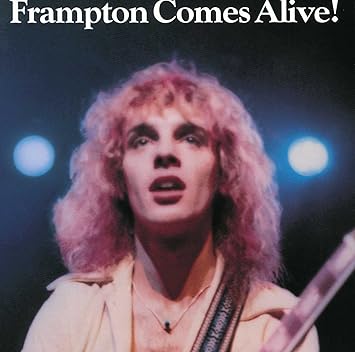
It is far from an original thought to note that Frampton Comes Alive! came out of nowhere. Up until its release, Frampton, a talented guitarist, a passable singer, and a good looking guy with great hair, had experienced some minor fame with various bands, notably The Herd and Humble Pie, and as a sideman, but his pre-Comes Alive! solo career was generally underwhelming. A&M co-founder Jerry Moss had signed Frampton to the label when he was 19, because "He had a cool face, he didn't mind working, and he had a great attitude.” Frampton toured relentlessly and was one of those artists whose songs seem to work better live than on vinyl. And there was the talk-box effect.

So, when he recorded a live album, mostly at the Winterland in San Francisco, but also at the Long Island Arena and SUNY Plattsburgh, there really wasn’t much expected—it was released in January, 1976, after the holiday buying season—and A&M had its collective fingers crossed that it might sell half a million copies and be certified as a gold record. Instead, the album turned into the ultimate “grower.” It charted at No. 51 its second week, then rose to No. 22, No. 6, No. 4 and No. 2, where it stalled throughout March, before hitting No. 1 in April. And it showed staying power, bouncing around the top 10 for the rest of 1976, logging a total of 10 weeks at No. 1, and selling a shocking 6 million copies, which broke Carole King's sales record for Tapestry. Ultimately, it has sold more than 11 million copies worldwide.

Why? I’m not really sure. It is not a great album; much of it is really pretty ordinary (which is why his prior solo albums were not big hits). There are a handful of really good rock songs on the album—songs that rocked hard enough, but not too hard to be offensive—filled with hooks and tight playing. As a high school student in 1976, I can tell you that rock radio played the crap out of the record, and it certainly was a part of the soundtrack of my high school years. Mostly, we heard the singles: "Show Me The Way," "Baby, I Love Your Way," and "Do You Feel Like We Do," but some stations went a couple of tracks deeper than that. So, it might just have been a case of the right album at the right time—a solid product, well promoted, that probably became discussed as one of those things that you had to buy, because everyone was buying it--sort of a pre-Internet version of going viral.

In addition to the rockers, a number of the songs on the live album were acoustic, which were included at Moss’ insistence.  They showcased Frampton’s fine playing and made for a nice contrast from the heavier tracks. One of the best of these is “All I Want To Be (Is By Your Side),” originally from his debut solo album. It’s a nice, bluesy, love song, although I find the lyrics a bit confusing—“I don't care if they cut my hair/All I want to be is by your side.” Huh? But it satisfies the theme by being one of approximately a billion songs that mention four leaf clovers. Yeah, I could have gone with the Old 97’s, but I’m trying to write about artists that I haven’t featured before.

Comes Alive! was, by far, the pinnacle of Frampton’s career. His next album, rushed out to capitalize on his new-found superstardom, was generally substandard, marred by a cheesy, cheesecake album cover and a truly sappy title track. It sold reasonably well, but was generally mocked, including by Frank Zappa. He then starred in the critically panned Sgt. Pepper's Lonely Hearts Club Band film, and was in a serious car accident. A few years later, all his guitars were believed to be destroyed in a cargo plane crash that killed three people, including the black Les Paul Custom that appeared on the cover of Comes Alive! (although it was found years later and returned to him).

Since then, Frampton has released albums, toured with his childhood friend David Bowie (who had been an art student of Frampton's father) and others as a sideman, released an unsuccessful Frampton Comes Alive! II, and has generally stayed active musically, even if most people don’t realize it.  And, like many of us, he no longer has great hair.

I think that it is fair to say that if the universe hadn’t aligned to give Peter Frampton one of the bestselling albums of his era, he’d probably have continued, putting out a series of albums that would have bubbled under the radar of most listeners, maybe occasionally having a radio hit, before being pushed aside from the public consciousness by new generations of musicians, like, say, Foghat, or Pat Travers. That certainly doesn’t mean that they are not good—to the contrary, such artists, including Frampton, are fantastically talented, but still, the incredible, massive,  success of Comes Alive! is an anomaly.