












Showing posts with label The Grateful Dead. Show all posts

Thursday, October 6, 2022

Musician Authors: Dead Authors (Grateful, that is)

Robert Hunter


Stories about the Grateful Dead, as with any number of other bands, often relate events that are wild, outrageous and salacious - of the "cannot believe they did this" variety.


 And while some of that is certainly true of the actual history of the Grateful Dead, my research indicates that the various members of the band were particularly prolific as authors themselves.

None of this to be confused with a book entitled The Grateful Dead: The History of a Folk Tale, available for free legal download from the gutenberg project.

On one hand, we can claim that any songwriter is, by definition, an author. However, the blog-task as I interpret it, would have us looking for musicians who have gone outside their lyric-writing realm to put pen to paper in an endeavor separate from their musical one.

Among the 157 books listed in a Google search for Grateful Dead books, we have Bill Kreutzman's Deal, Phil Lesh's Searching for the Sound, Garcia's Harrington Street, Garcia's A Signpost To New Space; Mickey Hart's Songcatchers and his Planet Drum, Drumming at the Edge of Magic, Spirit Into Sound.

A Box of Rain, credited to lyricist Robert Hunter may not count (it appears to be the published collection of his lyrics), but his novel Dog Moon does. Bob Weir's extracurricular authorship - as best I can discern-  seems to be limited to writing forwards for the books of various other authors.

Left over from my aborted attempt to post about The Road, we have A Long Strange Trip: The Inside History of the Grateful Dead; Living with the Dead: Twenty Years on the Bus with Garcia and the Grateful Dead; Home Before Daylight: My Life on the Road with the Grateful Dead; So Many Roads: The Life and Times of the Grateful Dead; Grateful Dead: the Illustrated Trip; No Simple Highway: A Cultural History of the Grateful Dead; Goin' Down the Road: A Grateful Dead Travelling Companion and more. These book titles in addition to no small number of Grateful Dead song titles are clear evidence of the importance of the road for the Dead. For any search for meaning in the trip through life, for that matter.

Because it is a song about writing a song, we'll go with Ripple.

If my words did glow with the gold of sunshine

And my tunes were played on the harp unstrung

Would you hear my voice come through the music?

Would you hold it near as it were your own?

It's a hand-me-down, the thoughts are broken

Perhaps they're better left unsung

I don't know, don't really care

Let there be songs to fill the air


Monday, January 17, 2022

Done: The Biggest Thing That Man Has Ever Done


Woody Gurthrie: The Biggest Thing That Man Has Ever Done
[purchase

I’m staying in the political song area again, but this time something more overt, Woody Guthrie’s “The Biggest Thing That Man Has Ever Done.” The song takes the form of recollections of an “historical bum,” present at great moments in human history (real or imagined), sort of like a folk song version of Zelig

It turns out that Guthrie borrowed the idea from earlier songwriters—the template (and even some of the lyrics) come from an 1894 song called “I’m A Highly Educated Man,” a version called “When Abraham And Isaac Rushed The Can,” was recorded in 1924 by “Fiddlin’ John Carson,” Grand Old Opry stars Uncle Dave Macon, Charlie Poole and Vernon Dalhart each did a version called “I’m The Man Who Ride The Mule Around The World,” (as has Loudon Wainwright III), and it has been recorded by many others, including Elvis Presley (in 1970), as “I Was Born About Ten Thousand Years Ago.” (And if you look hard, you might be able to find a version of the song by Jerry Garcia and Robert Hunter from 1961, before the Grateful Dead was formed). 

Guthrie took the bones of the song and grafted on to it the populist, pro-labor, probably small-c communist politics that he espoused (and yes, I know that the evidence shows that Guthrie was probably a member of the Communist Party at some points, but also that he really wasn’t a “Party” kind of guy.) So, he’s present at the creation, worked in the Garden of Eden (as a member of the apple pickers union), worked on the Pyramids and the Tower of Babel, fought in battles, beat Romans, Turks, and other great powers, helped win the American Revolution and the Civil War before moving on to the issue that was directly on Guthrie’s mind in 1944, when the song was recorded: World War II. 

There was a man across the ocean, I guess you knew him well,
His name was Adolf Hitler, goddam his soul to hell;
We kicked him in the panzers and put him on the run,
And that was about the biggest thing that man has ever done. 

There's warehouse guys and teamsters and guys that skin the cats
Guys that run my steel mill, my furnace and my blast
We'll stop the Axis rattlesnakes and thieves of old Nippon
And that will be the biggest thing that man has ever done.


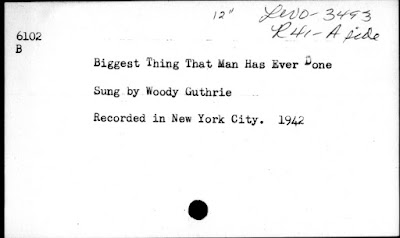
I know that the card that I used as an image indicates that it was recorded in 1942, and it may well have been—the record is vague—but the version above was probably from 1944, which makes sense, because by then, Hitler was more “on the run” than he would have been in 1942. But it is clear that Guthrie is also giving credit for winning the war to the workers, as well as the soldiers. 

Guthrie ends this version of the song (and if you’re interested, here’s a set of lyrics that has many more, and different verses, but I haven’t been able to find a recording of this version): 

Well I better quit my talking 'cause I told you all I know
But please remember pardner wherever you may go
The world is digging Hitler's grave and when the job is done
This'll be the biggest thing that man has ever done. 

And, in 1944, that probably was right (and it still might be right, today.) 

I’ll confess that the first time I heard this song, it was being sung by Dan Bern, and I didn’t know that it was a Woody Guthrie song until I did a little poking around. Bern, a family favorite who I’ve written about a few times, and seen even more times, is a folksinger in the Guthrie tradition, mixing politics with nonpolitical songs (and, like Guthrie, writing children’s songs and Hanukkah music). Bern released his version in 2004, and it included a few of the verses from the longer version linked to above (modified a bit). But he also updated it a little, adding a verse about the moon landing, and then the verse that probably was the impetus for the release: 

There's one big thing we must do when shove comes to push
Defeat the so-called President by the name of Bush
Vote early and vote often, November 2 not 1
And that will be the biggest thing Man has ever done
That'll be the biggest thing Man has ever done 

Now, that didn’t work, sadly, but it is nice to know that the Guthrie tradition of political songwriting carries on (and yes, Bern has written anti-Trump songs).  

Dan Bern: The Biggest Thing That Man Has Ever Done
[purchase]

Monday, September 14, 2020

Lessons: The Hard Way Every Time


I was well into my twenties when I learned that my grandmother and I share the same favorite musician. It makes me wonder how many forgotten childhood afternoons I spent in her house listening to Jim Croce, being unaware and unformed enough to remark on the occasions.


When it comes to learning and lessons, Jim Croce’s albums are a masterclass in life, love, and who not to mess around with. His song The Hard Way Every Time takes the subject on headfirst and reminds me of falling through a tree, painfully hitting every branch on the way down before landing softly in the grass at the end of the song. It’s hard not to hear the lyrics, and the strings that eventually accompany them, and not go through a mental slideshow of some of the hardest lessons we’ve each learned in our lives.


Covers of Croce that are worth listening to are few and far between. One reason being that his songs are written for two guitars and this doesn’t seem to deter any aspiring cover musicians from attacking it solo, at least not in the Youtube crowd. But Dale Ann Bradley does an incredible job of The Hard Way Every Time in my opinion on her album Hard Way. (The album also includes covers of Bobbie Gentry, The Grateful Dead, and Journey, among others) The bluegrass take and her country twang would have been even more at home in my grandmother’s farmhouse in the Appalachian foothills than Philly’s own Jim Croce all those years ago. It certainly takes me back.