Showing posts with label Dan Bern. Show all posts

Monday, January 17, 2022

Done: The Biggest Thing That Man Has Ever Done


Woody Gurthrie: The Biggest Thing That Man Has Ever Done
[purchase] 

I’m staying in the political song area again, but this time something more overt, Woody Guthrie’s “The Biggest Thing That Man Has Ever Done.” The song takes the form of recollections of an “historical bum,” present at great moments in human history (real or imagined), sort of like a folk song version of Zelig. 

It turns out that Guthrie borrowed the idea from earlier songwriters—the template (and even some of the lyrics) come from an 1894 song called “I’m A Highly Educated Man,” a version called “When Abraham And Isaac Rushed The Can,” was recorded in 1924 by “Fiddlin’ John Carson,” Grand Old Opry stars Uncle Dave Macon, Charlie Poole and Vernon Dalhart each did a version called “I’m The Man Who Ride The Mule Around The World,” (as has Loudon Wainwright III), and it has been recorded by many others, including Elvis Presley (in 1970), as “I Was Born About Ten Thousand Years Ago.” (And if you look hard, you might be able to find a version of the song by Jerry Garcia and Robert Hunter from 1961, before the Grateful Dead was formed). 

Guthrie took the bones of the song and grafted on to it the populist, pro-labor, probably small-c communist politics that he espoused (and yes, I know that the evidence shows that Guthrie was probably a member of the Communist Party at some points, but also that he really wasn’t a “Party” kind of guy.) So, he’s present at the creation, worked in the Garden of Eden (as a member of the apple pickers union), worked on the Pyramids and the Tower of Babel, fought in battles, beat Romans, Turks, and other great powers, helped win the American Revolution and the Civil War before moving on to the issue that was directly on Guthrie’s mind in 1944, when the song was recorded: World War II. 

There was a man across the ocean, I guess you knew him well,
His name was Adolf Hitler, goddam his soul to hell;
We kicked him in the panzers and put him on the run,
And that was about the biggest thing that man has ever done. 

There's warehouse guys and teamsters and guys that skin the cats
Guys that run my steel mill, my furnace and my blast
We'll stop the Axis rattlesnakes and thieves of old Nippon
And that will be the biggest thing that man has ever done.


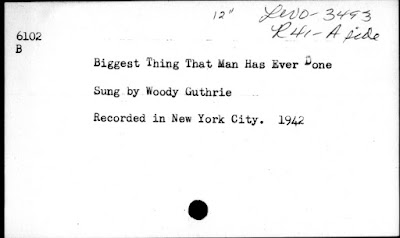
I know that the card that I used as an image indicates that it was recorded in 1942, and it may well have been—the record is vague—but the version above was probably from 1944, which makes sense, because by then, Hitler was more “on the run” than he would have been in 1942. But it is clear that Guthrie is also giving credit for winning the war to the workers, as well as the soldiers. 

Guthrie ends this version of the song (and if you’re interested, here’s a set of lyrics that has many more, and different verses, but I haven’t been able to find a recording of this version): 

Well I better quit my talking 'cause I told you all I know
But please remember pardner wherever you may go
The world is digging Hitler's grave and when the job is done
This'll be the biggest thing that man has ever done. 

And, in 1944, that probably was right (and it still might be right, today.) 

I’ll confess that the first time I heard this song, it was being sung by Dan Bern, and I didn’t know that it was a Woody Guthrie song until I did a little poking around. Bern, a family favorite who I’ve written about a few times, and seen even more times, is a folksinger in the Guthrie tradition, mixing politics with nonpolitical songs (and, like Guthrie, writing children’s songs and Hanukkah music). Bern released his version in 2004, and it included a few of the verses from the longer version linked to above (modified a bit). But he also updated it a little, adding a verse about the moon landing, and then the verse that probably was the impetus for the release: 

There's one big thing we must do when shove comes to push
Defeat the so-called President by the name of Bush
Vote early and vote often, November 2 not 1
And that will be the biggest thing Man has ever done
That'll be the biggest thing Man has ever done 

Now, that didn’t work, sadly, but it is nice to know that the Guthrie tradition of political songwriting carries on (and yes, Bern has written anti-Trump songs).  

Dan Bern: The Biggest Thing That Man Has Ever Done
[purchase]

Wednesday, June 3, 2020

War/Peace: The Warrior’s Code


I suspect that many of you who read this blog also attend live music performances—or at least, you did before that stopped being a thing (temporarily, I hope). Musicians have been trying different ways to get live music out to their fans, some for free, some charging, some seeking “tips,” and others seeking charitable donations, while some are trying to use Patreon or other similar subscription type programs to try to partially replace the revenue lost from cancelled tours. I think that it is pretty well known that these days, most musicians make the bulk of their living from touring and merch, and not so much from streaming and music sales.

Since the pandemic closed most venues, I’ve watched some of my favorite musicians from the comfort of my house—Richard Thompson, Jason Isbell and Amanda Shires, Dan Bern, Rhiannon Giddens and Francesco Turrisi, as well as her fellow Native Daughters, Amythyst Kiah, Allison Russell and Leyla McCalla, Ben Nichols of Lucero, Jeff Tweedy, Raul Malo, Lucy Wainwright Roche, Indigo Girls, and I’m sure I’m leaving some out. Most of these performances have come from the performers’ homes (or, at least where they are sheltering), except for an Isbell/Shires album release show from the stage of an empty Brooklyn Bowl in Nashville. These performances aren’t the same as being at a live show, but on the other hand, they are also more intimate—as one friend mentioned to me after we separately watched Richard Thompson, her husband was excited to be able to see the master’s hands close up while he played the guitar.

Last Friday, I watched most of an unusual performance—Dropkick Murphys, a band that is closely associated with the Boston Red Sox (they even were given World Series rings by the team one year), playing live on the field at an empty Fenway Park, with the band members all more than the now traditional six feet apart. The concert was organized to promote a number of charitable organizations, which is common for the band. For nearly two hours, the band ripped it up with their trademark Celtic flavored punk, and they were amazing. It wasn’t the same as when I saw them live at Warped Tour 15 years ago, but then again, what is? I had to reluctantly step away after two hours for a virtual college reunion Zoom session, but the next day, I found the video, and watched the end, when Bruce Springsteen appeared on the giant video screen in centerfield and performed two songs with DKM—one of theirs (“Rose Tattoo,”) and one of his, “American Land,” an appropriate anthem for our times, with its message of an America made up of immigrants and people of all races. Remarkably, considering the logistics, the entire concert sounded great, and I give much credit to whoever did the sound.

One of the songs that they played that night was “The Warrior’s Code,” which technically isn’t about war, but about a boxer, "Irish" Micky Ward. But since boxing and war often use each other’s metaphors and terminology, I’m OK with this. Also, back in 2016, I wrote about a different DKM song, a cover of “Fields of Athenry,” which is about World War I (and it is far from the only song by the band that references actual war, for example “The Fighting 69th” (Civil War) and “Johnny, I Hardly Knew Ye” (anti-war song written in Ireland in 1867), all of which were played at Fenway, along with a cover of The Standells' “Dirty Water,” which has nothing to do with war, but which I wrote about, here.)

The video of the show is still available here, among other places, so check it out, and send a few bucks to the charities.

Monday, April 6, 2020

Alone: Tired of Being Alone


Al Green: Tired of Being Alone
[purchase]

I’ve already lost count of how long I’ve been stuck at home—the few times I've gone out to get provisions or walk doesn’t really relieve the feeling of confinement—and it is getting tiresome. Other than the fact that the “current situation” has left us with nothing to look forward to—concerts are canceled, vacations are canceled, reunions are canceled, even our family seders are canceled, and I suspect that my daughter’s trip home this summer will be canceled—the hardest thing to deal with has been the isolation.

Don’t get me wrong—I’m generally an introvert—what I guess is considered a social introvert, meaning that I’m more comfortable in small social settings, enjoy being alone, and can appear to be more extroverted in some situations (my “Reunions Dad” personality), but then require some alone time to recharge. So, in theory, this whole staying home thing is not far from my wheelhouse. (But I’m not a hermit or a hoarder). And, luckily, I have my wife with me, so I’m far from really alone.

But since this whole thing started, as I mentioned in my last piece, I’ve thrown myself into connecting on social media and with my college classmates. We did that large Zoom gathering, and another one yesterday with about 100 people, which included a remarkable coronavirus panel, which I'd argue equaled anything that you can see on cable news.  Plus, a yoga demonstration. And as part of the planning process, I’ve been in contact by email, Facebook, Facebook Messenger, Slack, and even telephone with classmates (and an actual face-to-face meeting with one who lives around the corner, from a safe distance), and there’s always some personal catching up, even with people that I was never really close with. Even on work calls, with clients, co-counsel and even opposing counsel, there’s often a discussion of “how are you doing?" And like many others, we are using Zoom to have family calls and hang out virtually with friends. Just over two years ago, I wrote a piece on my personal blog called “In Praise of Social Media,” during a period when Facebook and other platforms were being rightly criticized for their flaws. But I saw the value in the connections that I made and maintained online, and if anything, it is more important right now. As someone with my personality type, this sort of social interaction from a distance is really perfect.

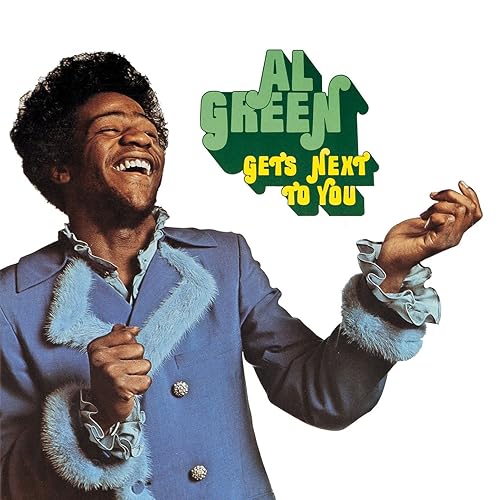
Al Green is, of course, one of the all-time greats, and his song “Tired of Being Alone” is, of course, on one of my many COVID-82 playlists. Released in 1971, it reached #11 on the Billboard Hot 100 and # 7 on the Hot Soul Singles Chart, and continues to be popular today. Because it is a great song. Of course, it isn’t about being forced to shelter in place, but about a lost love, because you don’t write great soul songs about being stuck in your house alone, living in sweatpants and bingeing Netflix. Although many musicians finding themselves with time on their hands are writing songs for the “current situation”—let me recommend Dan Bern’s new EP, Quarantine Me if you want to hear some good ones—I doubt that they will ultimately have the lasting appeal of “Tired of Being Alone.”  Green also has covered the great Hank Williams song, "I'm So Lonesome I Could Cry."  So, yeah, he's lonely.

Speaking of musicians stuck at home, how long will it be before there’s a genre of “how hard it is to be at home” songs to rival the many, many “how hard it is to be on the road” songs?

Wednesday, July 25, 2018

Remedies: Cure For AIDS


Dan Bern: Cure For AIDS [purchase]

A couple of weeks ago, my wife and I went to see Karen Finley’s show, Grabbing Pussy (based on her new book, coincidentally published by a company partially owned by a friend). If you have never seen Karen, one of the most famous performance artists ever, you really should. Her shows, which focus on political and social issues, are always thought provoking. She makes connections and observations that are truly astounding. Watching her shows is like trying to drink from a fire hose--her words and ideas come at you in torrents, you can't take it all in, but what you are able to digest is pretty incredible.

We first met Karen years ago when I coached her daughter Violet, a friend of my daughter’s, in soccer, and became friendly with her and her ex-husband Michael. We’ve seen Karen’s shows where she channeled Liza Minnelli, Jackie O and others, but she is always her provocative self. This show, though, as you can tell from its title, was focused on the current groper-in-chief, and others, such as Harvey Weinstein, who used their power to exploit women. Karen also touched on many other things, including something that has profoundly affected her (as we have seen from her other shows and writings), the many friends that she lost over the years to AIDS.

When my wife and I arrived at the theater (early, of course), we were happy to see that Michael was there, and that Violet (who was a pretty good soccer player, and has created her own controversial art) had flown in from LA). Not surprisingly, many people in the crowd knew Karen, Michael, and Violet, and we were introduced to some of them. Joining us at the table was a gentleman who was introduced to us as Michael, another old friend, and it quickly became clear that he had an electric personality. At one point, Karen came out of the dressing room to say hi, and new Michael mentioned that he had seen an exhibition of works by David Wojnarowicz, an artist and AIDS activist who died of the disease in 1992, who had been a friend of theirs.

Our new friend, it turned out, is named Michael Alago, and he has had a fascinating life, some of which we learned chatting with him before the show, and more of it we learned from watching a documentary about him on Netfilx, with the great title, Who The Fuck Is That Guy? Alago, a gay Puerto Rican from Brooklyn was, and is, a music obsessive, whose vast knowledge of, and boundless enthusiasm for, music got him jobs at The Ritz, eventually booking the shows at that legendary venue, and as an A&R representative for Elektra Records, where he signed Metallica and executive produced Nina Simone's last album, and later at Geffen Records.

Michael (and Karen and Michael) and I are roughly the same age, and yet we lived very different lives. While I was obsessing over music in my suburban bedroom, and at WPRB, Alago was going to Max’s Kansas City, CBGB and other clubs, staying out all night, and hanging out with Bono, Johnny Lydon, Springsteen, the Dead Boys, Metallica, and many, many, many others (which you can see in the film). The three of them were part of a world of music, art, photography, and writing that was sadly filled with many people lost to AIDS, addiction, or both. And it struck me that while these losses devastated people like them, to me it was really more of an abstract concept because none of my friends died from these scourges. So, while I can certainly understand it when Karen discusses the effect of this lost generation of her friends, it can't really affect me the same way. But one of the things that great art can do is to allow you to experience feelings outside your personal existence.

Towards the end of Who The Fuck Is That Guy?, the discussion turns to the fact that Alago was HIV positive, and appeared, a number of times, to be on the edge of death, something that he was open about during our discussions at the theater. Now, because current-day Michael is all over the film, we know that he didn’t die then, and the film doesn’t really explain what happened, except to refer to new drug cocktails and regimens, so it is fair to assume that this is what “cured” him. And today, he appears to be in excellent health, he is clean and sober (although he did eat a bunch of french fries during Karen’s show), and he has left the music business to become a photographer.

Another thing that we all discussed before the show (I did mention that we got there early, right?) was the fact that there doesn’t seem to be the same kind of protest music against the president and his awful policies as there had been against the Vietnam War when we were kids. We had heard the CSN&Y song “Ohio” in the car coming into the city, and that song, about the killing of students at Kent State during an antiwar protest, was all over the radio then, and continues to be part of the classic rock canon. And it isn’t the only song like that. While there are anti-Trump songs, they don’t get played as broadly, which in part is a result of the way that the radio and music business has changed, but it also does seem that there just isn’t as much political music being made these days. Alago mentioned that Ministry recently released AmeriKKKant, which is overtly political, but it is unlikely to break into the mainstream. I brought up Dan Bern, about whom I have often written, who writes political songs (and poetry, and paints political pictures), but again, he doesn’t get all that much airplay. The Drive-By Truckers released a pointedly political album at the end of 2016, which got a reasonable amount of positive press, but was not heard much on mainstream media.

Back in 1998, Bern released an album, Fifty Eggs, produced by Ani DiFranco, which had, as one would expect from Bern, a bunch of topical songs (and one beautiful tribute to his sister). One of them was “Cure For AIDS.” At the time, the AIDS epidemic was still rampant—the number of HIV infections, globally, peaked in about 1997, the number of AIDS deaths globally was still rising, as were the number of people living with HIV. But in the US, AIDS deaths, as a result of new drug regimens, had recently begun to plummet. Bern’s song, though, posits a magic bullet-type cure for the disease, which resulted in a six-month long period of sexual excess, ready access to morning after pills, and the end of homophobia. And, most importantly, “Nobody was afraid.” Of course, none of that has happened, but it is certainly better now, when an HIV diagnosis is no longer a sure death sentence, and AIDS is no longer an easy excuse for hatred.

In March, Bern mangled some of the fingers on his left hand, and had surgery, which led to the removal of part of his middle finger, a partial remedy at best. He is out on tour—I know that at one point he had friends play guitar for him, but I’m not sure if he is able to play guitar now (there is at least one pretty famous guitarist who did pretty well without a middle finger on his right hand, though).

Friday, February 5, 2016

The Accordion: Come Unto Me

[purchase]

As a devoted listener to WFUV, I was certainly aware of The Mavericks, but they were really just on the edge of my musical consciousness. I recognized and liked a few songs, and that was about that. My friend Tom, a fine singer and guitarist in his own right, whose bands often cover The Mavericks, kept telling me how great they were live. As usual in matters musical (not to mention food, TV and soccer, despite his support of Manchester United), Tom did not steer me wrong.

My first exposure to the band’s live show was at the 2014 Clearwater Festival. My wife and I had spent an incredible first day, seeing, among others, an all-star tribute to Pete and Toshi Seeger, Dar Williams, Guy Davis, Dan Bern and Richard Thompson (and you wonder why we were upset when they cancelled this year’s festival). My wife had enough, and decided to leave, but I wasn’t going to miss The Mavericks’ closing set. And it was worth every second. They truly kicked some ass, and had me dancing. And if you know me, you know that’s a big deal, especially because I wasn’t even close to drunk.

What makes them such a good live band? Start with the music—a mix of country, rock, Western swing, and more varieties of Latin music than I know how to name. Singer Raul Malo, whose deep, expressive voice is one of those that you never forget when you hear it, is of Cuban descent from Miami, and there is definitely some of that in there, along with all sorts of Tex-Mex sounds. Then, add the fact that it is just played well, and with incredible enthusiasm. Plus, as we know, horns make everything better. Stir in Malo’s charisma and stage presence, the goofy charm of keyboard player Jerry Dale McFadden and the menacing intensity of guitarist Eddie Perez, and you have something that is not only unique, but incredibly infectious and fun.

For some time, the band has made regular appearances at the Tarrytown Music Hall, in my town, and when they announced their 2014 dates, there was no question that I was going to go. My wife, Tom and I caught the show from the front row of the balcony, and the full set was even better than the shorter festival performance. The crowd was on its feet from the first note, and the show was a nonstop party. The video above was shot by someone on the floor, sort of below where we were sitting. The sound isn’t great, but it gives you a sense of what was going on. Another friend, Bob, who is a volunteer usher at the Music Hall, and thus sees many, many shows, swears that The Mavericks are, by far, the best live band that plays there.

I picked that song, “Come Unto Me,” because it features the button accordion, a common instrument in Mexican folk and popular music. Michael Guerra, who is not a full member of the band, but tours and records with them, does a great job lending a Mexican flavor to the song, not to mention has a long solo. Also, at the end, Malo points at me. Sort of.

At last year’s Clearwater Festival, The Mavericks again closed the show. And again, my wife left early (it really was raining hard when she left, but I really wanted to see The Mavericks again). Unfortunately, due to the rainstorm, which had stopped, but led to delays and equipment issues, they took the stage late and their set was truncated. But what they played was, again, great. We skipped last year’s Tarrytown residency, but I do hope to go back the next time they play there, with or without my wife.

Speaking of my wife, as I may have mentioned, she, and my daughter, are proud alumnae of Smith College, as is this feminist maverick:


Say hi to the legendary accordion player, Gloria Steinem.

Monday, August 24, 2015

1965: Oh Sister


Dan Bern: Oh Sister [purchase]

There was a hell of a lot of great music released in 1965.  Other writers have posted about some of it, and I hope that more posts about this music get written before the theme ends. But when I looked at a list, while I acknowledged that, yeah, there are some great songs there, nothing jumped out and said, “J. David (or whatever you real name is), you need to write about me.”

Instead, I decided to go with my first reaction to hearing the theme, which is that in 1965 my incredible sister was born. Although I was just shy of 4 years old when it happened, I do have some clear memories of the day, or at least the first time that I saw her at the hospital. And since then, I don’t think a cross word has ever passed between us.

When we were kids, we would get up early on Saturday to watch cartoons and eat cereal and Charles Chips pretzels from those big cans. And as we grew up, we always had each other’s back. My parents drilled into us from an early age that we were each other’s best friend, no matter what, and I suspect that there are still some things that went on that my parents don’t know about. Which is a good thing.

Interestingly, although we have always been close, we didn’t really share too many interests—she was not a big sports fan, we never really had the same musical taste (and music was much more important to me than it ever was to her), and history wasn’t her favorite subject—and four years (and five school years) can be a big age difference when you hit your teens. She went through some difficult times in high school while I was off in college, and in the pre-Facebook, pre-cell phone era, I wasn’t really around, and I’ve often felt bad that I wasn’t there for her, although she got through it, and turned out great.

I’ve always envied my sister because she found work that she loved and was good at, and which benefited humanity, way more than I ever did, and although her personal life hasn’t always been easy, right now she has two wonderful kids and seems happy in her personal relationship with a guy who, amusingly to me, drags her to concerts that she never would have imagined a few years ago. I’ve also envied her large group of close friends, with whom she regularly travels and socializes, although to be fair, with my borderline loner personality it isn’t surprising. Luckily for me, she lives only 15 or 20 minutes away, depending on traffic and how fast I drive, so we get to see each other fairly regularly. A few weeks ago, we were walking in town, and she and her boyfriend coincidentally stopped at the light as they drove through and were able to join us for dinner.

We’ve been able to watch her kids grow up, as she has watched mine. She babysat for my kids, and we have done the same with hers. She shops with my daughter and I’ve seen hers play soccer (and fed her dinner last night).

When I thought about writing about my sister, I thought of Dan Bern’s song, “Oh Sister.” Now, the song really doesn’t exactly fit our situation—Dan’s sister was the older one, who he credits for teaching him stuff and being there for him, and my sister is the younger one, although, to be fair, she’s taught me stuff and been there for me. And Dan’s family situation was different from ours, but the song works here for a couple of reasons. First, despite the differences, the song is about the love of a brother for a sister, and that definitely applies. And second, Dan Bern was born in……1965.

Friday, May 8, 2015

Darkness: The Dark Knight


Branford Marsalis Quartet: The Dark Knight [purchase]

Today is Harvey Day. That means that Matt Harvey will be pitching for the New York Mets tonight. As a baseball fan, there are some pitchers whose starts cause excitement, and it isn’t just because they are good pitchers. There’s something else, an X factor that creates the extra anticipation. Although the Mets have had good pitchers in the intervening years, and even finally had one pitch a no-hitter, it really hasn’t been since Doc Gooden’s first couple of seasons, in 1984 and 1985, that we have had someone like Matt Harvey.

Now, I will be the first person to say that press coverage of Harvey, whose career began only in 2012, and who sat out an entire season recovering from “Tommy John” surgery, has been over the top. Where he would rehab. What sporting events he attended, and what supermodel he was dating. And whether or not he would eventually break Mets fans’ hearts and sign with the Yankees, the team he rooted for as a child, and which would, traditionally, provide an even bigger spotlight than the perennially overshadowed Mets. And yet, here he is, after sitting out a year, and apparently not missing a beat. Undefeated, dominant and scary. His dark complexion, intimidating intensity and powerful pitching has led him to be dubbed the Dark Knight of Gotham, and in an era in which colorful sports nicknames have become scarce, it seems to have stuck. Thus, the Sports Illustrated cover above.

I’ve been a Mets fan all my life. I’ve referred to it as my longest relationship other than with my family, and like a family relationship, it has its ups and downs. Unfortunately, it has mostly been downs for us, but as I have said too many times, being a Mets fan builds character. One of my earliest memories is going to a Mets game with my father in 1968, when I was 6 or 7 years old. My strongest recollection of that day, though, is coming home in the car with my first yearbook, with its picture of Gil Hodges on the cover. I’m sure that I didn’t realize that the Mets were a bad team that year, and had been bad, even historically bad, every year of their existence since 1962 (just a year after I was born). But the next season, 1969, was the first year that I followed baseball as a fan, and the Mets rewarded me with a Miracle. I remember being allowed to stay up late to watch them clinch the pennant, and even watching post-season games in school (when they still had day games). I was hooked, but unfortunately, it was downhill from there for a while (with a slight blip in 1973 when they surprisingly made the World Series, but lost).

And yet, I persevered. Every season, I started out with hope, but usually I found myself disappointed. When I went to college, my roommate and I handed in our senior theses a day early so that we could drive up to Shea Stadium for the home opener in 1982, even though the team stunk. But shortly after that, we got the swaggering, fighting, dominant Mets that went wire to wire in 1986.

Since then, though, it has mostly been disappointment. Occasionally, we have been good, but have fallen short (1988, 2000, losing the World Series to the hated Yankees, to boot). But mostly bad, making even mediocrity seem good. And then there was 2006, when, in a packed, deafening and shaking Shea Stadium, I sat with my father, son and brother, and watched the Cardinals snatch victory, and the NLCS, away from us. We were there again at the last game in 2007, when the Mets completed an epic collapse and were eliminated from the playoffs, and again, in 2008, in the last game ever at Shea, when they were again eliminated from the playoffs on the last day of the season. But despite the heartbreak and another stretch of awful baseball, I keep watching, confounding my wife.

Yet being a Met fan is also something that my father, my son and my brother bond over. Like my family, there may be times that the Mets anger, annoy or even disappoint me, but I remain loyal. Maybe, the Dark Knight of Gotham will lead the charge to greatness again. Based on history, it isn’t likely, but if it happens, that would be pretty amazin’.

Branford Marsalis comes from a prominent musical family, to say the least. His parents, Dolores and Ellis are musicians, and his brothers, Wynton, Jason, Ellis and Delfeayo, are also musicians. Wynton, of course, is maybe the most famous contemporary jazz musician, and is considered to be a purist. Branford, on the other hand, while also an incredible player and composer, is a bit more flexible, having played with Sting (which led to well-publicized tension with Wynton), fronted the Tonight Show band and led a jazz/funk/hip-hop band, Buckshot LeFonque. He is also the subject of this very odd song by Dan Bern, also a huge baseball fan, in which Bern equates seeing Marsalis in a club in Prague with, among other things, seeing Babe Ruth in Yankee Stadium.

This song, “The Dark Knight,” is from the Branford Marsalis Quartet’s Crazy People Music, recorded in 1990, right around the time that Matt Harvey celebrated his first birthday, and was written by the group’s bassist, Robert Hurst. It is a long, straight ahead jazz piece featuring, not surprisingly, the bass. I have no idea if this song has anything to do with Batman, but I know that it has nothing to do with Matt Harvey, even though Marsalis is a Mets fan. I also know that all Mets fans will be anticipating tonight’s start against a weak Phillies team. And, unfortunately, I know that due to an important family event, I will not be watching, although my phone may get a workout when I can get away with checking the score.

Friday, June 13, 2014

Hotels and Motels:Songs About the Chelsea Hotel


Jefferson Airplane: Third Week in the Chelsea
[purchase]

I am willing to bet that there is no other hotel or motel in the world that has inspired more songs than the Chelsea, located in the lower Manhattan neighborhood of the same name. Recently purchased and closed for renovations, the hotel has long been identified as a place for artists, performers, writers and musicians to live and work, which probably explains its popularity in song.

Wikipedia lists 22 different songs referencing the hotel, and one of them, Leonard Cohen’s “Chelsea Hotel #2” has been often covered. You could create a pretty credible cultural Hall of Fame consisting just of residents of the Chelsea, which for years was a residential hotel, including Bob Dylan, Charles Bukowski, Janis Joplin, William S. Burroughs, Tom Waits, Leonard Cohen, Patti Smith, Jasper Johns, Claes Oldenberg, Iggy Pop, Arthur C. Clarke, Allen Ginsburg, Diego Rivera, Mark Twain, Arthur Miller, Tennessee Williams, Stanley Kubrick, Uma Thurman, Jane Fonda, Alice Cooper, Larry Rivers, Christo, Julian Schnabel, Alejandro Escovedo, Jimi Hendrix, Willem de Kooning, Robert Mapplethorpe, Gore Vidal, Jean-Paul Sartre, Simone de Beauvoir, Dennis Hopper, Thomas Wolfe, Elliot Gould, Elaine Stritch, Edie Sedgwick, and many, many more. And, of course, Sid Vicious’ girlfriend, Nancy Spungen, was found dead at the hotel, as were Dylan Thomas and Charles R. Jackson, the author of The Lost Weekend.

Cohen’s song has been discussed previously on this blog, here, and a cover by Lloyd Cole is discussed here, Dylan’s “Sara” was mentioned, if briefly, here, and a post about Joni Mitchell's "Chelsea Morning" is here. But there are many, many others to talk about.

My favorite is “Third Week in the Chelsea,” the second song from Jefferson Airplane’s Bark album that I have written about (which is pretty interesting, considering that it is generally considered a pretty mediocre album). It was written by guitarist Jorma Kaukonen, and it is a beautiful song, filled with sadness and resignation about the impending demise of one of the great bands of its era. It is a classic of the “leaving the band” genre, right up there with Peter Gabriel’s “Solsbury Hill.” Although the whole thing is great, this stanza always kills me:

All my friends keep telling me that it would be a shame 
To break up such a grand success and tear apart a name 
But all I know is what I feel whenever I'm not playin' 
Emptiness ain't where it's at and neither's feeling pain 

Because, when it is time to go, it is time to go. Luckily, he had Hot Tuna to fall back on.

Leonard Cohen’s song, which we really aren’t going to discuss, was about an (oral) sexual encounter at the hotel with a woman he later acknowledged was Janis Joplin. Jeffrey Lewis, a New York singer/songwriter, wrote “The Chelsea Hotel Oral Sex Song” which is both about and not about Leonard Cohen’s song, and has a certain shaggy dog charm of its own (and no actual oral sex):


Dan Bern, who is often compared to one time resident Bob Dylan, because they are both Jews from the Midwest who have raspy voices, play guitar and write interesting songs (making the comparison somewhat plausible), also wrote a song about having sex at the Chelsea. This version was recorded at the Turning Point in Piermont, New York, just across the Tappan Zee Bridge from my house, which gets surprisingly good acts, considering that it is about the size of a small living room. And it has a trumpet solo.


And, finally, here’s Okkervil River’s “Bruce Wayne Campbell Interviewed On The Roof Of The Chelsea Hotel, 1979.”


Campbell was the real name of the former Chelsea Hotel resident, singer Jobriath, who is considered to be the first openly gay rock musician signed to a major label, as well as one of the first well known musicians to die of AIDS.

The song appeared on Okkervil River’s The Stand Ins album, which is filled with songs musing about celebrity and pop culture. Jobriath, whose albums received generally good reviews (and had both Peter Frampton and John Paul Jones contribute to his glam-rock, very David Bowie-esque music), found his career derailed first by excessive hype by his management, then his disillusionment with the industry, and finally by his illness. He apparently did an interview from the roof of the Chelsea in 1979, but it was different from what Okkervil River sang about. Although not directly related to the hotel, here’s one of his songs, “Take Me I’m Yours,” about S&M, which certainly could have happened at the Chelsea Hotel.

Tuesday, December 18, 2012

Childhood: Kid’s Prayer


Dan Bern: Kid’s Prayer
[purchase City Folk Live X]
[Download the song from Bern’s Bandcamp page]

I am breaking my “no repeat” guideline this week, to post my second Dan Bern song, “Kid’s Prayer,” because it seems to be the most fitting song for this theme this week. I believe that the only official release of this song on CD was on WFUV’s City Folk II compilation from 1999, and re-released on the City Folk X disc in 2007. Bern recently posted it on Bandcamp for download with a “name your price” tag.

This song is Dan Bern at his most powerful. It was written after a school shooting in Arkansas in 1998. (Note-most of the information on the Internet says that it was written in response to a shooting in Oregon, which is what I originally wrote.  But Corny O'Connell, a DJ at WFUV, pointed out that Bern performed the song on the station in March, 1998--6 days after the Arkansas shooting, and a couple of months before the one in Oregon. Take a look here. So, I stand corrected, and reminded that what you read on the Internet is not always accurate) And since then, our country has taken the incredible position that gun laws should be made less stringent, and that an assault weapon ban should be permitted to expire. Thanks to the NRA and spineless politicians from both sides of the aisle.

The Newtown massacre has resulted in another bout of déjà vu. What Bern wrote in 1998 is exactly what I saw on TV over the last few days:

And all the world descends, and offers up their condolence
And offers up their theories what went wrong and who and why and when and how
It's all the killing day and night on television
It's all the movies where violence is as natural as breathing
It's guns and bullets as easily obtainable as candy
It's video games where you kill and begin to think it's real
It's people not having God in their lives anymore
Or it's all of it, or none of it, or some of it, in various combinations

Bern then offers up a secular prayer of his own, which is too long to quote, but the lyrics can be found here. His message is, essentially, treat your kids well and be open and honest with them. Encourage them, but set limits. I understand that much of the reason for the type of horrific incident that happened in Newtown is mental illness, and that no amount of good parenting can prevent that. But it can’t hurt.

And I hope that this incident finally galvanizes the President, Congress and state legislatures to restrict gun ownership. All the statistics that I have read support the argument that fewer guns, less widely available = fewer random shootings. Frankly, if strict gun control prevents just one mass murder (and it would likely prevent many more), I think that would be worth the restriction on the right to bear arms, as it has been (mis)interpreted (in my opinion). Constitutional rights are not absolute. The First Amendment, for example, does not allow unfettered speech.

So, for all of the politicians that read this blog, please get off your asses and do something. And for the non-politicians—tell your representatives to get off their asses and do something. I have, but in a somewhat more polite way.

Sunday, February 19, 2012

Spoken Word: Jerusalem


Dan Bern: Jerusalem
[purchase]

If I went to see Springsteen (and I haven’t since college) and he didn’t play “Born to Run,” I’d be unhappy. When I saw Led Zeppelin in 1977, I would have been horrified if they didn’t play “Stairway to Heaven.” And I expect to hear "1952 Vincent Black Lightning" when I see Richard Thompson. A Dan Bern show, to me, is not complete without “Jerusalem.”

Bern, a Jewish Midwestern singer songwriter with a nasal voice, has regularly been compared to Dylan, and he doesn’t seem to shy from the comparison, considering the number of talking blues he has written in Dylan’s style. Not to mention his hysterical “Talkin’ Bob And Woody, Bruce And Dan Blues” which updates Dylan’s “Song to Woody” (and which I thought about writing about, but decided to write about “Jerusalem” instead). Bern has long been a family favorite, with his songs that are funny, poignant and political. “Jerusalem” is one that has all of that.

As is common in Bern’s songs, “Jerusalem” takes a meandering route. It starts off with its somewhat cynical theme—the singer has expressed his love to someone, but warns that his love should be accepted and not tested, because it may be that he doesn’t really “love you all that much.” The song abruptly turns to an admonition to people who want to know what music he is going to play, and those who want to pigeonhole him—“And if you must put me in a box, Make sure it's a big box,” he sings. Then, out of nowhere, the song heads off into a strange place, with Bern talking about being asked to become an “ancient king”, and works in a reference to Einstein’s theory of time.

Bern then discusses how everyone seems to be waiting for the Messiah, and that he knows how hard it is to wait, illustrating the triviality of religion by equating waiting for salvation with waiting “for a bus or something; An important phone call,” before announcing that, in fact, he is the Messiah. He tells us that he was going to wait to make this announcement, and build the suspense, but his therapist, Dr. Nusbaum, suggested that he would feel better if he got it out in the open.

So, why exactly is this song called “Jerusalem?” Because, the singer then tells us, he spent 10 days in Jerusalem, eating nothing but olives, but that it was OK because, “I like olives.” He then segues into “I like you too” and a reprise of the initial warning about not testing his love. At shows, the audience sings along to this crazy song, which to me highlights a couple of Bern’s regular themes—ambivalence about love and ambivalence about religion. And it is very funny.

Thursday, September 9, 2010

Late: Too late to die young


Dan Bern: Too Late To Die Young

Purchase:

You can be late for a bus, late for a party, or late for an appointment. Although it may be a slight perversion of the intent of this theme, you can also be too late to die in your youth. Iowa native Dan Bern laments the slow death of Elvis and envies those who crashed and burned.


Saturday, March 6, 2010

Medical Conditions: Cure For AIDS


Dan Bern: Cure For AIDS

[purchase]

Highly political folk rocker Dan Bern presents a typically bitter-yet-hilarious condemnation of the sexually uptight fear society through portrayal of an alternate universe of orgies and acceptance that follows the invention of a simple little pill that cures AIDS.

The song, first published in 1998, still rings true; it may not be front page news any longer, but AIDS remains a gigantic killer, especially in sub-Saharan Africa, where it has a significant impact on economic growth, keeping entire countries from being able to garner the resources and attention they need to join the 21st century. But the sense of sexual urgency Bern pretends would follow such a solution seems improbable and dated, pointing to just how deeply our own culture has internalized AIDS and its subsequent social effects as perfectly normative.

Monday, November 3, 2008

Silly Songs: Tiger Woods


Dan Bern - Tiger Woods

[purchase]

I could probably spend this entire week posting nothing but Dan Bern songs. Hell, I might end up doing it. Dan’s odd, he's quirky and yet he's a totally awesome song writer. This song is not only funny as shit, it offer's some seriously quotable material. It even serves as a cautionary tale about achieving your life goals too early.

Sunday, May 18, 2008

Little Black Book: Estelle


Dan Bern: Estelle

[purchase]

This week is bound to be cool because not only will we get our regular dose of amazing tunes, but we'll also "get to know" a lot of different woman through the lyrics of these songs. I have to assume that in most cases the woman will be real people in the lives of the artists. So, as a man who loves women (none more than my wife) I look forward to hearing about the different personalities.

Meet Estelle. She is described by Bern as "the best person" he ever knew. She's a Mormon woman who calls him drunk every few months and asks him questions about things that he doesn't want to talk about. Bern says that he can't talk to her for long unless he is also drunk, in which case he can talk to her "aawwllll night".

(Note: There are a lot of lyrics in this song. You won't actually meet Estelle until the 5th verse or so.)