












Showing posts with label Robert Hunter. Show all posts

Thursday, October 6, 2022

Musician Authors: Dead Authors (Grateful, that is)

Robert Hunter


Stories about the Grateful Dead, as with any number of other bands, often relate events that are wild, outrageous and salacious - of the "cannot believe they did this" variety.


 And while some of that is certainly true of the actual history of the Grateful Dead, my research indicates that the various members of the band were particularly prolific as authors themselves.

None of this to be confused with a book entitled The Grateful Dead: The History of a Folk Tale, available for free legal download from the gutenberg project.

On one hand, we can claim that any songwriter is, by definition, an author. However, the blog-task as I interpret it, would have us looking for musicians who have gone outside their lyric-writing realm to put pen to paper in an endeavor separate from their musical one.

Among the 157 books listed in a Google search for Grateful Dead books, we have Bill Kreutzman's Deal, Phil Lesh's Searching for the Sound, Garcia's Harrington Street, Garcia's A Signpost To New Space; Mickey Hart's Songcatchers and his Planet Drum, Drumming at the Edge of Magic, Spirit Into Sound.

A Box of Rain, credited to lyricist Robert Hunter may not count (it appears to be the published collection of his lyrics), but his novel Dog Moon does. Bob Weir's extracurricular authorship - as best I can discern-  seems to be limited to writing forwards for the books of various other authors.

Left over from my aborted attempt to post about The Road, we have A Long Strange Trip: The Inside History of the Grateful Dead; Living with the Dead: Twenty Years on the Bus with Garcia and the Grateful Dead; Home Before Daylight: My Life on the Road with the Grateful Dead; So Many Roads: The Life and Times of the Grateful Dead; Grateful Dead: the Illustrated Trip; No Simple Highway: A Cultural History of the Grateful Dead; Goin' Down the Road: A Grateful Dead Travelling Companion and more. These book titles in addition to no small number of Grateful Dead song titles are clear evidence of the importance of the road for the Dead. For any search for meaning in the trip through life, for that matter.

Because it is a song about writing a song, we'll go with Ripple.

If my words did glow with the gold of sunshine

And my tunes were played on the harp unstrung

Would you hear my voice come through the music?

Would you hold it near as it were your own?

It's a hand-me-down, the thoughts are broken

Perhaps they're better left unsung

I don't know, don't really care

Let there be songs to fill the air


Monday, January 17, 2022

Done: The Biggest Thing That Man Has Ever Done


Woody Gurthrie: The Biggest Thing That Man Has Ever Done
[purchase

I’m staying in the political song area again, but this time something more overt, Woody Guthrie’s “The Biggest Thing That Man Has Ever Done.” The song takes the form of recollections of an “historical bum,” present at great moments in human history (real or imagined), sort of like a folk song version of Zelig

It turns out that Guthrie borrowed the idea from earlier songwriters—the template (and even some of the lyrics) come from an 1894 song called “I’m A Highly Educated Man,” a version called “When Abraham And Isaac Rushed The Can,” was recorded in 1924 by “Fiddlin’ John Carson,” Grand Old Opry stars Uncle Dave Macon, Charlie Poole and Vernon Dalhart each did a version called “I’m The Man Who Ride The Mule Around The World,” (as has Loudon Wainwright III), and it has been recorded by many others, including Elvis Presley (in 1970), as “I Was Born About Ten Thousand Years Ago.” (And if you look hard, you might be able to find a version of the song by Jerry Garcia and Robert Hunter from 1961, before the Grateful Dead was formed). 

Guthrie took the bones of the song and grafted on to it the populist, pro-labor, probably small-c communist politics that he espoused (and yes, I know that the evidence shows that Guthrie was probably a member of the Communist Party at some points, but also that he really wasn’t a “Party” kind of guy.) So, he’s present at the creation, worked in the Garden of Eden (as a member of the apple pickers union), worked on the Pyramids and the Tower of Babel, fought in battles, beat Romans, Turks, and other great powers, helped win the American Revolution and the Civil War before moving on to the issue that was directly on Guthrie’s mind in 1944, when the song was recorded: World War II. 

There was a man across the ocean, I guess you knew him well,
His name was Adolf Hitler, goddam his soul to hell;
We kicked him in the panzers and put him on the run,
And that was about the biggest thing that man has ever done. 

There's warehouse guys and teamsters and guys that skin the cats
Guys that run my steel mill, my furnace and my blast
We'll stop the Axis rattlesnakes and thieves of old Nippon
And that will be the biggest thing that man has ever done.


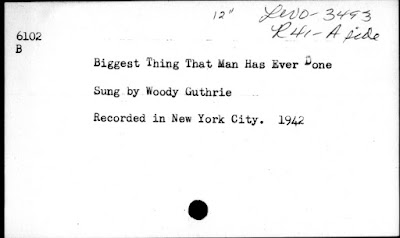
I know that the card that I used as an image indicates that it was recorded in 1942, and it may well have been—the record is vague—but the version above was probably from 1944, which makes sense, because by then, Hitler was more “on the run” than he would have been in 1942. But it is clear that Guthrie is also giving credit for winning the war to the workers, as well as the soldiers. 

Guthrie ends this version of the song (and if you’re interested, here’s a set of lyrics that has many more, and different verses, but I haven’t been able to find a recording of this version): 

Well I better quit my talking 'cause I told you all I know
But please remember pardner wherever you may go
The world is digging Hitler's grave and when the job is done
This'll be the biggest thing that man has ever done. 

And, in 1944, that probably was right (and it still might be right, today.) 

I’ll confess that the first time I heard this song, it was being sung by Dan Bern, and I didn’t know that it was a Woody Guthrie song until I did a little poking around. Bern, a family favorite who I’ve written about a few times, and seen even more times, is a folksinger in the Guthrie tradition, mixing politics with nonpolitical songs (and, like Guthrie, writing children’s songs and Hanukkah music). Bern released his version in 2004, and it included a few of the verses from the longer version linked to above (modified a bit). But he also updated it a little, adding a verse about the moon landing, and then the verse that probably was the impetus for the release: 

There's one big thing we must do when shove comes to push
Defeat the so-called President by the name of Bush
Vote early and vote often, November 2 not 1
And that will be the biggest thing Man has ever done
That'll be the biggest thing Man has ever done 

Now, that didn’t work, sadly, but it is nice to know that the Guthrie tradition of political songwriting carries on (and yes, Bern has written anti-Trump songs).  

Dan Bern: The Biggest Thing That Man Has Ever Done
[purchase]

Wednesday, March 22, 2017

PRISON: FRIEND OF THE DEVIL

Rather than dive straight into songs with jail, gaol or prison, I am going to run with the lyrics that alight always in my mind at any mention of prison. I refer to this perennial favourite, by the Darkstar hitmakers themselves. The first version I ever heard, and the one that sticks is the one below, 'Friend of the Devil', covered by Lyle Lovett. This was on my Grateful Dead entry level initiation, on a wonderful and recommended LP, 'Deadicated', a tribute to the band featuring, as well as Lovett, other dignitaries varying from Indigo Girls to Los Lobos, via Burning Spear and Suzanne Vega. It is terrific.


So why did I need this easy entrance? Primarily, fear. As a teenager in the UK, the Dead were a massive iconic template from far way in California. I had read and knew all about them, Haight, the Acid Tests, the Egyptian concerts and triple, quadruple sets featuring, if you were lucky, the aforementioned Darkstar, an old rock and roll standard and, at best, a couple of other songs, spread out and shpongled into epic proportion. It seemed all bit much, a bit exotic for my innocent ears. OK, I got there in the end, actually in my first U.S. jaunt, the sad, usual first american experience of us brits, the wonder(?!) of Orlando. I recall difficulty finding a record store, going on a mini-spree when I found one, jay-walking diagonally across a huge x-roads. Before I knew it I had 3 of their records, including the one with the original version, 1970's 'American Beauty'. (Am I allowed to say it isn't as good?)


I guess I should explain the prison relationship, it being all within the lyrics, a masterpiece of american western gothic, a lyric by Robert Hunter, longterm lyrical cohort to the tunes of Jerry Garcia. (In the interests of fairness, I need to add that New Riders of the Purple Sage guitarist John 'Marmaduke" Dawson also contributed to the song.) I love these story songs of derring do and it is one of the best in the milieu.

I lit up from Reno
I was trailed by twenty hounds
Didn't get to sleep that night
Till the morning came around
I set out running but I'll take my time
A friend of the Devil is a friend of mine
If I get home before daylight
I just might get some sleep tonight
I ran into the Devil, babe
He loaned me twenty bills
I spent that night in Utah
In a cave up in the hills
I set out running etc,
I ran down to the levee
But the Devil caught me there
He took my twenty dollar bill
And he vanished in the air
I set out running etc.
Got two reasons why I cry
Away each lonely night
The first one's named sweet Anne Marie
And she's my heart's delight
Second one is prison, baby
The sheriff's on my trail
And if he catches up with me
I'll spend my life in jail
Got a wife in Chino, babe
And one in Cherokee
First one says she's got my child
But it don't look like me
I set out running etc,
Got two reasons why I cry
Away each lonely night
The first one's named sweet Anne Marie
And she's my heart's delight
Second one is prison, baby
The sheriff's on my trail
And if he catches up with me
I'll spend my life in jail
Got a wife in Chino, babe
The one in Cherokee
The first one says she's got my child
But it don't look like me
I set out running etc.

As ever, the idea of the largely middle class and effete Garcia being in trouble for anything other than his consumables or his tax-return is a little bit laughable, but, hey, rock'n'roll! I have a nagging doubt and concern however as to who, or what was the devil, though. Answers on a postcard.

Meanwhile, get dedicated with 'Deadicated'.