












Showing posts with label Thin Lizzy. Show all posts

Wednesday, June 22, 2022

Back: Back of My Hand

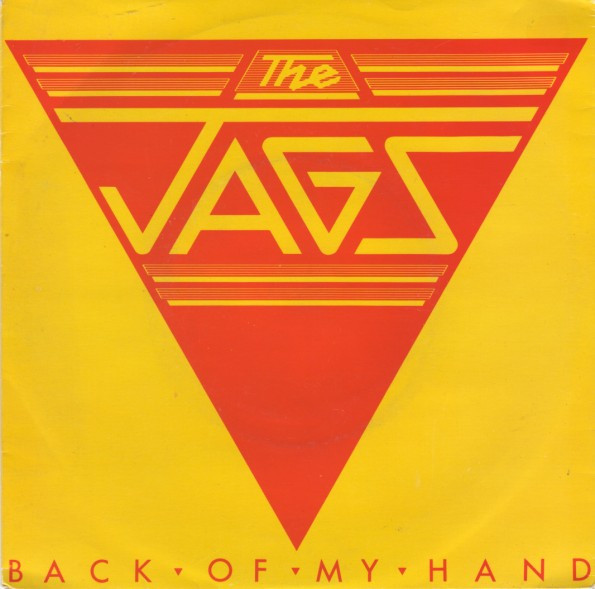
The Jags: Back of My Hand
[purchase

One of the fun things about writing for this blog is that I never really know where the piece is going to go when I start doing my “research.” There are so many songs that have the word “back” in their title (and even more with the word in the lyrics, and even more songs that I could write about, if I took a broad view of the theme). When I saw The Jags’ “Back of My Hand” come up in my search, I thought, “hey, this would be easy—a fun song that I remember from college that has pretty much been forgotten.” And yet, when I started to look into it, it became more interesting. 

The Jags were formed in 1978 by the Yorkshire-based songwriting team of singer Nick Watkinson and guitarist John Alder with Steve Prudence on bass and Alex Baird on drums. In July of 1978, they signed to Island Records and released a four-track EP, which included an early mix of “Back of My Hand.” It’s a great song—catchy, fun, but with a little edge. And no, it isn’t about hitting someone—it’s about the excitement of getting a girl to write her phone number on your skin, since the song long pre-dates cellphones. 

After dealing with the almost mandatory management issues, the song was remixed by Trevor Horn and Geoff Downes (The Buggles), and the resulting single release became a modest hit in both the US (peaking at 84) and UK (hitting 17), at a time when “new wave” music was not common on the charts. It was, I suspect, more popular on college radio (I definitely played it a few times) and more adventurous commercial stations that were beginning to embrace new wave music. That version was on the US release of their first full album, Evening Standards, although a newly recorded version was on the initial UK pressings. Honestly, I’m not 100% sure which version is embedded above, but I kind of think that it was the original version, not the Buggles remix. 

But here’s the rub. When I thought about writing about this song, my first thought was, “The Jags—that band that sounded like Elvis Costello.” And constant comparisons to Mr. MacManus appeared to torpedo the Jags. It’s kind of an interesting phenomenon. I remember that Costello was, initially, compared to Graham Parker, without damaging his career, and early Costello comparisons didn’t prevent Joe Jackson from becoming a star. So, the only conclusion must be that the Jags just weren’t that good. 

That conclusion would be wrong. 

In researching this piece, I found a number of reviews that call the song “a power pop classic,” their output in general as being of “uniformly high quality,” and having “a range of power pop that few—including Mr. Costello—ever achieved.” And I have to agree—the band was tight, and they wrote clever new wave pop songs that deserved better than just being dismissed as knockoffs. Yes, the Costello influence is hard to miss, but there’s also other things there-Thin Lizzy, maybe the Kinks. It’s a similar situation, I think, to the Knack, who were turned into a punch line despite some excellent songs because of, well, because of a bunch of reasons that I wrote more about here

After “Back of My Hand,” the Jags had some personnel changes and recorded a second album. While band members insist that they never tried to copy Elvis, as one member noted, for the second album, they tried not to sound like him. The album was unsuccessful, the band members feuded, there were legal and management squabbles, and the band broke up. As far as I can tell, none of the members appeared to join other known bands, it seems that their music is out of print, and some of it never was even released on CD. In fact, the version that I’ve uploaded is from a compilation, and the Amazon purchase link is from the soundtrack for the 2006 Owen Wilson movie, You, Me and Dupree

Then I found an article from 2013 entitled, Donate to Fund for UK Power Pop Legends The Jags’ Watkinson, in which I discovered that Watkinson had since about 2009, been, as the article put it, “living as a transvestite and performing at select clubs in the greater London area, generally under the name Virginia Plain.” The reason for the funding request was that Watkinson’s home was destroyed by a fire set when a lodger fell asleep with candles burning. And, of course, the flat was not insured, and the culprit fled and never paid a penny. Another article that I found about this situation noted that Watkinson was earning a “living as a gardener.” 

It's kind of a shame that such a talented songwriter isn’t writing songs, and that a talented band never really made it. But it shows how everything has to align for an artist to succeed.

Thursday, October 22, 2020

GUITAR HEROES: THIN LIZZY

Well, it's five years since I, grudgingly it reads, gave this band any pentime, but, you know, time has been kind to their memory, a new boxset retrospective, released round about now, raking up a fond nostalgia I am finding infectious. Hindsight further adds to the scallywag, loveable rogue image they allowed to be cultivated around them. For rogues they almost certainly were, or fiends even, certainly in the drug sense. But that is not what I have come to gaze upon, more the realisation that, amidst all the chaos and chutzpah, there band had a fair few rather good guitar slingers. Which, for a band that history famously places largely around the bassist, one Philip Lynott, makes for an interesting tale.

Like most, I first heard of 'em back in the very dim and distant, with a song that is still more likely to appear in compilations of folk music than of rousing rock anthems. But great it is, the guitar part, courtesy Eric Bell, arguably opening the door to any number of celtic rockers, from Big Country to Runrig. Lynott's drawled vocal just the right counterpoint for the crossover smash it became. Possibly the first time trad.arr. looked so good. But Eric Bell was not long for the band, abruptly walking off stage, mid-set, in 1973, "exhaustion" cited as his reason, with nary a regret ever offered, even as the fame of the band eclipsed his own part therein. In truth, his exhaustion was the sort that came in bottles and wraps, as described here, but his later legacy never built on the promise of his work with Lizzy over their first few recordings.

This left Lynott, along with drummer Brian Downie with a predicament, how to replace a guitarist who, in one song, had transformed the image of the band and their place in the market. Answer: if one guitarist let's you down, get two! This response, very much in keeping of the devil may care vagabond hero, as in the (Bell included) song, The Rocker, became their declared image. The two guitarists were Scott Gorham, allegedly hired because of his nationality, American, and his extravagant mane, and Glaswegian street fighter and musical polymath, Brian Robertson. Robertson was very much the lead foil, at least from the basis of his track record and experience, being hired because he could play. And play he could, responsible for defining the twin guitar sound, allegedly telling Gorham what to play, how and when. An accomplished writer too, he contributed to some of the material from this iteration of the band, actually their glory days, if Lynott still wrote the bulk, and most of the hits. However, he was another guitarist with a thirst, having to skip an important US tour on account of a hand injury, sustained in a drunken brawl, defending the honour of fellow Scots toper, Frankie Miller. His place, temporarily at least, was taken by Gary Moore, who clearly made a mark, if dispensed at the end of the tour. The next album was recorded as a three piece, but needing the dual guitar attack, Robertson was taken back, if on probation. But it couldn't and didn't last, as frictions flared, initiated at one point by Robertson's refusal to overdub new guitar parts on live album, Live and Dangerous. Which, at that time they were.

Gary Moore now bounced back in, his shared Irishness perhaps a better foil for Lynott, and, amongst a flurry of further hit singles, came the above, an epic, the title track of 'Roisin Dubh', back in the hinterland of rock and roll with traditional Irish folk. A direction I would have liked them to pursue further, but the swaggering lifestyle choices of powders and poteen probably put paid to that. In 1979, in classic Lizzy style, Moore left the band, mid-tour as ever. Astonishingly he was subbed by, of all people, Midge Ure, the soon to be Ultravox-er, but he had been one of a crew of musicians involved in Lynott's other side-project, the Greedy Bastards, wherein he allied with a number of punk and new-wave musicians to distance himself from being a dinosaur like other rockers of the earlier '70s.

In truth this was heralding the end. Other guitarists came and went, Dave Flett for one, once of Manfred Mann's Earthband, propping up the ship of Lynott, Gorham and the omni-present Downie. Ure hovered around the fringes for some time, sometimes on guitar, sometimes as a keyboard player, but he too didn't last long after the last great Lizzy guitarist was recruited. This was Snowy White, with a track record encompassing both Pink Floyd and Peter Green. A more sober minded individual, his gravitas gave the band a final lift. But he too left, in 1982, frustrated by the ever more confused borderlines between Lynott solo and Lynott Lizzy. Not party to the prodigious opiate enthusiasms of much of the rest of the band left him also somewhat apart. 

I confess I thought that was about it, only discovering whilst researching (ha!) this piece that there was then a further and final guitarist, John Sykes, ex of the NWOBHM stalwarts, Tygers of Pan Tang, very much dragging the ambience in a metallic direction. Thereafter, with both he and Downie having by now had time off for bad behaviour, Gorham had had enough, setting the scene for a farewell tour, as famous for the struggles to score heroin as to keep the band upright. A september festival gig at Monsters of Rock, surely an apt title, in 1983 and it was all over.

Lynott, the focus and frontman, died in 1986 of drug-induced multiple organ failure. Gary Moore died of an alcohol related heart attack in 2011. Eric Bell and Brian Robertson still play and record music sporadically. John Sykes "revived" the band name in 1996, persuading Downie and Gorham to join him, but this didn't last. Scott Gorham held the baton for a while, until Downie also jumped, whereupon Gorham re-branded as Black Star Riders, "out of respect to Phil Lynott". They gig on, with a sound exactly of classic Lizzy. Brian Downie has his own band, 'Alive and Dangerous'. Snowy White has had both his own band and ongoing working links with ex-Pink Floyd man, Roger Waters. Midge Ure has an ongoing solo career. Dave Flett, most ironically, is an addictions counsellor in Florida.

One band, five guitarists, six if you include Ure, seven even with Flett. Makes the boxset seem a whole lot more interesting?

Deep pockets?

Thursday, April 30, 2020

Musical Mysteries: The Boys Are Back In Town


Thin Lizzy: The Boys Are Back In Town
[purchase]

Like many of the themes that we use on Star Maker Machine, this one came to me when I was driving in my car, listening to the radio, and the song that prompted this particular theme was Thin Lizzy’s hard rock classic, “The Boys Are Back In Town.” Now, there have been many musical mysteries throughout history, and even if you limit it to the “rock era,” there are some really fascinating ones. I have to admit that “The Boys Are Back In Town” didn’t crack any of the lists that I found when I Googled “musical mysteries.” And yet, to me, it is deeply mysterious. Let’s delve right into the lyrics:

Guess who just got back today? 
Them wild-eyed boys that'd been away 
Haven't changed, had much to say 
But man, I still think them cats are crazy

OK, who got back today? Where did they come back to? Where have they been? Why did they come back? And what makes them crazy?

In doing some research about the song, which was in part inspired by the hard-drinking, working class fans of the band, it appears that singer/songwriter/bassist Phil Lynott’s mother Philomena ran the Clifton Grange Hotel (subject of an earlier Thin Lizzy song) with an after-hours bar in Manchester, England, which was frequented by the Quality Street Gang, a group of Manchester criminals and Manchester United supporters, as well as entertainers and footballers (which may have overlapped). So, it may be that some of these mysteries, but not all, have plausible answers. But not all of them. We still don’t know where they came from, and why they returned.

They were askin' if you were around 
How you was, where you could be found 
Told them you were livin' downtown 
Drivin' all the old men crazy 

Presumably, this is a about a woman (since at the time this was written, it was not likely that Lynott would have referred to a man who drove “old men crazy”). But who is the woman? And was it only old men that she drove crazy?  What effect did she have on younger men, if any?

The boys are back in town (The boys are back in town) 
I said, the boys are back in town (The boys are back in town) 
The boys are back in town (The boys are back in town) 

Yes, we know. The boys are back in town. But we still don’t know why. Or where they came from.

You know that chick that used to dance a lot 
Every night, she'd be on the floor, shakin' what she's got 
Man, when I tell ya she was cool, she was red hot I mean she was steamin' 

Is this about the same girl who was driving the old men crazy? Or a different one? What's she "got?" (I think we can make an educated guess.)  Is this town filled with beautiful women? Or just one (or two)?

And that time over at Johnny's place 
Well, this chick got up and she 
Slapped Johnny's face 
Man, we just fell about the place 
If that chick don't wanna know, forget her 

Where’s Johnny’s place? What did Johnny do to incite a face slap? (Although we can probably guess.) And why did everyone appear to find it so amusing? Is it sort of a slapstick thing? What is it that this woman doesn’t want to know? And is not being curious a sufficient excuse to forget her?

If you believe the Manchester story, then it is likely that “Johnny” refers to “Johnny The Fox,” a member of the Quality Street Gang, who is also the subject of the later Thin Lizzy song, “Johnny The Fox Meets Jimmy The Weed,” from the Johnny The Fox album. Of course, Johnny is a pretty common name, so we can’t really be sure.

The boys are back in town 
I said, the boys are back in town 
The boys are back in town 

Yep. They’re baaaaaaaaaaack!

Spread the word around guess who's back in town 
You spread the word around

Why is it necessary to publicize the arrival of the “boys?” Is it a warning, or an enticement? Or both?

Friday night they'll be dressed to kill 
Down at Dino's bar and grill 
The drink will flow, and blood will spill 
And if the boys wanna fight you 
Better let 'em 

Where’s Dino’s? Why will blood spill? And why should we let the boys fight?

Dino’s also appears to have been a different bar in Manchester, possibly "Deno's," a Greek/Cypriot place with a reputation for debauchery. Why it seems appropriate to condone fighting and violence remains a mystery.

That jukebox in the corner 
Blasting out my favorite song 
The nights are gettin' warmer 
It won't be long 
Won't be long 'til summer comes 
Now that the boys are here again 

What’s his favorite song? And why is the return of the “boys” a harbinger of summer? Are they like migratory birds?

Another mystery about this song is that the band originally didn’t want to include it on the Jailbreak album, or release it as a single, but two DJs in Louisville, Kentucky, latched on to the song and played it so much that it became a viral hit, and probably saved the band’s career.

And yet another mystery about this song is why the Republican Party thought that it was a good song to use at their convention in 2012 when failed House Speaker and failed Vice Presidential candidate, and alleged “policy genius,” Paul Ryan took the stage. Philomena Lynott was quoted afterwards as saying that son Phil, who died in 1986, would have disagreed with Mitt Romney and Paul Ryan on issues including gay marriage and taxes:

As far as I am concerned, Mitt Romney’s opposition to gay marriage and to civil unions for gays makes him anti-gay – which is not something that Philip would have supported. He had some wonderful gay friends, as indeed I do, and they deserve equal treatment in every respect, whether in Ireland or the United States.

It is, of course, mysterious, that in 2016, this country elected a Republican president who makes Romney look good by comparison.

Sunday, May 21, 2017

GOLD: FOOL'S GOLD

Iron, actually, iron pyrites, but, given its name, not to say the myriad songs so entitled, hopefully quite worthy of a mention here. And clearly a theme of some inspiration, the age old tale of being taken in by all that glitters. Akin to buying a record unheard on the strength of a review. Or a cover.


The Stone Roses were huge for a moment at the rump of the '80s, their debut single blazing a trail that could never quite be replicated, a blend of dance and guitars, heralding the era of 'Mad'chester. For a while (that still lingers) all drums sounded like this, leading rather than riding. I found it exhilarating and still do, but the combination of management and internal rancour effectively leaves it a much better epitaph than the much delayed later product and ill-advised ongoing reformation. Lyrically this is an odd concoction, seemingly both a warning and expectation, about the discovery/dessert of riches the final lines almost apocryphal:

'Gold's just around the corner
Breakdown's coming up round the bend'


Graham Parker and the Rumour are/were, in my opinion, the closest thing to Bruce Springsteen produced in the UK, Parker's gritty songs and presentation pre-dating the passion of punk by a year or two too soon, arguably then diminished by its onslaught. The Rumour were the epitome of classic bar band, grizzled pros even then, most still playing, not least when quirk and circumstance put the original line-up back on the road a few years back. Parker was the angriest man in music, spitting his words out with a venom barely believable from his slight frame. On his last tour of Britain, last year, in duo form with the exemplary Brinsley Schwarz on guitar, he seems finally to have found some mellow. The lyrics here seem to suggest a knowingness, suggesting not only is the music biz paved with fool's gold, but the searching of it is a fool's errand. Or it could be about girls:

'I'm a fool so I'm told I get left in the cold
'Cause I will search the world for that fool's gold, fool's gold'

Ryan Adams is almost frustratingly prolific and terrifyingly inconsistent, at least in live performance, previous shows often marred by his various demons. The story around Fools' Gold is almost typical of his battles. Gold was the name of his 2nd long player, to my mind his best, but not what he wanted or had intended, the idea being of a double set, thwarted by his record company. Some songs came in a limited edition extra disc, others sneaked out, like this, as a b-side for a single, the rest sneaking out as a bootlegged recording. As is so often the way with Adams, his best work is sometimes the hardest to source. The words perhaps display a well-learnt cynicism:

'Fool's gold can buy you anything you want
Fool's gold, fool's gold'


What hasn't ever been said about Amy Winehouse that I could add here, the backline almost lifted from any of the recent posts about Songs From Movies About Musicians,  riches and recognition to ruin. Whilst only putting out 2 records, she was prolific enough to have a swell of other material, b-sides, outtakes and more, and this is one, appearing on a later de-luxe edition of Frank. Of all the 4 songs I feature, it is lyrically the most poignantly apposite, a warning as to the falsehoods that can arise from the entrapment of a band of gold on your finger:

'For me it ain't real, it's fools gold
There too many fools sold, not an excuse, oh
For me it ain't real, it's fools gold
I don't hear everything I'm told'

There are other songs by other artists about this shiny deceitful stone, from Thin Lizzy to One Direction, citing it both a subject and a metaphor for the desperation of hope versus the disappointment of discovery. How apt for popular music, this most fickle of industries.

So, what Fool's Gold old are you going to buy? Fill yer boots!

Tuesday, March 21, 2017

Prison: Prisoners of Their Hairdos


Christine Lavin: Prisoners of Their Hairdos
[purchase]

My recent run of television-related posts would suggest a discussion of The Prisoner, one of the great TV shows of the 1960s, and one of the first shows designed to blow the viewers’ minds, and I still might, but while it had a theme song (with a great credit sequence), it really wasn’t a music based show.

I’ve also recently written elsewhere about Jason Isbell’s cover of Thin Lizzy’s “Jailbreak,” so that’s out. As I perused my music library, I came across this song, which I hadn’t listened to in years, and which reminded me that you don’t need to be in a cell to be a prisoner.

Christine Lavin has been on the folk scene since the 1980s, and while she has had a long, successful career as a singer-songwriter, she never had the sort of national breakout that some of her contemporaries like Suzanne Vega, Tracy Chapman or Shawn Colvin, although she is incredibly well respected in the folk music world. Lavin writes mostly about relationships, and while she can write seriously, she is probably best known for her sense of humor. Many of her songs are laugh out loud funny. I sometimes wonder if her lack of fame stems from the fact that women folk singers are stereotypically supposed to be sad, tortured souls, and Lavin’s humor prevents her from being taken seriously. But that’s really too bad, because she has consistently written and performed great songs, not all of which are jokey.

In addition, she has long been an incredible supporter of other musicians, playing them on the radio, and working with them. I remember listening to her as the first host of WFUV’s Sunday Breakfast, playing music by artists she liked, sometimes even unreleased tracks. Even after friend (and fellow former WPRB Program Director John Platt) took over the show, Lavin would send him music to play, and she occasionally would sub for him. As much as I loved listening to John, which I don’t get to do as much since the station, in a bad move, pushed him to Sunday evening, when sports, TV, life and dinner usually take precedence (sorry!), it was fun to hear Lavin’s unique style every once in a while.

“Prisoners of Their Hairdos” is on the funny side of Lavin’s musical spectrum, and points out that some people’s coiffures are so distinctive that:

If they changed the way they combed their hair 
They'd never be recognized anywhere 
They're prisoners 

Lavin lists Crystal Gayle, Dorothy Hamill, Don King, Lyle Lovett, Gloria Steinem, Stevie Nicks Leon Redbone, Pee Wee Herman, Tom Wolfe, Pope John Paul, Ted Koppel, and Mary Travers as hairdo prisoners, and I’m sure we could think of more recent ones, since the song was released in 1991. An amateur golfer/more amateur president comes to mind…..

The song points out that ZZ Top are, similarly, prisoners of their beards, and Dolly Parton is a prisoner of her…….wigs. But, on the other hand, the B-52’s beehives, she suggests, are prisoners of the band.

There was a time where I had a great deal of hair, but time and genetics has rendered me almost bald, and now I keep my hair short, for ease of care. Typically, when I go to the barber, she asks me, “what do you want to do?” And my response is usually, “there really isn’t much you can do.” My daughter’s father-in-law (English really needs a word like machatenester or consuegro) shaves his head daily, and has tried to convince me to do the same. I’ve declined, because I don’t want to become a prisoner of my baldness.

Thursday, June 11, 2015

REUNIONS: THE BOYS ARE BACK IN TOWN


I should here state I generally, to my shame, disapprove of the idea of Thin Lizzy, their cocky swagger always offending my carefully nurtured metrosexuality. Yet, dammit, the songs are so catchy and the twin guitars so darn effective, pop it on the playlist and I'm there, singing along and air-guitaring like a good'un. And I hate them for that. And love 'em, all the more with the doomed 'romance' of an early death, that crazy plus factor in the madness of rock and roll.


Wide boys out on the town is a recurring theme in Lynott lyricism, from Jailbreak to simply wild nights out on the lash. What group of drink-fueled youths cannot fail to feel the bigger and better for an anthem celebrating their empty celebrations of optimistic and all too often dashed hopes? When all there is left after the swagger and the bluster is the camaraderie of going home alone.

Phil Lynott seems to me the archetypal "lad," perhaps having to big his way in 60's/70s Dublin, where his background and complexion may have insisted on a rebel stance, otherwise facing an ostracism from the Irish Catholic orthodoxy and conservatism. Maybe he embraced that outlaw chic too hard, but it worked, it worked. Until.

The song was originally on the Jailbreak album in 1976, and was the lead single and opener for side 2 of the LP. Reaching 12 in the US charts and 8 in the UK, it was a resounding 1 at home in Ireland, being named, just, within the original Rolling Stone best 500 songs. (499) Another accolade came later, when British music magazine Q placed it 38 in the 2005 list of best ever guitar tracks, as the song is undoubtedly propelled by its dual riffing, adding verve to its already spunky vocal delivery.

Catnip for any band wanting to show off an edgy gang mentality, even if ironic, there have been a number of covers, notably the Happy Mondays and Bon Jovi . For all that, my favourite version is that by Sofia, on 'Search and Destroy, a Punk Lounge Experience,' in 2008, which transforms the song into the perspective of a maybe wistful witness, perhaps one of the the hideously dated "chicks" in the lyric.
Guilty pleasures abound.
Enjoy!

Saturday, March 20, 2010

Erin Go Bragh: Hollywood


Thin Lizzy: Hollywood

[purchase]

Seventies hard rock icons Thin Lizzy sound so americanized in songs like classic radio staple The Boys Are Back In Town, with blazing riffs, driving drums, and stereotypically anony-metal vocal accents, it's easy to forget that bassist, primary songwriter, and lead singer Phil Lynott formed the band in his native Dublin. Late-career album Renegade, which came out in the early eighties, is not always considered the most cohesive remnant of their sound, but the core that made them famous is still there in spades in Hollywood.

Certainly, the early-era Thin Lizzy version of traditional Irish pubsong Whiskey In The Jar would seem to better befit our theme. The '73 release was, after all, their first real hit on the European charts. And adoption of a tradsong fits the founder's backstory: Lynott - born of an Irishwoman and an African-Brazillian father, and as such, one of few black men to make it in the world of hard rock - was born and died in England, but he was raised by his Irish grandparents, and always identified himself as such. But fittingly, the band itself generally disdained the cover, claiming it was not representative of their sound or their image. See if you agree.

Thin Lizzy: Whiskey In The Jar

[purchase]