Showing posts with label Bill Frisell. Show all posts

Friday, May 28, 2021

JAZZ COVER: BILL FRISELL

The suggestion offered from above was to look at covers of jazz standards, you know the sort of thing, bluegrass Brubeck, country Coltrane and math-rock Miles. (OK, I may have struggled with the last, but you catch my drift.) Me, I immediately thought of the current glut of polyglot artists, nominally 'file under jazz', but equally at home cross piste. I'm thinking the likes of Brad Mehldau, Herbie Hancock and, most of all, the extraordinary guitar of Bill Frisell.

Tired of Waiting For You/Guitar in the Space Age: Bill Frisell (2014)

Frisell is an unlikely looking axe-hero, but axe-hero he is, and, whilst always thought primarily a jazzman, you may be surprised how far he crosses over and how many records by artists in the fields he has appeared on. Far more, say, than Pat Metheny, who is a name often dropped into great guitarist lists, yet seldom strays from his niche, give or take a sole dalliance with Queen and being the subject, loosely, of a Richard Thompson song. Yet, ironically, it is to Metheny he owes his place, depping for Metheny when Metheny unavailable for a session, he suggesting the bright eyed novice with tousled hair to take his place.  This was for the icy wastes of ECM, the sometimes seemingly dour Nordic label that is the go-to for glacial instrumental jazz, instantly identifiable by their 'postcards of the tundra' album covers. A number of albums with them, ahead of hooking up with John Zorn on the New York scene, all avant garde and spiky composition. But being an in-demand musician for other muses and producing like-minded material wasn't enough. So, on a move to Seattle, Frisell started cooking up something new, investigating, variously, other native musical forms: americana, rock, pop even.

This century he has spent flitting relentlessly between projects: a torrent of his own composition, further expeditions into idiosyncratically exploring and totally revising the music of others and, most delightfully, beginning to pop up in the mainstream, alongside artists such as Elvis Costello and Norah Jones. At the time of writing he has 39 recordings in his own name or as an integral part of the billing, 22 since the year 2000. Add in a series of live recordings and it another 22, plus a truly ridiculous number of collaborations, guest appearances and cameos. Check out his web page. (Bet you wouldn't expect him to have ever worked with Richard Hell and the Voidoids!)

For want of any other methodology, here are a few of his covers, whether coming from his own records, from collaborations or any other source, all displaying his maverick control of the fretboard, approaching melody always from its polar opposite, yet always finding it, often unexpectedly. A beautiful tone, this is sweet music: no atonal skronking here to frighten those with terror of the J word.

You Only Live Twice/When You Wish Upon a Star: Bill Frisell (2016)

Across the Universe/All We Are Saying: Bill Frisell (2011)

Cold Cold Heart/The Willies: Bill Frisell (2002)

I Heard It Through the Grapevine/East,West: Bill Frisell (2005)

Magnolia/Down Where the Spirit Meets the Bone: w. Lucinda Williams (2014)

Standing in the Doorway/Slipstream: w. Bonnie Raitt (2012)

As Tears Go By/Slipstream: w. Marianne Faithfull (1987)

And spot the great man, playing, in the video above.

More, here....


Saturday, January 14, 2017

CHANGE: A CHANGE IS GONNA COME

Well it is, isn't it? And it would have, anyway, because everything changes, that's a fact, to paraphrase Bruce Springsteen. Which is about as philosophical as I am going to get. So I am not going to trump on about politics, probably a relief, because everyone everywhere else will be. But I am going to celebrate this wondrous song, particularly as it later became quite an anthem for civil rights, something we could maybe start storing up in reserve. (Sorry, I said I wouldn't.....)


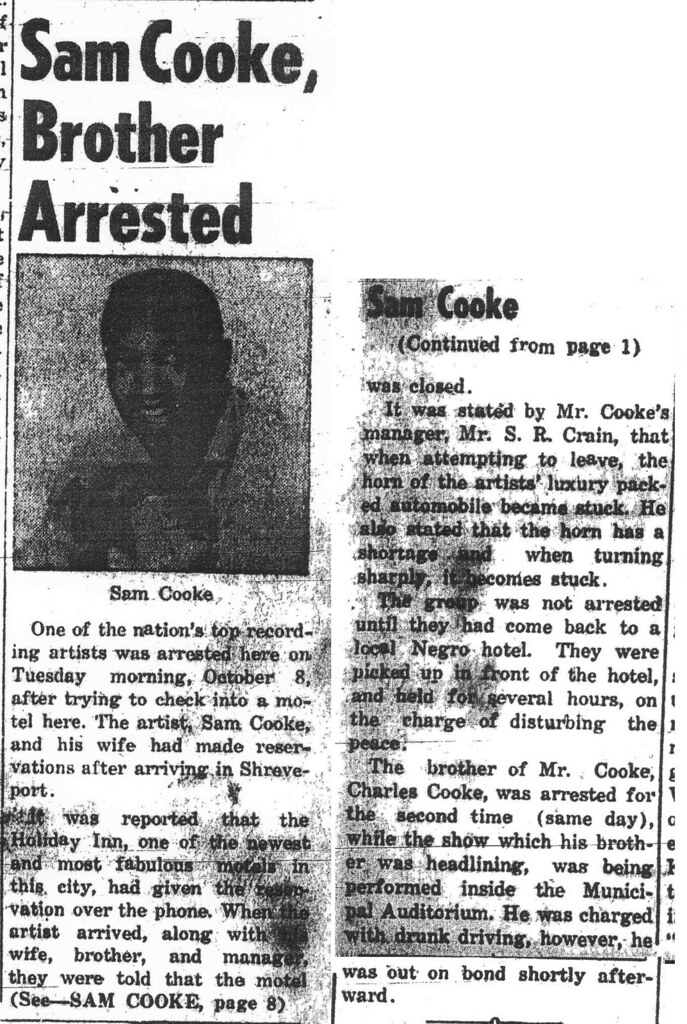
The b-side to a latter-day single in his career, Cooke was moved to write and record it, late 1963 into 1964, after an incident where he had been turned away from a whites only motel in Shreveport, Louisiana. A Holiday Inn. Despite being, arguably, a previously light-weight lyricist, perfect for the pop-soul that endeared him to a largely white audience, he had also been stung by Bob Dylan's emergence, social conscience a'blazing, so he seized the moment. ("Blowin' in the Wind" was a staple in Cooke's live set.) His producers, inevitably warned against the risks of alienating his fans, hence it's appearance on the flip of "Shake." No, me neither. Both "Shake" and the album both the songs appeared on, "Ain't That Good News", actually his last, sold modestly by Cooke's standards. But that has been dwarfed by the legacy and life of the song, voted number 12 in Rolling Stone's 500 Greatest Songs of All Time, as well as being selected for posterity within the Library of Congress, as being "culturally, historically or aesthetically important." All three, say I. But I am ahead of myself. Cooke actually only once played the song live, on TV, the Johnny Carson Tonight show. (I couldn't find any recording thereof to link, sadly.) It was then a full 10 months before the single was ready for release, which eventually took place, over a year after recording, in late December 1964. That release date was already planned, when Cooke was shot dead at another motel, this time in Los Angeles. Colour code uncertain.

There are myriad covers. Although maybe more the metier of the estimable Cover Me Songs, here are my favourite five.


For me, the song that makes The Band's 1973 album, "Moondog Matinee," an essential, the combination of Richard Manuel's keening vocal and the arrangement transformed from the orchestral splendour of the original to simple affecting sublimity.


Another radical revision of the arrangement, Herbie Hancock playing his jazz piano around, behind, on top of a conventional soul vocal version, englishman, James Morrison, the two morphing together just right. But only just.


An astonishing and the possibly OTT extravaganza that was Baby Huey. Just euphoric. Makes me, a middle aged white man, channel James Brown. Convincingly. (Maybe.)


Uncertain still whether this works, cello and the never-less-soul man Ben Sollee. On balance, it does.


Finally, an instrumental mix of all the styles shown above. And more. Bill Frisell, an alchemist of electric guitar, able to run with any genre and leave it resolutely unclassifiable beyond exquisite.

What a song, what a tune. Let it give confidence for the changes that will come. After all, it is all in the ear of the beholder.

Anyhow, don't get upset about the what if of politics, go here, cheer yourself up with some Sam.

Friday, October 10, 2008

Dylan Covers: Masters of War


In planning my posts for this week, I remembered that the blogosphere was all abuzz a while ago with Pearl Jam’s cover of Dylan’s “Masters of War." Here we had the meeting of two religions, the cults of Dylan and Vedder getting together for interfaith services. While I admire both, I don’t share the devotion of either group of fans, and I wound up not even playing the song when everybody was posting it. I had never even heard Dylan’s original until this week.

Now that I have, I must say that it is not Bob Dylan’s best work. The lyrics express a view that I absolutely agree with, but I find them angry and strident. The arrangement is simple, just a driving acoustic guitar and voice, but there is not much variety, and a song which is on the long side is made to feel even longer.

So why am I posting this? Given the simplicity of Dylan’s original, something remarkable happens when the song is covered. Some artists treat the song almost as an unfinished work, and feel free to fill out the arrangement and make it their own. And some of the results are amazing. And the words inspire some great impassioned vocal performances.

Martin Simpson: Masters of War

[purchase]

Martin Simpson is originally from England, where he started his career in folk music. Wanting to add some traditional American folk stylings to his guitar playing, Simpson came to the United States, and wound up staying. Simpson replaced Dylan’s guitar part with his own, to great affect. Simpson’s vocal style is very much in the English folk tradition, the song works very well delivered this way.

Bill Frisell: Masters of War

[purchase, available in mp3 format only]

Bill Frisell is one of the finest jazz guitar players working today, no wait! Bill Frisell is an Americana artist who specializes in instrumental numbers with a jazzy flavor... Perhaps it’s best just to say that Frisell’s music fits in the cracks between musical genres. I’ve often wondered what his music would sound like if he worked with a singer. It would have to be someone who could also straddle the line between jazz, blues, and country. Cassandra Wilson would be an obvious choice, and I would love to hear that, but I was actually thinking of...

Maria Muldaur: Masters of War

[purchase]

... Maria Muldaur. Now, if you’re thinking of “Midnight at the Oasis”, you must think I’m crazy. But as Maria Muldaur has aged, her voice has become richer and deeper, and she has learned to use it as a great jazz and blues instrument. Her take on “Masters of War” came out on her newest album this past July. This is her first album of all political material, which says a lot about the times we are living in.