










Showing posts with label Sam Cooke. Show all posts

Tuesday, September 8, 2020

Mail: Take A Letter Maria


R.B. Greaves: Take A Letter Maria 

[purchase

I’ve written in the past about how I started paying attention to music in 1969. as a result of hearing WABC, the classic New York Top 40 station, in the station wagon that took me to my summer day camp. And that fall, I have a vague recognition of being in the car with my mother, and hearing “Take A Letter Maria” on our car radio, and proclaiming it a hit. I was 8 years old, and already thought that I was a music critic. And here I am, more than 50 years later, still pretending to be a music critic of sorts. 

The funny thing is that my 8 year old self was right. “Take A Letter Maria” became a No. 2 hit on Billboard’s Hot 100 chart, blocked from the top spot by The 5th Dimension’s “Wedding Bell Blues,” also a great song. 

I’d be shocked if anyone reading this doesn’t know the song—it is sung from the perspective of a man who had just learned of his wife’s infidelity, and dictates a letter to his secretary, the titular Maria, informing his wife of their separation. At the end, he asks Maria to dinner. It’s a surprisingly peppy song, considering the subject matter, with Latin influences and mariachi horns. I think that the narrator is supposed to come off as a sympathetic character, trying to recover from the discovery that his marriage is over, and he’s been cuckolded. And overall, I think that holds up today, despite the fact that he breaks up with his wife by letter (the functional equivalent of the uncool breakup by text), and the fact that in today’s environment, asking out Maria would raise questions of power differentials and sexual harassment. To be fair, we don’t know whether Maria accepted the invitation. Also, I have to admit that the fact that he instructs Maria to “send a copy to my lawyer” makes me happy. 

“Take A Letter Maria” was written and recorded by R.B. Greaves, and I’d be shocked if most of the people reading this knew that, and if they did, if they knew anything else about Greaves. 

Greaves, who was the nephew of the great Sam Cooke, was raised on a Seminole reservation, but moved to England in 1963. A few years later, performing as Sonny Childe, and fronting a band called The TNT, Greaves became a popular live soul/R&B act in England and recorded a few singles, before leaving The TNT during the summer of 1967. (Without Childe/Greaves, The TNT became the backing band for P.P. Arnold, probably best known for her versions of “The First Cut is the Deepest” and “Angel of the Morning.”) 

Greaves’ big hit was recorded at the legendary Muscle Shoals Sound Studio, and featured the house musicians, including Donna Jean Thatcher (probably better known from her days with the Grateful Dead as Donna Jean Godchaux), Eddie Hinton, Jimmy Johnson and David Hood. And it was produced by Atlantic Records head Ahmet Ertegun (not even close to being best known as my ultimate boss during the summer of 1982). 

Greaves’ followup, a cover of the Bacharach/David song, “Always Something There to Remind Me,” stalled at No. 27 on the Billboard chart, and that, pretty much, was that for Greaves, although he continued recording into the 1970s. He died of prostate cancer in September 2012 at the age of 68.

Patterson Hood, of the Drive-By Truckers, who is the son of David Hood, the bass player on “Maria,” has covered the song during solo shows, sometimes with his father on bass. Here’s one such performance, in which Patterson talks about how the Rolling Stones wanted to record in Muscle Shoals in 1969, before leaving to perform at Altamont, and that on that day, Greaves recorded “Maria” during the day, and the Stones appeared at night to record “Brown Sugar.”

Wednesday, August 5, 2020

Great: The Great Pretender


purchase [ Platters version]
purchase [The Band version ]
purchase [ Freddy Mercury version ]

There are many notable version of The Great Pretender and it is no surprise that it was voted one of the greatest songs of all time by Rolling Stone magazine back in 2004 (Yeah, OK, in @ #360, but still...) But the song also carries on our previous mask theme, where the protagonist puts on a public face/performance that just aint true. And it would appear that this is something you just about have to do when you get up on a stage, be you Dolly Parton, Elvis, Freddy Mercury, Roy Orbison or Sam Cooke.

Way  back in  the year I was born, the story goes, a music producer named Buck Ram wrote this song in 20 minutes in a Vegas hotel washroom. At the time, he was the manager for the Platters, who recorded the song as a follow up to their first hit, Only You. When Mercury records signed them in a two-fer deal on the coat-tails of The Penguins (who, unlike the mostly unknown Platters, had a charting hit called Earth Angel), it wasn't at all clear that The Platters would go down in history. But they did- for a number of reasons - and the Penguins mostly did not. They went on to have many hits (something like 40 of them in about a 10 year span), they were like the first cross-overs from doo wop R&B to rock, they included a female in the line-up, and then they rapidly fell out of favor after they were busted.

Sam Cooke did a  version on his 1960 album Hits of the 50's


Dolly Parton covered it in 1984. Now there's someone who was well aware of the need for pretense as part of her show/pesona. Says Michelle Lindsey [link], "‘The Great Pretender’ is what she set out to be as a poor kid playing dress up, writing songs and hoping to become a star. ...  [Parton] admitted, ‘I do it because I’m a show person.’ To drop the pretence, the persona and age like a normal human being is not an option. You see this now in almost every famous person, trickling right down even to the average person in the street."


The most familiar to me is the version from the Band. I guess by that time I was consuming most of the music that was being produced and The Band, as J David recently noted was [link] hot. J David references the Stage Fright album. How appropriate! The best way to get over your stage fright? Pretend.


The version by Freddy Mercury in 1987 has a certain poignance to it in that it immediately predates his HIV public announcement, and most research indicates that he must have been aware of his health issues well before the song came out. That said, there isnt much debate about his sexual orientation at that time, and that, too, could certainly entail an element of pretense. These factors may be part of the strength of his commanding performance of the song. About Bohemian Rhapsody, Freddy's lover, Jim Hutton said "Freddie was never going to admit it publicly, because he had to carry on the charade about being straight, for his family. But we discussed it many times."


Old and In the Way also cover the song in a wonderful country style, this recording without Garcia unfortunately.


None of the above will be confused with the Foo Fighters' song similarly named The Pretender, which is a great song but doesn't pass our theme test for "great" unless you force a match like this :


Wednesday, July 11, 2018

JULY: JULY, JULY/The DECEMBERISTS


Can it really only be 16 years since the Decemberists first peered around the corner into existence? Strangely, and I speak as a fan, it seems so much longer. Not, it is true, to the taste of all, the vocals of bandleader Colin Meloy being possibly the main hurdle to mass approval, together with their unworldly appearance,  the senior common room at a Cahoots/The Band theme night, and their downright odd arrangements, a quirky mix of the archaic with the unexpected, conspire to a niche version of world famous. Which is just fine in my book. And 'July, July' is perhaps the standout track on debut LP 'Castaways and Cutouts'.

Colin Meloy reminds me of Richard Thompson in a strange way, a catalyst of tradition and electricity. But maybe not so strangely. (Yes, I am going to talk about Meloy mainly, rather than the band, regardless of how tremendous are his cohorts, instrumentally, and they are, without him as prime singer and songwriter, they are meaningless. His band and he calls the tunes.) Constantly ploughing his own singular furrow, undoubtedly indebted to the british folk revival of the 60s and 70s, yet ears attuned to influences elsewhere. He has produced a series of solo albums, EPs really, devoted to such disparate bedfellows as Shirley Collins, Sam Cooke, Morrissey and the Kinks. But are they so very different? In Meloy's hands, often just his guitar and marmite voice, sometimes with spectral backing vocals, the similarities become immense.


See what I mean? OK, so 'Summertime' is hardly unique to Cooke, but what a version this is, drawing into focus what a great song it is, a steamy Tennessee Williams 3 acts in a few simple verses. And so too the songs of Stephen M. and of Ray Davies, let alone the trad. arr. seamed by Collins. I have to question, mind, quite what Meloy now has to say about the increasingly bizarre rants of the erstwhile Smiths frontman, whose image he has allegedly inked on his skin.

The Decemberists, of course, plough similar, albeit augmented by the trappings of electric rock music, chucking in accordion and stand up bass where necessary, and now, in 2018, the introduction of synthesisers and similar new-fangled. And now, instead of ancient mariners, they sing about village idiots.

Having caught them live in Birmingham (UK!) on their 'King is Dead' tour, I found myself initially uplifted, ahead of finding their cerebrality perhaps fits better with the recorded than the live. And there is then a strange dichotomy between the earnest lyrical scene-setting and Meloy gradually morphing into a demented ringmaster, corralling the crowd into choral participation. (I should add I am the frowning geezer in the crowd who never sings along, when asked to, or claps or waves a lighter. I can't abide all that stuff.) However, when they recently revisited the canon of 60s/70s folk in the guise of 'Offa Rex', their collaboration with folkish gamine, Olivia Chaney, this I wanted to see, so wanted to see. Still do. Interestingly they are keeping mighty quiet as to who the support on their forthcoming UK tour might be, my hope and money on Chaney..........


A final thought, for those who have ploughed through the vids above, and can't quite get it. This helpful instruction manual might help.

Still with me? Probably the best place to buy.

Saturday, January 14, 2017

CHANGE: A CHANGE IS GONNA COME

Well it is, isn't it? And it would have, anyway, because everything changes, that's a fact, to paraphrase Bruce Springsteen. Which is about as philosophical as I am going to get. So I am not going to trump on about politics, probably a relief, because everyone everywhere else will be. But I am going to celebrate this wondrous song, particularly as it later became quite an anthem for civil rights, something we could maybe start storing up in reserve. (Sorry, I said I wouldn't.....)


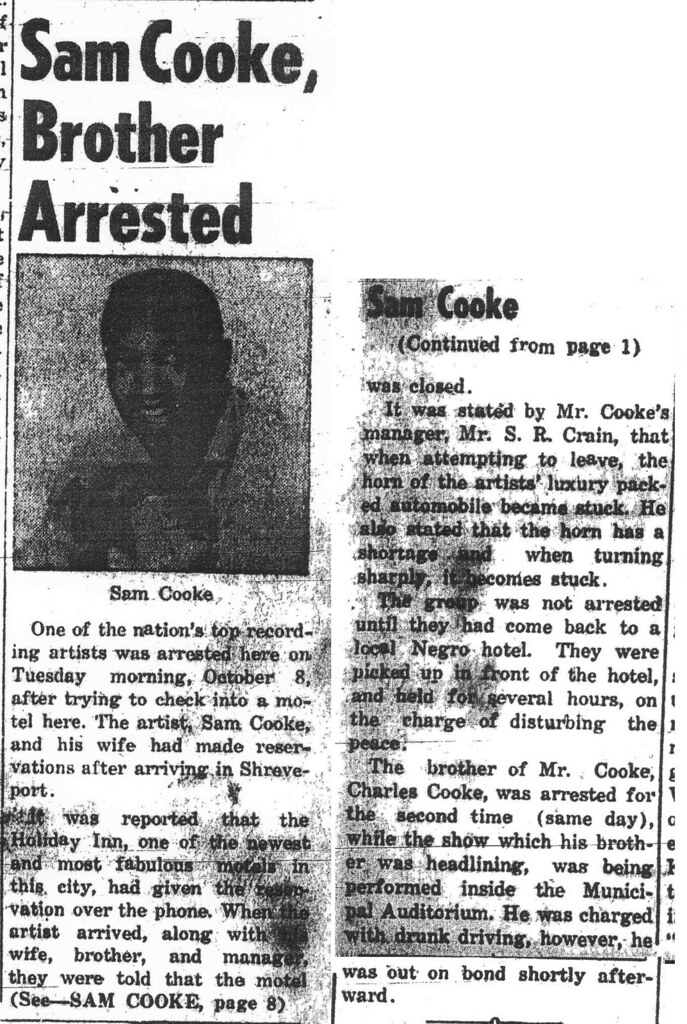
The b-side to a latter-day single in his career, Cooke was moved to write and record it, late 1963 into 1964, after an incident where he had been turned away from a whites only motel in Shreveport, Louisiana. A Holiday Inn. Despite being, arguably, a previously light-weight lyricist, perfect for the pop-soul that endeared him to a largely white audience, he had also been stung by Bob Dylan's emergence, social conscience a'blazing, so he seized the moment. ("Blowin' in the Wind" was a staple in Cooke's live set.) His producers, inevitably warned against the risks of alienating his fans, hence it's appearance on the flip of "Shake." No, me neither. Both "Shake" and the album both the songs appeared on, "Ain't That Good News", actually his last, sold modestly by Cooke's standards. But that has been dwarfed by the legacy and life of the song, voted number 12 in Rolling Stone's 500 Greatest Songs of All Time, as well as being selected for posterity within the Library of Congress, as being "culturally, historically or aesthetically important." All three, say I. But I am ahead of myself. Cooke actually only once played the song live, on TV, the Johnny Carson Tonight show. (I couldn't find any recording thereof to link, sadly.) It was then a full 10 months before the single was ready for release, which eventually took place, over a year after recording, in late December 1964. That release date was already planned, when Cooke was shot dead at another motel, this time in Los Angeles. Colour code uncertain.

There are myriad covers. Although maybe more the metier of the estimable Cover Me Songs, here are my favourite five.


For me, the song that makes The Band's 1973 album, "Moondog Matinee," an essential, the combination of Richard Manuel's keening vocal and the arrangement transformed from the orchestral splendour of the original to simple affecting sublimity.


Another radical revision of the arrangement, Herbie Hancock playing his jazz piano around, behind, on top of a conventional soul vocal version, englishman, James Morrison, the two morphing together just right. But only just.


An astonishing and the possibly OTT extravaganza that was Baby Huey. Just euphoric. Makes me, a middle aged white man, channel James Brown. Convincingly. (Maybe.)


Uncertain still whether this works, cello and the never-less-soul man Ben Sollee. On balance, it does.


Finally, an instrumental mix of all the styles shown above. And more. Bill Frisell, an alchemist of electric guitar, able to run with any genre and leave it resolutely unclassifiable beyond exquisite.

What a song, what a tune. Let it give confidence for the changes that will come. After all, it is all in the ear of the beholder.

Anyhow, don't get upset about the what if of politics, go here, cheer yourself up with some Sam.

Thursday, April 19, 2012

Suites and Medleys: Try A Little Tenderness/(I Love You) For Sentimental Reasons/You Send Me

Sam Cooke: Try A Little Tenderness/(I Love You) For Sentimental Reasons/You Send Me

[purchase]

Before “Try A Little Tenderness” was a soul classic, it was a standard beloved of crooners. Little Miss Cornshucks was the first to give it an R&B edge in 1951, and Aretha Franklin recorded it in 1962, drawing from the Cornshucks version. But it was Sam Cooke’s interpretation of it, as part of a medley recorded at the Copacabana club in New York City, that inspired Otis Redding’s definitive version from 1966 (which we have cause to remember this month following the death last week of Andrew Love, who with fellow Memphis Horns founder Wayne Jackson played that iconic horn intro).

Sam Cooke was Redding’s idol, but unlike Cooke, Redding didn’t compromise. The medley here, recorded on 8 July 1964, is Cooke at his compromisingest: he sings two standards which the mostly white audience can identify with, and then delivers his big crossover hit. To hear Cooke in a soul environment, one has to hear the live album recorded at the Apollo, and unreleased until the mid-’80s.

But make no mistake, bubbling just under the surface at the Copa, and especially on the “Try A Little Tenderness” part of the medley (which Cooke apparently based on Aretha’s version), is Sam Cooke the soul singer, the gospel singer, the voice that Otis Redding idolised and which he heard when he set off to record the song originally recorded in 1932 by the Ray Noble Orchestra (and shortly after by Bing Crosby and Ruth Etting).

There is a lovely story that Redding actually didn’t want to record the song, which was arranged by Isaac Hayes, because he could not stand the idea of competing with the by then dead Sam Cooke, and so intentionally sang it in a way he thought would make the recording unreleasable.

For more on the background to “Try A Little Tenderness”, go HERE

Thursday, March 15, 2012

Irish Accents: “Danny Boy” Collected


Frank Patterson: Danny Boy

[purchase]

Sam Cooke: Danny Boy

[purchase]

The Pogues: Danny Boy

[purchase]

Richard Thompson: Danny Boy

[purchase]

Jackie Wilson: Danny Boy

[purchase]

Elvis Presley: Danny Boy

[purchase]


“Danny Boy” has to a certain degree become the Irish-American anthem, with its overtones of exile, of loved family left behind, and the hazy prospect of return in the far future. So it’s a touch ironic that the tune – the “Londonderry Air” – is an anthem of Northern Ireland, that the lyrics were written by the Englishman Frederic Weatherly, that the song’s only about a hundred years old, and that the fist recording seems to be by a German singer. None of this means anything, of course; by now, there are any number of references to “Danny Boy in Irish-American culture, books that take almost every line of the lyrics as titles, and even a “Danny Boy” Premium Irish whisky (see picture). Any reference to the song is instant Hollywood shorthand for the Emerald Isle.

Before the song got wrapped up in manufactured Blarney, “Danny Boy” took roots in America in the ‘30’s and the ‘40s – promoted in part by versions by Bing Crosby and (in the movie Little Nellie Kelly) Judy Garland. In the 1950’s, it became one of a handful of ‘white’ standards that R&B artists added to their songbook, and at the same time, it drifted into the country repertory as well, (including Bill Monroe, Willie Nelson, and Johnny Cash in 1965 and again in the American sessions at the end of his life).

As far as I go, there’s no recorded version anywhere that sounds as good as it does when sung sometime after 1 AM with a bunch of friends, all several sheets to the wind. But it seems wildly unjust to subject anyone not wearing beer headphones to that experience, so – a few judicious nominations.

My own personal favorite is by Frank Patterson, a classically trained tenor who decided to follow in the Irish tenor tradition established by the likes of John McCormack. This is the version that’s best known from the Thompson gun scene in Miller’s Crossing.

Sam Cooke covered it on his first secular album. Predictably, Cooke sang the hell out of it (compare Jackie Wilson's version, from his first album; he took it to some very unusual places that I’m not sure it was supposed to go to).

Finally, two down-to-earth takes: a reverent a capella cut by Cait O’Riordan and the Pogues from the unfortunate film Straight to Hell, and a live set-closer from Richard Thompson. Good stuff.

Guest post by Neil

Sunday, March 6, 2011

Doublespeak -> Dance Moves: Everybody Loves To Cha Cha Cha


Sam Cooke: Everybody Loves To Cha Cha Cha

[purchase]

James Taylor: Everybody Loves To Cha Cha Cha

[purchase]

Things heat up a bit as we move from one title theme to another this week, leaving behind songs that use the same word twice to start a set of songs which mention dance styles or dance moves in their title. Yes, folks, it's a Star Maker Machine Dance Marathon, and if it works, I'm hoping it'll become an annual pre-spring event, marking the warming of the world with a bit of energy as we shake off winter with some dance floor moves.

Sam Cooke provides a solid transitional tune with his hot, humid, heavily rhythmic tribute to the Cha Cha Cha, a dance of Cuban origin often referred to doubly in American parlance; Sam's original is a worthy addition to the canon, and it'll certainly teach you how to do the moves, but it's James Taylor's 1991 version, off his sorely underrated Adult Contemporary album New Moon Shine, that brought me here: slow, sultry, languid, and aching with a kind of longing that Sam surely never envisioned, bless his heart.

Monday, January 18, 2010

There´s Something About Mary: Oh Mary, Don´t You Weep


When the Soul Stirrers sing gospel, even atheists perk up their ears...
I said that.

At the time they recorded Oh Mary, Don´t You Weep in 1964, the legendary Sam Cooke was no longer a member of the Soul Stirrers. Cooke had left that famous gospel group in ´57 to try his luck stoking the star-maker machinery behind the popular song. And as the pop hits kept coming, Cooke found himself a wealthy man. The first black artist to do so, he started his own label, helping gospel orientated artists as the Womack Brothers, R.H. Harris & His Gospel Paraders and the group he had just left, the Soul Stirrers.

Oh Mary, Don´t You Weep features Jimmie Outler on lead vocals, a fine singer who´s on record proclaiming that "there ain´t but one person in gospel that could beat me singing, but he´s not in gospel - and that´s Sam".

As a bonus, here´s some priceless studio chatter with Sam Cooke in the producer´s seat for his own SAR Records, instructing the Soul Stirrers before takes.

Thursday, November 5, 2009

Cool Kidsongs: Shortnin' Bread, This Old Man, My Grandfather's Clock


The Tractors: Shortnin' Bread

[purchase]

This week's theme is somewhat out of my area of expertise. Not being a parent I only have my own childhood to draw from. But from my earliest days there always was music in our house. If there wasn't something playing on their old Packard-Bell, our folks would make up for it by singing songs to us. Shortnin' Bread was one of those songs. I remember even then that I thought it was a silly song and even sillier was the idea of my mom singing it to me. But years later I heard a version of the song and all the memories of her singing that song came back like it was yesterday. I'd give anything to hear her sing that to me now. But I'll have to settle for the few versions of this I have, including this great one by the Oklahoma based band The Tractors.

Yellowman: This Old Man

[purchase]

Another one I remember from those wonderful days of innocent youth was This Old Man.. I should mention here that the Tractors have a great version of this but I've chosen to post the Yellowman version. There's just something about reggae that can make even the most mundane song sound great.

Sam Cooke: My Grandfather's Clock

[Out of print]

Years later, during music class in about the fourth grade,I got in trouble for acting off during our singing of Grandfather's Clock. The trouble was I was innocent! But it didn't matter...I was in trouble and that was all there was to it. My teacher made me stand up in front of the class and sing the song solo. Needless to say it made me hate the song for years.. or so I thought. The truth is I've always loved the song and no fourth grade teacher was going to spoil that for me! My first choice was to post the Johnny Cash version but I've chosen the Sam Cooke's because Johnny Cash has already been posted this week.

Sunday, October 5, 2008

Dylan Covers: Blowin' In The Wind


Sam Cooke: Blowin' In The Wind [purchase]

When (Sam Cooke) first heard "Blowin' In The Wind" on the new Freewheelin' Bob Dylan album J.W. (Alexander) had just given him, he was so carried away with the message, and the fact that a white boy had written it, that he was almost ashamed not to have written something like that himself. It wasn't the way Dylan sang, he told Bobby Womack. It was what he had to say. "I'm going to write something," Sam told J.W. But he didn't know what it was.
--Peter Guralnick, Dream Boogie: The Triumph Of Sam Cooke, pages 512-13

That "something" turned out to be Sam Cooke's finest moment as a songwriter and one of the artistic high points of the 1960s, "A Change Is Gonna Come." But, before writing "Change," Sam took Dylan's civil rights anthem uptown, during his July 1964 gig at the Copacabana in New York City.

As a bonus, here's a video of Sam singing "Blowin' In The Wind" on the premiere episode of Shindig in September 1964. Keep in mind that this was probably one of the first televised instances of a black man being surrounded by dancing white chicks. No doubt tears of rage were shed all over the country that night.

Monday, August 25, 2008

School Days: Wonderful World


Sam Cooke: Wonderful World [purchase]

During the time Lou (Adler) and Sam had roomed together, they'd tossed "Wonderful World" back and forth, Sam playing the few chords he knew on the guitar and messing with both lyrics and melody. Cooke fiddled with it as he did with all his material: trying it out on various people, announcing it was his latest hit, showing off to women by claiming he'd written the tune right there, for them. It took shape over a long time and a lot of partying.

"Then what happened," says Adler, "is we were in the back of Keen Records on 3rd Street, and he decided he wanted to cut some things, but we couldn't get the normal drummer that we used. We were cutting them more or less as demos, because Bumps (Blackwell) wasn't there ... We got a drummer that was 15 or 16 years old and was a nephew of one of the musicians." The session on March 2, 1959, could hardly have been more bare-bones. As Adolphus Alsbrook laid down a rhumba bass line, the teenage drummer tracked along, and Cliff White picked a pretty, high guitar line. Behind Sam, hitting the last, rhymed word in each line, is Lou Rawls; Deano Lappas (Keen's house engineer) remembers him standing about a foot and a half behind Sam, singing into the same mic.

--Excerpt from Daniel Wolff, You Send Me: The Life & Times Of Sam Cooke, pp. 220-21

Tuesday, May 6, 2008

2:42 - Another Saturday Night


Sam Cooke: Another Saturday Night

[purchase]

On December 11, 1964, Sam Cooke’s life was taken by shotgun at the hands of a female motel manager who feared for her life. The controversy to this day, is still not amicably solved by all parties involved. One thing’s for sure, we lost the “king of soul” far to early and like many Rock n’ Roll greats: what would he have become? That’s not to say that during his short life he hadn’t already become more than a somebody. During his short career he amassed 29 Top 40 hits, wrote, produced and performed his own music and started his own publishing and recording label. Sam was also directly involved in the Civil Rights Movement and was a strong voice for the black community in song. Here’s one of his pop nuggets, a Top Ten hit for Sam in 1963 and a undeniable classic.

Reader submission from Kevin.