Showing posts with label The Band. Show all posts

Thursday, July 8, 2021

Opposites: Awake/Asleep

purchase [the band]

"A tad obvious" says our own Seuras, speaking of feathers and lead in his heavy/light post a few days back. The same holds true for any of the opposites we have poked at in this theme - "a tad obvious". My choice of awake/asleep is no less obvious, once we say it outloud, it is: "but, of course."

That said, I think I can say I now have a favorite song from The Band's oevre. I mean, there are several fine tunes over the 10 years from '68 to '78 that included Robertson in the band. But I particularly like the  - I'm going to call it a jangle - of the song. Maybe it's the semi-ragtime keyboards in the original recording? I like the sound almost as much as I like the lyrics. Just a few of them that are stuck bouncing around my head:

you will be hangin' on a string from your when you believe

you will relieve the only soul that you were born with to grow old and never know

I could wake up in the morning dead

And if I thought it would do any good I'd stand on the rock where Moses stood 

But then I came across a version that Rick Danko (the vocals on the original) shared, and -for me - the song gained further respect.


Another awake. I confess I have never really felt a reason to follow Katy Perry's music. I can see why some folks do and did, however. But when I see that she, too, has an awake song, I guess it's time for me to dig a little deeper than knowing that she's done some American Idol stuff. Her <Wide Awake> from 2012 sounds to me like most of what I have heard of her music/style ("...anthemic and often sexually suggestive...electro-pop...", per britannica)


As for the other side of the coin ("ah", he says a little belatedly, "another pair of opposites we have here"), let's go back to Abbey Road, 1969, pretty much the end of the Beatles as a band.

Golden Slumbers is one of eight short songs that make up the 16 minute track titled <Medley>. You know the song. It's the one that begins "Once there was a way ... to get back home ... sleep pretty darling do not cry ..."


Let's continue sleeping with a listen to the better known version of Mbube, the song originally from Solomon Linda back in 1939 - the one that you've probably heard the version of from The Lion King as well as this one from The Tokens. It's not particularly going to put you to sleep, but maybe you don't want to spend the night near a sleeping lion, whether you "hush my darling" or not.


And we'll wrap it up, although there's plenty more to cover, with an appropriately named band (that I again really don't know much about except their name, which fits the subject): Asleep At The Wheel. They've got a coupla songs that - besides their name - touch on sleep: Midnight in Memphis, and an album titled <Keep Me Up Nights> plus more, for sure (In My Dreams ...)


Thursday, April 8, 2021

PASSED OVER: PASSED ON

 Yup, can't resist, the elephant in the room, or rather the dead elephant in the room, as passed over always has me reaching for the reflex, however thoughtful or thoughtless, sorry for your loss. It isn't a phrase that sits neatly in my lexicon, smacking of euphemism and a coy avoidance of the reality. So and so has passed over, so and so has passed on, all of that. To where says the passive-aggressive agnostic inside me? The other side isn't exactly helpful and arguably is also somewhat unrealistic. Mind you, I'm not keen on rest rooms or comfort stations either, and you can blame my earthy medical anglo-saxon roots for that, where folk die and go to the toilet, or even, sometimes, even  the other way round. 

Death songs then, a surprisingly large and popular canon from time immemorial, the annals of trad. arr. littered with maidens killing and being killed. But that's too easy, here I want to explore those songs written from the viewpoint of the slain. I love 'em. Here are five of the best.

Long Black Veil has to be one of the best, the happy little tale of how the honour of the canoodling was preserved, the song's protagonist taking the rap for a murder, as his only alibi would have to have been his paramour, his neighbour's wife. So that's all right then, is it? She gets off scot free, if then still leaving the neighbour wondering quite why, or where, his wife gets the penchant for going out of a rainy night, dressed in black and howling at the moon. One of many versions, this one, by the Band is the best, the lead vocals, all of the exquisitely ragged vocals for that matter, sounding distinctly of the grave. Which, sadly, is indeed now the case.

To follow, a beautiful song, set within a glorious string setting, coming from John Wesley Harding, aka Wesley Stace, initially a skinny tie "noo wave" singer, with hints of Costello in his style and timbre, to, now, an increasingly folky solo troubadour, an artist I have much time for. The song weaves a story of come uppance with a real sting in the tale and stunned me to silence the first time heard it. A warning to any uxoricidal maniacs out there, it certainly gave me pause for thought.

The sort of song perhaps older readers will remember from their parent's collection, the old Marty Robbins chestnut, with The Old 97s giving it a good kicking, providing a bit more of the adrenaline that a real gunfight might provide, the momentum giving credence to that apparent sense of disbelief that seems to arise after a wound sustained in the heat of skirmish.At least, that's what happens in films. The Old 97s have an intrinsic knack for polishing up old tropes and giving them a modern sheen.

Neither a judiciary death nor a killing, is this one about a natural death? Of course, with the way Elvis writes his songs, the whole thing may be an allegory. But irrespective of such musing, I like the way it is the first to offer a view of the life beyond the threshold. Rather than a wraith stranded here on this earth, here the protagonist offers a description of a disappointed creator, rueing his creation. Am I alone if feeling some hope in that? It is certainly preferable to the burning pit of hell, but is it heaven? Costello has always struck me as a man who thinks deeply about the human condition, his songs often offering the sour aftertaste of catholic guilt.


Hell, you say, you mean like this? And you can always trust the Pet Shop Boys to offer an acerbic and wry view of proceedings. So maybe this song doesn't, as actually did neither the last, overtly explain how the observer came to be where they were, and in this one there is even no reference per se to anyone dying. But, surely, any accurate reportage would require the ability to be there and even Bill and Ted had to die to get there, yes? So I have to assume the witness is deceased, my column and all that. Ex-journalist Neil Tennant effortlessly lists the names of the mad, the bad and the dangerous to know as being the main occupancy, which I suspect is a little hopeful. My hell would be full of people I know.

As would my heaven.

I'm sorry for my loss. In taste.

Monday, February 8, 2021

Walls/Obstructions: The Walls Came Down


The Call: The Walls Came Down
[purchase

If we were playing a game where I asked you to guess what band I was talking about, and the clues were: This band released their first album in the early 1980s. They wrote powerful rock anthems, with meaningful lyrics, sometimes with Christian themes, and performed them passionately and well, you very well might think I was talking about U2, which went on to become one of the biggest, most successful bands of all time. But of course, you saw the picture and read the title, so you know that I am talking about The Call, which, despite some success, did not go on to become one of the biggest, most successful bands of all time. 

OK, were they as good as U2? Not in my mind. But were they better than a lot of their contemporaries who went on to more fame and fortune? Definitely. 

The Call was formed in 1980 in Santa Cruz, and the leader and lead singer was Michael Been, who was born in Oklahoma, but moved to Chicago after high school. A performer from an early age, Been entered the Illinois state comedy competition (who knew that was a thing), coming in second, ahead of his friend John Belushi. 

After attending the University of Illinois in Chicago and playing in local bands, Been moved to the Los Angeles area in 1972, played in some bands, was a session musician, including on some Christian music albums, before relocating to Santa Cruz and, eventually forming The Call. Their first, self-titled, album was on a major label, was produced by Hugh Padgham, and had the Band’s Garth Hudson on a few tracks. I remember liking it a lot, and playing some tracks from it on WPRB. I wasn’t the only one. Peter Gabriel referred to the band as “the future of American music,” and recruited them to open for him. Gabriel later played on The Call’s third album, as did Simple Minds’ Jim Kerr and Robbie Robertson, and Bono appeared on their 1990 album Red Moon, as did T-Bone Burnett. Martin Scorsese cast Been in The Last Temptation of Christ, as the apostle John. Despite this appreciation, their success was limited and fleeting. 

The second album, Modern Romans, was released after I graduated from college, but I listened to it often, and loved our featured song, “The Walls Came Down.” A stridently anti-war song, it was inspired when Been saw the idealism of the '60s give way to more materialistic and militaristic mindsets of the Reagan years, including the Grenada and Lebanon conflicts. It uses the biblical imagery of Jericho’s walls coming down (without ever mentioning Jericho), and ends, though with the modern sentiment: 

I don't think there are any Russians
And there ain't no Yanks
Just corporate criminals
Playin' with tanks 

The band broke up after releasing Red Moon in 1990, and put out a reunion album in 1997, but that was it. Been played as a sideman for others, including Harry Dean Stanton, but for years acted as a sound engineer for Black Rebel Motorcycle Club, which featured his son, singer and bassist Robert Levon Been. (I haven’t been able to determine whether he was named in honor of two members of The Band, but it certainly makes sense). Been died of a heart attack in 2010, backstage at a music festival in Belgium, where BRMC was appearing. 

So, why did The Call not reach even half of U2’s fame? Were they too strident and angry? Was front man Been’s lack of classical good looks part of the issue? Read some of the tributes to Been and The Call here, and you get a sense that they were one of those bands that should have been bigger, but just never got there, and no one can really explain why.

Wednesday, August 5, 2020

Great: The Great Pretender


purchase [ Platters version]
purchase [The Band version ]
purchase [ Freddy Mercury version ]

There are many notable version of The Great Pretender and it is no surprise that it was voted one of the greatest songs of all time by Rolling Stone magazine back in 2004 (Yeah, OK, in @ #360, but still...) But the song also carries on our previous mask theme, where the protagonist puts on a public face/performance that just aint true. And it would appear that this is something you just about have to do when you get up on a stage, be you Dolly Parton, Elvis, Freddy Mercury, Roy Orbison or Sam Cooke.

Way  back in  the year I was born, the story goes, a music producer named Buck Ram wrote this song in 20 minutes in a Vegas hotel washroom. At the time, he was the manager for the Platters, who recorded the song as a follow up to their first hit, Only You. When Mercury records signed them in a two-fer deal on the coat-tails of The Penguins (who, unlike the mostly unknown Platters, had a charting hit called Earth Angel), it wasn't at all clear that The Platters would go down in history. But they did- for a number of reasons - and the Penguins mostly did not. They went on to have many hits (something like 40 of them in about a 10 year span), they were like the first cross-overs from doo wop R&B to rock, they included a female in the line-up, and then they rapidly fell out of favor after they were busted.

Sam Cooke did a  version on his 1960 album Hits of the 50's


Dolly Parton covered it in 1984. Now there's someone who was well aware of the need for pretense as part of her show/pesona. Says Michelle Lindsey [link], "‘The Great Pretender’ is what she set out to be as a poor kid playing dress up, writing songs and hoping to become a star. ...  [Parton] admitted, ‘I do it because I’m a show person.’ To drop the pretence, the persona and age like a normal human being is not an option. You see this now in almost every famous person, trickling right down even to the average person in the street."


The most familiar to me is the version from the Band. I guess by that time I was consuming most of the music that was being produced and The Band, as J David recently noted was [link] hot. J David references the Stage Fright album. How appropriate! The best way to get over your stage fright? Pretend.


The version by Freddy Mercury in 1987 has a certain poignance to it in that it immediately predates his HIV public announcement, and most research indicates that he must have been aware of his health issues well before the song came out. That said, there isnt much debate about his sexual orientation at that time, and that, too, could certainly entail an element of pretense. These factors may be part of the strength of his commanding performance of the song. About Bohemian Rhapsody, Freddy's lover, Jim Hutton said "Freddie was never going to admit it publicly, because he had to carry on the charade about being straight, for his family. But we discussed it many times."


Old and In the Way also cover the song in a wonderful country style, this recording without Garcia unfortunately.


None of the above will be confused with the Foo Fighters' song similarly named The Pretender, which is a great song but doesn't pass our theme test for "great" unless you force a match like this :


Tuesday, June 30, 2020

Looking Forward: Live Music


The Band: The W.S. Walcott Medicine Show
[purchase]

The one thing that I’m most looking forward to when it becomes possible again, not surprisingly, is going to see live music. At the end of the year, when I do my family holiday letter, I’m always struck by the number of live shows that I’ve been too, but this year will be different. My last live show was Richard Thompson at Symphony Space in NY in early February, and since then I’ve seen a bunch of live streams, which have their benefits, but there’s nothing like live music.

When I thought about this theme, my first thought was “Let There Be Rock,” by the Drive-By Truckers. But I’ve written about them so much, I thought, enough already. (Although “What It Means,” from American Band really hits home right now, I’m just sayin’). So, I turned to the blogger’s best friend, Google, to find songs about live music, and one that popped up was The Band’s “The W.S. Walcott Medicine Show,” from their Stage Fright album.

Now, to be clear, that song is about a minstrel or medicine show, and although these shows often included live music, I am emphatically not interested in seeing a minstrel show, but stay with me—it will make sense eventually. Minstrelsy was, remarkably, the most popular form of entertainment in the United States during the 1800s and early 1900s, until they were supplanted by vaudeville. Minstrel shows were, initially, white performers, in black face, portraying an exaggerated negative stereotype of blacks, and were undoubtedly racist. Later, black performers themselves pretended to be whites in blackface, but still pandered to the same racist stereotypes. To quote Rhiannon Giddens, “minstrelsy was terrible.” That quote is from one of the live streams I watched recently, sponsored by Carnegie Hall, featuring Giddens and her partner Francesco Turrisi, discussing minstrelsy, its roots, and more, including way too much information about the tambourine, and they performed a few great songs. Watch it here, for the historical background.

“The W.S. Walcott Medicine Show” is based on Levon Helm’s memories of attending minstrel and medicine shows in his youth in Arkansas, and the name is derived from one of the shows, F. S. Wolcott's Original Rabbit's Foot Minstrels. As Giddens mentions in the video, the awful, racist minstrel shows co-opted black string band music (which is what Giddens’ band Carolina Chocolate Drops championed). In fact, the Wolcott troupe was originally Pat Chappelle's Rabbit's Foot Company, formed around the turn of the century. It was owned by a black man, and featured black performers. Chappelle’s Rabbit Foot Company was remarkably successful, played all over the country, and even had its own baseball team. The show included, among others, Ma Rainey, often known as the Mother of the Blues. But, although I’m not 100% certain, I’m pretty sure that this black owned and operated show used blackface—because that was how to make money in those days. And when Chappelle died in 1911 (and I don’t see any connection between him and Dave Chappelle), he was considered one of the wealthiest black residents of Jacksonville, Florida.

Chappelle’s wife remarried and sold the business to a white man, F.S. Wolcott, who eventually renamed the troupe. It appears that the performers remained black, and included Bessie Smith, Louis Jordan and a young Rufus Thomas. Based on this “window card,” it seems pretty clear that the Wolcott show also performed in blackface:

 
The show was sold again in 1950 and continued to perform until 1959 when changing times and tastes led to the show’s equipment being seized for nonpayment of taxes.

So, why would The Band write a song about a minstrel show that advanced negative stereotypes of blacks? And which refers to a musical ensemble named the “Klondike Klu Klux Steamboat Band?” My guess is simply that they (and the song, as usual, is credited to Robbie Robertson, but who knows who really should have gotten credit?) wanted to write a slice of life story about a particular place and time without making a value judgment—much like “The Night They Drove Old Dixie Down” is a sympathetic song written from the traitor side. You can read some analysis of both songs, and others by The Band, here.

We’re in a time where people are (again) focusing on symbols of racism in the United States, and I admit that I’m delving deeper into issue of race and racism. People are marching. Statues are coming down, and there's actual bipartisan discussion about taking traitors' names off of military bases. White voice actors are stepping away from portraying characters of color. Amusement park rides are being re-themed.  People are realizing that the confederate (no capital letter used on purpose) battle flag is a symbol of racism and treason, and even NASCAR and Mississippi have had to banish it. Numerous TV shows have removed episodes containing blackface, and allegations of wearing blackface have caused politicians and others to lose their jobs.

In times like this, mistakes are bound to be made (passive voice use intended), and unfortunately the opponents of change are seizing on the apparent mistakes (toppling a statue of Lincoln, for example) to discredit the movement. But the fact is that we are more openly debating these issues—and things are happening—which is a good thing. I’m sure that there are people who would argue that Pat Chappelle’s Rabbit Foot Company was a positive—a black owned, black run business that made its owner rich and exposed many people of all races to black music and culture. But despite the fact that some of the music was groundbreaking, and ultimately led to the type of music that I want to see live, that version of black culture was a distorted, negative one that helped to oppress black Americans.  It was a shame that someone like Chappelle needed to reinforce those stereotypes to succeed. Let’s hope that this moment of reconsideration has a lasting positive effect, and doesn’t fade away, like the last wave of statue toppling and flag lowering in 2015. Or like Reconstruction.

And you thought this would be about me wanting to go to a concert.

Tuesday, June 23, 2020

LOOKING FORWARD: BETTER DAYS

That's the point of it, of life, wherever you are, the excitement and anticipation of a day yet to unfold, whether a definite day pinned on the calendar, or an arbitrary aspiration of a future different from the now. We call such days Lollo Rosso in my house, when we have had one and while we await one. Why? Italian lettuce, doncha know. Italian red lettuce.  Red lettuce/red letters? (I know, I'll give you a moment to repair your sides.)


My i-pod is crammed with songs about shit days; it is the basis, arguably, for the entire genre of music, the blues. So where's the hope, the optimism? If we disregard that happy-go-lucky music is so often a happy clappy pap of little merit, let's, instead, celebrate when it isn't.

Better Days/Bobby Charles

Where better to start than the down-home charm of Bobby Charles? A southern swampy country soul man in the style of Dan Penn, he moved in all the right circles, if never quite making it in his own right. I was alerted to him a couple of decades ago, via a friend pointing me in the direction of his first and eponymous album, a slow burner that first dropped in 1972. An acolyte of the Band, he actually appears in their Scorsese-helmed "farewell" performance, The Last Waltz, if edited out for the cinema cut. Rick Danko, of said band, produced his debut, the rest of the group offering cameos, as did Dr John, whose then band later backed him in the Last Waltz. Here's quite a nice bio. Cut short, the album didn't sell and, though later a cult record to many a current mover and shaker, he quietly ploughed his furrow, with several more popping out of his home studio until his 2010 death. This song, the title song from his chronologically second, and best, album, Better Days, which actually took his death, 36 years later, to give it a formal release.  What I hadn't, however, realised is that he was the author, as a much younger man, of both Bill Haley's See You Later, Alligator and almost the signature tune of Fats Domino, Walkin' to New Orleans. So maybe most of his better days were behind him, but the laidback drawl suggests he was never discounting the dream. The royalty checks possibly helped too.

(This is for the)Better Days/Band of Bees

Sticking with funky sounds, you could be mistaken for thinking this, vocal timbres apart, comes also from the Louisiana delta country, such are the distinctive keyboard burbles and understated guitar witterings. But you couldn't be much further wrong, with Band of Bees (or the Bees) coming from the UK's Isle of Wight, yes the festival one, and the record released in 2007. Like the rest of their work, a delightful summery breeze of slightly retro themes, allied with the trippier vocals of a "Madchester" influence, if you will, with more musical chops. Lovely, if with any new songs long overdue.

Better Days/Roseanne Cash (via Guy Clark)

Guy Clark is another wistful reference, maybe his name better known than his music. Certainly any fan of Steve Earle will be familiar with the name, given his recent tribute album thereto. Along with Townes Van Zandt, to whom Earle has also paid reverence, he was part of the nascent Texas scene of dusty troubadours that Earle always aspired to. Indeed, back in 1995, his career on the rise, Van Zandt's on the wane and Clark, well, pretty much where it always was, the three of them played a benefit together, recorded as Together at the Bluebird Cafe. The cause, of all things, was for the dental health of the dustbowl disenfranchised. Clark has always seemed a quiet and unassuming guy, who latterly kept an eye on the increasingly fragile Van Zandt, happier at home with his wife than endlessly promoting his hefty and respected repertoire. In 2011 a host of his friends and admirers put out a terrific two disc tribute, This Songs For Him; A Tribute to Guy Clark, The song above, as performed by Roseanne Cash, comes from that. Here's his own version. He died in 2016.

Better Days/Elliott Murphy

Another? Well, eschewing the Bruce song that this piece invites, have instead something occupying a similar territory. OK, you got me, I'm joshing with you, it IS the Bruce Springsteen song, if in a rootsier and acoustic format that bounces along with some considerable vim. And, rather than expectant of any better future, this celebrates that these are indeed now, already, better days. (Better than glory days? Hmmm..., I wonder.A: yes.) Murphy is another spectre on the sidelines, better name dropped than numbered amongst purchases. But he's well worth a punt, his easy going Long Island lope not a million miles removed from his more famous New Jersey neighbour, with whom he has often appeared and collaborated. Now a dedicated europhile, based in Paris, he has over 35 records to his name. Where to start? You could do a lot worse than his debut, 1973's Aquashow, released in the same week as Springsteen's debut, they both immediately grabbing the new Dylan tag so beloved of rock journalists. Last of the Rockstars gives a taste.

So let's agree, raise a glass, slainte mhor, to Bobby, Elliott, Guy and the Bees! Better days, bring 'em on!!

Wednesday, May 6, 2020

MUSICAL MYSTERIES: WHO DO YOU LOVE?

This is becoming topical, as the thoughts of our leaders turn to whether we, the great unwashed, albeit with very clean hands, can or should be crushed by the restarting wheels of industry. Which is more important, survival of the species or of the economy? With, as ever, the failure to appreciate the fairly solid link between the two. Maybe by both sides, but I am simply a medic, not a businessman. As I start writing, the Observer Sunday newspaper over here, the U.K., has published an opinion poll, stating a 4/5 majority wanting to err on the side of caution and to maintain the lockdown. However, many of the politicians are in the smaller subset, it seems and feels, with Boris uncharacteristically unforthcoming, with perhaps his throw of the dice having given him an unwelcome perspective, absent ahead of his hospitalisation. Anyway, one of the ideas out of lockdown is a concept of family 'bubbles', a named small list of family/friends with whom you may consort. So, who do you love? Enough?

The song is by Bo Diddley, the owlish rocker with glasses, often a bowler hat, funny shaped guitars and an unshakeable self-belief. Always looking for ways to aggrandise himself against his peers, the idea came to him as he witnessed a group of kids trying to outbrag each other. Full of arcane images to conjure up dread and a sense of mystery: rattlesnakes, skulls and graveyards, by showing he is the biggest baddest Daddy of all, he begs the question of his lover: Who do you love? With but one expected answer. Covered so many times over the years, I am sure we all think we know it, so the original may come as some surprise:

Bo Diddley

It doesn't even carry much of the trademark Diddley shuffle. That would come later. And it wasn't even a hit, at least for Bo. It took Ronnie Hawkins, the journeyman Canadian rocker, to get it charting, admittedly in his home country. The vocal is all swagger, dipping into a manic frenzy at each verse/chorus end. Not bad for 1963. Name mean anything? Ronnie Hawkins. And the Hawks. Yup, I can see that glimmer of recognition. Those Hawks, later the Band, with incendiary guitar from Robbie Robertson.This they reprised, with Hawkins, at their own zenith, for The Last Waltz.

Ronnie Hawkins & the Hawks

Fast forward another five years, and we are in San Francisco. Local hipsters the Quicksilver Messenger Service were so taken with the song it became the entire second side of their second album, extends and interpreted into six separate "suites, blending live performance with studio work-outs. Indeed, so keen were the band on Diddley, they included another of his songs, Mona, on the flip.   With twin lead guitars and access to all sorts of stimulants, this was a heady and ambitious project. Arguably no small amount of pretension but, hey, it was 1968.

Quicksilver Messenger Service

I confess I knew none of these versions as they dropped, my first exposure being via short-lived UK rockers, Juicy Lucy. I was 12 and found their 1969 rendition, as ever on Top of the Pops, sinister and exciting. This group were unusual for this country in that they included pedal steel guitar, via one Glenn Campbell, not that one and no relation. Sadly it has dated badly, and my rifle back into their catalogue prove disappointing likewise.

Juicy Lucy

Now I am all grown up, my tastes have broadened and I especially love covers. So, rather than penning words, here's some of my favourites, not all from expected sources.

Townes Van Zandt

Tom Rush

Carlos Santana (with the Fabulous Thunderbirds)


Dr. Feelgood

Dion DiMucci

So, decision time, who do I love? Who's going to be in my bubble? And how do make it happen?

Who?


Tuesday, February 4, 2020

Rockets/Space: Outa-Space


Billy Preston: Outa-Space
[purchase]

When I was 10, in the summer of 1971, my parents sent me to sleep away camp for the first time, and it was not a good experience. It was not a good camp (although based on some stuff I saw on Facebook, it might have been at one time), and I was homesick. But it wasn’t only me—it was common for campers to try to sneak out of camp, despite the fact that there was really nothing within walking distance (and I know, because we tried…but that’s another story that includes being locked in a hot van with nothing but Rice Krispies….). Also, the water tasted of sulfur. Other than that, it wasn’t too bad.

My complaints about that summer resonated with my parents, who then spent more time researching summer camps, before choosing to send me and my sister to Timber Lake Camp, which was an excellent camp that no one tried to escape, and had delicious drinking water. I absolutely loved my two summers there (and my couple of weeks as a counselor, years later, right before I went to college). Our experience at TLC led to a big influx of campers from my extended family and hometown over the years, and my sister and brother are still in touch with friends that they made there. (A few years after I stopped going, the camp was purchased by Jay Jacobs, now the NY State Democratic Chairman, and made even fancier and better than when I was there, and it was pretty good back then).

As I have previously mentioned, my first experience with radio, which in many ways was an onramp to my love of radio and music and without which I probably would not be a music blogger, was at WTLC, the camp radio station. But this isn’t about that. I think that most camps wake up their campers with some sort of “Reveille,” because there is something vaguely military about people sleeping in bunks. But at Timber Lake, in the summer of 1972, the counselors were, for the most part, young men and women in their late teens and early twenties, and during that era, in that place, I have to assume that the military wasn’t particularly popular. Instead, we were usually awakened by some loud rock music playing on the loudspeaker.

And if you asked me what songs they played, the only one that I remember was Billy Preston’s “Outa-Space,” a funky, spacy instrumental. It made waking up relatively fun, and I’m pretty sure that I played the song on the radio, learning that it was by Billy Preston, about whom I basically knew nothing.

What I know now, is that “Outa-Space” was a big success for Preston, despite the fact that his record company refused his request to release it as a single—instead, it was a b-side that DJ’s flipped. It sold more than a million copies and hit number one on the Billboard R&B chart and number two on the Billboard Hot 100 during that summer, and won a Grammy. And I also learned that its distinctive sound came from Preston experimenting with a clavinet run through a wah wah pedal.

Preston, a self-taught child prodigy, backed Mahalia Jackson when he was 10, joined Little Richard’s band in his teens, and while with Richard in Hamburg, met The Beatles, with whom he played a few years later, and who signed him to their Apple label. He is one of the candidates for the mythical “Fifth Beatle” title, but it wasn’t until he left Apple, and joined A&M Records, that he had solo success. His first release for that label, I Wrote A Simple Song, included “Outa-Space.” Over the next two years, Preston followed up a bunch of hit singles, "Will It Go Round in Circles,” "Nothing from Nothing", and the also theme appropriate "Space Race."

In addition to playing with The Beatles, Preston opened for and played with The Rolling Stones, wrote “You Are So Beautiful” for Joe Cocker, was the first musical guest on what was then called NBC's Saturday Night, did session work with Luther Vandross, Whitney Houston, and Patti Labelle, and toured with Eric Clapton and The Band. However, cocaine addiction and a sexual assault charge derailed his career in the early ‘90s, before he made a handful of live and recorded guest appearances in the 2000s. Preston died in 2006.

One of the great things about writing for this blog is that it often forces you to revisit music that you haven’t really paid attention to for years, and I have to say that “Outa-Space” sounds just as good today as it did to my 11 year old self back in 1972.

Thursday, May 24, 2018

Gems & Stones: Neil Diamond

[purchase Hot August Night]

I’m willing to bet that the first time you saw The Last Waltz, there was a moment when you shook your head, surprised at what you were seeing on the screen. After seeing The Band play, then a guest spot from the rough and tumble rocker Ronnie Hawkins, who basically gave the guys their schooling in the music business, a brief excerpt from The Canterbury Tales (OK, that was kind of a head scratcher), and then performances from Dr. John, Neil Young, and the Staple Singers, out to the stage, in all of his blow-dried, tinted aviator glasses glory, strode none other than Neil Diamond.

WTF?

In 1976, when the concert was filmed, Diamond was not really considered part of the rock world at all—his music was too theatrical and bombastic, it would have seemed, to have shared the stage with the rest of the performers that night—the royalty of what is now called Americana music—folk, blues, and rock. And yet, there he is, strumming and belting away. Apparently, his inclusion in the show was the result of the fact that he and Robbie Robertson were friends and neighbors. Robertson produced the album from whence came “Dry Your Eyes,” the song that Diamond performed (and which Robertson co-wrote).

Not surprisingly, the decision to include Diamond was as strange to the other Band members as it was to us watching, especially, of course, Levon Helm, who wrote in his autobiography, "When I heard that Neil Diamond was going to play I asked, 'What the hell does Neil Diamond have to do with us?' Robbie called me up and said, 'Well, Neil is like Tin Pan Alley. That Fifties Brill Building scene, songwriters like Doc Pomus.'" Levon wasn't convinced. "Why don't we just get Doc Pomus?'"

The funny thing, though, is that Diamond’s performance was not bad at all.

Here’s the other thing about Neil Diamond—the guy is a hell of a songwriter and performer, whose career really did straddle the music business from the Brill Building era, through the early rock era, into the folk-rock sound before he veered completely off into the easy listening, glossy pop world of people like his former high school chorus mate, Barbra Streisand (apparently, though, they didn’t know each other all that well).

Diamond was inspired to write music by a combination of seeing Pete Seeger perform at his summer camp (!), when Diamond was 16, and the fact that girls seemed attracted to guys who could play guitar and write love songs. He also attended NYU on a fencing scholarship (!) He wrote “I’m A Believer” (among other songs) for The Monkees, He wrote songs that were recorded by Cliff Richard, Jay and the Americans, Elvis Presley and others before he really got his performing career going.

In his early performing years, he had hits with “Solitary Man,” “Cherry, Cherry,” “Sweet Caroline,” and “Holly Holy,” and “Cracklin’ Rosie,” among others. In 1971, Diamond released his album, Stones, which I am basically only mentioning because it fits the theme, although it was successful, and spawned singles “I Am….I Said” and “Crunchy Granola Suite.” And as far as I am concerned, that was pretty much the end for me, other than “Song Sung Blue” from his next album.

The real turning point for Diamond, though was the release, in 1972, of his double live album, Hot August Night, which, as Allmusic aptly states:

Captur[ed] all the kitsch and glitz of Neil Diamond, the showman. And that also means that it's not just loaded with flair, but with filler [and] attempts to write grand, sweeping epics that collapse under their own weight. Still, that's part of the charm of Diamond and while it can sound unbearable on studio albums, it makes some sense here, surrounded by his pomp and circumstance. That spectacle is the great thing about the record, since it inflates not just his great songs, it gives the weaker moments character. 

I actually remember listening to that album, often, in those days, because it was captivating. Looking back now, I think that much of the appeal was the strength of (some of) the songwriting, but also by Diamond’s utter confidence and power as a performer.

There’s a story about Diamond’s performance at the Last Waltz concert that has been denied by him, but is still pretty good, and certainly reflects Diamond’s belief in his performing prowess. Supposedly, after his one song, Diamond came off stage and said to Bob Dylan, "Follow that," to which Dylan responded, "What do I have to do, go on stage and fall asleep?"

Thursday, November 2, 2017

Train: Somewhere Down The Crazy River

 
Robbie Robertson: Somewhere Down The Crazy River
[purchase]

Writing for three different music blogs often results in crossover posts. I wrote about The Jam here recently, and have just submitted a piece about another Jam song to Cover Me. And I recently wrote about The Last Waltz at Another Old Guy, so I guess that I have Robbie Robertson on my mind.

Strangely, though, this song popped into my head, despite the fact that its title doesn’t have the key word in it, and would seem more appropriate for a Boat theme. And yet, it works.  It took Robertson 11 years before he released his first, self-titled, solo album in 1987, and tried to stretch beyond the Americana sounds that he played for so many years with The Band. The album was produced by Daniel Lanois, who was also working with U2 and Peter Gabriel at the same time, and all of the members of U2, as well as Gabriel and members of his band all appear on the album. Lanois’ typically dreamy, atmospheric sound pervades the album.

“Somewhere Down the Crazy River” is an odd song. Robertson only sang lead on two Band songs, and Levon Helm has claimed that Robertson’s mic was off during the Last Waltz concert (and the Internet rumor mill has his mic off during most Band shows), so it is not Robertson’s singing that he will be remembered for. According to Lanois, he secretly recorded Robertson telling a story about hanging out with Levon Helm in Arkansas, fishing with dynamite on hot nights. Because that’s apparently what one does. Meanwhile, Robertson was fiddling with a Suzuki Omnichord, which Lanois also recorded, and he superimposed the storytelling over that, creating the basic tracks for the song. In between the spoken word parts, which have a sort of Tom Waits feel, Robertson sings, perfectly well, I might add:

Catch the blue train
To places never been before
Look for me
Somewhere down the crazy river
Catch the blue train
All the way to Kokomo
You can find me
Somewhere down the crazy river

In each case, the second “Somewhere Down the Crazy River,” is sung, somewhat distorted, by Sam Llanas of The BoDeans. Also featured on the track are fine bass playing and drumming by Tony Levin and Manu Katché, both of  Gabriel’s band (among other things). And Bono is somewhere in the mix, too. It is curiously compelling, which is a tribute to the combination of Robertson’s charismatic, deep voice, his storytelling ability, Lanois’ production and the talent of the musicians. And despite its unconventional sound, it was released as the album’s first single, and was successful.

The video for the song (above), was directed, like The Last Waltz, by Martin Scorsese, whose infatuation with Robertson’s face was still in force. Robertson’s lust interest is played by Maria McKee, at the time the lead singer of the pioneering “cow-punk” band Lone Justice, who were a mid-80s “next big thing” that never happened. Which in itself was sad, since McKee’s voice is incredible (and her solo career never went anywhere, either). She sings on a different song on the album, and one can only assume that she was chosen to be in the video for her looks. When asked about her “acting skills,” McKee was quoted as saying: "... what did I do, I was just being licked by Robbie..."

Friday, October 13, 2017

True Stories: The Night They Drove Old Dixie Down


purchase [The Last Waltz]


Who was Virgil Caine? Quora notes that there is a town called Virgil in Caine county Ohio, but the leads to Mr Caine seem to peter out at about that point.

Robbie Robertson (song credits) appears to have gotten help from Levon Helm (from AR) with the historical data for the song. The events are certainly true: the desolation at the end of the Civil War, the Danville-Richmond train that provided the life-blood of the Southern effort... and more. General Stoneman's tearing up the train tracks contributed to the North's victory. From there on, you have to begin to take sides. Robertson likely would not have done so, being Canadian. That much may not be said for many others today who would still make something of an issue best left to historians.

Back when The Band recorded this song, no one was offended that they/Levon Helm sang his heart out about a story that (you can't sing like that if you don't feel it!) carried lots of meaning. I wish I knew what it is that has perverted our perceptions in the ensuing 45 years.

Forget rejoicing in historical fact (yes, it happened), and certainly put aside attempts to see the other side of the coin (or everyone seeing things your way). Heck, forget about letting your kid discover the next block over: you'll be hauled in for endangering your own kid by letting him walk alone to the park. Fuggetaboudit singing about something so divisive as the Civil War. Sheesh.


I side with none - lived in NC, but consider myself a Northernern for the most part  - that's Northerner as in WA. But that doesn't mean I wouldn't vote for something else if the [wo]man spoke wisdom. And it don't mean that I think  the South was wrong across the board.

Don't know if you were around then, but The Band - when they were high in the charts - were great - in the mid 70s. So great that Dylan toured with them as his band. (Not all that shabby). But the Band were also a powerhouse on their own. Their 2nd album <The Band> includes this song and was part of the <Americana> theme of the album, which included others such as Cripple Creek and Across the Great Divide

The audio mix is superb: harmonica as a weaker instrument sounds like it should, the piano hammers a loud, powerful accompaniment and the vocals soar above the rest. One of their best.

edited later to include the original:


Saturday, January 14, 2017

CHANGE: A CHANGE IS GONNA COME

Well it is, isn't it? And it would have, anyway, because everything changes, that's a fact, to paraphrase Bruce Springsteen. Which is about as philosophical as I am going to get. So I am not going to trump on about politics, probably a relief, because everyone everywhere else will be. But I am going to celebrate this wondrous song, particularly as it later became quite an anthem for civil rights, something we could maybe start storing up in reserve. (Sorry, I said I wouldn't.....)


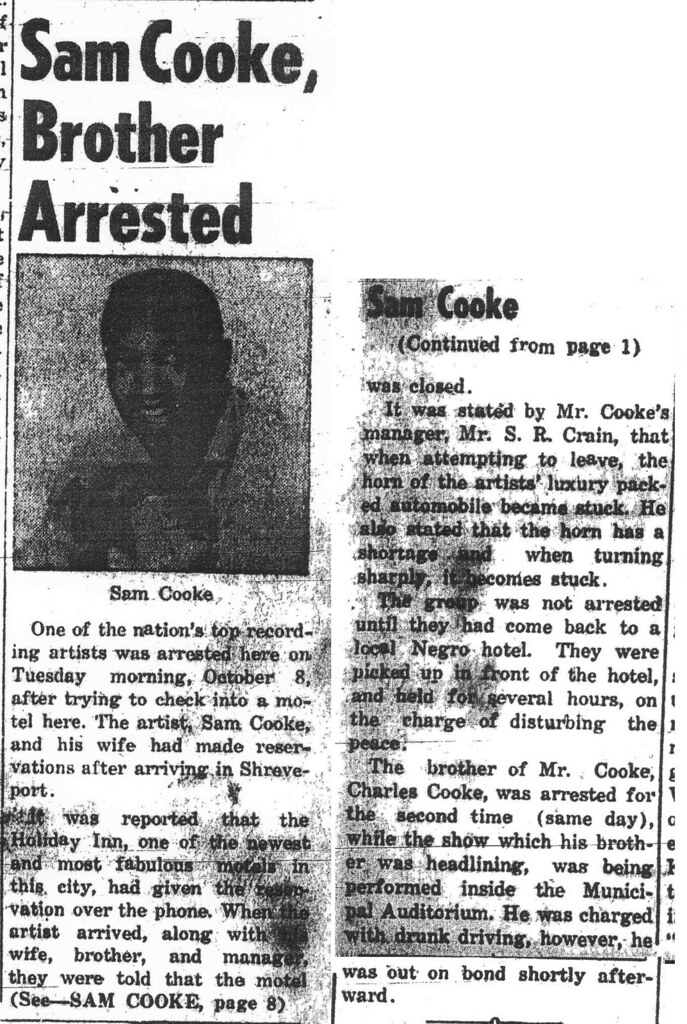
The b-side to a latter-day single in his career, Cooke was moved to write and record it, late 1963 into 1964, after an incident where he had been turned away from a whites only motel in Shreveport, Louisiana. A Holiday Inn. Despite being, arguably, a previously light-weight lyricist, perfect for the pop-soul that endeared him to a largely white audience, he had also been stung by Bob Dylan's emergence, social conscience a'blazing, so he seized the moment. ("Blowin' in the Wind" was a staple in Cooke's live set.) His producers, inevitably warned against the risks of alienating his fans, hence it's appearance on the flip of "Shake." No, me neither. Both "Shake" and the album both the songs appeared on, "Ain't That Good News", actually his last, sold modestly by Cooke's standards. But that has been dwarfed by the legacy and life of the song, voted number 12 in Rolling Stone's 500 Greatest Songs of All Time, as well as being selected for posterity within the Library of Congress, as being "culturally, historically or aesthetically important." All three, say I. But I am ahead of myself. Cooke actually only once played the song live, on TV, the Johnny Carson Tonight show. (I couldn't find any recording thereof to link, sadly.) It was then a full 10 months before the single was ready for release, which eventually took place, over a year after recording, in late December 1964. That release date was already planned, when Cooke was shot dead at another motel, this time in Los Angeles. Colour code uncertain.

There are myriad covers. Although maybe more the metier of the estimable Cover Me Songs, here are my favourite five.


For me, the song that makes The Band's 1973 album, "Moondog Matinee," an essential, the combination of Richard Manuel's keening vocal and the arrangement transformed from the orchestral splendour of the original to simple affecting sublimity.


Another radical revision of the arrangement, Herbie Hancock playing his jazz piano around, behind, on top of a conventional soul vocal version, englishman, James Morrison, the two morphing together just right. But only just.


An astonishing and the possibly OTT extravaganza that was Baby Huey. Just euphoric. Makes me, a middle aged white man, channel James Brown. Convincingly. (Maybe.)


Uncertain still whether this works, cello and the never-less-soul man Ben Sollee. On balance, it does.


Finally, an instrumental mix of all the styles shown above. And more. Bill Frisell, an alchemist of electric guitar, able to run with any genre and leave it resolutely unclassifiable beyond exquisite.

What a song, what a tune. Let it give confidence for the changes that will come. After all, it is all in the ear of the beholder.

Anyhow, don't get upset about the what if of politics, go here, cheer yourself up with some Sam.

Friday, August 26, 2016

Music Festivals: Newport Folk Festival 2012-Dawes


Dawes: A Little Bit of Everything (Live from Newport 2012)
[purchase the album that this song is on]

I have written about the trip that my wife and I took to the Newport Folk Festival back in 2012 a few times. It was our first time there, and it was a great experience, despite the fact that we got rained on both days. At a festival often identified with Bob Dylan, it was fitting that a hard rain did fall, and we unsuccessfully sought shelter from the storm, as we waited for our ship to come in and take us back to our hotel.

But I haven’t written about the moment at the festival that I remember most strongly. It was not a pleasant moment, and I’m willing to bet that my wife will be surprised when she reads this.

I’ve been a lawyer for a long time, and for a while before our Newport trip, I had not been happy at my job. Despite that, I stuck through it, because the pay wasn’t bad, and I had settled into somewhat of a rut—sort of like the one that Nick Lowe wrote about in “Rocky Road” (“The rut I was in had once been a groove”). By the time we went to Newport, the end was in sight, and I was looking for a new gig. I actually spent a good portion of my post-festival Newport vacation reviewing deposition transcripts using the Panera Bread’s free wi-fi (which was better than the hotel’s) for a summary judgment motion to try to stay in the senior partner’s good graces, to keep the paychecks coming in. I did a good job, I think, and I ended up creating a 45 page statement of undisputed facts from my Newport work. We lost the motion, and the trial (which I helped prepare for, but which took place as I was basically out the door.) So, as we were enjoying our time in Newport, I was very uneasy, because I didn’t know how long I would be staying at the firm, and had no alternatives, other than the risk of starting my own law practice.

One of the bands that I was excited to see at the festival was Dawes, a band that seems to have recently evolved into essentially the Newport Festival house band—supporting other musicians who don’t always travel with backup musicians, and often having other performers sit in with them. In fact, that is one big way that Newport differs from the other festival that we have gone to (and which I have written about), the hopefully-returning-in-2017 Clearwater Great Hudson River Revival. Although it does happen at Clearwater (seeing Jason Isbell and Patterson Hood sit in during each other’s solo set was a highlight, and there are other examples), it seems like more of a regular thing at Newport for people to play with each other. This adds a feeling of camaraderie and friendship to the music, and you get to hear interesting, often unique, combinations (like this great version of The Band’s “It Makes No Difference” by My Morning Jacket, with Brittany Howard of Alabama Shakes, from the 2012 festival, that I missed waiting for a ferry to get us out of the rain).

Dawes’ sound is often compared to the Laurel Canyon sound of the 1970s—CSNY, Joni Mitchell, The Byrds, etc., with a bit of Band thrown it. And I also have to believe that they also were influenced by the Uncle Tupelo/Wilco/Son Volt/Jayhawks alt-country sound and artists like Ryan Adams. In keeping with their debt to the great confessional singer-songwriters, their lyrics often plumb emotional topics, which is certainly true about one of my favorite Dawes songs, “A Little Bit of Everything.” The song has three vignettes: the first, focusing on a man planning to jump from a bridge, not for any one reason, but for an accumulation of things, the second about an older man in a buffet line, musing over his life’s disappointments while deciding what to eat, and the third features a woman writing invitations to her wedding, and explaining to her fiancé why she was working so apparently humorlessly on the wedding planning. As the song’s writer, Taylor Goldsmith, explained in an interview, “each verse would provide the phrase with new meaning. In the first verse, it’s used to describe why life’s unlivable, in the second, what it takes to forget, and finally, what matters most about love.”

So, I’m sitting there, watching Dawes, getting toward the end of a great first Newport day, very much enjoying their set, when they launch into “A Little Bit of Everything,” in the version you can hear above. And the next thing I know, tears are streaming down my face. Was I identifying with the suicidal guy who was feeling overwhelmed? With the old guy at the buffet thinking about “when his bright future had left him”? Or the woman who reassured her fiancé about the power of finding the person you truly love? Clearly, it was a little bit of everything, but it affected me so profoundly.

I recovered, though, both at the festival, where we went on to see Amy Helm, Patty Griffin and the beginning of My Morning Jacket before we evacuated, but also professionally. I played out the string at my old job, and in March of 2013, I opened up my own practice. It hasn’t been easy, and there have been struggles, but I’ve learned an enormous amount and have never enjoyed being a lawyer as much.

That all being said, I still get emotional when I hear this song, which, I guess, shows that Mr. Goldsmith knows what he is doing.

Saturday, January 23, 2016

Beginnings: Brand New Day


Purchase: Brand New Day

While certainly not his finest hour as a lyricist, Van Morrison’s Brand New Day, from Moondance (the album every one you know has in their collection), fits the bill for our theme this month. It’s a simple song, both hopeful and soulful. The mellow groove is pure Van Morrison blue eyed soul, with his lush and plaintive vocal styles, wavering piano and guitar lines and gospel chorus. Van Morrison crosses genres with grace—balladeer, soulster, mystic poet, party hound. Brand New Day is a small blip in the catalog he’s created, but it’s a beautiful song, in its own sense. The man himself explains the origins of Brand New Day as:

"Brand New Day" expressed a lot of hope. I was in Boston and having a hard job getting myself up spiritually...Then one day this song came on the FM station and it had this particular feeling and this particular groove and it was totally fresh. It seemed to me like things were making sense....I didn't know who the hell the artist was. It turned out to be The Band. I looked up at the sky and the sun started to shine and all of a sudden the song just came through my head. I started to write it down, right from "When all the dark clouds roll away…” (Wikipedia)

What song do you think it was? Have to be The Weight? Perhaps I Shall be Released?


For good measure, we should also mention Morrison’s Into the Mystic, itself a soulful meditation on a new beginning of sorts, magical and supernatural, and of heading into new and unknown places, concerning love and other delights…

Happy New Year to all our readers—I hope history proves 2016 to be a far better year than all the doomsayers are predicting. Starting out a year with forecasts of our guaranteed destruction before the next one begins gives me all the more reason to listen to good music and try to see the brighter side of sun. Harmony!

Tuesday, September 16, 2014

Royal -> Songs Under 3 Minutes: The Weight


Aretha Franklin (w/ Duane Allman): The Weight
[purchase]

When I heard about this theme, I thought that I might try to write about some of the shortest songs in my library, but none of these songlets inspired me. So I decided to look at songs that just made the cut—the songs that clocked in at 2:59. I had a surprising number of these, and decided to see if any of them jumped out at me as a potential topic. That’s one of the great things about writing for Star Maker Machine—our bi-weekly themes force me to reexamine my music library, and often I uncover songs that I haven’t listened to in a while, or other hidden gems. Today’s song is one of them, and it makes a nice transition from our Royal theme, too.

The original version of this great, but enigmatic, song was 4:34, and the fine cover by Diana Ross and the Supremes (and the Temptations) was exactly 3:00. The Staples Singers’ well-known version was also 4:34, so it doesn’t work. But there is another version, one that was performed by the Queen of Soul, Aretha Franklin, with Duane Allman on slide guitar, that is exactly 2:59. Bingo. It is a damn good version, which some believe is even better than the classic original, and that’s a tall order. I’m embarrassed to say that despite the fact that I have a copy of it, I was essentially unaware of it. By the way, “The Weight” has been covered many times, by many different artists (here’s an article from my other blogging home, but not by me, featuring five good ones).

Also, being a Band song, there is an ongoing dispute about who should have gotten credit for the song—it is officially credited only to Robbie Robertson. Levon Helm, who ended up disliking his bandmate just a bit (One quote from Helm on Robertson: “I hate the motherfucker. “I’d kick his ass if I can get to him. He’s a thieving, lying son of a bitch.”) has stated that the lyrics were 60% Robertson, Richard Manuel and Rick Danko about 20% each, and 5 or 10% for Helm (proving that Levon was a better musician than mathematician), and that Garth Hudson should have gotten some credit for the music. Whoever wrote the lyrics, their symbolism has been subject to a great deal of discussion over the years, and here are only a few examples of attempts to explain them.

Aretha’s 1970 album, This Girl’s In Love With You, from whence the featured song comes, was recorded at a difficult time for Franklin, both personally (her marriage had recently ended) and professionally. The album is filled with covers of pop songs, including two Beatles songs, in an apparent attempt at crossover success. Half of the album was recorded in Miami, where she often was late to sessions because she was in her suite at the Fontainebleau Hotel cooking soul food, and the other half was recorded in Muscle Shoals, Alabama’s legendary FAME Studio, where she had initially established her reputation. Many reviewers dismiss the disc as a mishmash and uninspired.

At the time that Franklin was recording part of the album in Alabama, Duane Allman, who had been playing with, among others, his brother Gregg, in the Allman Joys and Hour Glass, and who had cut some demos with Gregg and future Allman Brother Butch Trucks, as The 31st of February, was working as a studio musician at the FAME Studios. He either was invited by owner Rick Hall, or just showed up looking for work, but either way, he was put to work on a number of songs, including a great, Grammy Award winning instrumental cover of Joe South’s “Games People Play,” with King Curtis on sax. His unmistakable slide guitar part meshes well with Franklin’s vocals on “The Weight,” which, not surprisingly, skew toward a religious, gospel interpretation of the song, that may not actually be there (the Nazareth in the song, for example, is actually in Pennsylvania). Also backing Franklin on the track was the great Muscle Shoals rhythm section, Roger Hawkins, Jimmy Johnson, Barry Beckett, and David Hood, known as The Swampers (later memorialized by Lynyrd Skynrd in “Sweet Home Alabama”). For more background, check out this fine documentary about Muscle Shoals.

In reviewing This Girl’s In Love With You, critic Robert Christgau wrote: “I admit that when she sings "The Weight" it sounds as if she knows what it means. But I still don't.” On the other hand, album producer Jerry Wexler had second thoughts about the song, later stating that despite the fact that the song charted on both the R&B and Hot 100 charts, “I regret having submitted that song to her. . . . this is where commercial stupidity and greed got the upper hand in me.”

But the great thing about music, or art of any kind, for that matter, is that each audience member gets to decide whether you think something is great, trash, or something in between. I know what I think about this song, and I suspect that after listening to it, you will agree with me and Christgau, and not Wexler.

Tuesday, December 10, 2013

Holiday (Modern): Christmas Must Be Tonight


The Band: Christmas Must Be Tonight
[purchase]

So many “modern” original holiday songs are arch or ironic, or are novelties or are overly treacly. To my mind, it is easy to tire of these types of songs, and since the holiday season comes up every year, I appreciate songs with staying power.

I make no bones about the fact that I’m an atheist, and I have discussed here and elsewhere that I was raised Jewish, so it might be surprising that I picked this song to write about. It is a simple, beautiful, low key song with a strong Christian message. Not only that, but I’m willing to bet that no member of my family—who have listened to holiday music with me over the past quarter century plus—would guess that I’d pick this song to write about.

I’m not sure if I should admit to this in public, in a blog where I purport to opine about music, but when I listen to music, lyrics are not as important to me as the overall feel of the song. I suspect that some of that comes from the fact that with many rock songs, you can’t actually understand the lyrics, and when you do, often they are less than stellar. I mean, is “Louie, Louie,” less amazing because the lyrics are impenetrable? And I know that “Stairway to Heaven” still rocks, despite the fact that it exhorts me not to be alarmed by the bustle in my hedgerow, because it is just a spring clean for the May queen. And what exactly is an American aquarium drinker, anyway, Mr. Tweedy? Which is not to say that I don’t appreciate a good lyric, which adds to my enjoyment of pretty much any Richard Thompson or Bruce Springsteen song. Just a few weeks ago, when my son and I saw Lucero, I was struck for the first time by one of Ben Nichols’ lyrics—“It was Texas, it was Tennessee/It was exes and some wannabes.” Not deep, but clever and fun.

Maybe what I like about “Christmas Must Be Tonight,” is that it just sounds like a good Band song. Written by Robbie Robertson with lead vocals by Rick Danko backed by Levon Helm and featuring Garth Hudson’s organ, it works on its own. Robertson wrote it after the birth of his son Sebastian, and it can’t be a coincidence that the song describes how a little baby boy could “bring the people so much joy.” He intended it to be a Christmas single in 1975, but the record company wasn’t interested, so it languished until the Islands album, a collection of unreleased songs and outtakes. When The Band was good, their music had a timelessness to it, and this song fits that mold, with a gravitas that never crosses the line to overly reverent (although I have seen it referred to on another blog as “kitsch.” But what do bloggers know, anyway?). There is a “rehearsal” version that was later released as a bonus track to the Northern Lights, Southern Cross album which is faster and rocks more, and is missing the organ part. It is ordinary. (Robertson also recorded a version for the movie Scrooged with himself on vocals and a synth driven backing track that is really disappointing.)

The Band never performed the song live, but Danko, who coincidentally died 14 years ago today, did at some solo shows, and based on a few versions I’ve heard on the Internet, he played it well. But there is still something about the original version that strikes a chord, and if it doesn’t pop up on my iPod during the holidays, I make sure to throw it on my computer so that I hear it a few times.

Sunday, October 28, 2012

Disasters: The Night They Drove Old Dixie Down


The Band: The Night They Drove Old Dixie Down (YouTube Video link)
[purchase the '69 album @ Amazon]

How about this saying: One man’s misfortune is another man’s gain. Agree?

I got started on this train of thought (no pun initially intended) on account of my choice for a “Disaster” song. Although my current formal US residence is in the Northwest, I spent a fair amount of time in Greensboro, NC. There, I imbibed a certain amount of Dixie air, where no small number of US citizen fly the Confederate flag to this day. As Robbie Robertson (of The Band) remarked: there is a pain, a sadness there [to this day, about the loss to the North].

Robertson says he had the music in his mind, and from there did extensive research about the events he relates in the song. The South had all but lost the war, and Vergil Caine is telling us about the hardships of re-supplying the Confederate army by train in “the winter of ‘65”. Suffering? Certainly. Disaster? Depends on your point of view. For General Robert E. Lee, despite his defeat, it could have been a lot worse: he is still revered as a great American – curiously, even in the North, despite his “treason”. For countless landholders (and young men) of the South, the war and defeat spelled disaster that has not been forgotten or forgiven to this day.
In this YouTube video, we've got drummer Levon Helm doing the lead vocals. As you ought to know, we lost him to cancer this past spring of 2012. Knowing that he grew up in the South, I can't help but wonder if it didn't play at least some role in the strength and conviction behind his rendition of the song.


Thursday, October 21, 2010

Call Me: Operator Edition


Bob Dylan & The Band: Long Distance Operator

[purchase]

Jim Croce: Operator (That's Not the Way it Feels)

[purchase]

Roman Reese: Come in Operator

[purchase]

Bert's post got me thinking about the now obsolete job of the telephone operator.  Odds are that my daughter, who is now three months old will never have the experience of picking up a phone and simply dialing the switchboard operator for assistance with making a call.  Heck, I'm 32, and I don't think I've ever done it either.

My grandfather worked 30 years for AT&T.  When he started working for the phone company, the switchboard operator was an absolutely essential piece of the puzzle.  Now his great-granddaughter will likely have no idea the job ever existed.  Maybe he can tell her about it someday.

The first two songs here are fairly classic.  The third is a more recent track from former Knoxvillian (now in the DC area) Roman Reese about a more metaphorical phone call.  In it, the singer is sending up a prayer, and God is working the switchboard.

Thursday, July 29, 2010

You First: You Ain't Goin' Nowhere


Bob Dylan & The Band: You Ain't Goin' Nowhere

[purchase]

Bob Dylan (with Happy Traum): You Ain't Goin' Nowhere

[purchase]

Nitty Gritty Dirt Band (with Roger McGuinn and Chris Hillman): You Ain't Going Nowhere

[purchase]

Shawn Colvin, Mary Chapin Carpenter, and Roseanne Cash: You Ain't Goin' Nowhere

[purchase]

Cracker (with Adam Duritz and Joan Osborne): You Ain't Going Nowhere

[purchase]

Folks who know me well know that my current favorite pastime is sitting around with other musicians playing and singing songs. In the past few years, I've found several groups of people to play with on a regular or semi-regular basis. With every group, I've brought this old Dylan song. Some people know it, some don't, but it always goes over well. It's easy to play (just three chords), fun to sing, and offers plenty of room for solos.

Dylan first recorded it with what became the Band during his 1967 Woodstock time-out, but the first released version was by the Byrds, who countrified it for their groundbreaking Sweetheart of the Rodeo the following year. Bob's version was eventually released on The Basement Tapes in 1975, but before that, he recorded a radically different version with Happy Traum on banjo for his Greatest Hits, Vol. 2 album (complete with a dig at Roger McGuinn for messing up the lyrics on the Byrds' version).

Since then, the song has been covered by many, and it's usually the Byrds' version that's followed, and that's the template used by The Nitty Gritty Dirt Band (with Byrds Roger McGuinn and Chris Hillman), Cracker (with Adam Duritz and Joan Osborne) and the trio of Shawn Colvin, Mary Chapin Carpenter, and Roseanne Cash.