


























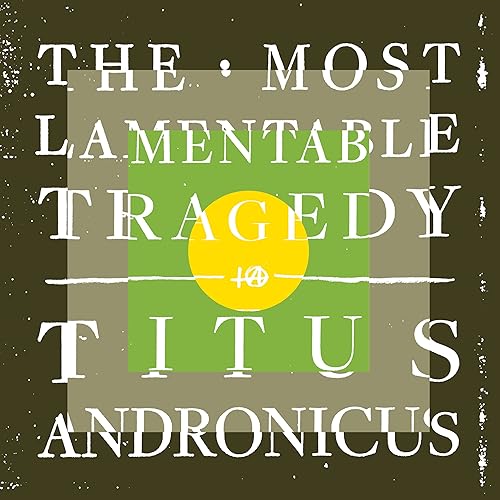
Titus Andronicus: The Void (Filler)
[purchase]
Titus Andronicus is a frustrating band. (Shakespeare’s Titus Andronicus, a play that I’ve never seen, is also supposed to be pretty frustrating, and for years was considered to be his worst play. But, as it always seems to happen, it appears that this appraisal has changed. End of gratuitous Shakespeare section). They’re frustrating because they have incredibly grand ambitions, but don’t always live up to them. Because some of their music is really great, and some of it is headscratching. Because the band’s leader, Patrick Stickles, can be incredibly open and interesting when interviewed, but sometimes comes off as difficult. Although he suffers from various mental health issues, which may explain some or all of this. And, by some reports, sometimes their live shows are great, and others stink.
And I need to admit that part of my frustration is that I recognize that Titus Andronicus is a band that requires the kind of attention that I haven’t really been able to focus on music since maybe college.
Back when I was in high school, it was not uncommon for bands to create “rock operas” or albums that had some sort of overarching narrative. Some of these were and are considered classics, and others were considered silly or pretentious or indecipherable. As punk music began to gain notice, one of the things that you heard regularly was that the simple, stripped down music was a reaction to the excesses of classic rock and prog, and all of the hifalutin’ pretense, particularly the rock opera and its ilk.
Eventually, though, punks succumbed to the artistic temptation of trying to create a song cycle with a narrative, and the stories that were told often rivaled the prog masters for incomprehensibility. Although the music was, generally, more concise.
It probably came as no surprise to fans of Titus Andronicus, though, a band that fused punk with large helpings of Springsteen-esqe rock, that Sickles would attempt his own rock opera. As a Civil War buff of sorts, I first became aware of the band in 2010 when they released The Monitor, which used themes from the Civil War to reflect Stickles’ emotional issues. And some of the music really was thrilling. Their next album, Local Business, was more straight-ahead rock, but for 2015’s The Most Lamentable Tragedy, Stickels created a rock opera lasting more than an hour and half, on the topics of mental health and neurodiversity. As Spin explained,
the rock opera’s plot is roughly as follows: A manic-depressive young man meets a lookalike who shows him, through pharmacology and/or religious awakening, a better way of life. He meets and falls for a girl, but has become drug-dependent and experiences a breakdown. He nearly ends it all, but learns at the last second that life is worth trudging through. It’s basically impossible to track the story just by listening — Stickles’ guttural spitting makes many tracks indecipherable — but Quadrophenia and American Idiot were hardly coherent original screenplays, either.
And have you ever read the liner notes to The Lamb Lies Down on Broadway?
The music is also diverse; while most of it skews punkward, there are also electronic/noise interludes, poppy songs, some clear Springsteen homages, fiddle-heavy Celtic rock, and a version of “Auld Lang Syne.” And it was reviewed in The New York Times.
Toward the end, is “Into the Void (Filler),” a hard rocker with more than a little bit of Bob Mould/Hüsker Dü influence. I’ve read the lyrics and I’m frankly not at all sure about what it means, but if it is part of a piece about mental illness, maybe it not a surprise that it is hard to decipher. I still don’t know, though, whether the “Filler” in the title refers to filling the titular void, or that the song is filler, but I don’t think so, because it's pretty good (although I've never seen it mentioned in any of the reviews I read in preparing this piece).
I saw Titus Andronicus in 2013 at Terminal 5 in New York with my son, where they were the second act on a bill with The Menzingers opening and Lucero closing. I was excited to see Lucero for the first time since 2006 and to hear Titus Andronicus, but had never heard of The Menzingers. I think that Terminal 5 had really crappy sound, so the loud fast dense sound of Titus Andronicus was hard to listen to or understand (and looking at the setlist now, it appears they played a few songs from the not yet released The Most Lamentable Tragedy). Lucero was fine, although not as good as the first time, although it was maybe because of the bad sound. The Menzingers, though, made a good impression.


