










Monday, April 22, 2019
What?!: So What
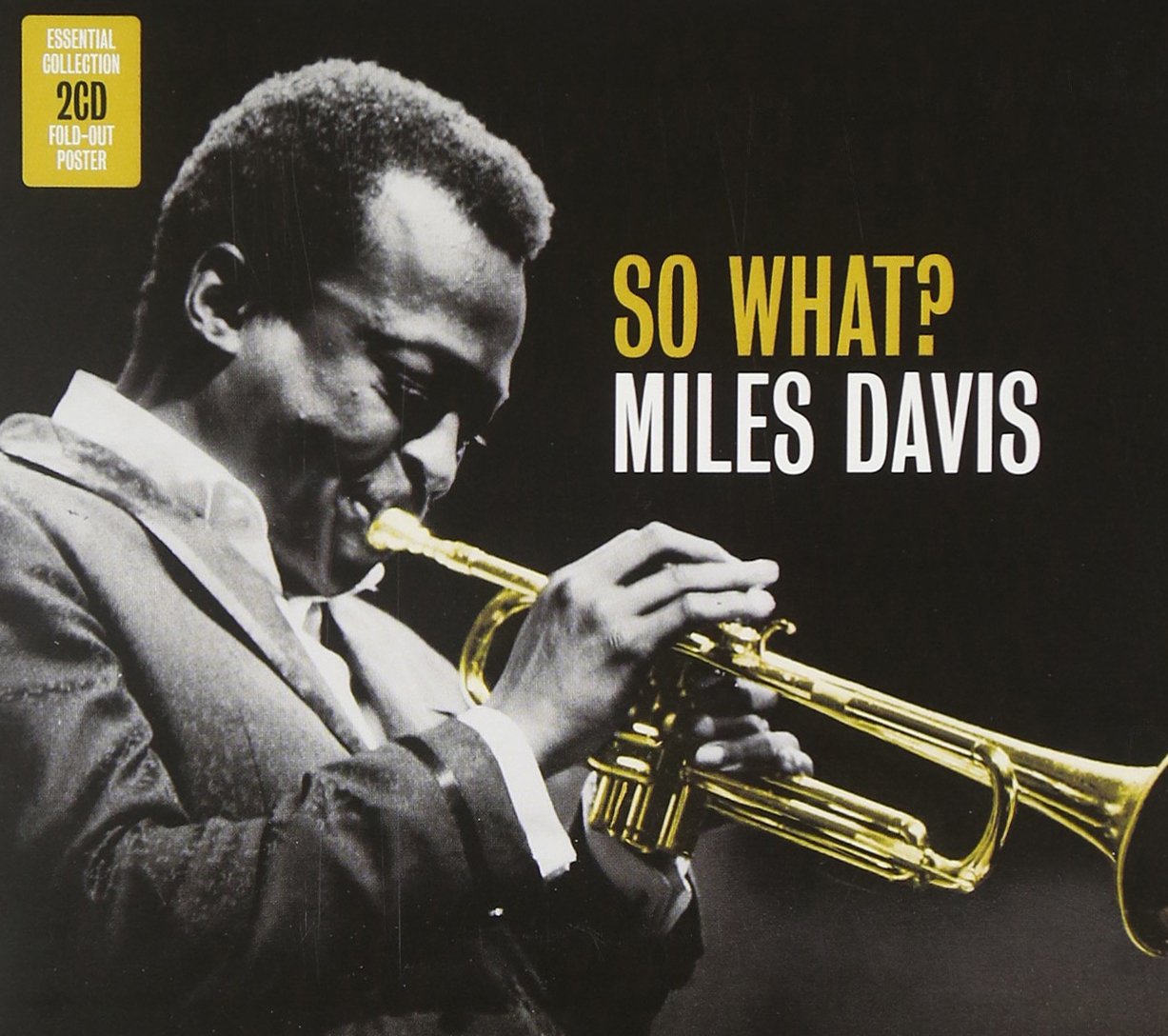
Miles Davis: So What
[purchase]
I’m pretty sure that I’ve lamented here at some point that I’m not a musician, and don’t really have the knowledge or vocabulary to analyze music, which is why most of my writing about music is some combination of historical discussion, memories tied to the music and personal opinions about what I like and what I don’t like. For someone who purports to opine about music for an audience, it is a real flaw, but as you can see, from the nearly 100 pieces that I’ve written here, plus the ones elsewhere, I haven’t let this stop me.
So, when I read that Miles Davis’ album, 1959’s Kind of Blue was important because it showed Davis was moving from hard bop to a modal approach, I’m really not sure what that means. But, I know what I like, and the music on Kind of Blue is incredible, even if I can’t really explain why. The fact that it is, by many accounts, the greatest selling jazz album of all time, and to some, the greatest jazz album of all time, tells me that I’m not the only one who likes it. Plus, I’m willing to bet that most of the purchasers couldn’t explain the difference between hard bop and modal.
The first song on the album, “So What,” may well be Davis’ most well-known song (although there appears to be some thinking that Gil Evans wrote the introduction). The title reportedly came from actor Dennis Hopper’s response to Davis’ intellectual musings.
The playing by Davis and the other members of his sextet, a veritable Jazz Hall of Fame consisting of saxophonists John Coltrane and Julian "Cannonball" Adderley, pianist Bill Evans, bassist Paul Chambers, and drummer Jimmy Cobb, is amazing. But let me quote someone who knows what he is talking about, Richard Cook, author of It’s About That Time: Miles Davis On and Off Record and former editor of Jazz Review:
The mystery of the piece is its air of elusive, almost secretive possibility. One feels that the solos could go anywhere, could follow any path, could drift on without stopping, and not feel ‘wrong’. It is a definition piece of jazz, if one identifies that music as something played by intuition and living on its instincts. For once, there seems to be no contrast in the solos played by Davis, Coltrane and Adderley: they move seamlessly together, as if each man were playing his part in a predetermined plan. Evans’s accompaniments are handsomely shaded, although one has to strain to follow him: the ear is drawn irresistibly to the horns and what they are saying. On his own solo, which features some surprisingly dissonant voicings that he plays on the bridge, the horns riff behind him. In the end, the music drifts back towards Chambers and his ostinato melody, Jimmy Cobb ticking impassively at his ride cymbal, Evans playing the so-what tag, and the entire piece fading away into silence.
Interestingly, when they played the song live, they played it faster, which I think detracts from some of that mystery, but does show off the musicians’ chops.
By the time I saw Miles Davis, in 1985, he had long passed the point that his music had the kind of influence that it had back when Kind of Blue was released, and for some time after. But he was playing to large crowds, including at the Pier on Manhattan’s West Side where I saw him (with Stanley Jordan, just a few years out of college at that point, opening). What I remember most about that concert (other than being amazed that Stanley was opening for Miles Davis), was that Davis’ band was incredible, that he spent much of the show playing with his back to the audience, and that occasionally, his playing was pretty remarkable.
Posted by Jordan Becker at 8:00 AM View Comments
Labels: Bill Evans, Cannonball Adderley, Gil Evans, john coltrane, Miles Davis, Miles Davis Sextet, Stanley Jordan, What?!
Monday, October 8, 2018
Leaves: Autumn Leaves
Cannonball Adderley: Autumn Leaves
[purchase]
During this theme, there has already been a mention of “the elephant in the room.” To me, the phrase refers to an obvious choice that everyone is ignoring. Indeed, it sometimes seems to me that one of our themes is more difficult than it needs to be, because everyone is rejecting a song as too obvious, My rule is that the first song that comes to mind is first for a reason: its quality. So here is my post of Autumn Leaves.
I know the song as a jazz standard. Cannonball Adderley’s version was released in 1958, one of three versions that year that established the song as a jazz classic. The passionate playing here of especially Miles Davis and Adderley show why. Although the song would become one of Davis’ signature tunes, available in at least four different live versions dating from 1958 to 1966, this is the only studio version of it that Davis made. Davis introduces the song, and his soloing stays close to the melody. This allows Adderley to make his entrance soloing, without restating the melody at all. So this version becomes a showcase for Adderley, which would explain why it is on his album, not Davis’. But make sure to listen all the way through to this one, for Hank Jones’ startling second solo near the end.
Yves Montand: Les Feuilles Mortes
[purchase]
In researching this post, I discovered something I never knew: Autumn Leaves has words! In fact, it has two sets of words, in French and English. The French lyric is the original. It started life as a poem, Les Feuilles Mortes by Jacques Prevert, and it was set to music by a Hungarian, Joseph Kosma. Yves Montand was the first to record it, in 1945. The French poem is quite different from the English lyric. Here is one translation I found:
Oh I would like you so much to remember/ The joyful days when we were friends./ At that time, life was more beautiful/ And the sun burned more than it does today.Fallen leaves can be picked up by the shovelful/ You see, I have not forgotten…/ Fallen leaves can be picked up by the shovelful,/ So can memories and regrets./ And the north wind takes them/ Into the cold night of oblivion.
You see, I have not forgotten/ The song you used to sing me./ This song is like us./ You used to love me and I used to love you/ And we used to live together/ You loving me, me loving you./ But life separates lovers,/ Pretty slowly, noiselessly,/ And the sea erases on the sand/ The separated lovers’ footprints
Karrin Allyson: Autumn Leaves
[purchase]
Karrin Allyson’s Autumn Leaves is the only version I could find sung in both languages. Allyson takes the French lyrics in the original tempo, and then switches to double time for the English lyrics. At both speeds, she finds all of the emotional power of the song. The English lyric is almost a new song. Johnny Mercer wrote it in 1950, and his wife at the time, Jo Stafford, was the first to sing it. There is, in my mind, no good name for the musical genre that Stafford worked in. I have heard it called “Standards”, but that term can refer to any song that is performed by multiple artists. I have also heard it called “pop music”, but again the term has broader application. At any rate, I am referring to the musical genre where the singer performs with a full orchestra, and the arranger is just as important as the singer. Frank Sinatra and Nat King Cole are examples of artists in this genre, and both would record their own versions of Autumn Leaves. Whatever this genre should be called, it is one of my least favorites, which is why I did not include Jo Stafford’s Autumn Leaves in this post.
Paula Cole: Autumn Leaves
[purchase]
In the jazz world, there are two ways to perform Autumn Leaves, fast and slow. Karrin Allyson does both, but I wanted to conclude with a great slow sung version, and Paula Cole of all people nails this one. Actually, the choice of Cole for this one makes more sense than I expected. I knew Paula Cole as a major label artist who had sung with Peter Gabriel and then had solo hits with Where Have All the Cowboys Gone? and I Don’t Wanna Wait. But it turns out that Cole was jazz singer before any of that happened. She records on her own label these days, using Kickstarter for funding, and her most recent album, Ballads, marks a return to her roots.
Posted by Darius at 4:22 AM View Comments
Labels: Cannonball Adderley, Karrin Allyson, Leaves, Miles Davis, Paula Cole, Yves Montand
Friday, January 14, 2011
Sleepsongs: A Sleepin’ Bee
Nancy Wilson and Cannonball Adderley: A Sleepin‘ Bee
[purchase]
Hey, did you know that Truman Capote wrote a musical? It’s true. It was called House of Flowers. The music was by Harold Arlen. The show debuted in December of 1954, with Pearl Bailey as the established star, and Diahann Carroll the up and coming star in the cast. Even with all that talent involved though, the show was a flop. So why even mention it?
The reason is that the songs survived and thrived. In particular, A Sleepin’ Bee became a standard, recorded by many jazz singers to this day. This version by Nancy Wilson and Cannonball Adderley is a fine example of why the song survives. The song has both tender and playful aspects. Some singers perform it as a ballad, but this swinging version is closer to the tempo in the original version from the show.
Posted by Darius at 3:18 AM View Comments
Labels: Cannonball Adderley, Nancy Wilson, Sleepsongs
Friday, November 19, 2010
Other People’s Songs: Mercy Mercy Mercy
Cannonball Adderley: Mercy Mercy Mercy
[purchase]
Joe Zawinul started his recording career as a bandleader in 1959, but he was soon working as a sideman. By 1966, Zawinul had been with Cannonball Adderley for five years. That was when he wrote Mercy Mercy Mercy. This was the rare jazz song to hit the pop charts, peaking at #11. Zawinul was a pioneer in the use of electronic keyboards in jazz; in this case, it is the electric piano.
The song became a jazz standard. But something else happened as well. The song acquired words somewhere, and was recorded by such artists as The Buckinghams and, later, Phillip Bailey of Earth Wind & Fire. Queen Latifah recorded a version with a different set of lyrics. And finally, Joe Zawinul, coming off a highly successful tenure in Weather Report, recorded a version as a leader, also with vocals. But, for me and many others, the original recording of Mercy Mercy Mercy will always be the real one.
Posted by Darius at 2:05 AM View Comments
Labels: Cannonball Adderley, Other People's Songs
Thursday, March 25, 2010
After Midnight: Green Door
Cannonball Adderley with Ernie Andrews : Green Door
[purchase]
I usually tell my mother-in-law about our new theme every week. She often has suggestions for songs, and I almost never take them. But we have fun with it. She has a remarkable memory for hit songs from the late 50s and early 60s, songs she often has barely heard since then. This is one of those, sort of.
Green Door was a #1 hit for Jim Lowe in 1956. His version, in the way it is performed, is a plea from an innocent teen who wonders about a party at a club he isn’t old enough to enter. But I went looking to see who might have covered it. It turns out that the song has become a signature tune for Chrystal Gayle. There are also versions by Shakin’ Stevens and The Cramps. But I was most intrigued by this jazz version by the great Cannonball Adderley, with Ernie Andrews. In these hands, the song depicts a man who doesn’t have the password to enter a speakeasy. Not a word of the lyrics has been changed, but Adderley and Andrews have given the song a completely new meaning just because of how they perform it. This flexibility probably explains why the song endures.
Cannonball Adderley was one of the best known jazzmen of the 1950s. Ernie Andrews is not nearly so well known, but he is still at it.
I hope I may be permitted a brief moment of self-promotion. If you enjoy this music, you should know that I just launched jazz singers week on my blog, Oliver di Place.
Posted by Darius at 2:27 AM View Comments
Labels: After Midnight, Cannonball Adderley, Ernie Andrews
Monday, September 14, 2009
Autumn and Harvest: Autumn Leaves
Posted by Ramone666 at 4:26 PM View Comments
Labels: Autumn and Harvest, Cannonball Adderley, Johnny Mercer

