












Monday, April 22, 2019
What?!: So What
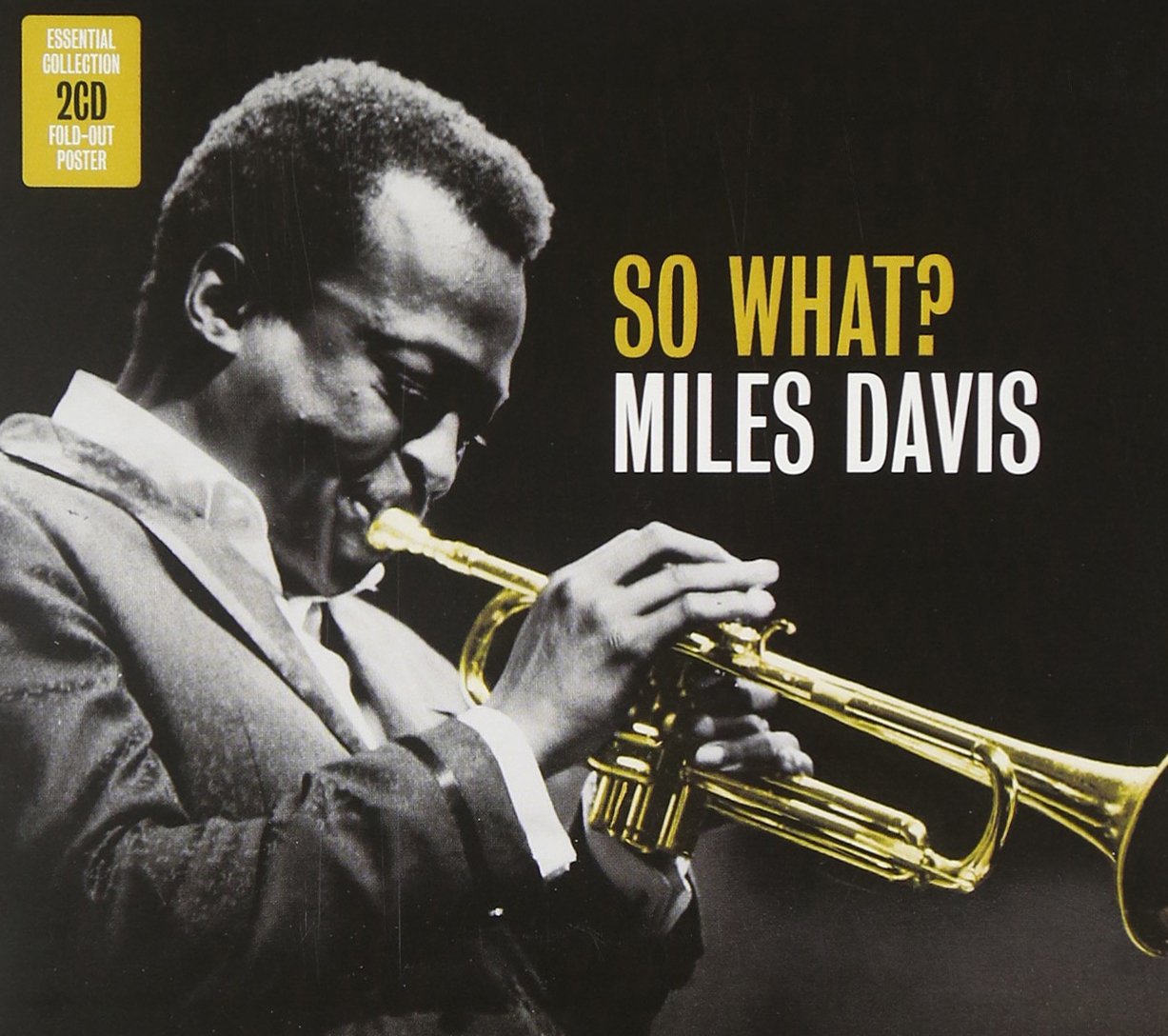
Miles Davis: So What
[purchase]
I’m pretty sure that I’ve lamented here at some point that I’m not a musician, and don’t really have the knowledge or vocabulary to analyze music, which is why most of my writing about music is some combination of historical discussion, memories tied to the music and personal opinions about what I like and what I don’t like. For someone who purports to opine about music for an audience, it is a real flaw, but as you can see, from the nearly 100 pieces that I’ve written here, plus the ones elsewhere, I haven’t let this stop me.
So, when I read that Miles Davis’ album, 1959’s Kind of Blue was important because it showed Davis was moving from hard bop to a modal approach, I’m really not sure what that means. But, I know what I like, and the music on Kind of Blue is incredible, even if I can’t really explain why. The fact that it is, by many accounts, the greatest selling jazz album of all time, and to some, the greatest jazz album of all time, tells me that I’m not the only one who likes it. Plus, I’m willing to bet that most of the purchasers couldn’t explain the difference between hard bop and modal.
The first song on the album, “So What,” may well be Davis’ most well-known song (although there appears to be some thinking that Gil Evans wrote the introduction). The title reportedly came from actor Dennis Hopper’s response to Davis’ intellectual musings.
The playing by Davis and the other members of his sextet, a veritable Jazz Hall of Fame consisting of saxophonists John Coltrane and Julian "Cannonball" Adderley, pianist Bill Evans, bassist Paul Chambers, and drummer Jimmy Cobb, is amazing. But let me quote someone who knows what he is talking about, Richard Cook, author of It’s About That Time: Miles Davis On and Off Record and former editor of Jazz Review:
The mystery of the piece is its air of elusive, almost secretive possibility. One feels that the solos could go anywhere, could follow any path, could drift on without stopping, and not feel ‘wrong’. It is a definition piece of jazz, if one identifies that music as something played by intuition and living on its instincts. For once, there seems to be no contrast in the solos played by Davis, Coltrane and Adderley: they move seamlessly together, as if each man were playing his part in a predetermined plan. Evans’s accompaniments are handsomely shaded, although one has to strain to follow him: the ear is drawn irresistibly to the horns and what they are saying. On his own solo, which features some surprisingly dissonant voicings that he plays on the bridge, the horns riff behind him. In the end, the music drifts back towards Chambers and his ostinato melody, Jimmy Cobb ticking impassively at his ride cymbal, Evans playing the so-what tag, and the entire piece fading away into silence.
Interestingly, when they played the song live, they played it faster, which I think detracts from some of that mystery, but does show off the musicians’ chops.
By the time I saw Miles Davis, in 1985, he had long passed the point that his music had the kind of influence that it had back when Kind of Blue was released, and for some time after. But he was playing to large crowds, including at the Pier on Manhattan’s West Side where I saw him (with Stanley Jordan, just a few years out of college at that point, opening). What I remember most about that concert (other than being amazed that Stanley was opening for Miles Davis), was that Davis’ band was incredible, that he spent much of the show playing with his back to the audience, and that occasionally, his playing was pretty remarkable.
Posted by Jordan Becker at 8:00 AM View Comments
Labels: Bill Evans, Cannonball Adderley, Gil Evans, john coltrane, Miles Davis, Miles Davis Sextet, Stanley Jordan, What?!
Friday, July 26, 2013
MUSICAL HOMONYMS: ALL OR NOTHING AT ALL
This was always going to be a tough assignment. I mean, let's be honest, we could all do "Hallelujah" or "Angel", and some may curse me as I write that, but SMM is all about digging a tad deeper. (Crosses fingers that the Boss won't take umbrage at my new boy, relative, gaucheness.) So, rather than "All or Nothing", cos you all know that, how's a bit of classic jazz and a bit of classic rock'n'roll, 80s style, and add the "At All."
Purchase (single track)
No introduction for the 'Trane. Bit of a latecomer to bebop me, as it all seemed atonal yet samey to my rockist ears, until I came to an epiphany. Stuff all this earnest head nodding, fingers a clicking in eyes-shut reverie. Jazz. Is. Dance. Music. That's right. Throw your head back and your arms out. Smile. Daaaance. (I'm struggling to convince my girlfriend of this, but bear with me. Try it!) When it suddenly kicks in, it will all be understood. Problem solved. I love it. This, from 1962, is wonderful, from the drum intro, percussive piano, then suddenly, marvelously, the horn. I'm weaving in my seat, on my chair, as this glides all over and around me.Join me? Of course there are lashings of other versions, with vocals, of this tune, with both Frank Sinatra and Diana Krall coming closest to mind, with my bestest singer, Mr Chet Baker, not far behind.. They're good, but why embellish the unnecessary?
Purchase (whole Lp, but well worth the investment!!)
You couldn't get much different than with Mr Crenshaw, an out and out classic rock 'n' roller with hints of Buddy Holly about his stylisations. Always tastefully tunesome, somehow a shame he has always seemed somewhat of an also run, at least perhaps thus avoiding the overkill of mass acclaim. I like him and this is a good example of his style. However, in just the same way that the Coltrane is a cover, or "standard" as that genre will have it, so too this is not of Crenshaw's pen, but being a mid period, E Street Band on leave, Springsteen, from "Human Touch" (And pedants will cite there is no g at the end of "Nothin", but I am nothin' if not too well brought up to ignore such a criticism, not least as I have only realised this point at this stage, 3 paras down. Live with it. Sue me. Either way, it's great.)
Posted by Seuras Og at 2:18 PM View Comments
Labels: All or Nothing at All, john coltrane, Marshall Crenshaw, Musical Homonyms
Friday, March 9, 2012
Goodbye: Everytime We Say Goodbye
Posted by Ramone666 at 4:50 AM View Comments
Labels: Cole Porter, Goodbye, john coltrane, Miles Davis
Wednesday, January 25, 2012
Standards: My One and Only Love
John Coltrane and Johnny Hartman: My One and Only Love
[purchase
So, what is a ‘standard’ anyway? The temptation is to see the term as defining that special type of popular song that has, through no real fault of its own, managed to move beyond mere ubiquity into the realms of cliché. Ask a cross-section of people to name a standard and the songs mentioned would be telling – My Way, perhaps, or Unforgettable. My Baby Just Cares For Me. That type of thing.
The only trouble there, of course, is that these songs aren’t standards. We equate them with a particular artist, but would be hard pressed to name a version of the song recorded by anyone other than that person. To an extent, they become cabaret fodder, or the purview of lazy impressionists in need of some kind of shorthand with which to telegraph to an equally lazy audience who it is they are trying to pastiche.
My One and Only Love, on the other hand, is a true standard having been recorded by a huge number of artists despite never exactly achieving the type of fame that can so effectively rob a song of all its power. This version comes from John Coltrane and Johnny Hartman’s self-titled 1963 masterpiece, and words can’t do it justice. Suffice it to say that if you are unfamiliar with Hartman this recording will make you wonder how it’s possible that a singer of such warmth and emotional range could possibly be so comparatively little-known. As for Trane – well, the avant-garde’s gain was certainly lyrical jazz’s loss: this was the only vocal album he would ever record as band leader, and that seems a damn shame.
Guest post by Houman
Posted by Darius at 8:48 PM View Comments
Labels: john coltrane, Johnny Hartman, Standards
Tuesday, January 10, 2012
All That Jazz: Jazz Saxophone Version
Sadao Watanabe: Turning Pages of Wind
[purchase]
Stan Getz : Desafinado
[purchase]
Sonny Rollins : God Bless the Child
[purchase]
John Coltrane : Giant Steps
[purchase]
Such a hard choice this time around, deciding what to leave out…I had to go with four, 'cuz three wasn't going to be nearly enough. But even though I go to more live performances of jazz guitarists, I myself played jazz sax back in the day, so I've got a ton of favorites to pick from.
First off is a song I used to play by Japanese saxophone giant, Sadao Watanabe. He's a bit of a hybrid, in a way, since he grew popular during the rise of smooth jazz (which in some circles is a sort of curse word). And yes, some of his stuff is pretty, well, smooth. On the other hand, he's no Kenny G: for example, he came out with a great album of Charlie Parker tunes in the 80's that's well worth buying. The song I'm sharing's got two other great talents as well in keyboardist Dave Grusin and guitarist Lee Ritenour (I knew I could sneak them in). It's from 1978's California Shower.
Next is another from my (very limited) repertoire. It's Stan Getz with a cover of Antonio Carlos Jobim's Desafinado, released in 1962, and it helped propagate the bossa nova enthusiasm in America. It features Charlie Byrd on guitar.
Sonny Rollins and guitarist Jim Hall together create an expressive cover of Billie Holiday's God Bless the Child from his best album, The Bridge, also released in 1962.
Finally, and probably best, is the sax legend unto himself: the great John Coltrane. Picking just one song was hardest of all. I nearly went with Naima, which is probably my favorite song, but I thought his 1960 classic, Giant Steps, might demonstrate what made his style unique.
I mourn that I can't share other favorite sax players like Cannonball Adderley, Gato Barbieri, Paul Desmond, Dexter Gordon, Eddie Harris, Charles Lloyd, Charlie Parker, Art Pepper, Houston Person, Dewey Redman and his son Joshua Redman, David Sanborn, Wayne Shorter, Zoot Sims, Grover Washington, Jr., or Sonny Stitt.
Posted by Geoviki at 9:37 PM View Comments
Labels: All That Jazz, john coltrane, Sadao Watanabe, Sonny Rollins, Stan Getz
Tuesday, July 19, 2011
Drums: Pursuance
The John Coltrane Quartet: Pursuance (Part 3 of A Love Supreme)
[purchase]
I may be coming to this week's theme the wrong way round. I suspect that the rest of the SMM gang will first think of a song with a striking drum part; instead, I'm checking out some of my favorite drummers and looking for songs where they really shine. And for me, the shiniest drummers are found in jazz.
Elvin Jones played on a bunch of jazz albums you've probably heard, or heard of. His lengthy recording career (from the 40's to this century; he died in 2004) saw him backing major artists such as Miles Davis, Stan Getz, Art Farmer, Sonny Rollins, Kenny Burrell, Yusef Lateef, Freddy Hubbard, Grant Green, Ornette Coleman, John McLaughlin, Dewey Redman, Bill Frisell…well, you get the idea. But one of his greatest periods was during his 5 year stint with tenor saxophonist John Coltrane. The Quartet also featured McCoy Tyner on piano and Jimmy Garrison on bass.
A Love Supreme is one of the best examples of modal jazz, a free-form style pioneered by Miles Davis and John Coltrane in the late 50's and 60's. This four-part suite, released in 1965, is widely considered to be one of the best jazz recordings ever. Part 3 begins with a 90 second solo by Jones and demonstrates his polyrhythmic style, which is why I chose this track, but I encourage you to listen to the entire album, which was powerful and spiritual enough to launch the St. John Will-I-Am Coltrane African Orthodox Church of San Francisco.
Posted by Geoviki at 11:32 PM View Comments
Labels: Drums, Elvin Jones, john coltrane
Tuesday, May 17, 2011
Show Tunes: My Favorite Things

John Coltrane: My Favorite Things
Posted by Ramone666 at 3:27 PM View Comments
Labels: john coltrane, McCoy Tyner, Show Tunes
Friday, August 27, 2010
Torch Songs: You Don't Know What Love Is
image by Roy Lichtenstein, 1963
Karrin Allyson: You Don't Know What Love Is
[purchase]
John Coltrane: You Don't Know What Love Is
[purchase]
You don't know what love is
'Til you’ve learned the meaning of the blues,
Until you’ve loved a love you've had to lose,
You don't know what love is.
Here's a classic jazz torch song from the Great American Songbook. But who torches it better? Gal, guy, or… Well, can you have a torch song without lyrics? I think so.
Representing for the women is Karrin Allyson, from her 2001 Grammy-nominated album, Ballads: A Tribute to John Coltrane. A nice, church-going girl from Kansas, she skipped around the midwest before settling in New York City and releasing 12 albums (and counting).
Saving the best for last, we have a classic take by John Coltrane (yet another heroin addict, but one who kicked his habit after several firings by Miles Davis, another—you guessed it—reformed addict. The smack-filled 50s were especially hard on jazz musicians). From 1962's Ballads, a gem of an album if you like your Coltrane mellow. That's McCoy Tyner on piano, Jimmy Garrison on bass, and Elvin Jones on drums. This version has my vote. If you don't think that listening to Coltrane is a religious experience, maybe you should visit San Francisco and check out a service at the Saint John Coltrane African Orthodox Church. From their website I learned that the weekly service features "the Coltrane Liturgy, which combines the Divine Liturgy of the African Orthodox Church and the Twenty-third Psalm, with the melodies, harmonies, and rhythms of Saint John Coltrane's masterpiece: A Love Supreme."
Posted by Geoviki at 4:58 PM View Comments
Labels: john coltrane, Karrin Allyson, Torch Songs
Friday, March 27, 2009
Record Labels: Blue Note

Blue Note Records is one of the preeminent labels in jazz history, known mainly for its hard bop, a style which combines bebop with elements of soul and R&B. Blue Note recording artists include Lee Morgan, Jimmy Smith, Art Blakey, John Coltrane, Thelonious Monk, Herbie Hancock, Eric Dolphy, Dexter Gordon, Horace Silver, and Donald Byrd.
As great as the music was, Blue Note is perhaps equally lauded for its contribution to the graphic arts. Cover artist Reid Miles developed a distinctive style that used black and white photographs with limited color palettes to great effect. There simply aren't any cooler album covers. See more here and here. Now enjoy some music. I know jazz isn't the usual fare around here, but this stuff is pretty good. Give it a listen.
Art Blakey & The Jazz Messengers: Moanin' [purchase]
John Coltrane: Lazy Bird [purchase]
Jimmy Smith: Back At The Chicken Shack [purchase]
For one more great Blue Note track, head over to my main blog.
Posted by Paul at 7:36 PM View Comments
Labels: Art Blakey, Jimmy Smith, john coltrane, Record Labels
Monday, September 8, 2008
Johns: John Coltrane
John Coltrane My Favorite Things
[purchase]
John Coltrane's music runs the spectrum from relatively straight-up jazz to the wildest free-jazz that you're likely to ever hear. The wilder stuff came toward the end of his career (and life) and it has been both praised and vilified. His earlier, more traditional, recordings are universally praised. My Favorite Things falls somewhere in the middle, probably leaning toward the more traditional side. Not being an expert on Jazz, I find this whole record to be eminently listen-to-able, musical, and lyrical. It's a beautiful piece of work.
Posted by bwrice at 1:17 PM View Comments
Labels: john coltrane, johns


