A last minute entry for the What?! theme from Amy Winehouse ... It was set for scheduling but didnt work as planned.
Where, who & what ...Winehouse could have been in another life?
The song is - she once said- about her parents' breakup when she was ~ 10. It's worth considering the longer term effects, n'est-ce pas? ...
Compare the lyrics of my previous [ Beatles] post --- and they're miles apart. The '60 Beatles repeat and repeat. Winehouse evolves a story.
You might learn some Spanish in the clip above by following along below:
[updated edit: my bad - that's not Spanish is it?!? I ought to know better - Portuguese]
Understand, once he was a family man
So surely I would never, ever go through it first hand
Emulate all the shit my mother hated
I can't help but demonstrate my Freudian fate
My alibi for taking your guy
History repeats itself, it fails to die
And animal aggression is my downfall
I don't care 'bout what you got, I want it all
It's bricked up in my head, it's shoved under my bed
And I question myself again, "What is it about men?"
My destructive side has grown a mile wide
And I question myself again, "What is it about men? What is it about men?"
I'm nurturing, I just wanna do my thing
And I'll take the wrong man as naturally as I sing
And I'll save my tears for uncovering my fears
Our behavioral patters that stick over the years
I beg you to look at how Winehouse wraps the lyrics around the music in a way that few ever could. You wouldn't think that words and notes would roll that way, but she makes it possible through her emotionally timed pauses/delays.
Aaah .. the Beatles. Or is it Ahhh ... the Beatles (How does one convey the proper inflection online?)
I confess: I will be a Beatles fan forever. Older stuff, later stuff ... they had the magic.
Sure ... their music is kind of basic, but basic/less can be more (if you get it right)
The lyrics for this ditty (a lot of their early stuff was one-step-removed from ditties) are typically repetitive:
What goes on in your heart?
What goes on in your mind?
You are tearing me apart
When you treat me so unkind
What goes on in your mind?
I think they were the first "band" I ever heard. Rather innocently. Probably hard not to have heard of them at that point in time - but I was maybe 10, so it didn't mean an awful lot. Certainly not as much as it means now with a deeper perspective.
And then, about 15-20 years ago, I happened across the freely distributed Beatles Ukelele project. Which sadly turned not-so-free after a few years. And which I have brought up here before.
I think I also recently brought up the fact that I once appeared on stage with a short-lived ensemble called the Beatless. (Sorry: those were VHS days - me, far left in shorts)
I’m pretty sure that I’ve lamented here at some point that I’m not a musician, and don’t really have the knowledge or vocabulary to analyze music, which is why most of my writing about music is some combination of historical discussion, memories tied to the music and personal opinions about what I like and what I don’t like. For someone who purports to opine about music for an audience, it is a real flaw, but as you can see, from the nearly 100 pieces that I’ve written here, plus the ones elsewhere, I haven’t let this stop me.
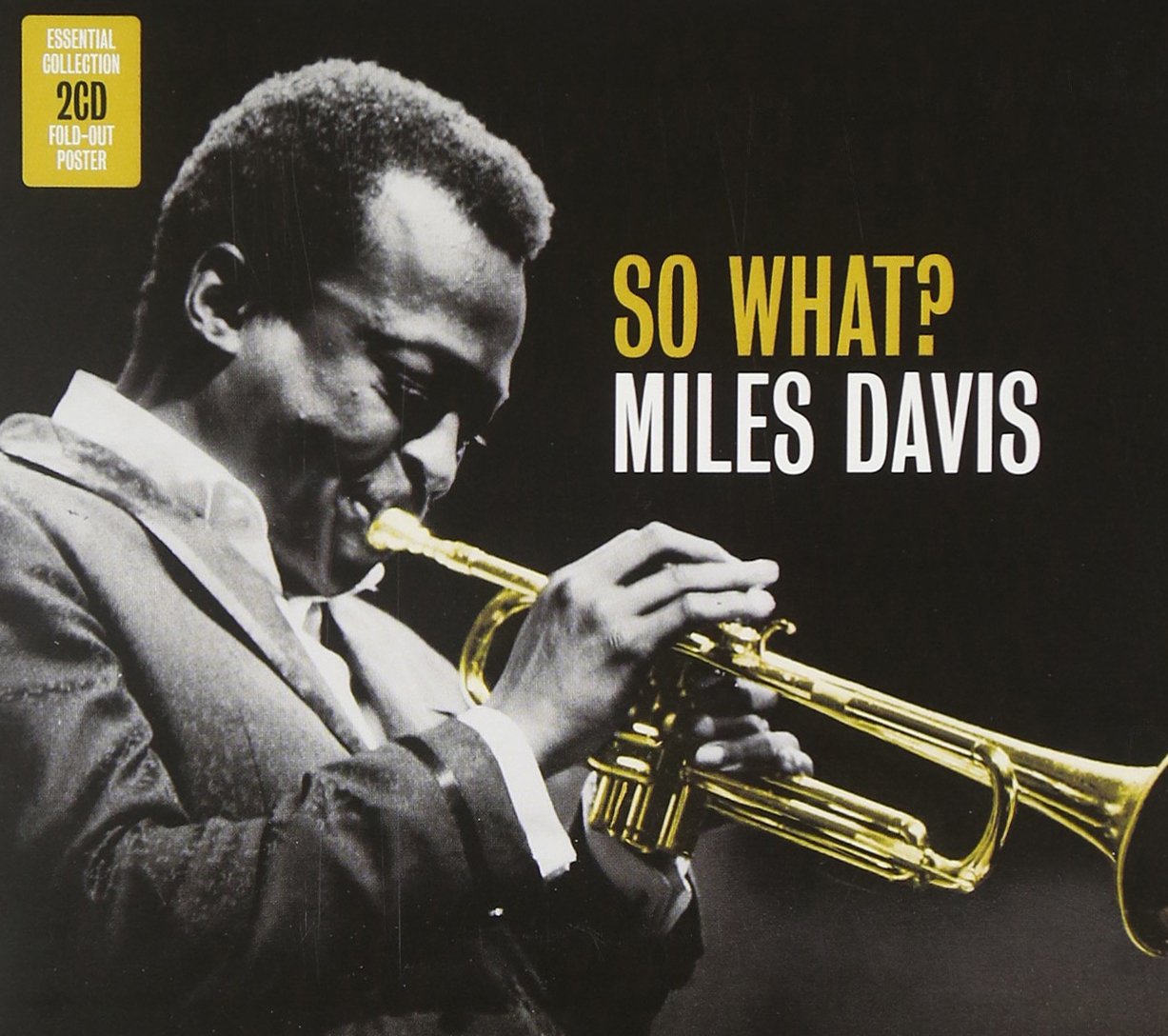
So, when I read that Miles Davis’ album, 1959’s Kind of Blue was important because it showed Davis was moving from hard bop to a modal approach, I’m really not sure what that means. But, I know what I like, and the music on Kind of Blue is incredible, even if I can’t really explain why. The fact that it is, by many accounts, the greatest selling jazz album of all time, and to some, the greatest jazz album of all time, tells me that I’m not the only one who likes it. Plus, I’m willing to bet that most of the purchasers couldn’t explain the difference between hard bop and modal.
The first song on the album, “So What,” may well be Davis’ most well-known song (although there appears to be some thinking that Gil Evans wrote the introduction). The title reportedly came from actor Dennis Hopper’s response to Davis’ intellectual musings.
The playing by Davis and the other members of his sextet, a veritable Jazz Hall of Fame consisting of saxophonists John Coltrane and Julian "Cannonball" Adderley, pianist Bill Evans, bassist Paul Chambers, and drummer Jimmy Cobb, is amazing. But let me quote someone who knows what he is talking about, Richard Cook, author of It’s About That Time: Miles Davis On and Off Record and former editor of Jazz Review:
The mystery of the piece is its air of elusive, almost secretive possibility. One feels that the solos could go anywhere, could follow any path, could drift on without stopping, and not feel ‘wrong’. It is a definition piece of jazz, if one identifies that music as something played by intuition and living on its instincts. For once, there seems to be no contrast in the solos played by Davis, Coltrane and Adderley: they move seamlessly together, as if each man were playing his part in a predetermined plan. Evans’s accompaniments are handsomely shaded, although one has to strain to follow him: the ear is drawn irresistibly to the horns and what they are saying. On his own solo, which features some surprisingly dissonant voicings that he plays on the bridge, the horns riff behind him. In the end, the music drifts back towards Chambers and his ostinato melody, Jimmy Cobb ticking impassively at his ride cymbal, Evans playing the so-what tag, and the entire piece fading away into silence.
Interestingly, when they played the song live, they played it faster, which I think detracts from some of that mystery, but does show off the musicians’ chops.
By the time I saw Miles Davis, in 1985, he had long passed the point that his music had the kind of influence that it had back when Kind of Blue was released, and for some time after. But he was playing to large crowds, including at the Pier on Manhattan’s West Side where I saw him (with Stanley Jordan, just a few years out of college at that point, opening). What I remember most about that concert (other than being amazed that Stanley was opening for Miles Davis), was that Davis’ band was incredible, that he spent much of the show playing with his back to the audience, and that occasionally, his playing was pretty remarkable.
And so I move, seamlessly, from one Soft Machine alumnus to another, from Robert Wyatt to Kevin Ayers, together the rhythm section in the original line-up. Kevin is no longer with us, my buddy J.David penning some words at the time of his demise, but he is a fella that gave me great teenaged pleasure, with his uber-cool image, his prog credentials, so important to me at that time, but mainly, through his gloriously quirky and quixotic songs, often exhilaratingly bonkers, as indeed is this. Duck call percussion?
I came to Ayers a little behind the loop, via the teenage prodigy he had earlier hired on bass for his band, The Whole Wide World, one Mike Oldfield. Soft Machine were too clever and a bit old for me, but Tubular Bells was a sensation for me, upon its 1973 release, introducing me to any number of connections, as I perused the back story and looked at the names of his address book, mustered together for the live performances. Whilst I don't think Ayers was involved in the latter, I was particularly taken with his peculiarly english style of singing, espousing the usual transatlantic twang, then and now still so prevalent. It reminded me of another very english vocalist, early Pink Floyd focal piece and front man, Syd Barrett, exemplarised in this later solo track.
What I didn't know was that 'O Wot a Dream' was actually about Barrett, and that, after Barrett's lysergic exit from Pink Floyd, the two actually performed together on the above clip, 'Singing a Song in the Morning (Religious Experience)', the compelling guitar calisthenic being performed by Barrett, I have to say somewhat against the myth around his having entirely lost it. Still, the record company still saw fit to cut the end coda from the original cut, it taking until a re-release for it to see light of day. In this brief interview, a looking seriously out of it Ayers mentions the relationship at the very end of the clip, about 5.25.
As arguably an ill-fitting tribute to both, here is a poor quality recording of a less than 100% Ayers performing 'O Wot a Dream' at a 2007 Syd Barrett memorial concert. I think I probably prefer the duck call on the studio version to the jaw's harp. Finally, in case any might wonder, why the spelling, wy the wot, if you will? Personally I think this just adds to the overall anglocentricism of the song, but, who knows, maybe it was to avoid any confusion with this.
Wikipedia tells us that Crosby's 1971 first solo album <If Only I Could Remember My Name> was selected for the Vatican's top pop 10 albums of all time list. What? David Crosby? The Vatican?
Said Crosby: It baffles me as much as it baffles you, man.
If Only I Could Remember My Name came on the heels of Deja Vu and was Crosby's solo album that coincided with the solo albums from each of the rest of CSNY.
The album seems rather raw to me. Others have labeled it as experimental. That is certainly true of this piece: the lyrics don't even kick in until the song is more or less finished, and up until that point, we listen to what I would call a rather wandering guitar. Very much <a la Jerry Garcia/Grateful Dead>. No surprise then to learn that Garcia helped to arrange and produce the album.
A news article in a recent Guardian noted that 1 percent of Brits own virtually all the land in the country. Although Crosby was probably more focused on the US, this song rifs on that theme.
What are their names? What do they care about you? About the state of the world beyond their wealth? What does their "charity" mean for the future of the planet (like rebuilding Notre Dame)?
The entire lyrics aren't long and the "choir" singing it includes most of the Airplane, the Dead, Joni Mitchell and CSNY
I wonder who they are
The men who really run this land
And I wonder why they run it
With such a thoughtless hand
What are their names
And on what streets do they live
I'd like to ride right over
This afternoon and give
Them a piece of my mind
About peace for mankind
Peace is not an awful lot to ask
Sometimes, when there’s a theme with almost limitless possibilities, the best course is to jump on the first song that jumps into your head. If that were the case here, I’d be writing about The Buzzcocks’ “I Don’t Know What To Do With My Life.” But I’m not (yet, at least). My second thought was “(What’s So Funny) ‘Bout Peace Love and Understanding,” since I heard Nick Lowe sing that live the other day. But I have already written about that song in detail at Cover Me. (Did you know that Cover Me has a Patreon site? Check it out!)
Scrolling through the official J. David iTunes library (yes, I still have one. And an aol.com email address. Proves I’m an early adopter), I came across a bunch of possibilities, but stopped cold when I came to “Be Thankful For What You Got.” You know, that great, smooth, 1970s soul song, with the memorable line, “Diamond in the back / sunroof top / digging the scene with a gangster lean," sung by….by….Curtis Mayfield? Nope. The singer is William DeVaughn, who wrote the song, originally as “A Cadillac Don’t Come Easy,” while working full-time as a government draftsman. Luckily, he changed the title, or I couldn’t be writing about it here.
DeVaughn took the song to Omega Sound in Philadelphia, maybe a step above a vanity studio, and paid $900 of his own hard-earned money to record it. Omega Sound, however, had connections with members of the MFSB group of studio musicians, who backed up many great acts, including Harold Melvin & the Blue Notes, the O’Jays, the Stylistics, the Spinners, Wilson Pickett, and Billy Paul, and had hits on their own, notably “TSOP (The Sound of Philadelphia).” MFSB sax player John Davis liked the song, suggested a jazzy, smooth, soulful arrangement, booked Sigma Sound Studios and enlisted some of his fellow MFSB members to play on the track.
DeVaughn, a Jehovah’s Witness, had a couple of minor hits after “Be Thankful,” but appears to have not fully committed to a music career. Which is a shame, because he has a great voice, and could really write a song.
I absolutely loathe this song. Or at least in the iteration it is best known, the version that ruined weeks and weeks and weeks of my childhood, spoiling my Top of the Pops viewing by being number one forever, or seeming to be. Louis bloody Armstrong, gurning away to the camera, all grimaces and duff notes, perpetually mopping his brow. How could anyone sweat that much? And as for the "woahhhhh yeaaaaaah" at the end. Dreadful, and still able to bring me out in hives. Now, don't get me wrong, I was probably about 10 years old, how was I to know that this buffoon was one of the seminal voices of jazz, albeit via a trumpet than his frayed vocal cords? I know all that now and respect the dude but still cannot allow myself much to like him. (And don't get me started on 'Hello Dolly'........)
But you know, it isn't actually a bad song. Or at least is capable of being made into quite a good song. There have been very many covers, many of which are clearly tributes to the original and, broadly, unnecessary. Then there are the standard make-overs in the idiom of the day. And others that are just downright odd. As in, what were they thinking? (I think a look in the eyes of the performers might just answer that question.)
But here are trio that, I believe, pass muster.
You could say this is just another idiom of the day offering, but you will have to understand the amount of love I have for this venerable performer, the sadly late Rico Rodriguez. This pillar of reggae trombone delighted me for many of his decades of activity in music. I probably first came across him on, again, Top of the Pops, he always present, alongside sidekick Dick Cuthell, on flugelhorn, whenever the Specials had a song in the chart. I later understood he had been an original in the early days of ska and reggae, in Jamaica, associated with the Skatalites, ahead of becoming an occasional member of Georgie Fame's Blue Flames in the 60s. His latter days were spent as a focal member of Jools Holland's Rhythm and Blues Orchestra, his solo spots always getting fond applause, even if eventually did little other than hold his trombone and sing a little. (Come to think of it, were I to witness, as a 10 year old, these performances, him as a grey bearded ancient, I wonder too whether I would have a similar opinion as I do now of Satchmo?)
Mac Rebennack, aka Dr. John is a serious fan of Armstrong and his legacy, producing a whole album in tribute to him. And it is a corker, start to finish, all tempered with the loose N'Awlins swing for which Rebennack is rightly lauded. This version also featured the Blind Boys of Alabama, vocal staples of a gospel and r'n'b sensibility since the cusp of the 40s. Having started off as a session man, a member of the fabled Wrecking Crew, Dr John invented himself as voodoo shaman, the Night Tripper, in 1968. However, he has perhaps become now more associated as a custodian and standard bearer for the musical pot-pourri that is his home city, often working with other vintage names from the heritage of New Orleans. His live shows remain a thing of wonder.
Finally I offer the majesty that is the vocal of Robert Wyatt. I apologise for each of my three choices having grey and grizzled beards; such now is the territory of musical iconography. Wyatt is another with a long lineage harking back into the 60s, initially as the drummer for proto-jazz-proggers Soft Machine and then his own band, Matching Mole. Following a terrible accident, in which he broke his back, he has become an elder statesman of a politically-hued brand of often unclassifiable blends of jazz, latin and all else available, both on his own and in any number of collaborations. And the odd hit single. This version of the song is the closing track on a wonderful 3 hander, alongside saxman, Gilad Atzmon and violinist Ros Stephen. This distils all the kitsch out of Armstrong's version, leaving a lighter sweetness that doesn't cloy on repeated. I love it.
Star Maker Machine does not accept music submissions from artists or promoters. However, most of the contributors here do accept submissions for our own blogs, listed below. Please visit our blogs, take the time to listen to what we post, and then feel free to contact us if you feel that your music would be a good fit.



























:format(jpeg):mode_rgb():quality(90)/discogs-images/R-565354-1431434503-5333.jpeg.jpg)


