












Thursday, January 9, 2020
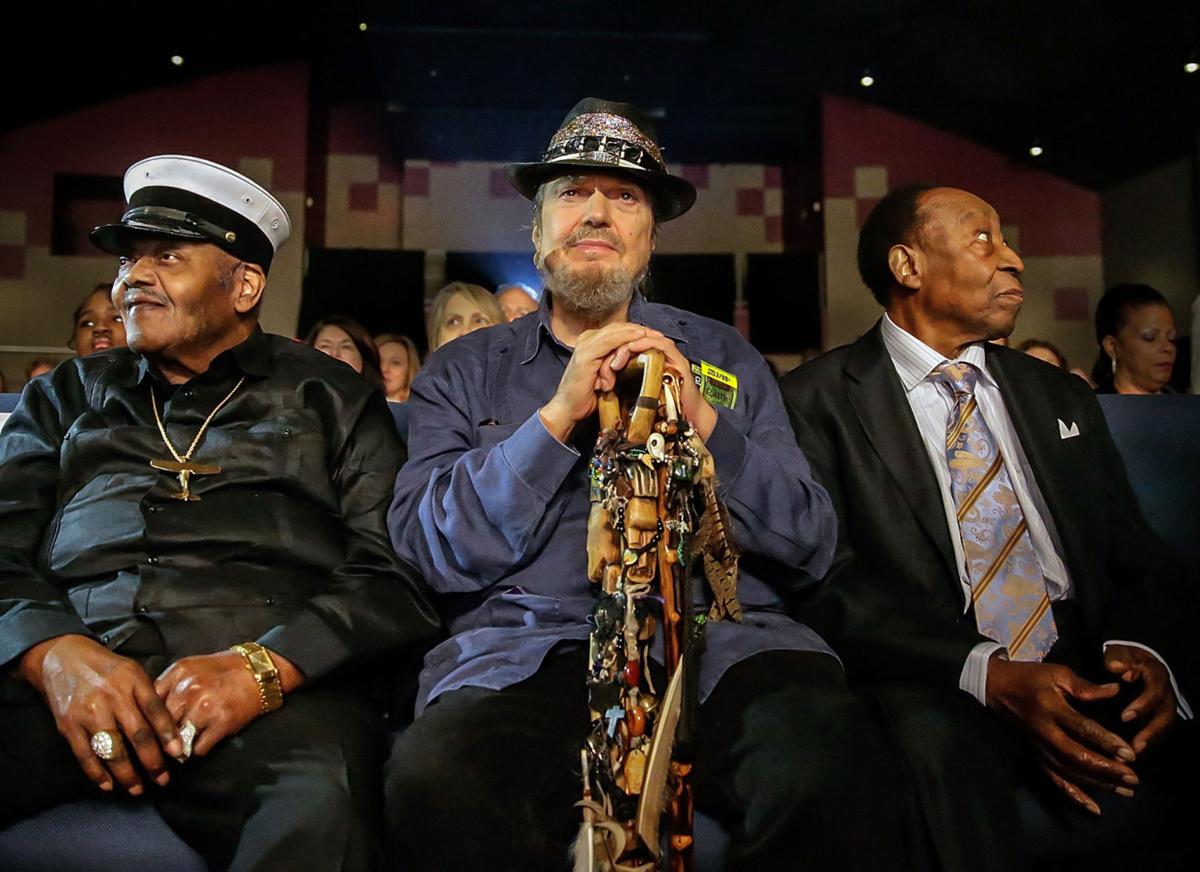
In Memoriam: Three New Orleans Icons
Fats Domino: The Fat Man
[purchase]
Despite Nashville’s self-proclaimed title as Music City, I think that New Orleans might have a stronger claim to the title (although Nashville certainly has a fair argument, and New Orleans already has some pretty good nicknames). I’ve written before about my interest and limited expertise in the area of New Orleans music, but it is fair to say that there are few places where so many types of music have developed and cross-pollinated over the years, and where music is so interwoven into the fabric of the city.
One of the reasons for this was Dave Bartholomew, who died on June 23, 2019 at the age of 100. Bartholomew rarely recorded under his own name, but instead was a trumpeter, composer, bandleader, arranger, and producer who, it could be argued, helped create both rhythm and blues and rock music. After an early career as a trumpeter and bandleader, Bartholomew connected with Fats Domino, and their co-written song, “The Fat Man,” kickstarted Domino’s career. Together, they had 65 singles on the Billboard pop chart from 1955 to 1964, including “Ain’t That A Shame,” “I’m Walkin’” and “Walkin’ to New Orleans.” Bartholomew also wrote or co-wrote "My Ding-a-Ling,” which was a hit for Chuck Berry, “I Hear You Knocking,” for Smiley Lewis, and produced Lloyd Price's recording of “Lawdy Miss Clawdy.” Among many, many others. And many of his songs were covered by artists including Elton John, Paul McCartney, the Rolling Stones, Hank Williams Jr., Elvis Presley, Dave Edmunds, and Cheap Trick. He was also name-checked by Elvis Costello in his song “Monkey to Man.”
Bartholomew remained active into his 80s, and in 2011, appeared in his first rap video –“Born in the Country,” a collaboration with his son, New Orleans hip-hop producer Don B, and grandson, rapper Supa Dezzy.
Dr. John: Right Place, Wrong Time
[purchase]
The young Mac Rebennack’s first studio session was supervised by Bartholomew, before he was Dr. John, and when he was still a guitar player. Rebennack started playing with Professor Longhair at the age of 13, and continued his career as a sideman and leader based in New Orleans, until 1960, when the ring finger on his left hand was injured by a gunshot at a gig in Jacksonville. This led him to switch to piano. At about this time, Mac also got involved with drugs and other illegal activities, and after a stint in jail, he ended up in Los Angeles as a studio musician, including being part of the fabled Wrecking Crew, and backing artists as diverse as Sonny & Cher and Frank Zappa (who fired him due to drug use).
In 1968, he adopted the persona of Dr. John, the Night Tripper, and released his first album, Gris-Gris, containing his particular brew of music, psychedelia, and voodoo. For the next few decades, he had a mostly successful career, with hit songs, exciting live performances, awards, guest appearances and star-studded collaborations, all focused on the varied music of his home city. One highlight was his 1973 album, In The Right Place, a collection of funky songs, including both “Right Place, Wrong Time,” and “Such A Night.” The album was produced by another New Orleans legend, Allen Toussaint, and featured the quintessentially New Orleans band, The Meters.
In later years, Dr. John explored many musical styles, including standards and classic jazz, but also collaborated on one of his last albums with Dan Auerbach. And, he played himself in the great TV show, Treme. Although a long-time heroin abuser, Dr. John had been clean since 1989 and died of a heart attack on June 6, 2019 at age 77.
The Neville Brothers: Fire on the Bayou
[purchase]
One of The Meters, who appeared on In The Right Place, was Art “Poppa Funk” Neville, who contributed keyboards. He was the oldest of four brothers, and began his musical career in his teens. By 1965, he had formed The Meters, which was later joined by brother Cyril. The Meters’ 1975 album, Fire In The Bayou, was a critical and popular success, and after all four brothers appeared on 1976’s The Wild Tchoupitoulas, an album of "call-and-response" style chants typical of Mardi Gras Indians, led by George “Big Chief Jolly” Landry, the Nevilles’ uncle, they formed The Neville Brothers. The group became a New Orleans institution, and for years, the New Orleans Jazz & Heritage Festival closed out with a Neville Brothers set.
In 1991, Art and Charles Neville inducted Dave Bartholomew into the Rock & Roll Hall of Fame. Neville later reunited with his Meters collaborators, and performed with both acts over the ensuing years. Neville retired from music in 2018, and died at the age of 81 on July 22, 2019, after years of declining health.
Posted by Jordan Becker at 9:00 AM View Comments
Labels: Art Neville, Dave Bartholomew, Dr. John, fats domino, In Memoriam, The Meters, The Neville Brothers
Thursday, July 25, 2019
CUTLERY: MACK THE KNIFE
Kurt Weill and Bertolt Brecht famously liked their grub, forever breaking off mid stanza to rustle up some rostbratwurst-und-kartoffeln, so cutlery always played a big part in their output, from Alabama Song**, a left-over from our last theme, which tackles southern soul food, to the Black Freighter, about the perils of cruise line buffet dining. Mack the Knife is arguably the best known of all their collaborations, which plays on a riff around a family so poor they each had but the use of one of their limited supply of eating irons. Mack, as head of the family, had access to the sole knife, with Lotte 'the fork' and Caspar, their son, 'the spoon.' Of course, translation from the original german has sometimes masked this true meaning, not least as, when Weill relocated to the states, tinseltown demanded the less literal versions we know today, fearing the american audience might wish something a little more metaphorical from old europe, especially as it was still black and white in those then still troubled parts of the world.
(Before we discuss some of the versions of this ditty, in a pause, let's reflect on life and it's parallel relationship with art, well, blogging, for by extreme coincidence, my favourite blog/message board, 'Afterword', has just this week asked for cutlery based musings, and, similarly, get this, a mere 7 years ago, Britains Guardian newspaper wrote this, also about Caspar and his ilk.)
Most folk, and I mean most old folk like me, first heard about Mack through Bobby Darin, as only the very very old and odd would be familiar with the original. (Have you ever sat through an entire Brecht and Weill in the original? And I don't mean the souped up David Bowie vehicle, itself, um, challenging*, let alone the whole Deutsche cabaret style.) But Darin gives a bouncy rendition, full of finger popping' opportunity, beloved of that style. I actually quite like it, the gold turning rapidly to base metal if copied by anyone, yes, anyone, in the same lounge/lobby format.
*Link unavailable, but trust me, I watched on the TV.
Jimmie Dale Gilmore was part of the seminal pre-americana country trio, the Flatlanders, alongside Joe Ely and Butch Hancock. I confess to finding his vocals a little too gloopy on most occasions, but here he nails it, a languid sway of background instrumentation conjuring elegant decay. So redolent is it of the production of Dylan/U2 producer Daniel Lanois, I had to look up whether it was, discovering it was the excellent Buddy Miller, guitarist and producer in no small right himself.
Simpler still is this delightful acoustic rendition by Vikesh Kapoor, a 21st century troubadour in the style of Woody Guthrie, so in a time and, if you expect his name to define his music, culture out of place. An excellent debut, 'The Ballad of Willy Robbins', from which this comes, came out in 2013, following which zilch.
Of course I got to play this, a completely off the wall version by my man, the good doctor, Mac Rebennack, Dr. John. Define it how you like, it could come from any of the last 8 decades and still sound completely out of place and of its time. An added bonus is the fact that, again, it gets the taste of this fella out my mouth. OK, not so keen on the rap section, but hey.
I thought 5 my limit, at least with directly featured videos, a struggle with the myriad options available, so I have nipped outside of my own collection into Second Hand Songs, the essential aide memoire for a covers freak like me, where I found many more. Plus, I wanted a feminine take on it. Unfortunately, the one I wanted, by Rickie Lee Jones, not only only came out a month ago, but has also yet to find a home on the youtube. So you'll have to wait. (It's good, tho') By way of consolation, here's a weird one from the 'Sleepwalk' hitmakers, Santo and Johnny. Kinda cute, yes? Kinda kitsch.
**This just in: how did you like Jimbo and the boys take on Alabama Song? Try this for size!
Get 'em all here!
Posted by Seuras Og at 12:51 PM View Comments
Labels: Bobby Darin, Brecht/Weill, Cutlery, Doors, Dr. John, Frank Sinatra, Jimmie Dale Gilmore, louis armstrong, Mack the Knife, Michael Buble, rickie lee jones, Santo & Johnny, steeleye span, Ute Lemper, Vikesh Kapoor
Sunday, April 14, 2019
WHAT?! : .........A WONDERFUL WORLD
I absolutely loathe this song. Or at least in the iteration it is best known, the version that ruined weeks and weeks and weeks of my childhood, spoiling my Top of the Pops viewing by being number one forever, or seeming to be. Louis bloody Armstrong, gurning away to the camera, all grimaces and duff notes, perpetually mopping his brow. How could anyone sweat that much? And as for the "woahhhhh yeaaaaaah" at the end. Dreadful, and still able to bring me out in hives. Now, don't get me wrong, I was probably about 10 years old, how was I to know that this buffoon was one of the seminal voices of jazz, albeit via a trumpet than his frayed vocal cords? I know all that now and respect the dude but still cannot allow myself much to like him. (And don't get me started on 'Hello Dolly'........)
But you know, it isn't actually a bad song. Or at least is capable of being made into quite a good song. There have been very many covers, many of which are clearly tributes to the original and, broadly, unnecessary. Then there are the standard make-overs in the idiom of the day. And others that are just downright odd. As in, what were they thinking? (I think a look in the eyes of the performers might just answer that question.)
But here are trio that, I believe, pass muster.
You could say this is just another idiom of the day offering, but you will have to understand the amount of love I have for this venerable performer, the sadly late Rico Rodriguez. This pillar of reggae trombone delighted me for many of his decades of activity in music. I probably first came across him on, again, Top of the Pops, he always present, alongside sidekick Dick Cuthell, on flugelhorn, whenever the Specials had a song in the chart. I later understood he had been an original in the early days of ska and reggae, in Jamaica, associated with the Skatalites, ahead of becoming an occasional member of Georgie Fame's Blue Flames in the 60s. His latter days were spent as a focal member of Jools Holland's Rhythm and Blues Orchestra, his solo spots always getting fond applause, even if eventually did little other than hold his trombone and sing a little. (Come to think of it, were I to witness, as a 10 year old, these performances, him as a grey bearded ancient, I wonder too whether I would have a similar opinion as I do now of Satchmo?)
Mac Rebennack, aka Dr. John is a serious fan of Armstrong and his legacy, producing a whole album in tribute to him. And it is a corker, start to finish, all tempered with the loose N'Awlins swing for which Rebennack is rightly lauded. This version also featured the Blind Boys of Alabama, vocal staples of a gospel and r'n'b sensibility since the cusp of the 40s. Having started off as a session man, a member of the fabled Wrecking Crew, Dr John invented himself as voodoo shaman, the Night Tripper, in 1968. However, he has perhaps become now more associated as a custodian and standard bearer for the musical pot-pourri that is his home city, often working with other vintage names from the heritage of New Orleans. His live shows remain a thing of wonder.
Finally I offer the majesty that is the vocal of Robert Wyatt. I apologise for each of my three choices having grey and grizzled beards; such now is the territory of musical iconography. Wyatt is another with a long lineage harking back into the 60s, initially as the drummer for proto-jazz-proggers Soft Machine and then his own band, Matching Mole. Following a terrible accident, in which he broke his back, he has become an elder statesman of a politically-hued brand of often unclassifiable blends of jazz, latin and all else available, both on his own and in any number of collaborations. And the odd hit single. This version of the song is the closing track on a wonderful 3 hander, alongside saxman, Gilad Atzmon and violinist Ros Stephen. This distils all the kitsch out of Armstrong's version, leaving a lighter sweetness that doesn't cloy on repeated. I love it.
Rico
Rebennack
Robert
Posted by Seuras Og at 12:02 PM View Comments
Labels: Blind Boys of Alabama, Dr. John, Jools Holland & his Rhythm & Blues Orchestra, louis armstrong, Matching Mole, Rico Rodriguez, robert wyatt, Specials, What a Wonderful world, What?!, Working Week
Saturday, December 23, 2017
SEASONS: SEASON OF THE WITCH
Beatniks are out to make it rich
Oh no, must be the season of the witch
Must be the season of the witch, yeah
Must be the season of the witch.
Posted by Seuras Og at 6:23 AM View Comments
Labels: donovan, Dr. John, Hole, Joan Jett, Julie Driscoll, Led Zeppelin, Lou Rawls, Luna, Richard Thompson, Season of the Witch, Seasons, The Dream Syndicate, The Vanilla Fudge
Monday, July 3, 2017
Right: Dr. John's Right Place, Wrong Time
purchase [Right Time, Wrong Place]
The Nite Tripper indeed. Malcolm John "Mac" Rebennack, better known as Dr. John has been making music since the late 50s- from time to time finding himself in the right place. The list of musicians he has worked with is so long that it is almost shorter to list those he hasn't played with at one time or another.
In '72, a year before he made a name for himself beyond being known as a great session player, he came out with Iko Iko. And then followed it up in '73 with "Right Time".
The lyrics for his classic <Right Place, Wrong Time> point out how close you can get and still miss the mark. Kind of like "close only counts in horseshoes and hand grenades". I appreciate the "brain salad surgery" reference to the Doctor's state of mind - which Emerson Lake & Palmer picked up on. And this phrase leads to my more favorite and related line: "refried confusion" . I also note the multiple references to missed opportunities such as "right vein... wrong arm" and "right road ... wrong car". And yes, Dr John has been clean since the 80s, before when he was definitely on the wrong path.
The song is such a classic that you'll find a number of friends performing it with the man himself.
There's a pleasantly informative interview done by SongFacts that will give you some additional perspective.
with Johnny Winter:
with Eric Clapton:
Posted by KKafa at 7:44 AM View Comments
Labels: Dr. John, Eric Clapton, Johnny Winter, Right
Friday, September 20, 2013
Brothers: Brother Can You Spare a Dime?
Brother Can You Spare a Dime? was written in 1931. The Great Depression had hit the United States with its full force. Men who fought for their country in World War I, who had come home to work at transforming the nation for the twentieth century, suddenly found themselves on breadlines. In Washington, Roosevelt had not yet been elected, and the plight of such men fell on deaf ears. The song was written for a Broadway musical called New Americana. New Americana was a musical revue, so Brother did not have to fit into a larger plot. I can find no other information about the show, so I think it is safe to say that Brother has proved to be far more enduring than the show that spawned it. As was the custom in those days, the song was soon covered by the pop artists of the day, and both Bing Crosby and Rudy Vallee separately took the song to number one shortly before the Roosevelt election.
Dr John and Odetta render the song as a slow blues. Of course, this fits both the lyric and the style of the original composition perfectly. But they are two different kinds of blues artists here. Dr John, with his gruff delivery, renders a passionate reading of the song, beautifully capturing both the pride of his past and the pain of his present that the narrator feels. Odetta has a smoother delivery, and her reading of the song submerges the pain and subdues the pride; both emotions are quieter, but just as palpable. The two trade verses, and the tension between their two approaches creates a dramatic tension that makes the performance even more powerful. I have not included a purchase link in this post, because I have not been able to find a source for this recording; if anyone knows where it can be found, I hope you will share the link with everyone in the comments.
Before I go, I should comment about the video. It is the work of an artist and videographer who calls himself Spadecaller. Born Matthew Schwartz, Spadecaller specializes in artworks that make connections between spirituality and social justice. Here, he makes a brilliant connection between the Great Depression and conditions today by juxtaposing images from the 1930s with those from today. You can see more of his videos on his YouTube channel, and there is a gallery of his other artwork on his website.
Posted by Darius at 1:25 AM View Comments
Labels: Brothers, Dr. John, Odetta, Spadecaller
Monday, October 25, 2010
Magic: I Walk On Gilded Splinters
Dr. John: I Walk on Gilded Splinters
[purchase]
Johnny Jenkins: I Walk on Gilded Splinters
[purchase]
Darius posted a great example of a hoodoo-influenced blue song yesterday and gave me the idea for this tune, which is a Louisiana voodoo-influenced blues song. Wikipedia tells us the difference between hoodoo and voodoo is that "Voodoo is a religion, whereas Hoodoo is a group of magical practices." This may be a typical Wiki oversimplification – there seems to be a lot of overlap between the two.
Malcolm Rebennack, Jr., was a New Orleans-bred session guitarist turned pianist in the 60's when he created his Voodoo stage persona, Dr. John, the Night Tripper. I Walk on Gilded Splinters is the last song on his 1968 debut album, Gris-Gris, and it features a slow, hypnotic rhythm that sounds like a spell, over lyrics that pledge vengeance against his enemies ( Walk thru the fire, fly thru the smoke, See my enemy at the end of dey rope…. After listening to this, I'm pretty sure I never want to get on the wrong side of this scary dude.
(this song was also featured here by Dean back in 2008, but I thought it bore repeating)
Johnny Jenkins, an American blues artist, covered the song on his 1970 Ton-Ton Macoutte!. The album was intended as a Duane Allman solo LP and includes most of who would soon become the Allman Brothers Band – that's Duane on dobro. Jenkins added the vocals to make what I think is a nearly-superior version. Which one do you prefer? If you can't decide, you might try the covers by Humble Pie (a 23-minute live marathon from the Fillmore East) or the 1995 live cut by Paul Weller and Noel Gallagher.
Posted by Geoviki at 1:23 PM View Comments
Labels: Dr. John, Johnny Jenkins, Magic
Tuesday, September 8, 2009
Poverty: On The Wrong Side Of The Railroad Tracks
Dr. John: On The Wrong Side Of The Railroad Tracks
[purchase]
Looking at it from a perspective of not having to pay income tax. On The Wrong Side Of The Railroad Tracks is from the Dr. John album of Duke Ellington covers titled Duke Elegant. In a word, I'd call this song bittersweet.
Guest Post by Bert
Posted by Darius at 12:11 AM View Comments
Sunday, September 7, 2008
Johns: Dr. John
Dr. John: I Walk On Gilded Splinters
[purchase]
Join Dr. John while he walks on guilded splinters with the King of the Zulu - if you dare!
Roll outta my coffin
Drink poison in my chalice
Pride begins to fade
And y'all feel my malice
Here's a great page with info on Gris-Gris, the landmark album I Walk On Gilded Splinters comes from: Dr. John's Gris-Gris
Posted by Anonymous at 2:56 AM View Comments
Saturday, August 23, 2008
Horns: Jock-A-Mo/Iko Iko
James "Sugar Boy" Crawford: Jock-A-Mo (1953) [purchase]
Larry Williams: Jockamo (aka Iko-Iko) (Late '50s) [purchase]
Dr. John: Iko Iko (1972) [purchase]
Dixie Cups: Iko Iko (1965) [purchase]
I posted the Dr. John version of "Iko Iko" last week in my tribute to Jerry Wexler, but I'm including it here to put the song in context. As it happens, Dr. John tells the "Iko Iko" story in the liner notes to Gumbo, his 1972 album that was produced by the late, great Mr. Wexler. Says Mac:
"The song was written and recorded back in the early 1950s by a New Orleans singer named James Crawford who worked under the name of Sugar Boy & the Cane Cutters. It was recorded in the 1960s by the Dixie Cups for Jerry Leiber & Mike Stoller's Red Bird Records, but the format we're following here is Sugar Boy's original. Also in the group were Professor Longhair on piano, Jake Myles, Big Boy Myles, Irv Bannister on guitar, and Eugene 'Bones' Jones on drums. The group was also known as the Chipaka Shaweez. The song was originally called 'Jock-A-Mo,' and it has a lot of Creole patois in it. Jock-A-Mo means 'jester' in the old myth. It is Mardi Gras music, and the Shaweez was one of many Mardi Gras groups who dressed up in far out Indian costumes and came on as Indian tribes. The tribes used to hang out on Claiborne Avenue and used to get juiced up there getting ready to perform and 'second line' in their own special style during Mardi Gras. That's dead and gone because there's a freeway where those grounds used to be. The tribes were like social clubs who lived all year for Mardi Gras, getting their costumes together. Many of them were musicians, gamblers, hustlers and pimps."James "Sugar Boy" Crawford addressed his original in a 2002 interview with OffBeat Magazine:
How did you construct "Jock-A-Mo"?Finally, I realize that The Dixie Cups version of "Iko Iko" doesn't actually have horns, but I couldn't NOT include it. It might be my favorite version, simply because of its simplicity. According to Dixie Cup, Barbara Hawkins, "We were just clowning around with it during a session using drumsticks on ashtrays. We didn't realize that Jerry (Lieber) and Mike (Stoller) had the tapes running." Leiber and Stoller, producers of their version of "Iko Iko," later overdubbed a bass and drums and released it.
It came from two Indian chants that I put music to. "Iko Iko" was like a victory chant that the Indians would shout. "Jock-A-Mo" was a chant that was called when the Indians went into battle. I just put them together and made a song out of them. Really it was just like "Lawdy Miss Clawdy." That was a phrase everybody in New Orleans used. Lloyd Price just added music to it and it became a hit. I was just trying to write a catchy song. Leonard Chess (president of Chess & Checker Records, then Sugar Boy's label) contacted me and arranged for me to go to Cosimo's (J & M Studio) and record it. That was in (November) 1953.
Listeners wonder what "Jock-A-Mo" means. Some music scholars say it translates in Mardi Gras Indian lingo as "Kiss my ass," and I've read where some think Jock-A-Mo was a court jester. What does it mean?
I really don't know (laughs). It wasn't my idea to call the song "Jock-A-Mo," Leonard Chess did that. If you listen to the song, I'm singing C-H-O-C-K, as in Chockamo. Not J-O-C-K, as in Jock-A-Mo. When Leonard listened to the session in Chicago, he thought I said, "Jock-A-Mo." When I saw the record for the first time I said, "That's not the title. It's 'Chock-A-Mo'."
Posted by LD at 9:21 PM View Comments
Labels: Dr. John, Horns, James "Sugar Boy" Crawford, Larry Williams, The Dixie Cups


