












Showing posts with label Frank Sinatra. Show all posts

Tuesday, December 29, 2020

Pandemic Holiday Songs: Have Yourself A Merry Little Christmas

Judy Garland: Have Yourself A Merry Little Christmas
[purchase

I’ve reached my holiday song limit, having been listening for days to various traditional and nontraditional seasonal music, but this holiday music theme runs for a bit longer, and so here I am. 

There are a bunch of articles that I’ve seen recently arguing that “Have Yourself A Merry Little Christmas” is the perfect song for this year’s less-festive-than-usual holiday season. But that’s really only true if you focus on the original version of the song, originally sung by Judy Garland in the 1944 film, Meet Me in St. Louis, and not what is probably the most famous cover, by Frank Sinatra, who had the lyrics changed in 1957 to make the song more optimistic (although he did sing the original lyrics in a 1948 recording). 

In the movie, Garland’s character sings the song to her younger sister. The clip is above. 

Coming out during World War II, the song’s message hit home with soldiers and those on the home front who were missing soldiers, with lyrics about how everything will be better “next year.” The Sinatra version, following Ol’ Blue Eyes’ directive to “jolly it up,” declares that all the troubles are gone “from now on.” Where the original version pined for the time when “Someday soon we all will be together/If the fates allow,” and acknowledged that “Until then, we’ll have to muddle through somehow,” in Sinatra’s version, we’ve already been together through the years, and rather than muddling through, we are supposed to hang a shining star on the highest bough. 

There are other changes, and you can read more about them here, but the key thing is that Garland’s version recognizes that things are not great, but there’s hope for the future, while Sinatra’s celebrates how good the current situation is. And that’s why the original is a great pandemic song, while the later version might be better for 2021. By the way, the original original lyrics to the song were even bleaker—for example, “Have yourself a merry little Christmas/It may be your last / Next year we may all be living in the past,” which was rejected by Garland and director Vincente Minnelli, and replaced with the less creepy version that appeared in the movie. 

Not surprisingly, the jollied up version has been covered more often than the darker original, although Ella Fitzgerald remained true to the Garland version in her swinging1960 cover, as did Swedish sistes First Aid Kit in their folky recent cover. (I’m sure there are others that hew to the original, but the generally pretty accurate cover website SecondHandSongs lists nearly 1600 versions, and writing for this blog is just a hobby). For what it is worth, Garland sang a hybrid version to her children on a 1963 TV special, so she must not have been too offended by the change.
Tuesday, February 25, 2020

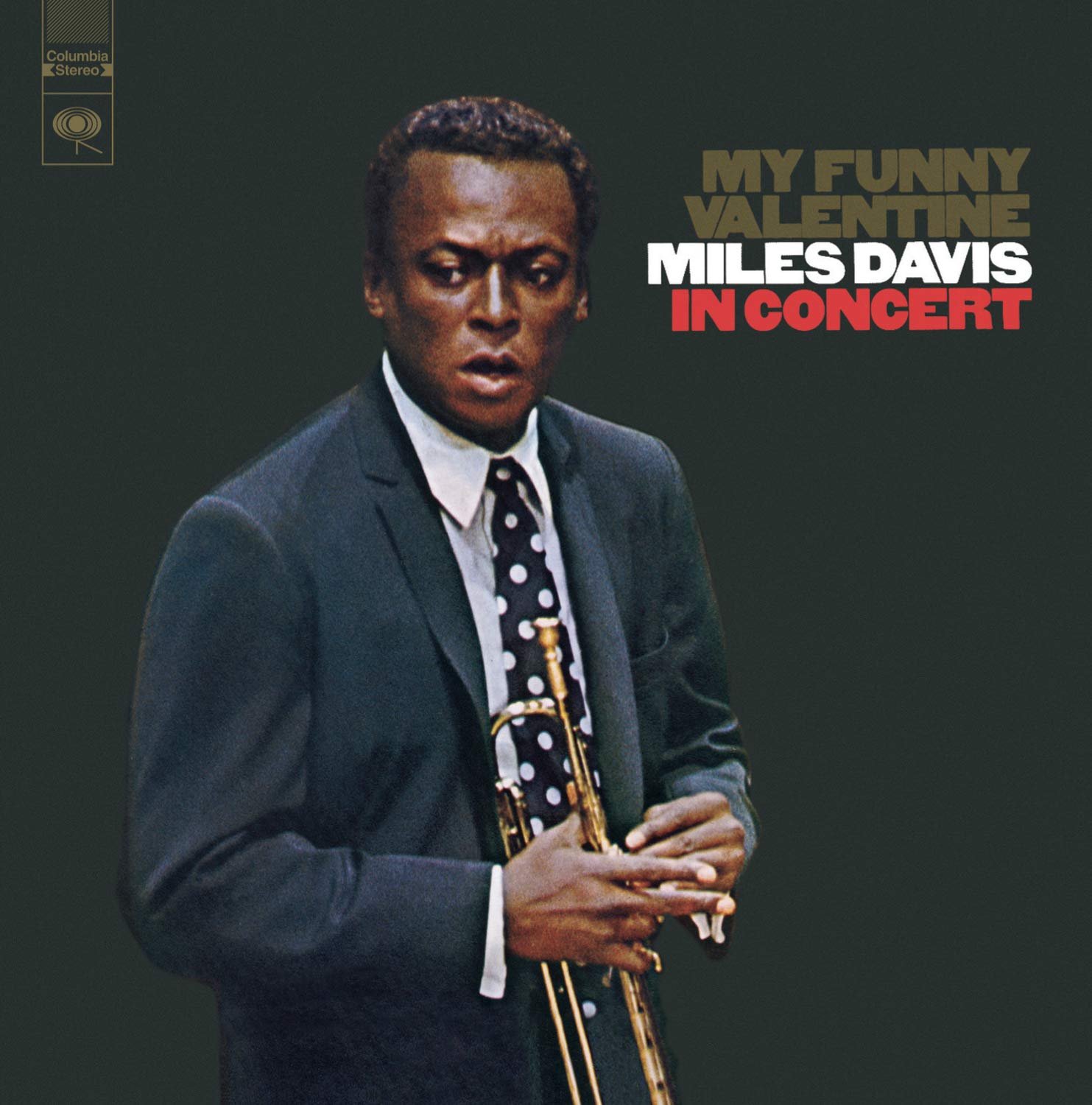
Valentines: My Funny Valentine


Miles Davis: My Funny Valentine
[purchase]

What makes a standard a standard? Clearly, there has to be something timeless about the songwriting, and there probably has to be a performance of the song that captures the imagination of other musicians, and through them the interest of their audiences. Certainly, “My Funny Valentine” qualifies as a standard. According to Wikipedia, the song, written by the great team of Rodgers & Hart for the 1937 musical Babes In Arms, appears on more than 1300 albums performed by over 600 artists, ranging from Chet Baker to Miles Davis, to Frank Sinatra, to Ella Fitzgerald to Chaka Khan, to Linda Ronstadt, to Elvis Costello. Apparently, it has become a song that many jazz musicians are sick of; yet it continues to be performed and recorded (although I read somewhere that in the 50s, one New York club owner banned the song).

I think that what makes the song so compelling is that while it is a love song, it isn’t a song where the singer objectifies his or her love. To the contrary, the song is a catalogue of physical imperfections that nevertheless do not detract from the ardor that the singer professes. And since most of us aren’t perfect and fall in love with imperfect people, there’s a universality in this sentiment.

It appears that it took almost two decades for the song to move from Broadway to the Great American Songbook. In fact, when Babes In Arms was made into a movie in 1939 featuring Judy Garland and Mickey Rooney, the future classic wasn’t even used. But a gentle, quiet version of the song, sung in 1954 by the trumpeter Chet Baker (who had performed on an instrumental version with Gerry Mulligan the prior year that was so good that the Library of Congress added to the National Recording Registry in 2015) made the music world reconsider “My Funny Valentine.” Sinatra recorded it the same year, a couple of years later, Miles Davis recorded it with his quintet, and it was off to the races.

In fact, in 1957, the song appeared in the film Pal Joey, which was loosely adapted from Rodgers and Hart's 1940 musical of the same name, despite the fact that it hadn’t appeared in the musical. Sort of a musical make up call.

The version featured above, though, is from My Funny Valentine: Miles Davis in Concert, recorded on February 12, 1964, at the Philharmonic Hall of Lincoln Center in New York City, and in addition to Davis, features Herbie Hancock on piano, Ron Carter on bass, Tony Williams on drums and George Coleman, whose sax solo is remarkable.

I don’t think that we post many 15 minute jazz pieces here, so, when we do, it better be good—and this really is.

Friday, October 25, 2019

WITCH: CRAFT or QUEEN/EDWYN COLLINS

I've wanted to do this post for a while, just waiting for the right opportunity, serendipity offering perhaps the least obvious way to shoehorn it in. Collins, erstwhile pin-up poster boy for Glasgow 80's band, Orange Juice, has had a (brief) mention here before, but given his current renaissance, a fight back against most expected odds, and on the back of a new and acclaimed album and tour, time to stake his claim as an ongoing artistic presence of merit.

The two photos are decades apart; that much is obvious, but, following his pair of devastating brain haemorrhages in 2005, when it was assumed he might never fully function again, not only is he writing, singing and performing, he has become a pillar of his home community, Helmsdale, in the far north east of scotland, a small coastal fishing community, from where his forefathers had arisen. Initially unable to speak, one strange quirk of such a brain injury can be the retention of ability to sing. Following surgery and through intensive therapy, he was able to build up from only 4 words/phrases: 'yes', 'no', 'Grace Maxwell' (his wife's name) and, intriguingly and prophetically, 'the possibilities are endless'. True, he can no longer play his earlier and visceral guitar, at least by himself: his right arm is significantly weakened, but, with another person making the chords, he can still strum and pick. Making music again these past twelve years, a momentum of appreciation has built up, as his powers and prowess have built back up, using the recording studio almost as an instrument. 

I can commend a documentary made in 2014, The Possibilities are Endless, recounting his progress until then. This year saw his latest record, Badbea, an older name for the ancestral home to which he had returned and where he had his own studio built. (More accurately, Badbea is the name of the clearance village, to which the local clans were herded, ahead of being "emigrated" to the new world: read about it here.)  The picture of the bekilted Collins is from the 2010 Helmsdale Highland Games, at which he had been asked to be chieftain, able to reprise the role of his grandfather decades previously.

So far and so few witches, you say. Yes, indeed, so let me draw you to a superlative sampler of Collins' earlier output, ahead of the event described, featuring Orange Juice and his early solo works. Entitled Edwyn Collins & Orange Juice: A Casual Introduction, 1981-2001, this came out in 2002, it's need more a reflection of some slight industry dissatisfaction with his direction, the business wanting more poppy fare than the angrier material he was putting out following the demise of that group. It is an excellent sampler and an excellent round-up, ideal to prepare the palate for his current. The OJ hit single is there, in a unique melding of both the 7" and 12" versions, Rip It Up, alongside still standout highlights of his live repertoire, Gorgeous George, and, single, A Girl Like You
(Witches? I'm getting there.......)
Also included are a pair of covers, coincidentally linked by their subject matter of, you guessed it.

Witch Queen of New Orleans
Quite why this cheesy one hit wonder was chosen has continued to baffle me, an ear worm that burrowed into my youthful hatred back in 1971, by the weretherealorweretheyMemorex native indian band, Redbone. I learn, in fact, that their credentials were actually genuine, and that they had a number of hits, even if Witch Queen was the only one to cross over to my side of the pond. And, to my horror, having always devoutly skipped this version on playing this cd, I played it for this piece. You know, it's OK. It IS definitely and desperately cheesy, sure, but more in a mature scottish cheddar way than a monterey jack. It is only available on this disc.

Witchcraft
Showing off Collins' masterful croon, this is a cover from the great american songbook I am usually so wary of, although, written by Cy Coleman and Carolyn Leigh, and dating from 1957, I guess it could have featured in my last post on this theme. Collins here has me thinking more of mid to late period Motown, the time of big ballads and slinky synths, and is, more generally, a style, Motown, to which he increasingly returns, motor city horn arrangements being especially prevalent on Badbea.  Frank Sinatra loved it so much he cut it thrice, but other and more modern versions have included everyone from Robert Palmer to Robert Smith, by way of even Siouxsie Sioux. They all diminish in comparison.

So maybe not so witchy, but hopefully will still cast a spell on any unknowing ears.
The featured album is tough to find, but newbie, Badbea, isn't.
Here's a taster.


Thursday, July 25, 2019

CUTLERY: MACK THE KNIFE

Kurt Weill and Bertolt Brecht famously liked their grub, forever breaking off mid stanza to rustle up some rostbratwurst-und-kartoffeln, so cutlery always played a big part in their output, from Alabama Song**, a left-over from our last theme, which tackles southern soul food, to the Black Freighter, about the perils of cruise line buffet dining. Mack the Knife is arguably the best known of all their collaborations, which plays on a riff around a family so poor they each had but the use of one of their limited supply of eating irons. Mack, as head of the family, had access to the sole knife, with Lotte 'the fork' and Caspar, their son, 'the spoon.' Of course, translation from the original german has sometimes masked this true meaning, not least as, when Weill relocated to the states, tinseltown demanded the less literal versions we know today, fearing the american audience might wish something a little more metaphorical from old europe, especially as it was still black and white in those then still troubled parts of the world.

(Before we discuss some of the versions of this ditty, in a pause, let's reflect on life and it's parallel relationship with art, well, blogging, for by extreme coincidence, my favourite blog/message board, 'Afterword', has just this week asked for cutlery based musings, and, similarly, get this, a mere 7 years ago, Britains Guardian newspaper wrote this, also about Caspar and his ilk.)


Most folk, and I mean most old folk like me, first heard about Mack through Bobby Darin, as only the very very old and odd would be familiar with the original. (Have you ever sat through an entire Brecht and Weill in the original? And I don't mean the souped up David Bowie vehicle, itself, um, challenging*, let alone the whole Deutsche cabaret style.) But Darin gives a bouncy rendition, full of finger popping' opportunity, beloved of that style. I actually quite like it, the gold turning rapidly to base metal if copied by anyone, yes, anyone, in the same lounge/lobby format.
*Link unavailable, but trust me, I watched on the TV.


Jimmie Dale Gilmore was part of the seminal pre-americana country trio, the Flatlanders, alongside Joe Ely and Butch Hancock.  I confess to finding his vocals a little too gloopy on most occasions, but here he nails it, a languid sway of background instrumentation conjuring elegant decay. So redolent is it of  the production of Dylan/U2 producer Daniel Lanois, I had to look up whether it was, discovering it was the excellent Buddy Miller, guitarist and producer in no small right himself.


Simpler still is this delightful acoustic rendition by Vikesh Kapoor, a 21st century troubadour in the style of Woody Guthrie, so in a time and, if you expect his name to define his music, culture out of place. An excellent debut, 'The Ballad of Willy Robbins', from which this comes, came out in 2013, following which zilch.


Of course I got to play this, a completely off the wall version by my man, the good doctor, Mac Rebennack, Dr. John. Define it how you like, it could come from any of the last 8 decades and still sound completely out of place and of its time. An added bonus is the fact that, again, it gets the taste of this fella out my mouth. OK, not so keen on the rap section, but hey.

I thought 5 my limit, at least with directly featured videos, a struggle with the myriad options available, so I have nipped outside of my own collection into Second Hand Songs, the essential aide memoire for a covers freak like me, where I found many more. Plus, I wanted a feminine take on it. Unfortunately, the one I wanted, by Rickie Lee Jones, not only only came out a month ago, but has also yet to find a home on the youtube. So you'll have to wait. (It's good, tho') By way of consolation, here's a weird one from the 'Sleepwalk' hitmakers, Santo and Johnny. Kinda cute, yes? Kinda kitsch.


**This just in: how did you like Jimbo and the boys take on Alabama Song? Try this for size!

Get 'em all here!

Friday, March 9, 2018

MAR* SONGS: Águas de Março


Or Waters of March, the english translation of what has been called the all-time best Brazilian song, in a 2001 poll. Written by arguably the best and certainly the best-known of Brazilian composers, the king of Bossa Nova, Antonio Carlos ('Tom') Jobim, in 1972, it has sustained myriad versions over the years since. Unusually, both the portuguese  of the original and it's translation were both written by Jobim. Bossa Nova seemed, in my youth, inescapably naff and forever attached to cheesy black and white travelogues. More recently it has seemed to attain a revisioned renaissance and  sits well alongside other latin dance and music forms, thanks in part to the dance music attuned stylings of bands such as Bossacucanova, the translation of which even I can work out.


It was Jobim's stepfather who encouraged his playing, after the he and his mother moved to Ipanema, yes that one, starting his nascent career playing in clubs and bars. Although now deemed to side most closely with jazz, in fact early influences and passions were derived from the classical field. Already big in Brazil, courtesy his writing partnership with Vinicius de Moraes, a celebrated poet, his wider breakthrough came with, in 1963, his collaborations with Stan Getz and the husband and wife team of Joao and Astrid Gilberto, including that song from Ipanema. Writing most of the music over the two volumes of Getz/Gilberto ensured worldwide recognition and many awards. The bossanova craze was in full swaying swing.


Aguas de Marco, as a song, has had a fascinating history, starting life as the 70s brazilian equivalent of a cover disc: a free and probably flimsy vinyl distributed with O Pasquim, a magazine of the day. Thereafter it was picked up by Elis Regina, later to work closely and to collaborate with Jobim, appearing on her 1972 debut. Jobim himself didn't officially release his own version until a year later, with the additional english lyric now attached to the verses in portuguese. This was then reprised, by both of them, another year later, on the seminal 1974 album Elis and Tom. (See top clip above.) Since then there have been a flood of versions from artists as varied as Frank Sinatra, Art Garfunkel and David Byrne. Unarguably now a standard, it was also purloined by advertisers, no doubt for a fat fee, but never, for me, the real thing.

So what are the waters of march? March is the rainiest month in Rio, and the words, more a tone poem of images than any narrative, are said to represent the torrents of water flowing down the steep hillsides of the city, flooding the gutters with all manner of debris. I encourage you to sift through the floodwater of what can so often be so much supper club and hotel lobby flotsam and jetsam, looking for the class of what this much maligned music style has to offer. Tom Jobim will always rise to the top.

                                                  Antonio Carlos Jobim 1927 - 1994

Still thirsty?

Saturday, October 18, 2008

Civics Lessons: Your Neighborhood


Bob McGrath: The People In Your Neighborhood

[purchase]

Oh, who are the people in your neighborhood?
In your neighborhood?
Say, who are the people in your neighborhood?
The people that you meet each day

Is there any greater act of citizenship than knowing the people in your neighborhood? I think not - join Bob McGrath as he strolls around his environs, greeting the people that he meets each day. Here's the lyrics so you can follow along.


Sesame Street - People in Your Neighborhood


Frank Sinatra: The House I Live In (That's America To Me)

[purchase]


The House I Live In was part of a ten-minute short film starring Frank Sinatra to oppose anti-Semitism and racial prejudice at the end of World War II. It received an Honorary Academy Award and a special Golden Globe award in 1946.

With the US political season in the home stretch, I have to say this is the ugliest Presidential race I've ever witnessed. The House I Live In reaffirms what this country should stand for, I think Americans need to be reminded of that right now.

What is America to me
A name, a map, or a flag I see
A certain word, democracy
What is America to me

The house I live in
A plot of earth, a street
The grocer and the butcher
Or the people that I meet

The children in the playground
The faces that I see
All races and religions
That's America to me

Here's the short, though keep in mind using a war to explain brotherhood is indicative of the dire times.


Frank Sinatra- The House I Live In video short (1945)

Sunday, June 29, 2008

Fifty States: Vermont


Billie Holiday: Moonlight In Vermont [purchase]

Frank Sinatra: Moonlight In Vermont [purchase]

Pennies in a stream
Falling leaves, a sycamore
Moonlight in Vermont

Icy fingers wave
Ski trails on a mountain side
Snowlight in Vermont

Telegraph cables, they sing down the highway
And travel each bend in the road
People who meet in this romantic setting
Are so hypnotized by the lovely...

Evening summer breeze
Warbling of a meadowlark
Moonlight in Vermont

Tuesday, May 6, 2008

2:42 - A Foggy Day


Frank Sinatra: A Foggy Day

[purchase]

When it comes to songwriting, it's hard to top George Gershwin.

Scott's great post on Nancy reminded me that her father had a pretty strong flair for pop music, so I found this 2:42 gem, penned by Gershwin, in Frank's catalog.