












Showing posts with label Mike Rutherford. Show all posts

Monday, February 28, 2022

Weather: Which Way The Wind Blows

Anthony Phillips: Which Way the Wind Blows
[purchase

I’ve been having trouble with this theme (and, based on the lack of posts, I’m not the only one)—not that there is a lack of appropriate songs, because there are tons, but for me, there has to be some reason to write about the song—like a personal story, a political connection, or just because I want to write about the artist or song. So, when this song came up in a search, and I listened to it again (after many years), I realized that this song could actually have worked for our “What If” theme that I enjoyed. Plus it has been nearly two months since I’ve delved into the world of prog-rock obscurity, so why not? 

This song sort of answers the burning question, “What if Anthony Phillips had never left Genesis?” 

I’m pretty sure that I’ve discussed the origins of one of my favorite bands somewhere—original members Peter Gabriel, Tony Banks, Mike Rutherford, Anthony Phillips and Chris Stewart all met in the 1960s at the Charterhouse School in England. Eventually connecting with older Charterhouse alum, the singer, songwriter, producer and convicted child abuser Jonathan King, who named the band and got them signed. Stewart left and was replaced by another Charterhouse alum, John Silver, who was later replaced by John Mayhew. After recording their second album Trespass, Phillips, the guitarist, quit, due to bad health and stage fright, and was eventually replaced by Steve Hackett; Mayhew was sacked and replaced as drummer by Phil Collins. 

So, let’s say that Phillips never left, so Hackett never joined. In the short term, there probably wouldn’t have been much difference because both guitarists, who became good friends, acknowledge that their sound and sensibilities were very similar, but our featured song gives you a sense of what the band might have sounded like after Gabriel left, and Collins stepped up as lead singer. 

After Phillips left Genesis, he wanted to continue a project he had been working on with Rutherford but first decided to expand and improve his musical knowledge and ability, studying classical music, orchestration and harmony, and taking lessons in guitar and piano. Eventually, Phillips and Rutherford returned to their project, which was slowed by the fact that Rutherford’s commitments to the increasingly popular Genesis were taking up more and more time. A push to finish the album came in fall 1974, when Steve Hackett injured his hand, delaying a Genesis tour, and allowing Phillips and Rutherford time to complete the bulk of the recording. In addition to bringing Collins in to sing on two tracks, Hackett’s younger brother John contributed flute on some of the songs. 

The album, The Geese and the Ghost, was finally finished in 1976, but Genesis’ label Charisma refused to release it, so it sat in the vaults until March 1977, just as punk was on the rise, and the sort of lyrical classical/folk influenced prog rock of the album was falling out of favor, and it was a commercial failure. Compare that to Hackett’s first solo album, Voyage of the Acolyte, which was mostly recorded around the same time, and also included contributions from Collins on vocals (and drums), Rutherford and John Hackett, but was released in 1975, and charted in the UK and (just barely) in the US. 

Our featured song, “Which Way The Wind Blows,” is a quiet ballad featuring Phillips, Rutherford and Collins, and would not have sounded at all out of place on Trick of the Tail, the first Genesis album on which Collins served as lead vocalist, released in 1976. Compare it, for example, to “Ripples,” from that album. 

Phillips tried to move toward a more pop direction, but that also was unsuccessful (although I found this track fun), and while he has released other solo albums, Phillips’ focus was more on soundtracks and “library music,” and occasionally guesting on projects with Rutherford, Camel, and Hackett.


Wednesday, September 27, 2017

Down: Geese


Camel: The Flight of the Snow Goose  
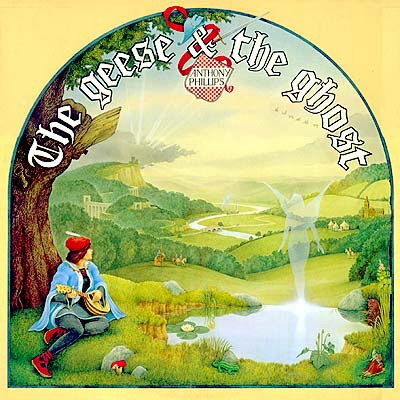
Anthony Phillips: The Geese and The Ghost
[purchase The Snow Goose]
[purchase The Geese and The Ghost]

One of the joys of a theme-focused blog is that it gives you a challenge to wrack your brain and try to think of a related topic. And it can be fun to take the theme to an unexpected place. Clearly, the obvious way to interpret “Down” is consistent with the thumbnail being used to illustrate the theme—“toward or in a lower place or position.” But the word has other meanings, including certain feathers of a bird used for insulation, often from a goose. So, here we are.

Camel is one of those English prog-rock bands from the 70s that had some success, both critically and commercially, but aren’t generally grouped in the top tier of the genre’s acts. Nevertheless, they released a bunch of good albums and have continued to perform and record until the present day, with a dizzying revolving door of members surrounding founding member Andrew Latimer.

After releasing two albums with minimal success, the band decided to try a concept album. Rejecting a few novels to base their work on, they ultimately decided to attempt to create a work based on a 1941 novella by Paul Gallico (a prolific writer probably best known for The Poseidon Adventure), titled The Snow Goose. It tells the very sentimental story of the friendship and love between Philip Rhayader, a disabled artist living in a remote lighthouse in Essex, England, and a local girl, Fritha. A wounded snow goose is nursed back to flight by Fritha, whose friendship with Rhayader grows, while the goose returns over the years to the lighthouse. Rhayader uses his sailboat to rescue hundreds of soldiers in the Dunkirk evacuation, but is lost. The goose finds Fritha on the marshes, which she interprets as Rhayader’s soul leaving her, and she realizes her love for the lost man. The lighthouse is leveled by German aircraft, destroying all of Rhayader’s work, except for a portrait of Fritha, as a child, holding the injured snow goose.

The story struck a chord, and the book won an O. Henry Prize in 1941. It was read on the radio in 1944, turned into a BBC TV movie in 1971 featuring Richard Harris (as the goose—just kidding), and that won a Golden Globe and was nominated for both a BAFTA and Emmy. When Camel announced that it planned to release their musical adaptation of the book, Gallico gallantly threatened to sue the band (yay, lawyers!), so they were forced to call the album Music Inspired By The Snow Goose, and they had to abandon the idea of using lyrics based on the text, rendering the album fully instrumental. Despite these obstacles, the album, released in 1975, was both a critical and commercial success.

It is a beautiful, moving work, featuring rock instrumentation along with the London Symphony Orchestra (and, on one song, a duffle coat, used to simulate the flapping of wings). It is hard to pick a favorite song, but to be theme-appropriate, I picked “Flight of the Snow Goose,” which starts off slowly, but builds to a triumphant end.

In doing my research for this, I found a review which claimed that the Gallico novella also inspired another song, Anthony Phillips’ “The Geese and The Ghost.” Turns out, that isn't true. In fact, the title derives from two sounds on the ARP Pro-Soloist synthesizer which was used on the album.

Phillips was the original guitarist in Genesis, but left after recording their second album, Trespass, ultimately being replaced by Steve Hackett. Phillips left due to a combination of stage fright and other health reasons, and an aversion to being in the public eye. After leaving Genesis, Phillips decided to study music, and didn’t record anything for a number of years. His solo debut, The Geese and The Ghost, featuring some music that he had worked on while still in Genesis with friend and former schoolmate Mike Rutherford, and solo compositions, was released in 1977.  In addition to Rutherford, Phil Collins provided some vocals (recorded before he succeeded Peter Gabriel as Genesis’ singer) and Hackett’s brother John added flute.

In general, the album is somewhat folky, with orchestral flourishes, and the title track is beautiful. Genesis fans could definitely hear a kinship to some of the quieter moments of Trespass. Phillips went on to release music to little commercial success, more successfully create “library music” for use in films and TV shows, and appear on other artists' albums playing guitar and keyboards.

In fact, in 1982, Phillips appeared on Camel’s album The Single Factor, and co-wrote a song with Andy Latimer. That album is utterly devoid of any goose-related material (which unfortunately cannot be said of our local athletic fields).

Wednesday, July 19, 2017

On/Off: Turn It On Again

Genesis: Turn It On Again
[purchase]

If you are a fan of Genesis, as I have made it abundantly clear that I am, there are a number of turning points where people jumped on and off the band’s wagon. Genesis’ rise to popularity probably began with their second album, Trespass, which introduced the band’s dense, theatrical progressive style (their debut, From Genesis to Revelation, sounds mostly like a cross between The Moody Blues and pre-disco Bee Gees). From there, the band gathered followers until 1974’s epic (and epically confusing) concept double album, The Lamb Lies Down on Broadway. Then, lead singer and focal point, Peter Gabriel climbed up Solsbury Hill and out of the band.

Gabriel was, of course, replaced by Phil Collins, and while the next few albums were somewhat lighter and simpler than in the Gabriel-era, they were still recognizably prog. Many Gabriel lovers were reflexively turned off, but Collins’ greater accessibility (and even a love song) retained some fans and attracted more. But when guitarist Steve Hackett defected, and Genesis released …And Then There Were Three…, with an actual pop hit, much of the old guard jumped off.

Not me, though. I had moved to college at that point, and was working at WPRB, at a time when our staff included both lovers of prog and punk (and lovers of both), when the rock music world was really changing. And while it seemed that Genesis might have been done, instead, we got Duke, which I liked. It had long, proggy songs, but also harder rock, and maybe one of the band’s most divisive songs, “Misunderstanding,” an obvious attempt at a pop hit that sounded like nothing the band had ever done. Collins reportedly based the song on The Beach Boys' "Sail On, Sailor", Sly and the Family Stone's "Hot Fun in the Summertime" and (ugh!) Toto's "Hold the Line.” The album was the band’s first to top the UK charts, and hit 11 on the US Billboard Hot 200. I remember long discussions in the WPRB studios as to whether Duke indicated that the band was staying on course, or whether “Misunderstanding” and some of the other poppier tracks were an indication that they were off the tracks.

As it happened, “Turn It On Again,” our featured and theme-appropriate song, was probably the song that showed the direction that Genesis was heading towards. An apparently fairly straight ahead rocker about a man obsessed with television, it nevertheless had sections in odd time signatures (13/4 and 9/4). (Aside—the first song I thought about for this theme, The Tubes’ “Turn Me On,” another TV focused tune, was actually the subject of this piece I wrote back in 2014).

When the band reconvened to create their new album, they reportedly decided to focus on simpler songs, and the result was Abacab. That album’s harder edges, punchier synths, “gated” drum sound and even horns, led to commercial success, reaching number one on the UK Albums Chart and number 7 on the US Billboard 200, but I think that it is fair to say that fans of songs like “Supper’s Ready,” jumped off the bandwagon in droves. A popular (mostly) live double album was next, followed by a self-titled disc in 1983, that, while still retaining a few longer pieces, is probably mostly remembered for its pop hits, and the catchy, but ultimately very embarrassing song, “Illegal Alien.” The album reached No. 1 in the UK and No. 9 in the US, so clearly their fanbase was increasing, but, I suspect, even more longtime supporters were turned off.

I flipped the “off” switch on my fandom after the next disc, Invisible Touch, which had some well-crafted songs, but ultimately left me cold. Although I heard some of the songs on the next album, We Can’t Dance, on the radio, I didn’t buy it. The next album was recorded without Collins, and I think it is fair to say that most Genesis fans were put off by Calling All Stations—I know that I never turned it on.

That all being said, there have been rumors over the past few years of a Genesis reunion, now that Phil Collins has rescinded his retirement notice. If I were a betting man, and I’m not, I’d say the chances of a Collins/Rutherford/Banks reunion is high—it would incredibly lucrative to get them on stage (and probably a popular album, if they cut one). Hackett, who often tours playing old Genesis songs, has indicated a willingness to join, but I’d bet that scheduling would make that a less likely option. And I think that the chances of Gabriel signing on would be low, although the concept has been bandied about. I’d be interested in seeing them, increasingly so depending on how much of the “classic” lineup was on stage, but suspect that it would be a stadium tour, which turns me off.

Tuesday, December 6, 2016

Leftovers: Ste*--Prog Rock Guitarists Steve Howe, Steve Hackett and Steve Hillage


Yes: Mood For A Day  
[purchase Fragile by Yes]

Steve Hackett: Ace Of Wands
[purchase Voyage of the Acolyte by Steve Hackett]

Steve Hillage: Castle In The Clouds/Hurdy Gurdy Man (Live)
[purchase Live Herald by Steve Hillage]

Ste* was one of the odder themes we had in 2016, and in response, I wrote about brilliant guitarist Steve Tibbetts, a relatively obscure musician whose music, as I said, “exists somewhere in the never particularly commercial intersection of jazz fusion, world music and ambient music.” Thinking about our Leftovers theme, I realized that I was aware of three more guitar virtuosi whose first name is Steve. So, I figured, why not write a little about each of them, in reverse order of their fame.

Despite the fact that all three of them are remarkable guitarists, and have continued to make music for years, I pretty much stopped following their careers years ago. Whether it was a change in their music, or changes in my tastes, or, more likely, a combination of both, I’m really not knowledgeable about their work from after the 1980s, which may well be very good. I do still enjoy the music that they made back in the day.

Steve Howe (who was already the subject of a Ste* post), of course, is best known for his work with Yes. Born in 1947 in North London, he made his first recording, a cover of Chuck Berry’s “Maybelline” in 1964 with the Syndicats, and played in a number of other bands, including Tomorrow and Bodast. Check out this Bodast tune, “Nether Street,” part of which was later used in Yes’ “Starship Trooper.” After passing on the chance to join the Nice and Jethro Tull, once it was clear that Bodast was not going to get a deal, he agreed to join Yes, replacing Peter Banks. Howe’s eclectic influences, including classical, jazz, and rock helped to create the distinctive Yes sound during their best and most iconic period.

He left Yes when it broke up in 1981, wasn’t asked back for the reformation of the band (so, he didn’t play on “Owner of a Lonely Heart”), and reunited with most of the “classic” Yes lineup in Anderson Bruford Wakeman and Howe. He has participated in some, but not all, of the various Yes lineups over the years. I really stopped listening to Howe after he left Yes the first time. I never really paid much attention to his solo albums (including the ones he made while still in the band), or any of the later Yes efforts that he appeared on. There were a few good songs on the first Asia album, but I felt that the band was less than the sum of its parts, and his project with Steve Hackett, GTR, also failed to interest me. Howe continues to record with Yes and in a jazz trio featuring his son on drums, and to perform.

Steve Hackett, Howe’s GTR bandmate, is best known for his work with Genesis. Born in 1950 in central London, he was a self-taught guitarist. After gigging with a few bands, in 1970, he joined Quiet World with his brother John, a flutist, and appeared on their only album, before leaving the band. Hackett put an ad in Melody Maker magazine for musicians "determined to strive beyond existing stagnant music forms." Peter Gabriel answered the ad because his band, Genesis, had lost their original guitarist, Anthony Phillips. Like Howe, Hackett wasn’t the first guitarist in the band which made him famous, but was part of the band’s best, and best known, lineup.

Over time, Hackett began to feel marginalized by Genesis which gradually put less of his music on its albums. After the tour supporting the Wind And Wuthering album in 1977, Hackett left the band. I followed Hackett’s solo work for a while. His first solo album, Voyage of the Acolyte, recorded while he was still in Genesis, featured the band's drummer Phil Collins, who also sang on one song (before he was the lead singer of Genesis), and bassist Mike Rutherford, along with John Hackett, and is probably a minor prog rock classic. I was also a big fan of 1979’s Spectral Mornings, and continued to listen to, and enjoy Hackett’s solo work, to a somewhat diminishing degree, through the mid-1980s.

One of Hackett’s big problems is that he is a great guitarist and a bad singer. So, when he writes songs with lyrics, he either has to bring in outside vocalists with varying success, or sings himself, usually with the assistance of significant processing, and mostly unsuccessfully. After that, I again pretty much lost track of Hackett’s career—occasionally listening to some of his studio and live Genesis “revisited” work, but ignoring most of his varied output, which has ranged from classical, to world music, to blues, to prog and rock. Hackett also continues to record, as a solo artist and with others, and to tour as a solo act, and with a mostly Genesis-based show.

Steve Hillage, the youngest and least well-known of the trio of Steves, was born in 1951 in northeast London. Hillage played in a number of bands as a teenager, a couple of which even recorded and released albums. While attending university in the Canterbury area starting in 1969, Hillage began to play with other musicians and bands in the Canterbury scene. In 1971, he formed Khan, which released one album of psychedelic prog, before breaking up. Hillage then joined Kevin Ayers’ band before becoming a member of Gong in 1973, as the band was starting work in its “Radio Gnome” trilogy. But when Gong inevitably disintegrated, Hillage began a solo career.

I was introduced to Hillage while at WPRB, almost certainly from hearing his great live, spacy cover of Donovan’s “Hurdy Gurdy Man,” from the 1979 album Live Herald, which led me to the rest of his solo work. I will admit that my immersion into the Gong world focused mostly on the later, Pierre Moerlen-led albums which were almost entirely Hillage-free, and it was only much later that I spent any time listening to the bizarre Daevid Allen era band’s eclectic psychedelia that featured Hillage.

Just as I was getting into Hillage’s music, he began to move away from the prog rock guitar heroics that I liked, and into ambient dance music, which I didn’t, so I basically stopped paying attention to his career after the late 70’s. Over the years, Hillage produced albums for a variety of acts, including Simple Minds (pre-Breakfast Club fame) and continues to focus on performing and recording dance music under the name System 7 and Mirror System with his long time musical and personal partner, Miquette Giraudy. He also occasionally participates in Gong reunions. And, for some reason, he appeared on this Elton John cover “sung” by William Shatner.

I’d love to be able to tie this up with some clever ending, but like a post-Thanksgiving turkey, cranberry and stuffing sandwich, it is sometimes better just to be happy that things work together, without overthinking why.