Saturday, October 28, 2017

Listen: Hear Me Lord


purchase [Silver Linings]

Time's just about up for the <listen> theme and I confess I haven't found the time to go as deep as I had hoped for this one and I still have to put up the next theme. I could have left it for our traditional <leftovers> theme after Thanksgiving, but .. no. So, I'll take a page from the early days of SMM when many posts weren't much more than: "Here's one for you."

There are famous quotes that say "you hear but you do not listen."
There are others that say "You listen but you do not hear."
Is this any different from the dichotomy between seeing and looking?

I guess it is fair to include a song that includes "hear" but not the listen of the current theme.
Heck ... any song that includes Bonnie Raitt is OK any time.

This one sounds a bit like Paul Simon from Graceland.
Hear Me Lord from Raitt's 2002 album Silver Linings was written by Oliver Mtukudzi of Zimbabwe and you could do worse than to head off down that path for a listen or two.

Wednesday, October 25, 2017

Listen: Stop, Look and Listen/Jeff Beck


purchase [ Blow By Blow]


It may have been Beck-Ola that turned me on to Jeff Beck but I can't really single out a particular piece from the album that has stuck with me. On the other hand, my copy of the 1975 Blow By Blow 33RPM album probably had worn out grooves from being played so much. It's no longer in my possession to check.

<Stop Look and Listen> from the "Flash" album almost a decade after Blow By Blow wouldn't be in my list of Jeff Beck favorites. The song just happens to fit our theme and Beck hasn't had much written about him here.

I actually saw him in concert ... must have been about '72, in Philly.

Listening to Beck again after a few years, I am struck by how eclectic he is: there are elements of all sorts of musical styles.

Beck has paid his dues: one of the Yardbirds, almost one of Led Zeppelin, known by all in the field, played with ... you name him/her.

ConsequenceOfSound has a raw review of his latest =- after a 6 year absence. You might enjoy checking it out. I did.

The album from whence Stop, Look and Listen comes (Flash, from 1985) is noted as a time when Rod Stewart re-united with the Jeff Beck group. (Come again? Rod Stewart and the Jeff Beck Group? Guess I didn't know that!) The <Flash> album itself has various other curiosities on it: covers of "Wild Thing" and "People Get Ready" Beck himself [apparently] didn't particularly care for the album, but it did pretty well on the charts.

But maybe my favorite Beck:

Tuesday, October 24, 2017

Listen: Are You Out There


Dar Williams: Are You Out There
[purchase]

Dar Williams is about 6 years younger than me, and grew up about 12 miles as the crow flies from me (or about 25 miles driving, on a route that takes you virtually past where I am writing this). Which is a long way of saying that we both lived in the New York area, at roughly the same time. Meaning that we had pretty much the same choices of radio stations to listen to, growing up.

I’ve written ad nauseam about how I became a music fan, and how important for me it was to listen to the radio as a teenager—mostly WNEW-FM—until I headed off to college and WPRB. That was how you learned about music then, for the most part, and where the DJs were people like you who really cared about the minutiae, about the trivia, about the connections, about good segues, about the music. And also, in those days, the DJs, and musicians, were not reticent about talking about politics and other issues, because the radio stations weren’t run and programmed by some conglomerate devoted to creating a uniform, sellable product that sounded the same wherever you happened to be.

So, when I heard this Dar Williams song, about the importance that listening to the radio had to her, it clearly resonated with me. In preparing to write this piece, I found a bunch of live videos of Dar performing this song, often with her introductions included. She sometimes talks generally about the power of radio to introduce listeners to music, and always mentions that the song was inspired by her listening, in her teenage years, to WBAI, a radical, left wing station probably best known for having played George Carlin’s Filthy Words routine in 1973, which resulted in an iconic Supreme Court case that defined the government’s ability to regulate obscene and indecent material on the airwaves. Williams talks about how the station’s discussion of all sorts of conspiracy theories made her think, and the music opened her mind. In addition, there are references in the song to WRSI, 93.9 “The River,” a station in Northampton, Massachusetts, where she was living when she wrote the song (and which is also, I must add, the home of Smith College, the alma mater of my wife and daughter, where I was last week to attend the groundbreaking for the school’s library renovation).

For me, WBAI was something that I respected, but never listened to—too much talking, not enough music for me, but the song is really universal, at least for those of us who grew up obsessed with radio (and are still obsessed). I’ve long been a fan of Williams as both a songwriter and singer—she was probably one of the first artists that WFUV got me hooked on, her appearance at the Clearwater Festival in the 90s was the main lure for my family to attend our first one, and her song, “When I Was A Boy,” was a family favorite, reminding us of our daughter as a child, around the time the song was released.

Dar, and Lucy Kaplansky and Richard Shindell, joined together in Cry, Cry, Cry a few years back, but after one album and some touring, they went their separate ways, for the most part, reuniting last summer at Clearwater for a fun, if sloppy and under rehearsed set. They are back now on the road for a mini-tour, which will be stopping in Tarrytown this weekend, and my wife and I will be there, despite having to fight our way through the Halloween parade and block party right by the Music Hall.

Listen: Listen to the Lion


Purchase Van Morrison's "Listen to the Lion" or from the masterful St. Dominic's Preview

Van Morrison's "Listen to the Lion" is an 11 minute epic, a magisterial hymn. Orchestral, blooming with strings, a shower of cymbal and piano trills and delicately teetering guitars that flash like lightning over the seesaw vocal line, where words and utterances of grunts, guttural inflections and non-verbal cadences and tones--so much more than "ohs" and "ahs"--sound equally poetic.

No one but Van Morrison could deliver a song like "Listen to the Lion." For all that I said above, hallmarks of Van's music from the 60s and 70s, plus the poetic vibe of a transcendental troubadour delivering soulful, heartfelt reflections on one's place in the mystic lacework of the universe, there is something special, yet utterly intangible, about his music.

"Listen to the Lion" shouldn't really work--it has none of the snap jazz kick of say "Moon Dance" or the dirty swagger of Them's "Gloria" or "Here Comes the Night". But, like much of what he did on that incredible string of 1968's Astral Weeks to 1973's Hard Nose the Highway, the music doesn't so much defy as transcend classification. There's pop, soul, jazz, folk--a veritable jukebox of genre and sounds. (Van Morrison was--is--if nothing else, a master of soul.) Yet, to me, there was always something indefinable in Van Morrison's music. How did he create such off-center harmonies, singing with a vocal delivery like the rise and fall of a mad hatter on the run?

Van Morrison's music, from a certain period, is like the amalgamation of everything good about music, perhaps what God would have envisioned when He invented the idea of music. Everything is there: a fleet of musicians playing an array of instruments that only rarely make it on to a rock record. The vocalizations are incantation, repetitive like a grand soul singer, and he always manages to cast a spell with that stuttered, off-track floating delivery.  He rises from despair to joyousness, carrying emotion on a wing in the air, and while a phenomenal writer, he needs little more than a few repeated phrases to create a poetic image rich in tone and as colorful as a painted masterpiece. The brilliance in "Listen to the Lion" is in it's breathlessness. A hushed masterpiece; an epic ballad of an imagined diaspora, a payer to a higher being, calling the soul to a journey that has no true destination. An evocation of something spiritual and beautiful that is unnamable. An invocation of the animal soul inside us, growling to be released.

"Listen to the Lion" is visceral, beautiful, a prayer sung rather than spoken.  Proof of a thesis I didn't know even existed: That vocals are far more important than words.             

Thursday, October 19, 2017

LISTEN: TO THE MUSIC/DOOBIE BROTHERS

This has to be one of the most magical bits of riffing in music, I sooooo love this simple sounding casual wrist action, as patented by the Doobie's Tom Johnston, singer and guitarist, of many, in the early incarnation of the band, as well as the writer of this song. It was clearly a sound he enjoyed, as it reprises often in other songs, notably the big early other song they are famous for. And, does it remind you of anything? Let me give you a clue, here's Nile Rogers explaining his style. But that doesn't matter, so glorious a sound it is, in any hands.


But it isn't just the guitar, it is the subtle appearances of what sounds like some mandolin after the first chorus, the banjo slowly leaking through during and after the second, and all the flanging/phasing effects so beloved of the time. (God, I miss flanging. Or is it phasing......) Did I say it had two drummers? Surely the first two drummers on a big hit single in history. Or my memory It is the sound of joy on a plate.

Over to Johnston, who later explained his inspiration, in a never more 70s way:

"The chord structure of it made me think of something positive, so the lyrics that came out of that were based on this utopian idea that if the leaders of the world got together on some grassy hill somewhere and either smoked enough dope or just sat down and just listened to the music and forgot about all this other bullshit, the world would be a much better place. It was very utopian and very unrealistic (laughs). It seemed like a good idea at the time." 

Who could argue with that?

I always felt a bit sad about the Doobie Brothers, this earlier raw and less polished aspect of their sound sometimes a little airbrushed out by the smoother Michael McDonald years. Sure, a terrific and gifted singer and interpreter, but why were my beloved hippy band singing philly soul, something I couldn't embrace until a new century beckoned. Did Johnston feel the same? Having started the band and been the main focus, from their tentative start in 1970, breakthrough album, 'Toulouse Street', in 1972, from which this song comes, he left in 1975, nominally from a hospital bed, suffering from what was called road stress. Actually a duodenal ulcer. But the die had been cast, the band slowly seeping in soul and smooth jazz music sounds ahead of that, as ex-Steely Dan-ner Jeff Baxter joined the band. With Johnston in hospital, his Dan alumnus, McDonald, was invited in. (I accept this may be a slightly unfair stance to take, one part of the Doobie style always being the contributions of all, but the Johnston bits were my favourite. )

Since then Johnston has been in and out of the band a couple of times, initially rejoining a near-original line-up in 1989, stimulated by an almost accidental reunion of the by then legion of ex-members available two years earlier. Officially he remains, with Patrick Simmons, singer and guitarist, alongside him at the beginning, and the only permanently present member during the band's on-off history. I guess, for me, they are the two true siblings of this fraternal band. (Is here the place to state I once thought all these contemporaneous bands of brothers just had funny american names, imagining, as well as Mr and Mrs Doobie and their sons, so also Mr and Mrs Burrito, let alone Mr and Mrs Freak, that most hirsute of families? Thought not.)

Back to the song, such is the catchiness of the beat that it is no surprise it captured a few covers. However, fascinatingly, both the two I enjoy most come, arguably, from artists who probably picked up and on the band in their blue-eyed soul phase. So, the Isley Brothers (who were):


and Candi Staton:


I still prefer the original. Here!

Listen: Listen Mr Bilbo

Pete Seeger: Listen Mr Bilbo

[purchase]

In the early part of the twentieth century, the Democratic Party was the one that welcomed racists. One such was Theodore Bilbo, Senator from Mississippi from 1935 to his death in 1947. Bilbo was one of the most important Southern racist senators that Roosevelt courted to win passage of his New Deal programs. Bilbo boasted of his membership in the Ku Klux Klan, and he promoted segregation and Jim Crow laws throughout his career. Listen Mr Bilbo was written by Robert and Adrienne Claiborne in 1946, the year of Bilbo’s last Senate campaign. Robert Claiborne performed with Pete Seeger, so that would be where Seeger learned the song. I have not been able to find a recording of the song by Robert Claiborne, if there even was one. Bilbo had by this time made himself the face of Southern racism, and of bigotry more broadly. Claiborne’s song is a reminder of how important all the people Bilbo hated were in American history.

Peter Paul and Mary: Listen Mr Bilbo

[purchase]

By 1990, when Peter Paul and Mary recorded Listen Mr Bilbo, Theodore Bilbo himself was largely a forgotten figure, but the attitudes he embodied were still very much with us. So they sang the song as Listen Mr Bigot, but they kept the original title. Where Pete Seeger kept the arrangement simple, just him and his banjo, Peter Paul and Mary created a musical setting that reminds us of the cultural contributions made by minorities, especially black musicians. The song has eerie echoes in our situation today, so it may be time for someone to make a new recording of it.

Wednesday, October 18, 2017

LISTEN: Listen to Her Heart


Purchase Listen to Her Heart

I'm still grieving over the death of Tom Petty, so, though I've written about him many times, there's got to be a place in our blog for a mention of the Heartbreaker's "Listen to Her Heart."

From 1978's You're Gonna Get It!, "Listen to Her Heart", more so than any other early Heartbreaker's track, helped contribute to the new wave label that clung to the band for so long. And for good reason: the chiming, chorus-drenched guitar, working in a groove over tub drums and the tranced out vocal lines all do sound...modern.  It's a great tune, driving and unique, an FM radio rocker from the AM era, a stadium-style anthem that bounced as hard as it grooved. I've always loved the fade out on the song, where Campbell's guitar lead and the Tench's piano line compete in a crescendoing melody, winding up, then fading out entirely, in that sad way that a great song is one that you wish wasn't so short, though it's compact brevity is part of what makes it so great to begin with. A staple gun shot of a track.

Apparently, Petty wrote the song in response to Ike Turner hitting on Petty's wife. I'd never heard that, but between Wikipedia and re-runs of VH1's Behind the Music, you can learn a hell of a lot...


Tuesday, October 17, 2017

LISTEN: TO THE RADIO/NANCI GRIFFITH

Spoilt for choice, really, songs about the radio abound all over, and it is the immediate word association I link to listen, watching or touching the radio seeming always a bit pointless. Let alone smelling. But there are only a few that go as far as to spell it out, and Nanci came up top of my pile this morning.


And I've been wondering what's been happening to Nanci Griffith of late. For a time, in the 80s, she was huge over here, well, as huge as what-was-then-country-and-is-now-americana got in the UK at that time. She seemed to be forever touring her neat little ankle socks off, perhaps taking advantage of the local enthusiasms, playing venues such as the Birmingham Irish Centre on more than one occasion. (Come to think, there has always been a hibernian appetite for twangy guitars and half her band were from Ireland, so maybe the clue is in the name of the hall.) I snapped up all her early records up until suddenly I reached peak Nanci, round about the brace of covers albums she put out, somehow feeling she had lost her muse. The truth, it seems, is more prosaic, she was losing her health, with breast cancer, treated successfully, and a prolonged spell of what was (euphemistically?) called writers block. There have been sporadic records this century, but her innocent sparkle seems anachronistic now. But then, hell, it was a delight, her quirky introductions, all in look at li'l ol' Texas me high school prom voice, giving me as much delight as the songs. I strongly commend her 'One Fair Summer Evening' live opus from 1988 to catch that flavour at its sweetest, just one stir ahead of saccharine.


So this song, 'Listen to the Radio', what about it? Well, it's from her 8th record, 'Storms', the one where she was being groomed slightly away from her folk-country hybrid into a hoped for wider appeal, with a more easily consumed and slightlier (slighter?) AOR sensibility. Produced by Glyn Johns, the alchemist of the early Eagles output, and without a fiddle or a steel guitar in sight, it was initially dissed by the purists, but I have to say its legacy has lasted longer than its forbears. It sounds good to these ears, my delight heightened as I read the names of Bernie Leadon, Albert Lee and Jerry Donoghue amongst the contributing musicians. The lyrics are typical Griffith, harking back to west texas backroads, nostalgia tinged with regret, loneliness never far away, but :
                                           
                                           When you can't find a friend  
                                           You've still got the radio  
                                           When you can't find a friend  
                                           You've still got the radio …,

words with which I can relate with ease. So my days by the radio were an oceanwide away, a room in a shared house in London, south of the thames, but, 10 years later, settled in Birmingham, I could remember well the feeling. Do people still listen to the radio in this way, I wonder? I know I don't, beyond an occasional catch of the morning news in the car. Are there now songs about Spotify playlists, or YouTube channels? Perhaps there are.

Go on, then, listen to the radio.......

Sunday, October 15, 2017

Listen: Do You Want to Know a Secret?

Sharon Clark: Do You Want to Know a Secret

[purchase]

The first word of this song is also our new theme: Listen. I can think of a number of great songs for this theme. Perhaps that is because songwriters feel a certain degree of insecurity. They come to a point where they feel they must ask us to listen to their work, regardless of how popular they may be at the time.

Certainly, The Beatles should not have had that problem. The whole world was listening, even in the early part of their career that this song comes from. On the other hand, ask any random group of people to make a list of Beatles songs, and Do You Want to Know a Secret will come pretty far down the list. The song is a fairly simple pop love song of the sort The Beatles once excelled at. Heard today, those “doo da doo” backing vocals sound pretty hokey. In part, however, that is because the later musical innovations of The Beatles made such devices all but obsolete. Indeed, I listened to many versions of this song to prepare for this post, and no one keeps the doo da doo’s.

Do You Know a Secret is not covered that often, and it seems to present a challenge to many who have tried. True, Billy J Kramer and the Dakotas had a hit with it the same year the Beatles version debuted, but that early cover does not add much to the musical conversation. I listened to very unfortunate club, pop, jazz, and new wave versions that just completely lose track of the song. When I did find hints of where to take the song, it was in the world of jazz. Still, Sharon Clark, who is far more of a secret than she should be, is the only one who I heard who finds the way to make the song her own. Her small band Brazilian tinged version gives the song a sensual intimacy that is suggested by the lyrics. The doo da doo’s become a piano line that works perfectly with the song’s tropical groove. The vocal, if you are going to do the song this way, needs to be quiet but passionate, and Clark delivers beautifully.

Friday, October 13, 2017

True Stories: The Night They Drove Old Dixie Down


purchase [The Last Waltz]


Who was Virgil Caine? Quora notes that there is a town called Virgil in Caine county Ohio, but the leads to Mr Caine seem to peter out at about that point.

Robbie Robertson (song credits) appears to have gotten help from Levon Helm (from AR) with the historical data for the song. The events are certainly true: the desolation at the end of the Civil War, the Danville-Richmond train that provided the life-blood of the Southern effort... and more. General Stoneman's tearing up the train tracks contributed to the North's victory. From there on, you have to begin to take sides. Robertson likely would not have done so, being Canadian. That much may not be said for many others today who would still make something of an issue best left to historians.

Back when The Band recorded this song, no one was offended that they/Levon Helm sang his heart out about a story that (you can't sing like that if you don't feel it!) carried lots of meaning. I wish I knew what it is that has perverted our perceptions in the ensuing 45 years.

Forget rejoicing in historical fact (yes, it happened), and certainly put aside attempts to see the other side of the coin (or everyone seeing things your way). Heck, forget about letting your kid discover the next block over: you'll be hauled in for endangering your own kid by letting him walk alone to the park. Fuggetaboudit singing about something so divisive as the Civil War. Sheesh.


I side with none - lived in NC, but consider myself a Northernern for the most part  - that's Northerner as in WA. But that doesn't mean I wouldn't vote for something else if the [wo]man spoke wisdom. And it don't mean that I think  the South was wrong across the board.

Don't know if you were around then, but The Band - when they were high in the charts - were great - in the mid 70s. So great that Dylan toured with them as his band. (Not all that shabby). But the Band were also a powerhouse on their own. Their 2nd album <The Band> includes this song and was part of the <Americana> theme of the album, which included others such as Cripple Creek and Across the Great Divide

The audio mix is superb: harmonica as a weaker instrument sounds like it should, the piano hammers a loud, powerful accompaniment and the vocals soar above the rest. One of their best.

edited later to include the original:


Thursday, October 12, 2017

TRUE STORIES/IT'S ALL TRUE - TRACEY THORN


So here is a quandary for you, both the above are Tracey Thorn and both the above are the song entitled 'It's All True', so it must be. But which one is true for you?
OK, so this is a deceit, but one worth sharing, the two songs being so clearly one and the same and so clearly different. The first is, had you not gauged, the remix, by one Martin Buttrich, (no, me neither) actually came in the year ahead of the second, in 2006, the 2nd, Tracey's "own" version appearing on her 2007 solo record, 'Out of the Woods'. As a boomer from the last century I confess to not always getting the cult of re-mixes. Sure, yes I can enjoy them, as with this, but, as someone who likes to own my music, as shiny black plastic, or smaller silver discs, I can't keep up. With myriad versions and reinterpretations being pumped out willy-nilly, do I want to have them all? This particular song, according to the excellent trainspotter site Discogs, had 16 versions alone of the single, each or most with numerous and differing remixes.
I suspect I miss the point; music for me is a an immersive experience. For the dance floor it is probably a means to the end, for the dancing, for the experience, being even entirely ephemeral to and for the moment. So it is for streaming, for hearing and for disposing, not for listening. (The fact I listen to dance music in the car proves beyond doubt I am not the intended audience.)

Tracey Thorn was the singer, with her husband, Ben Watt, in the hugely accomplished 'Everything But The Girl', who emerged as bedsit jazz in 1984 to drum'n'bass melodicists 12 years later. The connection was always Tracey's honeyed vocal, making her latterly girl to go for any number of electronica projects, most notably Bristol's Massive Attack. She has retired from live music, by and large, to be, initially, carer to her ailing husband, then as mother to their children. (Incidentally, he is now much better, having recovered from Churg-Strauss syndrome, a very nasty auto-immune disease that nearly killed him, and now has a solo career as well, albeit with occasional live appearances.) As well as music, she has also written a couple of well-commended books, one her autobiography of performing, the second around the art of singing. (Should any of this sound familiar, yes, I have written about her before.)

Let's finish with some more truths, sung by Tracey, but written by Stephen Merritt, of  the Magnetic Fields, this time about love, possibly the most powerful truth we ever, any of us, if we are lucky, experience.


Music and Books, go get

True Stories: The Eton Rifles


The Jam: The Eton Rifles
[purchase]

I’ve never written about The Jam, which on one hand is surprising, because they are an amazing band, with great songs, who were on top of their game back in my WPRB days (and very shortly thereafter). On the other hand, though, they are a band that were much bigger in England than they ever were in the States, in part—if not mostly—because they often wrote about specific British issues and sensibilities that didn’t directly resonate here.

“The Eton Rifles” was written by Paul Weller in response to a news account about a street brawl that took place in Slough, in 1978 between “Right To Work” marchers and the upper class students who were members of the Eton College Combined Cadet Force, colloquially known as the Eton Rifles. The marchers were unemployed, and the march was sponsored by the Socialist Workers Party, and they were being jeered by the Eton students. Apparently, the marchers took exception to the taunting from the rich kids, and wanted to teach them a lesson. But the students were in better shape, and routed the workers, leaving them beaten and bloody.

Weller, who was trying to write more political songs, seized upon this clear example of the entrenched class system’s oppression of the working class to write a powerful song that clearly was sympathetic to the workers and mocked the posh schoolboys to make a point about the worsening divide between rich and poor. Although the song was written about a specific time and place, its message about the class divide is sadly still resonant on both sides of the Atlantic.

I saw The Jam in May, 1982 at the Trenton War Memorial with a bunch of my WPRB friends. It was probably one of the last shows that I saw as an undergraduate. What I remember most about the show was that it was fucking loud. At that point, the band was moving away from its harder edged sound and incorporating more Northern Soul influences, but without abandoning the strong working class political message. Apparently, Weller’s insistence on changing the sound resulted in the band’s breakup later in 1982, and the other members of The Jam, Rick Buckler and Bruce Foxton, didn’t speak with Weller for decades.

In 2008, the British Conservative Prime Minister David Cameron, an Etonian, somewhat inexplicably picked “The Eton Rifles” as a favorite song, stating, “I was one, in the corps. It meant a lot, some of those early Jam albums we used to listen to. . . I don't see why the left should be the only ones allowed to listen to protest songs." Weller, a bit dumbfounded (gobsmacked?), responded: "Which part of the song didn't he get? Did he think it was a celebration of being at Eton or something? I don't know. He must have an idea what it's about, surely? It's a shame really that someone didn't listen to that song and get something else from it and become a socialist leader instead. I was a bit disappointed really." Of course, our country has examples of conservative politicians misunderstanding lyrics.

Interestingly, the background vocals, credited to the “Eton Rifles Choir,” were a bunch of random people hanging around the studio. They were recorded in the same room that Phil Collins used to create the famous drum sound used in “In the Air Tonight.” Also, there’s a subtle swipe at The Clash in the lyrics, because Weller thought that they weren’t really as committed to the revolution as they claimed.

True Stories: The Way


How the time flies—October, already? For those of you living in normal climates, you are probably starting to see changing leaves and cooler temperatures. Hope so. I live in the desert now, so I wake each day to varying degrees of scorching hellishness. Luckily, I have music to ease me though the weather until the inevitable winter cool off. I listen to a lot of country now that I live in the desert, as the landscape—varying degrees of sandy browns and beiges—just seems to fit. 

Which, in a roundabout, trying to force a connection kind of way, brings us to my song choice for this week’s theme—true stories.  Here, then, is a desert song—a Texas band doing a Texas song with a vaguely Eastern cosmopolitan swing, that oscillates over a funky piano line set to a tin drum lifted from a scratchy 78” vinyl, that climbs up and down the scales, a wandering, ballad that hides a truly sad story beneath that finger-snap veneer. Fastball’s “The Way” was a mega-hit in the late ‘90s, a staple of alt-radio for years. It remains their only real hit, and can serve as an apt definition of the term ‘one-hit-wonder’: “Hey, who was that band that did that song, you know, the one that goes like…” 

I always thought "The Way" was an interesting song: musically, it was unique to the alt-explosion sound of the late 90s, most of that being Pearl Jam rip-offs like Creed and Stone Temple Pilots, or worse, pop-punk with the substance and energy of a rubber ball in a dwindling up down up down up down 3 minute shuffle. You remember 90s radio—it was full of do nothing bands, sandwiched between  the stalwart sounds that will always be “the 90s”. Fastball, on this track at least, sounded as if they were channeling a much earlier era, mono, AM radio scratch and pop, some slick haired crooner making blinky eyes at a starlet, as they both flit around in the herky-jerky sped up motion of an early “talkie.” The vocals start out in a strange mono, with an AM radio scratch and pop track starting the song, and the guitar is simultaneously spit-fire modern and married to nostalgic bygone pop hooks, winks included, but not for irony’s sake. 

“The Way” was a unique track, probably better than a lot of what was getting spun on alternative radio at the time, but it was easy to overlook that: like a lot of good songs, the less is more commandment was violated to a shake your head in shame degree and “The Way” went from fun and quirky to goddamn annoying. I'm talking about being overplayed: “This song again? Turn it!” Which is too bad—Fastball has a lot of really interesting music, but for the average mainstream listener, their knowledge of the band stops at “The Way”—me included. I started doing a deep listen to write this article and what struck me most was how bad radio can be for an artist. “The Way” was a massive crossover hit for the band, which was great for them, but it was their only one. Radio didn’t touch Fastball after 1998, yet here they are, still cranking out music. I suppose the death of radio, while drawn out and painful and pretty much unending, is sad, but it’s given way to musical libraries has enabled people to listen to music like researchers, in pursuit of deeper truth. Thank you, Spotify, for making my musical life such a richer, more fulfilling experience.

Back to “The Way.” Disguised behind that rich piano march and sunny-sounding disposition, is a true story, one that is a mysterious tragedy. The song does what fictional re-creations do best: takes a story with few details, and imagines what led to the one part of the plot that we know: the end. Frustratingly clueless as to the who, the why, the what, the denouement can be haunting if we can’t connect the exposition to the rising action and follow it all along the plot arc. This story in particular is a tragic one: Lela and Raymond Howard were an elderly couple from Saldano, Texas who disappeared June 29, 1997 after leaving their home bound for a festival a mere 15 miles away. They were found two weeks later, in Arkansas, over 500 miles from their original destination, both dead in their car, at the bottom of a ravine. The original article chronicling their disappearance appeared in the Austin Statesman and while the story is tragic, Fastball’s Tony Scalzo turned the tale into a sort of mystic fairy tale of two people hitting the road and finding happiness by leaving all they know behind. In the song, the couple doesn’t die, but ends up in a kind of ethereal, other world happiness, having discovered that freedom that comes with enlightenment, or stumbling on a path to a place where nothing real is real anymore.  It speaks most directly to the fantasy of just ditching the keys and walking off into a metaphorical sunset. Sadly, those kind of wandering off to nowhere stories, in real life, never end well. The real life protagonists of this story were elderly and ill: Lela was suffering from Alzheimer’s and Raymond was recovering from recent brain surgery. Worse yet, they were stopped twice by police on their odyssey—once for driving without their headlights on, once for driving with the high beams on, but neither police officer knew they had been reported missing and sent the couple on their way. 


The search for the Howards stretched out over much of the southwest and included 11 states. The story went from local to national and was featured on the big network morning shows . In their home, it was reported that the couple had laid out clothing, as if to pack, and unplugged the television. However, they had left everything behind, including their cat, who was named “Happy”. The author of the original article stated that: “The Howards were in their 80s and both had been exhibiting cognitive impairments, so the scene in the house didn't seem to bode well. When I found out the cat they left behind was named 'Happy,' the melancholy spoke for itself.”  What made things worse as they were sighted multiple times in that first day, not just by the police, but by a coffee shop attendant and someone at their local Walmart. It seemed, they were lost, but they weren't really lost. It is sad to think that perhaps they were wandering, perhaps they weren't lost, in that traditional, panicked sense of not knowing where you are, but worse, not knowing where to go. Maybe that singular sense of desperation hadn't kicked in and they were on their own adventure? 

When the Howards were finally found, as I said, it was at the bottom of a ravine, where Lela had driven the car off a cliff, but the wreckage was obscured by vegetation. Raymond was still in the car; Lela had made it out of the crash, taken her purse and gone over to Raymond, and apparently tried to remove him from the car. She then walked away from the wreck and made it a short distance before succumbing.The crash had occurred on that first night on the road, which strikes me as even sadder. All that time, missing, but already gone.  And the song’s refrain, “Where were they going without ever knowing the way”, while cheery and happy go lucky when set to a tune, takes on an entirely different sense when you look at it as question that can’t really be answered in real-life. Where were the Howards going? How had they been allowed to keep going? And what were those last moments like? Were they happy, out there on the road, feeling a little of that giddy freedom that comes from being on the road, on the move; or were they lost and driving endlessly on to the hope of being found, that awful sense of panic that we get when we don't know where we are, tugging at their already frail constitutions? Part of me thinks: I'm glad they were together. I hope they knew that and were happy, and that they never really knew they were lost. 


Sunday, October 8, 2017

True Stories: The Death of Silas Deane

Pinataland: The Death of Silas Deane

[purchase]

Pinataland is a musical project headed by songwriter Dave Wechsler. Wechsler seeks out historical curiosities for his song subjects. The Death of Silas Deane is a fine example. Silas Deane is a largely forgotten figure in the history of the American Revolution. That is probably not fair in light of what he accomplished. Deane was sent by the Continental Congress on a secret mission to France, to obtain supplies and funding for the revolutionary cause. Officially, he was sent as a private merchant, because France could not openly deal with a nation that did not exist yet. So you could call Deane a spy in that sense. He was successful, and the support he obtained was vital to the victory in the battle of Ticonderoga. Along the way, however, Deane befriended Benedict Arnold before he turned traitor, and Deane also acquired a powerful enemy named Arthur Lee. Eventually, Lee was able to exploit the connection to Benedict Arnold and the secrecy of Deane’s dealings to ruin Deane’s reputation. By the time Deane embarked for the last time for his home in the United States, he was in failing health, and he died on board the ship not long after it departed.

This is where it gets interesting. Most historical accounts cite Deane’s failing health as the cause of his death, but it was also the subject of what may have been an early American conspiracy theory, which alleges that Deane was poisoned. Pinataland take the uncertainty over the cause of death as the starting point for their song. Wechsler imagines a dying Deane wondering what may be killing him. The lyrics also reference the fact that Deane accomplished his mission without knowing a word of French. The whole thing is given a musical setting that I would call carnival Americana. A mostly acoustic rock foundation is decorated with occasional bursts of gypsy jazz and even klezmer. It sounds like it should be chaotic, but the band not only makes it into a coherent whole, but they also succeed in making it work emotionally. The song honors the seriousness of its subject, but it never musically succumbs to despair.

Saturday, October 7, 2017

TRUE STORIES: BACK O' THE NORTH WIND/BRIAN McNEILL

True Stories inevitably conjures up, at least to me, the wide and wonderful world of trad.arr., of broadsheet ballads and bards, distributing the events of the day in song, all the news that's fit to sing. OK, I accept that veracity may on occasion be debatable, particularly if the spirit world is involved, maidens becoming ravens and back again, fairies chasing fleeing horsemen, all of that, but a lot are based on the received wisdom of the day.

Brian McNeill I have mentioned the once, seemingly his only appearance in these pages, one-time fiddle (and other stringed instrumentation) powerhouse of Scotland's mercurial Battlefield Band. During and since his time with said band: he left in 1990, he has been far from idle, writing a couple of detective novels, putting out 12 largely solo records, as well as a handful with and as a member of fiddle supergroup, Feast of Fiddles. O, and lest I forget, the short-lived Clan Alba, the 2 drummer, 2 (bag)piper, 2 harps, bass, fiddle and guitar behemoth, set up by Dick Gaughan and doomed to near obscurity, courtesy the odd behaviour of their distribution company, the story of which would make a song in itself.

Back o' the North Wind was McNeill's 4th solo project, and the 1st after leaving Battlefield. It is a song cycle based on telling the true tales of those scots who elected to seek their way across the atlantic, seldom by choice. In his own sleeve notes he writes:
     "Over the centuries they (the scottish people) seem to have been prey
      to a perpetual outward force, pushing them to all parts of the globe.
      If it's a wind, then it's one that has many names, some harsh -
      poverty and persecution - and some hopeful- betterment, restlessness,
      a desire to know what's over the next hill, the next ocean."
And thus, in a variety of styles are portrayed the true stories of the celebrated and those not, from  Bonnie Prince Charlie's saviour, Flora McDonald to McNeill's Uncle Jim, from John Muir, conservationist and founder of Yosemite, to Andrew Carnegie. Here's the song about John Muir:


I remember thinking this a wonderful album when it came out, in 1991, thinking it would make a great show. I was thus both delighted (and disappointed) to learn that it had become such, an audio-visual show, of which I had been earlier unaware.

McNeill is still out there and on the road. He has for some years curated saturday afternoons at the venerable Cambridge Folk Festival, in a showcase for new scottish artists and any other of the performers passing by at that time. I recall a phenomenal set in which he played alongside Larry Campbell and David Bromberg, trading acoustic licks at 100mph. He is unimposing figure, greying now, his noteworthy girth barely contained by his trademark  braces, just, I think, visible in this clip, which shows his gentler side and the mastery of one of his many instruments.


For a more detailed background to this hero of mine, here's a an excellent documentary/showcase in the From the Artists Studio series.

Get Back O' The North Wind here


Friday, October 6, 2017

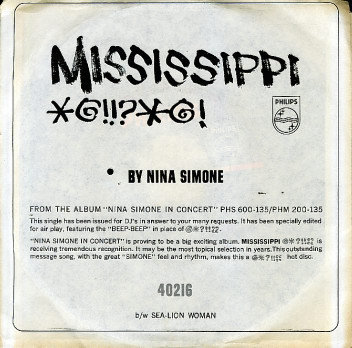
True Stories: Mississippi Goddam


Nina Simone: Mississippi Goddam
[purchase]

When I decided to write about this song, I had no idea that a couple of days later, Nina Simone would be nominated for the Rock and Roll Hall of Fame. Simone is one of those prodigiously talented artists who is widely influential, but has, I think, sort of fallen out of the conversation because of the course of her career, and her long illness and death back in 2003. I’ll admit that I was one of those who had heard her name, was familiar with a few songs, but really knew very little about her until I watched the 2015 documentary about her, What Happened, Miss Simone?

What happened was a sad combination of being an outspoken, black civil rights activist a few years before it wasn’t a career killer, mental illness, spousal abuse and poor advice, which resulted in Simone leaving the public eye for years, just when her music and message would probably have been successful. And it is likely that “Mississippi Goddam” was the turning point in her career, for better and for worse. I recommend reading her bio somewhere, or seeing the movie (or one of the other movies about her that are out there).

The song was written by Simone, reportedly in an hour, as a reaction to both the killing of Medgar Evers in Jackson, Mississippi and the bombing of the 16th Street Baptist Church, in Birmingham, Alabama, about three months apart in 1963.

Evers, a World War II veteran, became a leading civil rights activist, ultimately becoming the NAACP field secretary for Mississippi, where he led efforts to desegregate schools, beaches, parks, buses and the state fair, while also leading voter registration drives. He became a particular target of the White Citizen’s Council, and Evers survived two assassination attempts in May and June 1963 before being gunned down in his driveway. He was taken to a white hospital, where he became the first African American patient admitted to an all-white hospital in Mississippi, but he died within an hour of admission.

Byron De La Beckwith, a member of the White Citizen’s Council, and later on, the KKK, was arrested and charged with the murder, but all-white juries would not convict the piece of crap. It was not until 1994 that he was convicted and imprisoned, and he died behind bars in 2001, at the age of 80.

Evers has become a member of the pantheon of civil rights martyrs, and in addition to Simone, songwriters such as Bob Dylan, and Phil Ochs have written songs about him (one of which, I featured in the second piece I ever wrote for this blog). He has a college named after him, statues of him have been erected, and stories, books and films have chronicled his life and death.

A few months after Evers’ shooting, some KKK cowards dynamited a black church in Birmingham, killing four girls, Addie Mae Collins (age 14), Carol Denise McNair (age 11) (a friend of Condolezza Rice), Carole Robertson (age 14), and Cynthia Wesley (age 14) and injuring 20 more. The death of these four young girls has been credited with opening the eyes of many to the need for change. That being said, although the FBI had identified suspects, J. Edgar Hoover blocked any prosecutions at that time. Three of the four murderers were convicted much later, one in 1977, one in 2001 and one in 2002. The fourth escaped prosecution by dying in 1994. Not surprisingly, this incident has been memorialized in song, writing, sculpture and film.

Simone’s song was first released in a live version, recorded at Carnegie Hall in 1964. While the music is jaunty, its lyrics are not, and the performance includes a few pointed asides from Simone. Although the song became an anthem for the civil rights movement, Simone believed that it damaged her career, and that the music industry turned against her. It isn’t one of those songs that singers trot out anymore when they want to hearken back to the civil rights era, maybe because it isn’t a great sing along, and that’s too bad.

I heard “Missisippi Goddam” on the radio the other day in the car, and I was struck by how Simone married what sounds like happy music with such angry lyrics. It wasn’t the impetus for this theme, but when I realized that it fit, I had to write about it.

Wednesday, October 4, 2017

True Stories: Frankie and Albert


purchase [the Taj version]

Back when I was first learning how to play on stage, one night a friend of mine showed up with a friend of his and they played an impromptu version of Frankie and Albert. My guitar playing friend was good enough to manage on a one-man show. His friend, no less - he covered the rhythm section on a book - beating on the cover with a pencil and slapping it closed from time to time.
This is that kind of a song - so down to the "roots" that that all it needs to get its message across is the basics, and the story itself.
 

The provenance of the song appears to be muddy: credited to Bill Dooley and then Hughie Cannon and then made famous by Mississippi John Hurt, Leadbelly and [phew] ... go check the excellent and extensive link from planetslade below.


It's been covered all over the place - maybe best by Taj Mahal.

But is it a True Story? What is it's historical basis?
The song goes back to the early days of the blues, so I always assumed it must be based on some true account. The story is too elemental not to be so: the story of how he done her wrong ...


The panetslade site seems to have a pretty complete coverage of the history. They sez that the song about Frankie and Albert and the song Stagger Lee have tended to get mixed together - both based on <True Stories>. Do see the site by clicking the link above for their informative and entertaining details. It's extensive.


Some alternative versions


Jim Kweskin and Frank Muldaur above

Mr Harold Allen below


Sunday, October 1, 2017

True Stories: The Wreck of the Edmund Fitzgerald

Gordon Lightfoot: The Wreck of the Edmund Fitzgerald

[purchase]

I have enjoyed all of the hit songs I have heard by Gordon Lightfoot, but many have a 1970s commercial sheen in the production that has kept me from exploring his work further. My research for this post has me rethinking that position. Certainly, from the sound of the song, you can tell that this was released on a major label. There are no quirks or mistakes that can either ruin or give an intimate and personal quality to an independent recording. Still, The Wreck of the Edmund Fitzgerald is a song whose haunting quality grabbed me when I first heard it when it is was new, and the years have not changed that. What I found in researching the song is that many artists have tried and failed to create a quality cover of the song. I found folk versions that overdo the subtlety and lose the song’s haunted sound as a result. I found punk and hard rock versions that lose the song’s empathy by overdoing the drama. And there are jam band versions that lose track of the song altogether. Also, Gordon Lightfoot’s words have power, so instrumental versions exist for no reason that I can understand.

Our new theme is True Stories, and yes, there was a wreck of a ship called the Edmund Fitzgerald. Over the next two weeks, we may hear songs on happier topics, but some of the greatest tragedies in history have inspired great songs, so I am sure there will be more of those as well. The Edmund Fitzgerald sank, with all 29 hands lost, on November 10, 1975. You can find a great account of the incident here. Newsweek had a report of the wreck in their issue of November 24 that year, in which they misspelled the name of the ship, as the Edmond Fitzgerald. Gordon Lightfoot has said interviews that he felt this dishonored the men who died in the wreck and that this was why he wrote the song. The song must have come to him almost fully formed, because he recorded it in December of the same year. Lightfoot spelled the name of the ship correctly, but the song scanned and rhymed better when he changed the ship’s destination from Detroit to Cleveland. The old cook in the song was a Lightfoot invention, and some of the dialog in the song was not part of any official record. But the bottom line is this: Lightfoot’s song is the reason the wreck of the Edmund Fitzgerald is still remembered today, forty years later. And as popular as the original song was, no one has had even a minor hit with a cover in all these years. You have only to think of all of the other hits that have been covers in that time to realize how remarkable that is.

Thursday, September 28, 2017

Down: Down Where the Drunkards Roll

Richard and Linda Thompson: Down Where the Drunkards Roll

purchase]

I wish I could tell you that I own and know intimately the contents of every album containing every song I post here. Alas, no. So when this theme was announced, I immediately thought of Down Where the Drunkards Roll. But I was expecting it to be by Tom Waits. Indeed, the song is about the kind of people Tom Waits loves to write about, those down on their luck. Like Waits, the actual songwriter Richard Thompson does not ask for pity; rather, he finds beauty in lives most would dismiss. But, where Waits would have chosen a character, and presented his view of things, Thompson instead evokes a powerful sense of place. Thompson finds both depravity and madness here, but what he asks us to notice is that this place makes all of us equal. No one is judged, and some can return to their normal lives without consequence when the leave here.

Down Where the Drunkards Roll is also a wonderful vehicle for Linda Thompson. The song comes from a time when Richard and Linda were a couple, and at their creative peak together. Richard Thompson wrote here a perfect song for Linda Thompson’s voice, and she delivers the goods. While we are talking about the sound of the song, I believe the stringed instrument featured here is an autoharp.

Wednesday, September 27, 2017

Down: Geese


Camel: The Flight of the Snow Goose  
Anthony Phillips: The Geese and The Ghost
[purchase The Snow Goose]
[purchase The Geese and The Ghost]

One of the joys of a theme-focused blog is that it gives you a challenge to wrack your brain and try to think of a related topic. And it can be fun to take the theme to an unexpected place. Clearly, the obvious way to interpret “Down” is consistent with the thumbnail being used to illustrate the theme—“toward or in a lower place or position.” But the word has other meanings, including certain feathers of a bird used for insulation, often from a goose. So, here we are.

Camel is one of those English prog-rock bands from the 70s that had some success, both critically and commercially, but aren’t generally grouped in the top tier of the genre’s acts. Nevertheless, they released a bunch of good albums and have continued to perform and record until the present day, with a dizzying revolving door of members surrounding founding member Andrew Latimer.

After releasing two albums with minimal success, the band decided to try a concept album. Rejecting a few novels to base their work on, they ultimately decided to attempt to create a work based on a 1941 novella by Paul Gallico (a prolific writer probably best known for The Poseidon Adventure), titled The Snow Goose. It tells the very sentimental story of the friendship and love between Philip Rhayader, a disabled artist living in a remote lighthouse in Essex, England, and a local girl, Fritha. A wounded snow goose is nursed back to flight by Fritha, whose friendship with Rhayader grows, while the goose returns over the years to the lighthouse. Rhayader uses his sailboat to rescue hundreds of soldiers in the Dunkirk evacuation, but is lost. The goose finds Fritha on the marshes, which she interprets as Rhayader’s soul leaving her, and she realizes her love for the lost man. The lighthouse is leveled by German aircraft, destroying all of Rhayader’s work, except for a portrait of Fritha, as a child, holding the injured snow goose.

The story struck a chord, and the book won an O. Henry Prize in 1941. It was read on the radio in 1944, turned into a BBC TV movie in 1971 featuring Richard Harris (as the goose—just kidding), and that won a Golden Globe and was nominated for both a BAFTA and Emmy. When Camel announced that it planned to release their musical adaptation of the book, Gallico gallantly threatened to sue the band (yay, lawyers!), so they were forced to call the album Music Inspired By The Snow Goose, and they had to abandon the idea of using lyrics based on the text, rendering the album fully instrumental. Despite these obstacles, the album, released in 1975, was both a critical and commercial success.

It is a beautiful, moving work, featuring rock instrumentation along with the London Symphony Orchestra (and, on one song, a duffle coat, used to simulate the flapping of wings). It is hard to pick a favorite song, but to be theme-appropriate, I picked “Flight of the Snow Goose,” which starts off slowly, but builds to a triumphant end.

In doing my research for this, I found a review which claimed that the Gallico novella also inspired another song, Anthony Phillips’ “The Geese and The Ghost.” Turns out, that isn't true. In fact, the title derives from two sounds on the ARP Pro-Soloist synthesizer which was used on the album.

Phillips was the original guitarist in Genesis, but left after recording their second album, Trespass, ultimately being replaced by Steve Hackett. Phillips left due to a combination of stage fright and other health reasons, and an aversion to being in the public eye. After leaving Genesis, Phillips decided to study music, and didn’t record anything for a number of years. His solo debut, The Geese and The Ghost, featuring some music that he had worked on while still in Genesis with friend and former schoolmate Mike Rutherford, and solo compositions, was released in 1977.  In addition to Rutherford, Phil Collins provided some vocals (recorded before he succeeded Peter Gabriel as Genesis’ singer) and Hackett’s brother John added flute.

In general, the album is somewhat folky, with orchestral flourishes, and the title track is beautiful. Genesis fans could definitely hear a kinship to some of the quieter moments of Trespass. Phillips went on to release music to little commercial success, more successfully create “library music” for use in films and TV shows, and appear on other artists' albums playing guitar and keyboards.

In fact, in 1982, Phillips appeared on Camel’s album The Single Factor, and co-wrote a song with Andy Latimer. That album is utterly devoid of any goose-related material (which unfortunately cannot be said of our local athletic fields).