Thursday, May 3, 2018
Punk: Punky Reggae Party
Bob Marley & The Wailers: Punky Reggae Party
[purchase]
On the one hand, punk music and reggae don’t appear to have much in common musically—one is hard, fast, aggressive, and loud, the other, more laid back, slower, and mellow. I think that it is fair to point out that both styles arose as music of angry, rebellious, disaffected youth, making their philosophical connections more obvious than their musical connections. And yet we know that there has been a strong merger of the two styles, by bands like The Clash, the Two Tone bands, and in the ska-punk genre.
So, how did this marriage get arranged? Not having a clue, I turned to Google, which served me up this article that makes the case that the matchmaker was Don Letts.
Letts was born in England, of Jamaican heritage, and ran a London clothing store popular with musicians from both the punk and reggae scenes. He was able to meet Bob Marley after a gig, and they became friendly. When the Roxy nightclub opened, catering to the emerging punk scene, Letts became the DJ, and began to spin reggae and dub songs, along with punk music, in large part because the scene was so new, there weren’t that many punk records to play. Apparently, the punks enjoyed the music, including Joe Strummer of The Clash, and members of The Slits and The Sex Pistols.
Meanwhile, Letts convinced Marley, who appeared to have a negative feeling about punk based on sensationalist tabloid newspaper articles rather than from actually listening to the music, that it was worthwhile. According to Letts, he went to collect some money from Marley, dressed in punk bondage clothing, and Marley mocked him, to which Letts responded, “They ain't no crazy baldheads, they're my breddrin.” Shortly thereafter, inspired by the message and the music of punk rock (and by The Clash’s cover of the reggae song “Police and Thieves”), Marley wrote “Punky Reggae Party,” which referenced punk and New Wave, and namechecked The Clash, The Jam, The Damned, Dr. Feelgood (really more of a pub rock than a punk band, but whatever), as well as The Wailers and The Maytals. But even more importantly, Marley makes sure to point out that while all of those musicians would be at the party, “no boring old farts will be there.”
Letts went on to a career as a musician, most notably as a member, along with former Clash member Mick Jones, of Big Audio Dynamite, which mixed many genres of music, including punk and reggae where his role was, mostly, to supply audio samples to the songs. But he is best known as a filmmaker and video producer.
And the punk and reggae marriage remains strong to this day.
Posted by Jordan Becker at 8:00 AM View Comments
Labels: big audio dynamite, Bob Marley, Don Letts, Dr. Feelgood, Joe Strummer, Mick Jones, Punk, Rancid, The Clash, The Damned, The Jam, The Sex Pistols, the Slits, The Wailers, Toots and the Maytals, Two Tone Ska
Thursday, April 26, 2018
Punk: Fly The Flag
Stiff Little Fingers: Fly The Flag
[purchase]
It is a complete coincidence that our Punk theme follows our Jokes, Pranks & Fools theme, since one of the meanings of being punked is being the victim of a prank. Although people may go there, I suspect that most of the posts over the next couple of weeks will be about punk music (or songs with the word in the title).
As I think I’ve mentioned somewhere before, when I showed up in college in 1978, I had begun to dip my toes into “New Wave” music, but found “punk” music, such as The Ramones and The Sex Pistols, to be basically unlistenable. It didn’t take too much time working at WPRB before I did a full 180 on that, and began to appreciate much of what is called punk. That being said, my tastes have always leaned toward punk bands that could write good tunes, and still have problems with some of the more hardcore bands that sound like a bunch of screaming. But that’s me.
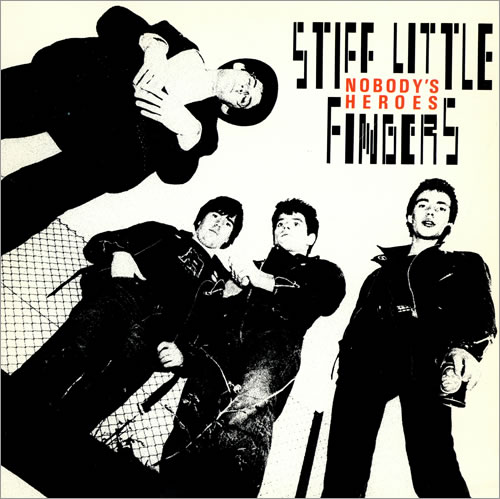
Stiff Little Fingers was a band that I fell hard for, and fast. My introduction to them was their second album, Nobody’s Heroes, which came out in 1980. It was only later that I discovered their excellent debut album, Inflammable Material, and the song that vaulted them to prominence, “Alternative Ulster.” It was clear that SLF were a political band—the first album was mostly about the “Troubles” in their native Belfast, and I learned, much later, that the advance that they got from Chrysalis Records before recording Nobody’s Heroes allowed most of the members to flee to the relative safety of London.
“Fly The Flag” was the song that stuck out to me then, and I still like it today, despite the fact that it doesn’t seem to be one that gets mentioned much in discussions of the band or its music (and it doesn’t even make some of their “best of” collections, which is crazy). It is anthemic and stirring, but its energy, and singer Jake Burns’ gruff vocals, place it clearly in the punk style. The song is also, from start to finish, sarcastic. It appears to be sung from the viewpoint of an ultra-conservative super patriot, similar to the rhetoric advanced by the fascist National Front in Britain at the time. But because the message of the song seemed so contrary to the band’s other music, it was clear that they were mocking that position, not supporting it. (You had to be careful, because other punks at the time did support racist and nationalist policies). If anything was a giveaway, though, it was the repeated “gimme gimmes” that made it clear that they were pointing out the selfishness of the ostensible narrator and his ilk.
Burns has written that the song was a response to the Thatcher generation, and “the whole ‘me, me, me’ attitude and the naked greed that was around at the time.” But he was horrified when National Front supporters took the song at face value.
When I started writing this, I just wanted to discuss a band that I haven’t written about, and a song that I like. But when I listened to it again, it struck me that it works today (with a minor change of venue) as a satire of Trumpism, with its cruel anti-immigrant and nativist sentiment, its greedy social Darwinism, and mocking of the “helpless.” I mean, here are just some of the lyrics:
Gimme a nation where people are free
Free to do and free to be
Free to screw you before you screw me
And
Gimme a Britain that's got back the Great
A race of winners not cramped by the State
And only the helpless get left at the gate.
SLF put out an excellent live album and another studio album, both of which I played the crap out of on the radio. They released one more studio album in late 1982, which I have no recollection of, before disbanding. They reformed in the late 1980s, with former Jam bassist Bruce Foxton replacing original member Ali McMordie, and have put out albums and toured, with some lineup changes, on and off since then. I admit to not being aware of any of this music.
Posted by Jordan Becker at 9:00 AM View Comments
Labels: Punk, Stiff Little Fingers, The Jam
Thursday, November 2, 2017
Train: Somewhere Down The Crazy River
Robbie Robertson: Somewhere Down The Crazy River
[purchase]
Writing for three different music blogs often results in crossover posts. I wrote about The Jam here recently, and have just submitted a piece about another Jam song to Cover Me. And I recently wrote about The Last Waltz at Another Old Guy, so I guess that I have Robbie Robertson on my mind.
Strangely, though, this song popped into my head, despite the fact that its title doesn’t have the key word in it, and would seem more appropriate for a Boat theme. And yet, it works. It took Robertson 11 years before he released his first, self-titled, solo album in 1987, and tried to stretch beyond the Americana sounds that he played for so many years with The Band. The album was produced by Daniel Lanois, who was also working with U2 and Peter Gabriel at the same time, and all of the members of U2, as well as Gabriel and members of his band all appear on the album. Lanois’ typically dreamy, atmospheric sound pervades the album.
“Somewhere Down the Crazy River” is an odd song.
Robertson only sang lead on two Band songs, and Levon Helm has claimed that Robertson’s mic was off during the Last Waltz
concert (and the Internet rumor mill has his mic off during most Band
shows), so it is not Robertson’s singing that he will be remembered for.
According to Lanois, he secretly recorded Robertson telling a story about hanging out with Levon Helm in Arkansas, fishing with dynamite on hot nights. Because that’s apparently what one does. Meanwhile, Robertson was fiddling with a Suzuki Omnichord, which Lanois also recorded, and he superimposed the storytelling over that, creating the basic tracks for the song. In between the spoken word parts, which have a sort of Tom Waits feel, Robertson sings, perfectly well, I might add:
Catch the blue train
To places never been before
Look for me
Somewhere down the crazy river
Catch the blue train
All the way to Kokomo
You can find me
Somewhere down the crazy river
In each case, the second “Somewhere Down the Crazy River,” is sung, somewhat distorted, by Sam Llanas of The BoDeans. Also featured on the track are fine bass playing and drumming by Tony Levin and Manu Katché, both of Gabriel’s band (among other things). And Bono is somewhere in the mix, too.
It is curiously compelling, which is a tribute to the combination of Robertson’s charismatic, deep voice, his storytelling ability, Lanois’ production and the talent of the musicians. And despite its unconventional sound, it was released as the album’s first single, and was successful.
The video for the song (above), was directed, like The Last Waltz, by Martin Scorsese, whose infatuation with Robertson’s face was still in force. Robertson’s lust interest is played by Maria McKee, at the time the lead singer of the pioneering “cow-punk” band Lone Justice, who were a mid-80s “next big thing” that never happened. Which in itself was sad, since McKee’s voice is incredible (and her solo career never went anywhere, either). She sings on a different song on the album, and one can only assume that she was chosen to be in the video for her looks. When asked about her “acting skills,” McKee was quoted as saying: "... what did I do, I was just being licked by Robbie..."
Posted by Jordan Becker at 8:30 AM View Comments
Labels: Bono, Daniel Lanois, Levon Helm, Lone Justice, Maria McKee, Peter Gabriel, Robbie Robertson, The Band, The BoDeans, The Jam, Train, U2
Thursday, October 12, 2017
True Stories: The Eton Rifles
The Jam: The Eton Rifles
[purchase]
I’ve never written about The Jam, which on one hand is surprising, because they are an amazing band, with great songs, who were on top of their game back in my WPRB days (and very shortly thereafter). On the other hand, though, they are a band that were much bigger in England than they ever were in the States, in part—if not mostly—because they often wrote about specific British issues and sensibilities that didn’t directly resonate here.
“The Eton Rifles” was written by Paul Weller in response to a news account about a street brawl that took place in Slough, in 1978 between “Right To Work” marchers and the upper class students who were members of the Eton College Combined Cadet Force, colloquially known as the Eton Rifles. The marchers were unemployed, and the march was sponsored by the Socialist Workers Party, and they were being jeered by the Eton students. Apparently, the marchers took exception to the taunting from the rich kids, and wanted to teach them a lesson. But the students were in better shape, and routed the workers, leaving them beaten and bloody.
Weller, who was trying to write more political songs, seized upon this clear example of the entrenched class system’s oppression of the working class to write a powerful song that clearly was sympathetic to the workers and mocked the posh schoolboys to make a point about the worsening divide between rich and poor. Although the song was written about a specific time and place, its message about the class divide is sadly still resonant on both sides of the Atlantic.
I saw The Jam in May, 1982 at the Trenton War Memorial with a bunch of my WPRB friends. It was probably one of the last shows that I saw as an undergraduate. What I remember most about the show was that it was fucking loud. At that point, the band was moving away from its harder edged sound and incorporating more Northern Soul influences, but without abandoning the strong working class political message. Apparently, Weller’s insistence on changing the sound resulted in the band’s breakup later in 1982, and the other members of The Jam, Rick Buckler and Bruce Foxton, didn’t speak with Weller for decades.
In 2008, the British Conservative Prime Minister David Cameron, an Etonian, somewhat inexplicably picked “The Eton Rifles” as a favorite song, stating, “I was one, in the corps. It meant a lot, some of those early Jam albums we used to listen to. . . I don't see why the left should be the only ones allowed to listen to protest songs." Weller, a bit dumbfounded (gobsmacked?), responded: "Which part of the song didn't he get? Did he think it was a celebration of being at Eton or something? I don't know. He must have an idea what it's about, surely? It's a shame really that someone didn't listen to that song and get something else from it and become a socialist leader instead. I was a bit disappointed really." Of course, our country has examples of conservative politicians misunderstanding lyrics.
Interestingly, the background vocals, credited to the “Eton Rifles Choir,” were a bunch of random people hanging around the studio. They were recorded in the same room that Phil Collins used to create the famous drum sound used in “In the Air Tonight.” Also, there’s a subtle swipe at The Clash in the lyrics, because Weller thought that they weren’t really as committed to the revolution as they claimed.
Posted by Jordan Becker at 8:30 AM View Comments
Labels: Paul Weller, The Jam, True Stories
Tuesday, October 27, 2015
Cartoons/Comics: Winged Mammal Theme
R.E.M.: Winged Mammal Theme
[purchase]
I’m a little obsessed with baseball right now, on the verge of Game 1 of the World Series. As a Mets fan, this has really been an unexpected and exciting playoff run. I’ve already discussed this in my Future post, and I’ve also written about tonight’s Game 1 starter, Matt Harvey, the Dark Knight of Gotham.
Which brings me to today’s discussion of Batman. I was utterly unaware of the Batman comics that predated the TV series that ran from January 12, 1966, to March 14, 1968. I have a pretty strong memory of watching maybe the first episode as a young child, and watching many more episodes, either during the initial run, or after school in syndication. I’m sure I knew that it was silly, even before I understood the concept of “camp.”
I never read any of the later Dark Knight stuff, or any of the later Batman comics, and while I remember seeing the Tim Burton/Michael Keaton Batman movie, I can’t remember whether I’ve seen any of the sequels or reboots (although I’m pretty sure I saw the one with George Clooney). Because I really don’t care all that much.
In fact, after all these years, it is probably the great theme song from the TV series that I remember the most. Written by the great musician, composer and arranger Neil Hefti (who also wrote the Odd Couple theme), the version that played during the credits is faster, and was arranged by the great composer and arranger Nelson Riddle. And I’m obviously not the only one with the song stuck in my brain, because the “Na na na na na na…..Batman!” meme is pretty much ubiquitous on the Internet. (There are, apparently 80 “nas” in the theme.) You can even buy shirts with it.
Considering the theme’s exalted place in popular culture, it is not surprising that it has been covered many, many times, by bands as diverse as Jan & Dean, The Jam, John Zorn, Serbian alternative band Disciplina kicme, The Who, Link Wray, The Ventures, and The Standells (and yes, I know I'm leaving some out).
R.E.M. submitted their reimagining of the theme for inclusion in the soundtrack of Batman Returns, the sequel to the first Burton/Keaton film. It was rejected, and instead became the B-side to the “Drive” single, and has been included in a few box sets and anthologies. It actually hit #11 on the UK charts, and was used by the Weather Channel under local weather updates.
Pow!
Posted by Jordan Becker at 8:30 AM View Comments
Labels: Batman, Cartoons and Comics, Disciplina kicme, Jan & Dean, John Zorn, Link Wray, R.E.M., The Jam, The Standells, The Ventures, The Who
Tuesday, July 7, 2015
Colors of the Rainbow: Pink City Twist
[purchase]
The Colors of the Rainbow theme was specifically chosen to celebrate the decision of the United States Supreme Court in Obergefell v. Hodges, which determined that the United States Constitution required that a marriage between two people of the same sex be treated the same as a marriage between two people of different sexes. In other words, mandating that same sex marriage be legal throughout the United States. Following the announcement of the decision, the rainbow flag motif has been everywhere. In addition, coincidentally, just the other day, the United States Women’s Soccer team, coached by an openly gay woman, with two proudly gay stars, one of whom is already married (and a few other players who have, at least, hinted at being lesbians) won the Women’s World Cup, and the adulation of men and women of all sexual preferences. While certainly not perfect (anti-discrimination laws still need fixing, and acceptance still isn’t universal, but it will never be considering that there are always going to be small minded people who reject logic and progress), I think that it is fair to say that this is the best time ever to be gay in the United States.
I was ecstatic when the Court issued its decision. It doesn’t directly affect me—I’m a straight man in a “traditional marriage” (whatever that means), and both of my children are currently in heterosexual relationships. But as a human, an American and a lawyer, it was hard for me to understand exactly what the Equal Protection Clause of the Fourteenth Amendment meant if it didn’t mean what it said—that no state could “deny to any person within its jurisdiction the equal protection of the laws.” I never understood how anyone could read that and think that it was acceptable to allow some people to marry and not others. So, to see that five Justices of the Supreme Court finally realized that this was the case was a beautiful thing. That four Justices couldn’t see it was disappointing, if not surprising, considering the degree of brainwashing (mostly religious based, in my opinion) that our country has tolerated for years against gay people. I can’t think of many days that I was prouder to be an American than on June 26, 2015.
And, as long as this struggle has taken, it is remarkable how quickly things have changed. When I was a kid, the concept of gay rights was never discussed. Even in my liberal home, in a pretty open minded area of the world, it simply wasn’t a topic of conversation. I don’t remember anyone in my high school identifying as gay, and to be fair, I don’t remember any overt anti-gay activity or taunting. Which is not to say this was a good situation—it was simply swept under the rug, presumably out of fear of ostracism, or worse. In fact, it wasn’t until 1980 that the New York Court of Appeals struck down all laws against private consensual homosexual sexual conduct between adults, a decision that had no resonance in my life (the decision warranted only a small story on page B2 of The New York Times). If my memory is wrong, then I hope that my high school friends set me straight (no pun intended). In college, in the late 1970s and early 1980s, I was aware of the existence of a Gay Alliance, and parties sponsored by gay groups, but again, I have no memory of anyone in my circle of friends identifying as gay. I’m actually surprised at how many of my college friends are gay, and embarrassed that I didn’t know it then, either because I never even considered the possibility or discussed it, or because they were uncomfortable being out in that place at that time.
My children’s generation is completely different, and that shows how things have changed, for the better. From a love that dare not speak its name, to joyous celebrations of pride, attended by everyone and anyone.
To my children, a person’s sexuality is not an issue. They have had friends come out in high school with essentially no difficulties. The high school they attended has a gay-straight alliance. They both went to colleges where there was zero stigma attached to homosexuality—in fact, at my daughter’s college it seemed that gay culture was actually the more dominant (or at least the most vocal).
I know that it is probably a cliché to say that the next generation will look at mine and shake their head at the fact that it took so long to recognize that Obergefell was the only logical conclusion that could be drawn from the Fourteenth Amendment, like my generation has trouble believing that it took until 1954 for the Supreme Court to rule that “separate but equal” treatment of blacks also violated the Constitution. And they will look at the four Obergefell dissenters as troglodytes whose reason was overwhelmed by their prejudices, like the seven Justices in the Dred Scott or Plessy majorities.
So the theme is to write about colors of the rainbow, and despite the fact that the color pink isn’t on the standard ROY G BIV rainbow, there is a long-standing relationship between the color and the gay community. I have to assume that the Nazis chose it as the color for the triangle badge they forced gay prisoners to wear for a reason (no quick answer presented itself through a Google search, and this is a music blog and not a research paper). And like so many slurs, it was later adopted as a symbol of pride. Pink was originally part of the rainbow flag designed by Gilbert Baker in 1978 for San Francisco’s first Gay Freedom Day Parade, but as demand increased, the pink stripe was removed because of the difficulty in obtaining enough fabric.
When I tried to think of a song about the color pink, there were a few that seemed to fit, but none seemed as much fun as this goofy trifle from the pretty much forgotten band The Fabulous Poodles, a band whose first album was produced by the Who’s John Entwistle, who also played bass on it. Although initially a pub-rock act, like many of their contemporaries, they morphed into a new wave band, with poppy songs and zany stage antics. Their first American album, Mirror Stars, was released on pink vinyl and reportedly outsold the debut albums from The Jam and The Clash. They even opened for the prog-rock supergroup UK on some dates in 1978, which would have made for an odd, if strangely entertaining, evening of music.
The sort of title track from their next record, Think Pink, “Pink City Twist” is essentially a surf-rock sounding instrumental track with heavy breathing and the occasional interjection of processed vocals saying “Think Pink.” I know that description doesn’t make you want to listen to the tune, but give it a listen and I guarantee that it will become lodged in your brain, like it has in mine for more than three decades.
Posted by Jordan Becker at 9:14 AM View Comments
Labels: Colors of the Rainbow, John Entwistle, The Clash, The Fabulous Poodles, The Jam, The Who, UK
Sunday, May 16, 2010
Street Names: 'A' Bomb on Wardour Street
The Jam: 'A' Bomb on Wardour Street
[purchase]
Wardour Street runs through Soho, central London. When this song was released in 1978, Number 90 Wardour Street was home to The Marquee Club and hosted upcoming British groups like The Stranglers, Joy Division, The Buzzcocks, Generation X, The Cure, and our featured band, The Jam.
The Jam were heavily influenced by earlier mod power pop groups like The Who, The Small Faces, and the Kinks, and they led a mod revival in the late 70s. One of the unfortunate side effects of the musical revival was a resurrection of violence among British subcultures who bolstered their identities from the music. The 60s saw mods against rockers (remember Quadrophenia?); in the 70s, that animosity reignited, with skinheads and Teddy boys joining in for kicks.
'A' Bomb in Wardour Street is a diatribe against the skinheads and punks who brought violence into the clubs, and describes an attack by Doc Martin-shod thugs: I'm stranded on the vortex floor/My head's been kicked in and blood's started to pour/Through the haze I can see my girl/15 geezers got her pinned to the door. It's a two-chord rant that borrows more from The Clash than from The Who, harsh and vitriolic—and effective.
A P O C A L Y P S E !
Posted by Geoviki at 7:28 PM View Comments
Labels: Street Names, The Jam
Monday, February 23, 2009
Shorties: All Mod Cons
[Image removed by request from the creator]
The Jam: All Mod Cons
[purchase]
All Mod Cons (short for All Modern Conveniences) is the title track to what is certainly one of my 20 favorite records of all time. In this short 1:20 song, Paul Weller rails against those in the music industry who glom onto every hot band, but abandon them just as quickly if the money stops coming in.
Seen you before, I know your sort, You think the world awaits your every breath. You'll be my friend, or so you say, You'll help me out when the time comes.
And all the time were getting rich, You hang around to help me out. But when were skint, oh God forbid! You drop us like hot bricks
Artistic freedom. do what you want. But just make sure that the money ain't gone. I'll tell you what, I got you sussed, You'll waste my time, when my time comes.
Posted by bwrice at 7:46 PM View Comments
Sunday, June 22, 2008
Songwriting: Little Boy Soldier
The Jam: Little Boy Soldier
[purchase]
I plan to approach this new theme, at least in part, by discussing the various ways that artists become inspired to write. I have at least three posts in mind, and this is the first.
Imitation: One way to write music is to use your favorite bands as inspiration. It's well known, for example, that John Lennon was trying to write like Dylan when he wrote both Hide Your Love Away and Norwegian Wood. Neither of these songs sound particularly like Bob Dylan, but imitation was the doorway to inspiration for Lennon in both of these cases.
Paul Weller of The Jam has always been a vocal fan of The Kinks. The Jam covered David Watts on their All Mod Cons album, and they have covered many other Kinks songs in live performances. In an interview at the time of the release of their fourth studio album, Setting Sons, Weller said that they entered the studio specifically setting out to make something like a Kinks album.
Weller has stated publicly that the featured track, Little Boy Soldier, was a specifically deliberate attempt to write a song like The Kinks. You can judge for yourself whether or not their imitation was successful. As far as I'm concerned, as with Norwegian Wood, whether or not the end product actually sounds like the imitated artist is not as relevant as whether or not it is worth hearing in and of itself.
Posted by bwrice at 9:10 AM 4 comments
Labels: songwriting, The Jam
Monday, June 9, 2008
Advice: Town Called Malice
The Jam: Town Called Malice
[purchase]
Paul Weller et al., give us some sound advice with a Supreme's Can't Hurry Love bass line as a backdrop. The Jam was one of my favorite bands in the 80's and they still are today. Why they never got a more solid following in the U.S. is one of the great mysteries of that whole period of music as far as I'm concerned.
This is Town Called Malice, off of their last LP, The Gift:
Better stop dreaming of the quiet life -
cos it's the one we'll never know
And quit running for that runaway bus -
cos those rosey days are few
And - stop apologising for the things you've never done,
Cos time is short and life is cruel -
but it's up to us to change
This town called malice.
Posted by bwrice at 9:34 AM 0 comments
Wednesday, April 23, 2008
Spring & Flowers: English Rose
The Jam: English Rose
[purchase]
For me any excuse to feature a song by The Jam is a good excuse. This tune is not about spring, or even really about Roses, but it does have the word Rose in the title and several times in the lyrics. This is one of the more melancholy Jam songs, with Paul Weller traveling the world, but pining for his native land, his English Rose.
Posted by bwrice at 8:16 PM 1 comments
Labels: spring and flowers, The Jam