Showing posts with label Rick Wakeman. Show all posts

Sunday, July 11, 2021

2021-50=1971: Yes


purchase [The Yes Album and Fragile ]

I don't recall having ever seen an album production credit for "bank loan arrangement" before. It equally stikes me as strange considering that the album where I saw it was produced immediately on the heels of an apparently successful tour supporting the release of The Yes Album that same year. Woulda thought they had made some money? One explanation is that they needed money to buy equipment for their newly added keyboard player, a man named Rick Wakeman.

So, in February, Yes released The Yes Album, in the summer, keyboardist Tony Kaye is removed from the band, Wakeman joins, and in November, they release >Fragile<.

The addition of Wakeman accomplished the band's intentions to give more prominence to electronic keyboards, and it was Kaye's reluctance to go down that path that led to his departure. 

Of these two 1971 albums, my personal preference is for The Yes Album - Fragile, perhaps because it was a bit rushed into completion, perhaps because Wakeman was still new to the group - doesn't seem to have the cohesion of a "band", but a band that does actually come together on their next album, Close to the Edge. The Yes Album is the product of a group that is working together and on the verge of defining the prog rock genre. The Yes Album is the band's third and the first with guitarist Steve Howe (who appears above at far right in the photo on the album cover of the 2nd album without having actually played on it). 

Shades of Genesis?


Monday, October 21, 2019

Witch: Anne Boleyn 'The Day Thou Gavest Lord Hath Ended'


Rick Wakeman: Anne Boleyn 'The Day Thou Gavest Lord Hath Ended'
[purchase]

Today, we are going to debunk two myths.

First, Anne Boleyn, King Henry VIII’s second wife and Queen of England from 1533 to 1536, was not a witch, although she has been accused of being one in popular culture. In fact, her execution was based on (probably false) claims of adultery, incest, and high treason designed to get her out of the way so that Henry could move on to wife III. But she was an incredibly divisive figure in English life of the day, ascending to the throne after the controversial end of Henry’s marriage to Catherine of Aragon and otherwise contributing to the move of England from Catholicism to Protestantism. The politics of this period is fiendishly complex, with lots of players and shifting alliances, so, I’m not going to even try to explain all of this. I do recommend reading Hilary Mantel’s novels about this period, Wolf Hall, and Bring Up The Bodies, or watching the PBS adaptation of them, Wolf Hall, in which Claire Foy portrays Anne (before being cast in The Crown as the young Queen Elizabeth II, who was a descendant of Anne’s older sister Mary, a mistress of Henry VIII before her sister took her place. Like I said, complex.).

It seems that the witchcraft allegations stemmed from two main sources all derived from basic misogyny—first, if you were a powerful woman, and had enemies (and Anne fit that bill perfectly), it was likely that you would be called a witch. For example, while many contemporary commentators remarked on Anne’s beauty, brilliance and charm, one Catholic writer, long after her death, described Anne as having a “protruding tooth,” a “large wen (growth) on her neck,” and six fingers. You know, sort of like a caricature witch. There is no claim, however, that she wore a pointy hat, rode a broom, or weighed as much as a duck.

The second basis for the claim that Anne Boleyn was a witch is based on a comment reportedly made by Henry VIII, not the most reliable of narrators, to be sure, that he had been “seduced and forced into his second marriage by means of sortileges and charms.” “Sortilege,” however, appears to have been used to mean “bewitched or enchanted” in both the supernatural and non-supernatural sense, and there is significant evidence that Henry was smitten by Anne’s beauty, intelligence, charm, and expertise in flirting, and not so much by witchcraft.

If you are really interested in delving more into this question, check out this page.

Myth 2—Rick Wakeman’s 1973 album, The Six Wives of Henry VIII, is a terrible example of the worst excesses of progressive rock. Yes, it was a concept album about historical figures, and yes, it is mostly Wakeman showing off his talent on various keyboards and synthesizers, and yes, there are moments of pomp and excess (which, to me, can have their place, anyway). But overall, the album contains beautiful music and great musicianship. And there are many, many worse examples of over the top prog pretension, so I think that, in retrospect, at least, the album holds up reasonably well.

The album was inspired by Wakeman’s dissatisfaction with his playing on his first tour with Yes, and his attempt to find a personal style. In an airport in Richmond, Virginia, Wakeman bought a copy of The Private Life of Henry VIII by Scottish writer Nancy Brysson Morrison, and the chapter on Anne Boleyn reminded him of a musical idea he had previously recorded. Wakeman decided to focus on each of the wives, “interpreting the musical characteristics of the wives of Henry VIII. Although the style may not always be in keeping with their individual history, it is my personal conception of their characters in relation to keyboard instruments.”

Listening to his take on Anne Boleyn, can I hear “a tribute to her feisty temper and valiant courage that she maintained while standing up to her husband,” as the Allmusic reviewer heard? Maybe, but overall, it is a nice piece, and not, to my hearing, excessive or bombastic. Plus, it has Bill Bruford on drums, which to me is always a positive.

Monday, February 5, 2018

Aliens: Flight of the Moorglade


Jon Anderson: Flight of the Moorglade
[purchase]

Reading my music writing probably might give you the impression that I listen to prog rock all the time, but I don’t. More than anything, I listen to what would be classified as Americana music, but I am clearly an unrepentant lover of progressive rock. But just because I enjoy the music, that doesn’t mean that I can’t mock some of its excesses. And maybe the easiest things to make fun of about the 70s prog that I enjoy are the concept albums, with their often bizarre narratives. I mean, there are some pretty straightforward ones, like Rick Wakeman’s Journey to the Center of the Earth, essentially a dramatization of the Jules Verne novel, or Gryphon’s Red Queen to Gryphon Three, about chess (a hidden gem, by the way), or even Pink Floyd’s The Wall, basically a story about a person's difficult childhood and life.

But then there are the crazy ones, like Gong’s acid-fueled three album Radio Gnome Trilogy, or pretty much anything by Magma, or Genesis’ The Lamb Lies Down on Broadway, which purports to be about a Puerto Rican youth living in New York City, but turns surreal (and is one of my favorite albums, anyway).

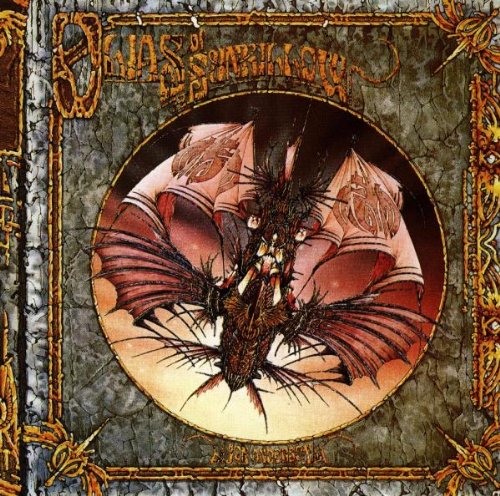
This genre of music, which is often tied up with fantasy and science fiction, is ripe for stories of aliens and interplanetary travel (although as we have seen, other genres go there, too.) And thus, we come to Jon Anderson’s Olias of Sunhillow, the Yes singer’s solo debut, released in 1976, after Yes released Relayer (an album that I have zero memory of) and before Going For The One (which I enjoyed more), during a period when the band’s members were all releasing solo albums. Wikipedia describes the album as telling:

the story of an alien race and their journey to a new world (the story printed in the LP jacket calls it "the earth", lowercase 'e') due to a volcanic catastrophe. Olias, the title character, is the chosen architect of the glider Moorglade Mover, which will be used to fly his people to their new home. Ranyart is the navigator for the glider, and Qoquaq (pronounced 'ko-quake') is the leader who unites the four tribes of Sunhillow to partake in the exodus. 

Now, let me start off by saying that I like this album, and particularly the featured track, very much. Anderson is credited with all of the voices and instruments on the album, which took two years in conception, and 8 months of work, to record. There have long been rumors that Vangelis, who had unsuccessfully auditioned for Yes at that time, and who Anderson collaborated with, played some of the parts, but both men have denied this, and unless Devin Nunes has a memo to the contrary, I see no reason to dispute that (actually, if Nunes had such a memo, it might be more likely that I’d take a contrary position, but I’m going off the rails here).

If you want a chuckle, go ahead and read the whole elaborate story, which was printed on the inner album sleeve. And because most of you won’t buy the album, here’s a link to a website devoted to Olias of Sunhillow which contains the story, and more.

Meanwhile, it appears that Anderson has been working on a sequel to Olias since 2001, to be called The Songs of Zamran: Son of Olias, and as recently as 2014, Anderson confirmed that he is still working on it. Based on his comments over the years, it will be a multi-hour work, and possibly released as an app, including visuals. Here's a preview, from 2013.  And why not, I say?