












Showing posts with label Jon Anderson. Show all posts

Friday, October 22, 2021

Rock Hall Snubs: King Crimson


King Crimson
: The Court of the Crimson King
[purchase The Condenced 21st Century Guide to King Crimson 1969-2003

I think that it was in the Bill James Historical Baseball Abstract that I read, years ago, something like the only definition of who belongs in the (baseball) Hall of Fame is who gets elected. In other words, even in a statistically driven sport such as baseball (which has become even more so due to the work of James and fellow sabermetricians), there’s no formula to decide who belongs. James, and others, have created various predictive formulas, but they are not an attempt to determine who deserves to be in the Hall, but rather to predict whether the player’s statistics are the type that would convince the voters to vote them in. 

This type of determination is even harder to do with the Rock Hall, because there are no stats, really, other than maybe sales, or streams, or concert attendance-but I think most people (at least most people who read this type of blog) are unwilling to equate popularity with quality. Although it is nice when it happens. For the Rock Hall, it sort of just comes to down to gut feelings, considering some objective, but mostly subjective factors—plus a fan vote. Of course to be fair, it is hard to take the Rock Hall all that seriously when it inducted Bon Jovi a few years ago. 

My pitch today is for King Crimson, which based on the number of times I’ve written about them, their music or their members (see here, here, here, here, here, here, here, here, here, here, here, here, here, and most recently, here), you might assume are my favorite band. They aren’t (don’t ask me what is, though). But when you look at the quality and variety of their work, the length of their career, even with all of the interruptions, and most notably, the influence of the band on so many genres of music, it is hard to justify their exclusion. There is one full member of King Crimson who is a Rock Hall inductee (and another performer who sang one song for Crimson who is in the Hall……the answer will be at the end of this piece). 

It is hard to argue that King Crimson did not influence, among other genres, progressive rock, hard rock, various forms of metal, jazz/rock fusion, punk, new wave, grunge, math rock, jam bands, noise rock, and even hip-hop. There’s a nice summary of some of this in Wikipedia, or just Google “King Crimson influence” and fall down the rabbit hole. 

Also, arguably, Robert Fripp belongs in the Hall individually for his solo guitar work/"Frippertronics" and collaborations with Brian Eno, David Bowie, Peter Gabriel and others. 

That’s it. Show me a band or artist that is more influential than King Crimson that hasn’t already been inducted. 

The answer to the question is that drummer Bill Bruford was inducted into the Rock Hall as a member of Yes, as was Jon Anderson, who sang “Prince Rupert Awakes” on Crimson’s third album, Lizard.
Monday, February 5, 2018

Aliens: Flight of the Moorglade


Jon Anderson: Flight of the Moorglade
[purchase]

Reading my music writing probably might give you the impression that I listen to prog rock all the time, but I don’t. More than anything, I listen to what would be classified as Americana music, but I am clearly an unrepentant lover of progressive rock. But just because I enjoy the music, that doesn’t mean that I can’t mock some of its excesses. And maybe the easiest things to make fun of about the 70s prog that I enjoy are the concept albums, with their often bizarre narratives. I mean, there are some pretty straightforward ones, like Rick Wakeman’s Journey to the Center of the Earth, essentially a dramatization of the Jules Verne novel, or Gryphon’s Red Queen to Gryphon Three, about chess (a hidden gem, by the way), or even Pink Floyd’s The Wall, basically a story about a person's difficult childhood and life.

But then there are the crazy ones, like Gong’s acid-fueled three album Radio Gnome Trilogy, or pretty much anything by Magma, or Genesis’ The Lamb Lies Down on Broadway, which purports to be about a Puerto Rican youth living in New York City, but turns surreal (and is one of my favorite albums, anyway).

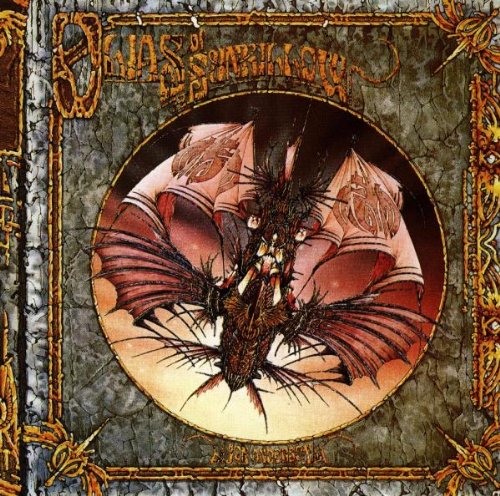
This genre of music, which is often tied up with fantasy and science fiction, is ripe for stories of aliens and interplanetary travel (although as we have seen, other genres go there, too.) And thus, we come to Jon Anderson’s Olias of Sunhillow, the Yes singer’s solo debut, released in 1976, after Yes released Relayer (an album that I have zero memory of) and before Going For The One (which I enjoyed more), during a period when the band’s members were all releasing solo albums. Wikipedia describes the album as telling:

the story of an alien race and their journey to a new world (the story printed in the LP jacket calls it "the earth", lowercase 'e') due to a volcanic catastrophe. Olias, the title character, is the chosen architect of the glider Moorglade Mover, which will be used to fly his people to their new home. Ranyart is the navigator for the glider, and Qoquaq (pronounced 'ko-quake') is the leader who unites the four tribes of Sunhillow to partake in the exodus. 

Now, let me start off by saying that I like this album, and particularly the featured track, very much. Anderson is credited with all of the voices and instruments on the album, which took two years in conception, and 8 months of work, to record. There have long been rumors that Vangelis, who had unsuccessfully auditioned for Yes at that time, and who Anderson collaborated with, played some of the parts, but both men have denied this, and unless Devin Nunes has a memo to the contrary, I see no reason to dispute that (actually, if Nunes had such a memo, it might be more likely that I’d take a contrary position, but I’m going off the rails here).

If you want a chuckle, go ahead and read the whole elaborate story, which was printed on the inner album sleeve. And because most of you won’t buy the album, here’s a link to a website devoted to Olias of Sunhillow which contains the story, and more.

Meanwhile, it appears that Anderson has been working on a sequel to Olias since 2001, to be called The Songs of Zamran: Son of Olias, and as recently as 2014, Anderson confirmed that he is still working on it. Based on his comments over the years, it will be a multi-hour work, and possibly released as an app, including visuals. Here's a preview, from 2013.  And why not, I say?

Wednesday, March 26, 2014

RUSSIA/UKRAINE: Yes, "Siberian Khatru"


Yes: "Siberian Khatru"
[Purchase]

During my junior high and high school years in the late '70s and early '80s, I became something of a Yes fan, probably primarily because a few of my close friends were into them. I'm pretty sure I liked "Roundabout" prior to that anyway, but this more extended exposure hearing my friends' albums gave me an appreciation of some of their less radio-friendly fare. I grew to know all of their album titles -- I'm pretty sure I could even list them in the correct order -- even if I didn't care for all of them to the same degree as my friends. To this day, hearing such album names as Tales from Topographic Oceans will always evoke an immediate visceral reaction flashing me back to that period of my youth. Not that I progressed much farther into the prog rock scene than Yes, a (very) little Emerson, Lake, and Palmer, and, later, some Rush. Even prior to the punk explosion, I could tell that almost by definition, much of prog rock was pompous and bloated. I only cared about the bands among them who managed to blend something of an appreciation for pop hooks into their pretentiousness. I didn't need to hear bands trying to rewrite classical symphonies for rock instrumentation; if it didn't have some form of hook, I quickly lost interest.

Which is why a handful of Yes's albums appealed to me: The Yes Album, Fragile, and Close to the Edge, the three albums I ended up growing to love, all have their share of great hooks. And my favorite songs were scattered across the albums, so they ended up drawing me into the more long-winded songs that might not have otherwise grabbed my attention. "Siberian Khatru" was most certainly one of those, a sprawling epic of a song, much like its namesake geographical region, dominating a massive portion of Russia. The song, despite its nearly 9-minute length, moves along at a brisk pace and keeps coming back to Steve Howe and Chris Squire's hooky riff and Jon Anderson’s melodious singering. (Just made that term up!) I certainly don’t know how I’d feel about it if I hadn’t had the appreciation for the full Close to the Edge album (from 1972), but for those not familiar with the album, this fact might be of interest: “Siberian Khatru” is the shortest song on the album! Side 1 contains a single, 18-minute track, and Side 2 kicks off with a 10-minute multi-part song, making the third and final album track, “Siberian Khatru,” seem like a radio-ready single by comparison.

Friday, June 28, 2013

The Other Guy: Jon Anderson

[purchase]

I’m working on a King Crimson related post for another blog, and it reminded me that, in King Crimson terms, Jon Anderson is the other guy. Crimson is a band that, if anything, is consistent in its inconsistency— its history is filled with constant turnover in personnel and styles, with Robert Fripp as the only member who has been in every incarnation of the band. Most histories of King Crimson seem to refer to musicians leaving because they didn’t like or understand the music, which raises the question of why they joined in the first place. Wikipedia reports that there are over fifteen-hundred releases on which members and former members of King Crimson appear.

The band’s third album, Lizard, was a departure from the first two, with greater jazz influences, and Greg Lake’s powerful vocals being replaced by Gordon Haskell’s more ethereal style. But the song “Prince Rupert Awakes,” was too high for Haskell, so Jon Anderson, of Yes, was enlisted to sing, his only contribution to the Crimson oeuvre.

On the other hand, when it comes to Yes, in my mind, Anderson is the guy, despite the fact that Yes has had membership turnover that rivals King Crimson. But despite the fact that Anderson was replaced as lead vocalist by "other guys" Trevor Horn, Benoit David and Jon Davison (the latter two having been vocalists in Yes tribute bands before moving up to the major leagues) who attempt to mimic the original, there can be no question that for that band, Anderson is affirmatively the guy.