A last minute entry as we switch themes - on the assumption that any post is better than no post.
Songs in the Key of Life vies with Talking Book as my favorite Stevie Wonder album. Saturn is one of its least known songs.
The 1970s, when the album came out, were full of dreams of the opportunities that space presented us Earthlings: working forward from the 70s, we had Skylab and Mir and then the current ISS. In the 70s, NASA still had a fair amount of PR mojo - hype and hope for humans in space. It was hard not to be influenced by the vast possibilities open to us. Today we have Elon Musk and his cohorts.
The 70s mark a point in Wonder's career where he both changed management and musical style. Gone was the [limiting/limited] image of the somewhat coddled boy-wonder: here was a man in tune. Actually, a man leading a musical revolution. Talking Book matches chronologically with Exile on Main Street, Thick As A Brick, Close to the Edge, Ziggy Stardust, Eat a Peach, Can't Buy a Thrill - just to give you some perspective.
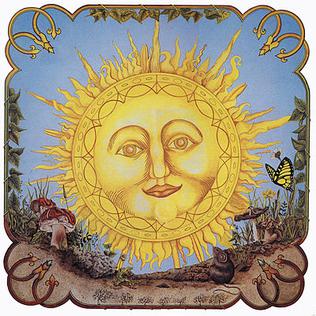
Nice picture, eh? Sort of a Phillip K. Dick-ian vibe, which in turn leads me on to discover that Electric Sheep is the name of a company that makes the fractal variations many computers have as their screen savers. Go take a look, it is fascinating. If nothing either to do with the picture. Or indeed the song. (And had you known or remembered that Bladerunner, the film, recently reprised as Bladerunner 2049, was based on the book in the link? Any excuse to have a bit of Vangelis.....)
OK, to business. Lamb. Lamb are a longstanding UK band of some 20+ years standing, with a blend of electronic styles leavened by the organic vocals of the singing, the mix of the pastoral with the pulsatile. An on-off existence has seen the duo, Andrew Barlow and Lou Rhodes, electronics and vocals respectively, break up innumerable times, always then seeming to find the incentive, or funds, to rise again like a phoenix. The last such 'final' performance, for they also tour and perform live, was towards the end of last year. I missed the London dates, but don't feel the chance gone forever. Plus, a bonus for me, as an out of the closet and unashamed folkie, as it allows Rhodes to pick up her solo career in the downtime, being more reflective of her upbringing in the world of folk clubs, the daughter of singer Annie Burton. Below is an example of her solo oeuvre, from 2006's solo debut, 'Beloved One'.
'Alien' is from the 2nd Lamb album, their highest charting release thus far, in 1999, hitting the lofty UK peak of 37. It captures the amalgam of drum and bass rhythmic with a more trip-hop dynamic overlying, perhaps why they have tended to blend more with the Bristol scene of Massive Attack and Portishead than of other Manchester bands, from where they hail. Probably the best known song by Lamb is below, 'Gorecki', a paean and tribute to the 20th century Polish composer, which samples his 3rd Symphony, perhaps helping to usher in the expanding respect for his work, especially within the neo-classical movement, enriched and fed by modern electronic composers such as Nils Frahm, Olafur Arnalds and Colin Stetson. (It seems almost facile to try and explain the wonder of Gorecki, the man and the composer, in a piece such as this. Forgive this feeble mention and explore elsewhere.)
Finally, with no apology, a brief redux of my opening para and 'Bladerunner', with it's memorable Vangelis soundtrack. The 2049 version has just as memorable and incisive a soundtrack, largely via Hans Zimmer, orchestrated by Benjamin Wallfisch, if that is the correct phrase. Here is an excerpt, the links between Vangelis, Zimmer and Lamb being all too apparent.
Aliens, UFOs, little green men in carbon zoot suits, come down to Earth to collect rocks, or kidnap people and probe them for info. Maybe probe our livestock, too...
What comes to my mind when the topic of aliens arises stems from the movies. I've never been much of a sci-fi reader, but I do love a good, ol' fashioned flying saucer flick. There's the old standbys, like Sigourney Weaver in her underwear and vicious little creatures pulsing out of chest cavities in a shower of gore. But, what else? What other little green men walk through the halls of my imagining? Invaders destroying everything they encounter with death rays, ala Mars Attacks!; strange, long fingered and round-eyed curiosity seekers, peeking through windows, like ET: The Extraterrestrial; or Donald Sutherland recognizing Veronica Cartwright upon exiting his pod and becoming part of the Invasion of the Body Snatchers...
And, my personal favorite, and original encounter with the wonders of R-Rated films, the spaced out aliens on their way to Earth via a blissed out Venice Beach, California, in a giant, smiley faced orb, from 1981's Heavy Metal... Heavy Metal, with its excessive cartoon gore and oversized, lampoon nudity, it's oddly-shaped plot and disconnected framing devices, devil's cabinet of bizarre characters, and overall bizarrely full blown technicolor beauty, was my first R-rated film. I saw it for the first time as one half of a double-feature on a sleep over, in a dark basement, under the snoring, un-watchful (probably snoring) noses of a friend's mom and dad (the other film was John Carpenter's The Thing).
And not to understate things, but at the first sign of cartoon boobs, zombie tail gunners, and the glowing green menace called the Loc-nar, among many, many more glorious oddities, I was pretty much hooked, for good. On comic books, nudie mags, and most of all rock n roll, and maybe heavy metal--the magazine and the sound. And, while the only real metal on the soundtrack was a cut from the Ronnie James Dio led Black Sabbath, the movie was a pulsing, stereo blast of day-glo guitar fever, a romp through the wildest kind of imaginings.
My memory of the film is tied directly to the sound: the imagery is forever tied to the music in the film that played over the scenes, a roving scoped-out freak show of atmospherics. Slashing guitars, thrumming, angry keys, phasing drums, Sammy Hagar's howling vox, Don Felder's space trip title track, a dobblering car horn from a UFO speeding past, and the strange incantations of Blue Oyster Cult's "Veterans of the Psychic Wars." But, by far the standout cut from the soundtrack is Cheap Trick's "Reach Out". The song is driven by a purely 80's inspired keyboard march, one that sounds like a bank of spaceship computers pumping out data and coordinates. It's powerpop at its finest, with soaring vocals and churning guitar, but the song is also a spaced out symphony of great early Cheap Trick, with ethereal melodies from a galactic orchestra, laying layers of sound over a staticky transmission.
Aural association is a potent force for me, and just a few seconds of a sound byte will send my imagination and my memory tumbling end over end to not only a movie, but the entire span of an era. The sounds of a song pulled from a memory come with all sorts of weight. And I love the impact, the immediate and and total sensation of nostalgia, when you hear a song from your past.
As I grow older, to continue the metaphor, I often feel alienated from my past--not the places or the people, but the emotional aspects of who I was. My sense of wonder, my curiosity, my willingness to be expansive and expanded by what I saw and heard, and the avenues of discovery I could wander so easily--this all before my psyche began to feel bent and worn down from taking on the weight of too many daily burdens. Hearing old music will especially take me back to being a less complicated, more easily awed kid, bowled over and blown away by all the oddness of the universe, rather than buried beneath the weight of it all.
I still scan the sky for UFOs, eager to catch a lift to places unknown. I signal with a flashlight, I signal with a lighter (Incubus), I dream of concerts on Mars, and I know that aliens can get Pearl Jam tickets a lot more easily than me (The Simpsons), and while I have many more alien references, I feel like I'm beating this metaphor into stardust...Sail on, space cowboys. I'll see you on the dark side of the moon...
EXTRA-CURRICULAR READING: A great write up on the soundtrack from Crave
Reading my music writing probably might give you the impression that I listen to prog rock all the time, but I don’t. More than anything, I listen to what would be classified as Americana music, but I am clearly an unrepentant lover of progressive rock. But just because I enjoy the music, that doesn’t mean that I can’t mock some of its excesses. And maybe the easiest things to make fun of about the 70s prog that I enjoy are the concept albums, with their often bizarre narratives. I mean, there are some pretty straightforward ones, like Rick Wakeman’s Journey to the Center of the Earth, essentially a dramatization of the Jules Verne novel, or Gryphon’s Red Queen to Gryphon Three, about chess (a hidden gem, by the way), or even Pink Floyd’s The Wall, basically a story about a person's difficult childhood and life.
But then there are the crazy ones, like Gong’s acid-fueled three album Radio Gnome Trilogy, or pretty much anything by Magma, or Genesis’ The Lamb Lies Down on Broadway, which purports to be about a Puerto Rican youth living in New York City, but turns surreal (and is one of my favorite albums, anyway).
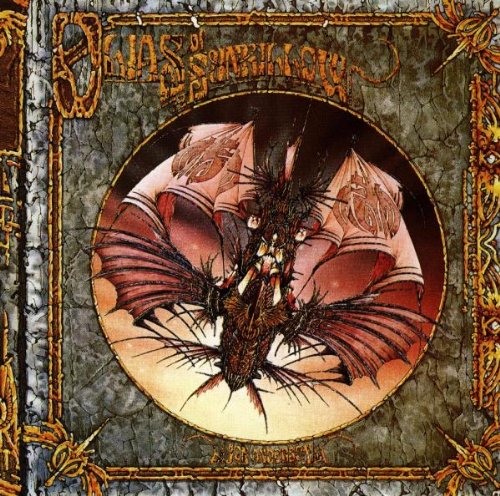
This genre of music, which is often tied up with fantasy and science fiction, is ripe for stories of aliens and interplanetary travel (although as we have seen, other genres go there, too.) And thus, we come to Jon Anderson’s Olias of Sunhillow, the Yes singer’s solo debut, released in 1976, after Yes released Relayer (an album that I have zero memory of) and before Going For The One (which I enjoyed more), during a period when the band’s members were all releasing solo albums. Wikipedia describes the album as telling:
the story of an alien race and their journey to a new world (the story printed in the LP jacket calls it "the earth", lowercase 'e') due to a volcanic catastrophe. Olias, the title character, is the chosen architect of the glider Moorglade Mover, which will be used to fly his people to their new home. Ranyart is the navigator for the glider, and Qoquaq (pronounced 'ko-quake') is the leader who unites the four tribes of Sunhillow to partake in the exodus.
Now, let me start off by saying that I like this album, and particularly the featured track, very much. Anderson is credited with all of the voices and instruments on the album, which took two years in conception, and 8 months of work, to record. There have long been rumors that Vangelis, who had unsuccessfully auditioned for Yes at that time, and who Anderson collaborated with, played some of the parts, but both men have denied this, and unless Devin Nunes has a memo to the contrary, I see no reason to dispute that (actually, if Nunes had such a memo, it might be more likely that I’d take a contrary position, but I’m going off the rails here).
If you want a chuckle, go ahead and read the whole elaborate story, which was printed on the inner album sleeve. And because most of you won’t buy the album, here’s a link to a website devoted to Olias of Sunhillow which contains the story, and more.
Meanwhile, it appears that Anderson has been working on a sequel to Olias since 2001, to be called The Songs of Zamran: Son of Olias, and as recently as 2014, Anderson confirmed that he is still working on it. Based on his comments over the years, it will be a multi-hour work, and possibly released as an app, including visuals. Here's a preview, from 2013. And why not, I say?
Leon Russell could have made our In Memoriam list this past year: he passed in November, age 74. I saw him once back in the 70s - must have been in Philly, just after I had arrived in the US of A. This would have been at the Spectrum, which has been through a number of name changes over the years.
I bring up the rather personal "just arrived in the US" because it leads into my choice for the Aliens theme. Now, I didn't fit the legal definition of an alien in the US, having been born with an American passport. But I had spent most of my first 15 years outside the US, so I certainly felt like an alien - I had virtually none of the prerequisite cultural references of my peers - except maybe music.
When I saw him back in the early 70s, it would have been about the time of Mad Dogs and Englishman. About the time that I heard him on Dave Mason's Alone Together - you know? the LP with the mad swirling vinyl? And then again in the Concert for Bangladesh. For 2-3 years, I followed him closely up until about the time of Carney - he was all over the musical charts, playing with anyone who was somebody.
So, while the song isn't about extraterrestrials, it is about being an alien. Well, actually, it's about seeing the world with a different, compassionate eye - and one that isn't all that pleased with what he sees.
Leaders take us far away from ecology With mythology and astrology Has got some words to say About the way we live today Why can't we learn to love each other It's time to turn a new face To the whole world wide human race
Stop the money chase Lay back, relax Get back on the human track Stop racing toward oblivion Oh, such a sad, sad state we're in And that's a thing
For me this was always the consummate Byrds track, given as it is one of the earliest outriders, 1966, for their later more overt country influences. Undoubtedly a yee-haw hayride of a tune, yet coupled with, literally, spaced out lyrics, it was ideal for the time; the Byrds still in their first flight of success, together with the race for the moon being in full pelt. Too 'and western' for the UK charts it bombed in my home-land, but did better at home, no little assistance coming from the phased psychedelia of the instrumental middle 8. Indeed it is still argued as to whether it was forerunner more of psychedelia or of country-rock. Both, say I.
The video represents it's first airing, on the Smother Brothers Show, with a 4 member band, the legendary rotating door of this band already in full swing. Whilst writer of the song and singer Jim (later Roger) McGuinn is clearly still present, along with Chris Hillman and Michael Clarke, on 12-string rickenbacker, bass and drums respectively, David Crosby is conspicuously absent for the first time. Especially as he was, arguably, the biggest space cadet and sci-fi freak in the band. And Gene Clark, in or out of the band depending on whether there was a plane trip expected, and who was nominally only a supporting musician for the recording, is there, pretending to play Crosby's guitar. It seems certain his is the key second voice in the harmony however, miming though they all are. A memorable tale from the time was that the band famously took out a million dollar insurance policy, with Lloyds of London, against being abducted by aliens. They didn't of course. And weren't. Although, with Jim to Roger, who's to say?
It remained a staple of live performances over the years, as members came and went, McGuinn the sole staple, but the style of the song fitting well with the directions driven by later members Gram Parsons and Clarence White. There is a nice video filmed in the desert featuring the former, but with the original recording still the one playing. Various reunions of the earlier line-up also featured it, as have various off-shoots of the original band, notably the equivalently ever changing Flying Burrito Brothers, who probably featured every other living Byrd, McGuinn apart, at some stage. McGuinn also trots it out at the drop of a hat, it often being the song chosen should he make a guest appearance, as he here does with Wilco.
Don’t feel bad if you never heard of this one. Two Little Men in a Flying Saucer is one for Ella Fitzgerald completists. It comes from 1951, fairly late in the swing era. The soldiers have been back from World War II for some time now, and rock and roll will be unleashed on an unsuspecting world very soon. The songwriters on this one were Arthur Pitt and Elaine Wise. I could find no other credits for Pitt, and Wise wrote two other songs also recorded in 1951, and then disappeared from pop music history as well.
Having said all that, this is a fun song, and Fitzgerald sings it with the perfect light hearted tone. Before we are done with our Aliens theme, we may well hear a song that takes the concept of humans seen through alien eyes far more seriously. It’s a device for criticizing humanity that can be very powerful. But Two Little Men has fun with the idea. Not knowing the rules of baseball, for example, these planetary visitors simply shake their heads in a non-judgemental way and leave Earth. There is a little gag about politicians here, but it is nopartisan and played for laughs. I am not going to tell you that this is classic Ella Fitzgerald, but it is a fine example of her playful side, and it makes me wonder why there weren’t more songs recorded by Pitt and Wise.
In 1976, it seemed that Beatlereunionmania was rampant. Lorne Michaels famously had offered The Beatles $3,000 to reunite on Saturday Night. Later that year, Capitol Records, The Beatles’ label, released an album of Beatle-ish pop, 3:47 EST (called Klaatu in the US), from a band called Klaatu, with no identifying credits, and rumors began to spread that Klaatu was, in fact, The Beatles. If anything, Capitol did nothing to squelch the rumors, because they led to increased sales of albums from an unknown band. Of course, Klaatu wasn’t The Beatles; they were a Canadian band, heavily influenced by The Beatles, and named after the extraterrestrial character in the film The Day the Earth Stood Still, consisting of John Woloschuk, Dee Long, and Terry Draper. None of whom were ever in The Beatles.
If you are interested in reading more about the whole rumor thing, which is amusing mostly due to the level of analysis that people went through to try to convince themselves that there was actually a secret reunion (including, for example: “While there are 8 trees pictured right at the very bottom of the front cover of the band's first album, only 7 have their roots showing. There are 7 letters in the name Beatles”) click here or here.
Klaatu's debut album led off with a 7:22 long slice of psychedelic pop entitled “Calling Occupants of Interplanetary Craft.” According to Woloschuk:
The idea for this track was suggested by an actual event that is described in "The Flying Saucer Reader", a book by Jay David published in 1967. In March 1953 an organization known as the "International Flying Saucer Bureau" sent a bulletin to all its members urging them to participate in an experiment termed "World Contact Day" whereby, at a predetermined date and time, they would attempt to collectively send out a telepathic message to visitors from outer space. The message began with the words..."Calling occupants of interplanetary craft!"
As far as we know, the message didn’t result in any alien contact. Or at least, that’s what they tell us.
“Calling Occupants” definitely has a Sergeant Pepper’s feel, but also some more prog influence, with heavy use of Mellotron and synthesizer. Also, drummer Draper was reportedly a fan of the first King Crimson drummer Michael Giles (as well as Ringo), and some of the drumming sounds a bit like “In The Court of The Crimson King.” A single version, edited to 3:23, nosed around the bottom of the charts. Klaatu’s next album, Hope, was a concept album about aliens, and their next three albums moved more toward pop and away from psychedelic experiments. By 1982, Klaatu was essentially defunct, except for a few small reunions and the creation of a record label to re-release their material.
Now, if you were alive in 1976, and were asked to name a musical act that was the opposite of adventurous psychedelia and prog, you might have suggested The Carpenters, the sibling duo with the squeaky clean reputation, and an output of mostly sugary ballads and bland pop, enhanced, though, by Karen Carpenter’s voice, and her brother Richard’s arranging skills. So, it was a bit surprising when they decided to cover “Calling Occupants.” Their version, released in 1977, a lush, orchestral pop song, featuring over 150 musicians including the Los Angeles Philharmonic Orchestra and a choir, was originally over 7 minutes long. As a result of their popularity, and the coincidentally recent release of Close Encounters of the Third Kind, a film about space travel, The Carpenters’ cover, edited down for single release, was more successful than the original.
Draper, Klaatu’s drummer and co-writer of the song, said this about The Carpenters’ version:
Not only did they do a great job, it was such a stretch for them, they were really stepping out of their comfort zone and doing what could possibly be described as prog rock although I like to call it progressive pop.
Also, it probably made him a few bucks, which couldn't have hurt, particularly since he wasn’t a Beatle.
Star Maker Machine does not accept music submissions from artists or promoters. However, most of the contributors here do accept submissions for our own blogs, listed below. Please visit our blogs, take the time to listen to what we post, and then feel free to contact us if you feel that your music would be a good fit.