Thursday, March 28, 2013

The Bard: When That I Was & A Little Tiny Boy

Elvis Costello/John Harle: When That I was & A Tiny Little Boy
[purchase (full album on vinyl?)]


Elvis Costello has on more than one occasion worked Shakespeare into his music, in fact, he did a whole album in 1993, named the Juliet Letters, whose concept revolved around sending letters to Juliet (of R& J fame) to the sounds of the Brodsky Quartet.

So it was not much of a surprise to anyone when in 1997 he was featured in John Harles album Terror and Magnificence where Shakespeare is set to John Harles saxophone.

A particular highlight for me When That I Was & A Little Tiny Boy, sung by Costello, is a song taken from Twelfth Night in which the character Feste, the fool of the household of Countess Olivia, reflects on the events that had transpired throughout the play. In this retrospective Feste demostrates the ability to correct foolish acts and times ability to temper things.

While detractors of Costello don’t bother with his solo output, I think he did an incredilble job with both the Juliet Letters, as well as, in Terror and Magnificence.

Perhaps it’s because of the amount of Shapespeare being crammed down my throat for three summers selling tickets to the theatre or maybe it’s because I enjoy musicians being self-indulgent or just maybe it’s because Costello’s delievery is so great but I enjoy the hearing Costello literally play the fool and make me sing lyrics from the Twelfth Night on my way to In-N-Out.

Guest post by Edgar

The Bard: Ophelia


Natalie Merchant: Ophelia
[purchase]


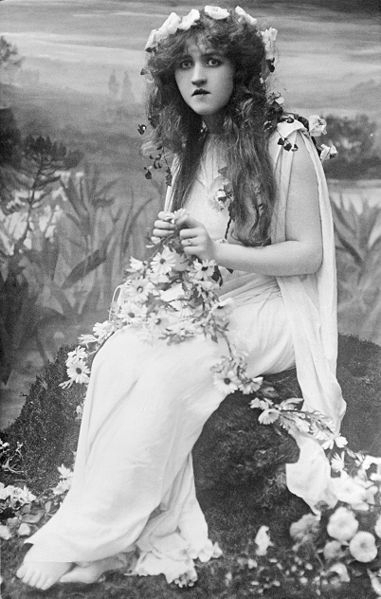
Struggling to avoid the all too tempting lure of Romeo, and mindful also of a paucity of appropriate references to Bottom or Puck, I had to cast my mind back to GCSE English literature and school plays for inspiration. Given I only ever played the likes of Friar Francis and Falstaff, I was unlikely to ever find much joy there. But fate threw me a googly, as I watched the remake of The Picture of Dorian Gray, with his first “victim”, Sibyl Vane, the actress, playing Ophelia at Drury Lane. Of course, I thought, immediately making this a simple toss-up between the unbridled joy of Levon Helm leading the Band through their Ophelia at The Last Waltz or this. Somehow this felt more apposite, with, if no direct and overt mention of Shakespeare as source, received wisdom seeming to be that this song is using Ophelia as a metaphor for the fate and circumstance of womankind? Pretentious? I’ll come to that……

I guess I was an early acolyte of 10,000 Maniacs, their heyday coinciding with the end of a self-imposed immersion I had undertaken in nothing but traditional folk for a number of years. Their version of “Just as the Tide was a Flowing” burst through my prejudices, reawakening me to a brighter and broader palette of musics. I was lucky enough to catch them live on a subsequent tour of the UK, totally in awe of the extraordinary and unusual stylizations of Ms Merchant, coming on like a librarian on heat, full of passive-aggressive intellectual bombast. With the final encore being her solo piano emotional overload of “Verdi Cries”, I knew that something special had this way come. Ultimately her musical needs strayed beyond the conventions of US college rock, necessitating a solo career, and her subject matter exploded through unlikely scenarios and scapes, becoming ever more bleak and desolate.  Pretentiousness, as alluded to above, was seldom more than a foot fall away, but somehow, just somehow, at least for me, she managed to step just shy of it.

If only she could pronounce her “R”s, or is that part of the appeal?

Guest post by Retropath2

Tuesday, March 26, 2013

The Bard : Under The Greenwood Tree


[Purchase]

In the Spring of 1967 Sir Laurence Olivier met with Donovan who was then at the height of his sunshine superman stardom. Olivier asked Donovan to compose melodies for his modern production of Shakespeare's "As You Like It". In his autobiography Donovan writes that he was delighted to transform these songs:
         
I gave "Greenwood Tree" a light, rocking  musical form and kept the sonnet in the troubadour style.


 The lyrics are all Shakespeare's but they reflect Donovan's interest in nature.

Under the greenwood tree
Who loves to lie with me
And tune his merry note....

Ever the mischief maker, Donovan couldn't pass up a little joke at the end. In the recording that appeared on A Gift From a Flower to a Garden (best known for the hit "Wear Your Love Like Heaven"),  Donovan sings:

Do the Willie the Shake

The Bard: Summer, Summer

 
Two Gentlemen of Verona: Summer Summer
[purchase]

I am not a musical theater lover, but in my family, I am outnumbered 3-1. Both of my children have musical talent, and performed in musicals in high school. My son’s Luther Billis in South Pacific was hysterical, and my daughter’s Babe Williams in The Pajama Game, was awesome (although I have a soft spot for her Harry the Horse from Guys and Dolls). In addition, my wife has a beautiful voice, and sang on stage when she was in high school.

I have no such talent, but many of my friends at Clarkstown North were involved in our theater program, so I was convinced to join the stage crew. Remarkably, I have even less talent at building sets than I do at singing, but I found a role. My school was old, and did not have a modern “back stage” with counterweights to allow for easy raising and lowering of backdrops. I’m a big guy, so my job was to raise and lower the backdrops. I was also good at carrying things, bracing things, getting pizza and driving people home in my parents’ huge Pontiac Catalina. For this dedicated service to the theater, I got to be part of the production, and, notably, attend the cast parties where we black clad crew members would mostly sit together and complain about the actors.

One of the most fun shows that we did was Two Gentlemen of Verona, a rock musical adaptation of Shakespeare’s comedy. Not only was it different from most of the other shows I was involved in—the music did kind of rock—but it was a pretty risqué show. Note the album cover in the video above. Naked breasts!! And they let us do this show in a high school. I specifically remember that there was one scene with simulated intercourse (which is not what we called it back then). As a parent whose kids did theater, I can pretty much guarantee that stuff wouldn’t fly today.

For a regular high school in suburban New York, I remember that the production was quite good—in fact, a few of the cast members went on to professional careers in show business (and a bunch became lawyers, too). Demonstrating my keen talents as a stage crew member, I got to lower an actor from the sky, a feat that I actually performed again the following year, when we put on Once Upon a Mattress. Which is another thing that I suspect would not happen today, due to insurance issues.

A few years ago, if I decided to write about this production, the odds of any of my fellow crew members, or any of the cast members, reading it would have been small. But now, because of Facebook, I have reconnected with a bunch of them over the last few years. So, I will post the link on my page, and maybe it will spark some nostalgia in others.

Monday, March 25, 2013

The Bard: Stuck Inside of Mobile


Having moved to a bi-weekly theme format, this means we have the extended time-frame to post more than once during the window.
In the world of popular music, I suspect that for most of us, “the bard” equates to Bob Dylan;  in fact, a number of Dylan’s works include  Shakespearean references – some more direct than others. The Shakespeare reference in “Stuck Inside of Mobile …” is a straightforward in-your-face naming of the Bard:

Well, Shakespeare, he’s in the alley
With his pointed shoes and his bells
Speaking to some French girl
Who says she knows me well
So … tell me … “Shakespeare’s in the alley, with his pointed shoes and bells”… Picture this scene with me for a minute. An alley in 1600 or so. London? Pointed shoes and bells. So far, so good: I can see the scene. Probably kind of muddy. Uneven cobblestones most likely. A French girl? Possibly. Knows me well? Mmmm. Poetic license, I guess. Maybe had to have been there to know the rest of the story. But there’s so much more to the lyrics: this is just the part that has the direct reference to “the Bard”. How about “.. built a fire on Main Street and shot it full of holes”?
I got my prompt for selecting this song from a site that has many, many more Dylan/Shakespeare links that could be worth your time to explore if you are interested in the theme.
The musician performing the above-linked version – Owen Scott III – confesses that he wishes he had had more time to perfect his recording: it is yet another Soundcloud free download:  and a very decent rendition at that. In places his vocals ring like Johnny Cash – in others, more like John Prine, and hey: he’s generously giving it away. The ‘net says he is “psychologist by day, novelist and electric guitar playerby night.” From Baton Rouge.
Dylan’s Stuck Inside of Mobile appeared first on Blonde on Blonde – 1966 – and on some others after that (Greatest Hits …) Another of my favorite bands – the Dead – performed the song periodically in the 80s and 90s and there is a free live version of that here http://archive.org/download/gd90-09-10.aud.wiley.11807.sbeok.shnf/gd90-09-10d1t08_vbr.mp3

Sunday, March 17, 2013

The Bard: Romeo Had Juliette


Lou Reed: Romeo Had Juliette
[purchase]

My guess is that there are more songs that reference “Romeo and Juliet” than any other Shakespearian work. So many songs are about love and its various permutations, and “R & J” is, to my mind, the most accessible of Shakespeare’s plays because most of us have experienced first love, and can easily understand the idea of falling in love with someone that they shouldn’t. That is easier to identify with for most of us than, say, being a member of royalty. Or killing a member of royalty. Or being confused with your long lost twin and having to disguise yourself as a member of the opposite sex.

So, there is West Side Story, the Bard’s tale transposed to a turf war between dancing and singing gangs in New York in the 1950’s, or “The Cinema Show,” (discussed above) which sets it in England in, I guess, the 1970’s. And there is the Lou Reed adaptation posted here, set in the gritty New York of the 1980’s. This version is part of Reed’s brilliant New York album, in which he and a group of incredible musicians paint an indelible view of the city during a difficult time, when money was tight, drugs were rampant, and crime was endemic. The music is tight, the lyrics are sharp, the songs are memorable, and if you somehow don’t own this album, you should.

I lived in New York during that time, and although I was mostly spared the bad stuff, you couldn’t ignore it. Of course, New York is also a hotbed of Shakespeare, with productions of his work almost constantly in theaters, most famously the Shakespeare in the Park shows each summer in Central Park, featuring top performers and usually interesting direction.

Now, I live in a community a little north of the city where, remarkably, Shakespeare is an integral part of the fabric of life. Spearheaded by my friend Peter, an incredibly talented director of children and teenagers, he began by offering workshops where kids would learn and perform scenes from Shakespeare plays. I’m proud to say that both of my kids were involved at the start, and what makes Peter’s approach special is that he makes sure that the kids understand and appreciate what they are saying. So that they are really acting, and not just reciting lines. I remember reading Shakespeare in high school, where it was unfortunately treated as something difficult and off-putting, and I regret that I never got the appreciation of his work at a young age like my kids and their friends.

These workshops, due to the vision of our local schools foundation and the YMCA, pushed by my friend Barbara, grew into regular productions of Shakespeare plays in the schools, starting at the elementary level, and in an incredibly popular summer theater camp, culminating in our own Shakespeare in the Park outdoor productions, featuring casts of children and teenagers. Peter and his crew do not dumb down the language, and the kids, as kids usually do, rise to the challenge. He often has fun setting the plays in different times, including my favorite, As You Like It, set in the 1960’s. He commissioned one of my son’s friends to write original music for the show, a band of high school students performed the music, including some period pieces, during the play, and my daughter belted “Somebody to Love,” channeling her inner Grace Slick. (If you are interested in having your mind sort of blown, check out what this still young composer is doing now--Orkinpod). The summer performances are a highlight, and draw big crowds.

Not only that, but a couple of summers ago, two recent high school grads, and alumni of Peter’s troupe, formed their own theater company, generally for adults (although they have worked in a few kids). The first summer they produced A Midsummer’s Night Dream, (which my kids were in) and last summer was The Tempest. Also produced outdoors, these productions were sophisticated and well-acted, even considering the shoestring budget that was available.

I’m proud of my community for supporting such amazing theater and I wanted to give credit where it is due. And if my friends read this, and inflate the blog’s page views, so much the better.

The Bard: The Cinema Show


Genesis: The Cinema Show
[purchase @ Amazon ]

In case the powers that be conspire to block your access to the mp3 above, try this URL: https://soundcloud.com/kc-the-pier-82/10-cinema-show

Back in their prime, Genesis was one of my favorites. Could have been because of my classical music upbringing: I sang tenor is such things as Handel’s “Messiah”. Could also have been on account of Peter Gabriel and Phil Collins’s innate musicality. (J. David has touched on Genesis here before)
Genesis’ 1973  release “Selling England…” reeks of British history (of which “the Bard” is an obvious part). In “The Cinema Show”, from this album, Genesis bring Shakespeare’s Romeo and Juliet into the modern age, singing:
  
   Home from work our Juliet
   Clears her morning meal
And later …
   Romeo locks his basement flat
   And scurries up the stairs

As Gensis prove: so little has changed in 500 years: the plight of Romeo and Juliet is more or less the same: a daily struggle. Indeed: a cinema show for Romeo & Juliet! A chocolate surprise in 1600...
I particularly focus regularly on the line in the song: "there is indeed more earth than sea." We are taught in school that the oceans comprise 2/3 of the surface of the Earth - but we don't learn that that which supports the seas is in fact "earth" - and that it goes miles deep.
While the Genesis versions of "The Cinema Show" are the definitive ones, Soundcloud offers less well-known renditions that may pique your fancy as well. For example:

Sunday, March 10, 2013

Beware: Warning


Green Day: Warning
[purchase]

Having a Broadway musical based on your songs is not generally a sign of “indie cred.” Green Day has to be considered one of the greatest “sell out” bands ever. I mean, they were just a bunch of punks, right? Who played loud, fast music with a remarkable pop feel. So, of course, they shouldn’t want to be successful, have millions of people hear their music and make lots of money. No, the purity of their art demands that they refuse to change, reject popularity, play shitty hole in the wall clubs their whole career, and have trouble paying their bills.

Bullshit.

From their earliest days, Green Day exhibited extraordinary songwriting talent, and I think that it was a great thing that the world ultimately appreciated it. Why is it that fans turn on bands they love when they become popular? Why is it so important for so many fans to think that they are the only ones who can appreciate a band, and when more people like them, they feel betrayed? I understand when an artist changes their sound significantly so that what you liked about them is gone, but I always wonder why fans often take success as a personal affront.

I write these blog posts because I enjoy doing it. It makes me feel good, and I like to think that there are people out there who enjoy my work. And I do it for free. But, if Mojo Magazine, for example, offered me a bunch of money to write blog posts, you can bet your ass that I would take the checks. And if they did that and told me to write about more popular bands every week, I’d certainly consider it. Would I write about REO Speedwagon? Not unless the check was for a very, very large number. Which reminds me of an old story, the punchline of which is: “We’ve already established that. Now we’re just haggling over the price.”

So, has Green Day changed so much due to their success (or to cause their success) that their fans should reject them? I say, no. Yes, they have broadened their palette a little, and yes, they wrote "Good Riddance (Time of Your Life)," which was overplayed, and probably overused in photo montages, but you know what? It’s a good ballad. And yet, the band is obviously concerned about their image. They released an album under the pseudonym “Foxboro Hot Tubs,” in part, I believe, to see if they could still be successful without the power of their name, and their recently released trilogy has been billed as a return to their punk roots. But they have moved on, a little, and the three albums show that they can’t fully return, and that’s O.K. Artists grow, mature and change, and fans can follow or not. But in my mind, they should not just walk away because they resent success.

So, maybe that’s the “Warning.”

Beware: Candyman


Grateful Dead: Candyman (music only)
Grateful Dead: Candyman (interview)
Candyman: purchase link @ amazon


Searching through the SMM archives to see if this song had been done before, I found that although we have nigh on 20 Grateful Dead posts, this isn’t one of them. (Incidentally, to search SMM, type http://sixsongs.blogspot.com/search/label/yoursearchtermhere in your browser.)

Mississippi John Hurt, singing about the Candy Man back in 1928, warned his (lady) listeners “..dont stand too close … “ because the Candy Man had a stick of candy “just nine inch long”. The Grateful Dead, for their part, tell us to “Look out, look out” … “when I get back to Memphis, be one less man alive …” On your guard!

Actually, the Candyman’s reputation is either as a womanizer who’ll take your girl or alternatively, as a drug dealer who'll waste your life and take your money for his goods. In short, someone you definitely want to beware of. The Dead lyrics include references to both. In the interview above, Bob Weir calls the character of their version a “roomy persona”. Make of that what you will, but keep in mind that the date is ~ 1970.

The Dead's Candyman appeared first on their 1970 release American Beauty along with various other songs warning you about things you might want to steer clear of, for example, “Friend of the Devil.”

For your listening pleasure, I took the liberty of chopping up the original file hosted at archive.org into two parts: extracting the song itself from the longer file that begins with an interview with Bob Weir and Jerry Garcia – so’s you can choose to listen to them separately. You can find the full uncut copy here

Friday, March 8, 2013

The March: The Pikeman’s (or Halting) March


Sierra Highlanders Pipe Band : The Pikeman’s March

[purchase]

With St. Patty’s Day just around the corner, it seems appropriate to offer something Celtic. One of my favorite Celtic groups of all time is The Boys of the Lough, and I learned to play “The Pikeman’s March” on my concertina and mandolin after listening to their second album (Rounder 3006) back in the mid-1970s.

The Boys of the Lough are purveyors of the Celtic tradition, and that album included some fine musicians - Aly Bain, Cathal McConnell, Dick Gaughan and Robin Morton. The New York Times calls the group, “one of the finest bands in Celtic traditional music.”

Today, the slow march is more often heard performed by pipe and drum bands. And whenever I hear the moving piece, it conveys an image of a group of pikemen marching and thrusting their spears at the front of their infantry battalions.

I like to hear “The Pikeman’s March” played rather slowly and with a lot of feeling. Slow Celtic tunes are just as difficult to play as fast ones. They’re often even more difficult to play them slowly because you have to present them with considerable sensitivity to the Celtic tradition and musical heritage. They also require good tone and technique. Sensitivity is a trait that musicians develop by playing with other good musicians, and it’s difficult to teach.

I was pleased by this set of tunes that The Sierra Highlanders Pipe Band have on You Tube. Here they begin with “The Pikeman’s March” before transitioning to a jig. Their sensitivity to the music is quite apparent, and it was no doubt enhanced and fine-tuned by a few pints of Guinness at the Bucket of Blood tavern in Virginia City, Nv. before they marched in the 2008 Veterans Day parade there.

Thursday, March 7, 2013

The March: The Liberty Bell March


[purchase the complete Monty Python]

I presume to consider myself to be a pretty funny person, and I like to believe that other people agree with me. If not, I’ve been operating under a serious delusion for a long time. Like musical taste, a sense of humor develops over time, and like musical taste, I suspect most of us who care about such things can point to certain influences on our senses of humor. Clearly, my father, a funny guy in his own right, was an influence on me, and Saturday morning cartoons (particularly Rocky & Bullwinkle, Underdog, Bugs Bunny and The Roadrunner), were an early source of humor. Later in my life, Mel Brooks and Woody Allen, the Marx Brothers, Borscht Belt one-liners, Saturday Night Live, SCTV, George Carlin, Richard Pryor, Johnny Carson, David Letterman and Seinfeld have all been sources that have shaped what I think is funny. And I’m sure I’m leaving some out.

But it is hard for me to imagine how different my sense of humor would be if it were not for Monty Python’s Flying Circus. The show aired on the BBC in 1969-1974. I first heard Python on a reel-to-reel tape played for me when I was 11 or 12 at summer camp in either 1972 or 1973 by one of the counselors in charge of the camp radio station (it was a very good camp, and among other things gave me my first taste of radio, something that has led, almost directly, to my writing for this blog). I didn’t know the name of the crazy Englishmen, or really understand everything that they were doing, but I knew that it was funny, and different from anything I had ever heard. In retrospect, what I heard was probably a recording of one of the troupe’s records.

It was not until 1974 that the Flying Circus came to the United States, in New York on Channel 13, the PBS station. I don’t recall whether I first heard about it from my friends, or from an article in the Sunday New York Times Arts & Leisure section, but I started to watch in on Sunday nights. I was hooked, and my friends and I began a life-long annoying tradition of reciting bits. This figures into the “how I met my wife” story, but that is, maybe, for another day. It took me a while before I put together the stuff I heard in camp and the TV show and realized that I had been unwittingly ahead of the curve.

My father, for some reason, never got Python, and to this day, it is a point of disagreement between us. (He also doesn’t get Letterman.) Dad was, however, good enough to take me to see “Holy Grail,” in New York City when it opened. I have to admit that even as a big fan, the 14-year old me was a little befuddled by the movie, and it took me a few years and a few re-watches before I truly appreciated its brilliance. And to this day, I still see things through the anarchic eye of the Pythons, who allowed me to understand that comedy did not have rules, and taught me about obscure British politicians and public figures of the late 1960’s and early 1970’s.

Oh, yeah—this is a music blog. The theme song for Flying Circus is an excerpt from Sousa’s “The Liberty Bell March,” chosen apparently because it was something completely different from the spirit of the show.

Tuesday, March 5, 2013

The March: The March

[purchase Live at the Wetlands]

No, that isn’t a typo—The title of the song is the theme for the week. One of the most noticeable things about a Robert Randolph and the Family Band concert is the joy in the music and in the attitude of the musicians. That has to be something that is ingrained in their personalities, and must also be fed by the fact that Randolph’s band includes two of his cousins and his sister on background vocals. Now, I know that many families are dysfunctional and don’t get along, but based solely on watching them on the stage, I would like to go to a Randolph family barbecue.

Randolph’s story is interesting. A pedal-steel guitarist who learned his craft in a church in New Jersey, Randolph was discovered at a “sacred steel” convention and was asked to join John Medeski and the North Mississippi Allstars in a project called “The Word,” which included gospel and original, but still gospel-sounding, music. Shortly after that album was released, Randolph and the Family Band released Live at the Wetlands, which included a version of “The March.” As you can see in the video (from a more recent performance), there is a dance associated with the song, and Randolph leaves his instrument to lead the audience in the dance.

My wife and I saw Randolph in 2003 at Roseland, with the just-breaking Los Lonely Boys as the opening act. As you can imagine, it was a great show. My son and I saw the band again at the Tarrytown Music Hall recently, and while it was a good show, it didn’t measure up to the memory of the Roseland gig. Maybe it was just an off night, or maybe my memory is playing tricks on me. Or maybe Randolph needs to be seen in a place where you can stand and dance, not sit in a seat, to be best appreciated.

Randolph often wears sports jerseys on stage, and is a New York Knicks fan. In fact, Madison Square Garden has, for a few years, featured him and the band as part of a “Friday Night Knicks” promotion, where his music is played. Unfortunately, the team has had a bad record on Fridays, and many fans think that there is a curse—which Randolph himself has apparently acknowledged (although others just blame James Dolan, the owner). But I don’t believe in those things, knock on wood.

Sunday, March 3, 2013

The March: Hello I Love You


Eric Escxis via Sound Cloud: HelloI Love You
[Purchase the Doors original]
 
 John Densmore's drumming with the Doors never left me in awe. Not when one of my other influences at the time was Ginger Baker, drummer of Cream. Most of Densmore's Doors drumming style strikes me as "military shuffle" - lots of snare and brush that's just right for this week's theme.

There's not much in the lyrics to Hello I Love You that support my choice of the song for military march.

  Her arms are wicked and her legs are long
  When she moves my brain screams out this song


It's a very rhythmic syllabication. Yet, it's the match of the lyrics to the musical rhythm that conveys the effect of a march - and the Jim Morrison factor.

The march as a musical form was intended to have an effect on soldiers. Often, the tempo and sounds (drums, wind instruments) work to keep soldiers moving forward together, to keep them pumped up. Curious, perhaps, that the Doors were among the most vocal anti-war groups of their time. To my mind, several songs on Waiting for the Sun are military-tinged: The Unknown Soldier and Five To One.

There have been numerous covers of Hello, including a recent version from Glee. The Doors in fact ended up getting sued by Ray Davies of the Kinks for ripping off the music from All Day And All of the Night to come up with Hello I Love You. The version here is yet another free download from SoundCloud and the posting person is Eric Escxis (https://twitter.com/Escx1s)

After the breakup of the Doors, the remaining members have tried their hands at various solo projects. Among other projects, Densmore was the driving force behind Tribaljazz, a project which appears to be ongoing. Check it out here http://www.johndensmore.com

Saturday, March 2, 2013

The Oscars: Paul Newman - Plastic Jesus


Paul Newman: Plastic Jesus
[via YouTube]

How about a transition from “Songs about Actors” to our next theme? Here, we have an actor who won an Academy Award and was nominated for several others. A man who by all appearances made the most of life. An actor who appears in this clip to be a musician of sorts.
In addition to acting, Paul Newman raced cars, played no small role in opposing the Vietnam war, directed films and founded a food company, the profits of which he donated to charity. There’s certainly more to his life that I don’t know and haven’t listed here.
Oh, and he served in WWII before his acting career, which leads us into our theme for the coming week: military & marching.
I dug as deep as I could to try to learn the facts: is he really playing the banjo in this clip? The amateur nature of the scene indicates “yes”, but I have no proof. Do you know more than I? Does the man’s resume include “simply playing the banjo while singing”?
"Plastic Jesus": so indicative of our times. Probably made in China.
Oscars >> Military Marching

Tuesday, February 26, 2013

The Oscars: Searching For Sugar Man


[purchase the Soundtrack]

The winner for Best Documentary Feature at Sunday’s intermittently entertaining, but generally overstuffed, politically incorrect and dull Academy Awards broadcast was Searching for Sugar Man, a film about the musician Sixto Rodriguez and the his unusual career. Although I haven’t seen the movie yet, I am aware of the story and won’t ruin it for those who want to be surprised. The music was recorded back in the early 1970’s, but most of it holds up today.

My wife and I attended the Newport Folk Festival last summer, and it was an incredible experience. The Rodriguez story was getting a bunch of press. Anyone who has been to the festival, or other similar events with multiple stages, knows that you have to make hard choices, and we chose to skip Rodriguez’s performance, in a tiny, indoor stage where we would have had to wait on line and risk not getting in, in favor of seeing New Multitudes, the band that included Jay Farrar, Jim James, Will Johnson and Anders Parker playing original music composed for Woody Guthrie lyrics at the second largest outdoor stage. They were great, and I don’t regret seeing them. But as we were walking there from seeing Trampled By Turtles, we saw Rodriguez walking into the festival grounds. Yes, that is sort of like the old David Letterman bit, “Brush with Celebrity Greatness,” but without the writer’s embellishment.

Monday, February 25, 2013

The Oscars: James Dean

The Eagles : James Dean

[purchase]

Where were you on August 14, 1974 when Asylum Records released The Eagles’ “On the Border” album? On that project, "James Dean" is a song written by Don Henley, Glenn Frey, Jackson Browne, and J. D. Souther. It climbed to #77 on the pop singles chart in the U.S.

James Dean (Feb 8, 1931 – Sept 30, 1955) achieved stardom in films like East of Eden, Rebel Without a Cause, and Giant. All three were released within a year of his premature death in an automobile accident. Dean’s 1955 starring debut in “East of Eden” was an emotional adaptation of the John Steinbeck novel about two brothers’ rivalry for the love of their father. “Rebel Without a Cause” was a portrait of youth’s alienation, and the powerful movie (with Dean as L.A. teen Jim Stark) spoke to an entire generation. “Giant,” based on Edna Ferber’s novel about two generations of Texans, was Dean’s last film. All three of these movies received several Academy Award nominations, and two of the three won a few.

The song’s lyrics document James Dean’s lifestyle as a “lowdown rebel,” as well as his dangerous, carefree ways:

James Dean, James Dean.
I know just what you mean.
James Dean, you said it all so clean,
And I know my life would look alright,
If I could see it on the silver screen.

You were the lowdown rebel if there ever was,
Even if you had no cause.
James Dean, you said it all so clean,
And I know my life would look all right,
If I could see it on the silver screen.

We'll talk about a low-down bad refrigerator,
You were just too cool for school.
Sock hop, soda pop, basketball and auto shop,
The only thing that got you off was breakin' all the rules.

Little James Dean, up on the screen.
Wond'rin' who he might be.
Along came a Spyder and picked up a rider.
And took him down the road to eternity.

James Dean, James Dean, you bought it sight unseen
You were too fast to live, too young to die, bye-bye
Bye-bye, Bye-bye, Bye-bye, Bye-bye.

"James Dean" had originally been recorded by The Eagles for what was to become their “Desperado” album in 1973. Because that project evolved into an album with its wild west theme, “James Dean” was shelved and not completed until recording began for their 1974 project, “On the Border.” When released as a single, the B-side "Good Day in Hell" is remembered as the first Eagles track recorded with Don Felder, who joined the band midway through the sessions for the “On the Border” album.

I once heard The Eagles play “James Dean” live in concert, at the “Day on the Green” in the Oakland Coliseum on June 29, 1975. Although it was hot and most of the 55,000 people there were in a haze, The Eagles really rocked “James Dean.” It was one of the best concerts I’ve ever been to. Some others performing were Elton John, Doobie Brothers, Kingfish, and Commander Cody and His Lost Planet Airmen. When I get some time, I’ll scan and upload some of the photos I took that day.

Sunday, February 24, 2013

The Oscars: Winona


Matthew Sweet: Winona
[purchase]

Choosing a Matthew Sweet song would make it seem like I was heading back into the land of power pop again, since Sweet is one of the best in that genre, and Girlfriend, the album from which this song comes is a masterpiece, but no, “Winona” is a love ballad featuring an aching, very country sounding pedal steel part played by session man extraordinaire Greg Leisz (anyone who can play on albums by such diverse artists as Tiger Army, Avenged Sevenfold, The Jayhawks, Lucinda Williams, Wilco, Beck, Bad Religion, Chuck Prophet and Emmylou Harris, among many, many others, deserves that epithet).

Although the song is named after Winona Ryder, it was not written for her. Sweet wrote the song, with its line “Won’t you be my little movie star,” and Lloyd Cole, who played on the album, suggested that he call it “Winona” even though she is not mentioned in the lyrics. Sweet agreed, because he thought that it had the right “country” sound. Sweet has said that he didn’t think that Ryder was that famous at the time, and he didn’t think that anyone would care what he did or that anyone would think that he wrote the song for her. He was wrong. In any event, Ryder apparently liked the song.

Ryder has been nominated for two Academy Awards, for Best Supporting Actress for her role in “The Age of Innocence” and for Best Actress, for her role in “Little Women,” but she did not win either time. She has had an interesting career, although it seems like she peaked back in the ‘90s and her career suffered after her shoplifting arrest in 2001 (which is strange considering that performers with much less talent have flourished after much worse legal trouble). She has an interesting background—her godfather is Timothy Leary, and the author Philip K. Dick was a family friend (which I only mention because, coincidentally, I’m reading one of his books now).

The cover of the Girlfriend album is a picture of the actress Tuesday Weld, who also was nominated for a Best Supporting Actress award, for Looking for Mr. Goodbar, but did not win. After being told that her picture would be on the cover, she objected to the original name of the album, Nothing Lasts, so Sweet changed it.

Girlfriend has long been a family favorite of ours. I put songs from it on mixtapes that we used to listen to in the car, starting when my kids were young, in an attempt to limit the amount of awful children’s music that so many parents get sick of, and my son became a big fan (it was just before the era of good musicians making good children’s albums). A few months ago, Sweet, whose career never reached that peak again, despite a number of excellent post-Girlfriend albums, did a tour where he played Girlfriend in its entirety, followed by a set of some of his other tunes. We were lucky enough to see the show at the Tarrytown Music Hall, and it was one of the happiest shows I have been to. Not a bad song was played, and the crowd loved it.

Which makes me think about why I am O.K. with Sweet playing his greatest hits, or seeing a Graham Parker & the Rumour reunion show, but turn my nose up at, say, the Fleetwood Mac, Kiss or Eagles reunions. And the answer is that there is no rational reason. I want to see Sweet or GP and not the other ones. Remember what the man said, “A foolish consistency is the hobgoblin of little minds,” a quote that should be the credo of all critics.

Saturday, February 23, 2013

The Oscars: Candle in the Wind


Randy Reer/Drakytown: Candle in the Wind
[download free from SoundCloud]


You have to dig beyond the first few pages of Google links to find any reference to “candle in the wind” that isn’t related to Elton John. The juxtaposition of those particular words may not have been his originally, either; however, it is the title of T. H. White’s fourth book from The Once and Future King series that was published between 1939 and 1958.
One source notes that Elton John’s writing partner, Bernie Taupin, took his inspiration for the lyrics from the short life of Janis Joplin. He is quoted as saying that the song could be about any “.. actor, actress, musician … who died young … It’s a beauty frozen in time.”  When he was criticized for re-writing the lyrics in 1997 for Princess Diana’s funeral, he apparently remarked, “it would serve you much better to get up in the morning, look in the mirror, and say, 'I wonder what I can do today to really make a difference.' “ The fact is that all of our lives resemble a burning candle.
The version here is one of many renditions you can locate at SoundCloud, and I chose it because it is a cover by someone I’ve never heard of that is freely downloadable – partly in light of the fact that, while we honor actors, actresses and such this week, it is also their “guardian” (in the form of the MPAA and associates) that has made the work of SMM bloggers that much harder – to no one’s real benefit.
Having said I had never heard of the musician of my choice this week, what I do know is that there appears to be a “group” called Drakytown and that Randy Reer – from Leverkusen, Germany, may be the vocalist. A decent if not top of the line performance, but – hey … it’s free. And, the lyrics are altered as well.
As we wrap up our week of Presidents, the somewhat murky relationship between MM and JFK might be relevant. Marilyn Monroe never got an Oscar, but "Some Like It Hot" was nominated for several and she did get a Golden Globe Award for best actress.

Thursday, February 21, 2013

Presidents, Rulers and Leaders: Get Outta Here Hitler


Cinemechanica: Get Outta Here Hitler 
[purchase]

The theme isn’t limited to presidents, so I figured, what better time to post this song? It is an instrumental, and listening to it, I hear no obvious connection to Hitler, who was, of course, known as the Führer, which means “leader” in German. And what better sentiment could be expressed about the leader of Nazi Germany, whose insane policies resulted in the death of millions, but “Get Outta Here”? I never tire of quoting Indiana Jones, who said, in The Last Crusade, “Nazis. I hate those guys.”

I know little about Cinemechanica, except that they are from Athens, Georgia, and sound very different from most other bands that I’m familiar with that call that city home. Their allmusic.com page has no bio (actually, they have two separate pages, one for each album, which indicates to me that no one is paying attention). Their Facebook page has a recent entry that indicates that the band is finishing up a new album, though. And their myspace page (yes, myspace) has some links to get merch, listen to songs, buy music, etc.

I’ve seen their music classified as “post-rock,” a genre that definitely is one of those, “I know it when I hear it” kind of things, and “math rock,” which is also a strange genre, and confuses me, because I like the song, but don’t really like math.

“Get Outta Here Hitler,” is, as I said, an instrumental featuring loud, abrasive guitars and busy drumming at the start, then moves into a complex, less abrasive section with ringing guitars in an odd meter (aha--math rock!), before returning to the crunch of the opening section. I originally downloaded the song because the title amused me, but it turns out to be a pretty good song. And not one that Hitler would have liked.

Wednesday, February 20, 2013

Presidents, Rulers & Leaders: Her Majesty

 
Jon Albrink: Her Majesty
[Purchase]


The Beatles Complete on Ukulele project, spearheaded by Roger Greenawalt, aimed to offer up the entire Beatles collection for free. The main caveat: there had to be a ukulele in the music. For the first few years (there are currently in excess of 180 songs in the collection), you could download each and every song in the collection. Not so any more. I haven’t been able to find out the reason for the change: the collection is still available for listening online (http://beatlescompleteonukulele.com and/or http://thebeatlescompleteonukulele.com), but they are now charging to download the songs.
The Beatles included Her Majesty  on Abbey Road. As with all the other downloadable copies of these songs, the downloadable ukulele version includes informative inline notes – both about the ukulele version and about the original. For this song, these notes claim that “… the song was originally placed between Mean Mr Mustard and Polyethelene Pam… “ but McCartney asked to have it removed and destroyed. However, EMI policy was that no Beatles recordings should be destroyed and the song eventually ended up as the close to the album (in spite of the song “The End”, which should have been the end of the album.) I assume "her majesty" is Queen Elizabeth?
This version, by Jon Albrink, includes additional lyrics and it sure sounds like he is having a good time. He does the guitar and vocals (http://www.jonalbrink.com/) while John Benthal plays the uke in this 2011 recording. Depending on your browser, the linked file may well show you the "liner notes" I reference above.