












Showing posts with label Lou Reed. Show all posts

Monday, January 31, 2022

Boss: Little Johnny Jewel

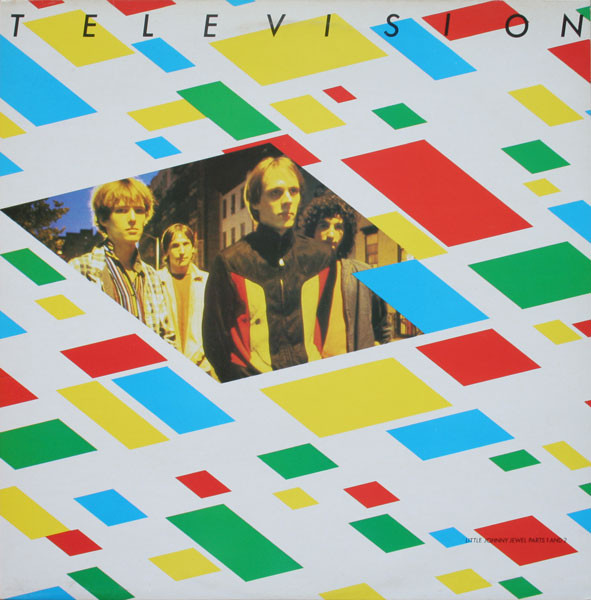
Television: Little Johnny Jewel
[purchase

I scanned my list of potential subjects for this theme (read my last post if you don’t know what I’m talking about) and decided again to write about a band that I hadn’t discussed before—Television. I’ve written about small-t television many, many times, here and elsewhere (not going to link, since there are too many), because watching TV is probably how I spend more of my leisure time than anything else, but I’ve never written about the band. While Todd Rundgren’s failure to ever be discussed in this space was very surprising, it is almost as surprising that Television has only been discussed twice—back in 2008 and 2009—and both times about the same song, “Marquee Moon.” Which happens to be an excellent song, but we’re going back to Television’s first release, “Little Johnny Jewel,” a single on their manager’s label, released in 1975. 

Although Television came up out of the same C.B.G.B. scene as the Ramones, Blondie, Patti Smith, Talking Heads, Richard Hell and the Voidoids and the Heartbreakers, among others, who I often played on the radio back in the 1979-1982 period when I was doing college radio, I had trouble connecting with the band then. As someone who grew up on classic rock and prog, I (eventually) came to understand the hard, fast ethos of punk that those other bands followed (although for some, that changed over time) as a rejection of the older forms of rock.  While I still loved what I grew up on, I also learned to love punk (and new wave). But Television’s meandering jams and guitar solos and stream of consciousness lyrics, sung by Tom Verlaine in a yelping voice that, to my ears at least, made David Byrne sound great in comparison, somehow didn’t fit in to the slots that I had in my head at the time. I couldn’t understand how they were in the same category as the Ramones, whose simple two-minute songs done at breakneck speed were nothing like the long songs that Television produced. 

Because of their timing, and their identification with the downtown NYC music scene, and because of the rough sound of their music, Television is usually lumped in with the punks, but interestingly, I’ve seen them referred to as both proto-punk and post-punk, which seems impossible without some sort of time machine. And yet, it makes sense, when you look closely. Television presaged punk both temporally and in their attitude, but their sound was not “punk” in the way that word is commonly used, so like “post-punk” bands, they embraced the brashness of punk, but not all of the sound. 

In my old(er) age, I’ve come to appreciate Television more and more. Maybe it is my more mature approach to music that is less interested in putting artists and their music in genre slots, so that I enjoy the connections that artists that seem very different actually have. I know, for example, that the first time that I heard “Impossible Germany,” by Wilco, one of my favorites, I was struck by how the intertwined guitar parts played by Nels Cline and Jeff Tweedy reminded me of Television’s Verlaine and Richard Lloyd. 

As mentioned above. “Little Johnny Jewel” was the first song released by Television, its 7 plus minutes split into two parts on a 45, and it’s an odd one. Opening with a bass line (from Fred Smith, who had replaced Richard Hell), before Billy Ficca’s drums and the guitars enter, the instrumental eventually resolves into a groove before the vocals begin. The song may be about Iggy Pop, whose real name was James Newell Osterberg, Jr., but his middle name is sometimes listed as “Jewel.” There’s a long instrumental guitar section featuring Verlaine soloing in the middle that sounds closer to psychedelia or even jazz than punk before the groove returns, along with the lyrics: 

Oh, Little Johnny Jewel
He's so cool
But if you see him looking lost
You ain't gotta come on so boss


Verlaine recalled in an interview: “Lou Reed asked me, ‘Why’d you put out this song? This is not a hit.’ I said, ‘What band playing a bar in New York, issuing their own single, is gonna have a hit?’” However, the single sold surprisingly well, and arguably kickstarted the New York punk movement.

Monday, August 30, 2021

Bigger Strings: The Black Angel’s Death Song


Velvet Underground: The Black Angel’s Death Song
[purchase

John Cale is another musician whose work I’m aware of and have enjoyed, but never (until now) spent much time learning about his life and career. I knew he plays the viola, among other instruments, that he was one of the founders of the Velvet Underground, put out some solo albums, at least one of which I played back in my WPRB days, and did an album with Brian Eno a couple of decades ago (gasp!). This turns out to be, somewhat embarrassingly, a pretty pathetic summary. So, in brief (and admittedly, mostly gleaned from Wikipedia), Cale was born in Wales in 1942, adopted the viola as his primary instrument and studied music at Goldsmiths College, University of London. Cale once described the viola as the “saddest instrument of all and, no matter how adept you get at it or no matter how fast you play it, you can’t get away from the character of it.” 

Cale quickly became enamored by the more avant-garde and experimental classical music becoming popular in the 1960s, including organizing a Fluxus concert in 1964 and conducting the first U.K. performance of a John Cage piece. He obtained a scholarship to work with Aaron Copland at Tanglewood, but they “fell out,” and Cale then moved to New York where he participated in an 18 hour performance of an Erik Satie composition and joined La Monte Young’s Theater of Eternal Music. 

OK—enough with the classical music (I mean, really, two posts in a row writing about classical music which I know basically nothing about…. I’m really not trying to pull a Metal Machine Music and alienate you all). 

Cale also liked rock music, and joined up with Lou Reed to found what became the Velvet Underground in 1964. Cale’s taste for the experimental, particularly drones, when combined with Reed’s penchant for rock and poetry (and manager Andy Warhol’s Andy Warhol-ness) resulted in early albums that were kind of all over the place. 

One of the more experimental songs from the debut album, Velvet Underground & Nico is the cheerily named, “The Black Angel’s Death Song,” which, for the most part, features Cale’s droning and dissonant electric viola with Reed and Sterling Morrison each playing away on guitar, while Reed chant/sings wordy lyrics in a style that had to be influenced by Dylan. There’s also what sounds like feedback, but was actually Cale hissing into the mike. I know that description doesn’t make it sound all that appetizing, and the song got the band fired from their residency at Manhattan’s Café Bizarre. But while it isn’t something that I’d listen to regularly, there’s something intriguing about it that made me glad that I checked it out again for this piece. 

So, what’s the song about? It is hard to say. Reed himself has said that “The idea here was to string words together for the sheer fun of their sound, not any particular meaning.” But the imagery is so strong, I find that hard to believe. I’ve seen claims on the Internet that the song is about life’s choices, heroin, suicide, the Holocaust, and Communism. Check it out, and let me know what you think. 

Eventually, Reed and Cale fell out over the direction of the Velvets, and Cale was replaced by Doug Yule (I guess you had to have four letters in your name). Cale went on to a career as a producer (for, among others, the Stooges, Jennifer Warnes, Patti Smith, The Modern Lovers, Squeeze, and Alejandro Escovedo), collaborator (including with Reed on Songs for Drella in 1990), and solo and soundtrack artist.

Wednesday, October 28, 2020

Hidden Places: Dirty Blvd.


Lou Reed: Dirty Blvd.
[purchase

I’m sure that I was listening to some song that mentioned some place that wasn’t in the title when I thought of this theme, but I suggested it so long ago that I can’t remember what song it was. So, when I tried to figure out what to write about, I decided to write about my favorite city. The city that I’ve loved since my father brought me into Manhattan from my birthplace in Queens when I was a little kid, to go to museums, and magic shows, and just to walk around and spend time with him. Where I’d go with him to court, or to hang out in his office. And when I got older, where I’d sometimes come with friends, to go to the theater or museums or restaurants or ball games. Where I went to law school, lived for almost a decade, met my wife and started a family. And where I worked until a few years ago, commuting on the train after moving the suburbs, and loving the excitement and bustle of New York. Except on the night they lit the Rockefeller Center tree, which made my usual 10 minute walk to the train an ordeal. I miss New York, having started working from home back in 2013, and I miss it even more now, when thinking about going to the City raises all sorts of new issues. (Interestingly, in 2013, I wrote about another song from the same album, although strangely as a tribute to my suburban home).

I have a “New York” playlist on iTunes, and the rules, such as they are, are that the song has to mention New York City, or some part of the City, or at least some recognizable location or feature of the City. I’m guessing that I’ve missed a few, but it currently has over 500 songs on it. It’s possible that no artist has more songs on the list than Lou Reed, who was born in Brooklyn and grew up on Long Island, but has long been associated with New York from his move to the City in 1964 to be a songwriter, and especially from his co-founding the Velvet Underground. The Velvet Underground was, of course, part of the New York underground scene around Andy Warhol and his “Factory,” and more than a few of their songs were about the seedy, druggy underbelly of New York, such as “I’m Waiting For The Man,” a tale of scoring drugs on Lexington Avenue and 125th Street in Harlem. 

Reed’s focus on New York continued after he started his solo career, including his biggest hit, “Walk On The Wild Side,” which mentions the city itself, and the Apollo Theater, and also referred to members of Warhol’s clique. Again, Reed focused not on the mainstream, but on the marginalized part of New York, because that was the life he was living and those were the people that he knew. 

For 1989’s New York album, Reed, approaching 50, and thus an elder statesman, put together an entire album of observations of the City. In fact, Reed’s liner notes instructed listeners to listen in one sitting, “as though it were a book or a movie” (although I know few people who read a book in one sitting, but you get the point). It’s a bleak album, about a bleak time in New York. I loved the album, although I have to admit that things for me were the opposite of bleak—I had a high paying job, a nice apartment, and best of all, I had been married to the love of my life for about four months. 

Still, I was able to appreciate Reed’s observations and lyrical wordplay, and the tight, stripped down, music from Reed, guitarist Mike Rathke, bassist Rob Wasserman and drummer Fred Maher (with some guests, including former Velvet Underground drummer Moe Tucker), which was perfect for the songs. The album was critically acclaimed, and the single, and our featured song, “Dirty Blvd.” was a No1. hit on Billboard’s Modern Rock chart. 

“Dirty Blvd.” is not a hopeful song, by any stretch of the imagination, about Pedro, from a poor immigrant family who, because of the city’s (and country's) mistreatment of both those groups was destined to fail. It’s an angry song, contrasting the wealthy at Lincoln Center, only blocks from the rundown hotel where Pedro lives, with the difficulties of his life.  In one of the most memorable passages, Reed sings: 

Give me your hungry, your tired your poor I'll piss on 'em
that's what the Statue of Bigotry says
Your poor huddled masses, let's club 'em to death
and get it over with and just dump 'em on the boulevard 

By the way, guesting on background vocals on the song is another New Yorker, Dion DiMucci

Although since 1989 much more of Manhattan, and the other boroughs, are gentrified, and safer than back in the era described in New York, income inequality in the City, and elsewhere, is worse than ever. And the current administration’s anti-immigrant policies even led to one advisor, whose name I will not type, attempt to distance the Statue of Liberty from Emma Lazarus’ iconic verses. The album still holds up, mostly because of the music and lyrics, and also in part as a period piece and in part because of its timelessness. 

New York City has, like most of the country, taken a hit from the coronavirus and the failure of our national “leadership” to take appropriate action in face of the pandemic, but contrary to the recent statement from the liar in chief, it is far from a ghost town. My son and daughter-in-law stood on line for more than two hours the other day to vote, which is a lot of ghosts. In fact, although things are generally not going well, there’s some evidence that New York City is attracting new people, which it always has, from well before the days that my ancestors showed up here from eastern Europe (one, by way of England) before and just after World War I, and whose energy and vitality has always been fed by immigrants from other countries, and from other parts of the United States. 

[I found out late last night that yesterday, October 27, 2020, was the seventh anniversary of Reed's death, which didn't enter into my decision to write this piece.  But if I had known, I would have tried to post it earlier.  Oh, well.]

Thursday, December 20, 2018

Extras: Albums that came with extras


I veer from the standard "post a song with extra" because I just couldn't get into my original idea. It's not that Lou Reed's Claim to Fame has no claim to fame, but ... it *is* just one more of a few hundred songs that happen to have the word "extra" in the lyrics. I wanted something a little more entertaining at this time of year.

There must have been like a million albums produced since the invention of the phonograph, and it must be a perennial quandary for the artist and the producer to come up with something that makes yours stand out. Sometimes good music in and of itself isn't enough. I think of my copy of Dave Mason's Alone Together, which was pressed onto somewhat psychedelic multi colored swirling vinyl - kind of unique. I've seen albums with funky shapes.

One album with something "extra" that sticks in my mind is Sticky Fingers, with its actual zipper "sewn" into the album cover. You can't help but pull it down to see what's ...
And aside from this kind of attraction, lots of albums have included band-related posters.

But going to a more extreme additional form of entertainment for the fans ... (and these - for the most part - are generally verified hearsay. Sue me if I'm wrong)

Cheech and Chong's Big Bambu included a huge rolling paper. No surprise there.


Sgt. Pepper's included a a cardboard page of cutouts - epaulettes, moustache, badges ....


ELO's Out of the Blue included a cardboard cutout of their iconic spaceship.


Three Dog Nights' Seven Separate Fools album came with seven oversize playing cards.


Alice Cooper's Schools Out came with paper panties as a wrapper.
Any you care to add?

Tuesday, December 30, 2014

Holiday Blues: Blue Christmas


It's a bit bloody obvious, I know, and I can't even be arsed to see if it has been done before, but it seems so apposite in so many ways, covering any number of the bases I enjoy covering, even, in this case, if that veneer is of and with a thick, snowy schmalz. It's possible I may have previously mentioned my love of cover versions and this song, almost to my shock and awe, is one I have way more versions of than I ought. Or anyone ought. Who knew so many folk woke up one day and felt that this and only this was the song to cover. But then, Christmas, for all it's peace to the world and joy to all people can be a pretty godawful time of year for many, anticipatedly or contrived, through the foibles of massed family and friends. The main problem with the compulsory good cheer of Christmas is that it emphasizes the family, it expects partnership, it insists on conviviality, with that very pressure often enough to burst asunder through any too great expectation based upon. Been there, done that, and, hells teeth, alone at Xmas is the pits, the more so if you are clutched to the bosom of what loved ones you still have, rendering the essence of gooseberry to it's quintessential. I feel that Billy Hayes and/or Jay W. Johnson, who wrote the song back in the 40s knew this, the lyrics extolling the pain of lost love at Yuletime. (Having added my own existing knowledge to the 37 and counting pages of youtube vids, the repeated hearing of this song can itself render one near suicidal, alone or otherwise, but that's another story.)

Elvis is clearly the template most are aware of, originally appearing on his 1957 LP, Elvis' Christmas Album, later as a 1964 single, each doing well in their own formats, either side of the Atlantic. But it had been well-covered ahead of that, as early as 1948, by Ernest Tubb, a lot less ornately, and hence, to my ears, a lot more attractively. Since then the list has been extensive and extraordinary, largely within the canon of country (+/- western), encasing such disparates as Willie Nelson and Billy IdolWynton Marsalis and the Partridge Family and many, many more, sadly more distinguished by their bland similarities than any novel differences. Particularly galling examples I cannot even begin myself to link are by latter day "Great American Songbook" destroyer Rod Stewart and the appalling Mickey Bubbles. And even a live Bruce Springsteen and Jon Bon Jovi, separately (unless you know better) have managed to savage it to an ignoble death. There is also the horror of Lou Reed, together with the unlikely collaboration of, God help us, the McGarrigles, so truly bad I have to offer it, pleading then your forgiveness. But there are a few that can proudly stand above the parapet, if only by the quality of the production or the quirkiness quotient. So let me present odd UK Led Zep reggae tribute band Dread Zeppelin, Scotland's finest, the Proclaimers, credible mainly for their heavily accented diction, and recently deceased reggae legend John Holt.

There are many more. If you seek yet more malaise still, the versions by Jerry Lee Lewis, Leon Redbone, Sheryl Crow, Nicole Atkins, Low, Jimmy Martin (quite good actually), Tammy Wynette, Jewel, the Ventures (likewise), Brian Wilson with the Beach Boys, Fats Domino, Bright Eyes, Johnny Mathis, Robert Gordon, Dean Martin, the Platters and Leann Rimes, they are all but a click away, in all their varieties of awfulness.

I need to leave you with some imagery though, to break up this wall of prose, so here are 2 final personal favourites: Porky Pig.....


........and Kermit the Frog:


Happier New Year!!

Sunday, March 30, 2014

Anniversary:Go Deeper-Sunday Morning


The Velvet Underground: Sunday Morning
[purchase]

I’ve only been writing for Star Maker Machine for a little more than two years, but I was a reader for some time before that. I’ve long appreciated the breadth of the music discussed here and the knowledge and writing skill of many of the contributors, many who have unfortunately long stopped contributing to this blog. I’ve followed some of these writers to their personal blogs, and have enjoyed learning from them. I may not be the best person to write about the history of SMM, and I hope that some of the writers who have been involved here longer can fill in the gaps in my knowledge, but I’m going to kick things off, as we look back before we move forward.

From what I can tell, this blog was started by a guy named Paul under the name “Six Songs.” The first post was on February 6, 2008, and the concept was that Paul was going to post a song six days a week, hoping to engage readers to create a conversation in the comments. The first song he posted was Emmitt Rhodes’ “With My Face on the Floor.” But on March 23, 2008, Paul posted “We’re Taking a Break,” writing:

“Posting a new song everyday is surprisingly stressful, even with the Sunday rest. So we're off for some R&R. We may be back with a new format.”

Four days later, Paul teased the blogosphere with the announcement that he had come up with a new concept, and, on March 28, 2008, he announced the new name, “Star Maker Machine,” posting a picture of Joni Mitchell, and the song “Free Man in Paris,” from whence the blog name came. And then, on March 29, 2008, Paul announced the new concept—that he would open the blog up to writers who wanted to post about music, without necessarily starting their own blog. And, in essence, the SMM journey began.

On April 5, 2008, in a nod to the original “daily song” roots of the blog, Paul announced the first theme, “Days of the Week.” The first song that Paul posted was “Sunday Morning,” by Margo Guryan. I wanted to “go deeper” with that song, for historical reasons, but, frankly, it doesn’t speak to me, even though the album that it comes from, Take a Picture, was described by Allmusic as “one of the most exquisite and appealing, if little heard, one-shot "California" (although actually recorded on the East Coast) soft-pop gems of the kaleidoscopic late '60s.” So, instead, I decided to discuss the different Velvet Underground song, with the same title, which was also fleetingly mentioned on SMM back on April 3, 2010. (I also thought about writing about the SCTV soap opera parody, but decided against it.)

When you think of the Velvet Underground, you think of dark themes, drugs, and kinky sex. You think of Lou Reed’s twisted, literate brilliance, John Cale’s unusual arrangements and instrumentation and Andy Warhol’s peculiar Warholness. “Sunday Morning” is a little different. The last song recorded for the band’s debut, The Velvet Underground and Nico, it was the leadoff track, and an attempt to create a hit single. On an album that included songs like “Heroin,” “I’m Waiting for the Man,” “Black Angel Death Song” and “Venus in Furs,” “Sunday Morning” sounds almost benign and friendly, although there is still an unsettling question about what happened the Saturday night before. It was originally going to be sung by Nico, the German singer who was shoehorned into the band by Warhol, but instead Reed took the lead. The song also features a prominent celesta part, played by Cale on an instrument he happened to find in the studio, which makes the song sound strangely happy.

After the first post, Star Maker Machine slowly began to engage other writers and commenters. It appears that Paul stopped writing for the blog in October, 2008, after posting a Pete Townshend demo of “We Won’t Get Fooled Again,” in a piece entitled “Meet the New Boss, Same as the Old Boss,” to focus on a personal music blog, “Setting the Woods on Fire,” but it appears that blog is also defunct.

As we move forward with Star Maker Machine, we hope to continue to engage, interest and amuse our readers, and maybe lead them to new musical discoveries.

Sunday, March 17, 2013

The Bard: Romeo Had Juliette


Lou Reed: Romeo Had Juliette
[purchase]

My guess is that there are more songs that reference “Romeo and Juliet” than any other Shakespearian work. So many songs are about love and its various permutations, and “R & J” is, to my mind, the most accessible of Shakespeare’s plays because most of us have experienced first love, and can easily understand the idea of falling in love with someone that they shouldn’t. That is easier to identify with for most of us than, say, being a member of royalty. Or killing a member of royalty. Or being confused with your long lost twin and having to disguise yourself as a member of the opposite sex.

So, there is West Side Story, the Bard’s tale transposed to a turf war between dancing and singing gangs in New York in the 1950’s, or “The Cinema Show,” (discussed above) which sets it in England in, I guess, the 1970’s. And there is the Lou Reed adaptation posted here, set in the gritty New York of the 1980’s. This version is part of Reed’s brilliant New York album, in which he and a group of incredible musicians paint an indelible view of the city during a difficult time, when money was tight, drugs were rampant, and crime was endemic. The music is tight, the lyrics are sharp, the songs are memorable, and if you somehow don’t own this album, you should.

I lived in New York during that time, and although I was mostly spared the bad stuff, you couldn’t ignore it. Of course, New York is also a hotbed of Shakespeare, with productions of his work almost constantly in theaters, most famously the Shakespeare in the Park shows each summer in Central Park, featuring top performers and usually interesting direction.

Now, I live in a community a little north of the city where, remarkably, Shakespeare is an integral part of the fabric of life. Spearheaded by my friend Peter, an incredibly talented director of children and teenagers, he began by offering workshops where kids would learn and perform scenes from Shakespeare plays. I’m proud to say that both of my kids were involved at the start, and what makes Peter’s approach special is that he makes sure that the kids understand and appreciate what they are saying. So that they are really acting, and not just reciting lines. I remember reading Shakespeare in high school, where it was unfortunately treated as something difficult and off-putting, and I regret that I never got the appreciation of his work at a young age like my kids and their friends.

These workshops, due to the vision of our local schools foundation and the YMCA, pushed by my friend Barbara, grew into regular productions of Shakespeare plays in the schools, starting at the elementary level, and in an incredibly popular summer theater camp, culminating in our own Shakespeare in the Park outdoor productions, featuring casts of children and teenagers. Peter and his crew do not dumb down the language, and the kids, as kids usually do, rise to the challenge. He often has fun setting the plays in different times, including my favorite, As You Like It, set in the 1960’s. He commissioned one of my son’s friends to write original music for the show, a band of high school students performed the music, including some period pieces, during the play, and my daughter belted “Somebody to Love,” channeling her inner Grace Slick. (If you are interested in having your mind sort of blown, check out what this still young composer is doing now--Orkinpod). The summer performances are a highlight, and draw big crowds.

Not only that, but a couple of summers ago, two recent high school grads, and alumni of Peter’s troupe, formed their own theater company, generally for adults (although they have worked in a few kids). The first summer they produced A Midsummer’s Night Dream, (which my kids were in) and last summer was The Tempest. Also produced outdoors, these productions were sophisticated and well-acted, even considering the shoestring budget that was available.

I’m proud of my community for supporting such amazing theater and I wanted to give credit where it is due. And if my friends read this, and inflate the blog’s page views, so much the better.

Wednesday, October 20, 2010

Call Me: New York Telephone Conversation


Lou Reed: New York Telephone Conversation

[purchase]

It seems that a lot of telephone talking (judging by what I overhear on the bus, anyway) deals with "who has" "who did" "...did not!" "...better not!", and all that same stripe of gossip.

It's disheartening.

Lou Reed nails that wearying, spot-on, during the set up of New York Telephone Conversation.

Getting woke up, and deciding whether to answer... is much easier now, what with caller ID, no?

Deciding to answer and finding out it is nothing important, just idle chatter and gossip. No more easier then than now, no?

But then Lou spins it. curing the emotional bend of too-much-talking into what every person who has been in love has ever wanted to hear:

"For I know this night will kill me if I can't be with you."

Wednesday, August 25, 2010

Torch Songs: One For My Baby (And One More For The Road)


Lou Reed: One For My Baby (And One More For The Road)

[purchase]

From the album simply entitled Duets, Lou Reed and bassist Rob Wasserman have produced a great cover of this fine old standard. But it's is a departure from most of the other versions I'm familiar with. You might say this isn't your father's 'One For My Baby'. Written for the musical comedy film 'The Sky's The Limit', starring Fred Astaire, Reed and Wasserman take this song to a new level. Interestingly the word torch was added in a line that replaces one from the original and that seems to be tailor made for this weeks theme. For the sake of comparison I've included the Johnny Mercer track as well.

Johnny Mercer: One For My Baby (And One More For The Road)

[purchase]

Tuesday, August 11, 2009

Body Parts: Foot of Pride

Photo of a foot.


Lou Reed: Foot of Pride

[purchase]

Here's a song to bridge the gap between last week's theme and this week's.

Back in 1992, I had an old Chevy pickup truck that had been bouncing around the family for a while. Not everything worked on it, including the gas gauge. I relied on the odometer to guess when I needed to get gas. I usually got it right. On October 16 of that year, I was driving home from somewhere, and I knew I was running low. But I was trying to make it home in time to catch the live television broadcast of Bobfest, the the huge 30th anniversary Bob Dylan tribute concert at Madison Square Garden. As I pulled off of Rt. 1, a mile or two from home, the engine died. I managed to steer it into an empty parking lot and mulled over my options. It didn't take me long to figure out what my priority was. I left the truck, walked the rest of the way home, watched the whole concert broadcast, then figured out how I'd get gas for my truck. It was one of those events I did not want to miss.

The concert was flawed (where were Joan Baez and the Grateful Dead?), but there were many highlights. Some even involved people other than Neil Young. One of my favorite performances was Lou Reed's take on this relatively obscure song. He stretches out the original's six minutes to almost nine, and the guitars get almost psychedelic.

I have to confess, I've never studied all the lyrics to this song. I just like the way they come pouring out, almost too fast for Lou to keep up. I remember at the time people were dissing Lou for using a lyric sheet, but I recall his defense was that the teleprompter everyone else was using just wasn't able to keep up with the lyrics for this one.

I eventually sold the truck and bought a Honda Civic hatchback. Loved that car for ten years, but I had a lot more friends when I owned the pickup.