












Showing posts with label Monty Python. Show all posts

Tuesday, January 2, 2024

In Memoriam-Robin Lumley and John Giblin


 [purchase Product]

Robin Lumley and John Giblin were members of Brand X at various times.  I’ve written before about Brand X, a jazz-rock fusion band probably best known for the contributions of Phil Collins (who I’ve written about, too), but the band’s membership was somewhat of a revolving door.  (And I wrote about another member, guitarist John Goodsall, for our 2021 In Memoriam theme.)  Lumley was a founding member of the band, on keyboards, and was involved from 1974-1980, with a brief hiatus in 1978, while Giblin, a bass player, was a member in 1979, although his recordings were released through 1982. 

Robin Lumley was born on January 17, 1948, in Devonport, England.  Originally a drummer, he switched to keyboards in the 1970s.  In 1972, his former neighbor, David Bowie, rang him up one day, to see if he would be interested in replacing Bowie’s ill keyboard player, Matthew Fisher from Procol Harum, starting the next day.  He was interested and joined the Spiders From Mars.  After that, Lumley worked as a studio musician and met Collins, which led to the formation of Brand X.  Lumley also became interested in music production.  His hiatus from Brand X in 1978 was to work on production projects, including Rod Argent’s Moving Home, and Bill Bruford’s Feels Good to Me, and he later produced records for Orleans, Anthony Phillips and Isotope, among others.

In the 1980s, he formed a jazz-rock band that included Rod Argent, Graeme Edge (of the Moody Blues), Morris Pert (of Brand X), and Gary Brooker (of Procol Harum). Lumley later married an Australian and moved to Australia. In 2001, he formed SETI with Graeme Edge, bassist Rob Burns, and Rod McGrath (cellist for the West Australian Symphony Orchestra).  He also composed and produced music for over 250 television and radio commercials for numerous television productions in the US, UK and Australia.

Lumley died from heart failure in Plymouth, on March 9, 2023, at the age of 75.

***

John Giblin was born on February 26, 1952, in Bellshill, Scotland.  He was best known as a studio musician, contributing bass to albums and performances by artists such as Peter Gabriel, Paul McCartney, Eric Clapton, Kate Bush, Simple Minds, John Anderson, Phil Collins, Al Green, and Annie Lennox.  Giblin was best known for his mastery of the fretless bass.

As noted above, Giblin recorded with Brand X in 1979, when the band was being pushed to make more commercial music.  The surprising response to this pressure was to have two separate units record—one with bassist Percy Jones, keyboard player Peter Robinson, drummer Mike Clarke and Goodsall, and the other featuring, Lumley, Giblin, Collins and Goodsall.  The output of these two groups were released, but no improvement in commercial success was achieved, leading to a band breakup.

More recently, Giblin was playing more acoustic bass, and was involved in projects with Peter Erskine of Weather Report and Alan Pasqua of Tony Williams Lifetime. 

Giblin died of sepsis following a long illness on May 14, 2023 in Cheltenham, England, aged 71.

You can hear both men on the Brand X track in the video, “Algon (Where an Ordinary Cup of Drinking Chocolate Costs £8,000,000,000),” a title taken from a Monty Python sketch (in which the cup of chocolate only cost £4 million), from the Product album.
 

Monday, November 8, 2021

CANDY/SWEETS: CHOCOLATE

Duty bound to prop up this side of the atlantic, with candy, like movies and garbage, an americanism that has crept in and gained an increasing traction in the language over here. I feel I have to say we eat sweets, or, even, sweeties, when in need of a sugar kick. So, true to form, tapping 'sweet' into my i-tunes search, I anticipated reams of inspiration. Sadly, give or take this song, very little fitted the bill, even were I to turn a blind eye to the innumerable double entendres out there, as most of the sweetness and most of the honey referred to comes in a two legged form. Needing, thus, a quick reboot, and chocolate became my go-to. 


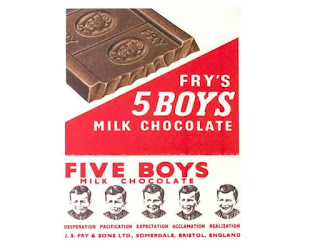
Courtesy disallows any discussion over the pros and cons of US versus UK in this confection, the age-old Hershey versus Cadbury, perhaps now academic that Cadbury, for chrissakes, are owned by the cheese paste magnate, Kraft. (The answer, by the way, is neither, my taste erring towards dark and interesting, the continental "plain" chocolate that actually bears some acquaintance with the cocoa bean.) So, with no further ado, here's a selection box of choccy treats, which I will deliver in the form of the once mighty Fry's Five Boys bar. This was a childhood treat in, admittedly, simpler times, a thin bar comprising 5 segments, each with a different boy at the different 5 stages of engagement therewith. Entitled Desperation, Pacification, Expectation, Acclamation and Realisation, the classic stages of how to bribe a small child. Once the most recognised bar in the world, it was launched in 1902, surviving until the late '70s, by which time it had become desperately low key and old hat. 

Desperation:

I Like Chocolate/Johnny and the Raindrops

Has anyone actually heard this monster before? Uncertain quite as to which demographic it was aimed toward, nonetheless it is so gallingly sickly as to deserve a place here. Johnny and the Raindrops, who "have been making music for children and their grown-ups since 2008", that quote giving away the game that they are in that small selection of bands for pre-school kids, like Australia's more famous Wiggles. (I'd love to say like They Might Be Giants, but I am aware their fans now come also in long trousers and are fiercely protective of the band and their oeuvre.)

Pacification:

Chocolate/Tindersticks

An unusual piece from the Tindersticks canon. Unusual, in that it is spoken word, spoken with a voice that sounds normal and unmannered. The singing style of the vocalist, Stuart Staples, is not always so, with one of the, let's say, more curious timbres out there. Don't get me wrong, I adore the band, and his odd vocal style is a big part of that, this song somehow diminishing him a little, making him sound just a normal lad from Nottingham. The backing remains, of course, exquisitely characteristic, a mix twixt David Lynch soundtrack and european art-house film music. It is a long track; please bear with it. If you can't, well, skip to the end. With luck you will then want to hear the whole thing.

Expectation:

Chocolate Girl/Deacon Blue

The song that first endeared me to this ongoing Scottish institution. A terrific song from their debut album, the mere act of adding some sublime pedal steels ensured my interest and attention. I have written about them before, my belief maintained that their first work was their best, further albums never quite having quite the same hooks. But they play on, fairly big hitters, still, on the bigger UK indoor venue circuit: indeed, I caught them, if briefly, playing at  festival just this last summer. With a largely all the hits show, they had the audience lapping it all out of their hands. And, sure, they played this.

Acclamation:

Chocolate Drops/Iggy Pop

A newer song, slightly, one of the highpoint of Mr Osterberg's 5 year old opus, Post Pop Depression. I like it, he coming on all over like a cross between his old mucker, David Bowie, and Mark Lanegan, the thoughtful use of chimes in the percussion department always a mood lifter in my house. It has intriguing lyrics, Pop's own, added to a riff album producer Josh Homme had had lying around for some few years. Basically a variation on the Monty Python song about looking on the bright side, here Pop muses on how, as you sink to the bottom, you become the top of that trajectory, inviting the then corollary that the brown stuff accumulating there might then become chocolate drops. Enticing stuff, eh? But it is a lovely little tune so, with that positivity in mind, who is to say the yellow snow isn't honey?

Realisation:

More Songs About Chocolate and Girls/The Undertones

I'm not sure whether this was written as a response to the Talking Heads' worthy sounding album, More Songs About Buildings and Food; I should check. (A: It came two years later and both bands were on the same label, so it seems a reasonable supposition.) No clever allegorical verbiage here, just a dumb yet smart ode to the simple pleasures of, um, chocolate and girls, sung in Feargal Sharkey's unmistakeable wobbly warble. At the end of this or any day, I am not sure if any of the greatest philosophers could put it better:

"Sit down, relax and cancel all other engagements
It’s never too late to enjoy dumb entertainment"

So, there you have it, 5 boys worth of chocolate. Before I finish, however, let me share with you the delight of discovery as to what the Scots Gaelic for candy turns out to be, sweeties being so integral in Scottish life and dentistry..... (Hint: try saying 'suiteas' aloud. And 'seòclaid' isn't heaven a million miles away, either!)


Wednesday, September 12, 2018

WINE: GIVE BOOZE A CHANCE/BONZO DOG DOO-DAH BAND


I suspect the Bonzo's didn't really translate that well across the pond to the USA, that second of two nations divided by a single language. Indeed, apart from a cult of ageing sex- and septuagenarians, I've never been sure whether they actually meant so much over here, their one slab of chart action being produced by one Paul McCartney, often mistakenly thought to be also written by him. But this glorious parody never fails to make me smile, even as I repeatedly play it to my bemused, and unamused, wife. Nonetheless, it seems, in a fortnight of songs about wine, perhaps to give a thought about the downside. And this is probably best appreciated within the context that Vivian Stanshall, the singer and frontman of this anarchic ensemble, died arguably not indirectly from his giving booze one hell of a chance, in a fire on his houseboat, in no small part contributed to his prodigious alcohol consumption. Details vary.


The Bonzo Dog Doo-Dah Band had no right being a success, but, in a small way, a success they were. Formed in about 1962, the aim was to provide a dada-ist counterpoint to the then trad-jazz revival of its day, which involved the deadpan recreation of the often absurd and very english approach to dixieland. Take "Hunting Tigers out in Indiah", which might be considered one such example, their recreation of an original song dating from the '30s. By this stage they were in transition from an all brass and banjo line-up, beginning to introduce more conventional, for the '60s, instrumentation. Helped in no small part by a resident spot on children's TV programme, "Please Do Not Adjust Your Set", they gradually morphed into a slightly broader parodic approach to all styles of popular music. Should you pursue the clip, it shows also the nascent beginnings of "Monty Python's Flying Circus", with all but John Cleese present. I was a child of that time, and took to this nonsense with ease, able to effortlessly assimilate the Bonzo's into my developing musical palette. (And no surprise that, as I grew older, so could become the peak audience for Python.)

Come 1967 and they had formally ditched most of the jazz, and many of the members who had played that style. A further boost was when Paul McCartney secured them a place in the Beatles' "Magical Mystery Tour". Here's some outtakes of their included song "Death Cab For Cutie", should you wonder where Ben Gibbard came up with the name. It was still hardly rock and roll in any conventional sense, they somehow still finding favour on the gig circuit and, especially, at festivals. They did manage one tour to the US, as support to the Kinks, themselves perhaps on a revers journey from rock to vaudeville. It was a disaster. They lurched on for a few more tours and a few more albums, shedding members, yet retaining a hard core of Stanshall, later Rutles mastermind Neil Innes and tap-dancing drummer, "Legs" Larry Smith, alongside saxophonists Rodney Slater and Roger Ruskin Spear, inventor of ever more Heath Robertson wind instruments. Acclaim did not, however, translate into sales.


After dissolution in 1970 they had a couple of short-lived reunions. Stanshall descended into ever more eccentric behaviours, ricocheting between drunken japes with Keith Moon and writing a body of works around fictitious upper class gentleman explorer, Sir Henry Rawlinson: "Sir Henry at Rawlinson End", initially as spoken word projects, later a series of books and a radio piece, even a film, with Trevor Howard, no less!. He died in 1995. Innes, ahead of the Rutles, went on to be the resident musical go-to for the Monty Python team, often appearing in their live concerts. Between 2006-8 a final official reunion took place, with Stanshall replaced by comedians/actors Phill Jupitus and Ade Edmondson, playing to nostalgia hungry audiences of (very) ageing schoolboys.

I confess I always found the band to be a better idea than a reality. You probably had to be there, recorded material having dated dreadfully. But for that idea I am grateful. And, for a short time, back in the dim and distant, glad also that I was there. Surely that is worth raising a glass to.

Give booze a chance.


Thursday, March 1, 2018

Mar* Songs: Rosie Flores Came to Town (Mar 1914)


The Honeydogs: Rosie Flores Came to Town (Mar 1914)
[purchase]

Sometimes, I like to pull the screen back and let you see what goes on in my mind when I choose what to write about. For me, when a theme is posted (or when I choose the theme), it immediately prompts me to think of a song and a personal story that ties to the song. Those are my favorite types of pieces. On other occasions, the theme leads me to a song, but I have no story, so I end up writing about the song, or the band. Those are fun, too, but less compelling. Then, you have themes, like this one, which prompt neither a song nor a story, and I’m reduced to scrolling through my iTunes library hoping for inspiration to hit. Those can be interesting, because this type of piece often pushes me to learn about a song or a band that I’m not all that familiar with. That’s what you are getting today.

Part of the problem is that in some ways, this is a repeat theme. Back in March, 2013, we did a “March” theme that was not particularly popular with our writers. Only four posts were written, two of which were by me. One was about my love for Monty Python, whose theme song was “The Liberty Bell March,” and the other was about Robert Randolph’s song “The March.” So, those were really the two songs that were foremost in my consciousness for “March,” interestingly neither of which related to the month.

Searching my library for ‘mar” led me ultimately to this song, “Rosie Flores Came to Town (Mar 1914)” from The Honeydogs. I know very little about this band, and the Internet is actually pretty stingy with information. I became aware of them initially because their original drummer, Noah Levy, played on Golden Smog’s Down By The Old Mainstream album (credited as Leonardson Saratoga). They were an alt-country band who arose from the same Twin Cities scene as The Jayhawks, The Replacements, Soul Asylum and others. Led by Noah’s brother Adam, The Honeydogs released albums, often with critical praise, every few years since 1995, but with very little commercial success.

I’m not 100% sure what this song is about, though. It appeared on an album of unreleased tracks called Island of Misfits (released on September 11, 2001, maybe not the best day to have been putting out new music).  To be honest, it sounds enough like “Gentle On My Mind” that the lawyer in me started wondering if there was a plagiarism claim available. In part, it seems to tie a missing child incident to a show by Rosie Flores, the great rockabilly singer and guitarist. But it is hard to say. I can’t find any lyrics online, it is hard to understand all of them from listening to the song, and I can’t find any articles about any such incident tied to an appearance by Flores. Nor can I figure out what the reference to March 1914 is, since Flores was born in 1950. Maybe it isn’t about that Rosie Flores at all. So, you’ll have to just enjoy the song, without much analysis. By the way, Noah Levy played drums on Flores’ 2013 album, Working Girl’s Guitar, more than a decade after he left The Honeydogs. Also, this is the second time I’ve discussed a song about when a musician “came to town.” But a very different musician.

As I said above, sometimes posts like this are interesting because they push me to find out more about a band that I don’t know much about. It turns out, that happened here, and it even ties into something tangentially semi-personal. In trying to find out more about the band, and specifically the featured song, I found out that Adam Levy’s son Daniel committed suicide in 2012. Daniel was essentially the same age as my son, and Daniel’s mother Jennifer Delton is a history professor at Skidmore College (and a Princeton Ph.D.), where my son and future daughter-in-law attended. Daniel, an artist, started college at the Minnesota College of Art and Design, but left after a year and a half, returning to Saratoga Springs, where he took classes at Skidmore. His suicide happened in Saratoga Springs, between semesters, just after my son finished taking Professor Delton’s class. However, neither my son, nor his fiancée, recall anything about this incident.

Wednesday, March 8, 2017

Middle: Piggy In The Middle


The Rutles: Piggy In The Middle
[purchase the album]
[purchase the DVD of All You Need Is Cash]

It’s my fourth TV related post in a row (fifth, if you count the section of my In Memoriam piece about Fred Tomlinson, who did much of the music for Monty Python’s Flying Circus). And speaking of Monty Python, we’re going to discuss The Rutles, created by Python member Eric Idle and Neil Innes, who became part of the extended Python family late in their TV run, performed live with them and wrote music for, and appeared in, Monty Python and the Holy Grail. More about Innes’s distinguished career can be found here.

Idle and Innes created The Rutles, “The Prefab Four,” for a sketch show called Rutland Weekend Television. Innes, who had worked with Paul McCartney in his Bonzo Dog Band days, was able to brilliantly, but, for the most part, lovingly, parody The Beatles. Idle later played bits from Rutland Weekend Television, including The Rutles segment, when he hosted Saturday Night in 1976 (before Live was added to the show’s name), and Lorne Michaels suggested expanding it to a one hour show. A few months earlier, Michaels had taken the stage at Saturday Night and offered The Beatles $3,000 to reunite on the show, and when they never collected, it seems that he thought that The Rutles might be a good substitute. Years later, it came out that Lennon and McCartney were together that night watching the show in Lennon’s apartment in New York, only a short cab ride to the Rockefeller Plaza studio, and considered showing up to try to claim half the money.

In 1978, years before Spinal Tap popularized the rock mockumentary as a genre, All You Need Is Cash appeared featuring Idle as Dirk McQuickly, Innes as his writing partner Ron Nasty, Ricky Fataar, who had a stint in the Beach Boys, as guitarist Stig O’Hara and drummer John Halsey, who played with Lou Reed, as Barrington Womble, better known as Barry Wom. Ollie Halsall actually sang and played the McQuickly parts which Idle mimed and lip synched in the film. Halsall also appeared in the movie as “Leppo,” the Fifth Rutle, at once a commentary on his behind the scenes performance and a parody of both Stuart Sutcliffe and Zeppo Marx. Andy Brown played bass on the album, but didn’t appear on screen.

The film is, essentially a series of sketches that parody and follow The Beatles’ history. There were some pointed barbs at the band, but apparently they (mostly) didn’t mind—George Harrison, a huge Python fan who also helped to finance Life of Brian—appears in the show as a reporter. The cast also featured Python Michael Palin, SNL performers John Belushi, Dan Ackroyd, Gilda Radner and Bill Murray, Bianca Jagger, and Ron Wood. Paul Simon and Mick Jagger appeared as themselves.

But the best part of the show, and what has lasted, are the songs, often direct parodies of specific Beatles songs, and others pastiches of a bunch of tunes. Innes, in fact, was sued by the former holder of The Beatles’ publishing rights, and was required to add Lennon and McCartney as co-writers to many of the songs.

“Piggy In The Middle” is the alt-“I Am the Walrus,” if John Lennon had used different nursery rhymes as inspiration. The title refers to a game that I remember better as “monkey in the middle,” or less insultingly, if not less infuriatingly, as “keep away.” Here’s a piece from American Songwriter about the song which explains it better than I can.

A few semi-reunions of the Prefabs took place after the release of the movie. In 1996, a new album, Archeology, was released, parodying The Beatles’ Anthology, and a weaker sequel film was released in the early 2000s. And in 2014, Innes put out what he called Ron Nasty’s last song, “Imitation Song,” a parody of "Imagine."

The spot-on quality of the music and cleverness of the parody have continued to make The Rutles one of the most beloved fake bands ever. There even is a Rutles tribute album and Rutles cover bands. Which is still pretty odd.

Friday, January 6, 2017

In Memoriam: Some Overshadowed 2016 Losses


In a year in which we lost David Bowie, Prince, Merle Haggard, two thirds of ELP, Paul Kantner, George Michael, Leonard Cohen, Maurice White, George Martin, Glenn Frey, Sharon Jones, and Mose Allison, to name just a very few (most of whom are still available as subjects for this theme, hint, hint), it is not surprising that some deaths during 2016 were overshadowed by bigger names. Here are a few that you may have missed:

Fred Tomlinson: Tomlinson wrote much of the music that added to the lunacy of Monty Python’s Flying Circus and other British shows, and as leader of the Fred Tomlinson singers, performed a good deal of it. If he did nothing else but write the music for “The Lumberjack Song” and lead the Vikings in singing “Spam,” he’d deserve lionization, but he did much more.

[purchase the complete Monty Python series]

Dave Swarbrick and Pete Zorn: I was introduced to both of these musicians due to their connection to Richard Thompson. Swarbrick was best known as a fiddler, and was a member of Fairport Convention, remaining as a member after Thompson left, playing numerous instruments, singing and writing songs. He also contributed to many albums by Thompson and other members of the extended Fairport circle and performed as a solo artist and in various combinations. Check out this footage of him wailing on the fiddle, and singing, with Fairport Convention live in 1970.


Pete Zorn was an American multi-instrumentalist who played with Thompson live and on record, as well as other bands, often in the same English folk world as Swarbrick, and it does seem that they crossed paths. Zorn was Gerry Rafferty’s first choice to play the sax solo in “Baker Street,” but was unavailable; instead Raphael Ravenscroft got the gig. I remember seeing Zorn play with Thompson and handling many stringed and woodwind instruments, including the bass flute. Here he is, singing and playing sax on Thompson’s “Tear Stained Letter.”

[purchase Richard Thompson’s Hand of Kindness, featuring Zorn]
[purchase Fairport Convention’s Liege & Lief]

Gilli Smyth: The co-founder of Gong, with her partner and collaborator Daevid Allen (who died last year), Smyth was a musician, poet, writer and activist. Her contributions to Gong (where she was sometimes billed as Shakti Yoni), and the spin off collections that sprung up over the years, were eccentric, provocative and always interesting. You can get a sense of her "space whispering" performing style, and that of Gong, in this performance from 1973 of “Witch's Song, I Am Your Pussy.”

[purchase Gong’s Flying Teapot]

Bernie Worrell: O.K., enough with the Brits. Worrell, a New Jersey native, was a classically trained pianist who gained fame (and entry to the Rock & Roll Hall of Fame) playing funk with Parliament/Funkadelic in the 1970s. I really began to appreciate Worrell when he joined the expanded Talking Heads. After that, he continued to play with a wide variety of musicians, and as a leader of his own group. Here he is, featured in the introduction and throughout the live performance of “Life During Wartime” from Stop Making Sense.

[purchase the DVD of Stop Making Sense]

Tuesday, March 22, 2016

Re/Again: It's Like Déjà Vu All Over Again

[purchase]

It is unlikely that Yogi Berra actually said "It's like déjà vu all over again," but who really cares.  It's still a great line.

Darius' piece, though, made me want to post this video, of the Monty Python sketch, It's The Mind, which twists itself into an infinite Möbius strip that, not surprisingly, terrifies its protagonist.  

Continuing this theme, I point out that I have previously written about Monty Python, most notably here, and to a lesser degree, here.  So, if you want your own déjà vu experience, go back and read them again.  Or read them for the first time, I guess.

Friday, September 5, 2014

Royal: Duke Ellington and Count Basie


Duke Ellington and Count Basie : Battle Royal
[purchase]

In a way, I kind of wish that I had been able to do the transition post from “Offensive” to “Royal” because I find the concept of royalty to be offensive. As the great political thinker Dennis the Peasant pointed out, “Strange women lying in ponds distributing swords is no basis for a system of government. Supreme executive power derives from a mandate from the masses, not from some farcical aquatic ceremony.” On the other hand, YouTube explainer CGP Grey makes a good case that the British monarchy, at least, is a net benefit to Britain (although not everyone agrees).

But I have to say that the fawning over the British royals and their stupid hats is annoying. Even a constitutional monarch like (former) King Juan Carlos of Spain, who did much to help the country recover from the Franco dictatorship, abdicated a few months ago, after a corruption scandal relating to his daughter and son-in-law’s business dealings, and the reports that the King had been on a lavish elephant hunting safari during the country’s fiscal crisis.

So, as far as I’m concerned, the less attention paid to these generally undeserving winners of the genetic lottery, the better. As I see it, my country was built on a categorical rejection of hereditary nobility, yet maybe we have "highness envy," because so many people seem irrationally fascinated by them. (I make an exception, though, for former King Zog of Albania, because he sounds like a character from Star Trek).

But Royal it is, and I knew that I wasn’t going to write about someone who received their status because “some watery tart threw a sword” at one of their ancestors, or something similar. Instead, I thought of two men who received their exalted status by virtue of their musical genius, Edward Kennedy “Duke” Ellington, and William James “Count” Basie.

Now, I don’t know a hell of a lot about jazz, although I like to listen to it. I learned about rock music sort of organically, by buying records, listening to the radio and reading about it. Jazz, though, is something I really only started to dip a toe into during college and after, and never got the bug to learn much of the details. Because there are just too many details. But, of course, I knew about Duke Ellington and Count Basie. And, when I decided to write about them for this theme, I wondered whether they ever played together. Google is a beautiful thing, and when I put their names in to a search, I discovered in 0.46 seconds that, in fact, they actually did one album together, First Time! The Count Meets The Duke, and (a few minutes later) that it was a pretty well received album.

Apparently it took some serious planning to get Ellington, Basie and their entire orchestras together for a session, but it happened on July 6-7, 1961, at the 30th Street Studio in New York. As one article noted, the sessions included “requisite breaks for recreational liberties,” which is a phrase so delightful it is worth stealing. Under the English tradition, Dukes outrank Earls (the equivalent of Counts), and Ellington was one of Basie’s idols, but the album is nevertheless democratically split down the middle—an equal number of each band’s classics, Duke’s orchestra is in the right channel and Basie’s is on the left, and in most cases the leaders each took piano solos (although Basie refused to play on Ellington's signature song, “Take the A Train,” so instead the composer, Billy Strayhorn, was the second pianist). Where that leaves the “Duke of Earl,” is unresolved here.

Our featured song, “Battle Royal,” opens the album. It was originally written by Ellington for the movie Paris Blues, which featured Paul Newman, Sidney Poitier, Joanne Woodward and Diahann Carroll, who could be considered acting royalty. In the film, the song represents a “Battle Royal,” when the band led by Newman and Poitier is challenged by a band led by Louis Armstrong, uncrowned jazz nobility himself, playing a character named Wild Man Moore. The Ellington/Basie version featured above starts off somewhat more restrained than the exuberant film version, but rapidly turns into a battle between the two orchestras and their soloists that is both intense and thrilling.

Wednesday, August 14, 2013

Unusual Collaborations: Run-D.M.C. & Aerosmith

[purchase]

Although I like to believe that I have pretty broad musical taste, I just don’t like rap music, with very few exceptions. And I don’t like Aerosmith, again with very few exceptions. And yet this pairing, which at the time was considered to be shocking, just works.

The original version of “Walk this Way,” by Aerosmith, is admittedly one of the few exceptions to my generalized dislike of the band. Not only is the title based on one of my favorite old rimshot jokes (the punchline being, “if I could walk that way, I wouldn’t need the talcum powder,” often referenced on Monty Python), it is a buoyant hard rock song with a great riff and clever, internally rhyming lyrics that made it a natural for a rap version. (And it actually sounded good in context the other night at my 35th high school reunion.)

Really, it is the video that really makes it work. The conceit is that Aerosmith (actually just Steven Tyler and Joe Perry—in a cost saving move, the rest of the band is impersonated by members of the band Smashed Gladys) is playing the song loudly in a room next to where the Run-D.M.C. crew is hanging out. The rappers are annoyed by the song, and yell for the band to turn it down. But when their pleas are ignored, Run-D.M.C. cranks up their turntables and drum machines, and the song begins in earnest.

Initially Aerosmith seems pissed off by the intrusion, and Steven Tyler breaks down the comically thin walls with his mike stand. Ultimately, everyone gets along, the two groups perform together in front of a rapturous (mostly white) audience and all is well with the world.

This version of the song charted higher than the original, and shot Run-D.M.C. to stardom. Not only that, it is credited with the dubious achievements of opening MTV up to playing rap, revitalizing the sinking career of Aerosmith and spawning the genre of rap rock. A great example of the Law of Unintended Consequences.

Thursday, March 7, 2013

The March: The Liberty Bell March


[purchase the complete Monty Python]

I presume to consider myself to be a pretty funny person, and I like to believe that other people agree with me. If not, I’ve been operating under a serious delusion for a long time. Like musical taste, a sense of humor develops over time, and like musical taste, I suspect most of us who care about such things can point to certain influences on our senses of humor. Clearly, my father, a funny guy in his own right, was an influence on me, and Saturday morning cartoons (particularly Rocky & Bullwinkle, Underdog, Bugs Bunny and The Roadrunner), were an early source of humor. Later in my life, Mel Brooks and Woody Allen, the Marx Brothers, Borscht Belt one-liners, Saturday Night Live, SCTV, George Carlin, Richard Pryor, Johnny Carson, David Letterman and Seinfeld have all been sources that have shaped what I think is funny. And I’m sure I’m leaving some out.

But it is hard for me to imagine how different my sense of humor would be if it were not for Monty Python’s Flying Circus. The show aired on the BBC in 1969-1974. I first heard Python on a reel-to-reel tape played for me when I was 11 or 12 at summer camp in either 1972 or 1973 by one of the counselors in charge of the camp radio station (it was a very good camp, and among other things gave me my first taste of radio, something that has led, almost directly, to my writing for this blog). I didn’t know the name of the crazy Englishmen, or really understand everything that they were doing, but I knew that it was funny, and different from anything I had ever heard. In retrospect, what I heard was probably a recording of one of the troupe’s records.

It was not until 1974 that the Flying Circus came to the United States, in New York on Channel 13, the PBS station. I don’t recall whether I first heard about it from my friends, or from an article in the Sunday New York Times Arts & Leisure section, but I started to watch in on Sunday nights. I was hooked, and my friends and I began a life-long annoying tradition of reciting bits. This figures into the “how I met my wife” story, but that is, maybe, for another day. It took me a while before I put together the stuff I heard in camp and the TV show and realized that I had been unwittingly ahead of the curve.

My father, for some reason, never got Python, and to this day, it is a point of disagreement between us. (He also doesn’t get Letterman.) Dad was, however, good enough to take me to see “Holy Grail,” in New York City when it opened. I have to admit that even as a big fan, the 14-year old me was a little befuddled by the movie, and it took me a few years and a few re-watches before I truly appreciated its brilliance. And to this day, I still see things through the anarchic eye of the Pythons, who allowed me to understand that comedy did not have rules, and taught me about obscure British politicians and public figures of the late 1960’s and early 1970’s.

Oh, yeah—this is a music blog. The theme song for Flying Circus is an excerpt from Sousa’s “The Liberty Bell March,” chosen apparently because it was something completely different from the spirit of the show.

Tuesday, January 13, 2009

Soundtrack Songs: Monty Python Edition

Monty Python: The Galaxy Song
[purchase]

Monty Python: Every Sperm is Sacred
[purchase]

Monty Python: Always Look on the Bright Side of Life
[purchase]

Monty Python: Camelot Song
[purchase]

When I first got word of this week's theme, my first instinct was to do a Monty Python mega post complete with songs from each of the major Python films. So that's what I'm doing.

I love Monty Python's Flying Circus. I love how they created their own brand of comedy that could leave me confused by absurd philosophical debates one minute and then laughing at the low-brow lunacy of The Gumbys or Mr. Creosote the next. And while nerds around the world (myself included) could spend hours reciting line after line of dialogue from the movies (Ni!) and the BBC television series (Nobody expects the Spanish Inquisition!), the musical output of the group can sometimes be over looked.

"The Galaxy Song" and "Every Sperm is Sacred" come from 1983's Meaning of Life. "Always Look on the Bright Side of Life" is from 1979's The Life of Brian. This song was first addressed here by boyhowdy back in June as part of Advice week. Finally, "Camelot Song" comes to us courtesy of 1975's Monty Python & The Holy Grail. Here's a slightly different version of that one as well...


And since the original e-mail for this week said we could include songs from television soundtracks as well as movie soundtracks... Here's one more Python classic from the tv show.

Monty Python: The Lumberjack Song
[purchase]

Monday, June 9, 2008

Advice: Always Look On The Bright Side Of Life


Monty Python: Always Look on the Bright Side of Life (original)
[purchase]

Harry Nilsson: Always Look on the Bright Side of Life
[out of print]

Bruce Cockburn: Always Look on the Bright Side of Life
[purchase]

Brobdingnagian Bards: Always Look on the Bright Side of Life
[purchase]

And now for something completely different...

Here's some sage advice and advocacy for cheerful eternal optimism originally delivered from the cross at the close of Monty Python's Life of Brian. The story has it that the guys were hot and "cross" (if you'll pardon the pun) up on their crucifixes while filming the final scene, so Eric Idle started making stuff up to entertain them all. In the end, the Python troupe chose to make the song into a kind of wide-shot cinematic nod to the big finish, a majestic parody of the type of big number that closes, say, a Disney film, all the better to make light of the impending death of the singing, dancing characters.

I've also included three great covers of the same, each arguably as zany and tongue-in-cheek as the original, from three artists with a strong handle on irony themselves. Bonus points: Eric Idle actually worked with Harry Nilsson on the production of Flash Harry, Nilsson's obscure and out of print last full album, from whence the above cover comes.