Friday, November 20, 2015

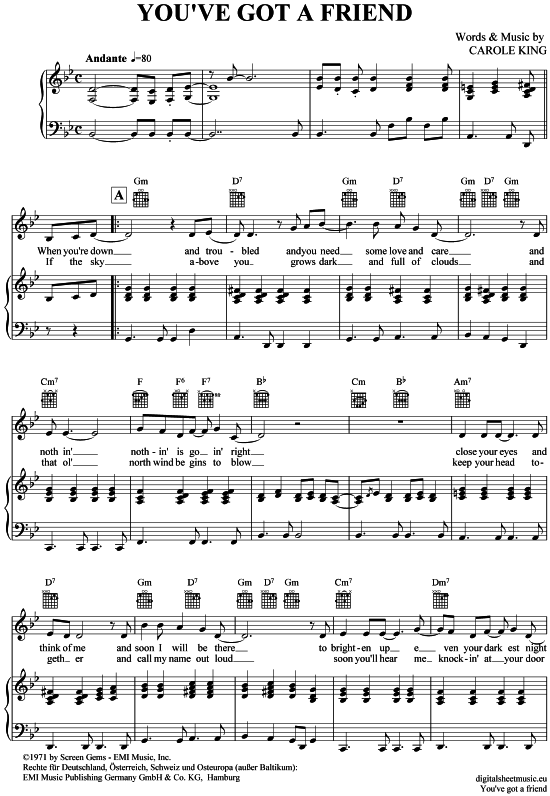
Carole King Covers: You've Got A Friend


It's possibly a fact that Ms King's best known song is in itself best known as a cover, namely the comforting and syrupy balm of James Taylor singing "You've Got a Friend", perhaps also "his" best known song. I don't know whether this can or could be proven as, with someone having a career stretching from being a Brill Building manufactured popsmith in the early 60s, to hippie chick troubador a decade later, to damn right, yes, she's still going with a bit of both and everything in between, it's difficult to work out. I guess it's in part generational, with the hepcats of '66 nodding sagely as the by then far and wigged-out Byrds phase their way through "Goin' Back", or the soulsters grooving to Aretha and "...Natural woman", so my generation picked up on "Tapestry", through her old friend and guitar slinger lifting a song from it as his break through single. But this isn't about sweet baby James, being more a tribute to some of the less well travelled versions. (Or is that so far travelled?)


I remain uncertain whether this is the worst thing I have ever heard or whether it is worse even than that, inescapably making me see the Muppets in my minds eye, so expertly do Bing Crosby and Fred Astaire channel Fozzie and Kermit. From the hideous patronising patronage of "contemporary" to the plodding singalongagramps of the performance, any nostalgic buzz for, say, "The Little Drummer Boy" evaporates.

Let's try something a bit more up-tempo, yeah, a James Brown influence:


Nooooooooo, take it off, take it away. Hideous even more than the old groaning above, is this supper club travesty really that Fred Wesley, those J.B.s? No wonder the album was "The Lost Album". I would.

Let's try again, some UK 80s indie, that'll be something, eh?


The Housemartins were the short-lived first band of Paul Heaton, later of "The Beautiful South" as here, and Norman "Fatboy Slim" Cook. And this version of the song is awful.

I'm beginning to lose faith and falter here. I mean, how difficult can it be? Hell, premium cover version listings site, Second Hand Songs, lists 125 versions. OK, so the list includes everyone from Billy Ray Cyrus to Barry Manilow, and God knows who in between.

One more, some late 90's acid jazz:


Brand New Heavies were/are a UK originally instrumental band forming in the mid 80s, diversifying into a somewhat bland vocal hybrid between jazz, funk and nods toward hip-hop and dance music, with a string of sultry southern US vocal divas passing through their ranks, Carleen Anderson and N'Dea Davenport being perhaps the 2 best known, but with Siedah Garrett on the above, a minor hit in the UK. Tellingly, it was not even on the US copy of its parent album. I have to say it's the best of the lot I have found today, if purely by virtue of comparison.

So what's my point? Is it a good song? Well, I had always thought so, but maybe there is rather more of the Brill Building professional hit maker weave in "Tapestry" and "You've Got A Friend" than first hearing makes believe, hence the ease with which it sheds any credibility into a nylon leisure suit of schmaltz. And thus, maybe it is just the consummate interpretation skill of Taylor that embues it with any subtlety at all, although, to be fair, the original is pretty damn good too. Carole King was trained to write songs that would sell. 125 versions is a lot of versions and, by virtue of the names mentioned, hideous though to my ears, a lot of royalties. Success by any marker.

Finally, by way of a lift to my sorry conclusion, was it a fluke? Has the song got the capability of rising above it's apparent formula? Well, who better to give us that answer than the writer and the singer already mention, both here together, a mere 5 years ago.


Praise be! No fluke. Song good, interpretations vary............


Sunday, November 15, 2015

Carole King Covers: Don’t Bring Me Down


David Johansen: We Gotta Get Out Of This Place/Don't Bring Me Down/It's My Life
[purchase]

Last week, I watched all 10 episodes of Aziz Ansari’s great new Netflix series Master of None. In addition to being very funny, the show deals head on with issues of racism, sexism and ageism, among other “isms.” So, when I thought about suggesting a cover song theme for the next two weeks, I became sensitive to the fact that over the years we have done nine other themes focusing on cover songs, and in each case, but one, the spotlight artists were male. Joni Mitchell was the only featured woman. (And as I write this, I realize that all nine artists are white, something that also needs to be addressed). And that’s how we ended up with a theme highlighting Carole King Covers. (That’s a lot of “K” sounds, so it must be funny.)

Next year is the 45th anniversary of the release of Tapestry, which was King’s second solo release. It established her as a commercial success as a performer, and is still one of the largest selling albums of all time. Pretty much every song on the album is great, and I loved it when I was a kid, but it is, honestly, not an album that I pull out to listen to anymore. I hope that some of the other writers here write about covers of songs from Tapestry, and I might down the road, but not today.

By 1971, when Tapestry was released, King had already had a 20 year long music career, beginning with her appearance on the Horn and Hardart Children’s Hour as an 8 year old, recording demos in high school with her friend Paul Simon, and, while attending Queens College, writing songs for others, mostly with Gerry Goffin, from an office in the famous Brill Building in Times Square. The number of hit songs she turned out is stunning, as is the breadth of styles—artists as diverse as Aretha Franklin, The Monkees, The Shirelles, Herman’s Hermits, The Drifters and even The Beatles recorded covers of her songs. The Broadway show Beautiful does a nice job bringing this to life, as well as discussing King’s later career. It is, of course, a cleaned up, streamlined version of the story, but it is very entertaining.

The Animals, led by singer Eric Burdon, were created in the early 1960s, and featured a gritty, blues based sound. In 1964, they released their signature song, a cover of the traditional blues song, “House of the Rising Sun.” Their producer, Mickie Most, reportedly called into the offices of Screen Gems music, then run by Don Kirshner, looking for songs. A furious competition ensued among the various writers and teams, which ultimately resulted in three hits—“We Gotta Get Out Of This Place,” written by Barry Mann and Cynthia Weil (who were friends and rivals of Goffin and King), “It’s My Life,” written by the team of Roger Atkins and Carl D’Errico, and “Don’t Bring Me Down,” a Goffin/King composition, which was the last hit for the band, before it was renamed “Eric Burdon and The Animals," before breaking up. (Burdon re-formed the band, with new members and a psychedelic style after moving to California in 1966, although the old incarnation also had reunions.)

I had the opportunity to interview David Johansen, I believe in 1981, when he appeared in Trenton at City Gardens. I might even have introduced him. Johansen is one of those musicians who has successfully reinvented himself over the years, from his days fronting the legendary New York Dolls, which was followed by a solo career under his own name, to his partying alter-ego Buster Poindexter and his more recent country-blues work with The Harry Smiths. I was, and continue to be a big fan of the music he released in the early ‘80s, particularly his first three albums, David Johansen, In Style, and Here Comes the Night, all of which received heavy airplay on my radio shows.

Shortly after I graduated from college, and regrettably left the radio world behind, Johansen released a great live record, Live it Up, which capitalized on his justified reputation as a great concert performer. The collection kicks off with an intense medley of the three songs that Mickie Most bought for the Animals from Screen Gems, including a great version of “Don’t Bring Me Down.” Not only is Johansen in total command of the material, his band is tight. It included guitarists Huw Gower, who power pop lovers might know best as the guitarist on The Records’ incredible “Starry Eyes,” and Dave Nelson, who was in Nektar, New Riders of the Purple Sage and The Turtles, as well as keyboard player Charlie Giordano, who now plays with the E Street Band and drummer Tony Machine, who had been in later versions of the New York Dolls.

Math & Science: Battles/Atlas


[purchase]

Why can't land speeders fly higher than five meters above the ground? Why does R2D2, despite being a droid, have feelings and a confidence suggesting the force is in him? How can anyone possibly say that Superman is stronger than Green Lantern when GL can simply make a cage of green kryptonite? Why does Prince Adam get tan after becoming He-Man and why can't anyone recognise him? And in Greek mythology, how can Atlas hold the world on his shoulders and still preside in that world? If he sneezes, does his body shake twice?  Does he also carry the atmosphere and space? I did poorly in science and math, but at least I asked the important questions.

These are questions that still entertain me as an adult, but I keep them to myself unless I'm lucky to find another child man who's been dwelling on them. When musicians mention gods, demi-gods and Titans from myth, I usually take notice. Often it's either sadly generic or so intensely honorific that it's unsettling. (Dead Can Dance's "Song of the Sirens" and "Persephone" do well, and of course Fleetwood Mac's "Rhiannon").  Battle's "Atlas" is more on the ambiguous side without referring to Atlas himself or the heavens, but it's a hell of a tune, stomping forward into thunderous hypnosis. A flinging guitar riff teases, and then a freaky childish taunt leads you to believe the song will unravel. However, like Atlas, spare a brief time when he passed the world onto Hercules via a trick, the beat is maintained except for one grisly breakdown.

Atlas must have been on the verge of going nuts with all that responsibility, or at least severely pissed off at times. But he was compassionate enough to never let go. Battles presents different versions of "Atlas" and its repetitive madness that could go on for another twenty minutes without tiring you. There are lots of live versions available. This take at the Fuji Rock Festival is one of the best.


text by Jake

Friday, November 13, 2015

Math & Science: Five to One

I’m a teacher in my real life—or is it the other way around?  And one thing I hate, that makes me squirm with embarrassment is when teachers try to teach by co-opting popular songs and parodying the lyrics, or the video, to bring home their curricular goals in a way the kids “will really understand.”


It’s just embarrassing, in the same way your parents were embarrassing when they yelled at you in front of your friends or tried to get down on your level by dropping a bit of slang. You know, to show you they were on your level. Ugg…it’s like every mom is Marge Simpson, too clueless to have a clue, or Homer; too dumb to know how dumb he is acting.

Teachers love parodies, love trying to really reach the kids in ways they will understand. Hey, why don’t we take Shakespeare and rap the lines. Shakespeare would approve—after all, he was just using language in new ways, too…Oh, I know it well: desperate to reach these twitter net numbed little vacant oxygen abusers, we resort to making horse’s asses of ourselves. But, for a phenomenal paycheck…ahhhbullshitchoo!

Point is, school and…almost anything else good in my life never mixed. Strange, in a cosmic way, that I became a teacher. But, I still get the chills when a teacher ditches their dignity to teach a lesson to kids in language they can understand…just reminds me too much of that disaffected little Walkman and MTV numbed oxygen abuser I was not so long ago.

OK, I’m whining…Here’s a case in point, though I have to admit: If any of my teachers looked like this, I might have given the whole school thing another chance…


Annnnndddd.....then, there’s this….


Stop…just stop. You might grow up, but you never grow up too much to not be embarrassed.

Yeah, OK…I’ll stop…

So, this month’s theme is math. Math. The subject I struggled with the most all the way up until I graduated…from college. Math was my preeminent anxiety from grade school on—I had tutors, I failed courses, I did summer school. Once, on the SAT, I did so poorly on my math that my Math score was 100…this was when the top SAT score was only 1400. I got an 800 total…That’s…pretty bad.

In high school, I liked music, and writing, precisely because they were as opposite of mathematics as could get: freedom minus rigidity, enjoyment divided by anxiety equaled a shitty GPA and lowered expectations. The last day I ever had to take a math class was one of the happiest days of my life. I remember walking out of Rawl Hall at East Carolina University, thinking: I will never take another f#$%ing math class again. It was a great feeling, like I’d suffered something for longer than I thought I could and walked out with all parts—limbs and sanity—in tact. I had worked really hard, to be honest and at the end, I knew I wasn’t going to let my relationship with mathematics end with my slinking away to nurse my wounds and regret the fight I hadn’t put up. I worked hard that semester, harder than I’d ever worked and ended the semester with a B-…the highest grade I’d ever scored in any math class. F#$k math. I’d won.

What does this have to do with music? Nothing, other than hating the sciences and the numbers was probably the catalyst for my love of music, and if it was nothing else, it was a precious escape.

One of the first bands I became truly obsessed with in my alternate, music-oriented education, was The Doors. It makes sense in many ways: The Doors are kind of a “gateway” band into serious music for a lot of teenage boys; Morrison was an incorrigible class clown, in school and out (I know this—part of the right of passage of being a Doors fan was to read No One Here Gets Out Alive, Danny Sugarman’s bio); the music was dark enough to be an antidote to a lot of the classic rock that got spun as voice of the generation stuff; and on a personal level, Morrison, much like me at the time, wanted to be and considered himself above all, a poet. I wasn’t a student when I was 16 and 17—I would have accepted any label other than that. Poet was good—the idea was cool and writing poetry got me more than a few girls. Playing guitar helped, too. I suppose that is an equation that still works.


The Doors were a great band to get into—there was plenty of mythology to dig, a real fabled aura around the shamanistic Morrison, and musical sound that was often a dark opposite to the flower power, ‘come on people, smile on your brother’ stuff that was a primer for the 60s rock explosion. Hendrix did it better, of course, but he was solo artist, in a sense. The Doors were a group and thus presented a more unified system of disorder. And while Morrison in particular can be almost cringe-inducing when I go back and listen (L’America?) some tracks, like their first hit, Break on Through, and others— The Whiskey Song, Love Me Two Times, When the Music’s Over— cook with some kind of other spirit, blues-influenced, incendiary, dark and magisterial—when the Doors were on, they were stunningly good—rock n roll dredged through the dirt. I loved that sound when I was young; it represented a true rebellion, an antidote, if you will, to all the forces in life working to keep me stifled in a classroom.

So, in honor to my wayward days, my wasted youth, all the tests I failed, all the desks I carved “The Doors” into, all the dreams I had about blowing it up and blowing it out, I choose The Doors, “Five to One.” This explosive chant and stomp reads like a child’s rhyme, but it burns with a controlled fury that takes aim at the listener or anyone who might not dig what Morrison was pushing. I love John Densmore’s pounding, military drums; Robby Krieger is at his bluesy best when he rips off the solo, and Ray Manzarek’s fuzzed out keyboard line fills in as a static-infused bass, crackling with serious mojo, far advanced and way modern for its time. As for Morrison—he says it all here. Talking about hippies crawling across the floor, flowers in hand, he sets himself in firm opposition to the flower power ethic of peace and love, then goes on to engage in what, to me at the time, was as a pure a middle finger in the face of my teachers, the cops, my folks, as many authority figures as I could find to be pissed off at:

The old get old
And the young get stronger
May take a week
And it may take longer
They got the guns
But we got the numbers
Gonna win, yeah
We're takin' over

A little light on the true rebellious capital, I realize, but at the time, that was all I needed: a little stomp, a lot of anger and either a stepping stone to something better, or just a nice, fist sized stone through any ready window.

Rock on, Jim…I might make a little fun of you, but deep down, you’re my first and always rock n roll hero.

Purchase
Listen

Wednesday, November 11, 2015

Math & Science: Π


Kate Bush: Π
[purchase]

As I wracked my brain for another topical track to write about, I discarded a few ideas, mostly because I didn’t have anything personal to write about. I looked at lists of songs, but none called out to me. So I decided to find a song that had an interesting story, and I remembered that Kate Bush had written a song called “Π.” This being a Math & Science theme, I decided to do a little research on the song, to see whether there was anything there.

I remember when the song came out, hearing that it consisted of Bush singing π to some large number of digits. But that’s not all it is. It is actually a song about a mathematician who is obsessed with the number, somewhat irrationally (sorry), and Bush, a notorious musical eccentric with a remarkable voice, does sing many digits of π in a way that is not at all boring.

But if that was all I found, I’d probably be looking for another, meatier topic. Instead, guess what? A couple of math types posted stuff about the song.

Let’s start with the less strange. Chris McEvoy, a self-described “rabble rousing programmer who hates technology but loves people” pointed out in a blog post on November 11, 2005, that Kate got it wrong. As he wrote:

All was well for the first 53 decimal places but then Kate sang "threeeeee oneeeee" when she should have sang "zeeeeeeerooo" instead. She recovered for the next 24 digits but then it went to hell in a handbasket when she missed out the next 22 digits completely before finishing with a precise rendition of her final 37 digits. (Note—McEvoy later amended his statement, agreeing that she said “zeeeeeeerooo" and not "threeeeee oneeeee").

Which led to a bunch of somewhat hostile comments, because apparently π, and Kate Bush, are not to be trifled with. On the other hand, there’s also a positive comment from someone identifying as “Kate Bush,” but it’s the Internet, so you never know.

On March 14, 2006, McEvoy took to the blogosphere to point out that while that day is considered “Pi Day” in the United States, in countries that use a “Month/Day” system, “Pi Day” should be April 31 (31/4), a date that doesn’t exist, so he suggested May Day as the solution. Also, he cited to a number of British newspapers and radio programmes (as he spells it) that referred to his π digit “Gotcha!” Apparently in England, Kate Bush and π are big deals.

Now, let’s discuss Steve Luttrell, who has a degree in “theoretical physics and [a] PhD . . . in quantum chromodynamics (QCD).” Luttrell was convinced that Bush’s “errors” were actually a deliberate creation of a number puzzle. He put together an entire website devoted to this puzzle, A Great Big Circle, which sadly appears to be gone, but discussed his findings in a series of blog posts, here. In essence, he “solved” the puzzle, to find the exact location of an “artefact built out of stones to resemble a steam locomotive.” And, of course, “The locomotive theme is part of an extended metaphor that runs throughout π, consisting of tunnels, columns, chimneys, mine shafts, and generally anything and everything to do with sex.”

Me, I’m more of a fan of Occam’s Razor, but not in the way that Luttrell interprets it. Although I don't have a PhD in quantum chromodynamics, which according to Wikipedia is is the theory of strong interactions, a fundamental force describing the interactions between quarks and gluons which make up hadrons such as the proton, neutron and pion.  I still don't know what that means, but I did wedge a little more science into this piece.

Tuesday, November 10, 2015

Math & Science: Tom Lehrer Again!


purchase [Tom Lehrer: the Elements]

Yes, it's not "pop". But it once was.

I hadn't planned this ahead, but - digging around - I recalled that Tom Lehrer (in his total output of 37 songs) not only covered the field of Math, but also got around to Science. No surprise - math ... science ... it's all greek to many of us.

As he says at the end - if you can listen all the way through: "Life was much simpler in those days."

Friday, November 6, 2015

MATH(S) & SCIENCE : 7 AND 7 IS

14.
(That's it and I could end it there, but that would save me from sharing with you how this remarkable piece of raw garage punk energy came to be so entitled. Or should that be saving you.......)


I was 9 in 1966 when this song came out. Originally an outtake from earlier recordings it was released as a single ahead of appearing on their 2nd album, 'Da Capo'. How I came to be listening to such arcane thrash at such tender years may sound I am bigging up my supercool but sadly, not so, the truth being more mundane. My big sister, upon whom I blame my musical precocity, had a boyfriend with their 1967 masterwork, 'Forever Changes' in his meagre collection. I loved some of the tracks, 'Andmoreagain' principally, disliking others, especially the noisy ones and the trumpety 'Alone Again Or'. (OK, so sue me, I was 10, I have learnt from that error of judgement.) But the name, the concept and the legend stuck with me as I became a teen. At my school there was a a cult of the obscure: you have to imagine nerdy and spotty brits in the UK, which is why, of course, I add an S to MATH, with each of my peer group endeavouring to out-gun the rest by virtue of claiming a love for ever more unlikely west coast bands. Zappa and the Mothers, Beefheart, the Dead, hell, we were entirely the wrong demographic. Remembering my sisters boyf and Love, my street cred was going to be a cert! Provided you accept the street was a quiet suburban cul-de-sac. So I bought 'Love Revisited', belatedly discovering this song, and now old enough to love it! But that's enough of me.


What of the song? Very few chords, frenzied drumming, shouted and incoherent vocals; what's not to love? But in the research for this piece I was astonished to see the association of the Elektra label legends with a song quite so spare, with it being produced by Jac Holzman and engineered by Bruce Botnick. As a later Doors freak, these men are/were legendary to me, but I guess, Love, as their first "rock" signing to this iconic label, it was probably more that there was nobody else. My second astonishment was to recall one of the best named individuals in modern music, step forward one Mr Snoopy Pfisterer on drums, 2nd only to Lowell 'Banana' Levinger of the Lovin' Spoonful. Debate remains as to whether Snoopy actually managed the drums in this song, Arthur Lee, writer of the song, later claiming he may have taken over as Pfisterer faltered. And the explosion at the end of the song? Sadly the sound of atoms splitting were not the first frazzles of Lee's famously sometimes addled mind but from a sound effects LP. Pity. But the best discovery of all was the b.side! Ladies and gentleman, I give you:
Number 14


So, after all that, how was the song so entitled? I still have absolutely no idea.

Buy it, and the answer

Math & Science: Tom Lehrer- New Math


purchase [new math]


As a child of the 50s/60s, I grew up with Tom Lehrer albums (along with Mozart, Bach, The Temptations and Jimi Hendrix).

And like JDavid, I made my way through American college life with the minimal requirements - lots of other interests along the way , only to find myself teaching math 20 years later!

About a year ago, I ran across and article about Tom Lehrer, wherein it noted that the man essentially dis-appeared of his own accord - having made it big and facing a critical request to return to the big time. (He vehemently declines. Worse yet: he wishes that his oeuvres become publicly non-monetary)
Lehrer simply stopped performing. His entire body of work topped out at 37 songs. [source]

Sunday, November 1, 2015

Math & Science: E=mc2


Big Audio Dynamite: E=mc2
[purchase]

Among the things that I never did at Princeton, either as a student or alumnus are:

-I never went by the house where Albert Einstein lived from 1933-1955;

-I never visited the Institute for Advanced Study, where Einstein worked (his Institute office was initially on the Princeton campus and he worked in the physics lab, which is now part of the campus student center, but he never was a member of the Princeton faculty, although, according to University sources, he “often helped students with math problems”);

-I never took a math class or any serious science class (I satisfied my distribution requirement through a Psychology lab and credit for a good AP Chem score from high school, which annoyed my freshman advisor, a chemistry professor, who urged me to take Organic Chemistry, an offer I declined. I also took an intro Astrophysics class which was designed for non-scientists and was an excuse to sit in a dark room and look at pictures of stars).

Math and Science are just not what I was interested in studying, and although, at least at the high school level, I could do reasonably well (I survived AP Calculus BC, but when my kids took calculus, I remembered exactly zero about it—and I still count on my fingers). To this day, I’m curious about science, but I knew that it wasn’t what I wanted to spend my time in college on.

So I’m not going to even attempt to explain what E=mc2, which is also the title of a song by Big Audio Dynamite, means. However, if any of my surprisingly large number of friends and classmates who are, in fact, physicists want to weigh in in the comments, feel free.  Which is not to say that I don’t know that it stands for--Energy equals mass times the speed of light squared. But knowing that is far from knowing what it “means.” Instead, I will talk about the song a bit, a job for which I’m somewhat more qualified.

Big Audio Dynamite was formed by Mick Jones with film director Don Letts in 1984 after Jones was tossed from The Clash. The band’s first album, This Is Big Audio Dynamite, fused The Clash’s post-Sandinista!/Combat Rock punk with dance and rap, and liberally used samples from other songs and movies, something which was pretty audacious in that era. It’s actually a pretty great record.

“E=mc2” is one of the real standout tracks. According to Wikipedia, it was the first song to be created all from samples, which either was a great achievement (particularly in the analog age), or was the first step toward the destruction of music. The song is inspired by the films of Nicolas Roeg, particularly Performance and Insignificance (in which Einstein is a character). Roeg’s films are best known for unusual directorial techniques and non-linear narratives that rearrange the time sequence, requiring the viewer to reassemble the pieces. Which, maybe, relates to the whole relativity thing (although maybe not—remember, I’m not a scientist and I’m not a film critic).

Interspersed in the song, whose lyrics reference those, and other, Roeg films, are quotes from Performance, including one snippet featuring Mick Jagger, who starred in the movie. Controversial on its release in 1970, due to its graphic sexual content, drug use and violence, it became a cult classic, and an influence on music videos and films, notably by Quentin Tarantino and Guy Ritchie (which shouldn’t be a surprise, based on the description).

In addition to being a clever, catchy tune, it was a success, hitting 11 on the UK singles chart and 37 on the US Billboard Hot Dance Club Play chart. Einstein, a violinist who loved Mozart and Bach, and whose musical tastes were described as “conservative,” probably would not have liked it.

Thursday, October 29, 2015

Cartoons and Comics: Magneto and Titanium Man


Purchase [Wings: Magneto and Titanium Man]

I thought this had to be done from the get-go of this theme, and hung back with the expectation that someone else was going to latch on to it. Heading down to the theme expiration deadline, I guess it's up to me.

The song itself, I know well. The Magneto/Titanium Man comic book heroes: only through this song. Of all possible comic book heroes, Mr McCartney .. why this one? There must be some story lurking behind the choice that I can't fathom - even after some Internet research. Guess I'm not much of a Marvel fan.
.

Of the various YouTube versions available, this version seemed the most appropriate: itself a cartoon that helps explain the song. A bit. All said and done, the song is a classic example of the Wings/McCartney genre. All due respect aside, most other YouTube versions show the band for what it's worth (sorry, Linda).

Tuesday, October 27, 2015

Cartoons/Comics: Winged Mammal Theme


R.E.M.: Winged Mammal Theme
[purchase]

I’m a little obsessed with baseball right now, on the verge of Game 1 of the World Series. As a Mets fan, this has really been an unexpected and exciting playoff run. I’ve already discussed this in my Future post, and I’ve also written about tonight’s Game 1 starter, Matt Harvey, the Dark Knight of Gotham.

Which brings me to today’s discussion of Batman. I was utterly unaware of the Batman comics that predated the TV series that ran from January 12, 1966, to March 14, 1968. I have a pretty strong memory of watching maybe the first episode as a young child, and watching many more episodes, either during the initial run, or after school in syndication. I’m sure I knew that it was silly, even before I understood the concept of “camp.”

I never read any of the later Dark Knight stuff, or any of the later Batman comics, and while I remember seeing the Tim Burton/Michael Keaton Batman movie, I can’t remember whether I’ve seen any of the sequels or reboots (although I’m pretty sure I saw the one with George Clooney). Because I really don’t care all that much.

In fact, after all these years, it is probably the great theme song from the TV series that I remember the most. Written by the great musician, composer and arranger Neil Hefti (who also wrote the Odd Couple theme), the version that played during the credits is faster, and was arranged by the great composer and arranger Nelson Riddle. And I’m obviously not the only one with the song stuck in my brain, because the “Na na na na na na…..Batman!” meme is pretty much ubiquitous on the Internet. (There are, apparently 80 “nas” in the theme.) You can even buy shirts with it.

Considering the theme’s exalted place in popular culture, it is not surprising that it has been covered many, many times, by bands as diverse as Jan & Dean, The Jam, John Zorn, Serbian alternative band Disciplina kicme, The Who, Link Wray, The Ventures, and The Standells (and yes, I know I'm leaving some out).

R.E.M. submitted their reimagining of the theme for inclusion in the soundtrack of Batman Returns, the sequel to the first Burton/Keaton film. It was rejected, and instead became the B-side to the “Drive” single, and has been included in a few box sets and anthologies.  It actually hit #11 on the UK charts, and was used by the Weather Channel under local weather updates.

Pow!

Cartoon and Comics: Superman


REM, Superman, from Life's Rich Pageant

My song choice is a no-brainer for this month’s theme; it’s long been in any number of my personal faves lists—I have a lot of ‘lists’, that cover any emotional, historic, or aesthetic and are subject to as many, probably a lot more, criteria for membership. I know—the whole list thing has been done, thanks very much Nick Hornby…But, I don’t believe there is a true music fan who does not naturally gravitate towards list making. It’s almost instinctual—a way of cataloging the music one loves and justifying the multiverse of songs, bands and genres we love. No reason one can’t have favorites in multiple arenas of music, and revel in their love of many sounds.

The song I picked for this month’s theme fits neatly under three—probably more—categories. One: it’s from a band that is at the top my personal Most Influential list. Two: it is featured on an album that is on my personal Top Albums of all Time list. And three: it is one the first songs I played live with a band (another list—bands I’ve played in), and still one of my favorite songs to play.

So, I present, in honor of “Cartoons and Comics”: REM’s “Superman”… an obvious choice. The song is originally a cover by ‘60s band, The Clique. They were from Texas, and honestly: I don’t know much more about them. REM’s version was recorded for the album Life’s Rich Pageant, and released in 1986. It received some airplay, but not as much as their breakthrough, “Fall on Me.” It is also the first time bassist Mike Mills handled lead vocals—according to the Wikipedia page, lead signer Michael Stipe did not like the song and wanted little to do with the recording. He handles backing vocals only on the cut.


Historically, it might be a silly little single, dashed off and added to the album to perhaps lift the spirit of the thing, add a little levity in an otherwise somber, yet still emotional driving set of songs.The originally is garage rock at it’s best: sludgy guitars, churning and ditzy rhythm, and full of hippy, 1960’s bounce and sunshine.


Lyrically, I like the fact that it takes an iconic story of a guy we all know (Superman), and puts him in the place of any average love sick dude, pining for a girl he probably has no chance of getting. Is it really Superman, or is this guy just bragging? I don’t know; but I do like the very human quality the speaker shows—a lot of bravado to cover up the very evident self-doubt. But, no one ever won by sitting back and letting the race come to them, right…? This guy might be a little full of himself, but, in the end, I think he definitely got the girl…

I love this song, not only for the sense of fun it still has and the infectious urge to bob along when the hear it, but also for what it represents to my own personal heritage of music. REM was one of the first ‘real’ bands I listened to: I graduated from Bon Jovi, Cinderella and a lot of other hair metal crap to their 1987 release, Document, and I’ve always felt they were my introduction to music that mattered. And certainly, they set me on a path of amazing musical discoveries. Life’s Rich Pageant is a collection of songs so integral to my early education that to go back and listen to it is an exercise equally nostalgic and educational at the same time. Nostalgic because those songs still make the same spark in me as when I first heard them and was instantly hooked. Educationally? Probably for the same reasons—good music has that ineffable sense of importance that it achieves almost upon first listen. You hear a great song and it immediately finds a place in your heart, in your personal favorites list. There is time enough for explication and analysis, to determine where the music actually fits and on which list. It’s that initial spark, that beautiful chemistry, that defies numbers and categorization. It is what, as Kant said, makes music the ‘quickening art’—something that is alive in you for the first time. Loving music brings that quickening sensation on a near daily basis. I can’t think of anything else more exhilarating, save for having a few Superpowers of your own…

Wednesday, October 21, 2015

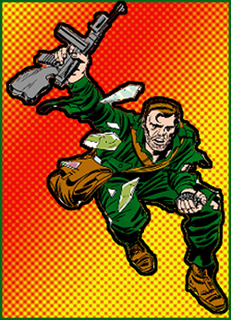
CARTOONS & COMICS: Sgt. Fury/S.A.H.B.


So who is the bigger cartoon? Is it the character in the song, Sergeant Nicholas Joseph Fury, or the singer, the 'Sensational' Alexander James Harvey? OK, easy question, really, but as a teenage Brit in the 70s it was sometimes hard to tell.


Marvel comics reached my consciousness mid 60s, I guess, not in their original multi-hued kaleidoscopes of smudgy ink, collectors items to this day, but as black and white facsimiles in UK comics 'Fantastic' and Terrific', almost entirely consisting of reprints of The Fantastic Four, the X Men and similar. Sgt Fury and his Howling Commandos seemed always unusual bedfellows amongst all these mutants and super-heroes, despite, in hindsight, being equally muscle bound and indestructible. In my somehow more sterile world, the wise-cracking and cigar-chomping irreverence shown towards WW2 appealed, and certainly far more so than the worthier by far UK war comics, populated by far cleaner cut and heroic fictions. Warfare seemed like so much fun........


Alex Harvey was so nearly of that generation, being born in 1935, and almost too old for the generation he became latterly most associated with, in, most famously, the Sensational Alex Harvey Band, their heyday between 1972 and 78. After various dead-end jobs he eventually staggered to his musical feet in 1954, embracing a number of styles in turn, dixieland and big band jazz, skiffle, soul/r'n'b, never quite breaking through, ending up in the pit of the London production of the musical 'Hair.' Rock music now inevitably in his blood, a chance meeting with Glasgow prog rockers 'Tear Gas' led to the end of an abortive solo period and the positively tongue-in-cheek entitled eponymous band. Perennials on the UK touring circuit, unless you are reading this in Cleveland, the chances are that the name will mean nothing to US readers. Bizarrely, they could fill venues in this city, bombing elsewhere. Gloriously and gratuitously Scottish, Harvey enunciating perfect Glaswegian, his band a side-show of grotesques, the songs a mix of Gothic Grand-Guignol with full on hard rock, they were foremost a live band. Harvey, unkempt and gurning, a swashbuckling figure in striped mate lot jerseys and buccaneers boots, with the extraordinary figure of guitarist, Zal Cleminson, in full clown make up and green jumpsuit, leering to his side. The songs, carefully chosen  cover versions of anything from 50s rock'n'roll to Jacques Brel, mingling with unpretentiously art school originals, evoking comic books, as at the top of and the title of this piece, or dystopian vignettes of disturbed delusion. 'Sgt Fury' comes from their 1974 album, 'The Impossible Dream', and is a blend of all the styles dallied with earlier, perhaps in keeping with the era of the songs subject.

Stage sets and album covers became increasingly caricatures of themselves, hence my uncertainties as to who was the more or less real. Possibly their most famous moment was in 1975, their top 10 single, a remodelling of Tom Jones' chestnut, 'Delilah', horrifying teatime audiences across the UK as the true murderous menace of the lyric became acted out upon 'Top of the Pops. Magnificent (and still my sole ever performed karaoke piece.) Here it is from late night serious rock show, 'Old Grey Whistle Test':


Sadly, bedecked by alcohol issues, Harvey then left the band, who continued as the 'Sensational Alex Harvey Band without Alex', his absence seemingly little detraction. He joined again briefly before, aged 47, sustaining a pair of massive heart attacks, he died, in 1982. Whilst the band had broken up by then, I can report that, having been voted 5th most influential band in Scotland in 2005, they reformed and remain intermittently on the road to this day.

This has all the songs featured here and might be a safe place to start......
Or you may wish to read more about the band.

Tuesday, October 20, 2015

Cartoons and Comics: Soul Asylum/Cartoon


[purchase]

The band Soul Asylum brings to mind a few non-musical things: Dave Pirner's ripped jeans, Winona Ryder, milk cartons. Musically, the band has never put together a complete album, one with a balance of their finest assets: driving guitar leads, nostalgic melodies and graceful nods to their Americana roots. One of their best songs, "Cartoon" off 1988's "Hangtime" hits on all three, however, and includes the lyrical gem 'You're in the movies now that I'm in your cartoon."

text by JakeB

Cartoons and Comics: Huckleberry Hound


purchase [Easy Rider]


Hanna-Barbera literally dominated the American cartoon market  during the 60s with a slate of the most popular shows, including (to name just a few) The Jetsons (which see), Tom and Jerry, and Huckleberry Hound.

It should be no surprise that mention of some of these characters crops up in popular culture - in all sorts of creative endeavors, including music.
Before Pearl, Janis Joplin appeared with backing band Big Brother and the Holding Company. Their first album, while it gave indication of what might come next (Cheap Thrills), wasn't a major success. All the same, with 20/20 hind sight, you can sense what was on the horizon, and Joplin's voice is right there alright.

Easy Rider, written by guitarist James Hurley, fits our bill for this theme - if just barely: his lyrics include the line
..he watches Huckleberry Hound on his TV ...
Thinks I: Who didn't?


For most of us the obvious reference to Easy Rider is most likely the Dennis Hopper/Peter Fonda film. Which came out in 69 - three years after Hurley penned this song. (Among other similar titles is Jimi's Ezy Rider on Cry of Love)
But it's probably no surprise to you that the term Easy Rider goes back a ways in (American music)history - as a reference either to someone who rides through life kinda easy like, morals and so on, man or woman. There is suggestion that the phrase is also linked to CC (or See See) Rider, and that those two letters are also linked to all sorts of Americana that might interest you to research, not unlike Huckleberry itself.

A closer look at the complete lyrics and a sense of the 60s/hippies would suggest that the easy rider of this song is the guy who has an rather accommodating hippie girlfriend:
Well, I got a girl with a diamond ring,
I'll tell you, boys, she knows how to shake that thing.
Oh! Easy rider don't you deny my name


Monday, October 19, 2015

Cartoons and Comics: Cartoon


The former drummer for San Diego progressive rock band Horsefeathers, and L.A. cult groups Elton Duck and Invisible Zoo, Andy Robinson is now a purveyor of an experimental Americana sound. His 2004 debut solo album was called Exotic America. Then in 2011, he released “Music Bucket,” that refers to the pail lowered into a well and the musical surprises it holds when pulled back up.

Besides some vocals, the multi-instrumentalist uses an arsenal of tools including mountain dulcimer, guitar, synthesizer, percussion, lap steel, kalimba, toy xylophone and harmonica. By far, the most whimsical piece is "Cartoon," dedicated to Zal Yankovsky. According to the liner notes, that track even includes "various junk recorded at the Blue Moon Bunny Farm," tastefully incorporated into the mix.

Three other tracks ("The Golden Feather," "Surge," "November Too") use loops to impart a Zen-like flow and upwelling to the music. Robinson demonstrates that he not only carries a song inside but that he has found a successful recipe for unlocking the door and sharing his discoveries.

Music Bucket features guests Mike Keneally (electric guitar), Carlos Olmeda (vocals), David Ryan Norgren (vocals), Dennis Caplinger (fiddle, mandolin), Tripp Sprague (sax), Jamie White (bass), PJ Bovee (bass), Coco Brown (bass), Nicki Elledge (vocals), and Doug Robinson (bass). Chuck Elledge, Allison Boles, Mick and Cynthia Garris add voices to the opening cut, "Yeah." Andy closes the project with "The Open Door," the song's genesis evolving from solo kalimba to a transcendent statement that seems to encourage exploration, innovation and adventure. That's the organic nature of his music that resonates with character and emotion. Tapping his heart's spirit, Andy Robinson's music bursts forth with a shout from the soul.

You've got to appreciate any instrumentalist who has fun with his compositions. “Cartoon” is such a piece that is full of quirky fun and melodic frolic. 

On a non-musical note, Robinson is also involved in improv comedy and currently performs on two teams (Coincidence? and Tribal Luminescence) in San Diego. The teams take audience suggestions and make up spontaneous plays based on them, discovering the humor that usually lies hidden beneath all of our ordinary day-to-day human relationships. It will be fun, and you will laugh!