Showing posts with label Bob Marley. Show all posts

Friday, September 24, 2021

COPS: POLICE AND THIEVES/JUNIOR MURVIN

I can't think of cops without robbers, the pairing being as intrinsic as salt and pepper, fish and chips and rock and roll. So, for me, the no brainer is this iconic song from the 1970s. Given, too, it is barely a month since the producer, one Lee 'Scratch' Perry, departed this earth, it seems as good a time as any to give it centre stage.

Police and Thieves/Junior Murvin (1976)

A supreme distillation of both reggae and dub, anyone unfamiliar with either couldn't fail to appreciate and understand the complex simplicities at work here. A beautiful melody, sung in a delightful falsetto without an an ounce of strain or grating, the sturdy skanking undercurrent, a perfect storm of controlled concern. But burbling in the middle distance is the stuff of genius, Perry fading aspects of the backing so subtly in and out, the barest hint of echo raising a presence intermittently. Sometimes dub is so full on and so frightening as to scare a first time rider: this is surely the song for sceptics to listen to. Of course, if you want and need a little more, there is the full on dub version: check in at about 4 minutes here, where all the studio shenanigans gets the full treatment, yet still leaves the majesty of Murvin's vocal intact. However, this is neither the time of the place to celebrate Perry, this is Murvin's gig. (Check back in to our yearly Obituary thread, at the end of the year, for that pleasure.)

Solomon/Junior Soul (1972)

Murvin, too, is no longer with us; he died, at the age of 67, in 2013. But 'Police and Thieves' was certainly not all he left behind him, even if most of his other hits were local only to the West Indies. Like so many on these islands, he was influenced by black American soul music, and, given the timbre of his voice, it is little surprise that it was Curtis Mayfield who most floated his boat. Trying, unsuccessfully, to get in with the bigger JA studios, he first found some recognition, as Junior Soul, with 'Solomon', above, in 1972. It was clear he had a stand out voice, even if the song is a little weak and generic. Four years later he again auditioned for greater attention, this time being picked up by Perry's Black Ark studio, and with whom he together wrote the set of songs released as the 'Police and Thieves' album. This was 1976, and it was released worldwide on Chris Blackwell's Island records. Hindsight places it as at the pinnacle of Perry's productions, with the ultimate backing musicianship of the Upsetters, the Black Ark houseband, with stalwarts such as Sly Dunbar, Boris Gardner and Ernest Ranglin contributing. Anyone unfamiliar and beginning to be intrigued by the dub reggae palette could do a lot worse than to invest in this LP. Should invest, rather. It actually took until 1980 for the titular song to become a major hit, based, in part, on soundtrack appearances. Murvin then continued to work with Perry, moving on to work with other producers and with other studios, if never quite repeating this earlier success. Here are a couple of later gems, tho', each with their respective dub workouts. Wise Man was his last recording, in 1998.

Cool Out Son/Junior Murvin (1979)

Wise Man/Junior Murvin (1998)

By now, I dare say some may be itching for their vague recollections of where else they know the featured song from, perhaps, in part, prompted by Jordan's recent post here. I refer, of course, to the Clash, seminal punks turned musical roots polymaths, who, on hearing the song in its original format in 1976, took it to heart and included it on their eponymous 1977 debut album. Eschewing the term white reggae, they categorised it as punk reggae. Murvin, apparently, loathed it: "they have destroyed Jah's work". Nevertheless, if intriguingly, it became the inspiration for Bob Marley to write his song, 'Punky Reggae Party'. Almost included by accident and an afterthought, 'Police and Thieves' became one of the band's most popular songs.

Police and Thieves/The Clash (1977)

And that wasn't the end of the song, there having been a plethora of subsequent covers, although the quality has been, let's say, variable. One of the more interesting was when the Orb, the UK psy-ambient electronica outfit, got together with Lee Perry. Their joint 'Orbserver in the Star House' project is, on occasion, an unwieldy and indulgent piece of work, but has a number of moments where their disparate worlds collide in alignment, and the revisioning of 'Police and Thieves' is certainly one of those moments.
(Well, it's different, but I always love this crazy shit.)

Police and Thieves/The Orb with Lee 'Scratch' Perry (2012)

The original and best. (Yup, get the whole album, you know you want to.......)


Thursday, September 23, 2021

Cops: The Clash Covered


The Clash
: Police & Thieves

The Clash
: I Fought The Law

The Clash: Police On My Back 

[purchase The Clash]
[purchase Sandinista!

When I thought about responding to this theme, I realized that the Clash covered three songs (that I could think of) about police, and was going to write about them. But then I saw that Seuras was working on a post about their cover of Junior Murvin’s “Police & Thieves,” so I won’t say anything more about that one, and direct you to Seuras’ piece, when it is posted. Although I will engage in some self-promotion by referring to my earlier article about the punk/reggae connection that the Clash was very much involved in, and which mentioned how “Police & Thieves” in part inspired Bob Marley’s “Punky Reggae Party.” 

Although the Clash’s self-titled first album was released in the UK (and elsewhere) in 1977, it didn’t get released in the USA until 1979. In 1978, while working on their second album, Give ‘Em Enough Rope, Joe Strummer and Mick Jones went to San Francisco to do some overdubs at the Automatt studio, where they heard, for the first time, the Bobby Fuller Four song, “I Fought The Law.” Originally written by Sonny Curtis, the song was recorded in 1959 by Curtis and the Crickets, after Buddy Holly died, to little notice. The song was recorded by other musicians, including Bobby Fuller, with minimal success. But when Fuller re-recorded the song in 1965 with the Bobby Fuller Four, the song became a top-10 hit, and since then has been often covered. Only a few months after the song charted, Fuller was found dead from asphyxiation in his mother's car in a parking lot near his Los Angeles apartment. 

The Clash’s cover was added to the US release of The Clash and was instrumental in getting the band airplay in the US. It’s a great version of the song, to the point that I think that many people (not anyone reading this, of course) think it is an original. And that’s not to take anything away from the Bobby Fuller Four version, which is also great. Although it is interesting to think about the fact that the Clash’s version was released less than 15 years after the Bobby Fuller version, when I think about them as being from such completely different eras. If you'd like to read more about the song, from the Financial Times, of all places, go here.

London Calling is my favorite Clash album, and is actually one of my all-time favorites, and while it has a few cover songs on it, none are explicitly police related (I don’t think). Their next album, Sandinista! was a sprawling three-disc release, and some critics thought it was better than London Calling, while others, including me, thought that it had a little too much filler, and might have made a killer double album. But they do get points for ambition. There was a strong reggae and dub influence all over Sandinista!, and one of the covers on that album was “Police On My Back,” written by Eddy Grant (probably best known for his early-1980s hit, “Electric Avenue”) for his group the Equals in 1967. The Equals may well have been the first popular racially mixed band in the UK, and their version of the song, while sounding very consistent with British pop of the era, had a definite ska undertone. Interestingly, the Clash’s version is a straightforward rocker, with, to my ears, no real reggae or ska influences. And if you want to read a 29 page analysis, “Police On My Back and the Postcolonial Experience,” go here.

Wednesday, July 28, 2021

Posthumous: Redemption Song (Strummer and Cash)


Joe Strummer: Redemption Song
Johnny Cash and Joe Strummer: Redemption Song 

[purchase Streetcore]
[purchase Unearthed]

When Bob Marley wrote “Redemption Song,” one of his masterpieces which was influenced by a Marcus Garvey speech from 1937, he had already been diagnosed with the cancer that would take his life within a few years, and clearly was thinking about his own mortality. It was a rare acoustic track, and was released as a single in 1980, and on the album Uprising. Because Marley didn’t die until 1981,  the song was not released posthumously. 

However, two very fine, and related covers, of “Redemption Song” were released after the performers’ deaths, so I don’t lose any points for theme violations. (Sorry, I've been watching the Olympics.)

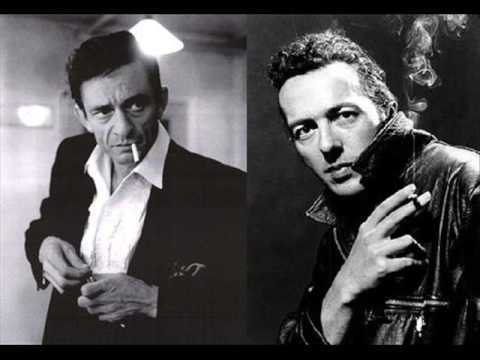
In 2002, Johnny Cash was working with producer Rick Rubin on what would become American IV: The Man Comes Around, the last album released during Cash’s life. Joe Strummer, who was on vacation in Los Angeles, decided to hang around the studio, because he was a fan of Cash—he even extended his vacation an extra day to spend time with Cash. During this time, the two men reportedly discussed a wide variety of topics—Cash’s role in the early days of rock and roll, and Strummer’s role in the early days of punk—and their love of Jamaica and its music. Strummer was, of course, a big fan of ska and reggae, and was influential in including it in The Clash’s music, and Cash owned property on the island. 

With some apparent nudging from Rubin, they decided to record a duet of “Redemption Song.” "Originally, the song was supposed to be a duet, and we recorded it as a duet. But, just in case, both Johnny and Joe sang the whole song several times," Rubin recalled. It did not, however, make it on to The Man Comes Around (which is fine, because that album is already incredible) 

In December, 2002, Strummer died due to an undiagnosed congenital heart defect, before he was able to complete Streetcore, his final album with The Mescaleros. The album was pieced together from early takes of songs and subsequent additions by producers Martin Slattery and Scott Shields.  Although it may not have originally been planned for the album, they included one of Strummer’s solo takes of “Redemption Song,” featuring only his vocal and guitar, additional guitar from Smokey Hormel, piano added by Rubin, and atmospheric harmonium added by Benmont Tench. It is spare, rough and affecting.

Rubin and Cash were working on compiling a box set of unreleased songs and alternative takes from Cash’s tenure at American Recordings, when Cash died on September 12, 2003 of complications from diabetes. He was only 71, which frankly shocked me. Unearthed, a five disc set, was released a little over a month later, and it included the duet with Strummer. As good as the solo Strummer version was, the duet—although similarly arranged—is better. Obviously. adding Johnny Cash to a song is likely to improve it, and his voice was filled with the gravitas that only increased as he aged. Second, there’s some great acoustic guitar from Tom Morello. Although I don’t think that this is a case of a cover improving on the original, it gives Marley a run for his money. 

I should add that in or about 2003, some friends of ours got a black dog, and named him Cash, in honor of the recently deceased Man in Black. In 2004, we got our own black dog, and named him Strummer, in honor of Joe (and my family’s love of music) (coincidentally, our Strummer died 7 years ago yesterday). The two dogs did spend time together and probably barked together, but they never figured out how to do “Redemption Song.”

Tuesday, January 12, 2021

In Memoriam: Toots Hibbert

Toots and the Maytals: Do The Reggay
[purchase

I suspect that like most American music lovers, my knowledge of reggae music is limited to the Bob Marley classics (and a few tunes by his family members), some Jimmy Cliff, a little Peter Tosh, a handful of Toots and the Maytals songs, and maybe a few other well-known tracks. I like reggae, but rarely went out of my way to listen to it (I am more familiar with the ska revival music of the late 70s and early 80s and the ska-punk music of the 80s and 90s). (By the way, check out Lovers Rock on Netflix, if you want to hear some great reggae music and see an excellent movie.) 

But in 2018, when I started to occasionally blog shows for the Capitol Theater in Port Chester, I had the chance to see Toots and the Maytals, and experiencing the then 75 year-old reggae legend play for 2 hours was a night I won’t forget. You can read about it here

Like probably every genre of music after the first caveman banged a stick on a rock (although someone probably would claim that the caveman’s efforts were derivative of some “more authentic” ape music), it is impossible to literally pinpoint when reggae was created. I discussed this a few years ago in the context of determining what was the first rock song. Trying to figure out where ska and rocksteady stopped and reggae began is similarly fraught, but most historians of the music agree that it was Toots & the Maytals’ 1968 single, “Do The Reggay” that gave the genre its name. Hibbert was once explained:

There's a word we used to use in Jamaica called 'streggae'. If a girl is walking and the guys look at her and say 'Man, she's streggae' it means she don't dress well, she look raggedy. The girls would say that about the men too. This one morning me and my two friends were playing and I said, 'OK man, let's do the reggay.' It was just something that came out of my mouth. So we just start singing 'Do the reggay, do the reggay' and created a beat. People tell me later that we had given the sound it's name. Before that people had called it blue-beat and all kind of other things. Now it's in the Guinness World of Records 

Frederick “Toots” Hibbert was born on (probably) December 8, 1942 in May Pen, Jamaica. His earliest performances were of gospel music in church choirs. At the age of 11, he was orphaned, and moved to the Trenchtown neighborhood of Kingston, the capital, to live with his brother. In 1961 or 1962, along with Raleigh Gordon and Jerry Mathias, he formed a band. Maytals is a word of unclear origin, which may be a reference to Hibbert’s home town, or to the Rastafarian term for “do the right thing.” The Maytals became a top ska act, initially releasing songs with religious themes powered by Hibbert’s powerful, soulful voice (and his multi-instrumental talent), influenced by, among others, Elvis Presley, Mahalia Jackson, James Brown, Wilson Pickett and Otis Redding, and eventually branching out into more secular songs. 

After Toots served 18 months in prison for marijuana possession, the band had a hit in the “rocksteady” style with "54-46 (That's My Number)," which Toots wrote about his prison sentence. They released “Do The Reggay," and then hit the UK charts with “Monkey Man.” Toots and the Maytals appeared in the 1972 film The Harder They Come, which popularized reggae worldwide, and had two songs on the film’s soundtrack. The band’s next album, Funky Kingston, released on Island Records, was a critical and commercial success (a different version of the album was released in 1975 in the US). Robert Christgau wrote about the album: 

The quick way to explain the Maytals is to say that in reggae they're the Beatles to the Wailers' Rolling Stones. But how do I explain Toots himself? Well, he's the nearest thing to Otis Redding left on the planet: he transforms 'do re mi fa sol la ti do' into joyful noise. 

In 1981, the original Maytals broke up, and after about a decade as a solo act, Toots formed a new Maytals in the mid-1990s. In addition to continuing to record and perform, Hibbert has collaborated or performed with Willie Nelson, Gov’t Mule, JJ Grey & Mofro, Red Hot Chili Peppers, Eric Clapton, Bootsy Collins and The Roots, Willie Nelson, Bonnie Raitt, Keith Richards and Jamaican greats Shaggy, Marcia Griffiths and Ken Boothe, among others. 

Hibbert was hit in the head on stage by a thrown bottle in 2013, and despite the injury that caused a nearly three year hiatus from touring, Toots wrote the judge, pleading for leniency for his attacker who, nevertheless, was sentenced to a six month sentence. After recovering from the injury, Hibbert and his band continued to tour and appear on television. He released his first new album in years, Got To Be Tough on August 28, 2020. 

Two days later, Toots was admitted to University Hospital of the West Indies in Kingston with, it has been reported, COVID-19, and on September 11, 2020, he died “peacefully . . . surrounded by his family.”

Tuesday, September 22, 2020

Lessons: Better Git Yer Learnin’

Our Native Daughters: Better Git Yer Learnin’
[purchase

I’ve written fairly frequently and glowingly about Rhiannon Giddens, who is amazing. But I’ve barely mentioned the album, Songs of Our Native Daughters, a project that Giddens spearheaded, and which also included Amythyst Kiah (who I wrote about here), Allison Russell and Leyla McCalla. It probably would have been my favorite album of 2019, if I ever got around to writing that list for my other blog, and I did write about the one cover song on the album, Bob Marley’s “Slave Driver,” for the Cover Me "Best Covers of 2019" piece (which also included a cover by Giddens). They also put on one of the best shows that I saw in 2019, at an outdoor venue, where even light rain didn’t prevent me from really enjoying the show. At one point, I posted on Facebook, “Rainbow to my left, sunset to my right, brilliant music in front of me and raindrops on my head.” It was a pretty great night. 

The liner notes for the album, which are extensive, as you’d expect from a Smithsonian Folkways release, explain the project as an attempt to shine “new light on African American stories of struggle, resistance, and hope, pulling from and inspired by 17th-, 18th-, and 19th-century sources.” Giddens gathered the other three women of color, all of whom play, among other instruments, the banjo, an instrument with West African roots that nevertheless became an integral part of American music, including music made by whites (and usually white men). There’s a lot in the liner notes, and you can download them here, although better yet, buy the damn album. It’s fucking amazing (but if you want to hear this song, don’t buy the vinyl—it’s not on that version). 

Rather than try to explain the genesis of “Better Git Yer Learnin’” and what it’s about, here’s a long quote from Giddens from the aforementioned liner notes, because she wrote the song and knows it way better than me. Also, she’s a MacArthur Genius award winner, and I’m not: 

The tune for this song is attributed to the banjo performer Thomas F. Briggs, found in a banjo method book published in 1855 entitled Briggs’ Banjo Instructor. It provides an early glimpse into that first truly American cultural sensation, the minstrel show. These tunes were published with no words, which gave me the opportunity to engage with them as pieces of music with no baggage. After learning quite a few, I braced myself to read the original lyrics, and was faced with a mountain of offensive sentiments and the degraded characters of the “minstrel nigger” and “plantation darky.” I thought about what an actual emancipated ex-enslaved person might have to say in a song like this, and “Better Git Yer Learnin’” was born. Each verse refers to well-known difficulties in the African American world of the mid-1800s, and all around education. Education was what the enslaved person wanted above all else, yet even trying to learn to read was often a punishable offense. 

After the Emancipation Proclamation freed slaves in 1863 (many in Texas and other territories didn’t find out until the June of two years later—a date celebrated by the holiday Juneteenth), young teachers (white and black) who graduated from schools like Oberlin went to teach at newly formed schools for black children all over the South, but the conditions were so bad many of them took sick and died, or gave up. 

Where all-black schools were established, sometimes white supremacists would blow them up. Opportunities for education were hard to come by but, to a newly freed person, worth fighting for. 

Despite the fact that this song relates to the 1800s, we are still dealing with the incontrovertible fact that black Americans do not get the same quality of education as white Americans. This sort of systemic racism is, to say the least, a huge problem, and won’t be fixed as long as people of color have generally worse economic health than whites, and as long as school funding is often tied to the wealth of the surrounding community. And the fact that the current president of the United States has appointed judges who refuse to confirm that Brown v. Board of Education was correctly decided, and recently made a big deal about trying to prevent schools from using the 1619 Project information about the effects of slavery on our country, makes it clear that we have a long way to go—and that the way will be much longer if we don’t get rid of the racists in the current administration

Thursday, May 3, 2018

Punk: Punky Reggae Party


Bob Marley & The Wailers: Punky Reggae Party
[purchase]

On the one hand, punk music and reggae don’t appear to have much in common musically—one is hard, fast, aggressive, and loud, the other, more laid back, slower, and mellow. I think that it is fair to point out that both styles arose as music of angry, rebellious, disaffected youth, making their philosophical connections more obvious than their musical connections. And yet we know that there has been a strong merger of the two styles, by bands like The Clash, the Two Tone bands, and in the ska-punk genre.

So, how did this marriage get arranged? Not having a clue, I turned to Google, which served me up this article that makes the case that the matchmaker was Don Letts.

Letts was born in England, of Jamaican heritage, and ran a London clothing store popular with musicians from both the punk and reggae scenes. He was able to meet Bob Marley after a gig, and they became friendly. When the Roxy nightclub opened, catering to the emerging punk scene, Letts became the DJ, and began to spin reggae and dub songs, along with punk music, in large part because the scene was so new, there weren’t that many punk records to play. Apparently, the punks enjoyed the music, including Joe Strummer of The Clash, and members of The Slits and The Sex Pistols.

Meanwhile, Letts convinced Marley, who appeared to have a negative feeling about punk based on sensationalist tabloid newspaper articles rather than from actually listening to the music, that it was worthwhile. According to Letts, he went to collect some money from Marley, dressed in punk bondage clothing, and Marley mocked him, to which Letts responded, “They ain't no crazy baldheads, they're my breddrin.” Shortly thereafter, inspired by the message and the music of punk rock (and by The Clash’s cover of the reggae song “Police and Thieves”), Marley wrote “Punky Reggae Party,” which referenced punk and New Wave, and namechecked The Clash, The Jam, The Damned, Dr. Feelgood (really more of a pub rock than a punk band, but whatever), as well as The Wailers and The Maytals. But even more importantly, Marley makes sure to point out that while all of those musicians would be at the party, “no boring old farts will be there.”

Letts went on to a career as a musician, most notably as a member, along with former Clash member Mick Jones, of Big Audio Dynamite, which mixed many genres of music, including punk and reggae where his role was, mostly, to supply audio samples to the songs. But he is best known as a filmmaker and video producer.

And the punk and reggae marriage remains strong to this day.

Tuesday, February 28, 2017

Pour: Sugar, Sugar


The Archies: Sugar, Sugar
[purchase]

A couple of years ago, I wrote about how my love of music began in the summer of 1969. That summer saw the release of “Sugar, Sugar,” a classic “bubblegum” rock song credited to The Archies, a fictional band of cartoon characters from the comics, and specifically, from The Archie Show, a cartoon series that began airing in 1968 on CBS. As a 7 year old, I was directly in the target demographic, and remember watching the show, and its various later incarnations and spin offs. The Archies, of course, were an attempt to piggyback on the success of The Monkees, a fictional group of actual humans which remarkably turned into a real band, themselves created to piggyback on the success of The Beatles, an actual band of legendary humans.

“Sugar, Sugar” was written by Jeff Barry and Andy Kim, and features the lyrics ‘Oh, sugar, pour a little sugar on it honey/Pour a little sugar on it baby,” making it theme-appropriate. Because Archie, Betty, Veronica and the gang were fictional, the song featured a crew of studio musicians managed by Don Kirshner (who had originally supervised The Monkees’ music), including Chuck Rainey, who played with Quincy Jones and Steely Dan, on bass, and drummer Gary Chester, who appeared on tons of hit records. Lead vocals were performed by Ron Dante, accompanied by Toni Wine, who multitracked their voices to create the full Archies sound.

Ultimately, “Sugar, Sugar” was the number one song of 1969, and its influence cannot be underestimated. You find its DNA in the power pop that arose in the 70s and 80s, and even in punk bands like The Ramones. Not to mention Def Leppard. Since I love that music (other than Def Leppard), I have to believe that constant repetition of “Sugar, Sugar” during the summer of 1969 somehow imprinted in my brain a susceptibility to poppy, hooky music. Remarkably, the song became a hit again the next year in a cover by Wilson Pickett, a very different artist. It has been covered often, by artists as diverse as Alex Chilton, Bob Marley, The Germs, and Homer Simpson. There are also German, two Czech, and Spanish covers. Recently, it was featured on Riverdale, a noir live action version of the Archie comics, played not by some modern version of The Archies, but by Josie and the Pussycats. (All of a sudden, this is turning into a Cover Me "Five Good Covers" piece....)

Flash forward from the summer of 1969 to the summer of 1978. That was the summer that I graduated from high school, and as a graduation present, my parents sent me to Europe on a multi-week teen tour. It was an incredible experience. We flew to London, took a ferry to Holland, and then bussed south to Italy—I’ll never forget waking up in the middle of the Alps for the first time—then north to Paris before I somehow was trusted to lead a small group of my fellow teens back to New York while the rest of the group continued on without us. We had a good group of kids, mostly from the New York area, and I very quickly became closest with two other guys, Larry and Keith. We spent an enormous amount of time together that summer, riding buses, touring and just hanging out.

It turned out that Larry’s father was Don Kirshner’s partner, and he joked that The Monkees and Archies were going to put him through college. At the time, though, their big act was Kansas, and after we returned from the trip, we all saw the band play Madison Square Garden together. As things happened, we grew apart as our lives turned to college, careers and families.

Flash forward to 2011, about a year after I joined Facebook. I had reconnected with Keith and Larry, and another woman, Nancy, who had been on the trip. We met for dinner in New York, and had a great time, but although we promised to do it again, we haven’t. I’ve been in touch, on and off with Larry, on Facebook and off, have had a little contact with Keith on Facebook, and it appears that Nancy has unfriended me. That’s sort of the way life is, I guess. It is difficult to keep in contact with people when your social circles really don’t overlap, your relationship is based on a short, intense period decades in the past, with a long eventful gap and considering the amount of effort that it takes to rekindle a friendship.

The other day, I was lucky to attend a speech at Princeton Alumni Day by Eric Schmidt, the CEO of Alphabet (the holding company for Google). He talked about how his belief was that technological innovation would solve the world’s problems. In response to a question about the effect of social media on human interaction, he observed, essentially, that we may have more relationships, but that those relationships are not as deep. And that does seem to be the case in the Facebook era.

Personally, I’m not complaining. I’ve always been somewhat introverted with a small number of close friends at any given time. Through Facebook, I’ve been able to create a larger circle of friends, some who I haven’t spoken to in years and some of whom I’ve never even spoken to in person, and enjoy interacting with them comfortably in the ether.

Saturday, August 1, 2015

It's Elemental--A Mixtape of Sorts


What is most elemental about summer? For me, it’s getting out on the road and being gone gone gone.
Like one of our other bloggers, I make my life as an expat teacher, so travel is a pretty...well, elemental part of life. and I'm gone as much as can be.

Which doesn’t leave a lot of time for writing—at least for me. I’m a creature of habit when it comes to getting the words down, and I often lament that I’m not taking advantage of new environments to inspire my work into new directions. Great writers would scoff at that notion--that it's hard to write when you're on the road. Maybe I spend too much time seeking out and imbibing the local booze...
  
When I do travel, though, I love listening to music, especially music inspired by the places I am. When I went to Philadelphia a few years back for a ball game and a night of boozing it up at one of my favorite bars, 12 Steps Down  I listened to Marah’s brilliant rock epic Kids In Philly the entire weekend, and the music made more sense when backed up by the visual vibe of the streets it spoke about.
 (an aside: Marah? One of the greatest f@#king bands you've never heard--The LAST Rock 'n Roll band!)
Meeting your music this way—viscerally, tactically, by-hand—is the best way to hear what it means.

Same goes for this batch of tunes I’ve picked out for our theme this month: elements. Each of these are songs I’ve dug into deeply in their proper places, by inspiration, by the fact that the song was written in or is about the place I heard it, or…just because it made sense to associate the place with the song. And speaking of, that is another great way to connect to a tune: loving it because of the time and place you first heard it, and forever associating it with the place. For example, I can not hear OutKast’s “Hey Ya!”  without going back to Spoleto, Italy 2003, when I was falling in love with the Umbrian hills and “Hey Ya!” was coming out of every radio I passed. It was the soundtrack to a great time. Always will be. And even if I don't particualrly like the song, the association has the magical, unnameable resonance forever attached to it, so, I will always listen when it comes on the radio.

That being said, here is a small selection, culled from a much longer list, from the strange soundtrack of my life with a brief explanation of how each song came to achieve its own unique significance.  (Making sure I could satisfy the ‘elements’ requirement made this all the more interesting…)

Iron Man by Black Sabbath—The Pawnshop, Woodbridge, Virginia.
There was a pawnshop right next to the Music and Arts Center where I first took guitar lessons. I was in 7th grade at the time, and while the guitar lessons were great, the pawn shop was it’s own wonderful treasure chest. Among the usual pawnshop fare—guns, jewelry, power tools—the place had a huge section of vinyl for sale. This is where I bought AC/DC’s Backin Black and Dirty Deeds; LedZeppelin Four; and Black Sabbath’s Paranoid, which featured Iron Man, a strange little exercise in sci-fi headbanging. And the main riff , the one everyone knows, was pretty much the first thing any nascent guitar student learned. When I hear Iron Man, I always think back to rushing headlong across Rt.1 with my pocket full of saved up quarters, wondering musical gem I was about to find.


 Mercury by Counting Crows—Outerbanks, North Carolina
This gem from Recovering the Satellites is a ghost walking in a blues funeral suit. Recovering the Satellites was my constant soundtrack after graduating from college. Released in October of 1996, this disc was a perfect accompaniment to a quiet winter of near-total solitude when I lived in Nag’s Head, North Carolina, trying to figure out what to do with my life. The album, soaring and contemplative, full of affirmation and dark, whispery sadness, was the perfect turbulent collection of songs I needed to get from one ending to a new beginning. It was also a different, sometimes harder and much more complex sound than their debut, August And Everything After. And where that album spun gold out a feeling of nostalgia for American solitude and Van Morrison-esque lyricism, Recovering nearly roared to life at moments, and for this listener, cemented Counting Crows’ reputation as one of America’s finest bands. Mercury , one of the quieter tracks on Recovering, is a song about a girl who is unstable, and whose changes of mind and heart put the speaker through that special hell known as ‘love’, and though she changes like mercury, ‘she’s alright with me…’ Multilayered slide and whisper guitars and a rhythm like a creaking ship on the water, Mercury showed the band was capable of brilliant musical chameleonism, and they made a brilliant career out of exploring and expanding rock n roll soundscapes. And Mercury will forever remind me of sitting on a cold, windy beach at night, with my guitar, trying to capture not only that sound, but also a clue.

Silver and Gold, U2—Cape Town, SA
Another bluesy stomp, with the politically charged lyrics that are now almost an afterthought when it comes to the definition of U2’s sound and themes. Originally released on a compilation called Artists United Against Apartheid, with Keith Richards and Ron Wood, the better-known version appeared on Rattle and Hum. Both versions smoke—but it is Bono’s lyrical reaction to apartheid politics, the boom drop drums and the Edge’s lightning sweep guitars make this a loud and strident statement. When I was in South Africa, I kept hearing Bono’s famous refrain, “Am I bugging you? I don’t mean to bug you—OK, Edge, play the blues!” After listing a imagistic litany of grievances and abuses that dwelled in black and white on subjects like rich versus poor and freedom versus slavery, Bono’s question to the listener is hard to ignore. The song is literally on fire, taking about fevers burning white hot, and doing its best to explain to those who might not understand, why it is the oppressed is ready to take up arms against an oppressor.
One doesn’t need to study too long to know that sad tale that is modern South African history. The sense of wrong doing is palpable when you go there and
It’s hard not to shake your head in terrible wonder at what happened in South Africa for so long. Ghost stories about troubled times that seem like they might never really go away—but Bono’s take—that money and greed will always trump good will and morality—rings particularly true and rang in my head the entire trip.

Iron Lion Zion- Bob Marley—St. Anne’s Parish, Jamaica

Honestly, I never paid attention to Marley until I went to Jamaica and stayed off-reservation, so to speak. Bob Marley’s Legend was a prerequisite requirement for college admissions and honestly, every tool I knew that wore frat letters could sing Redemption Song by heart, and thought Get Up, Stand Up was all they needed to know to get a poli-sci degree. Marley was realpolitik to most of the kids I partied with and I thought I might crack if I had to dance another slow groove with some girl to Waiting In Vain. So, I never listened. Ever. Unless I was at…oh, any party ever.  Fast forward a few years later, my misspent college days far behind me, I got the opportunity to in a private seaside mansion in a pretty remote part of Jamaica, on the shore in Saint Anne’s Parish, where Marley was born. It was a pretty amazing trip—far away from the resorts and the pale, never- smoked-a-jay-tourists lounging it up in Montego Bay and really, just kind of out there. No Internet, no phone—just the vibe of solitude and the sound of the surf. Honestly, with what I know about the place now, I probably would never stay that far away from any kind of security, but at the time, it was pretty cool just to be in the middle of the island, walking to the villages, snorkeling in the open water and fishing for our dinner every night. Someone in our group was a big Marley fan, well beyond the greatest hits, and when I said I didn’t dig the music, he told me to put Rastaman Vibration, “dig into the stuff that doesn’t get played all the time.” By the end of the week, I’d gone deep, devoured all the LPs, and heard the songs that never got played on the college radio station.  By pure stroke of luck, he’d brought all his CDs with him—this was pre-ipod and mp3 days. So, in fitting with our theme, I pick Iron, Lion Zion as my representation of this time and the amazing memories I have of Jamaica. The track comes from the Songs of Freedom box set, which is where anyone not interested in hearing Legend for the billionth time needs to start. And the song itself is a good primer for the complicated political and religious belief system that mark so much of Marley’s music. Rastaman Vibration remains my favorite album by Marley, and even though, I don’t listen to Legend on principal no matter what song happens to come up by the man, I will always be reminded of good times on a strange, quiet part of the island of Jamaica.


...As I write this, I am waiting to get on a plane to head back to America. While I’m excited to see home, see my family, drink amazing IPAs and eat Mexican, I wonder excitedly at what new music I will discover on this trip and hope to find yet another perfect song that will define this summer and all the strange places I will be…


(Hint—I’ve been digging hard on the Dead this summer, so….and the new Wilco…hmmm….? What's next?)

Wednesday, August 6, 2014

Impecunious: No Woman, No Cry


Bob Marley & The Wailers: No Woman, No Cry
[purchase]

After I was chosen to become the program director of WPRB, my friend Eric Klein, the outgoing station manager, and I spent some time discussing my future tenure. I valued Eric’s advice, and generally considered him a smart guy with good musical taste. To this day, though, I remember one thing he said to me, which was, I have to say, profoundly wrong. He warned me against playing too much reggae.

It was extremely unlikely that as PD, I was going to change the sound of the station’s rock programming, which was filled with an interesting combination of new wave/punk music, prog rock and classic rock, with the occasional folk, blues and jazz interlude, into a full-on reggae station. And at the time, bands like the Clash and Police were experimenting with reggae influences in their music. So, I pretty much ignored Eric, and WPRB continued to flourish, in its own college radio way.

I can’t say that I was ever a huge reggae fan anyway. I mean, like most people of my generation, I was issued a copy of Legend, Bob Marley’s greatest hits collection, and I was aware of a few of his other songs, as well as a selection of Peter Tosh and Jimmy Cliff tunes. And as my musical education continued over time, I learned about other reggae artists, but I can’t say that I ever sat down and decided to listen to reggae. That all being said, I have always loved the live version of “No Woman, No Cry” that appears on Legend (originally from the Live! album). You can hear the way that Marley commands the stage and the confidence in his voice, and I suspect that it was no coincidence that the song was recorded not too long after Tosh and Bunny Wailer left the Wailers and Marley became the acknowledged star.

The song is a message from a man to the woman he is (temporarily) leaving, assuring her that even though they are poor, and live in the ghetto, things will still be fine. What is remarkable about the song is the singer’s fond memories of sitting in “a government yard in Trenchtown” (a poor housing project), around a fire, sharing cornmeal porridge. The sense of community triumphing over need is palpable, and you can understand why he can insist that she not cry, because their friends will make sure that “everything’s gonna be alright.” In retrospect, though, you wonder how good those old days really were, or if Marley was engaging in a little selective nostalgic amnesia. (And Marley did write the song, even if it was credited to Vincent Ford, a friend of Marley’s, so that the royalties would allow Ford to operate a soup kitchen in Trenchtown.)

Musically, the live version is slower and more languorous that the studio version from the Natty Dread album, which was a hit itself.  The slower tempo (and fewer electronic clicks, chirps and noises) makes the live version stronger and more powerful than the original. As did the stellar guitar work from Al Anderson, a New York native who grew up in New Jersey, attended the Berklee School at the same time as Pat Metheny and Al DiMeola, and reportedly was in early versions of Aerosmith, before turning his attentions to reggae.

There is, also, an even lesser known, older demo version of the song, featuring Marley on vocals, Tosh on piano, and some uncredited background singers. Usually referred to as the “gospel” version, this stripped down version is also powerful.

Tuesday, July 3, 2012

National Celebrations: Zimbabwe

Bob Marley: Zimbabwe

[purchase]

In the country formerly known as Rhodesia, it was Zimbabwe’s Liberation War that resulted in their independence from Britain on April 18, 1980. Bob Marley was invited to the country’s independence celebration, and he sang a song he wrote in their honor called “Zimbabwe.” Marley opens with these profound lyrics:

Every man got a right to decide his own destiny,
And in this judgment there is no partiality.
So arm in arms, with arms, we’ll fight this little struggle,
‘Cause that’s the only way we can overcome our little trouble.

In the song, Marley pleads for “Africans a-liberate Zimbabwe.” Marley is now deceased, and he’d be saddened that the country is still experiencing transition and turmoil. Marley’s song was optimistic but also cautionary. Since 2000, the U.S. has condemned the Zimbabwean Government’s record on human rights and rule of law. The country needs to embrace democracy, as well as provide freedom and empowerment for all its citizens. Marley’s song still speaks relevancy for Zimbabweans today – “We’ll ‘ave to fight (we gon’ fight), fighting for our rights!” …. and it’s very simply because “every man got a right to decide his own destiny.

Monday, February 21, 2011

The Hammond Organ: I Shot the Sheriff


Bob Marley and the Wailers: I Shot the Sherriff

[purchase]

Eric Clapton: I Shot the Sherriff

[purchase]

Eric Clapton established himself as a, perhaps the, guitar god with his work in Cream, Derek and the Dominos, and Blind Faith. So when he went solo, expectations were high. That’s why his version of I Shot the Sherriff was greeted with such derision and contempt by long-time fans. But was the song really such a departure? Consider: Clapton made his name with covers of classic blues songs, and part of his mission was always to encourage his fans to seek out the original versions and artists. With Sherriff, Clapton was asking his fans to do the same thing with Bob Marley and reggae. I would argue that reggae is a musical spiritual cousin to the blues. Both take a people’s grievances and provide a forum where they become a shared experience. Blues is more personal, while reggae is more political, but the communal experience is essential to both.

As for Clapton’s fans, there is no guitar solo in Sherriff. In fact, the only solo in either version is a brief organ solo at the end of the Marley. But, having said that, Clapton’s Sherriff sounds pretty good to me now. And, to the extent that it helped the world discover Bob Marley and reggae, I am grateful.

Friday, July 10, 2009

Basslines: No Woman, No Cry


Bob Marley and the Wailers: No Woman, No Cry

[purchase]

I have mentioned elsewhere that the bass line is essential to the workings of funk. The other place where this is true is reggae. Rock typically has the rhythm in the drums, bass, and rhythm guitar, with the lead guitar playing a line that helps propel the song along. Reggae, on the other hand, has the rhythm in the drums and two guitars, with the bass playing the line that propels the song.

My introduction to reggae was Bob Marley’s album Natty Dread. The music on this album is a perfect example of what I mean. The song that first grabbed me off this album was No Woman, No Cry. I am not alone in this: the song routinely turns up on Bob Marley tribute albums, and is one of Marley’s most covered tunes. What surprises me is how many cover versions somehow lose the bass line. It’s just not the same song without it.

Friday, June 6, 2008

Boats: Redemption Song


Bob Marley: Redemption Song

[purchase]

OK - There are two songs that I thought for sure would be featured this week, but it's Friday night and neither has made the cut yet. One is When The Ship Comes In by Bob Dylan and the other is Redemption Song by Bob Marley. Since Dylan was featured in another, and more fun, context, I figured I'd take care of Marley here. This song is not about boats, but the first verse features a ship in a very powerful image that most people are familiar with:

Old pirates, yes, they rob I;
Sold I to the merchant ships,
Minutes after they took I
From the bottomless pit.

I'm not being faux-modest when I say that I just don't have the chops to do this song justice. It has become something of an anthem for many people over the years. It is beautifully written. And more than anything it is delivered with intangible authority and compassion that only Bob Marley can deliver.

But, I'm not a Marley devotee, or even a serious fan, so in this case I'm much more comfortable letting the music speak for itself.

So, dig it.


Friday, May 30, 2008

1984: Stir It Up


Bob Marley and the Wailers: Stir It Up

[purchase]

I have no idea how much, or indeed whether, reggae was a part of the normative american soundscape in the years before 1984. But I do know that after that year, one could definitively say that the sound of reggae music was and would forever be everywhere, from the huge posters above the bed of the barefoot and tie-dyed guy down the dormitory hall to the Top 40 charts.

It was all due to the musical genius of one guy. And in 1984, he had been dead for three years.

Bob Marley's greatest hits release Legend may have been just a posthumous compilation, but it was a perfect, complete set; it caught fire upon its release, bringing the sound of reggae full-bore into mass culture for the first time. Some of this was surely timing -- the album was released in May, and the songs rode up and down the charts like an elevator all summer long, moving virally and fluidly among those of us at summer camp, and catching fire in the schoolyard upon our return.

But the album was also a timely signifier of authenticity for a growing dissatisfied American underclass left out of the Yuppie movement. College students bought the album in droves. The album went platinum ten times, and set what would appear to be an unbreakable benchmark as the highest selling reggae record ever. By the time I hit high school a few years years later the dreadlocked poster was perfectly familiar; so were the chunky beats, the fat bass, and the loose, rough-hewn vocal harmonies of the Wailers coming from a summer boombox.

There are many, many great songs on this album, from love songs to to peace songs to angry calls for social justice, and you probably know all of them from the first chord: No Woman No Cry, Exodus, Three Little Birds, One Love, the original I Shot The Sherrif. But Stir It Up was the sexiest, sultriest call to action that ever graced a turntable. It said hot summer and hotter possibility in a way I'd never experienced before.

It is a joy and a rare privilege to relive this feeling, just by playing music. And it is fitting to play it today, as we turn towards June, and freedom.