












Showing posts with label Johnny Cash. Show all posts

Thursday, January 13, 2022

DONE: ANOTHER GOOD MAN DONE GONE

 I think it probably the garbled syntax that attracted me first to this song, having always a love for the vagaries of language and how it can devolve. (Yes, devolve.) Especially in the southern states of the US, where there seems often gratuitous joy in treading roughshod over any concept of grammatical fluency. But it seems I am wrong to poke fun or criticise, as the good folk of Yale have looked into all of this, and more, in some depth. I give you the Yale Grammatical Diversity Project, which addresses the use of english in north America. Done gone is what is called a "perfective done". Good, innit!? And I refer and recommend you to the whole of the rabbit warren that clicking on that site can open up, but not right now, we have a song to discuss.........

You may know this song from other versions, which may be touched on, but it is hauntingly and stunningly gaunt in this presentation, a lone voice of lamentation that burns through any need for accompaniment. The singer is one Vera Hall, she acknowledged as, if not the author, certainly the owner, via possession being  9/10 of the law. For, when John Avery Lomax, the ethnomusicologist began collating the songs of America in the 1930s, it was Hall he wooed more asiduously than many, recording as many songs as she could sing for him. This is the one that stuck the hardest, with it being recorded for the Library of Congress in posterity. Lomax's son, the slightly better known Alan, who continued in the same stock of trade, later presented her in concert at Columbia University's American music Festival of 1948. 

But what of those other versions? Perhaps the most well known is that by Johnny Cash. In a spare call and response with Anita Carter, his sister in law, it remains a striking call to arms, solitary vocal tracks drenched in echo. So what or why was the subject done gone? It seems the song refers to the death of a man, a black man, on a chain gang, the unsaid implication that his presence in said chains was down to some trivial misdemeanour, such as within the context of such times. (Such times? This article opens a not so distant eye to the practice I had thought long since, along with Paul Muni, been confined to history.) Still, my new year resolution is be to avoid outraging myself as much I can, so, rather than progressing this as any diatribe, have another, final version, this time with backing.

In 1974 Jorma Kaukonen was probably still better known as the shit hot electric guitarist in Jefferson Airplane, although he had dropped stellar hints around his fabulous acoustic technique as well, courtesy the Hot Tuna side project he and JA bassman Jack Casady set up five years earlier, and which still survives, if only from time to time. Quah was a solo album he dropped that year, nominally in cahoots with his friend, Tom Hobson on additional guitar and occasional vocals. 45 years on it is a record to which I frequently turn, the pervasive mood of melancholy something I find uplifting. His picking and the spectral hollowness of his voice is just perfect for this song.

And that's all I done got to say.

Done Vera, Done Johnny and Done Jorma (a later live version).

Wednesday, July 28, 2021

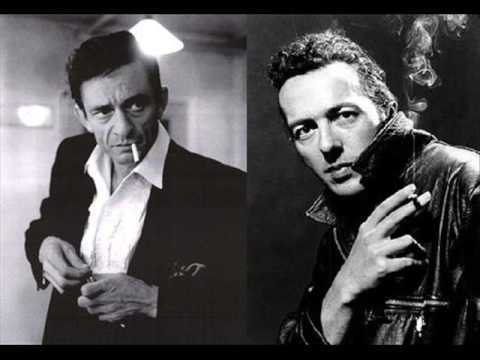
Posthumous: Redemption Song (Strummer and Cash)


Joe Strummer: Redemption Song
Johnny Cash and Joe Strummer: Redemption Song 

[purchase Streetcore]
[purchase Unearthed]

When Bob Marley wrote “Redemption Song,” one of his masterpieces which was influenced by a Marcus Garvey speech from 1937, he had already been diagnosed with the cancer that would take his life within a few years, and clearly was thinking about his own mortality. It was a rare acoustic track, and was released as a single in 1980, and on the album Uprising. Because Marley didn’t die until 1981,  the song was not released posthumously. 

However, two very fine, and related covers, of “Redemption Song” were released after the performers’ deaths, so I don’t lose any points for theme violations. (Sorry, I've been watching the Olympics.)

In 2002, Johnny Cash was working with producer Rick Rubin on what would become American IV: The Man Comes Around, the last album released during Cash’s life. Joe Strummer, who was on vacation in Los Angeles, decided to hang around the studio, because he was a fan of Cash—he even extended his vacation an extra day to spend time with Cash. During this time, the two men reportedly discussed a wide variety of topics—Cash’s role in the early days of rock and roll, and Strummer’s role in the early days of punk—and their love of Jamaica and its music. Strummer was, of course, a big fan of ska and reggae, and was influential in including it in The Clash’s music, and Cash owned property on the island. 

With some apparent nudging from Rubin, they decided to record a duet of “Redemption Song.” "Originally, the song was supposed to be a duet, and we recorded it as a duet. But, just in case, both Johnny and Joe sang the whole song several times," Rubin recalled. It did not, however, make it on to The Man Comes Around (which is fine, because that album is already incredible) 

In December, 2002, Strummer died due to an undiagnosed congenital heart defect, before he was able to complete Streetcore, his final album with The Mescaleros. The album was pieced together from early takes of songs and subsequent additions by producers Martin Slattery and Scott Shields.  Although it may not have originally been planned for the album, they included one of Strummer’s solo takes of “Redemption Song,” featuring only his vocal and guitar, additional guitar from Smokey Hormel, piano added by Rubin, and atmospheric harmonium added by Benmont Tench. It is spare, rough and affecting.

Rubin and Cash were working on compiling a box set of unreleased songs and alternative takes from Cash’s tenure at American Recordings, when Cash died on September 12, 2003 of complications from diabetes. He was only 71, which frankly shocked me. Unearthed, a five disc set, was released a little over a month later, and it included the duet with Strummer. As good as the solo Strummer version was, the duet—although similarly arranged—is better. Obviously. adding Johnny Cash to a song is likely to improve it, and his voice was filled with the gravitas that only increased as he aged. Second, there’s some great acoustic guitar from Tom Morello. Although I don’t think that this is a case of a cover improving on the original, it gives Marley a run for his money. 

I should add that in or about 2003, some friends of ours got a black dog, and named him Cash, in honor of the recently deceased Man in Black. In 2004, we got our own black dog, and named him Strummer, in honor of Joe (and my family’s love of music) (coincidentally, our Strummer died 7 years ago yesterday). The two dogs did spend time together and probably barked together, but they never figured out how to do “Redemption Song.”

Sunday, June 27, 2021

Opposites: Southern Man/Girl From The North Country

Neil Young: Southern Man
[
purchase]

Bob Dylan: Girl From The North Country
[
purchase]

Bob Dylan w/Johnny Cash: Girl From The North Country
[purchase

Watching the Trump Party and its propaganda outlets whip themselves into a frenzy over what they are mischaracterizing as  “Critical Race Theory,” either due to political calculation or ignorance (or both), when what they are really afraid of is not the actual theory, but the “Truth,” could easily send me spinning off into a discussion, centered around Neil Young’s 1970 song, “Southern Man,” about institutional racism, the Civil War, and the Lost Cause myth, but I’ve written about that before. 

Instead, let’s (mostly) talk about the two songs I’ve chosen for the Opposites theme which are basically double opposites—one about a southern man, the other about a northern woman (although, if gender is really a spectrum, are they really opposites?) But there are even more things about the songs that are opposites. 

Young’s “Southern Man,” as most readers of this blog probably know, was released in 1970, at the height of the anti-war and civil rights unrest in the country. It is an angry song, about racism and slavery, and features harsh, searing electric guitars. (It also famously inspired, at least in part, Lynyrd Skynyrd’s “Sweet Home Alabama,” but there really wasn’t any sort of rivalry between Young and Skynyrd, who were mutual fans of each other. Really.) 

Bob Dylan’s “Girl From The North Country,” on the other hand, released in 1963, is a wistful, acoustic love song, maybe about one of Dylan’s actual former girlfriends, or some of them, or all of them, or none of them. While it didn’t inspire a response song, it did inspire Dylan to record a duet version of the song with Johnny Cash, which was released in 1969, about a year before “Southern Man.” 

Despite the Opposite features of the songs, there was great mutual respect among Young, Dylan and Cash. They’ve performed together and covered each other’s songs, and Dylan and Young were both on Cash’s TV show (where Cash and Dylan sang “Girl From The North Country” together—you can read more about it, and watch the video here.). The Young performance was part of a a special episode of Cash’s show, shot at Vanderbilt University. It focused on students’ issues, including drugs, and Cash openly discussed his own problems, before introducing Young at the Ryman Auditorium, where he performed “The Needle And The Damage Done” and another song. 

I’m guessing that was pretty much the opposite of what many of Cash’s country music fans would have expected. 

A small footnote—after the Ryman performance, Young and his guests, Linda Ronstadt and James Taylor, hit the studio and worked on songs for the forthcoming Harvest album.

Monday, December 7, 2020

Leftovers: Crowded Table (Looking Forward)

[purchase]

I guess this is sort of related to my “No Thanks” post about Old 97’s “Lonely Holiday,” but back in June, when I think that we were really coming to grips with the changes that the coronavirus was causing to our lives, our theme was “Looking Forward,” as in, things we were looking forward to in the After Times. I wrote about seeing live music, which I continue to miss terribly. 

But, as you know if you’ve read my “Lonely Holiday” piece, not to mention some of my other writings about family and friend-filled meals, I miss getting together with people to eat. Whether it is a holiday meal, or a backyard BBQ, or even if there’s no specific reason, I love to cook for a group, and I enjoy eating with a group. So, yeah, I miss having a crowded table. 

Now, the song, “Crowded Table,” by The Highwomen, seems to me about more of a big nuclear family, but the message still fits. 

I want a house with a crowded table
And a place by the fire for everyone
Let us take on the world while we're young and able
And bring us back together when the day is done 

And, to add to the inclusivity message: 

The door is always open
Your picture's on my wall
Everyone's a little broken
And everyone belongs
Yeah, everyone belongs 

If you don’t already know, The Highwomen are an all-female country/Americana “supergroup” created officially in 2019 by Amanda Shires, Brandi Carlile, Maren Morris, and Natalie Hemby, all of whom have varying levels of fame in the business. The idea was to pay homage to The Highwaymen, Johnny Cash, Waylon Jennings, Kris Kristofferson and Willie Nelson. So, they didn’t want to put much pressure on themselves, right? Their first live appearance was at a show celebrating Loretta Lynn’s 87th birthday at the Bridgestone Arena in Nashville (go big, or go home, I guess). 

The project was designed to include other musicians, so that their first single, “Redesigning Women,” had a video that included, among others, Tanya Tucker and Wynonna Judd, and their self-titled debut album featured a re-write of Jimmy Webb’s “Highwaymen,” other co-writes with, among others Jason Isbell (Shires' husband), Miranda Lambert, and Ray LaMontagne, and appearances by Yola, Sheryl Crow, Isbell, and members of Carlisle’s and Shires’ bands.

“Crowded Table,” was written by Hemby, Carlile and Lori McKenna, and features vocals that weave in and out of unison and harmony. Rolling Stone considered the song to be the Highwomen’s mission statement noting that it is "looking for a world where everyone is given a chance to fit in. This isn’t about leaning in or fighting for the top chair. It’s about making room." 

Which is a good message, both as I look forward to someday sitting at a crowded table for a big meal, but also as we look forward to the post-Trump world.

Wednesday, July 8, 2020

Wait/Don’t Wait: Desperados Waiting For A Train


Nanci Griffith: Desperados Waiting For A Train
[purchase]

No personal story, no long history lesson, no political discussion today. Just a short discussion about a fine song, Guy Clark’s “Desperados Waiting For A Train.” (I mentioned this song a few years ago in a piece on Clark’s “Homegrown Tomatoes," but it’s worth its own post.)

As someone who backed into “country” music through alt-country/Americana/roots/folk music, I first became aware of the great songwriter Guy Clark from covers, particularly this version on Nanci Griffith’s 1998 release, Other Voices, Too (A Trip Back To Bountiful). On that album, Griffith performed the song with Clark, Jerry Jeff Walker, Steve Earle, Rodney Crowell, Jimmie Dale Gilmore, and Eric Taylor. In fact, before Clark released a version, on 1975’s Old No.1, it had already been covered by Walker, Rita Coolidge, David Allan Coe and Tom Rush. And before Griffith’s version was released, it had been covered by Slim Pickens and probably most famously, The Highwaymen (Johnny Cash, Waylon Jennings, Willie Nelson, and Kris Kristofferson, some pretty fine songwriters in their own right). And there have been many other covers released and performed, including by Earle, on his recent tribute to Clark, and Jason Isbell, who performed the song at Guy Clark's induction into the 2015 Austin City Limits hall of fame ceremony. Which is just to say that many, many great musicians and songwriters have felt the song worthy of recognition.

Clark had the ability that some great writers, and not only songwriters, have of being able to economically create an entire world, and entire characters, with no wasted words. (On the same album, Griffith also covered Richard Thompson and Woody Guthrie, who have that same talent.) I’m jealous as hell. In less than five minutes, the song tells the story of the relationship between a boy and an old man, and you can feel the love they felt for each other, and the respect that the boy had for the man, an old school oil worker, who seemed to the boy like he was from an old western. And one day, the boy realizes that the man is old, and dying, and the metaphorical train comes to take him away. Two lives in about four and a half minutes of brilliance. I don’t know if the song is studied in songwriting classes, but it should be.

It’s a true story. Clark wrote it about his grandmother’s boyfriend, who stayed at the hotel that she ran in a small Texas town. You can read more about it here.

In 1998, when Griffith released her album, she appeared with all of the guys (including Guy) who sang with her on David Letterman’s show. And since readers of my work here know I’m a huge Letterman fan, and a huge fan of the song, here’s a video:

Thursday, June 27, 2019

(IN)DEPENDENCE: NO ONE TO DEPEND ON/SANTANA

I don't know about you, but I love playing with words, adding and subtracting the prefixes that conjure up meaning, sometimes discovering more about the derivation of the meaning in a more nuanced way. This can creep up on you in a most insidious way, itself making me wonder why sidious isn't used more often, or ever, as its opposite. (Which led me again further to an interesting website which, in turn, has me wondering why no Darth Depende, but that is another story.)


OK, the/a state of independence aside, let's drill down into what there is to celebrate. Over here, of course, we don't, July 4th being just the day the state of dependency on this nation was lost. (It would be a holiday here every day, were a party thrown every time the once pink parts of the map changed colour.) And, as the recent ghastly kowtowing to Trump demonstrated, perhaps is not now the parent state now dependent on the child? And, in terms of folk to rely on, leading the country and all that, child really is begetting on the man......... If the picture above says anything, surely it is that. Anyhow, that's yer ten pennorth of politics, let's talk Santana.


Just how many of the Woodstock class of '69 are still performing, and, possibly, still performing at the top of their game? Carlos Santana has just brought out another record that seems to be suggesting he is doing just that. At a time and an age when merely to issue a new release can herald automatic fanfares of a return to form, often more, its true, in hope than in anticipation and reception, he may well have cracked it. Of course, there are a number of Santana's, the frantic percussion heavy latino rock that burnt the stage alive at Max Yasgur's farm, the mellower and jazzier mid period, morphing into a mystical fusioneer and, latterly, the elder statesman pumping out largely lacklustre material, "enriched" by special guests. I am a fan mainly of the first period, up to and including 'III', 'Caravanserai' onward, through 'Borboletta' and the John McLaughlin diversions sometimes failing to hold full interest. (The 'Caravanserai' mob here announce my soon to be arranged period of pillory, but I have tried, really, I have tried.) I think that once he had that hit with the fella from, FFS, Matchbox 20, I knew the rot had set in, and 'Guitar Solos' seemed to cement that, even if the conceit of that project, in my opinion, was no worse than any other vocalist thrashing through an album of covers. Santana's voice is, after all, his guitar.

I had high hopes for Santana 'IV', the old band brought back after their own stab at recreating thatt same time period, but both it and 'Abraxas Pool' disappointed. The next outing, hand in hand with the residual Isley Brothers, 'Power of Peace', was better, if seeming a vehicle more for they than he. So why should this one, 'Africa Speaks,' be any different, as they too were acclaimed as the rediscovered grail? Could it be the presence of Rick Rubin, the catalyst behind many a revitalised career, from Johnny Cash to Neil Diamond? Or is the presence of one Concha Buika, a veritable powerhouse of afro-flamenco influences? I have been following her career for some time, marvelling at her vocal prowess in several genres. Santana has never much used a female voice to any great extent, if Flora Purim will forgive me, and, if it has taken Rubin to sow this seed, well done that man. Listening to this record has had me excited about Carlos Santana for the first time in many a long year. OK, it is arguably a Buika vehicle with added Carlos, but the namecheck will boost the sales no end, the hopeful ever hopeful. It is outside SMM's usual structure to put up any video from music so new, and I am not going to change that now*, but here is some Buika to whet any appetite.


So, when you ain't got no one to depend on, when your old heroes are all out to pasture and recycling processed self-parody, who are you going to call. I'm thinking Rick Rubin might be your man. Not bad for an old hip-hop producer, say I

*Go on, then, no one's looking.....

It's speaking, you listening?

Thursday, June 29, 2017

RIGHT: DEVIL'S RIGHT HAND

I don't know what colour the devil's right hand may be, but it would not surprise me if it were, too, red, what with what he has in it, as the theme moves to another right hand. (And there are a few other right hands out there, should the rest of the team choose to follow.....)

The song, 'Devil's Right Hand', written by Steve Earle in the very early 80's, yet appearing first on 1989's 'Copperhead Road', down to an earlier record label owning the rights to it, on an album they never released. So already typically part of the Earle paradigm of paradox, luck never quite in step with his profligate writing talents. And, since then, much as Earle's fortunes have changed in every which way, down, up and sideways, so the song has morphed with him, appearing in many styles and with, often, subtle symbolic shifts in the lyric.  It was still his encore when I saw him live last year.


At face value it is a simple and almost traditional folk ballad, warning of the dangers of gunplay. Earle himself fought initially shy of citing it an overt anti-firearms/anti-handgun song. But, at at time when his own private life was under some federal scrutiny, there came a surprising life imitates art moment.  I will let Earle take up the tale:


And I make no bones about including a 3rd version, this time the re-recording for the 'Brokeback Mountain'. Why a re-recording? It seems there was some disquietude in having a film set between 1963 and 1983 featuring a song (nominally) from after that time. This faster version is designed to be in the style of relevant time period. (And you thought filmmakers just slap any old song in to fit a mood, with neither thought nor consistency! Well, of course most do......)


With a song of this sort, a message with a moral, a good ol' tale of ornery folk, it has been hardly surprising that it has been much covered by the great and the good, with the royalty of country outlaw chic leading the way. Johnny Cash and Waylon Jennings have each performed it separately, as well as together, in tandem with Willie Nelson and Kris Kristofferson, as the Highwaymen. Webb Wilder, Bob Seger and, english folk giants, Show of Hands (not on youtube), have also done the song proud. (Strangely, and I cannot quite see why, youtube shows me that not a few white supremacist bands have taken it up. I had never quite seen them on that side of the gun lobby, not least as I might be reasonably happy to see them all shoot themselves up, but I digress...)

Devil's Right Hand, buy it and make him one-handed!! Even more versions than featured here!!!

Saturday, March 25, 2017

Prison: Aint No Good Chain Gang


purchase [Aint No Good Chain Gang]

Love can make you a prisoner. Love can set you free.

I got the sense that a search of <Prison> resolved to an inordinate number of country songs. You call it: maybe there's no corellation -I thought there might be one. I've got no money on any side here. I love and wish I could play along with the best bluegrass or country players.  But folklore would seem to side with me: The origin of many outlaws? .... country. Bootleggers? ... country. I won t go deeper - it's not my personal opinion... just [insert Mr Trump] ...fact.

So ... apparently lots of prison experience in the realm of country music. Guess that means  there's a lot of content/first hand expeience to write about.  Perhaps (just thinkin).

We've got Waylon Jennings and Johnny Cash here doing a song about time inside: "There Aint No Good Chain Gang".

You might take a few seconds to picture the classic chain gang in order to gain some perspective before you prceed. As a good investigative reporter would prompt you, ask: "who, what, where, when... how?" Heck, even the name of this group pushes my point: what does the name Highwaymen evoke?

The Highwaymen were a "country supergroup" -  Johnny Cash, Waylon Jennings, Willie Nelson, and Kris Kristofferson. This song and its album, however, were produced by a slimmed down group: just Waylon Jennings and Johnny Cash

My vision of a chain  gang is the swamps of .... somewhere south. A good place to learn some lessons - that is - if you are of the type that learns lessons in prison. He sings:

There aint no good in an evil hearted woman (true)
I aint cut out to be no Jesse James (probably not)
Dont go writing  hot cheques (well ... yes)

Most likely, if you do, you'll end up <a-laying in jail>

Thursday, October 27, 2016

Politics: Ry Cooder


purchase [ Paradise and Lunch  ]

Politics is very muchly on my mind these days. Mind you, I'm not talking about the US elections (I am assuming that is a forgone conclusion). My focus has been on the materials I have used for my work/lessons for many years:

As part of my DigitalCitizenship computer lessons, I direct my students to the WayBack Machine - part of the Internet Archive (archive.org). Aside from the millions of legally free video and music files they host (woohoo! Grateful Dead!!), the WayBack Machine offers a look back to the early days of the Internet - you can call up the Facebook site in its earliest incarnations. The point I try to make to my students is that there is always, somewhere, a copy of that SnapChat photo.

But on to politics... As you might well imagine, a mirror on the past might upset some of the powers that be: we humans may forget that so-and-so said such-and such 30 years ago. The WayBack Machine can prove it one way or another.

And so, to my great  disappointment, this year, as I head into the "Your Internet Footprint" unit, I discover that the local <powers that be> have blocked access to archive.org - I dont know why, but I can surmise that there is information there that might not be ... er ... in our favor.
Music-wise, aside from his "chops", perhaps the thing I most bow down to is Ry Cooder's academics - the way he researches his music. From the very first album, his selections have shown a respect and understanding for the historical perspective: rock music is rooted in its antecedants (IE: cotton field music, which in turn has its roots ....)

As noted above, more often than not, perspective allows one to take a backward look with more information than we previously had. We once thought one way, but now see another: Jim Crow, LBGT, ...

Ry Cooder frequently zeroed in on songs about the poor: dustbowl farmers and such. Often his first albums included songs from previous stars like Woody Guthrie or relative unknowns like Blind Wilie McTell. Much later, he worked to give due credit to the Cuban Buena Vista Social Club. But behind each oevre, there is an academic approach: learn, teach and share. Subtle politics, but political in nature all the same.

Cooder's  repertoire is extensive, but we'll go for a few.
Way back when, Johnny Cash came out with Get Rhythm - a song filled with references to working conditions for African Americans. A few years ago, Cooder upgraded the song


first Cash, then Cooder

Way back when, Woody Guthrie sang about the plight of the dustbowl farmer, Ry Cooder upgraded that one too.

Politics? Not directly, but there are commentaries in the lyrics about the man who votes and why he votes the way he does. Politics all the  same ...

Monday, October 17, 2016

My First Album: Tea For The Tillerman


Cat Stevens: Father And Son
[purchase]

Unlike my predecessors in this theme, I’m pretty confident that Cat Stevens’ Tea For The Tillerman was actually the first album I owned.

I’ve written before about how my interest in rock music started in the summer of 1969, listening to the AM radio on the way to day camp. And the following summer, I remember that the cool, sophisticated counselors (who were probably all of 16 or 17), were listening to Cat Stevens. I became a fan, and I asked someone (parents? grandparents?) for a copy of Tea For The Tillerman, which I received, and listened to repeatedly.

I remained a Cat Stevens fan for years—the first concert I went to without my parents was to see him at Madison Square Garden with my friend Laura in, it appears, 1976. I remember that we sat way up in what were then the “blue seats,” but it was still great (although not everyone agreed).

My wife is also a big fan, but by the time that we got together he had already converted to Islam, changed his name and stopped performing until his return in the mid-2000s. And a few years ago, I wrote a piece about him over at Cover Me.

Tea For The Tillerman is, undeniably, a great album. It was both a critical and commercial success, and pretty much every song is a winner. It was the record that made Stevens a household name around the world.

In some ways the most unusual song on the album is “Father And Son,” originally written for an abandoned musical theater project about the Russian Revolution (which sounds like it could have been Max Bialystock's second idea). It features a dialogue between a father, sung by Stevens in a lower register, and a son, sung in a higher register, in which the son expresses his desire for independence and the father argues in favor of a more traditional future. Despite its initial historical inspiration, the song captured the generational divide of its era in a way that showed both the conflict it caused in families without neglecting the love. By the way, in the Cover Me piece there is a great version of the song by Johnny Cash with Fiona Apple.

Stevens, shortly after the song was released, was quoted as saying that "I’ve never really understood my father, but he always let me do whatever I wanted—he let me go. 'Father And Son' is for those people who can’t break loose."

This was probably not the favorite song on the album of the 9-year old me, but the 55-year old me, who has two adult children, and recently lost a father he was very close to, has found it quite touching and perceptive. It’s probably a sign that it is a good song, when it resonates with you as a child and as an adult, right?

Tuesday, September 1, 2015

BBQ/Grill: Mexican Radio


Wall of Voodoo: Mexican Radio [purchase]

I like it when a bunch of things come together to inspire a blog post. We’ve been kicking around the BBQ/Grill theme for much of the summer, but it never made the big time. Now, though, as we head into the unofficial end of the summer in the Northern Hemisphere where, I believe, all of our writers live, it was time. You’d think that there would be tons of songs about barbecuing or grilling, which are different things, and while there are a bunch, there don’t seem to be as many as I thought.

Being a stereotypical man, I enjoy cooking outside. For years, I insisted on using a charcoal grill, but a few years ago, I succumbed to the convenience of propane, and while the old charcoal grill sits next to its gas fueled cousin, I rarely have the patience to light the coals and wait for them to burn down to the appropriate ashy white. But, I do have the patience to use my smoker to slow cook ribs, pork butt and chicken (also, occasionally brisket, which is very hard to get right, leg of lamb, the rare Thanksgiving turkey, and even bacon and pastrami). Again, though, I opt for some convenience, using an electric smoker, rather than a wood, charcoal or pellet based contraption that has more street cred, but also takes more work. No one has yet complained about my food because my hickory, fruitwood, oak, mesquite or pecan chunks are burned by a big electric element. I also make a mean cole slaw and potato salad, and a much loved Memphis-style sauce, from a recipe I found years ago in the well-known barbecue bible, Newsday.

I’ve fired up the grill and the smoker a few times this summer, but starting on the Fourth of July weekend, it has been a bit crazier. That weekend, I smoked ribs and chicken wings and grilled chicken thighs for some friends. Shortly after that, we visited Tennessee and Kentucky and ate a bunch of really good ‘cue, which I didn’t have to cook. On our return, I kicked it into gear. Three weekends ago, we had a big family gathering at our house to celebrate a bunch of milestones, including our anniversary, my in-laws’ 60th anniversary, my father’s birthday and my nephew’s birthday. I did ribs and pulled pork in the smoker and chicken on the grill, although the most memorable thing about that gathering may well be the Tennessee whiskey and bourbon tasting. I didn’t even put away the smoker, because the next weekend was a party for our daughter, a combination late graduation and buen viaje celebration before she left for Barcelona on a one-way ticket. Not knowing exactly who would show up, and how much they would eat, we went overboard with ribs, wings and grilled chicken, along with a ton of sides and salads. And just today, I committed to a little Labor Day BBQ with some old friends, for which I am currently planning the menu (but pulled pork is pretty much a lock). As hard as it is to get everything just right, I enjoy it—the prep, the process, the eating, and, I admit, the praise.

But what song to write about? Nothing really grabbed me, until I remembered this sort-of hit by Wall of Voodoo, “Mexican Radio.” Like most of their songs, it is atmospheric and strange, and includes the memorable line:

I wish I was in Tijuana 
Eating barbecued iguana 

Research has indicated that barbecuing is an accepted way of cooking this large reptile, if not the most popular.

Which brings me to the second thread of this post. I first heard Wall of Voodoo while I was at WPRB—I remember hearing their very odd, ominous cover of "Ring of Fire" (which I thought, erroneously, was a Johnny Cash song). Readers of my work here, and pretty much anyone who knows me, is aware that my 3 and a half semesters working in the basement of Holder Hall has had an outsized influence on me, even if I didn’t go into broadcasting or music. I know that I am far from the only one that the station has affected, and it has been around for a long time. WPRB is currently celebrating its 75th anniversary in operation, making it one of the oldest college stations in the country, and possibly the oldest commercially licensed campus radio station in the nation. In connection with the anniversary, the station’s “educational advisor” (something that the station didn’t have back in my day. And get off my lawn), and others have worked hard to put together a comprehensive history of the station. There is a great blog, wprbhistory.org, on which yours truly is well represented (thanks), and later this month, an exhibit of WPRB history will be opening in the Seeley G. Mudd Manuscript Library on the Princeton campus, somewhere near where my thesis sits, likely unread by any scholars since its deposit there.

If those two threads weren’t enough, as I was thinking about writing this, I looked at The New York Times’ website and saw this story, about the fate of pink iguanas in the Galapagos Islands after the recent eruption of the islands’ tallest volcano. Because if one of those iguanas got too close to some lava, it might find itself like its long-ago eaten relative from “Mexican Radio.”

Wednesday, August 19, 2015

1965: Wer Kennt Den Weg


   In 1965 Johnny Cash recorded his 1956 #1 country single "I Walk The Line" in German. Fifteen years earlier, Cash was assigned to the 12th Radio Squadron Mobile of the U.S. Air Force Security Service at Landsberg, Germany as a Morse Code Intercept Operator for Soviet Army transmissions. While his friends headed to downtown bars to pick up women, he'd often stay at the barracks playing his guitar and dreaming of the day he'd become a country music star. 

    In 1965, the same year The Beatles recorded some of their songs in German, Cash tackled his old hit.


  With his customary twang, Cash delivered the lines:  Am allerschönsten war es doch zu Haus/ Und doch zog's mich einst in die Welt hinaus /Und in der Ferne suchte ich mein Glück /Wer kennt den Weg, den Weg zurück?

  And you know what? Country music doesn't sound half bad in German.

Tuesday, February 24, 2015

SONGS SOUTH: SOUTHERN ACCENT


Bet you're expecting me to extol the merits of a good old Cornish burr, Devonian dipthongs or even just my home county of Sussex and it's own idiosyncratic twang, but, no, they haven't written songs about that (unless you mean this, God help us!) I refer, and you knew really, didn't you, to the 1985 song by Tom Petty. Strangely, as a band of Floridians transplanted to the West Coast, I never really think of them as "Southerners," irrespective of latitude, as "the South", in music at least, seems to reserve itself for the Deep South, the territories of Stax and Capricorn record companies, so Alabama, Georgia, Louisiana, Mississippi and South Carolina, plus or minus parts of Texas. (If that's wrong, forgive me, but, just as you guys have quaint visions of Swinging London, so too do I about the seamy side of N'Awlins, with accents as stiff and impenetrable as a burnt hoggroast.)

There's a southern accent, where I come from
The young'uns call it country, the Yankees call it dumb
I got my own way of talkin' but everything is done
With a southern accent where I come from
Now that drunk tank in Atlanta's just a motel room to me
Think I might go work Orlando if them orange groves don't freeze
I got my own way of workin' but everything is run
With a southern accent where I come from
For just a minute there I was dreaming
For just a minute it was all so real
For just a minute she was standing there with me
There's a dream I keep having where my mama comes to me
And kneels down over by the window and says a prayer for me
I got my own way of prayin' but everyone's begun
With a southern accent where I come from
I got my own way of livin' but everything gets done
With a southern accent where I come from

Now I just love the sentiment in those lyrics, the sheer pride in belonging, into having an identity forged and formed in geography, believing the song could hold equivalent credence to other maverick nations, clinging on to their territories. "With a Scottish accent, where I come from" somehow comes instantly to mind. And the tune, too, carries a sedate majesty, tinged with just enough melancholia for the days gone by.

For such a simple song it is certainly my favourite within the Tom Petty canon, and it covers remarkably well.
So, here's Tom:

But don't you think the song was actually made for this guy?

Though, I have to say I am also very keen on this version, by Dawn Landes:


Buy Tom

Buy Johnny

Buy Dawn


Sunday, December 8, 2013

Holiday (Modern): Folsom Prison Christmas


For the past few years, I have been the glad recipient of postings from Santastic. Although the mashup genre may not be your bag, it certainly seems to fit the theme of "modern holiday".

Granted, most music is built on "the shoulders of others" (Isaac Newton), but the Mashup genre brings the style to the fore: take a collection of other people's songs and mash them together to create something new. This is a topic I covered at least once in my own (sadly neglected) blog >> see the right side list, but the subject of mashups deserves a re-visit at this time.

My favorite of the collection this year: banabul.com/muzik/fpc.mp3
It's a mashup of "Mr President" and Johnny Cash called Folsom Prison Christmas

[I suspect you will have to right click copy/download the file even though it is Creative Commons]


See this link for much more of this genre:http://www.christmash.com/

Wednesday, July 18, 2012

Elvis Covers II: The Big Light

Johnny Cash: The Big Light

[purchase]

Elvis Costello on Johnny Cash, from the June Carter Keep on the Sunnyside compilation Joe Ross wrote about a few weeks back:

Being pals of their son-in-law, Nick Lowe, seemed to afford us some kind of "friend of the family" status with Johnny and June, and they extended a very generous welcome to a group of pale and trembling young men who had been tearing it up every night of their stay in town.

Before dinner, John took us on a tour of the grounds and property...Struggling to find anything coherent to say, I spied a Sun 45 of "Cry, Cry, Cry" propped up on an old-fashioned display stand. I told Johnny that we had just cut a version of this song of his. He promptly snatched up the disc and signed it -- "To Elvis" at the top of the label and "Your friend, Johnny Cash" just under the title -- and handed it to me...

Needless to say, the minute I got it home, I had the record frame and hung it on the wall. A few months later, June was visiting London again and I happened to drop in at the Carter/Lowe household. During her visits June could sometimes be found "improving" on the housecleaning of this rather rock and roll abode...On this occasion, she stopped her labors to say that she was mad at "Johnny Cash," as she always seemed to call him. Apparently, the Sun 45 had been a gift to June, long before their romance...Naturally I offered to return the memento, but June said I should keep it as it was now dedicated to me.

Tuesday, June 19, 2012

Trinomials: June Carter Cash


June Carter Cash (and Johnny Cash): Jackson


[purchase]

June Carter Cash’s success story actually began two years before she was even born. It was a hot day in August 1927 when two women and a man (A.P. Carter, his wife Sara, and her cousin Maybelle) appeared at the New York studio door of a big-time talent scout for Victor Records. To audition, they’d spent the entire day before driving an old Model A Ford down mountain roads from the small hamlet of Bristol on the Virginia/Tennessee state line. Three flat tires later, they’d “arrived” in the big city. Impressed by their emotion, rusticity, charm and soul, Victor Records launched their career. It wasn’t long before The Carter Family’s music was playing from radios across the U.S. As country music hadn’t even been named yet, Victor simply called its brand “Old-Time Melodies of the Sunny South.”            

Maybelle gave birth to June in 1929, and by 1939 she was appearing on the radio too, playing autoharp and guitar. In fact, all three of Maybelle’s children would sing together as an act. At the time, June didn’t really want to sing, and her mother wasn’t even sure if she could carry a tune. Maybelle told the ten-year-old, “If you’re gonna be on the world’s largest radio station with us, we’ll need some kind of miracle.” The dream materialized, and all the kids found parts on the show that always opened with the upbeat theme song, “Keep on the Sunny Side.”    

The 2-disc album (linked above) comes with a hard cover CD book full of liner notes, historical perspectives, song credits and photographs. After the opening theme, we hear ten-year-old June Carter singing “Oh! Susannah” in 1939. The 1949 cut of “Root Hog or Die” includes her trademark “growl,” and her comic routines until 1948 as Aunt Polly might’ve even included buck-dancing. Onstage, she simply became “Little Junie Carter” when they came to the Grand Ole Opry in 1950.

Just from her tone and inflection, it's readily apparent that June was a good-time fun-loving gal who always kept on the sunny side of life. Although a true entertainer, her success was slow in coming in an era when female vocalists were more of a novelty in country music. June's various antics and hillbilly humor became part of her act presumably as a result of her own lack of self-confidence as a vocalist. After she and Carl Smith divorced in 1956, she studied acting in New York. In 1961, Johnny Cash invited Maybelle and the Carter Sisters to tour with him. June co-authored “Ring of Fire” with Johnny Cash. June and Johnny married in 1968. “Jackson” and “If I Were a Carpenter” both became top 40 hits for them. They toured widely and had a highly-rated television show in the late 1960s and 70s.

June Carter Cash’s music developed with experience, maturity, comedic verve and dramatic aptitude. She also never forgot her mountain soul and roots. She put out a successful album in 1999 called “Press On.” Shortly after she finished recording the album “Wildwood Flower,” June Carter Cash died on May 15, 2003. Check out the 2-CD compilation as a documentation of “her life in music.” Earl Scruggs once stated, “She was always full of energy and a really great show-gal.” And as Johnny Cash once said, “June’s work will live on and on.”

Sunday, May 20, 2012

The Animal Kingdom: Boa Constrictor


Johnny Cash : Boa Constrictor

[Purchase]

For his 23rd album, 1966's Everybody Loves A Nut, The Man In Black took his cue from Roger "Dang Me"  Miller and recorded a batch of silly songs that would entertain kids as well as adults. "Boa Constrictor" was written by poet, children's author and the man who would be responsible for Cash's 1969 worldwide hit "A Boy Named Sue" : Shel Silverstein.


As a single "Boa Constrictor" just barely crept into the Country Singles Top 40 in 1966. But my kids love it and I hope yours will as well.

Monday, January 23, 2012

Standards: We'll Meet Again

Johnny Cash: We'll Meet Again

[purchase]

"We'll Meet Again" is a song hope in times of trouble. A mega-hit in England at the dawn of World War II, the song was popularized by Vera Lynn, who is still alive and kicking at age 94. (In 2009, Dame Vera Lynn's "Best of" CD reached #1 on the British charts, making her the oldest person to achieve that distinction.) The song captured the national mood, helping Britons keep stiff upper lips as their soldiers headed off to battle and uncertain fates.

A quarter century later, "We'll Meet Again" was played for laughs in Dr. Strangelove, a tone that was echoed in what to many sounded like a tongue-in-cheek cover by the Byrds. But, to me, the most memorable version is the one on Johnny Cash's American IV - The Man Comes Around. Released in late 2002, American IV is the final album of new material issued during Cash's lifetime, and "We'll Meet Again" is the final track.

It's a fitting sign off; Cash was in ill health and repeated in interviews that his time was short and that he was looking forward to the afterlife. As a Johnny Cash fan from childhood, the song sent chills down my spine when I first heard it (even more so than "Hurt," whose companion video also foretold of Cash's demise). On "We'll Meet Again," Cash's voice is wobbly, but the instrumentation is surprisingly breezy. The opening guitar run by Thom Bresh (son of Cash's longtime friend Merle Travis) borrows from "Happy Trails to You." An uncharacteristic (for Cash) clarinet and Hawaiian-style dobro create the image of the singer sailing off into the sunset. Family and friends seem to be waving goodbye as they join in on the closing chorus. June Carter Cash can be heard in the crowd -- she would die less than six months after the record's release, with her husband joining her just a few months later.

Thursday, December 29, 2011

In Memoriam: Ralph Mooney and Marshall Grant

Ray Price: Crazy Arms

[purchase]

Waylon Jennings: Rainy Day Woman

[purchase]

Johnny Cash and the Tennessee Two: Luther Played the Boogie

[purchase]

The names Ralph Mooney and Marshall Grant may not appear above the title on many records. But, their contributions to music were instrumental -- in both senses of the word.

Ralph Mooney co-wrote one of the greatest country songs ever, “Crazy Arms.” It’s been covered zillions of times; Ray Price and Patsy Cline own the best-known versions, and it's one of the few covers in Chuck Berry's Chess catalog. It sounds good every time, in part thanks to some of the greatest lines of despair in country music. (“This ain't no crazy dream, I know that it's real, you’re someone else’s love now.”) But Mooney is even better known as one of the all-time great country sidemen. A pioneering steel guitarist, he’s often associated with the Bakersfield sound and can be heard on the early hits of Buck Owens and Merle Haggard. He also did some solo turns and made a fine duet album with James Burton. He found new fame in the 1970s as Waylon Jennings’ steel guitar player. Waylon’s band, The Waylors, lacked a standout lead guitarist. It was Mooney’s licks that propelled the arrangements. Mooney’s and Waylon’s interplay was at its finest on the 1974 hit, “Rainy Day Woman.”

Unlike Mooney, Marshall Grant didn’t leave behind distinctive solos or significant songwriting credits. But, he played an integral role in constructing the sound of Johnny Cash. He was the entire rhythm section of Cash’s original band, the Tennessee Three. (That was the group’s original name, the other two being Luther Perkins and Red Kernodle. They became the Tennessee Two when Kernodle dropped out, and went back to Three after drummer W.S. Holland joined a few years later.) Particularly on the Sun records, before Holland joined the band, it was Marshall Grant’s upright bass that provided the basis for the boom-chick-a-boom sound. The inevitable switch to electric bass dampened Grant’s sound, and his role in Cash’s shows and recordings diminished as players and singers flitted in and out of Cash’s band. He acrimoniously left Cash’s employ in the early 1980s, though the two reconciled shortly before Cash’s death. Grant died in the service of his old boss, after falling ill during rehearsal for a Cash tribute concert organized by Rosanne Cash.

Guest post by Mt Vernon Mike

Monday, November 2, 2009

Cool Kidsongs: Nasty Dan


Johnny Cash: Nasty Dan

[purchase]

The lead track on Johnny Cash's 1975 children's album was actually written for the Man in Black by composer and television writer Joel Moss of Sesame Street fame; it had made its debut several years earlier on the show in the admiring company of Oscar the Grouch. Cash and Grouch were a perfect pair, and the two minute sketch remains one of my favorites.


Sans Oscar's interjections, the song remains a fun little ditty, wry and somehow sweet. Heck, the whole album is an underrated gem.

Incidentally, today's feature marks the tenth Johnny Cash post in Star Maker Machine's history. Five posts a year isn't bad, kids, but I think we can do better.