


























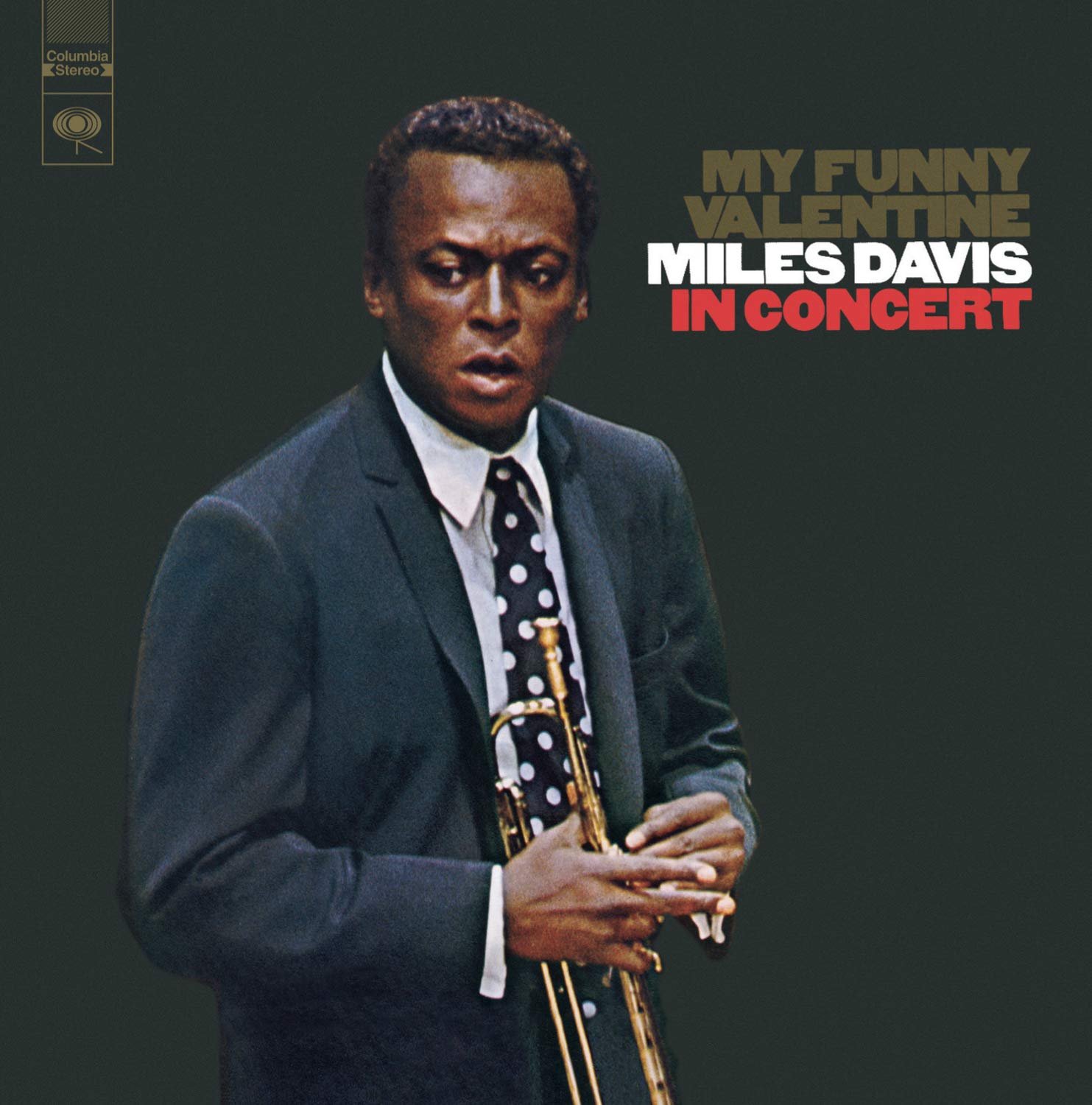
Miles Davis: My Funny Valentine
[purchase]
What makes a standard a standard? Clearly, there has to be something timeless about the songwriting, and there probably has to be a performance of the song that captures the imagination of other musicians, and through them the interest of their audiences. Certainly, “My Funny Valentine” qualifies as a standard. According to Wikipedia, the song, written by the great team of Rodgers & Hart for the 1937 musical Babes In Arms, appears on more than 1300 albums performed by over 600 artists, ranging from Chet Baker to Miles Davis, to Frank Sinatra, to Ella Fitzgerald to Chaka Khan, to Linda Ronstadt, to Elvis Costello. Apparently, it has become a song that many jazz musicians are sick of; yet it continues to be performed and recorded (although I read somewhere that in the 50s, one New York club owner banned the song).
I think that what makes the song so compelling is that while it is a love song, it isn’t a song where the singer objectifies his or her love. To the contrary, the song is a catalogue of physical imperfections that nevertheless do not detract from the ardor that the singer professes. And since most of us aren’t perfect and fall in love with imperfect people, there’s a universality in this sentiment.
It appears that it took almost two decades for the song to move from Broadway to the Great American Songbook. In fact, when Babes In Arms was made into a movie in 1939 featuring Judy Garland and Mickey Rooney, the future classic wasn’t even used. But a gentle, quiet version of the song, sung in 1954 by the trumpeter Chet Baker (who had performed on an instrumental version with Gerry Mulligan the prior year that was so good that the Library of Congress added to the National Recording Registry in 2015) made the music world reconsider “My Funny Valentine.” Sinatra recorded it the same year, a couple of years later, Miles Davis recorded it with his quintet, and it was off to the races.
In fact, in 1957, the song appeared in the film Pal Joey, which was loosely adapted from Rodgers and Hart's 1940 musical of the same name, despite the fact that it hadn’t appeared in the musical. Sort of a musical make up call.
The version featured above, though, is from My Funny Valentine: Miles Davis in Concert, recorded on February 12, 1964, at the Philharmonic Hall of Lincoln Center in New York City, and in addition to Davis, features Herbie Hancock on piano, Ron Carter on bass, Tony Williams on drums and George Coleman, whose sax solo is remarkable.
I don’t think that we post many 15 minute jazz pieces here, so, when we do, it better be good—and this really is.


