I’m a little surprised that I’ve never devoted a post to the great Mavis Staples—although she is mentioned at length in the In Memoriam piece that I wrote in January 2019 honoring her sister Yvonne. I’ve seen Mavis perform a few times, and every time she simply blew me away. She’s in her 80’s, has recorded amazing music her whole life—including a bunch of great albums over the past few years, and as I write this, is on tour, with dates scheduled in North America and Europe through next summer. If you get a chance to see her, do it, because sadly, she isn’t going to be around forever. And go see Mavis!, the movie from 2015 about her life, which is streamable. And while you are at it, make sure you see Summer of Soul, in which the young Mavis duets with her idol Mahalia Jackson, maybe the best performance in a movie filled with incredible performances. It’s on Hulu, but should be seen in a theater, unless you have a huge screen and big speakers.
What makes Mavis Staples so great goes beyond her voice, or even her ability to interpret a song. She somehow is able to mix the gospel music she grew up on, with secular soul music and the protest and message music of the 1960s and beyond, and do it in a way that is both uplifting and surprisingly sexy (without being trashy).
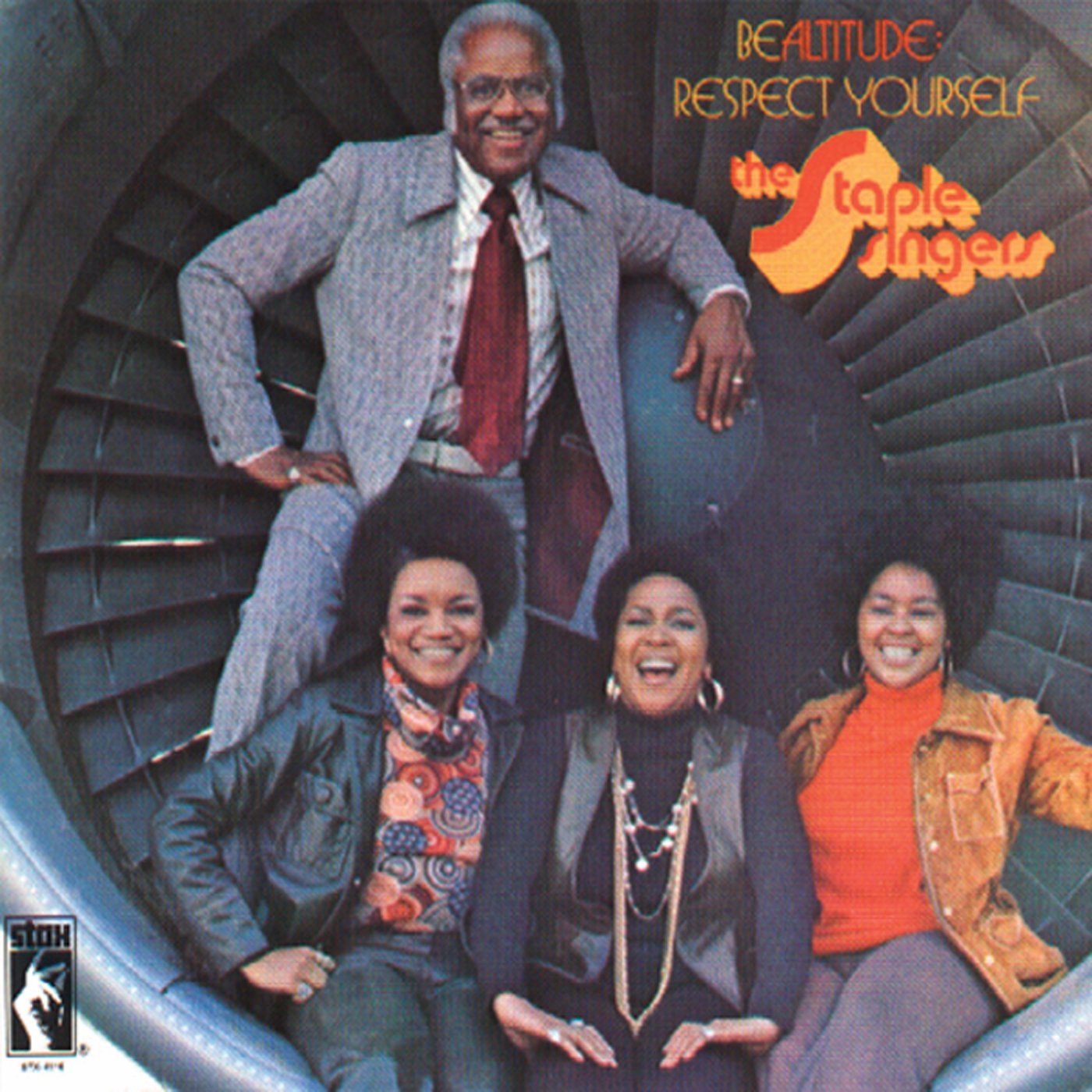
Her first No. 1 pop hit, “I’ll Take You There,” with her family group The Staple Singers, is a great example of this mix—and more. Recorded at the Muscle Shoals Studio and featuring the Muscle Shoals Rhythm Section (Eddie Hinton on lead guitar, David Hood on bass, Barry Beckett on piano, Roger Hawkins on drums, with additional guitar from Jimmy Johnson and Raymond Banks), with the Memphis Horns dubbed in later, its message can be interpreted as laying out the path to heaven, or to a world where the civil rights movement—still active when the song was released in 1972—had succeeded. And there’s something in Mavis’ delivery (much of which was ad libbed), which indicates that maybe she’s offering to lead to somewhere more private.
What I didn’t know is that the introduction to the song and much of the melody and arrangement, are borrowed from/influenced by a reggae song, “The Liquidator,” by the Harry J Allstars. Check it out here. Al Bell, one of the owners of Stax Records, who wrote and produced the song, had brought a copy of “The Liquidator” to the sessions and played it for the musicians, who thought it was a demo, and not an actual released song. David Hood said, "The Liquidator thing, we didn't know what that was. As I recall, [Bell] came in and brought what they call a dub. It was like an acetate or something, a disk that you put on the record player and play. And it had no lyrics on it. We just thought it was an instrumental track that somebody had done for a song. And it was only years later when I found out that that had been a record."
As we know from Seuras’ piece about the Muscle Shoals/Traffic connection, members of the rhythm section, including Hood and Hawkins, toured with Traffic, who regularly listened to Island labelmate Bob Marley and the Wailers’ album Catch A Fire, and as Hood recalled, "We kept hearing that. I thought, 'Wow, this is the greatest, wildest music I've ever heard.’" In fact, reggae influences permeate the entire album that “I’ll Take You There,” was on, Be Altitude: Respect Yourself.
Finally, here’s a nice piece by David Hood’s son Patterson, who you probably know from his regular job with Drive-By Truckers, about growing up in the Muscle Shoals area (including finding out that his father was the bass player on “I’ll Take You There”), and much more. Patterson’s a fine prose writer, as well as a great songwriter (which you probably know, if you’ve read my stuffhereandelsewhere).
I’ve written in the past about how I started paying attention to music in 1969. as a result of hearing WABC, the classic New York Top 40 station, in the station wagon that took me to my summer day camp. And that fall, I have a vague recognition of being in the car with my mother, and hearing “Take A Letter Maria” on our car radio, and proclaiming it a hit. I was 8 years old, and already thought that I was a music critic. And here I am, more than 50 years later, still pretending to be a music critic of sorts.
The funny thing is that my 8 year old self was right. “Take A Letter Maria” became a No. 2 hit on Billboard’s Hot 100 chart, blocked from the top spot by The 5th Dimension’s “Wedding Bell Blues,” also a great song.
I’d be shocked if anyone reading this doesn’t know the song—it is sung from the perspective of a man who had just learned of his wife’s infidelity, and dictates a letter to his secretary, the titular Maria, informing his wife of their separation. At the end, he asks Maria to dinner. It’s a surprisingly peppy song, considering the subject matter, with Latin influences and mariachi horns. I think that the narrator is supposed to come off as a sympathetic character, trying to recover from the discovery that his marriage is over, and he’s been cuckolded. And overall, I think that holds up today, despite the fact that he breaks up with his wife by letter (the functional equivalent of the uncool breakup by text), and the fact that in today’s environment, asking out Maria would raise questions of power differentials and sexual harassment. To be fair, we don’t know whether Maria accepted the invitation. Also, I have to admit that the fact that he instructs Maria to “send a copy to my lawyer” makes me happy.
“Take A Letter Maria” was written and recorded by R.B. Greaves, and I’d be shocked if most of the people reading this knew that, and if they did, if they knew anything else about Greaves.
Greaves, who was the nephew of the great Sam Cooke, was raised on a Seminole reservation, but moved to England in 1963. A few years later, performing as Sonny Childe, and fronting a band called The TNT, Greaves became a popular live soul/R&B act in England and recorded a few singles, before leaving The TNT during the summer of 1967. (Without Childe/Greaves, The TNT became the backing band for P.P. Arnold, probably best known for her versions of “The First Cut is the Deepest” and “Angel of the Morning.”)
Greaves’ big hit was recorded at the legendary Muscle Shoals Sound Studio, and featured the house musicians, including Donna Jean Thatcher (probably better known from her days with the Grateful Dead as Donna Jean Godchaux), Eddie Hinton, Jimmy Johnson and David Hood. And it was produced by Atlantic Records head Ahmet Ertegun (not even close to being best known as my ultimate boss during the summer of 1982).
Greaves’ followup, a cover of the Bacharach/David song, “Always Something There to Remind Me,” stalled at No. 27 on the Billboard chart, and that, pretty much, was that for Greaves, although he continued recording into the 1970s. He died of prostate cancer in September 2012 at the age of 68.
Patterson Hood, of the Drive-By Truckers, who is the son of David Hood, the bass player on “Maria,” has covered the song during solo shows, sometimes with his father on bass. Here’s one such performance, in which Patterson talks about how the Rolling Stones wanted to record in Muscle Shoals in 1969, before leaving to perform at Altamont, and that on that day, Greaves recorded “Maria” during the day, and the Stones appeared at night to record “Brown Sugar.”
For our last theme, Jukebox, I somehow figured out a way to write about the Gettysburg Battlefield. However, the connection between this theme, Songs South, and the Civil War, not to mention the war’s continuing influence on American culture as we approach the 150th anniversary of Lee’s surrender at Appomattox, is certainly more obvious. Being born in, and having lived my whole life in the North, though, I have to admit that I don’t have personal knowledge of what Southerners think, and to be fair, not all Southerners, or Northerners, for that matter, think the same thing.
But what I want to start off by discussing, and I’ll get to the music eventually, is the fact that throughout the South, Confederate politicians, generals and other “heroes” are honored with monuments, school names, and maybe most egregiously, by the Federal Government with at least 10 Army bases named for generals who took up arms against the very forces that now honor them (and in other inexplicable ways). President Obama, the country’s first African-American president (whose wife’s maternal great-great-great-grandmother, Melvinia Shields, was a slave) has even sent a wreath to be laid at the Confederate Memorial in the Arlington National Cemetery (on land that was formerly Robert E. Lee’s home, and which is bordered by the Jefferson Davis Memorial Highway), despite a petition signed by many prominent historians urging him not to do so. To again reference petition signer Professor McPherson, “I don’t think it appropriate for a president to send a wreath honoring a group that tried to break up the United States.”
I also don’t get it. Benedict Arnold was one of the most effective American generals in the Revolutionary War until he switched sides, and did some damage for the Brits (including, interestingly, capturing Richmond, the future Confederate capital). But there isn’t a Fort Benedict Arnold anywhere, or a Benedict Arnold High School. (Yes, there are a few historical markers commemorating his pre-traitorous accomplishments, and a few that generally commemorate his achievements, but simply omit his name, but had he never turned traitor, things would have been very different.) We don’t honor Aldrich Ames or Tokyo Rose, or John Walker, Jr. or any of the Americans who have assisted Al Qaeda or ISIS. And I suspect that many of the supporters of honoring Confederate “heroes” who took up arms against Americans are the same people who still call Jane Fonda a traitor for having expressed support for the North Vietnamese government (but not actually, you know, shooting any Americans).
It’s actually pretty clear to me: Article III, Section 3 of the U.S. Constitution states:
Treason against the United States, shall consist only in levying war against them, or in adhering to their enemies, giving them aid and comfort.
And while I wasn’t there, I’m pretty confident that people like Jefferson Davis, Robert E. Lee, Stonewall Jackson and Nathan Bedford Forrest (who likely led a massacre of black troops at Fort Pillow and was an early leader of the Klan), and the officers and men that they commanded were “levying war” against the United States. I don’t buy the arguments made by Southern apologists that secession wasn’t illegal—it was—or that no Confederate was convicted of treason—that was an embarrassing matter of political expediency, not to mention that the 14th Amendment made it clear that anyone engaged in acts of “rebellion” had certain rights taken away.
Much has been written about the Southern “Lost Cause” nostalgia, and all of that is too much to tackle in what is, really, a music blog, so let's talk about music. There are few bands that are as committed to analyzing their Southern identity as the Drive-By Truckers (who I have writtenaboutmany, manytimes). In fact, there may not be any other bands that do so to the degree that the Truckers do. They come by it naturally—the founding members, Patterson Hood and Mike Cooley, are from Alabama, and the band is essentially centered in Athens, Georgia. But Hood has been especially vocal about the fact that his upbringing was not traditional—his father, David Hood, is a legendary Muscle Shoals sideman and producer, who appeared on countless great records with black musicians—and his family was anti-segregation when that was not the popular thing. And Athens, where he ultimately settled as an adult and where he lives, is a liberal bastion in a conservative state.
Southern Rock Opera is considered to be the Truckers’ defining album, and while it may not be my favorite (I like a couple of the later ones with Jason Isbell a little better), it clearly is the one that not only moved the band into the public eye, it crystalized their viewpoint and, for better or worse, set them up as analysts of what Hood, in “The Three Great Alabama Icons,” called “the duality of the Southern Thing.” In an excellent essay for The Bitter Southerner website in 2013, Hood discussed the legacy (and burden) of Southern Rock Opera, and defined the “duality of the Southern thing” as
being from a region that is known for great music and literature and art and something called “Southern hospitality,” but is also known for Jim Crow laws, slavery, racism and the Ku Klux Klan. I talked about being fiercely proud of the good parts of my heritage and mortified and ashamed of the bad parts, the ones that too often define how other people perceive us.
And that’s what both of these songs are about.
“The Southern Thing,” is a song which Hood wrote to tie the whole project together. It is, stylistically, probably the most “Southern Rock” song on the album, and it describes, with some examples, the duality that he feels as a Southerner who is proud of his identity, even if he doesn’t agree with every—even most—of the stereotypes of that identity. Better you should read the lyrics, than for me to try to summarize them.
The next song on Southern Rock Opera is “Icons," a spoken word essay about Ronnie Van Zant, Bear Bryant and George Wallace, as paradigms of the duality, and points out that there were Southerners who were against segregation and racism, just as there were Northerners who supported it. But the song is mostly about Wallace, who as the song notes was an avid segregationist and racist, yet, at the end of his career, “opened up Alabama politics to minorities at a rate faster than most Northern states or the Federal Government. And Wallace spent the rest of his life trying to explain away his racist past, and in 1982 won his last term in office with over 90% of the black vote.” Despite that, Hood consigns Wallace to hell,
not because he's a racist… His track record as a judge and his late-life quest for redemption make a good argument for his being, at worst, no worse than most white men of his generation, North or South… But because of his blind ambition and his hunger for votes, he turned a blind eye to the suffering of Black America. And he became a pawn in the fight against the Civil Rights cause.
Hood notes in the Bitter Southerner piece that this song is, for the most part, written from the viewpoint of his father. He also mentions that Wallace’s grandson is a big fan of the Truckers.
Interestingly, when they perform the songs live, they switch the order, which makes sense from a performance standpoint—in essence “Icons” acts as an introduction to the more rocking “Southern Thing.” Here’s a video from a 2012 show (recorded and edited by DBT fan extraordinaire “Jonicont”) that shows this—and that Hood goes way off script, to make some topical political points, without losing the underlying message.
Star Maker Machine does not accept music submissions from artists or promoters. However, most of the contributors here do accept submissions for our own blogs, listed below. Please visit our blogs, take the time to listen to what we post, and then feel free to contact us if you feel that your music would be a good fit.



























:format(jpeg):mode_rgb():quality(90)/discogs-images/R-8447283-1461785389-4167.jpeg.jpg)


