












Showing posts with label iggy pop. Show all posts

Monday, January 31, 2022

Boss: Little Johnny Jewel

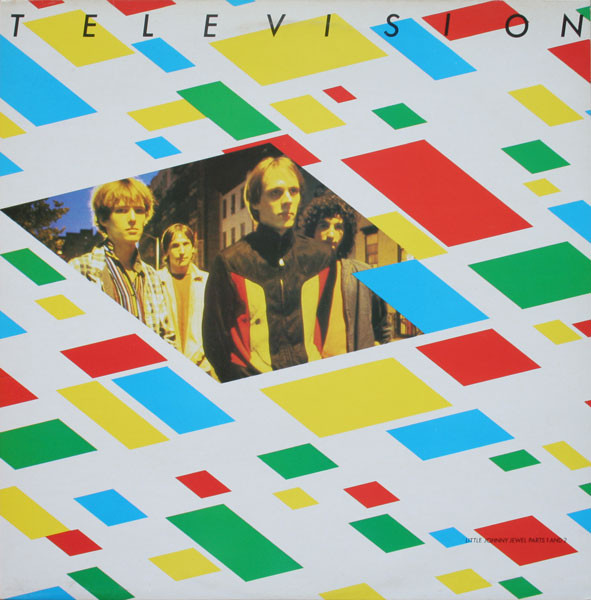
Television: Little Johnny Jewel
[purchase

I scanned my list of potential subjects for this theme (read my last post if you don’t know what I’m talking about) and decided again to write about a band that I hadn’t discussed before—Television. I’ve written about small-t television many, many times, here and elsewhere (not going to link, since there are too many), because watching TV is probably how I spend more of my leisure time than anything else, but I’ve never written about the band. While Todd Rundgren’s failure to ever be discussed in this space was very surprising, it is almost as surprising that Television has only been discussed twice—back in 2008 and 2009—and both times about the same song, “Marquee Moon.” Which happens to be an excellent song, but we’re going back to Television’s first release, “Little Johnny Jewel,” a single on their manager’s label, released in 1975. 

Although Television came up out of the same C.B.G.B. scene as the Ramones, Blondie, Patti Smith, Talking Heads, Richard Hell and the Voidoids and the Heartbreakers, among others, who I often played on the radio back in the 1979-1982 period when I was doing college radio, I had trouble connecting with the band then. As someone who grew up on classic rock and prog, I (eventually) came to understand the hard, fast ethos of punk that those other bands followed (although for some, that changed over time) as a rejection of the older forms of rock.  While I still loved what I grew up on, I also learned to love punk (and new wave). But Television’s meandering jams and guitar solos and stream of consciousness lyrics, sung by Tom Verlaine in a yelping voice that, to my ears at least, made David Byrne sound great in comparison, somehow didn’t fit in to the slots that I had in my head at the time. I couldn’t understand how they were in the same category as the Ramones, whose simple two-minute songs done at breakneck speed were nothing like the long songs that Television produced. 

Because of their timing, and their identification with the downtown NYC music scene, and because of the rough sound of their music, Television is usually lumped in with the punks, but interestingly, I’ve seen them referred to as both proto-punk and post-punk, which seems impossible without some sort of time machine. And yet, it makes sense, when you look closely. Television presaged punk both temporally and in their attitude, but their sound was not “punk” in the way that word is commonly used, so like “post-punk” bands, they embraced the brashness of punk, but not all of the sound. 

In my old(er) age, I’ve come to appreciate Television more and more. Maybe it is my more mature approach to music that is less interested in putting artists and their music in genre slots, so that I enjoy the connections that artists that seem very different actually have. I know, for example, that the first time that I heard “Impossible Germany,” by Wilco, one of my favorites, I was struck by how the intertwined guitar parts played by Nels Cline and Jeff Tweedy reminded me of Television’s Verlaine and Richard Lloyd. 

As mentioned above. “Little Johnny Jewel” was the first song released by Television, its 7 plus minutes split into two parts on a 45, and it’s an odd one. Opening with a bass line (from Fred Smith, who had replaced Richard Hell), before Billy Ficca’s drums and the guitars enter, the instrumental eventually resolves into a groove before the vocals begin. The song may be about Iggy Pop, whose real name was James Newell Osterberg, Jr., but his middle name is sometimes listed as “Jewel.” There’s a long instrumental guitar section featuring Verlaine soloing in the middle that sounds closer to psychedelia or even jazz than punk before the groove returns, along with the lyrics: 

Oh, Little Johnny Jewel
He's so cool
But if you see him looking lost
You ain't gotta come on so boss


Verlaine recalled in an interview: “Lou Reed asked me, ‘Why’d you put out this song? This is not a hit.’ I said, ‘What band playing a bar in New York, issuing their own single, is gonna have a hit?’” However, the single sold surprisingly well, and arguably kickstarted the New York punk movement.
Monday, November 8, 2021

CANDY/SWEETS: CHOCOLATE

Duty bound to prop up this side of the atlantic, with candy, like movies and garbage, an americanism that has crept in and gained an increasing traction in the language over here. I feel I have to say we eat sweets, or, even, sweeties, when in need of a sugar kick. So, true to form, tapping 'sweet' into my i-tunes search, I anticipated reams of inspiration. Sadly, give or take this song, very little fitted the bill, even were I to turn a blind eye to the innumerable double entendres out there, as most of the sweetness and most of the honey referred to comes in a two legged form. Needing, thus, a quick reboot, and chocolate became my go-to. 


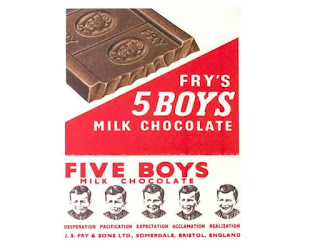
Courtesy disallows any discussion over the pros and cons of US versus UK in this confection, the age-old Hershey versus Cadbury, perhaps now academic that Cadbury, for chrissakes, are owned by the cheese paste magnate, Kraft. (The answer, by the way, is neither, my taste erring towards dark and interesting, the continental "plain" chocolate that actually bears some acquaintance with the cocoa bean.) So, with no further ado, here's a selection box of choccy treats, which I will deliver in the form of the once mighty Fry's Five Boys bar. This was a childhood treat in, admittedly, simpler times, a thin bar comprising 5 segments, each with a different boy at the different 5 stages of engagement therewith. Entitled Desperation, Pacification, Expectation, Acclamation and Realisation, the classic stages of how to bribe a small child. Once the most recognised bar in the world, it was launched in 1902, surviving until the late '70s, by which time it had become desperately low key and old hat. 

Desperation:

I Like Chocolate/Johnny and the Raindrops

Has anyone actually heard this monster before? Uncertain quite as to which demographic it was aimed toward, nonetheless it is so gallingly sickly as to deserve a place here. Johnny and the Raindrops, who "have been making music for children and their grown-ups since 2008", that quote giving away the game that they are in that small selection of bands for pre-school kids, like Australia's more famous Wiggles. (I'd love to say like They Might Be Giants, but I am aware their fans now come also in long trousers and are fiercely protective of the band and their oeuvre.)

Pacification:

Chocolate/Tindersticks

An unusual piece from the Tindersticks canon. Unusual, in that it is spoken word, spoken with a voice that sounds normal and unmannered. The singing style of the vocalist, Stuart Staples, is not always so, with one of the, let's say, more curious timbres out there. Don't get me wrong, I adore the band, and his odd vocal style is a big part of that, this song somehow diminishing him a little, making him sound just a normal lad from Nottingham. The backing remains, of course, exquisitely characteristic, a mix twixt David Lynch soundtrack and european art-house film music. It is a long track; please bear with it. If you can't, well, skip to the end. With luck you will then want to hear the whole thing.

Expectation:

Chocolate Girl/Deacon Blue

The song that first endeared me to this ongoing Scottish institution. A terrific song from their debut album, the mere act of adding some sublime pedal steels ensured my interest and attention. I have written about them before, my belief maintained that their first work was their best, further albums never quite having quite the same hooks. But they play on, fairly big hitters, still, on the bigger UK indoor venue circuit: indeed, I caught them, if briefly, playing at  festival just this last summer. With a largely all the hits show, they had the audience lapping it all out of their hands. And, sure, they played this.

Acclamation:

Chocolate Drops/Iggy Pop

A newer song, slightly, one of the highpoint of Mr Osterberg's 5 year old opus, Post Pop Depression. I like it, he coming on all over like a cross between his old mucker, David Bowie, and Mark Lanegan, the thoughtful use of chimes in the percussion department always a mood lifter in my house. It has intriguing lyrics, Pop's own, added to a riff album producer Josh Homme had had lying around for some few years. Basically a variation on the Monty Python song about looking on the bright side, here Pop muses on how, as you sink to the bottom, you become the top of that trajectory, inviting the then corollary that the brown stuff accumulating there might then become chocolate drops. Enticing stuff, eh? But it is a lovely little tune so, with that positivity in mind, who is to say the yellow snow isn't honey?

Realisation:

More Songs About Chocolate and Girls/The Undertones

I'm not sure whether this was written as a response to the Talking Heads' worthy sounding album, More Songs About Buildings and Food; I should check. (A: It came two years later and both bands were on the same label, so it seems a reasonable supposition.) No clever allegorical verbiage here, just a dumb yet smart ode to the simple pleasures of, um, chocolate and girls, sung in Feargal Sharkey's unmistakeable wobbly warble. At the end of this or any day, I am not sure if any of the greatest philosophers could put it better:

"Sit down, relax and cancel all other engagements
It’s never too late to enjoy dumb entertainment"

So, there you have it, 5 boys worth of chocolate. Before I finish, however, let me share with you the delight of discovery as to what the Scots Gaelic for candy turns out to be, sweeties being so integral in Scottish life and dentistry..... (Hint: try saying 'suiteas' aloud. And 'seòclaid' isn't heaven a million miles away, either!)


Tuesday, November 5, 2019

SPIRIT: SPIRIT DITCH/SPARKLEHORSE

Some might say I am, again, entirely missing the point of this theme, submitting posts around arcane or unknown musicians, rather than jolly japes around the spirit world that befit the feast of St Michael (Myers). So be it, my defence arguably resting on the deceased nature of the musicians concerned. In this case, rather than the takentoosoon of cancer, this time it was the at least as ghastly act of suicide that took Mark Linkous, singer, songwriter and, in reality, the end-all and be-all of Sparklehorse.

Spirit Ditch

I would expect most readers of this site to know the name, even if little known in the civilian world of charts and videos. His band, which lasted between 1995 and his death, 15 years later, gave us 6 albums, including collaborations. These are a scatter shot of styles and influences, possibly denoting the scatter shot status of his brain waves, he having been no stranger to the use of mind-altering drugs, not least in their life-changing capabilities. And not in a good way, as you may below follow. They're good records, though. Spirit Ditch is from the first, vivadixiesubmarinetransmissionplot, and is as good a place as any to get to grips with his impossibly fraught vocals, a whispered scream of frailty. With stream of consciousness lyrics, it is hard to say quite what it is about, but the lifted transcript from a(n actual) phone call with his mother, she talking of a bad dream he had described her, gives a clue to the mindset. I like what I see as a lyrical nod to After the Goldrush: "I woke up in a burnt out basement", sensing some psychological kinship with Neil Young. Having said, he is just as capable, like Young, of a raucous wig-out like Someday I Will Treat You Good.

I first came across the band for their second outing, having read of the horrendous incident that pre-ceded its release, widely felt to preface much of the material. This was later denied by Linkous, saying it had already been written. (Musicians traditionally always deny any obvious inspirations to their muse, whether Bob Dylan or Nick Cave, mind.....) But I am drawn to such, and found the slightly more synth embellished textures of Good Morning Spider being to my taste. (Below I shoehorn in a track, later covered by Susanna Hoffs, if unreleased, in a lame attempt to fit in with the theme.)

Ghost of His Smile

Next album, the was it ironically entitled It's a Wonderful Life, is said to be more straight ahead, made without added stimulants (or downers). Ditching any firm concept of a band, it is rammed full with collaborations, from PJ Harvey and Nina Persson, to, Linkous' hero, Tom Waits. Whilst some of these extra voices add to the overall, largely I feel they detract, the earlier shambolic being key to my enjoyment. These songs are just too conventional. (Don't get me wrong, they're fine, it's the comparison. And the Waits' one is shit.)

Brian Burton, aka Danger Mouse, the now big name influential game changer for Michael Kiwanuka and Karen O, and electronic ambient artist Fennesz now entered Linkous' orbit, both and/or either intrinsically involved with the rest of the Sparklehorse canon. Firstly with Dreamt For Light Years in the Belly of a Mountain, which comes across as a bit of a muddle, with tracks redolent of each of their stylistic tropes, together with a leftover or two from the earlier album. Again, don't ignore it, just don't seek it first.

Getting it Wrong(?)

Chronologically the next should be In the Fishtank, Vol. 15, jointly credited with Fennesz, but delayed in release until after his death. I guess you have to be in the mood, but it smacks to me of too much self-indulgence. It looks a whole lot better live. So I will move swiftly to the last, this time a direct 3 way credit with both Danger Mouse and with David Lynch, the film maker, for his photography. Too many egos?  I don't know, but legal difficulties delayed the release by a year, during which Linkous took his own life. Designed as a feature for songs Linkous felt uncomfortable singing himself, this features an array of bussed in vocalists, some of whom work better than others.
I would prefer it to have been Linkous, personally, and, thankfully, he features on a couple. It works best when similar voices are used, like Grandaddy's Jason Lyttle, less when a different atmosphere is sought, like with Iggy Pop. A sum less of its parts, it features the song below, almost clairvoyant in mood, featuring vocals shared with Linkous and, again, Nina Persson. Because, all too soon, he was.

Daddy's Gone

Here's his obituary.

Finally, back to where I began, with the realisation of his talent bearing fruit, here is a remarkable cover version of Spirit Ditch, made by Nadine Khouri, the up and coming UK based melancholist.

Spirit Ditch

Spirit Ditch here, or, with and in respect to the relative newness of the cover version, AND here.

Monday, November 5, 2018

Trick/Treat: Candy


Iggy Pop featuring Kate Pierson: Candy
[purchase]

And now here’s the Treat.

That Iggy Pop wrote a catchy pop love song is more than a little surprising. Best known for musical and personal excess, confrontation, and a wildly unpredictable stage persona, Pop reached out in early 1990 to Don Was, a fan and fellow Michigander, who was beginning to make a name as a producer, to try to make an album that would be more polished and commercial than his recent output. Was gathered a diverse group of musicians, including Slash and Duff McKagan from Guns N’ Roses, Kate Pierson, from the B-52’s, whose recent hit album, Cosmic Thing, he had produced, John Hiatt, studio veterans Waddy Wachtel, Kenny Drayton, Kenny Aronoff, and David Lindley, and members of his own band, Was (Not Was).

He succeeded. Brick By Brick is a great album, filled with great songs that split the difference between the harder rock of his prior work and a more commercial sensibility, but with, for the most part, angry, cynical lyrics.

And then there’s “Candy.” A love song sung as a duet with Pierson, it is an anomaly, and was a hit. As Pop has said, “I’ve written one good pop song, ‘Candy.’ It’s a very decent, proper pop song, but that’s as far as that went.” It is a more than decent pop song. On its surface, it appears to be a song about a lost love, who herself regrets the loss. Although it is a duet, the characters are singing past each other, but are heading to the same place. If you take that interpretation, which Pop has advanced (he says it is about a teenage girlfriend, Betsy), it really is sweet, and poignant.

But this is Iggy Pop, we are talking about, so there are other, darker, interpretations. One is that Pierson’s character is a prostitute, who gave Pop’s character “love for free.” And another is that Pierson’s character represents heroin, to which Pop was addicted to on and off over the years (and which he has written about before, maybe most famously in “Lust for Life,” a song that someone thought was an appropriate tune to use in commercials for a family cruise line. At least they edited out the part about liquor and drugs.)

You know, I’m going to take Iggy’s word for it—that he reached into his past to write a love song to a childhood sweetheart who still meant something to him—and not try to read too much into it.

Friday, October 14, 2011

Special Projects: Well Did You Evah?


Deborah Harry and Iggy Pop: Well Did You Evah?

[purchase]

1990 saw the release of Red Hot & Blue. The album is a special project for two reasons. First, it was recorded to raise awareness of AIDS research, and some of the proceeds from the album went to that purpose. Second, Red Hot & Blue is a tribute to the music of Cole Porter. The resulting album has a mix of music that often occurs on benefit albums. It seems like more artists want participate than there are room for, so some have to double up, and some unlikely collaborations are the result. Well Did You Evah? pairs Deborah Harry of Blondie fame with Iggy Pop. It may be worth remembering that Blondie got their start playing the famed punk club CBGBs. Well Did You Evah? as rendered here is a power pop blast with a punkish disrespect for its source. But most of all, it is the sound of two artists having a lot of fun.

Tuesday, January 13, 2009

Soundtrack Songs: Repo Man


Iggy Pop: Repo Man

[purchase]


If there was ever a Punk Rock film director, it would have to be Alex Cox, who brought his idiosyncratic style to films as Sid & Nancy and Walker.

Repo Man is a Cox romp that artfully mixes repo men, UFOs, the CIA, thieves and Punk Rock. It also has an amazing soundtrack that includes seminal Punk bands like the Circle Jerks, Black Flag, The Plugz and Fear, all at the top of their game, along with a theme song by the Godfather of Punk himself, Iggy Pop.

Take my advice and put Repo Man in your NetFlix Que. This way you can learn all about the Rodriguez brothers, John Wayne's two-way mirrors and just what the hell is in the trunk of that '64 Chevy Malibu.

Tuesday, May 13, 2008

History: The Western Lands


William Burroughs, Techno Animal, and Iggy Pop: The Western Lands

[purchase]

From Spiritus-Sempris:

"Hassan-i-Sabbah (in Persian / Arabic حسن بن صباح or حسن صباح ) (circa 1034 - 1124), or "The Old Man of the Mountain", was an Iranian Ismaili missionary who converted a community in the late 11th century in the heart of the Elburz Mountains of northern Iran. The place was called Alamut and was attributed to an ancient king of Daylam. When Hassan discovered Alamut in the late 11th Century, it was in the hands of a Seljuk subject. Hassan prepared the takeover of the castle by secretly converting its staff. With the household on his side, he was smuggled into the castle and began to establish his rule at Alamut. When the castle's residents realized they were no longer in control it was too late. Hassan graciously allowed the former tenant leave of his castle in addition to a draft of 3,000 silver dinars in payment for the castle. From this point on his community and its branches spread throughout Iran and Syria and came to be called Hashshashin or Hashshishin or Assassins, an Islamic mystery cult."
-------------

When I first came across the legends of Hassan-i-Sabbah, in the writings of William S. Burroughs, I assumed he was just another character that Burroughs invented. He was certainly an audacious enough type. Turns out the guy was real, though. If you check out the link to Spiritus-Sempris, up top, you can get the full story, so here's the short and fast:

After Hassan took over the mountain fortress of Alamut, he began assembling his forces. Local youths from neighboring tribes would be abducted and drugged. When they woke up, they found themselves surrounded with beautiful women and delicious foods and pretty much everything else an impressionable soul might determine to be just like paradise. Hassan explained to the drugged youths that they had been allowed a glipse into heaven, and if they would do his bidding (carry out assassinations against the enemies of Hassan-i-Sabbah), they were guaranteed admission to heaven for all eternity. The youths were trained in the art of assassination then sent to live in cities near and far, awaiting their orders...